In a study of 101 AI answers run on 17 November 2026, ChatGPT, Copilot Search, Gemini and Perplexity named specific SEO and Google Ads providers in 95% of answers, about five per answer, and mostly agencies (60%) over individual consultants (37%). The answers gave a specialism as the reason for 92% of picks and a location in the asked market for 55%; a price for 18%, reviews for 16% and years of experience for 14%. ChatGPT ended every answer with a follow-up question, 18 answers sent readers to directories such as Upwork and Clutch, and for the same question only 12% of names came from more than one tool. To be named, make sure the tools can read your site, make your specialism, location, prices and reviews easy to find, get listed honestly where the tools look, and check several tools more than once.
Key findings
- They name names. 96 of 101 answers (95%) named specific consultants or agencies, and the average answer named 5.3 businesses or people.
- Agencies first. 60% of the 535 names were agencies and 37% were individual consultants.
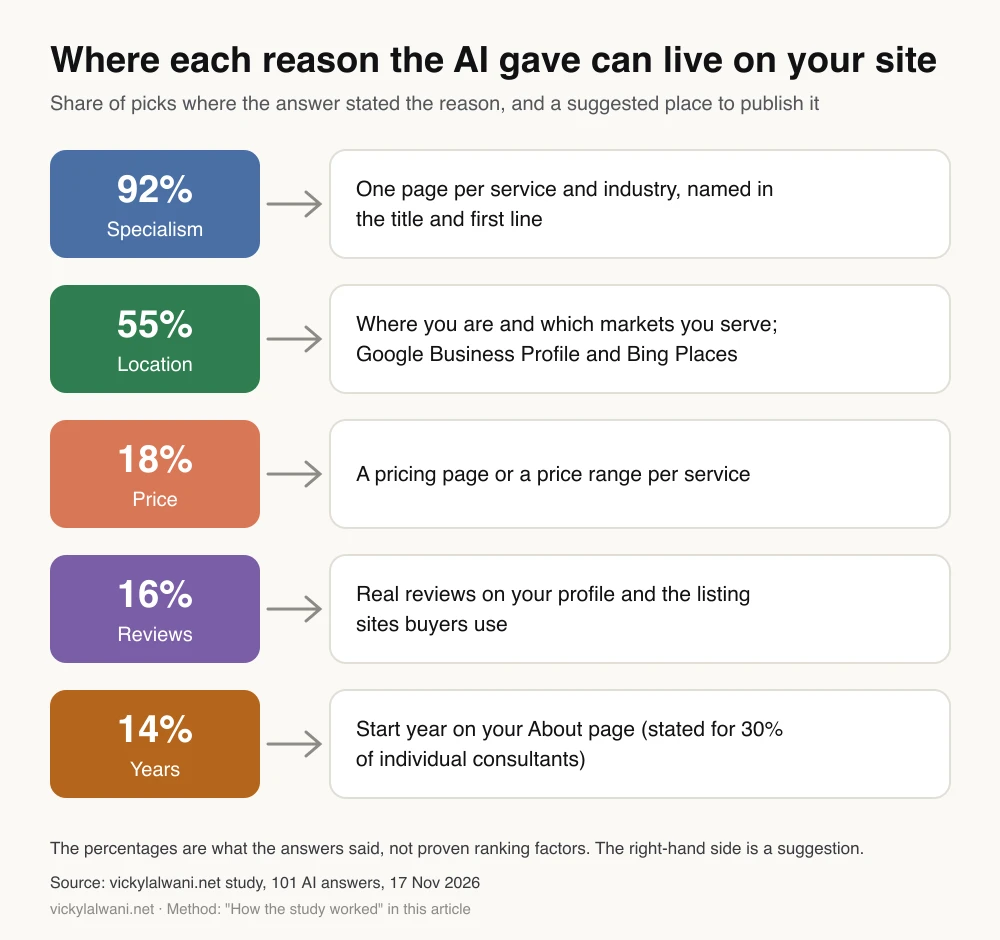
- What they said about each pick: a specialism for 92%, a location in the asked market for 55%, a price for 18%, reviews for 16% and years of experience for 14%.
- ChatGPT asks back. All 30 of its answers ended with a question for the reader, usually about the type of business or the budget.
- Listing sites show up. 18 answers sent the reader to a directory, most often Upwork (12) and Clutch (6).
- The tools barely agree. For the same question, only 12% of the names (55 of 472) came from two or more tools.
- This site: vickylalwani.net was named in 0 of 101 answers.
Jump to: Short answer · Method · Agencies or freelancers · Reasons · Follow-up question · Directories · Location · Same answer? · What to do · For buyers · Limits
A dental practice owner opens ChatGPT and types: "I need an SEO consultant for my dental practice. Who should I hire?" Within a couple of minutes they have a shortlist of names, a line about each, and a question back about their budget.
That owner is an example. The question is real: it is one of the 30 buyer questions this study put to ChatGPT, Microsoft's Copilot Search, Gemini and Perplexity on 17 November 2026.
This page reports what came back, what it means if you want AI tools to name your business, and what the study cannot show. If you want help, it is part of my work as a generative engine optimization consultant. GEO, generative engine optimisation, is work aimed at being named or cited in AI answers.
A note on evidence and names. Platform facts come from Google, OpenAI, Microsoft, Perplexity and the listing sites' own pages, read on 17 November 2026 and linked where used. The study's numbers come from the raw answers, recounted by script.
No consultant or agency the tools recommended is named here, because one run is not a ranking. Platforms and directories are named.
This site sells SEO, Google Ads and GEO services, the category studied, so weigh the study with that in mind. The prompts are listed in full so anyone can re-run them.
How does ChatGPT recommend businesses? The short answer
OpenAI does not publish how ChatGPT picks businesses. In this study, ChatGPT named providers in all 30 of its answers, 5.5 on average, and asked the reader a question every time.
The reasons it gave were mostly a specialism (94% of its picks) and a location in the asked market (67%). A price (28%), reviews (20%) and years of experience (14%) came up less.
Nobody outside these companies can see why a model picks one name.
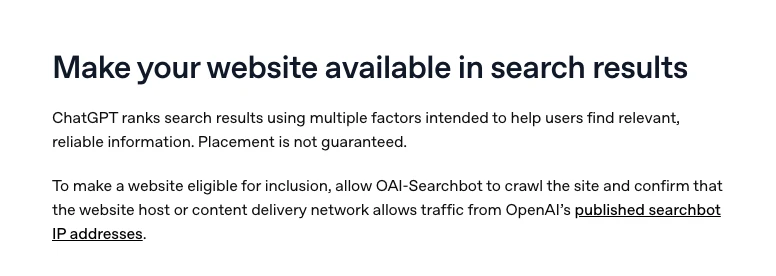
OpenAI's help centre says ChatGPT ranks search results on several factors and does not guarantee placement, without listing them. Google says there are no extra requirements or special optimisations for AI Overviews and AI Mode, its AI summaries and AI chat mode in Search. So this study records what the answers said about each pick, which is the part you can act on.
How the study worked
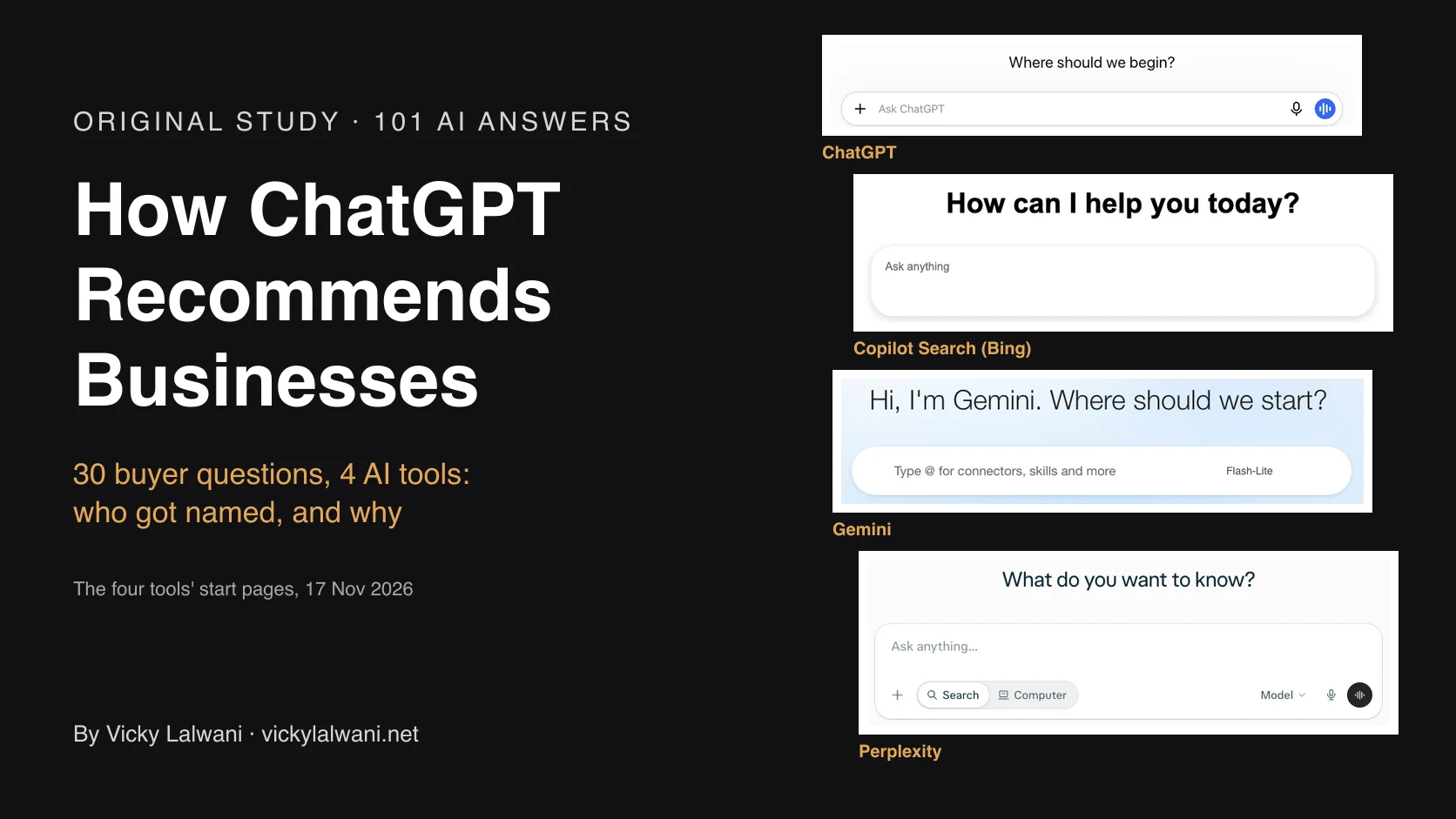
The study put 30 buyer questions to four AI tools on 17 November 2026 and got 101 answers back. There were ten questions, each asked in three versions that differ only in the country: the UK, the US and Australia. Each prompt ran once in each tool.
| Tool | How it was run | Answers |
|---|---|---|
| ChatGPT | Plus plan, signed in; temporary chat, unpersonalised; Thinking model; web search on | 30 |
| Copilot Search | Bing's AI mode, signed out | 30 |
| Gemini | Signed out, Flash-Lite (a lighter Gemini model) | 30 |
| Perplexity | Free plan, signed in, search mode | 11 |
| Google AI Mode | Blocked by a robot check | 0 |
- ChatGPT's setup. It ran on the author's paid Plus account, in temporary chats set to "Unpersonalized", which ignores the account's memory and custom instructions. The model picker showed the Thinking model at medium effort for most runs. Free ChatGPT may use a different model and give different lists.
- The other tools. Copilot Search is Bing's AI answer mode, launched in April 2025. Perplexity hit its free-plan search limit and stopped after 11 prompts, so it has no Australian answers and one US answer. Google AI Mode showed a robot check, which the study does not solve, and the Copilot app needs a sign-in.
- How the prompts were entered. Through each tool's normal web page, by a browser automation following a written script, on a computer in India. Three answers that failed to load (two Gemini, one Copilot Search) were re-run once in a fresh chat.
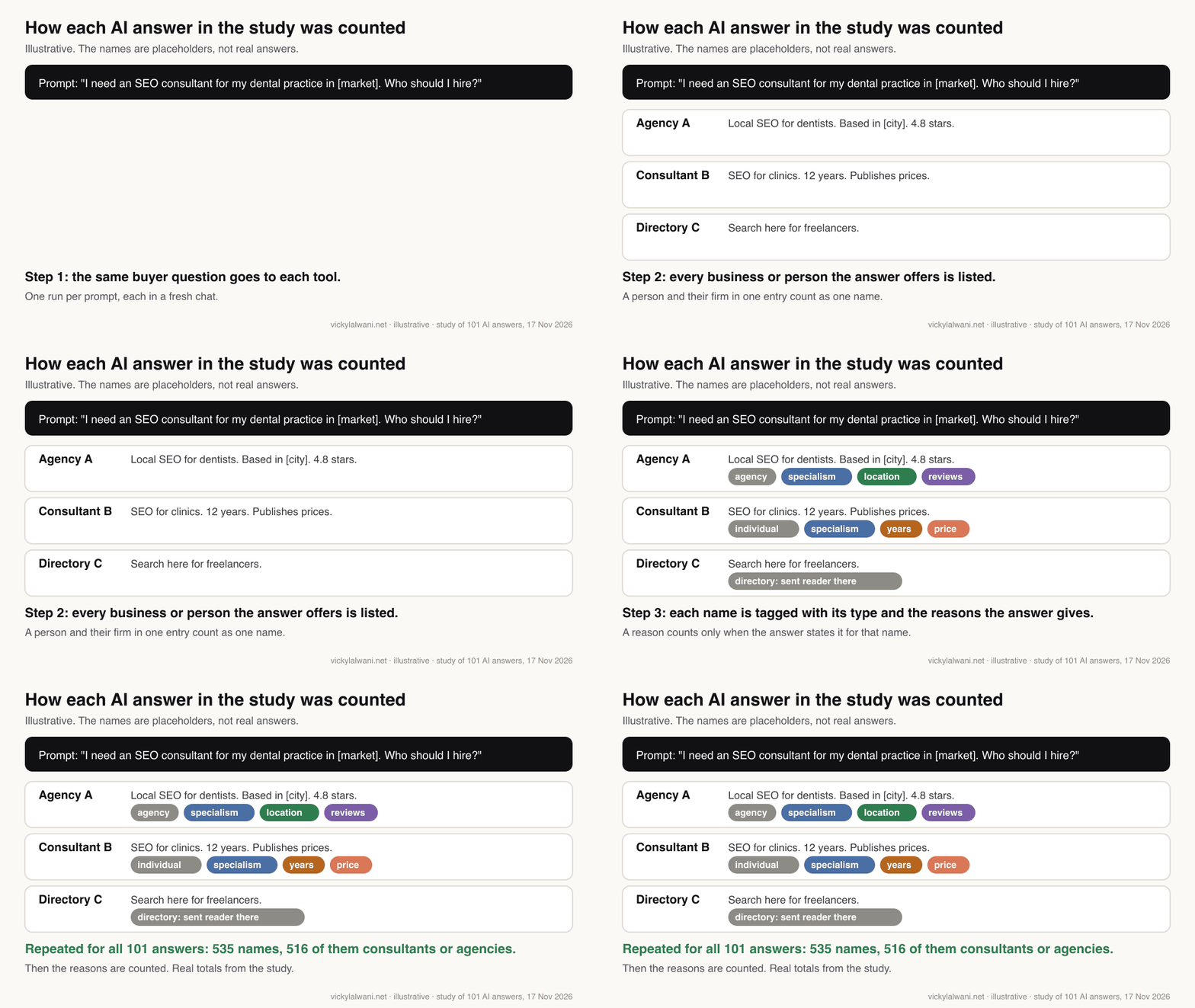
- How the answers were counted. An AI assistant read each answer against written rules and listed every business or person offered as an option, its type, whether the answer placed it in the asked market, and the reasons the answer gave for it. A script then checked that every recorded name appears in that answer. No second person re-checked the answers.
- Two words used below. A "pick" is one consultant or agency named in one answer (516 in all). "Names" also counts directories and tools (535). A reason counts only when the answer states it for that pick.
The raw answers, the counting rules and the scripts are kept. The plan is to re-run the same 30 prompts each quarter and compare like for like. The full prompt list is at the end of this page.
How many businesses does an AI answer name?
About five. The average answer named 5.3 businesses or people, and 96 of 101 answers (95%) named at least one consultant or agency: 535 names in all.
| Tool | Answers naming someone | Names per answer |
|---|---|---|
| ChatGPT | 30 of 30 | 5.5 |
| Copilot Search | 29 of 30 | 5.7 |
| Gemini | 26 of 30 | 4.4 |
| Perplexity | 11 of 11 | 6.0 |
Four of the five answers with no names came from one question: who can help a business get recommended by ChatGPT and Google AI Overviews. Those answers described types of provider instead.
Five is fewer than a larger study found. Clutch's analysis of more than 69,000 AI answers about business services counted about 14 providers per ChatGPT answer.
Most of these prompts asked for one consultant ("a good consultant", "an SEO consultant"), which invites a short list. Clutch also sells listings, so it has an interest in this topic.
Do AI tools recommend agencies or freelancers?
Mostly agencies. Of the 535 names, 60% were agencies and 37% were individual consultants, even though 21 of the 30 prompts used the word "consultant" (9 of them "freelance") and only 3 mentioned an agency, as an alternative.
The tools differ a lot here. Individual consultants made up 48% of ChatGPT's names and 47% of Perplexity's, but only 30% of Gemini's and 27% of Copilot Search's. By market, the share of individuals was 42% in UK answers, 36% in US answers and 31% in Australian answers.
So a freelancer has a better chance in ChatGPT and Perplexity than in Gemini or Copilot Search, at least on this run. Whether a freelancer or an agency suits you is a separate question, covered in freelance consultant or agency: who to hire.
Why does AI recommend one business over another?
Going by what the answers say, because of what a provider does and where it is. Across 516 picks, the answer stated a specialism or industry for 92% and a location in the asked market for 55%. Every other reason appeared for fewer than one pick in five.
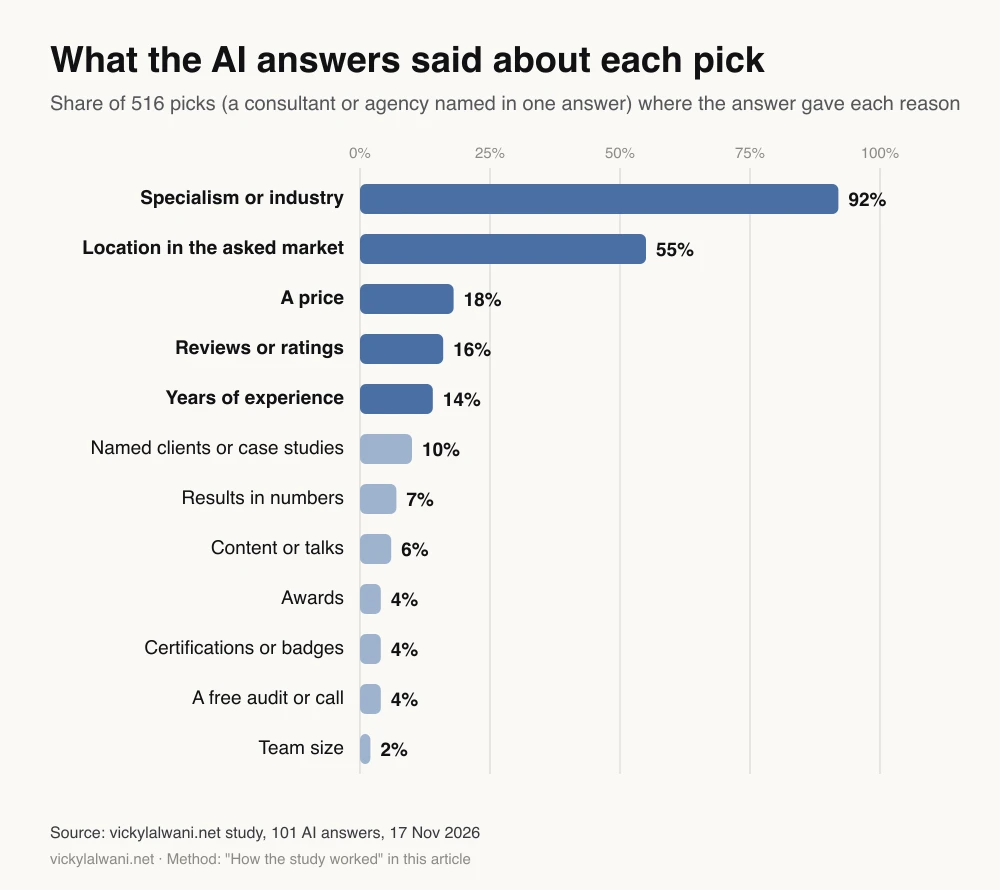
A "specialism" here is anything like "technical SEO", "Google Ads for dentists" or "local SEO for law firms". The answers lean on it partly because the questions asked for it: when someone asks about a dental practice, an answer about dental SEO fits. Clutch found the same effect at scale: adding an industry to a prompt changed about 70% of the recommended companies.
Individuals and agencies were described differently:
| Reason given | Individuals | Agencies |
|---|---|---|
| Specialism | 92% | 92% |
| Location | 61% | 52% |
| Years of experience | 30% | 5% |
| Reviews or ratings | 8% | 20% |
| A price | 15% | 20% |
| Named clients | 14% | 8% |
| Content or talks | 12% | 3% |
Beyond specialism and location, individuals were more often described by years in the job, named past work, and articles or talks. Agencies were more often described by reviews, and occasionally by awards and badges (6% and 5% of agency picks). Base: 196 individual and 320 agency picks.
One caution before you act on this. These are the reasons the answers stated, not proven ranking factors. Asking a tool why it chose someone does not settle it either: Google's Gemini help pages say Gemini can misrepresent how it works, including how it cites sources.
Does ChatGPT look at prices, reviews and experience?
Sometimes, but far less than specialism or location. ChatGPT gave a price for 28% of its picks, reviews or ratings for 20% and years of experience for 14%. Across all four tools the figures were 18%, 16% and 14%, and Gemini gave a price for only 3%.
- Price. When an answer gave a price, it was usually a starting figure or a monthly range. OpenAI says ChatGPT weighs price and reviews when it compares products, but it publishes nothing similar for services.
- Reviews. Stated for 20% of agency picks and 8% of individual picks, often as a star rating, including the ratings on the map ChatGPT sometimes shows for local results. For local results, Google says more reviews and positive ratings can help a business's ranking. A 2026 survey of 1,002 US adults by a local SEO software company found 45% said they used ChatGPT or other AI tools for local business recommendations.
- Years of experience. Stated for 30% of individual consultants and only 5% of agencies. If you work alone, your start year is one of the few facts an answer repeats about you.
Do not buy reviews to catch up. Google's policy for Maps content removes reviews that were paid for, in money or in kind.
Why does ChatGPT ask a question after its shortlist?
To fit the list to the person asking, it seems. All 30 of ChatGPT's answers gave a shortlist first and then asked the reader a question, often through a short form with budget options. Copilot Search asked in 14 of 30 answers (47%), Gemini in 3 of 30 and Perplexity in 1 of 11.
ChatGPT asked, for example, whether the business is local, ecommerce or B2B, and what the monthly budget is. A closing offer such as "Would you like me to shortlist more?" was not counted as a question.
- For a business: the follow-up shows what the answer needs next. Put it on your service pages in plain words: who you work with, typical project size, and a price range.
- For a buyer: answer the question. The second list is built for your situation rather than for a generic small business.
Do AI answers send buyers to directories like Clutch and Upwork?
Sometimes. 18 of 101 answers (18%) told the reader to search a directory or marketplace, most often Upwork (12 answers) and Clutch (6); ChatGPT did so in 4 of its 30. Of the 93 answers with captured links, the three most linked websites were listing sites: Clutch (12 answers), Upwork (9) and Semrush Agency Partners (7).
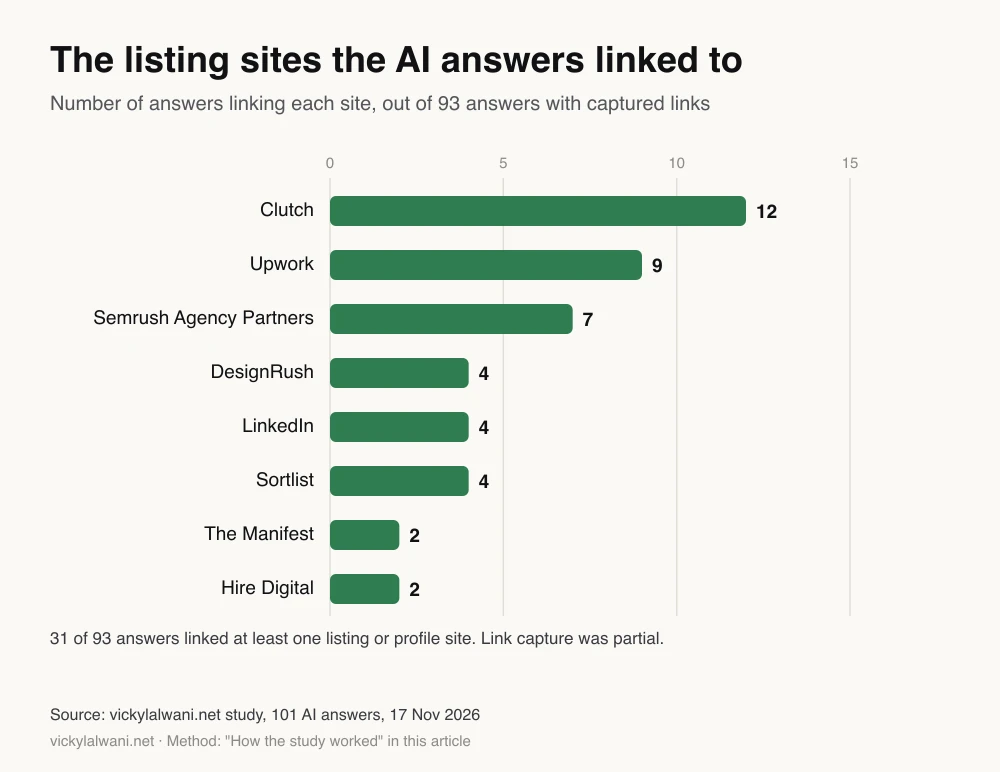
Gemini sent readers to directories most (37% of its answers), often Upwork.
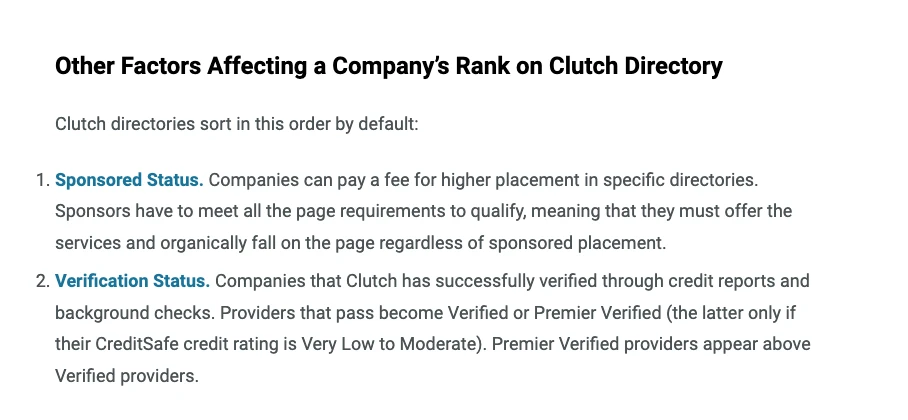
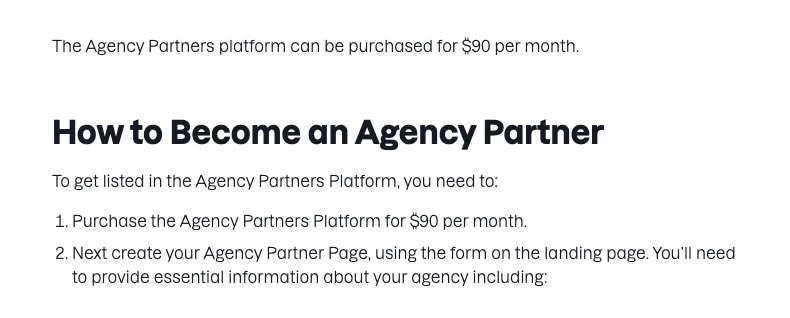
What the listing sites say about payment. This matters, because part of what an AI reads on a listing page can be paid placement:
| Listing site | What its own pages say |
|---|---|
| Clutch | Paid sponsors sort first by default |
| Semrush Agency Partners | Listing is a paid plan, $90 a month |
| DesignRush | Sponsored listings sit above organic ones |
| Sortlist | Visibility budget is a ranking input |
| Upwork | Help pages could not be opened |
Self-published "best agencies" lists. In at least 4 of Copilot Search's 30 answers, a linked source was an agency's own "best agencies" article, and that same agency was in the answer. Ahrefs found 'best X' lists made up 43.8% of the page types ChatGPT cited across 750 prompts, including agency searches.
Lists cut both ways. In a 2026 Ahrefs experiment, self-promotional "best conferences" pages featuring its own new conference brought 82% of that conference's new AI mentions, but 43% of the answers citing those pages recommended rivals from the same list instead.
Google's guide to generative AI search lists seeking inauthentic mentions among the things you can ignore, and says it is less helpful than it seems. Bought or swapped mentions are the risk; being listed honestly on a site buyers use is not.
Do AI tools favour providers in the market you ask about?
Yes, strongly. The answers placed 82% of all names in the market the question asked about, and gave a location as a reason for 55% of picks.
Only 4 of 535 names were clearly placed elsewhere: one agency in Singapore, two consultants in Canada and one described as globally based. None was in India.
By market, answers placed 96% of names in the UK for UK questions and 85% in Australia for Australian ones. For US questions it was 61%, with 37% unclear, because many US answers gave no location at all.
Some location claims were wrong. One Copilot Search answer to an Australian question placed three US agencies in Australian cities, while other answers placed the same firms in US states. Treat a stated city as a claim to check, not a fact.
This is the finding that matters most to me, and it is not good news. I am based in India and work remotely for clients in other countries.
vickylalwani.net was named in 0 of 101 answers. The study cannot say why, and location may not be the main reason.
On the day of the run, Bing showed only 6 of this site's 273 pages, and Copilot Search draws on Bing's index. Price ranges went on the pricing page about two hours before the run, so the tools are unlikely to have indexed them yet.
Still, on this run, an answer to "who is a good consultant in [country]" leaned hard towards providers it could place in that country. That is a fair warning for any remote provider.
Does ChatGPT give the same answer to everyone?
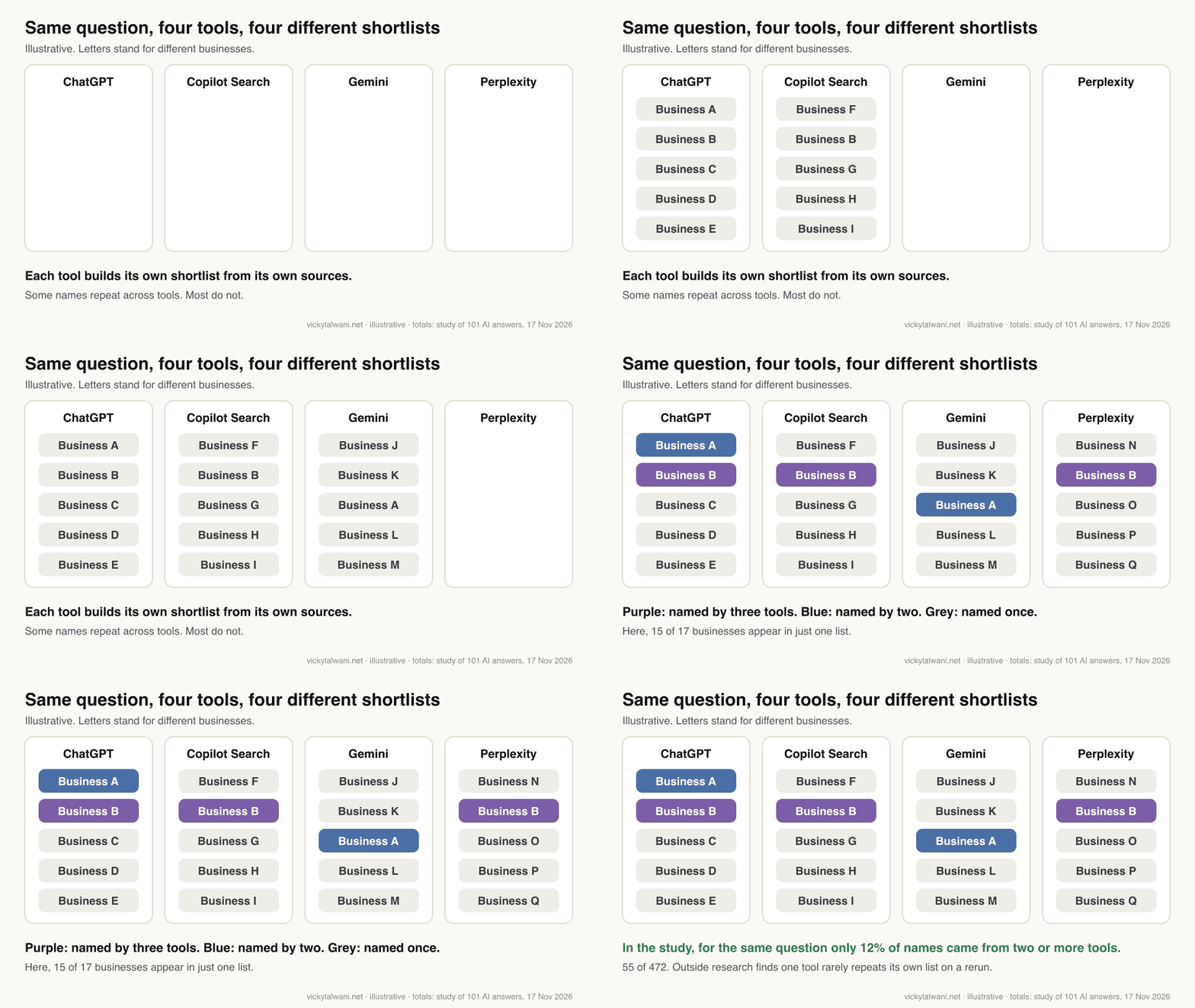
Probably not, though this study alone cannot prove it, because each prompt ran once. What it does show is how little the tools agree on the same question: for the same prompt in the same market, only 12% of the names (55 of 472) came from two or more tools. Just 15 names came up in three or more tools, and 1 in all four.
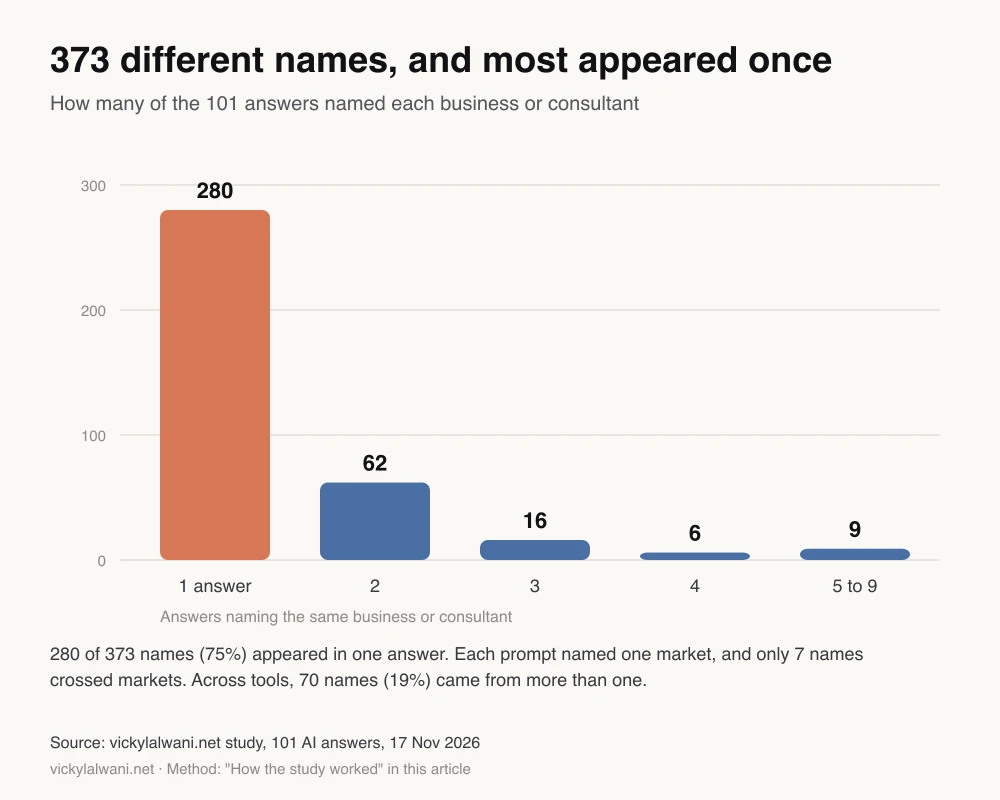
Across the whole study, 373 different names appeared and 280 of them (75%) appeared in only one answer. That figure mostly reflects the design: 10 different questions across 3 markets, with only 7 names crossing markets.
Outside research covers repeat runs. A SparkToro and Gumshoe study of 2,961 runs of 12 prompts, one of them about digital marketing consultants, found ChatGPT or Google's AI returned the same brand list less than once in 100 runs. Clutch found ChatGPT repeated only about 30% of providers when the same prompt was run again.
A five-minute retelling of the SparkToro research from an SEO agency's channel, published in February 2026. It ends with a pitch for the agency's course and services.
The practical lesson: a single screenshot of an AI answer proves little. Count how often a name appears across many runs and several tools, not where it sits in one list.
How ChatGPT, Copilot, Gemini and Perplexity differ
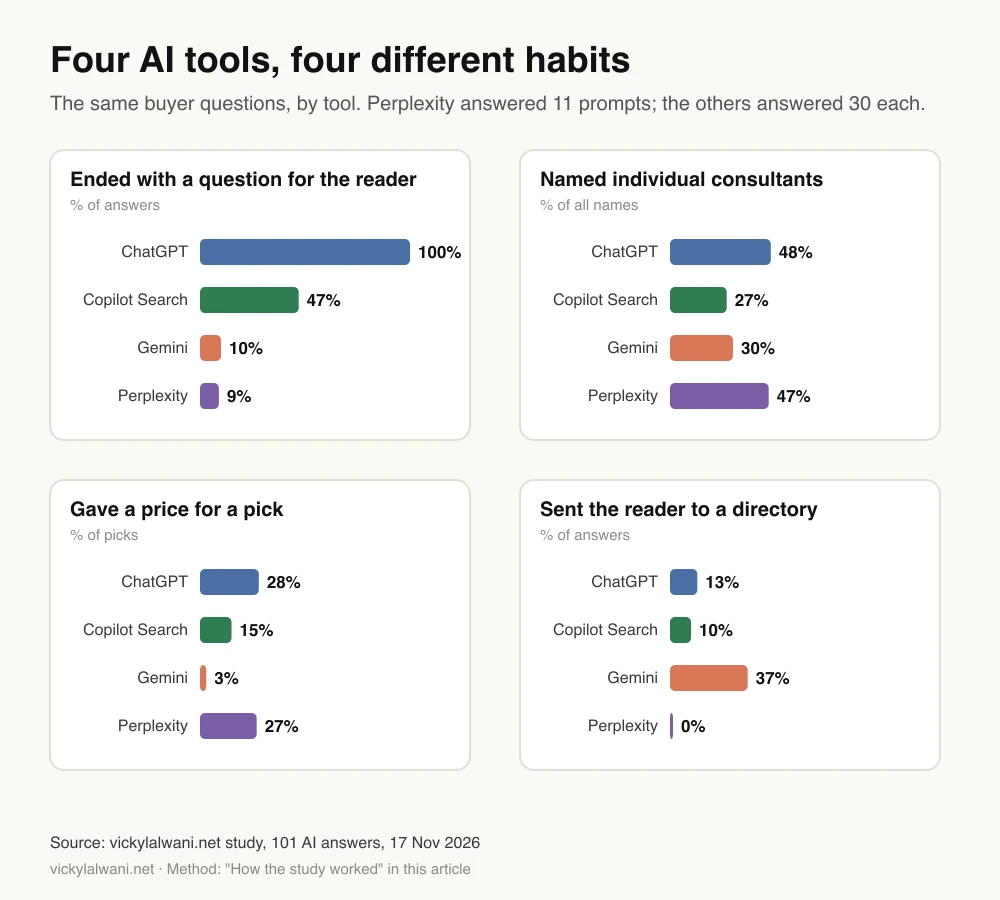
They behave like four different advisers. ChatGPT asked a question in 30 of 30 answers and named the most individuals (48% of its names). It gave a price most often (28% of picks, with Perplexity close at 27%).
Copilot Search named the most agencies (66%). Gemini named the fewest providers per answer and sent readers to directories most (37% of answers).
Perplexity answered only 11 prompts on its free plan, so read its figures with care.
Their sources differ too. Bing's webmaster guidelines say Copilot uses the same crawling, indexing and ranking foundation as Bing search, and Google says its AI features are rooted in its core Search ranking systems. So a page that does well in one search engine has a head start in that engine's AI answers, and not necessarily in the others.
In one AI search audit for a client, I ran their target questions in ChatGPT, Perplexity and Claude and recorded where the brand appeared. The audit found the brand named in ChatGPT answers but not in Google's AI Overviews. Check each tool your buyers use; for Google's, see how to appear in AI Overviews.
How to get your business recommended by AI tools
Make the facts the answers repeat easy to find and consistent everywhere: what you specialise in, where you work, what you charge, what clients say, and how long you have done it. Then get listed where these tools look, without buying fake signals. Nothing guarantees a mention: Bing's own guidelines say "GEO does not guarantee grounding or citations in AI experiences" (grounding is Bing's word for the pages an AI answer draws on).

AEO (answer engine optimisation) is another name for the same work. Here is the order I would do it in:
- Check where you stand. Run your buyers' questions in ChatGPT, Copilot, Gemini and Perplexity, in a temporary or private chat, more than once. Log who is named and which sources are cited. That is your baseline.
- Make sure the tools can read your site. Allow OAI-SearchBot, OpenAI's search crawler, in your robots.txt file, and check your main pages are indexed in Bing (which Copilot Search draws on) and Google, using Bing Webmaster Tools and Search Console. Make sure pages you want quoted are not set to nosnippet, which Google says limits what it shows from a page; I once found some pages on a newly launched client site set that way.
- Name your specialism plainly. One page per service, and per industry if you have real work in it. Put the service and the industry in the page title and the first line, and say who you work with and your typical budgets, the things ChatGPT asked about. Answers stated a specialism for 92% of picks.
- Say where you are and who you serve. Keep your address, service areas and markets the same on your site, Google Business Profile and Bing Places (Microsoft's version of it); Google's guide says a Business Profile can help a business show in AI responses. Check old directory listings too: one that still points at an old website or address can keep sending engines the wrong details. Answers stated a location for 55% of picks.
- Publish a price or a range. ChatGPT gave a price for 28% of its picks. It can only repeat a price it can find.
- Earn real reviews where buyers look. Your Business Profile and the listing sites in your field. Never pay for them or swap them.
- If you work alone, show your years and your work. Years of experience were stated for 30% of individual consultants. Put your start year and named, permitted work on your About page.
- Get listed on the sites the answers cite, knowing which placements are paid. A complete, honest profile is the aim, not a sponsored slot.
- Claim your ChatGPT business profile if it is open to you. Businesses in ChatGPT lets companies claim a profile. How it affects recommendations is not yet known.
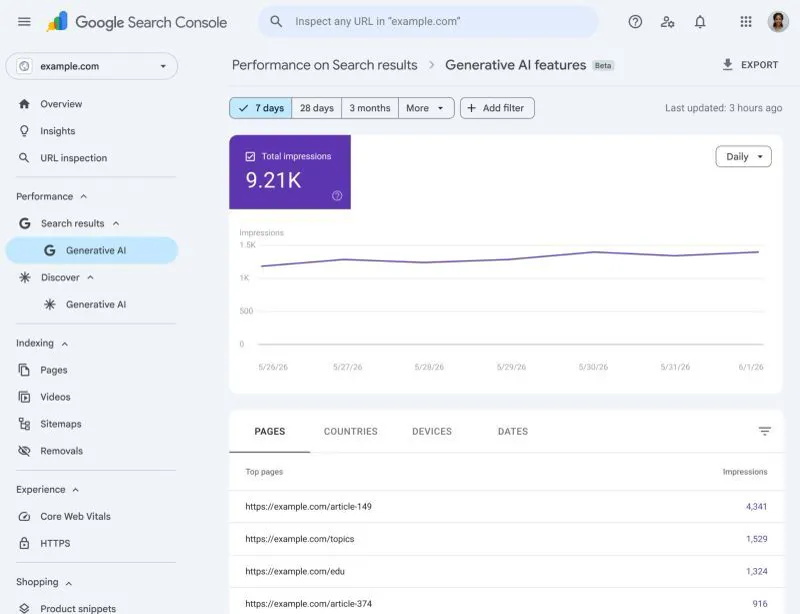
- Check again each quarter against your baseline. Bing Webmaster Tools has an AI Performance report for Copilot citations, and Google points to a generative AI report in Search Console.
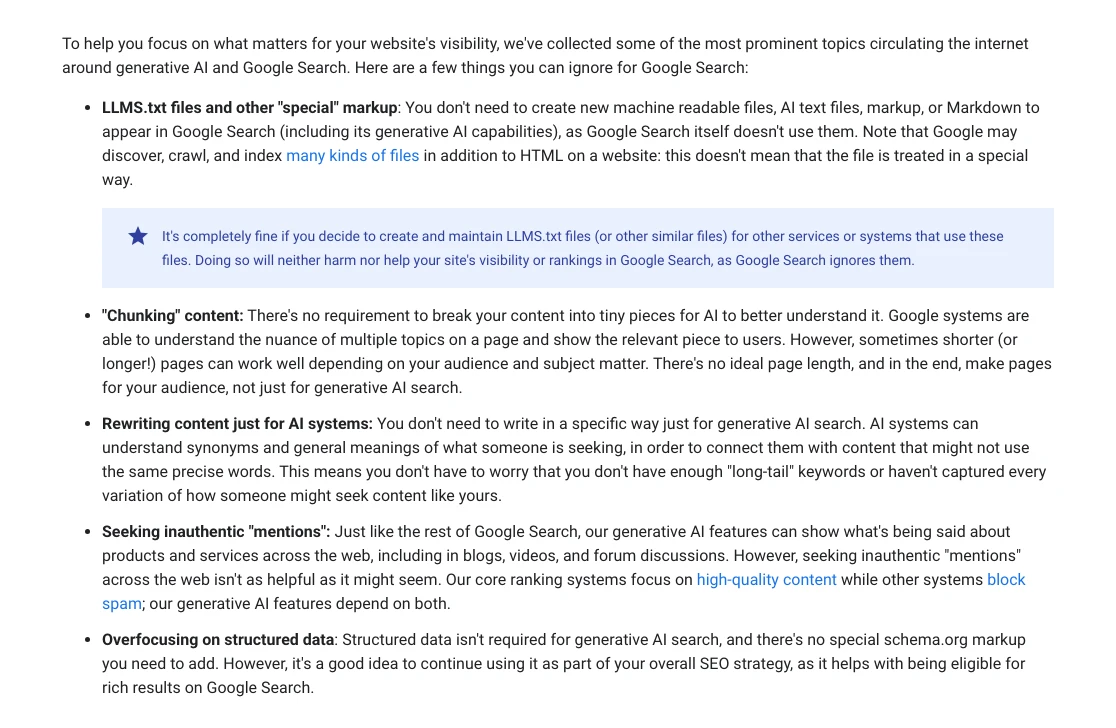
What you can skip. For Google Search, Google's guide says you can ignore llms.txt files (a text file some sites write for AI tools), chopping pages into small chunks, rewriting pages only for AI, chasing inauthentic mentions, and extra structured data (code that labels facts on a page) just for AI.
When a client told me they ranked, I had them check again in a private window, because your own browser flatters you. The same goes for AI tools.
Before you judge any of this, check that your analytics and lead emails record where each visit came from, and can tell a visit from ChatGPT apart from a paid Google click.
Google's own guide says that, for Google Search, optimising for generative AI is still SEO. I tell clients to expect two to three quarters before AI search work shows a visible change.
The step-by-step version is in how to get recommended by ChatGPT. If you would rather have it done for you, see my SEO consultant service.
How to use an AI shortlist when you hire a consultant
Treat the shortlist as a starting point, not a verdict. In this study, only 12% of names for the same question came from more than one tool, at least 4 Copilot Search answers linked a firm's own "best agencies" article, and some stated locations were wrong.
| What the AI said (examples) | What to check |
|---|---|
| Based in your city | Address, profile, time zone |
| Specialises in your field | Case studies in that field |
| Prices from a figure | Pricing page, what is included |
| 4.9 stars | Where the reviews are, and how recent |
| 15 years of experience | Start year and past work |
| A top agency on a list | Who published the list |
- Ask two tools, twice. A name that keeps coming back is a stronger lead than one that appears once.
- Answer its follow-up question. The second list fits your budget and business better.
- Open the sources. If the source is a directory, check whether the listing is sponsored. If it is a "best agencies" article, check who wrote it.
- Interview with Google's questions. Google's 'Do you need an SEO?' page suggests asking for examples of past work, experience in your industry and country, and how success is measured. It also says no one can guarantee a first place in Google.
If the shortlist is for Google Ads rather than SEO, the same checks apply. My Google Ads management page shows how I work, so you can compare it with anyone else on your list.
What people say on X and Reddit
On X the platforms are shipping ways to measure AI answers; on Reddit, owners and buyers argue about whether any of it can be trusted. Each item below was opened and checked on 17 November 2026. Reddit replies often come from people selling a service, so treat single comments as opinion.
| Where | Date | What it says | Type |
|---|---|---|---|
| A Bing product lead, X | 10 Feb 2026 | AI citation data in Bing tools | Official |
| A practitioner, X | 10 Feb 2026 | Wants Google and OpenAI to follow | Opinion |
| Bing Webmaster team, X | 30 Oct 2026 | A separate grounding preference | Official |
| Techmeme, X | 10 Nov 2026 | Businesses in ChatGPT, beta | Reporting |
| An ecommerce analyst, X | 13 Nov 2026 | First look at a business agent | Demo |
| r/Entrepreneur | 28 Oct 2026 | Answer differs every time | First-hand |
| r/smallbusiness | 28 Oct 2026 | Cannot track AI mentions | First-hand |
| r/PPC | 11 Mar 2026 | GEO budget back to search ads | First-hand |
| r/SEO | 10 Aug 2026 | Hard to vet AI search agencies | First-hand |
| r/smallbusiness | 2 Dec 2025 | Paid Clutch badge, few leads | First-hand |
| r/agency | 1 Nov 2025 | DesignRush rankings, weak leads | First-hand |
| r/smallbusiness | 26 Mar 2026 | Open offer to swap reviews | First-hand |
| r/SEO | 27 Apr 2026 | Regrets a self-ranking list | First-hand |
| r/smallbusiness | 5 Aug 2026 | Specific copy got named | Demo |
| r/SEO | 29 Sep 2026 | Visible in AI, few sales | First-hand |
One item is a control you can use today: Bing's webmaster account announced a preference in robots.txt, the file that tells crawlers what they may use, that separates AI training from grounding, the use of a page in AI answers.
Where they disagree: whether AI visibility brings customers at all. Owners who measure enquiries are the most sceptical, and sellers of GEO services the least.
Videos worth watching
Five videos on AI recommendations, all checked on 17 November 2026. Most come from people who sell tools, audits or services, so weigh them with that in mind.
| Video | Channel | Date | What it covers |
|---|---|---|---|
| AI Consistency Research 5 Minute Whiteboard | SparkToro co-founder's channel | Mar 2026, 6 min | Why AI lists rarely repeat |
| AI Search Rankings Are Completely Unreliable (NEW Study!) | An SEO agency channel | Feb 2026, 5 min | Retells it; sells a course |
| Google Search Gen AI Reports, Search Profiles & more (Q2 ‘26) | Google Search Central | Jun 2026, 6 min | Google's AI guide and myths |
| SEO in 2026: How I'd Rank in Google in the AI Era | Ahrefs | Mar 2026, 7 min | Getting onto cited lists; sells tools |
| ChatGPT Business Hub: How To Claim Your Profile | A marketing consultant | Nov 2026, 6 min | Claiming a ChatGPT profile |
Google Search Central's Q2 2026 news episode, published in June 2026. It covers the guide to generative AI search, the myths it rejects and the new Search Console report. It sells nothing.
Where this study is weak
- One run, one day. Each prompt ran once per tool on 17 November 2026. Answers change from run to run, so every percentage here is a snapshot.
- One ChatGPT setup. ChatGPT ran on a paid Plus account with its Thinking model. Free and signed-out users get a different default model, so their answers may differ.
- Uneven sample. Perplexity answered 11 prompts, one of them with a free preview of its advanced search, so the totals lean towards the UK (40 answers against 31 US and 30 Australian). Google AI Mode and the Copilot app are missing.
- The questions shape the reasons. Every prompt named a market and most named a service or industry, so specialism and location were bound to come up often. The 92% and 55% partly reflect the questions.
- Gemini did not always search. Gemini showed sources in 22 of its 30 answers. The rest may have come from the model alone.
- Run from India. ChatGPT can use an approximate IP location. The study did not test whether a run from inside each market changes the answers.
- Reasons are not causes. The study records what each answer said about a pick. It cannot see why the model chose it.
- Location claims can be wrong. The 82% in-market figure is what the answers said, and some of them were wrong.
- Partial links. ChatGPT's citation buttons carried no links and other tools hide sources behind buttons, so the link counts cover links inside the answers, not every source used.
- Counting involves judgement. An AI assistant applied the rules, and whether a one-person brand is an agency, or what counts as a specialism, is a call. The rules are written down and kept.
- One category, English only. SEO, Google Ads and GEO consultants in three English-speaking markets. A dentist or a plumber may see different patterns.
The 30 prompts
These are the ten questions, each asked three times with only the market changed: "in the UK", "in the US" or "in Australia". They are the study's method, so you can run them yourself.
| # | Topic | Prompt |
|---|---|---|
| 1 | SEO | Who is a good freelance SEO consultant in [market]? |
| 2 | SEO | Recommend an SEO consultant for a small business in [market]. |
| 3 | Local SEO | Who are the best local SEO experts in [market]? |
| 4 | Dental SEO | I need an SEO consultant for my dental practice in [market]. Who should I hire? |
| 5 | Google Ads | Who is a good Google Ads consultant in [market] for a small business? |
| 6 | PPC | Recommend a freelance PPC consultant in [market] for an online store. |
| 7 | Ads audit | My Google Ads are wasting money. Who in [market] can audit my account? |
| 8 | GEO | Who can help my business in [market] get recommended by ChatGPT and Google AI Overviews? |
| 9 | Law firm SEO | Affordable SEO consultant for a law firm in [market] |
| 10 | Hiring | Should I hire an SEO agency or a freelance SEO consultant in [market]? Name a few good options. |
Want to know what AI tools say about your business?
I can run your buyers' questions across ChatGPT, Copilot, Gemini and Perplexity, several times each, and show you where you are named, which sources the answers use, and what your site and listings are missing. Most of the fixes are ordinary SEO: service pages, listings, reviews and making sure the tools can read your site.
Send me your site and main services through the contact page. How I work is on the GEO and AI search and SEO consultant pages.
Sources
| Source | What it supports | Date | Link |
|---|---|---|---|
| vickylalwani.net study | 101 AI answers, all study figures | 17 Nov 2026 | Method |
| Google Search Central | No special AI optimisation; nosnippet | Updated 10 Dec 2025 | AI features |
| Google Search Central | Generative AI guide, myths, Business Profile | Updated 10 Jul 2026 | Guide |
| Google Search Central | Questions to ask an SEO | Updated 5 Jun 2026 | Do you need an SEO? |
| Google Help | Local ranking, reviews, paid ads, fake reviews | Read 17 Nov 2026 | Local ranking, ads in AI, fake engagement |
| OpenAI Help Center | Search ranking, location, temporary chat, ads, products | Read 17 Nov 2026 | Search, temporary chat, ads, shopping, crawlers |
| Microsoft Bing | Copilot Search, guidelines, AI Performance | Apr 2025 to Feb 2026 | Copilot Search, guidelines, AI Performance |
| Gemini Apps Help | Gemini can misrepresent how it works | Read 17 Nov 2026 | Responses |
| Perplexity Help Center | Free plan: very limited Pro Searches; no number published | Updated 12 Nov 2026 | Plans |
| Clutch, Semrush, DesignRush, Sortlist | Paid placement on listing sites | Read 17 Nov 2026 | Clutch, Semrush, DesignRush, Sortlist |
| Clutch research | About 14 providers per answer; 30% repeat | Oct 2026 | What AI tells B2B buyers |
| SparkToro and Gumshoe | Same list under 1 in 100 runs | Jan 2026 | Search Engine Journal, SparkToro |
| Ahrefs | "Best" lists; self-promotion experiment | Dec 2025; Jul 2026 | Best lists, experiment |
| Local SEO software survey | 45% used AI for local picks | Feb 2026 | Survey |
| X | Bing, Techmeme, two practitioners | Feb to Nov 2026 | Linked in the table |
| Owners, buyers, agencies | Nov 2025 to Oct 2026 | Linked in the table | |
| YouTube | Five videos, titles checked | Feb to Nov 2026 | Linked in the videos table |
FAQ
How does ChatGPT decide which businesses to recommend?
OpenAI does not publish how ChatGPT picks businesses; it says ChatGPT ranks search results on several factors and does not guarantee placement. In ChatGPT's 30 answers in a November 2026 vickylalwani.net study of 101 AI answers about SEO and Google Ads consultants, it gave a specialism for 94% of its picks, a location in the asked market for 67%, a price for 28%, reviews for 20% and years of experience for 14%.
How do I get my business recommended by ChatGPT?
To get your business recommended by ChatGPT, first check where you stand by asking your buyers' questions several times in a temporary chat. Then make sure OpenAI's search crawler, OAI-SearchBot, can read your site, and make the facts AI answers repeat easy to find: a clear page for each service and industry, where you work, a price or price range, real reviews and, if you work alone, your years of experience. Nothing guarantees a mention.
Does ChatGPT give the same answer to everyone?
ChatGPT probably does not give everyone the same answer. Research by SparkToro and Gumshoe across 2,961 runs found ChatGPT or Google's AI returned the same brand list less than once in 100 runs. In a November 2026 vickylalwani.net study of 101 AI answers, when four AI tools got the same question, only 12% of the names they gave came from more than one tool.
How many businesses does ChatGPT recommend in one answer?
In a November 2026 vickylalwani.net study of 101 AI answers about SEO and Google Ads consultants, ChatGPT named 5.5 businesses or people per answer on average and named at least one in all 30 of its answers. Across four AI tools the average was 5.3. A larger Clutch analysis of business service questions counted about 14 providers per ChatGPT answer, so the number depends on how the question is asked.
Do AI tools recommend freelancers or only agencies?
AI tools recommend both, but mostly agencies. In a November 2026 vickylalwani.net study of 101 AI answers about SEO and Google Ads help, 60% of the 535 names were agencies and 37% were individual consultants. ChatGPT (48%) and Perplexity (47%) named individual consultants far more often than Gemini (30%) or Microsoft's Copilot Search (27%).
Does ChatGPT use Google reviews to recommend businesses?
ChatGPT sometimes mentions reviews when it recommends a business, but far less often than a specialism or a location, and its answers do not always say where the reviews come from. In ChatGPT's 30 answers in a November 2026 vickylalwani.net study of 101 AI answers, reviews or ratings were mentioned for 20% of its picks, against 94% for a specialism. Google says more reviews and positive ratings can help in its own local results, and it removes reviews that were paid for.
Does showing my prices help AI recommend my business?
Showing prices gives AI tools something to repeat, but there is no proof it gets a business recommended. In a November 2026 vickylalwani.net study of 101 AI answers, a price was mentioned for 18% of recommended SEO and Google Ads providers and for 28% of ChatGPT's picks. Gemini mentioned a price for only 3% of its picks.
Does ChatGPT recommend businesses listed on Clutch or Upwork?
AI answers sometimes send buyers to Clutch and Upwork, but this study cannot show that a listing makes a business more likely to be named. In a November 2026 vickylalwani.net study of 101 AI answers, 18% of answers told the reader to search a directory, most often Upwork (12 answers) and Clutch (6); ChatGPT did so in 4 of its 30 answers. Clutch says paid sponsors sort first on its directory pages by default.
Do "best of" lists help you get recommended by ChatGPT?
A self-promotional "best agencies" list can get a business named by AI tools, but it can also hand the recommendation to a competitor. In a November 2026 vickylalwani.net study of 101 AI answers, at least 4 Copilot Search answers linked an agency's own "best agencies" article and named that agency. In a 2026 Ahrefs experiment, 43% of the AI answers citing its self-promotional conference pages recommended rivals from the same list instead. Google says seeking inauthentic mentions is less helpful than it seems.
Why does ChatGPT ask a follow-up question after its shortlist?
ChatGPT asks a follow-up question to fit its shortlist to the person asking, usually about the type of business or the budget. In a November 2026 vickylalwani.net study of 101 AI answers, ChatGPT ended all 30 of its answers about SEO and Google Ads consultants with a question, often a short form with budget options, after giving a first list. Copilot Search asked in 47% of answers, Gemini in 10% and Perplexity in 9%.
Do Gemini, Copilot and Perplexity recommend the same businesses as ChatGPT?
Gemini, Copilot and Perplexity mostly name different businesses from ChatGPT. In a November 2026 vickylalwani.net study of 101 AI answers, when the four tools got the same question, only 12% of the names they gave came from two or more tools, and just 1 name came from all four. The tools also behaved differently: Gemini sent more people to directories, and ChatGPT named more individual consultants.
Do AI tools recommend businesses from other countries?
AI tools rarely recommend a business from another country when the question names a market. In a November 2026 vickylalwani.net study of 101 AI answers about SEO and Google Ads consultants, only 4 of 535 names were clearly placed outside the market asked about, though for 17% the answer gave no clear location. Some location claims were wrong, so check a stated city. Remote providers should say plainly which markets they serve.
Can I trust ChatGPT to recommend an SEO or Google Ads consultant?
Use ChatGPT's recommendations as a starting list, not a verdict. In a November 2026 vickylalwani.net study of 101 AI answers about SEO and Google Ads consultants, some location claims were wrong, some sources were paid listings or a firm's own "best agencies" article, and the tools rarely agreed on names. Check each name's site and reviews, then interview them with the questions in Google's "Do you need an SEO?" guide.
How do I check if ChatGPT recommends my business?
To check if ChatGPT recommends your business, ask the questions your buyers would ask in a temporary, unpersonalised chat, run each one several times, and log whether you are named and which sources are cited. Do the same in Copilot, Gemini and Perplexity, and repeat each quarter. Bing Webmaster Tools reports Copilot citations, and Google points site owners to a generative AI performance report in Search Console.
How does ChatGPT choose its sources?
OpenAI says ChatGPT search turns a question into searches sent to its search partners and ranks the results on several factors it does not list, with no guaranteed placement. A site must allow OpenAI's search crawler, OAI-SearchBot, to be eligible. In ChatGPT's 30 answers in a November 2026 vickylalwani.net study of 101 AI answers, the most linked site apart from its own map was the listing site Clutch, in 5 answers.