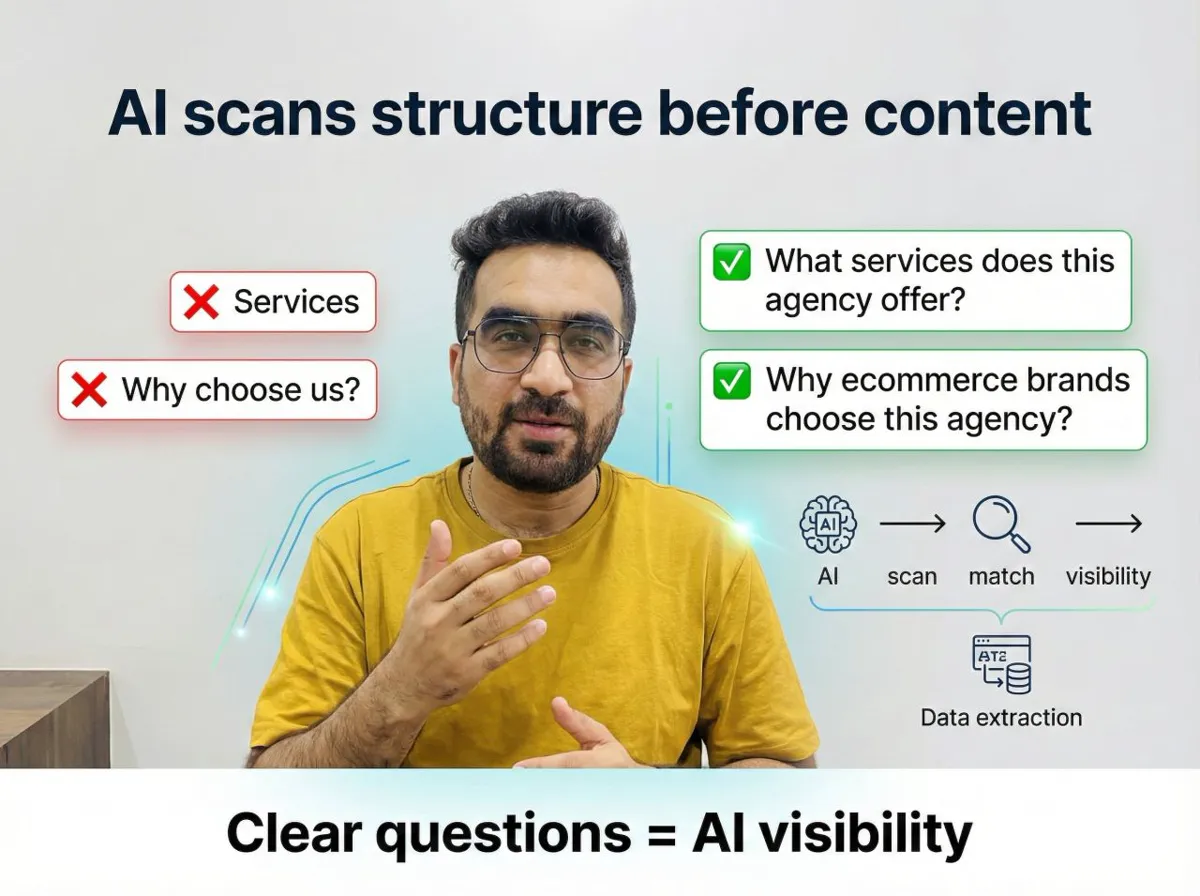
To optimize your website for AI search, let Googlebot, OAI-SearchBot and PerplexityBot crawl your key pages, organise each page around the questions buyers ask with a direct answer under each heading, and add first-hand detail nobody else has. Google says there are no extra requirements for AI Overviews or AI Mode, and that llms.txt and chunking are not needed.
TL;DR
To optimise your website for AI search, make each important page easy to find, easy to understand and worth quoting. AI Overviews, AI Mode, ChatGPT search and Perplexity all retrieve pages from a search index and link the ones that support their answer.
Google's own guidance, checked on 17 November 2026, says there are no extra technical requirements: a page must be indexed and able to show a snippet, and your site must not be opted out of the Search generative AI control in Search Console. Google Search ignores llms.txt, and "chunking" is not required.
What still helps: question headings in the buyer's words, a direct answer under each one, first-hand detail nobody else has, crawler access for Googlebot, OAI-SearchBot and PerplexityBot, and measuring with the Generative AI performance report.
Short answer: how to optimize your website for AI search comes down to three jobs. Let the right crawlers in, organise each page around the questions buyers ask with the answer first, and publish detail only you can give. There is no special file or markup that gets you cited.
This article is about being cited: your page shown as a source link inside an AI-written answer. If your question is about AI agents and browsers that act on your site (book a table, fill a form, add to a basket, check out), that is a different job with different fixes, covered in how to optimise your website for AI agents. If you would rather have someone review your pages for AI search, that is the core of my generative engine optimisation (GEO) service.
What does optimising for AI search mean in 2027?
Short answer: it means getting your pages chosen as supporting links when an AI system writes an answer. The main surfaces are Google's AI Overviews and AI Mode, ChatGPT search and Perplexity. Each one searches an index first, then cites the pages it used.
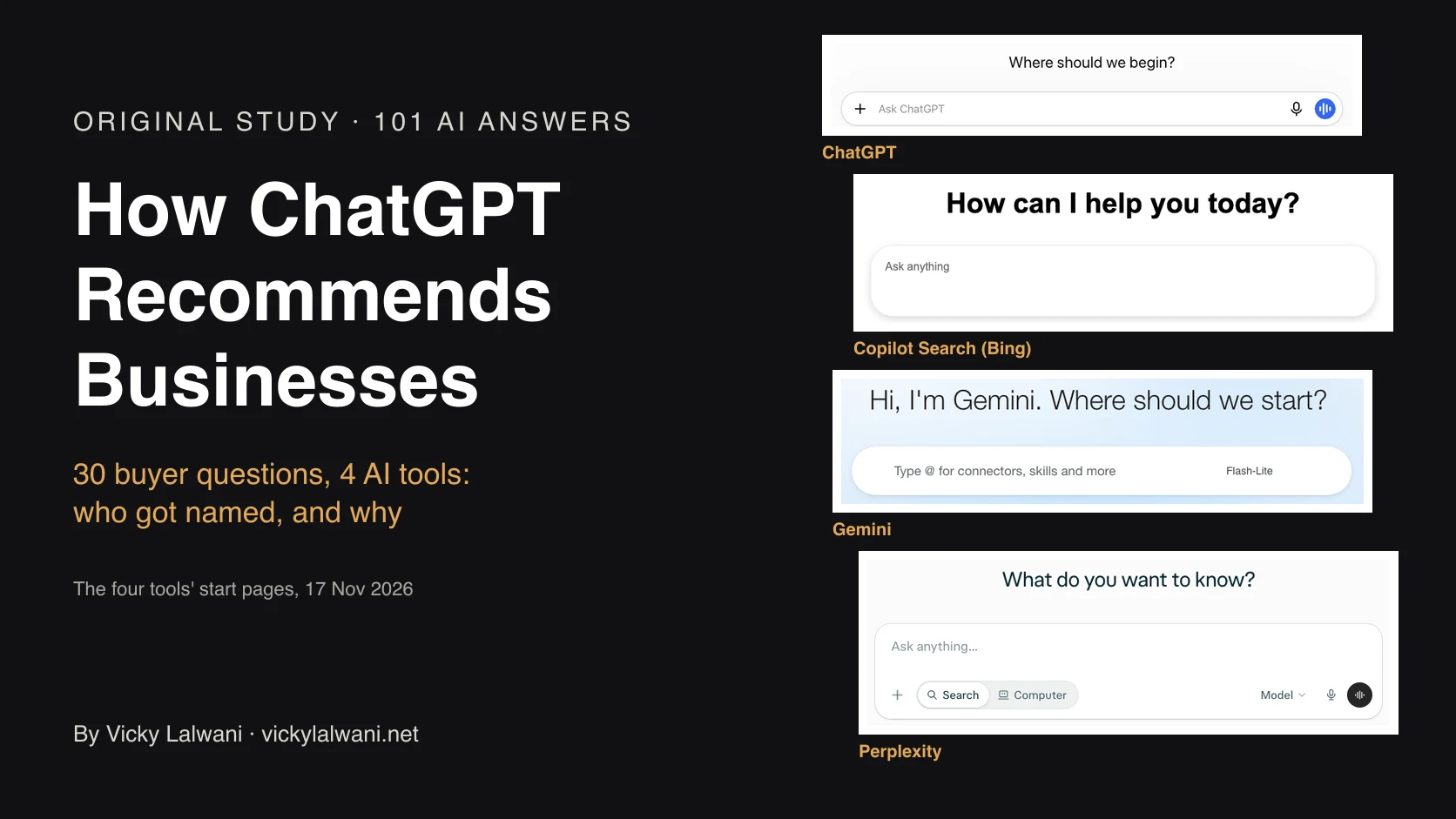
An AI Overview is the generated summary at the top of some Google results. AI Mode is Google's conversational search tab for longer, comparison-style questions. ChatGPT search and Perplexity work in a similar way: the model runs searches, reads the pages it finds, writes an answer and links its sources.
That shared pattern matters. None of these systems "knows" your business from scratch at answer time. They retrieve pages first, which is why plain search engine basics still decide whether you can be cited at all.
| Surface | Who fetches your page | Main control | Where to measure |
|---|---|---|---|
| AI Overviews | Googlebot | robots.txt, AI control | Search Console |
| AI Mode | Googlebot | robots.txt, AI control | Search Console |
| ChatGPT search | OAI-SearchBot | robots.txt | GA4 referrals |
| Perplexity | PerplexityBot | robots.txt | GA4 referrals |
On client calls the topic rarely arrives as "how do I get into AI Overviews". It arrives as "how do we get more leads", and AI search turns out to be part of the answer. That is the right way to think about it: being cited is a visibility job inside SEO, not a separate channel with its own tricks.
What does Google say you need to do to appear in AI features?
Short answer: almost nothing beyond normal SEO. Google says a page must be indexed and eligible to show with a snippet, and that there are no additional technical requirements. Since 2026 your site must also be included in the Search generative AI control in Search Console, which is on by default.
Google's page AI features and your website (last updated 10 December 2025) states that the best practices for SEO remain relevant and there are no additional requirements to appear in AI Overviews or AI Mode. It also says you do not need new machine-readable files, AI text files or special schema.org markup.
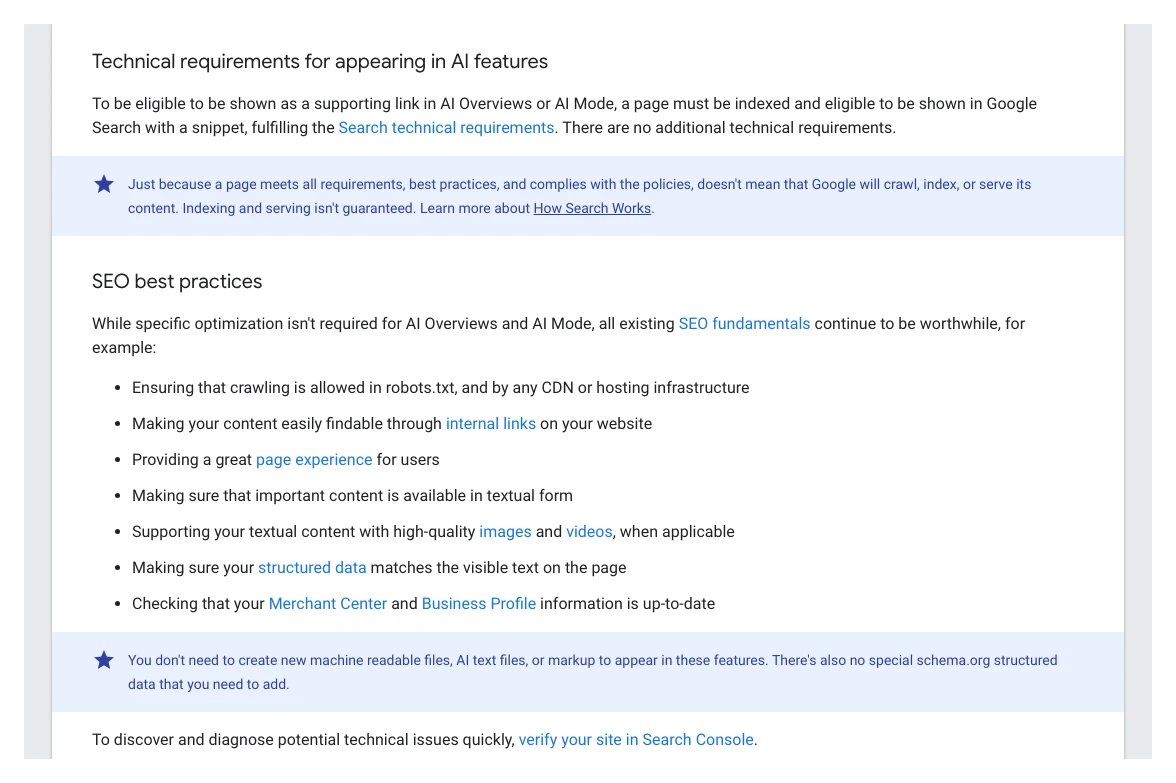
On 15 May 2026 Google went further and published its first full guide to generative AI features in Search, announced on the Search Central blog and last updated on 10 July 2026. Its position on "AEO" and "GEO" is blunt: from Google Search's point of view, optimising for generative AI search is still SEO.
The same guide explains the two techniques behind the answers. Retrieval-augmented generation (grounding) means the core ranking systems fetch pages from the index and the model writes from them. Query fan-out means the model runs several related searches at once to cover the sub-questions.
The one genuinely new requirement is a setting. The guide says a site must be included in Search generative AI features in Search Console to be eligible. The default is "include", so you only lose eligibility if someone opted out.
What can you ignore?
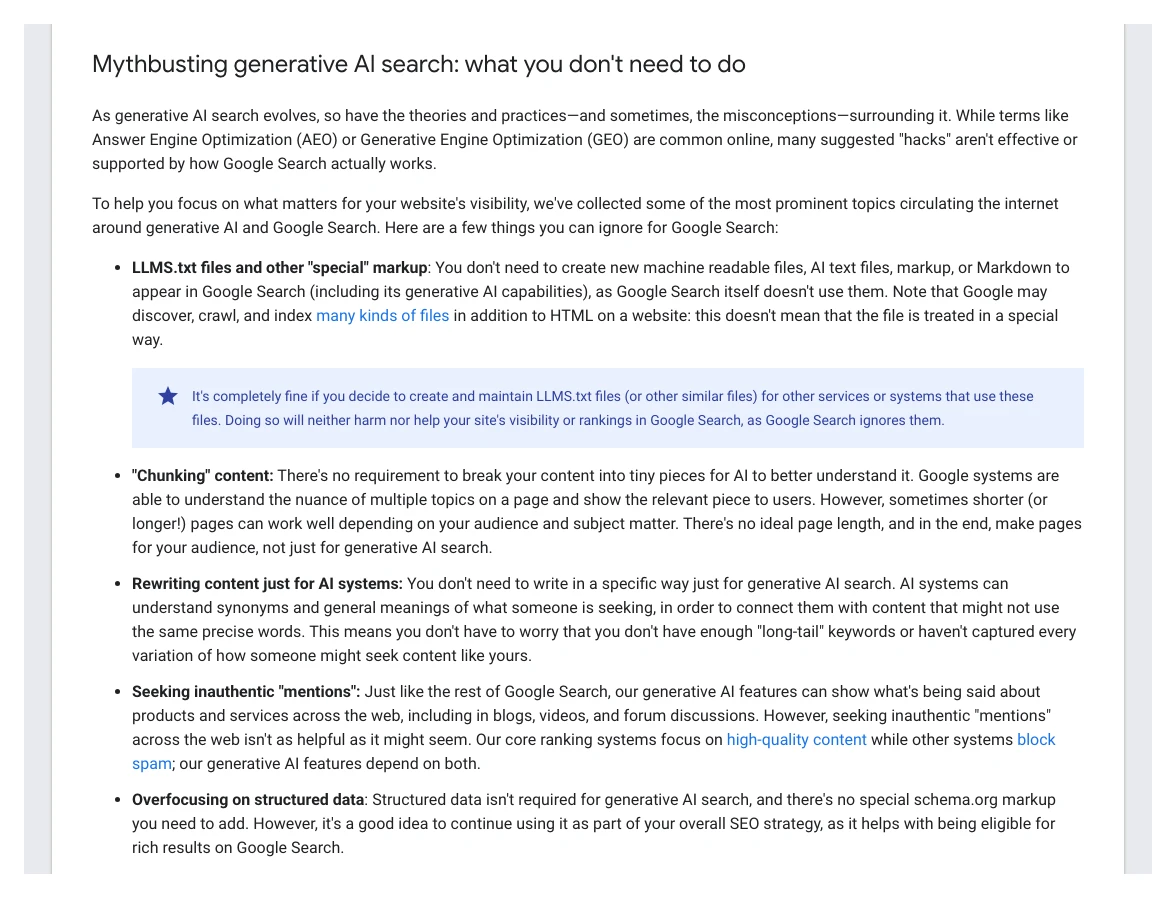
Short answer: for Google Search, you can ignore llms.txt files, cutting pages into tiny "chunks", rewriting copy in a special AI style, chasing inauthentic mentions and adding schema purely for AI. Google's guide lists all five under "Mythbusting".
| Popular tactic | What Google says | Do this instead |
|---|---|---|
| llms.txt file | Google Search ignores it | Fix crawl and index basics |
| Chunking pages | Not required | Organise for readers |
| AI-style rewrites | Not needed | Write plainly for buyers |
| Bought mentions | Not as helpful as it seems | Earn real reviews and coverage |
| Schema for AI | Not required | Keep schema for rich results |
| Page per query variant | Can breach spam policy | One strong page per job |
Two honest caveats. First, this is Google's guidance for Google. An llms.txt file will neither help nor harm you in Google, and other services may read it, so keeping one is a low-cost choice rather than a fix. Chrome's experimental Lighthouse agentic browsing audit does check for an llms.txt file, but that audit is about AI agents using your site, not about Google Search. Second, Google warns that producing separate pages for every fan-out query mainly to manipulate answers breaches its scaled content abuse policy.
This also corrects the earlier version of this article. It claimed AI systems "scan structure before content". Google has not documented anything like that, and its guide says its systems understand pages with several topics without chunking. Structure helps because it helps readers and makes your answers easy to check, not because it unlocks a hidden ranking step.
How should you structure a page so AI answers can cite it?
Short answer: give each page one job, turn vague headings into the questions buyers ask, and put a two-sentence answer with the key fact directly under each heading. Then add the detail, examples, tables and proof. Google's guide asks for content organised by paragraphs, sections and headings that give a clear structure.
Picture a service page with sections called Services, Why choose us and Our approach. A person who arrives from a question has to read every section to find the answer. So does a system checking whether your page supports a sentence it has written.
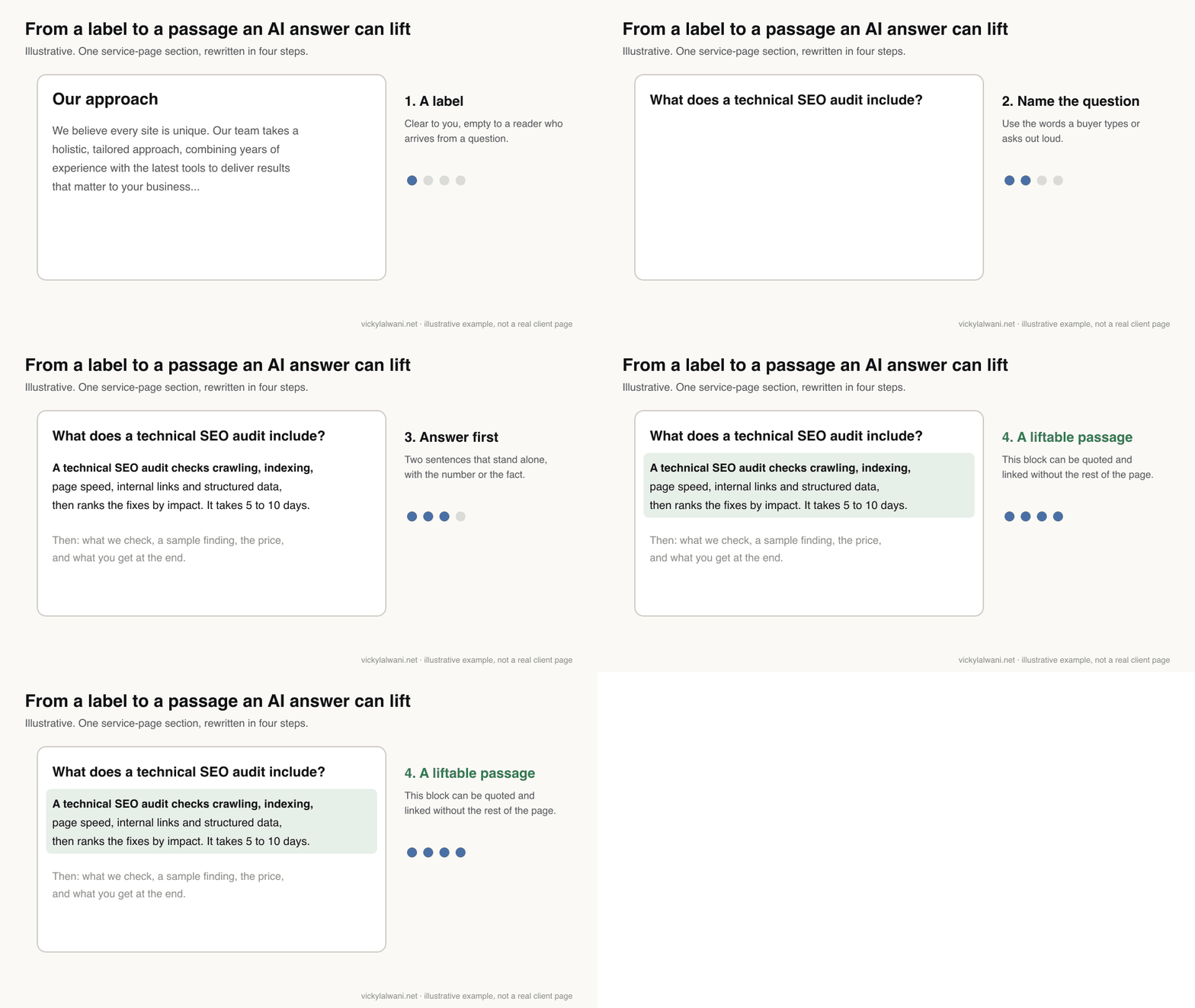
Use the words the buyer uses, not your internal name for the service. In my work the most common fix is exactly that: the plain service term people type instead of a branded product name, and the place name people search instead of the official district name.
| Vague label | Question heading |
|---|---|
| Services | What does a technical SEO audit include? |
| Why choose us | Why do ecommerce brands hire a specialist? |
| Pricing | How much does an SEO audit cost? |
| Process | What happens in the first month? |
| Locations | Which areas do you cover? |
A checklist for each important page:
- One H1 that says what the page is about and who it is for.
- H2s phrased as real questions, in the order a buyer would ask them.
- The first one or two sentences under each H2 answer it on their own, with the number, price range or fact.
- One idea per section. If a section answers two questions, split it.
- Comparisons and steps in tables or lists, with short cells.
- Key facts in text, not only in images, videos or PDFs. Google lists "important content available in textual form" as a best practice.
- An FAQ block for the objections you hear on sales calls, answered plainly.
- Structured data only where it matches the visible text, as Google asks.
Do not stuff a page with question headings you answer badly. A heading that promises an answer and then delivers a vague paragraph is worse than a plain label.
Why does first-hand content matter more than structure?
Short answer: because an AI answer can only cite one or two sources for each point, and it has dozens of pages that say the same thing. Google's guide says unique, valuable, non-commodity content will likely influence your presence in AI search more than anything else in the guide.
Google contrasts "commodity" content, such as a generic list of tips anyone could write, with first-hand content that shows real experience. A summary of what is already online gives the system no reason to pick you over the original.
For a business site, non-commodity content is usually sitting in your own sales process:
- Your real price ranges and what moves them up or down.
- What actually happens in week one, with the documents and tools you use.
- The questions customers ask on calls, answered the way you answer them.
- Photos and videos of your own work, not stock images.
- Limits: who you are not a good fit for.
Structure is the cheap fix. Original detail is the one that is hard to copy, and it is what makes a page worth citing.
Which technical checks stop you being cited?
Short answer: blocked crawlers, pages that are not indexed, snippet rules that hide your text, and an opted-out Search generative AI control. Check robots.txt for Googlebot, OAI-SearchBot and PerplexityBot, check your CDN or firewall, and check the control in Search Console.
Each AI search product has its own crawler, and each one honours robots.txt. OpenAI's crawler documentation says sites that opt out of OAI-SearchBot will not be shown in ChatGPT search answers. Perplexity's documentation recommends allowing PerplexityBot so your site appears in its results.
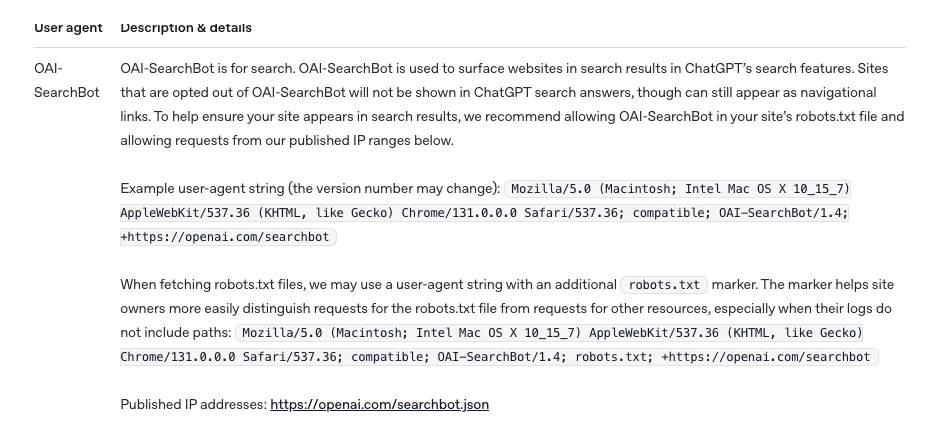
Blocking the training crawlers is a separate choice. GPTBot (OpenAI) and Google-Extended (Google) cover model training. Google's crawler list says Google-Extended does not affect inclusion in Google Search, so blocking it will not remove you from AI Overviews.
| Control | What it does | Effect on citations |
|---|---|---|
| Googlebot in robots.txt | Crawling for Search | Blocked = not cited |
| Search generative AI control | Opt in or out of AI features | Out = no AI links |
| nosnippet, max-snippet | Limit text shown | Can remove you |
| data-nosnippet | Hide part of a page | That part not used |
| Google-Extended | Gemini training, grounding | None in Search |
| OAI-SearchBot | ChatGPT search | Blocked = not shown |
| GPTBot | OpenAI training | None on search |
| PerplexityBot | Perplexity results | Blocked = not shown |
The Search generative AI control is the newest switch. Google's help page says it covers AI Overviews, AI Mode and generative AI features in Discover, sits under Settings in Search Console, and was rolled out to all websites worldwide as of 31 August 2026. Opting out means no links, no grounding and no traffic or impressions from those features.
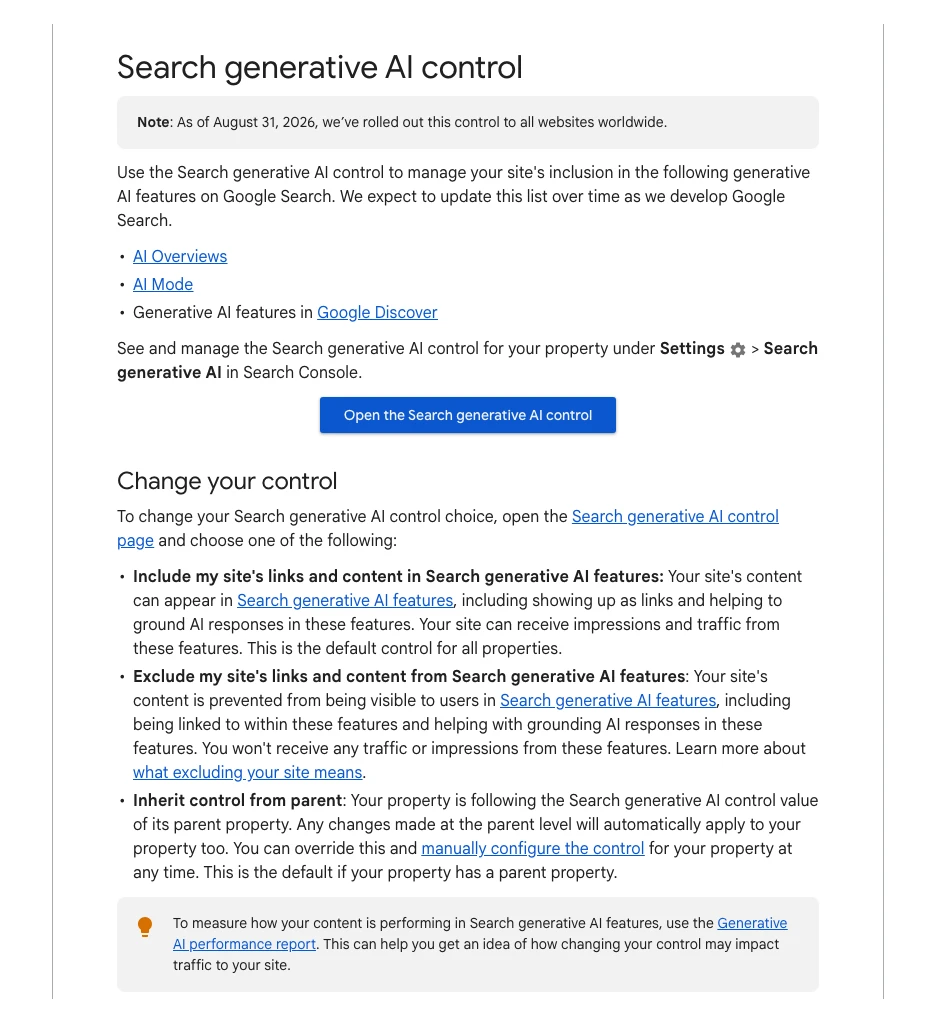
Two more checks catch a lot of sites. Make sure your CDN or bot protection is not challenging search crawlers, because Google lists crawling allowed "by any CDN or hosting infrastructure" as a best practice. And use the URL Inspection tool to see the HTML Googlebot actually received, especially on sites built with JavaScript.
How does an AI answer choose which pages to cite?
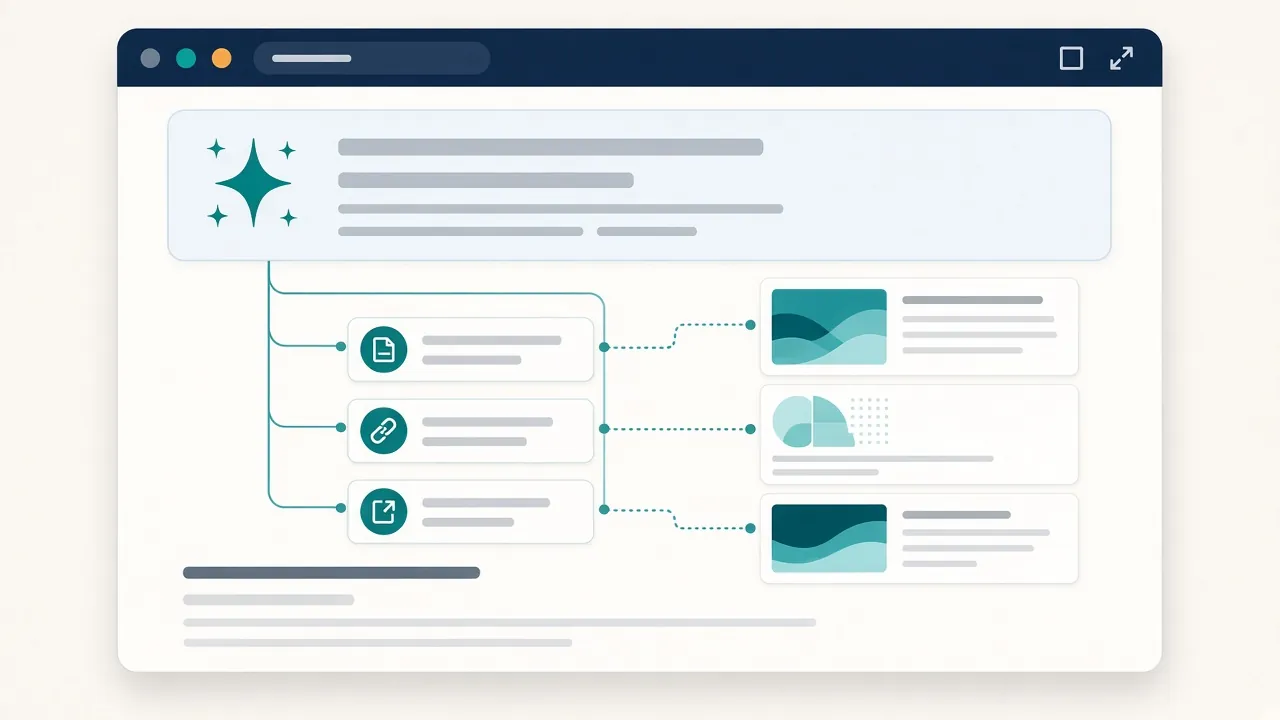
Short answer: it breaks the question into related searches (query fan-out), retrieves pages for each one with the normal ranking systems, then writes an answer and links the pages that support it. You are competing to be the best page for one of those sub-questions.
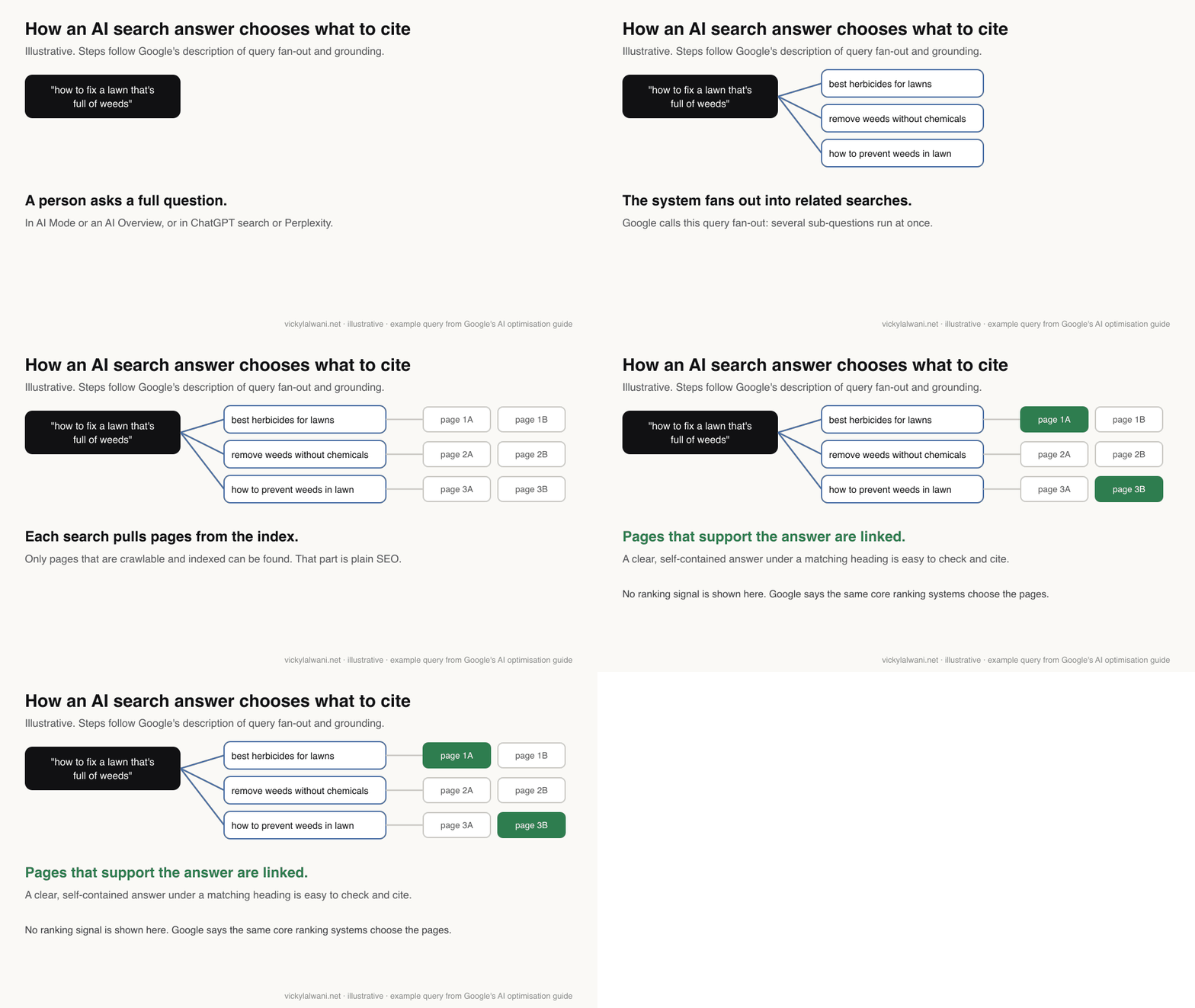
Google's example is the question "how to fix a lawn that's full of weeds", which might fan out into searches about herbicides, chemical-free removal and prevention. A page that clearly answers one of those sub-questions has a chance to be linked, even if it would never rank for the original phrase.
The practical consequence is coverage, not volume. Map the five to ten sub-questions behind your main service, then make sure each one has a clear answer on the right page. Google says AI Mode and AI Overviews can use different models, so the links they show will vary for the same question.
ChatGPT and Perplexity do not publish a ranking guide. Their documentation covers crawler access, not how sources are chosen. Treat any claim about exactly how they rank as a hypothesis to test.
How do you measure AI search visibility?
Short answer: use the Generative AI performance report in Search Console for AI Overviews and AI Mode impressions, GA4 referrals for ChatGPT and Perplexity, and a dated log of the questions you test by hand. No tool sees inside Google's ranking systems.
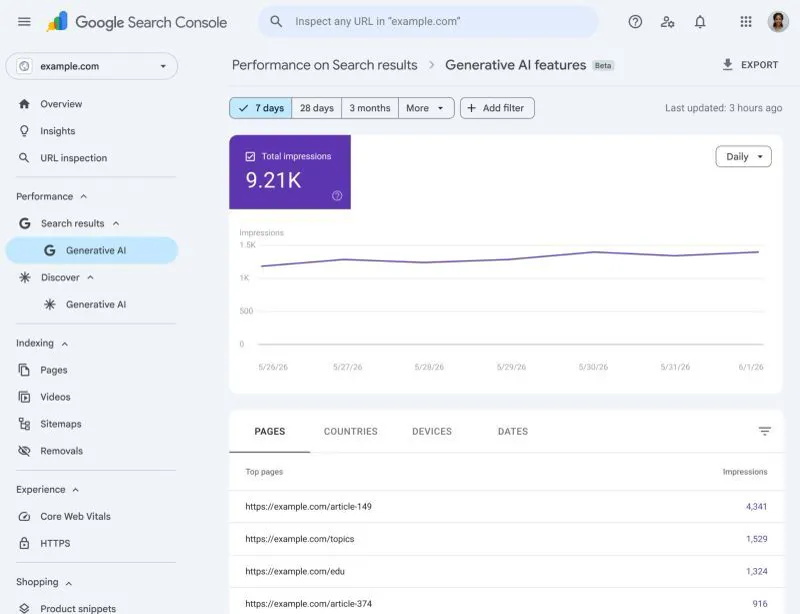
Google's Generative AI performance report counts how many times links to your site were shown in AI Overviews and AI Mode, by page, country, date and device. It reports impressions only, and it was rolled out to all websites as of 31 August 2026. I explain how to read it in the Search Console Generative AI report guide.
Why bother, if the traffic is small? Because fewer people click when an AI summary appears, so being the link inside it matters more. Pew Research Center tracked 900 US adults and found people clicked a traditional result on 8% of visits to a results page with an AI summary, against 15% without one.
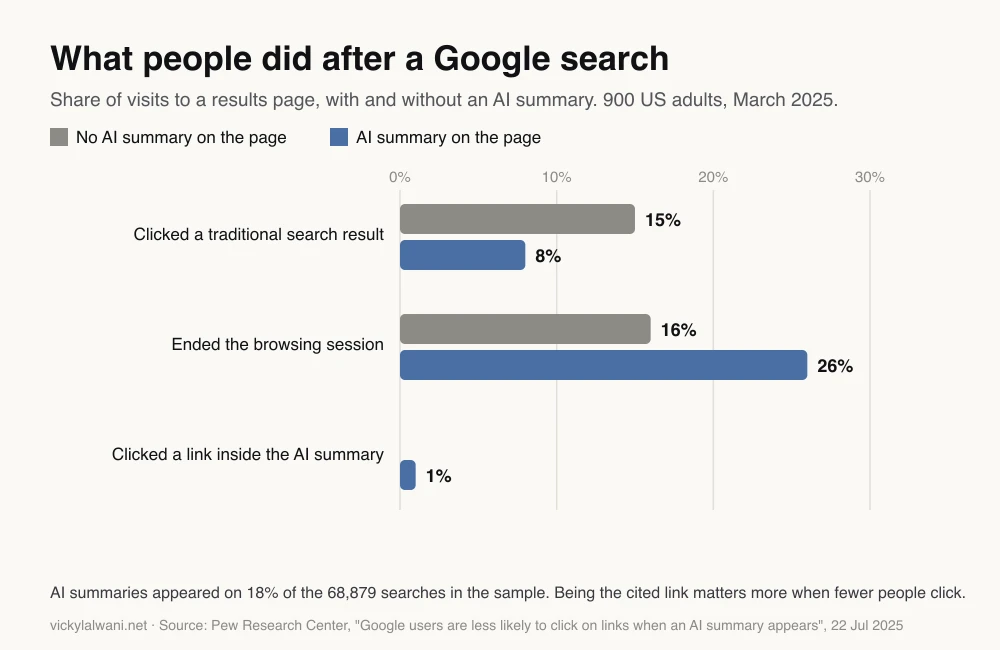
Read the chart carefully. It is US data from early 2025, before AI Mode was widely available, and it measures behaviour on results pages, not the value of a click. Google says clicks from pages with AI Overviews tend to be higher quality. Both can be true.
For the AI tools that do not report impressions, keep a simple test log: the question, the tool, the date, whether you were cited and which page. Ten to twenty buyer questions tested once a month is enough to see a trend. The AI citation audit article has a full template.
You are checking whether a web page is easy to cite in an AI search answer.
Page URL: [paste URL]
Main buyer questions this page should answer:
1. [question]
2. [question]
3. [question]

For each question:
- Quote the sentence on the page that answers it, or say "not answered".
- Say whether that answer works on its own, without the rest of the page.
- Suggest a question-style H2 in plain buyer language, and a two-sentence answer to put under it, using only facts already on the page.
Then list any facts that appear only in images, PDFs or scripts.
Do not invent prices, numbers or claims.
Where should you start?
Short answer: start with five pages that bring enquiries: the homepage, two main service pages, a pricing or comparison page and your best location page. Fix access first, then headings and answers, then add first-hand detail, and measure for two to three months.
| Week | Task | Check |
|---|---|---|
| 1 | Crawler and control check | robots.txt, CDN, Search Console |
| 1 | Baseline test log | 15 buyer questions, 3 tools |
| 2 | Rewrite headings | Questions in buyer words |
| 2 | Answer-first openings | Two sentences, one fact |
| 3 to 4 | Add first-hand detail | Prices, process, proof |
| Monthly | Re-test and compare | Same questions, same tools |
Keep the facts the same while you restructure, so you can see what the structure changed. Expect slow movement: SEO work on a site normally takes months, and AI features sit on the same index. If you are also seeing ChatGPT or Perplexity visits appear as another channel in your reports, fix the tracking before you judge the results.
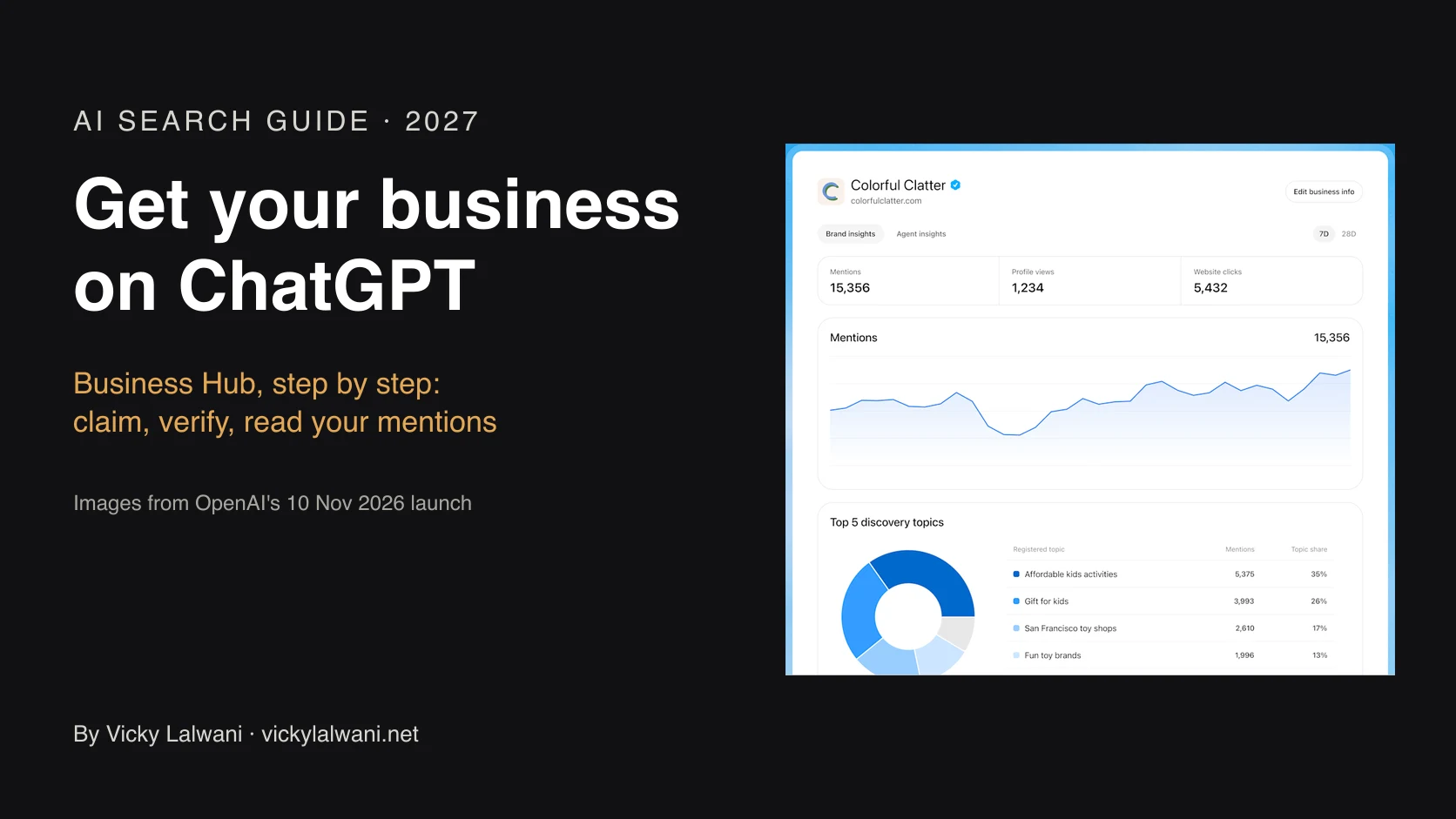
For Google's AI Mode in particular, see Google AI Mode SEO. For ChatGPT, how to get recommended by ChatGPT covers the business-profile side.
Rewrite these section headings as the questions a buyer would type or ask out loud.
Business: [what you sell, to whom, where]
Current headings: [paste list]
Rules: plain words, no brand jargon, under 70 characters, one question per heading,
keep the order a buyer would ask in. After each, write the one fact the answer must include.
What people say on X and Reddit
Short answer: practitioners welcomed Google's May 2026 guide because it confirmed that "AEO hacks" such as llms.txt and chunking are not needed in Google, and they are now debating what citations without clicks or brand mentions are worth.
| Who | What they said | Take it as | Link |
|---|---|---|---|
| An SEO consultant | Google's first AI search guide: SEO is the foundation; ignore chunking and llms.txt hacks (15 May 2026) | Opinion | X post |
| An SEO consultant | Read the Mythbusting section: no llms.txt, no chunking, do not overfocus on structured data (15 May 2026) | Opinion | X post |
| Search Engine Roundtable's editor | AI performance reports and the Search generative AI control rolling out globally (31 Aug 2026) | News | X post |
| An SEO practitioner | Generative AI report now showing on all of their Search Console properties (11 Aug 2026) | First-hand | X post |
| An SEO practitioner | ChatGPT, logged out, testing five blue links above the answer (14 Nov 2026) | First-hand | X post |
| An SEO practitioner | ChatGPT, logged out, hiding the answer behind "See more" with organic links below (11 Nov 2026) | First-hand | X post |
| r/SEO | A news site cited on about 700 pages by AI tools but named only five times asks what a citation is worth (13 Sep 2026) | First-hand | Thread |
| r/TechSEO | A B2B site shares its first 40 to 50 days of Generative AI report data and asks for comparisons (30 Jul 2026) | First-hand | Thread |
| r/TechSEO | A site owner reports dropping out of Google results after a spike in generative AI impressions (21 Oct 2026) | First-hand | Thread |
| r/bigseo | How do you see which questions bring visits from ChatGPT, Gemini and Claude? (7 Jul 2026) | Question | Thread |
The two ChatGPT reports are tests seen while logged out, not announced changes. The r/TechSEO drop-out thread is one site with its own indexing history, so read it as a reason to watch your index coverage, not as proof that AI impressions cause removals.
Videos worth watching
Short answer: start with Google Search Central's own updates; they explain the new reports, the AI control and why chunking is not needed. Use vendor videos for the non-Google engines, and treat their advice as a hypothesis.
Made by Google Search Central, 18 June 2026. It does not sell anything. It covers the Generative AI performance reports, the control over AI features and the updated documentation.
Made by Google Search Central (the Search Off the Record podcast), 8 January 2026. It does not sell anything. Google's search team explains why you should not rush to cut content into bite-sized chunks.
| Video | Channel | Date | What it covers |
|---|---|---|---|
| Gen AI reports (Q2 2026) | Google Search Central | 18 Jun 2026 | New reports and AI control |
| SEO, AIO, GEO and your site | Google Search Central | 8 Jan 2026 | Why chunking is not needed |
| How AI is changing Search and SEO | Google Search Central | 1 May 2026 | AI Overviews to AI Mode |
| Search news (Q4 2026) | Google Search Central | 26 Oct 2026 | Full report rollout |
| AI Overviews vs ChatGPT vs Perplexity | Ahrefs (tool vendor) | 29 Apr 2026 | Low citation overlap |
| Reading the Generative AI report | An SEO tutorial channel | 1 Nov 2026 | Report walkthrough |
Where this advice is weak
Short answer: Google publishes guidance for its own AI features, but OpenAI and Perplexity only document crawler access, so advice for those tools rests on testing, not rules. Citations also vary between runs, and nobody can promise one.
- Other engines are less documented. The ChatGPT and Perplexity advice here is limited to what their crawler pages say. How they pick sources is not published.
- Answers change. The same question can cite different pages tomorrow, and AI Mode and AI Overviews can use different models. Measure trends, not single answers.
- Impressions are not leads. The Generative AI report counts link impressions only. Judge the work on enquiries, not on a new chart.
- The Pew data is dated. It is US browsing from March 2025. Click behaviour in 2027 may be different, and in other countries.
- Question headings are a choice, not a rule. Google says no special structure is required. I recommend them because they help readers and make answers easy to check.
Want a second pair of eyes on your pages?
If you want your most important pages reviewed for AI search, from crawler access and the Search Console control to headings, answers and first-hand detail, that is what my generative engine optimisation service covers, alongside wider SEO consulting. Rates are on the pricing page.
If your next question is how AI agents use your booking forms, baskets and checkout, read how to optimise your website for AI agents.
Keep reading: How to appear in Google AI Overviews, Search Console Generative AI report and AI citation audit.
Sources
| Source | What it supports | Date |
|---|---|---|
| Google: AI features and your website | No extra requirements, best practices, controls | Updated 10 Dec 2025, read 17 Nov 2026 |
| Google: generative AI features guide | Still SEO, mythbusting, fan-out, non-commodity content | Updated 10 Jul 2026, read 17 Nov 2026 |
| Search Central blog | Guide published | 15 May 2026 |
| Search generative AI control | Opt in or out, rollout | Rolled out 31 Aug 2026 |
| Generative AI performance report | Impressions in AI Overviews and AI Mode | Rolled out 31 Aug 2026 |
| Google common crawlers | Google-Extended does not affect Search | Updated 30 Oct 2026 |
| Google robots meta tag rules | nosnippet, max-snippet, data-nosnippet | Updated 24 Mar 2026 |
| Google spam policies | Scaled content abuse | Updated 28 Aug 2026 |
| Lighthouse: Agentic Browsing | llms.txt check is an agent audit | Updated 5 May 2026 |
| OpenAI crawlers | OAI-SearchBot, GPTBot | Read 17 Nov 2026 |
| Perplexity crawlers | PerplexityBot, Perplexity-User | Read 17 Nov 2026 |
| Pew Research Center | Click rates with AI summaries (chart) | 22 Jul 2025 |
| X and Reddit posts | Practitioner reports, linked in the table above | May to Nov 2026 |
| YouTube videos | Linked in the videos table | Jan to Nov 2026 |
This article expands on my post on LinkedIn ↗.
FAQ
How do I optimize my website for AI search?
Make sure Googlebot, OAI-SearchBot and PerplexityBot can crawl your important pages, then organise each page around the questions buyers ask with a short direct answer under each heading. Add first-hand detail such as real prices, process and examples, and measure with the Search Console Generative AI performance report.
Is there anything special I need to do to appear in Google AI Overviews or AI Mode?
No. Google says a page must be indexed and eligible to show with a snippet, and there are no additional technical requirements. Your site must also be included in the Search generative AI control in Search Console, which is on by default.
Does llms.txt help with AI search?
Not in Google. Google's May 2026 guide says Google Search ignores llms.txt and other AI text files, so a file will neither help nor harm your Google visibility. Other services may read it, so keeping one is optional.
Do I need to break my content into chunks for AI?
No. Google says there is no requirement to break content into tiny pieces, because its systems understand pages that cover several topics. Organise pages with clear headings for readers instead.
Do question-based headings help AI search?
They help indirectly. Google does not require any special structure, but a heading in the buyer's words with a direct answer underneath makes the page easier to read and makes each answer easy to check and cite.
Does schema markup get me cited in AI Overviews?
Not by itself. Google says structured data is not required for generative AI search and there is no special schema to add. Keep using schema that matches your visible text, because it still helps with rich results.
How do I stop ChatGPT search from citing my site?
Block OAI-SearchBot in robots.txt. OpenAI says sites opted out of OAI-SearchBot will not be shown in ChatGPT search answers, although they can still appear as navigational links. Blocking GPTBot only affects model training.
How do I measure whether AI search cites my site?
Use the Generative AI performance report in Search Console, rolled out to all sites by 31 August 2026, for AI Overviews and AI Mode impressions. For ChatGPT and Perplexity, check referral traffic in GA4 and keep a dated log of buyer questions you test each month.