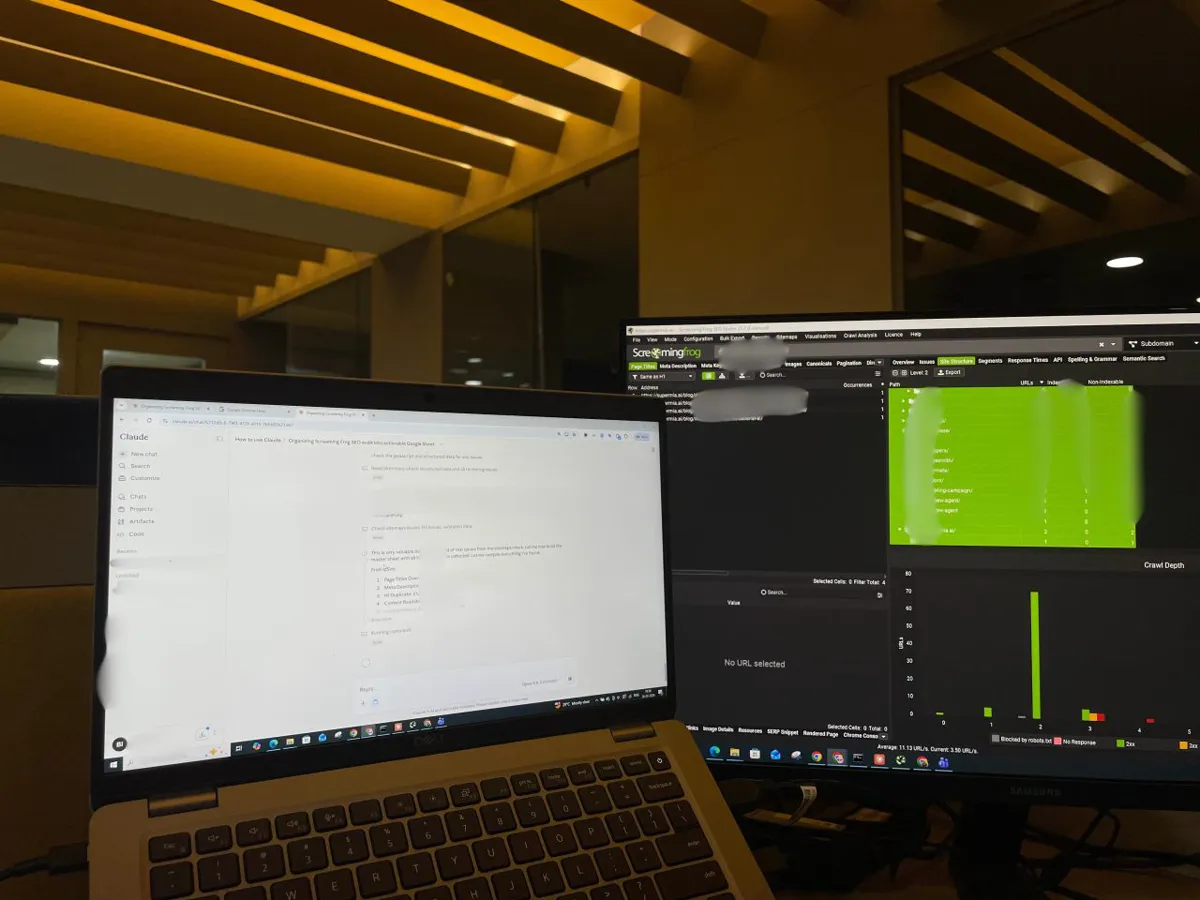
Keyword research with Claude works when Claude reads real data: Search Console for what you rank for, a keyword tool such as Ahrefs, Semrush or DataForSEO for volume and competitors, and GA4 for what converts. Claude then maps keywords to pages, groups them by intent and flags cannibalisation. It must never estimate search volumes itself.
TL;DR
Claude is the analyst, not the database. It has no live search volumes. Connect Search Console, a keyword tool (Ahrefs, Semrush or DataForSEO) and GA4, or upload their exports.
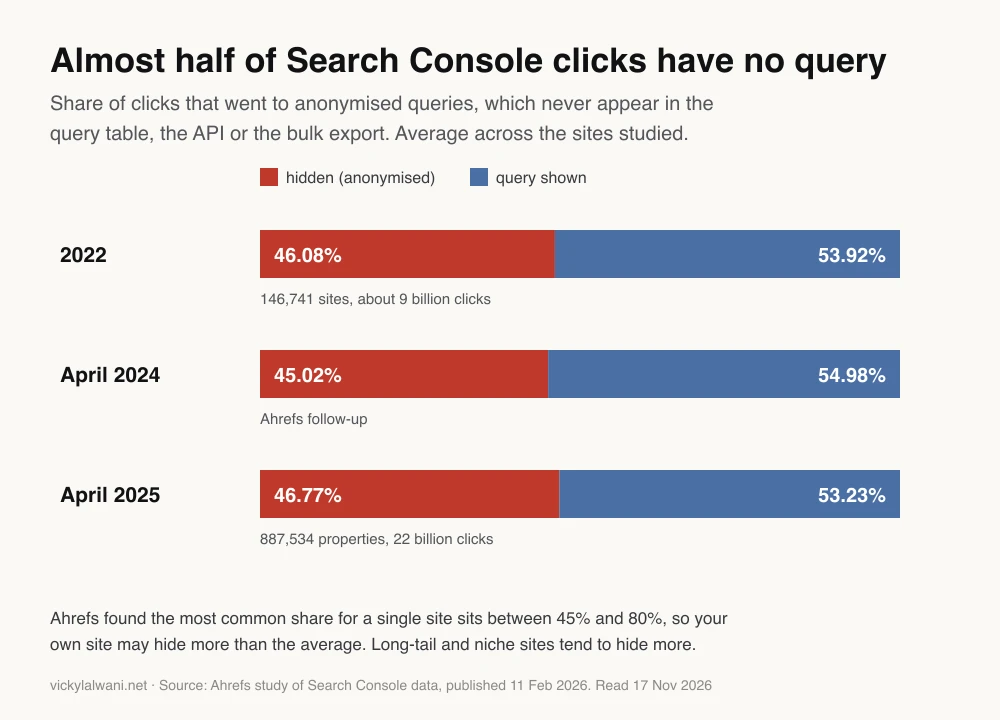
Know what Search Console hides. In an Ahrefs study of 887,534 properties, 46.77% of clicks went to anonymised queries that never appear in the query table.
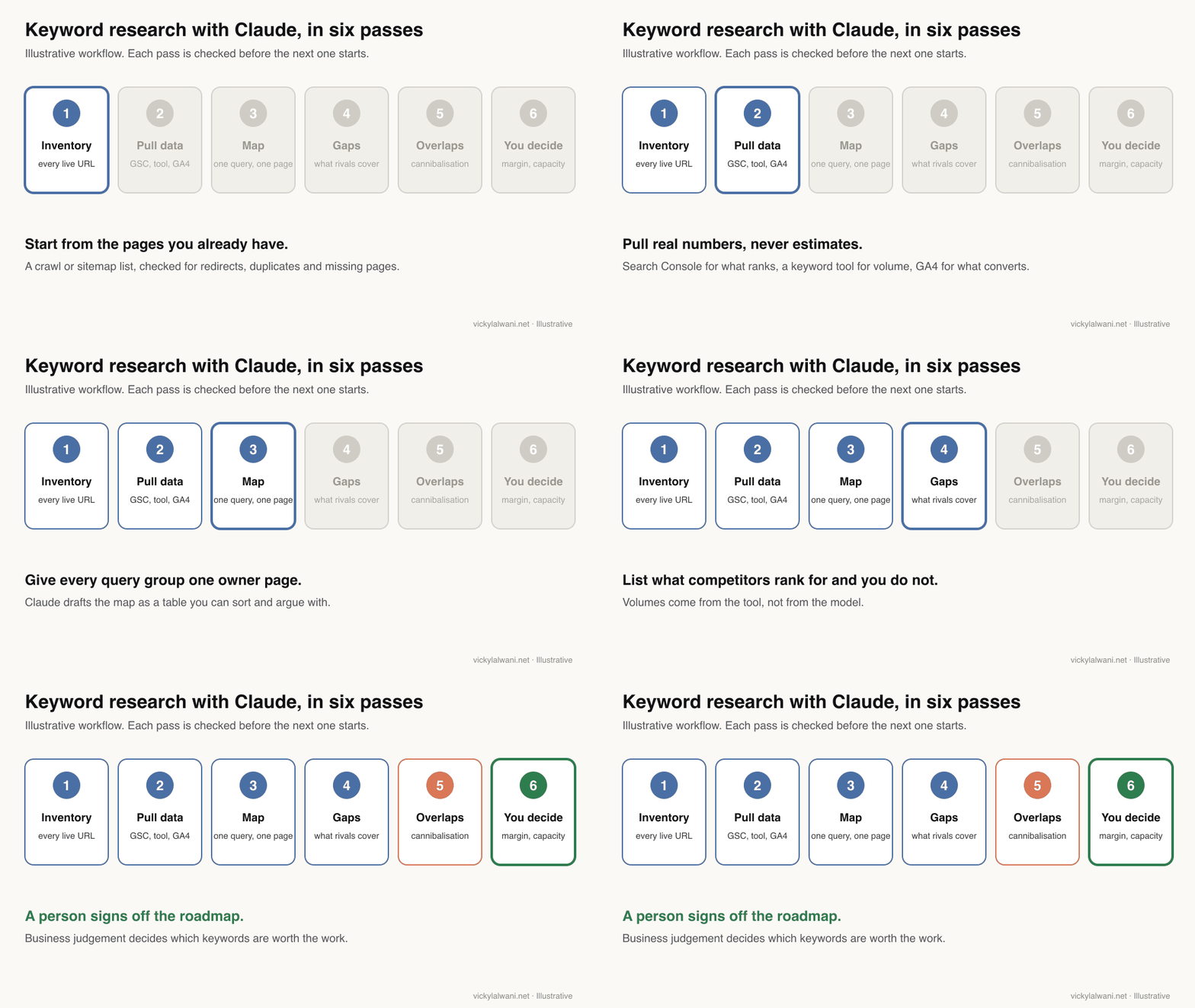
The workflow: page inventory, real data, a keyword-to-page map, competitor gaps, a cannibalisation check, then a person decides what is worth doing.
The rule: any volume, difficulty or ranking the model did not get from a tool is left blank.
You ask Claude for keyword ideas for a service page and get forty plausible phrases with neat monthly volumes. Some are real. Some nobody searches. The volumes are guesses dressed as data, and nothing in the answer tells you which is which.
Keyword research with Claude works the other way round: the data comes from tools, and Claude does the sorting, mapping and arguing. This guide shows the connections, the prompts and the checks. If you would rather have the research done and turned into a plan for your site, that is what my SEO consultant service does.
Can Claude do keyword research on its own?
Short answer: Not reliably. Claude has no live search volume, difficulty or ranking data, so any number it gives without a connected tool or an uploaded export is an estimate. It is very good at the work after the data: grouping, mapping to pages and spotting overlaps.
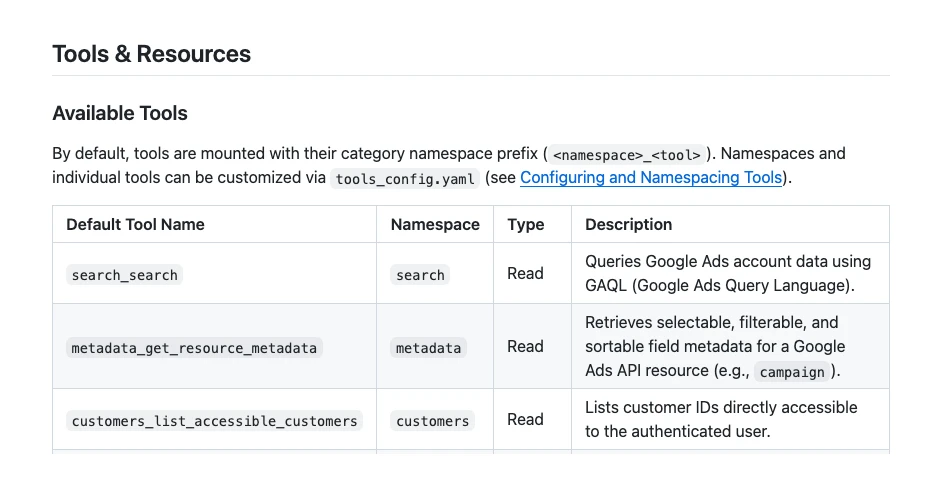
Even Google's own connector does not fill the gap. The official Google Ads MCP server reads your account with GAQL, Google's query language for ad data, and as of version 0.0.6 (2 November 2026) it has no Keyword Planner tool. Search volumes from Google come through the Keyword Planner idea service in the Google Ads API or Keyword Planner itself.
Keyword Planner has its own catch. Since 2016, accounts with low ad spend have seen volume ranges such as 1K to 10K rather than exact figures, as Search Engine Land reported at the time. Google's Keyword Planner help also warns that forecasts can look lower than the traffic you actually get. Treat Planner numbers as a guide, not a census.
So the first instruction in any keyword project is the same: no number without a source.
Project brief for keyword research. Keep it in this project and read it before every task.

Site: [domain]   Market: [country and language]   Goal: [enquiries, sales, sign-ups]
What we sell, in customers' words: [services or products]
What we will not do or cannot serve: [exclusions, areas, budgets]
Competitors to compare: [3 to 5 domains that actually win our customers]
Pages that matter most commercially: [URLs]

Rules
- Never estimate search volume, difficulty, CPC or rankings. If a connected tool or a file I uploaded did not provide a number, leave the cell blank and say so.
- Say which source and date range every number came from.
- Output tables I can paste into a sheet, one row per keyword or page.
Which data sources does Claude need for keyword research?
Short answer: Three cover most of it: Search Console for what you already rank for, a keyword tool for volume and competitors, and GA4 for what converts. Add a page inventory from a crawl or sitemap so every keyword can be mapped to a real URL.
| Source | Answers | Route into Claude | Watch out for |
|---|---|---|---|
| Search Console | What you rank for now | MCP server or export | Hidden and capped rows |
| Ahrefs or Semrush | Volume, difficulty, rivals | Official MCP connector | API units per call |
| DataForSEO | Raw SERP and volume data | MCP server, pay per call | Cost of big pulls |
| Keyword Planner | Google's own volumes | CSV export | Ranges on low spend |
| GA4 | Which pages convert | MCP server or export | Key events set up? |
| Crawl or sitemap | Which pages exist | Crawler MCP or file | Redirects, duplicates |
Ahrefs needs a paid plan from Lite and spends API units for every call Claude makes. Semrush includes 50,000 API units on four of its plans. DataForSEO charges per request. For how each server connects and what it costs, see MCP servers for SEO, which covers the setup in detail.
You do not need connectors to start. Exports work: Claude can read CSV files and, with code execution switched on, create spreadsheets from them on every plan. Connectors save the export step and keep the data current.
What does Search Console hide from keyword research?
Short answer: A lot. Anonymised queries, searches made by too few people to show, are never listed, and in the largest study available they carried 46.77% of clicks. Search Console also stores and shows only the most important rows, so the long tail is cut.
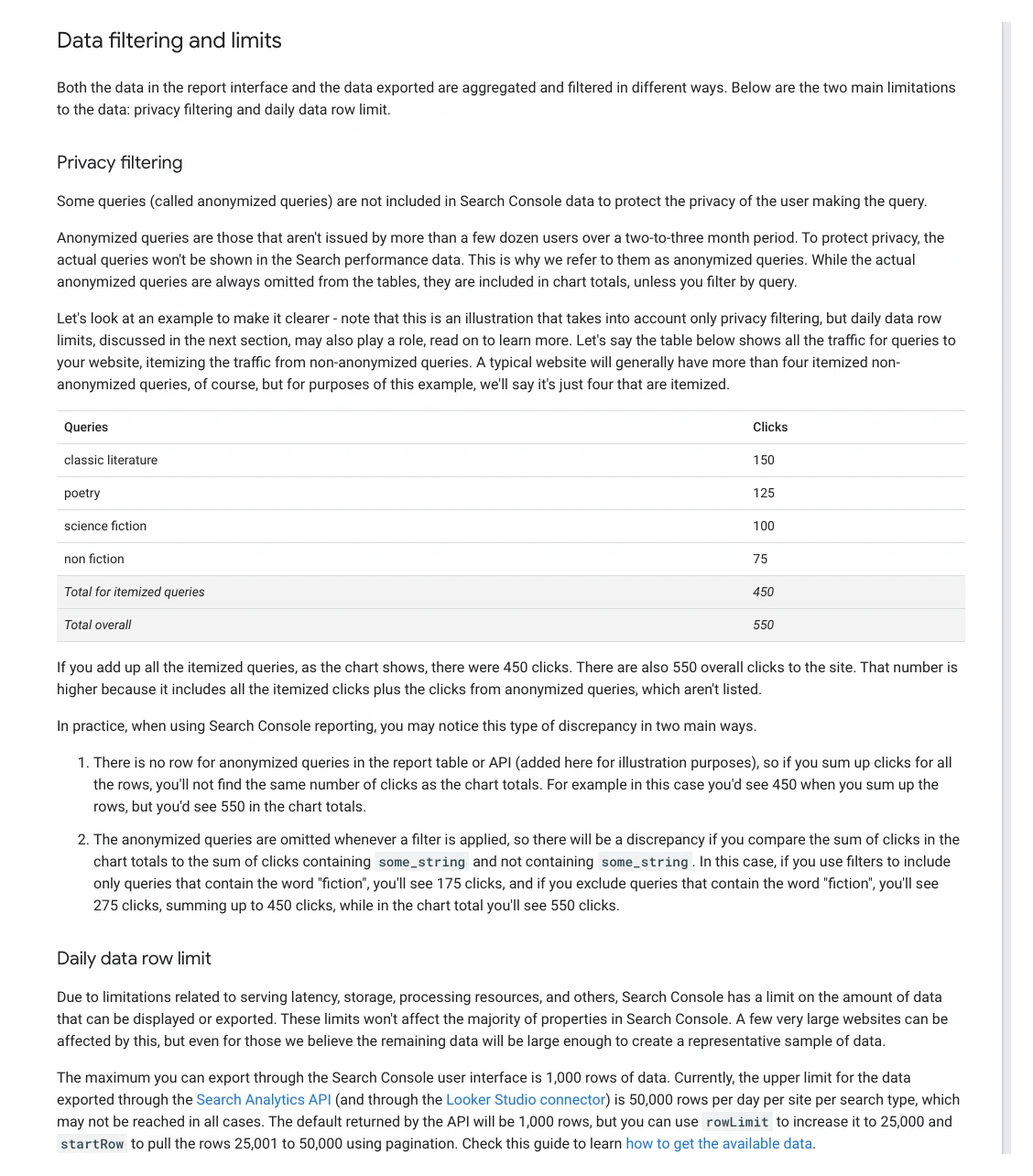
Google defines anonymised queries as those not issued by more than a few dozen users over two to three months. They count in the chart totals but never appear as rows, which is why the query table never adds up to the total. Google explains the maths here.
| Route | Rows you get | Anonymised queries |
|---|---|---|
| Screen export | 1,000 | Not included |
| API, default call | 1,000 | Not included |
| API, rowLimit raised | 25,000 per call | Not included |
| API or Looker Studio, daily | About 50,000 per site and type | Not included |
| Bulk export to BigQuery | No daily row limit | Not included |
The current Search Console help page adds that the report stores and shows only the most important rows, and points to the bulk export for the fullest list. Its branded query filter, introduced in March 2025, helps separate brand searches before you plan content.
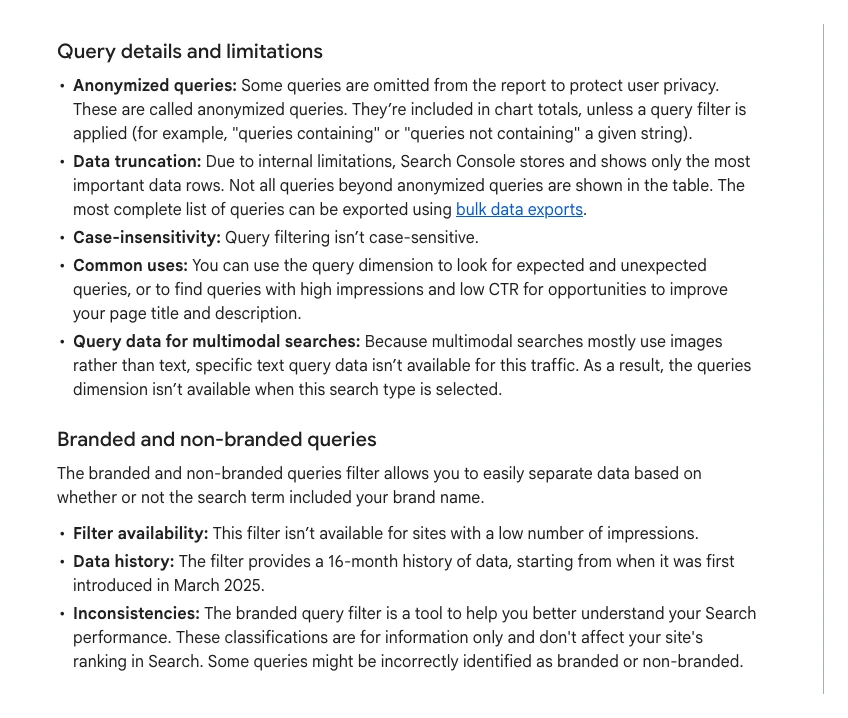
What this means for Claude: Search Console tells you which topics you already have a foothold in. It cannot tell you the whole demand. That is the keyword tool's job, and Claude should say which source each row came from.
How do you map keywords to pages with Claude?
Short answer: Give every group of related queries one owner page, chosen by search intent. Ask Claude to group Search Console queries into topics, label each topic's intent, name the page that earns its clicks now, and flag where the page type does not match.
Start with a page inventory. Ask for the list of live URLs from a crawl or the sitemap, and check it for redirects, duplicates and missing pages before anything else. A map built on a wrong page list is wrong everywhere.
Then map. Ask for the row limit explicitly, because a default API call stops at 1,000 rows.
Using Search Console (last 3 months, row limit 25,000) and the page inventory:

1. Group queries into topics. For each topic, list the queries, total clicks and impressions, and the page that earns most of the clicks.
2. Mark the search intent of each topic: know (wants information), do (wants to act or buy), website (wants a specific site) or visit (wants a place nearby).
3. Propose one owner page per topic. If no page fits the intent, say "new page needed" and suggest the page type.
4. Flag any topic where the owner page type does not match the intent, for example a blog post owning a "do" topic.

Table columns: topic, intent, queries, clicks, impressions, current page, proposed owner page, note.
Keep the result as a sheet, not a chat answer. The sheet is what you argue with, sort and hand to whoever writes the pages. For running this as a repeatable folder-based project, see the Claude Code SEO workflow.
How should Claude group keywords by search intent?
Short answer: Use Google's own vocabulary. Google's Search Quality Rater Guidelines sort queries into know, do, website and visit-in-person intent. Each maps to a page type, and a mismatch is the most common reason a page ranks badly for a keyword it targets.
| Intent | Searcher wants | Usual page type |
|---|---|---|
| Know | Information or an answer | Guide, explainer, FAQ |
| Do | To act, compare or buy | Service, product, pricing |
| Website | A specific site or page | Home, login, brand page |
| Visit in person | A place nearby | Location page, profile |
The guidelines (the version served on 18 November 2026 is dated 11 September 2025) are written for human raters, not as a ranking manual. They are still the clearest public statement of how Google thinks about intent, and the categories are easy for Claude to apply consistently.
Check intent against the live results page for the biggest topics. If the top results are all guides, a service page will struggle, whatever the keyword says.
How do you find keyword gaps against competitors?
Short answer: Ask the keyword tool, through its MCP connector or an export, for keywords your competitors rank for and you do not. Claude filters out irrelevant terms, labels intent and suggests a page. Volumes and difficulty must come from the tool.
Using the keyword tool connection (not your own knowledge):

For each competitor in the brief, pull the keywords they rank for in positions 1 to 10 in [market] that we do not rank for in the top 20.
Keep only keywords that match what we sell. Remove brand names, jobs, free and DIY searches.
Return: keyword, monthly volume (from the tool), difficulty (from the tool), competitor URL, intent, suggested page (existing or new).
Cap the request at [500] rows per competitor and tell me the API units used.
Cap the rows. Unit costs rise with the amount of data requested, and a request for every keyword of five competitors can spend a month's allowance in one session.
Then cut hard. A gap list is a list of things competitors do, not a list of things you should do. Remove anything you cannot sell, cannot serve or cannot credibly rank for.
How do you find keyword cannibalisation with Claude?
Short answer: Ask Claude to list every query where two or more of your URLs get impressions in Search Console, then decide for each one which page should own it. The fix is usually to retitle, relink, merge or redirect, not to delete.
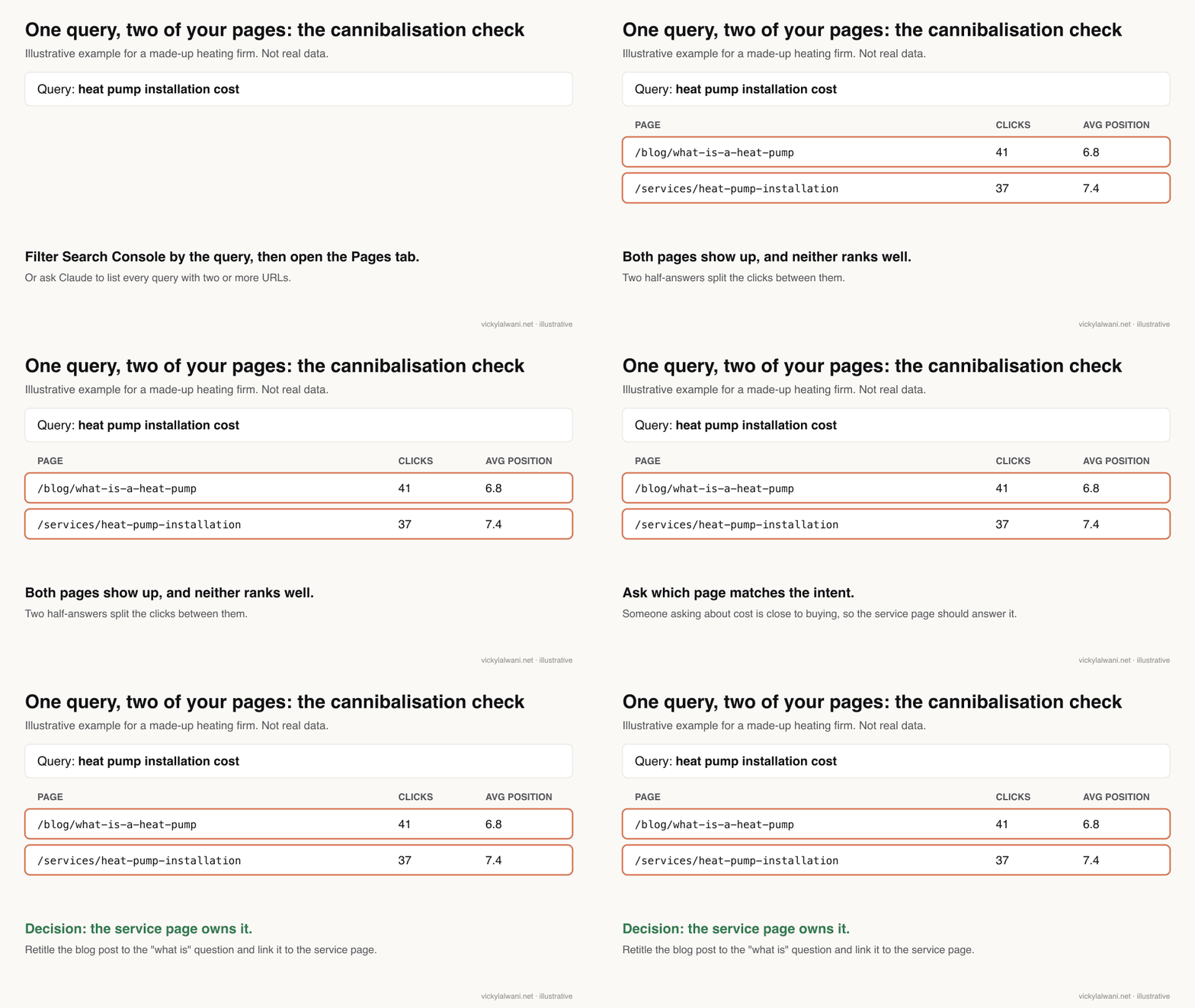
Cannibalisation check using Search Console only (last 3 months, query and page dimensions, row limit 25,000):

1. List every query where two or more of our URLs received impressions.
2. For each, show the URLs with clicks, impressions and average position.
3. Keep only queries with at least [100] impressions in total.
4. Suggest one action per query: merge, redirect, retitle, relink or leave alone, with one line of reasoning based on intent.

Do not suggest deleting pages. I will decide after checking each page myself.
| Action | When | Result |
|---|---|---|
| Retitle | Pages serve different intents | Each page targets its own query |
| Relink | Owner page is right but weak | Internal links point to owner |
| Merge | Two thin pages, same intent | One stronger page |
| Redirect | Old page adds nothing | Signals move to the owner |
| Leave alone | Both rank well, both convert | No change needed |
Not every overlap is a problem. Two pages showing for a broad query is normal. It becomes cannibalisation when the pages split clicks and neither ranks well. When you merge or redirect, Google's guide to consolidating duplicate URLs explains how redirects and canonical tags pass signals to the page you keep.
Semrush's own video on doing this with Claude Code is embedded below, if you want to watch the flow end to end.
How do you check Claude's keyword research before using it?
Short answer: Spot-check a sample of rows against the source tools, confirm every volume came from a tool, read the intent labels sceptically, and have a person decide priorities using margin and capacity. The model cannot know which customers you want.
| Check | How | Red flag |
|---|---|---|
| Volumes | Pick 10 rows, open the tool | Round numbers, no source |
| Rankings | Compare with Search Console | Positions that do not exist |
| Intent | Look at the live results | Guides ranking for "do" topics |
| Quick wins | Could you credibly rank? | Huge brands on page one |
| Mapping | Open each owner page | Page does not answer it |
| Business fit | Margin, capacity, area | Keywords you cannot serve |
My own rule, from client work: findings go into a sheet, I check them by hand, and nothing changes on the site before approval. Content is planned only around keywords people actually search, and a number only reaches a client once someone has seen it in the tool.
Be careful with the word "quick win". A low-difficulty keyword is only quick if your site already has authority on the topic. Ask Claude to explain each quick win in one line, then decide yourself.
Should you use Claude chat, a Project or Claude Code for keyword research?
Short answer: Use a Claude Project for one-off research with connectors and a saved brief, and Claude Code when you want repeatable runs, scripts and files on disk. Plain chat is fine for clustering an export you paste in.
| Surface | Best for | Limit |
|---|---|---|
| Chat with connectors | Quick questions, one site | No memory of the brief |
| Project | Saved brief, files, repeat work | Manual each time |
| Claude Code | Scripts, big exports, monthly runs | More setup |
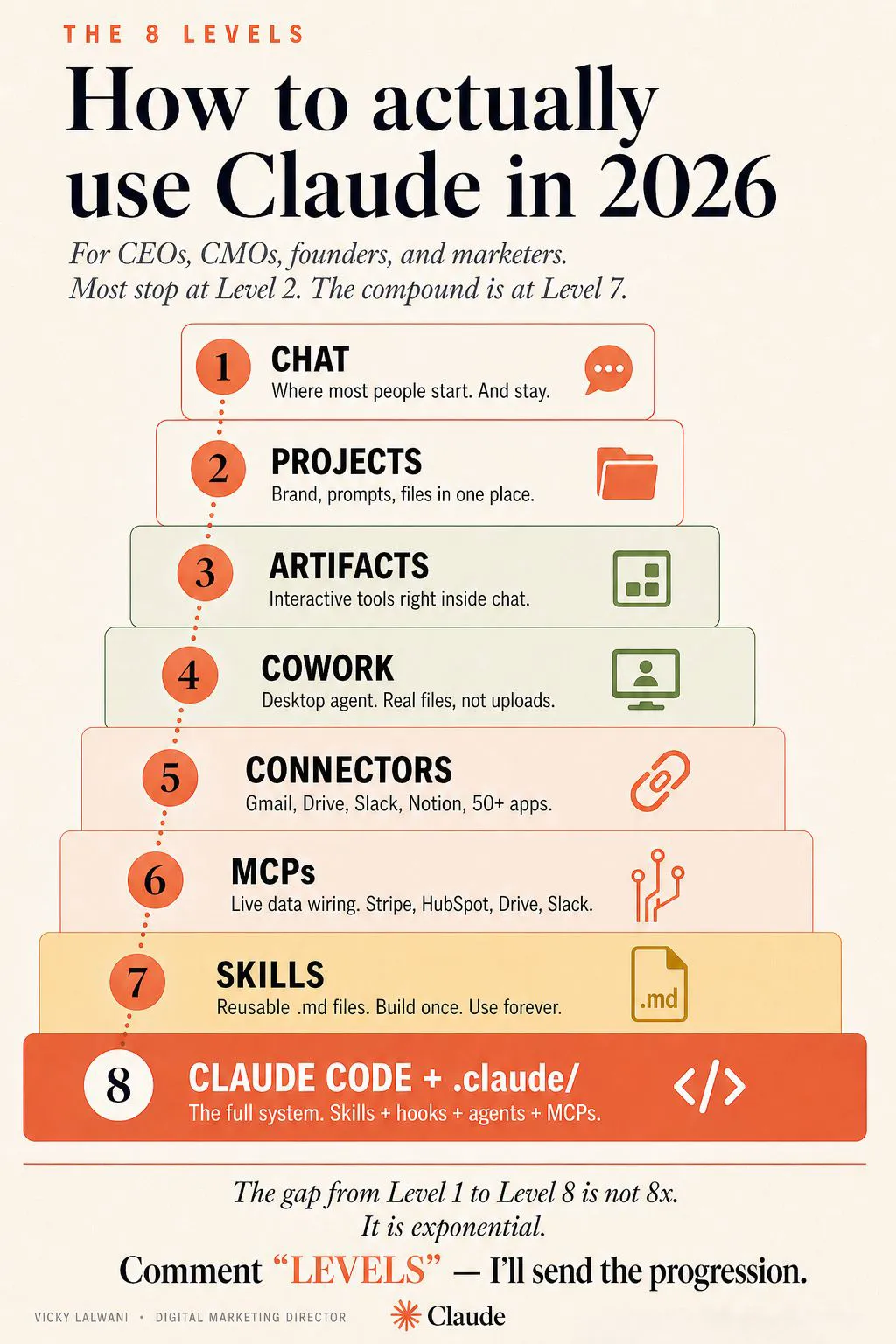
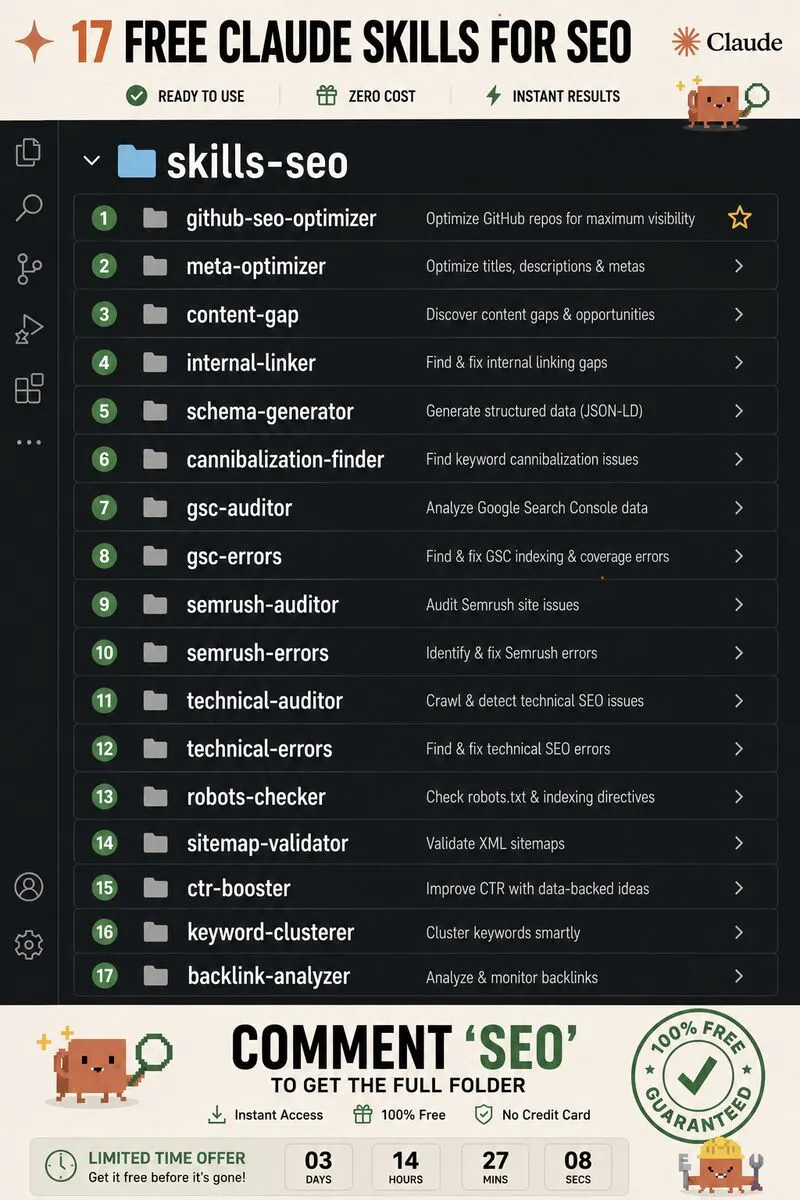
Whichever you pick, keep the brief and the rules in one place so every session starts from the same instructions. Claude skills for SEO shows how to save those as reusable skills, and the SEO tool stack guide covers which paid tools are worth keeping alongside.
What people say on X and Reddit
Short answer: Practitioners like Claude for clustering, mapping and cannibalisation checks on Search Console data. The repeated complaint is invented numbers when no tool is connected, and the repeated advice is to load real data and business context first.
| Post | Type | Date | What it says |
|---|---|---|---|
| A developer shares a Search Console plugin | First-hand (builder) | 11 Feb 2026 | Claude Code reads the Search Console API for CTR gaps, cannibalisation and striking-distance queries. |
| An SEO on X lists Search Console skills | First-hand | 19 Aug 2026 | A set of Claude skills built on Search Console data, led by a cannibalisation finder and query clustering. |
| An AI commentary account on clustering | Opinion | 25 Feb 2026 | Suggests exporting long-tail keywords and having Claude cluster them by intent and topic before building pages. |
| A blogger on why Claude gets SEO wrong | Opinion | 18 Oct 2026 | Blames vague prompts and missing business context for poor SEO answers, and lists fixes. |
| Thread | Community | Date | What people report |
|---|---|---|---|
| How are you using Claude for SEO? | r/SEO | 13 Jun 2026 | Clustering, briefs and topical maps lead. Replies press on whether "researching volume" means a real API, and note Keyword Planner API access takes weeks. |
| MCP server for keyword research? | r/PPC | 29 May 2026 | Keyword ideas come from the Ads API, so the bottleneck is access, not MCP. Planner stays the source of truth; AI clusters and labels intent. |
| Biggest challenges with AI agents for SEO | r/SEO | 28 Oct 2026 | Generic suggestions that ignore business context. Replies say SEOs use AI to speed up tasks, not to run strategy or write content. |
| What SEOs use MCP for | r/SEO | 1 May 2026 | Semrush MCP for content research and briefs; others track keywords through a connected tool rather than asking the model. |
Across these threads, Claude is trusted for clustering, intent labels and briefs, and distrusted for numbers. When someone mentions volumes, the first reply usually asks where they came from. Practitioners keep Keyword Planner or a paid tool as the source of truth and use the model to organise it.
Videos worth watching
Short answer: Watch Google's own walkthrough of Search Console performance data first, then Semrush's cannibalisation workflow in Claude Code. Together they cover the data and the method.
Google Search Central, 4 December 2025, about 10 minutes. How to read the Performance report, including queries and pages. Official and sells nothing.
Semrush, 8 September 2026, about 46 minutes. A full cannibalisation workflow using Claude Code and the Semrush MCP server. It sells Semrush; the method works with Search Console data too.
| Video | Channel | Date | What it covers |
|---|---|---|---|
| Analyzing performance on Google Search | Google Search Central (official) | 4 Dec 2025 | Reading query and page data |
| Keyword cannibalisation with Claude Code | Semrush (official) | 8 Sep 2026 | Finding and fixing overlaps |
| Claude Code + DataForSEO | FuturMinds (AI tutorials) | 11 Jun 2026 | Live keyword data in Claude Code |
| Keyword research in Claude Code | A content marketer's channel | 24 Mar 2026 | A full research session |
| Connect Keyword Planner to Claude | Smacient (agency) | 9 Apr 2026 | Planner data into Claude |
Where this advice is weak
Short answer: The anonymised-query figures are averages from one vendor's study, Keyword Planner's range rules are not published by Google, and keyword tools disagree with each other on volume. Treat every number as an estimate with a known source.
- Ahrefs found the most common anonymised share for a single site sits between 45% and 80%, so your site may differ a lot from the average.
- Keyword tool volumes are modelled and often differ between Ahrefs, Semrush and Keyword Planner. Pick one source per project and stay consistent.
- AI answers and AI Overviews change how many clicks a ranking earns. Volume alone no longer predicts traffic.
- None of this replaces knowing the business. A keyword that brings the wrong customers is not a win.
Want the keyword research done for you?
Short answer: If you want a keyword-to-page map, a gap list and a cannibalisation plan built from your own data, my SEO consultant service does exactly that. Prices are on the pricing page.
If you want to set up the connections yourself first, start with MCP servers for SEO.
Sources
| Source | What it supports | Date | Link |
|---|---|---|---|
| Ahrefs study | Anonymised share of clicks | 11 Feb 2026 | Anonymised queries study |
| Search Central blog | Anonymised queries, row limits | 19 Oct 2022 | Performance data deep dive |
| Search Console Help | Truncation, branded filter | Read 17 Nov 2026 | Performance report dimensions |
| Search Central blog | Bulk export | 21 Feb 2023 | Bulk data export |
| Google for Developers | rowLimit up to 25,000 | Read 17 Nov 2026 | Search Analytics query |
| GitHub (Google Ads) | MCP tools, no Keyword Planner | v0.0.6, 2 Nov 2026 | google-ads-mcp |
| Google Ads API docs | Keyword ideas service | Read 18 Nov 2026 | Generate keyword ideas |
| Google Ads Help | Planner forecasts caveat | Read 18 Nov 2026 | Keyword Planner forecasts |
| Search Engine Land | Planner ranges on low spend | 2016 | Planner data throttled |
| Ahrefs docs | Lite plan, API units | Read 17 Nov 2026 | Ahrefs MCP |
| Semrush developer docs | 50,000 units, plans | Read 17 Nov 2026 | Semrush MCP |
| GitHub (DataForSEO) | Official MCP server | Read 17 Nov 2026 | mcp-server-typescript |
| Google rater guidelines | Know, do, website, visit intent | 11 Sep 2025 | General Guidelines PDF |
| Google Search Central | Redirects and canonicals | Read 18 Nov 2026 | Consolidate duplicate URLs |
| Claude Help Center | File creation on all plans | Read 17 Nov 2026 | Create and edit files |
| X and Reddit | Practitioner views | Feb to Nov 2026 | Linked in the tables above |
This article expands on my post on LinkedIn ↗.
FAQ
Can Claude do keyword research?
Yes, if it reads real data. Claude has no live search volumes, so connect Search Console, a keyword tool such as Ahrefs, Semrush or DataForSEO, and GA4, or upload their exports. Claude then groups, maps and checks the keywords.
Does Claude know search volumes?
No. Claude does not have live search volume, difficulty or ranking data, so any figure it gives without a connected tool is an estimate. Tell it to leave the cell blank when no tool returned a number.
What data sources does Claude need for keyword research?
Search Console for what you already rank for, a keyword tool for volume and competitor data, and GA4 for what converts. A page list from a crawl or sitemap lets Claude map every keyword to a real URL.
Why does Search Console not show all my keywords?
Search Console hides anonymised queries, searches made by too few people, and stores only the most important rows. An Ahrefs study found 46.77% of clicks in April 2025 went to anonymised queries that never appear in the query table.
Can the Google Ads MCP server get Keyword Planner data?
Not as of version 0.0.6 on 2 November 2026. The official Google Ads MCP server queries account data with GAQL and has no Keyword Planner tool, so volumes come from Keyword Planner, the Ads API idea service or a keyword tool.
How do I find keyword cannibalisation with Claude?
Ask Claude to list every Search Console query where two or more of your URLs get impressions, with clicks and position for each. Then choose one owner page per query and retitle, relink, merge or redirect the others.
How should Claude group keywords by intent?
Use Google's rater guideline categories: know, do, website and visit-in-person. Map each to a page type, such as guides for know queries and service or product pages for do queries, and check the live results for the biggest topics.
Is the Semrush or Ahrefs MCP better for keyword research with Claude?
Both supply volume, difficulty and competitor data through official connectors and both charge API units per call. Use the one you already pay for and keep one source per project, because their volume estimates differ.
Can AI replace keyword research tools?
No. AI uses the tools. The keyword tool supplies the data, and Claude connects it to your pages, groups it by intent and drafts the plan, which a person then checks.