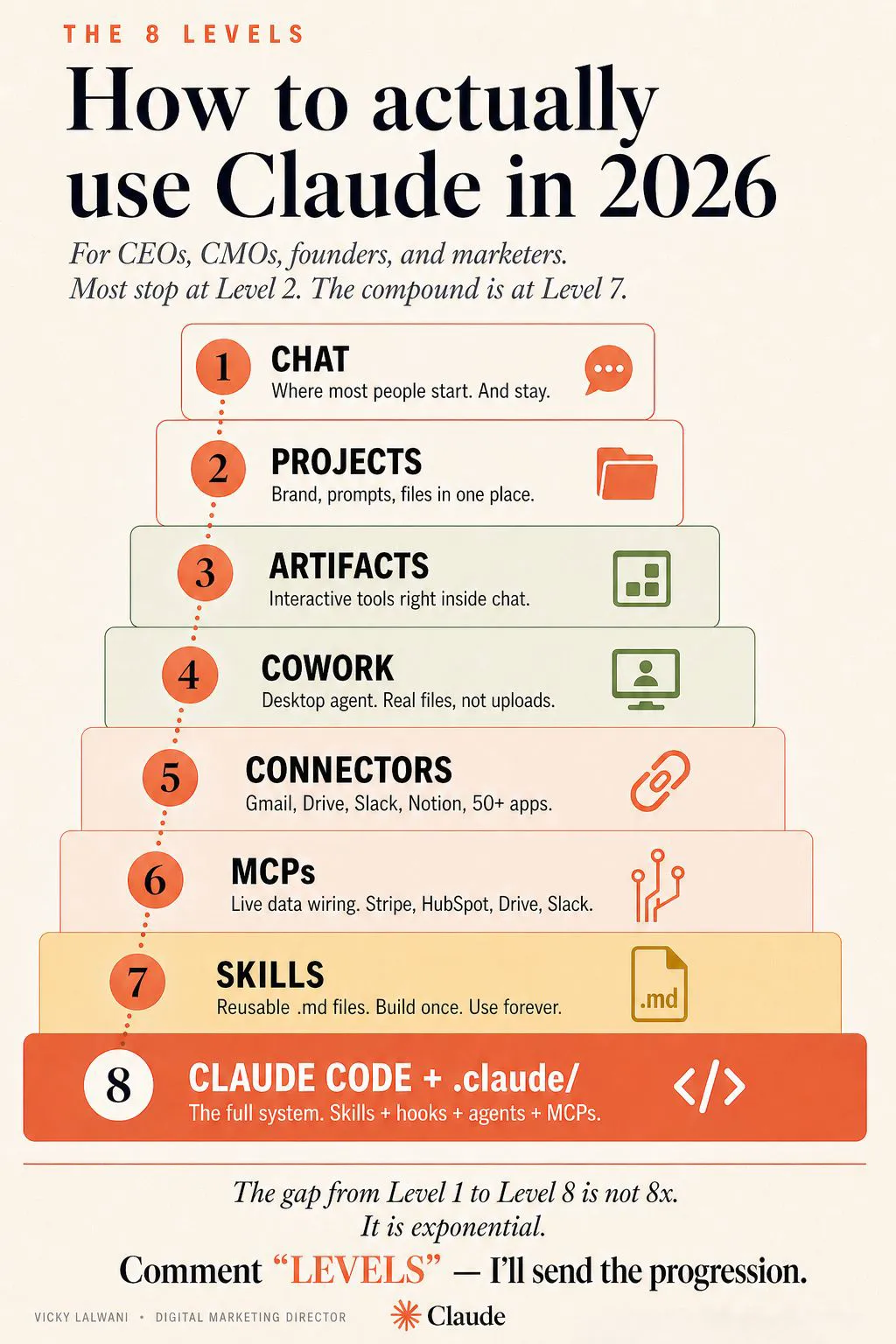
A Claude adoption framework pairs eight levels of individual use, from chat to scheduled tasks, with five team phases: prepare, pilot, team rollout, connect and schedule, then scale. Each phase ends with an exit test. Start with two or three repeatable SEO or PPC jobs, train everyone to build one skill, and keep a person approving anything that spends money.
TL;DR
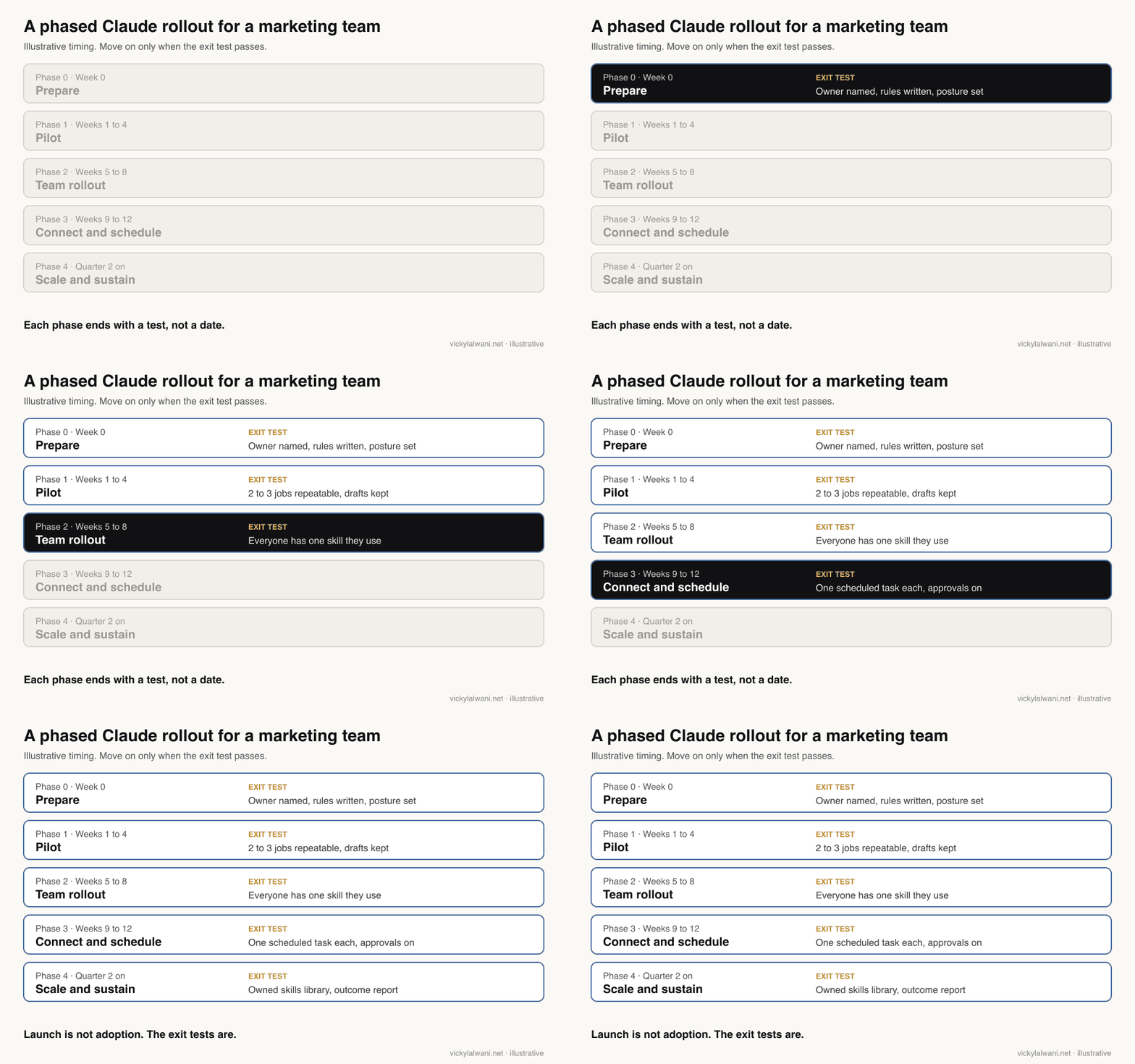
A Claude adoption framework has two halves. The eight levels describe what one person does with Claude, from chat to scheduled work. The five phases describe how a marketing team gets there: prepare, pilot, team rollout, connect and schedule, then scale.
Anthropic's own rollout guides use the same shape: a small pilot with champions, success measures set before launch, hands-on training, and features switched on in stages. Its suggested target for a healthy rollout is 70% of seats active each week.
Each phase ends with an exit test, not a date. Move on when the test passes, and keep a person approving anything that spends money or changes a live page.
Short answer: roll Claude out to a marketing team in five phases over about a quarter. Set rules and an owner first, pilot two or three repeatable SEO or PPC jobs with a few champions, train everyone to build one skill, then add read-only data connections and one scheduled task each. Measure weekly use first and business outcomes later.
You bought Claude seats for the marketing team in September. By November, two people use it every day, a few opened it twice, and nobody can say whether it is working. That is the most common shape of a stalled rollout, and Anthropic's own scaling guide names the cause in its list of pitfalls: launch is not enablement.
This page is the rollout plan: who owns what, what happens in each phase, what to train, what to govern and what to measure. If you would rather have it designed and run with your team, that is what my Claude consulting service does.
Three companion articles cover ground this one does not repeat. For which features exist and which plan to buy, read Claude features for marketing leaders. For the building blocks and a 30-day starter pilot, read Claude for marketing teams. If your team is coming from ChatGPT, start with how to switch from ChatGPT to Claude. Product facts below were checked on 18 November 2026.
What is a Claude adoption framework?
Short answer: a Claude adoption framework is a plan for moving a team from occasional chats to shared, repeatable work. It has two parts: levels of use for each person, and rollout phases for the team, each with an owner and an exit test.
The levels answer "where is this person now, and what is their next step?" The phases answer "what does the team do this month, and how do we know it is time to move on?" You need both. Levels without phases leave everyone climbing alone. Phases without levels turn into a launch email and a training session nobody applies.
Anthropic publishes two playbooks that shape this framework. Its Claude Enterprise administrator guide sets out four phases: technical setup, change management and launch, enablement and training, and scaling adoption. Its guide to scaling workflows across an organisation adds a pilot, an expansion and a "scale and monitor" phase, each with exit criteria.
| Part | Question it answers | Owned by |
|---|---|---|
| Eight levels | What can this person do next? | Each person |
| Five phases | What does the team do now? | Rollout owner |
| Exit tests | Are we ready to move on? | Owner and champions |
| Governance | What needs approval? | Plan owner |
| Measures | Is it paying off? | Marketing lead |
Both Anthropic guides are written for large companies with IT teams. A marketing team of five to fifty people needs the same logic at a smaller scale, which is what the rest of this page does.
What are the eight levels of Claude use in 2027?
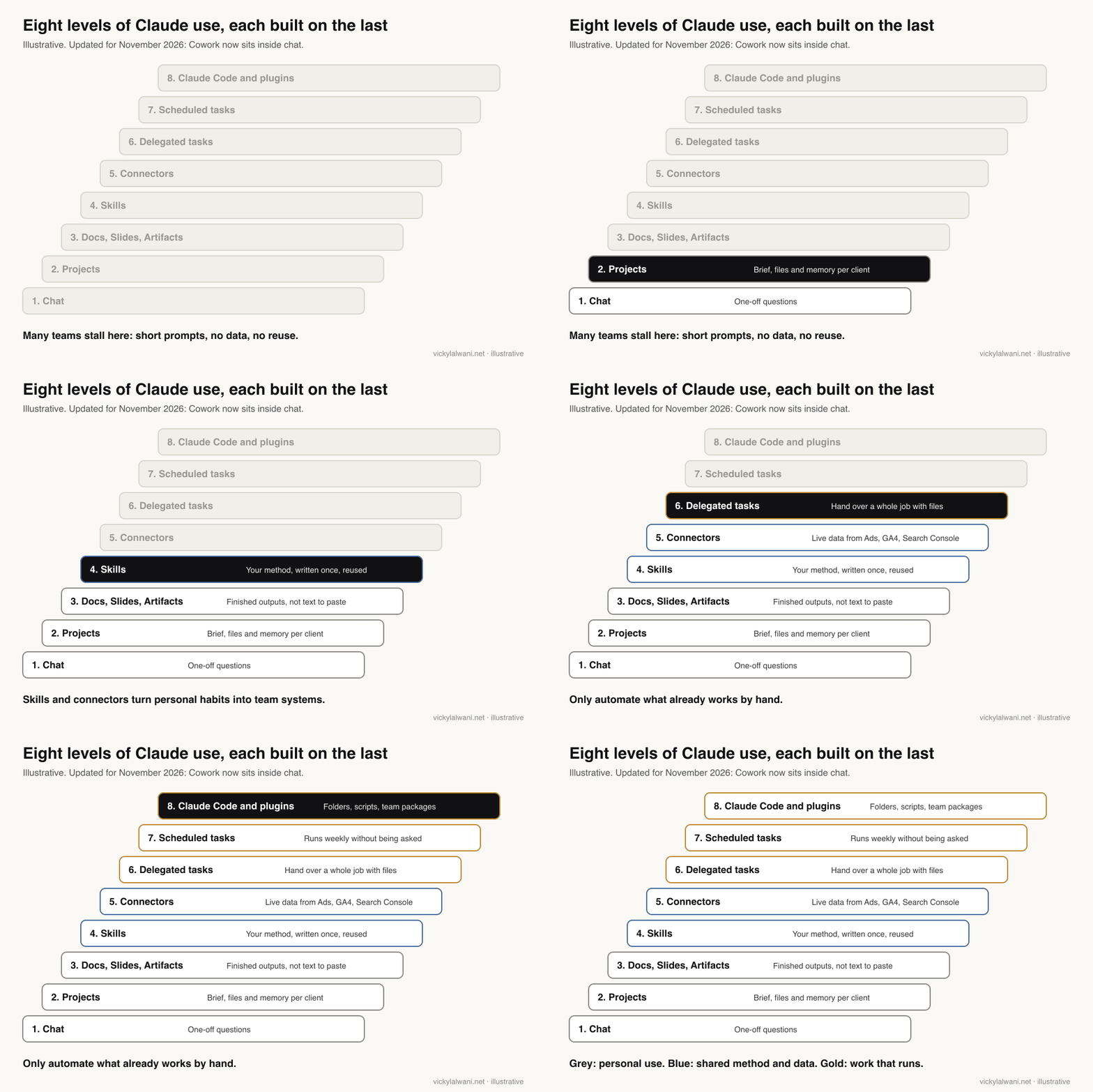
Short answer: chat, Projects, finished outputs (Docs, Slides and Artifacts), skills, connectors, delegated tasks, scheduled tasks, and Claude Code with plugins. Each level builds on the one below, so a team that skips Projects and skills tends to automate a mess.
| Level | What it adds | Marketing example |
|---|---|---|
| 1. Chat | Answers on demand | Rewrite an ad headline |
| 2. Projects | Shared brief and files | One Project per client |
| 3. Docs, Slides, Artifacts | Finished outputs | A client report deck |
| 4. Skills | Your method, reused | Search terms review |
| 5. Connectors | Live data | Search Console, GA4, Ads |
| 6. Delegated tasks | Whole jobs with files | Audit a folder of exports |
| 7. Scheduled tasks | Runs on a timer | Monday performance digest |
| 8. Claude Code, plugins | Folders and packages | A team SEO toolkit |
Three things changed since the first version of this ladder. Cowork is no longer a separate place: Anthropic merged Cowork and chat into one Claude on 16 September 2026, generally available on Team plans from 12 November. Connectors and MCP (Model Context Protocol, the standard most connectors use) are now one level. And skills moved earlier, because Anthropic's adoption roadmap finds skills and plugins come first in most pilots "because they're low-risk and high-reuse".
Scheduled tasks are now their own level. Claude's help centre says scheduled tasks run on all paid plans, hourly, daily, weekly or on demand, and run remotely even when your computer is asleep.
Most people stop low on the ladder. Anthropic calls it "the chat trap": users default to short prompts with no connectors. The fix is not more features. It is a curated first task per role and a demonstration of the same job done both ways.
Who should own a Claude rollout in a marketing team?
Short answer: one named rollout owner, one or two champions, and the person who approves anything that goes live. Anthropic suggests one champion per 25 to 50 users, mixing enthusiasts and sceptics, because "an all-enthusiastic pilot gives false positives".
| Role | Does | In a small team |
|---|---|---|
| Rollout owner | Plan, rules, measures | Marketing lead or ops |
| Plan owner | Seats, settings, connectors | Same person is fine |
| Champions | Build and demo skills | One or two people |
| Sceptic | Tests claims honestly | Your best reviewer |
| Approver | Says yes before go-live | Account or channel lead |
Anthropic is direct about accountability: when a champion publishes a skill or a scheduled task posts a digest, someone in your organisation owns that output and can explain, defend and fix it. A simple version from an r/ClaudeAI thread: whoever asked for the change owns it, not whoever or whatever typed it.
For client work, structure matters as much as roles. A simple convention works well: one Claude Project per client, chats named by service ("Google Ads", "SEO", "Website") and skills kept in one known place. It sounds basic. It stops one account's context leaking into another, because each Project keeps its own context, and it lets a colleague find last month's thread.
Phase 0: what do you set up before anyone starts?
Short answer: name the owner, choose the plan, write a one-page data rule, set how freely skills can be shared, and decide which connectors are allowed and at what access level. This takes about a week and saves months of untangling later.
| Decision | Sensible start | Why |
|---|---|---|
| Plan | Team, for shared setup | Admin, analytics, provisioning |
| Data rule | One page, plain words | What never goes in |
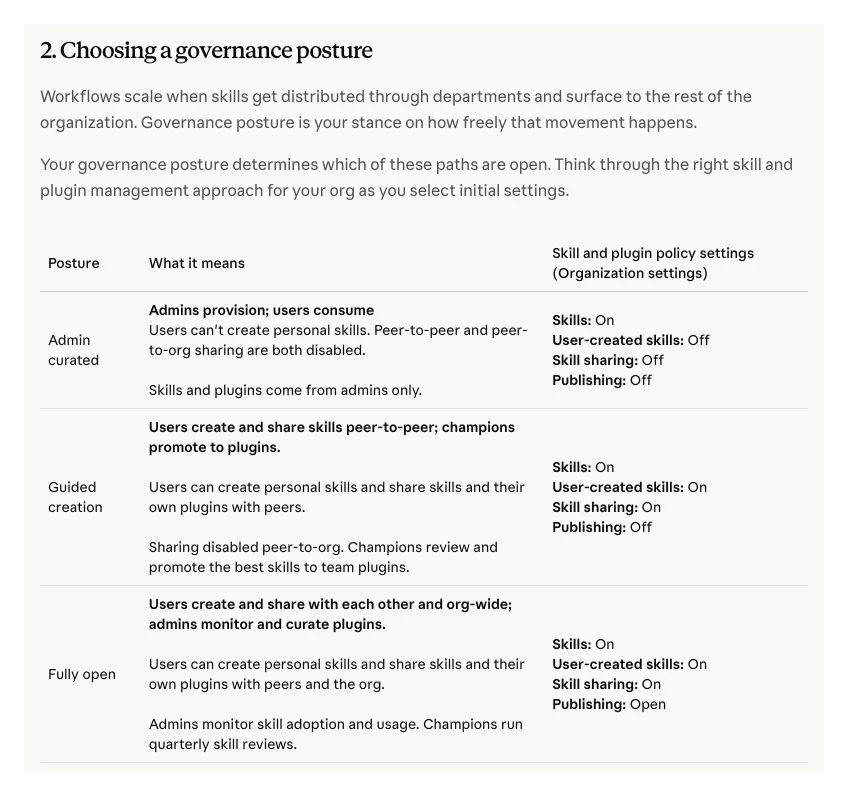
| Skill sharing | Guided creation | Peers share, owner promotes |
| Connectors | Read-only first | No accidental changes |
| Brand context | One brand file | Same voice in every Project |
| Approvals | Named per channel | Someone can say no |
Anthropic describes three "governance postures" for skills. Admin curated means only admins provide skills. Guided creation lets people create and share skills with colleagues while champions decide which ones reach everyone. Fully open lets anyone publish to the whole organisation. For most marketing teams, guided creation is the right start.
On Team and Enterprise plans, owners can also provision skills for the whole organisation, so a brand voice skill appears for everyone. Build that brand file before the pilot. My guides to an AI brand guidelines file and to training Claude on your voice cover how.
Phase 1: how do you run a Claude pilot?
Short answer: two or three champions run two or three real jobs for about four weeks. Pick work that repeats, follows a standard shape and gets reviewed before it ships. Measure time per job and how often the draft is kept without a heavy rewrite.
Anthropic's roadmap gives two pilot measures worth copying: cycle time on the job before and after, and "how often a user keeps Claude's draft without a meaningful rewrite". It also warns against piloting on novel or high-stakes work. In marketing terms, that rules out the big strategy deck and rules in the weekly grind.
| Good pilot job | Why it fits | Reviewed by |
|---|---|---|
| Search terms review | Weekly, same shape | PPC lead |
| Monthly report draft | Fixed template | Account lead |
| Content brief from Search Console | Repeatable inputs | SEO lead |
| Ad copy variants | Clear rules, fast check | Brand owner |
Keep a simple log. Every pilot run gets one row: the job, minutes taken, whether the draft was kept, and what went wrong. Paste this into the pilot Project so Claude keeps the log in the same shape each time.
You are helping us run a four-week Claude pilot for our marketing team.
After each task I describe, add one row to the pilot log table:
date | job | person | minutes taken | draft kept as is, light edit or rewritten | what went wrong | fix for next time
Rules:
- Never invent numbers. If I do not give the minutes, write "not recorded".
- At the end of each week, summarise: jobs run, share of drafts kept, top two problems.
- Flag any job where the draft was rewritten three times in a row.
The exit test, from Anthropic's scaling guide: weekly active use above 70% in the pilot group by week four, several repeatable use cases documented, and champions willing to teach. For a fuller four-week pilot plan, see Claude for marketing teams.
Phase 2: how do you roll Claude out to the whole team?
Short answer: run a short basics session, then a hands-on skills workshop where everyone builds one skill for their own work, then weekly office hours. Training should be on real tasks, and skills should be vetted by a champion before they reach the whole team.
| Session | Length | Leaves people with |
|---|---|---|
| Basics | 30 to 60 min | Projects, files, good prompts |
| Skills workshop | About 90 min | One working skill each |
| Office hours | 30 min weekly | Stuck tasks unblocked |
| Skill of the week | 5 min post | One idea to copy |
| Follow-up | 2 to 4 weeks later | Fixes from real use |
The session lengths for the basics session, office hours and follow-up come from Anthropic's administrator guide; the workshop length is my own estimate. Anthropic's guidance is that training should be "hands-on-keyboard when possible", and the skills workshop is the centrepiece: every attendee builds at least one skill for their actual work.
Skills then move through four steps Anthropic calls build, vet, promote and spread. One person builds a skill, a few colleagues test it, a champion promotes it to the team, and the library grows. Two habits help here. Share a short screen recording of each skill running on real work before people try it, then correct in person. And name skills by job: a skill written for sales offers, borrowed to write web pages, will make them read like adverts.
For the mechanics of writing skills, see Claude skills for Google Ads and Claude skills for SEO. For the shared instructions file a team can keep in a folder, see the CLAUDE.md file for marketing.
Phase 3: when do connectors and scheduled tasks come in?
Short answer: after skills are stable, usually from week nine. Connect Search Console, GA4 and Google Ads read-only first, then give each person one scheduled task, such as a Monday digest. Anything that spends money or changes a live page still waits for a named approver.
Anthropic's scaling guide has a phase it calls "habit": get everyone one scheduled task, so Claude's work is already waiting when people sit down. In marketing, the obvious first candidates are a weekly paid search digest, a Search Console movers list and a monthly report draft. The Claude morning briefing guide walks through one end to end, and Claude MCP connectors for marketing covers the connections.
| Task | Runs alone? | Why |
|---|---|---|
| Weekly performance digest | Yes | Read-only, reviewed later |
| Search Console movers list | Yes | Read-only |
| Proposed negative keywords | Drafts only | Approver uploads |
| Budget or bid changes | No | Spends money |
| Publishing page edits | No | Changes a live page |
Two settings matter. If a connector tool is set to "Always ask", a scheduled task that needs it will wait for your answer or finish without it, according to Claude's help centre. And data an agent pulls still needs a human check: a model can misread a tool, a date range or a location setting and return numbers that look plausible but are wrong. Spot-check every new connector's numbers against the platform itself before anyone relies on them. For which Google Ads changes are safe to hand over, read Google Ads automation with Claude.
This is also the phase where Claude starts to touch revenue, so it is the right time to bring in specialist help on the account itself: see Google Ads management and SEO consulting.
Phase 4: how do you scale Claude and keep it alive?
Short answer: give every shared skill and scheduled task a named owner, review the skills library every quarter, add Claude to new-hire onboarding, and introduce Claude Code or plugins only for the people who need folders and scripts. Then shift reporting from usage to outcomes.
Anthropic's guide describes steady state as every department having an owned plugin and an active champion, with new skills arriving faster from champions than from the central team. The habit it singles out is reassignment: every quarter, and whenever a champion moves on, ask who owns each plugin and each scheduled task now.
| Every quarter | Who | Output |
|---|---|---|
| Prune and merge skills | Champions | A smaller, better library |
| Check task owners | Rollout owner | No orphaned automations |
| Review connector access | Plan owner | Least access needed |
| Outcome report | Marketing lead | One page to leadership |
| Retrospective | Everyone | What to change next |
Claude Code belongs at the top of the ladder for a reason. It suits people who work across many files: technical SEO, bulk page edits, scripts for reports. The Claude Code SEO workflow shows what that looks like. Most of a marketing team will never need it, and that is fine.
How do you measure Claude adoption?
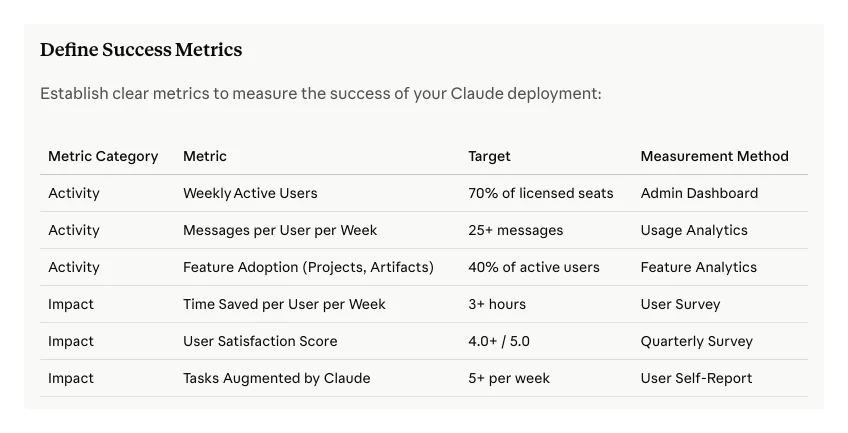
Short answer: start with activity, then move to outcomes. Anthropic's suggested targets are 70% of seats active weekly, 40% of active users on features such as Projects, and three or more hours saved per person per week. After the first quarter, report on marketing results instead.
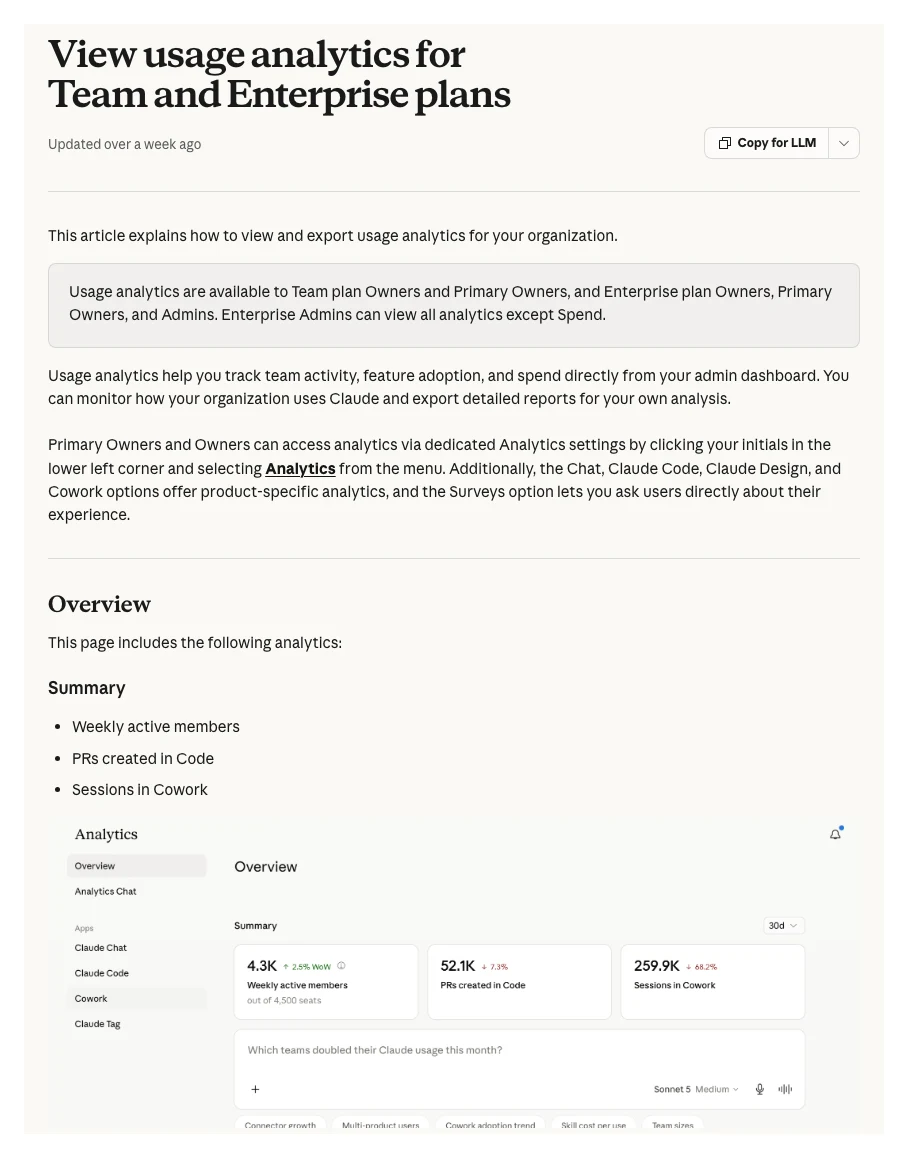
Team plan owners can see most of this without extra tools. Claude's help centre lists usage analytics for Team and Enterprise plans: weekly active members, adoption level, skills and connectors used, estimated time saved and spend, plus a surveys option. Analytics for individual members are only available to Enterprise organisations on usage-based billing.
Activity numbers are easy to game, so pair each with a marketing measure.
| Activity measure | Pair it with | Check |
|---|---|---|
| Weekly active seats | Jobs moved to skills | Monthly |
| Skills used | Drafts kept without rewrite | Monthly |
| Hours saved (survey) | Report turnaround time | Quarterly |
| Scheduled tasks running | Issues caught early | Quarterly |
| Connectors used | Cost per qualified lead | Quarterly |
What does good adoption look like after a year? The only public before-and-after figures I found are from Anthropic itself. In a survey of 132 of its engineers and researchers (published 2 December 2025), people said they used Claude in 28% of their daily work a year earlier and 59% in August 2025, with self-reported productivity gains rising from 20% to 50%.
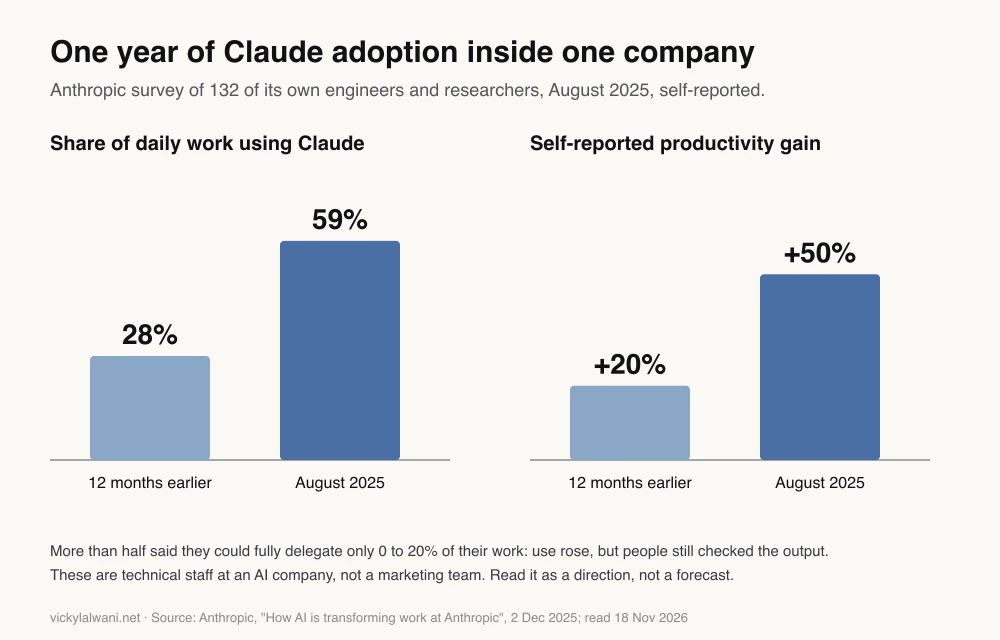
Read it carefully. These are technical staff at the company that makes Claude, the figures are self-reported, and more than half said they could fully delegate only 0 to 20% of their work. The useful lesson for a marketing team is the last one: use grew fast, but people kept checking the output.
What mistakes slow a Claude rollout?
Short answer: treating launch as enablement, leaving people at a blank chat box, opening everything on day one, having no owner for shared skills, and counting logins instead of outcomes. Each has a simple fix.
| Mistake | Sign | Fix |
|---|---|---|
| Launch as enablement | One email, then silence | Phases with exit tests |
| Blank first session | People try once, leave | Three starter tasks per role |
| Skipping levels | Automating messy prompts | Projects and skills first |
| Everything open | Duplicate, clashing skills | Guided creation |
| No owner | Stale skills, orphaned tasks | Quarterly reassignment |
| Unchecked output | Wrong numbers reach a client | Spot-check before sending |
| Counting logins | Busy dashboards, no results | Pair with outcome measures |
One more: rolling out to a team before the process exists. An AI workflow is worth adopting only once there is an agreed way of doing the job by hand. If your monthly report has no agreed template, Claude will produce a different one every month.
What people say on X and Reddit
Short answer: official accounts focus on plugins and admin controls for teams; practitioners talk about voice skills, shared Projects and small pilots; and Reddit threads keep returning to the same two problems: who owns the output, and what the team should do first.
| Who, on X | What they said | Type | Post |
|---|---|---|---|
| Claude (official) | Plugins bundle skills, connectors, slash commands and sub-agents for a role, team or company (30 Jan 2026) | Official | Post |
| Claude (official) | Cowork and plugin updates to customise Claude for every team (24 Feb 2026) | Official | Post |
| An AI commentator | Thread summarising how Anthropic's growth marketing team built workflows for paid search, paid social, email and SEO (21 Feb 2026) | Opinion | Post |
| A head of copy for info brands | Builds a voice skill per client from 15 to 30 pieces of their best writing (12 Oct 2026) | First-hand | Post |
| A marketing account | Feed brand voice, find the space between brand speak and hard sell, then turn it into a Claude skill (25 Nov 2025) | Opinion | Post |
| Community | What the thread says | Type | Link |
|---|---|---|---|
| r/ClaudeAI | "How to implement Claude into a company": one reply from someone who led a rollout to hundreds of staff credits company-level skills, a design system and onboarding on when to use what (31 Oct 2026) | First-hand | Thread |
| r/ClaudeAI | A Team plan for 20 non-technical staff: replies suggest a small pilot with one weekly task each, shared Projects and a one-page data rule (4 Nov 2026) | First-hand | Thread |
| r/ClaudeAI | Who owns what Claude ships? Top answer: whoever asked for the change owns it (10 Nov 2026) | First-hand | Thread |
| r/ClaudeAI | AI adoption and Goodhart's law: a company targeted token use, and staff padded usage instead of working better (26 Jun 2026) | First-hand | Thread |
| r/ClaudeAI | Enterprise adds smart reports, in-app surveys and pooled group budgets; a reply wants to see the recommendations before getting excited (29 Oct 2026) | Opinion | Thread |
The Goodhart thread is the one to read before you set targets. When a company rewarded token use, people reached for the most expensive settings to look busy. Count jobs moved to skills and drafts kept, not tokens.
Videos worth watching
Short answer: Anthropic's short film on how its own marketing team uses Claude shows the destination, its Projects explainer covers level two, and a recent training livestream walks from first prompt to first skill.
Made by Claude (Anthropic's official channel), 26 January 2026, under three minutes. The vendor showing how its own marketing team works, so treat it as the destination, not a typical starting point.
Made by Anthropic, 2 December 2025, about seven minutes. A plain walkthrough of Projects, level two of the ladder and the base of any team setup. Some screens have changed since.
| Video | Channel | Date | What it covers |
|---|---|---|---|
| How Anthropic uses Claude in Marketing | Claude | 26 Jan 2026 | A marketing team using Claude |
| Getting started with projects in Claude.ai | Anthropic | 2 Dec 2025 | Projects basics |
| Claude Chat and Cowork Fundamentals: From First Prompt to First Skill | DataCamp | 16 Nov 2026 | Training livestream; sells courses |
| How to Share (and Update) Claude Skills Across Your Team | A web design educator's channel | 22 Jun 2026 | Sharing and updating skills |
| I Built an AI Marketing Team With 5 Claude Skills | HubSpot Marketing | 14 Sep 2026 | Marketing skills; vendor channel |
Where this advice is weak
Short answer: Anthropic's playbooks are written for large companies, its targets are suggestions rather than benchmarks, the only before-and-after data comes from Anthropic's own engineers, and features and plan names change every few months.
- Built for big organisations. Pilots of 50 to 100 users and champion ratios assume scale. In a team of eight, "champions" may be one person.
- Targets are not benchmarks. Anthropic's 70% weekly use target is a suggestion in its guide, not an industry average.
- The data is not about marketers. The adoption figures come from Anthropic's own technical staff and are self-reported.
- Products move. Cowork merged into chat in September 2026, and plugin and skill settings changed during the year. Check the help centre before you build on a specific setting.
- No client figures. The pilot jobs and measures are recommendations, not results. I do not publish client numbers.
Want help rolling Claude out to your team?
The hard part is not the software. It is choosing the first jobs, writing the rules, training people on their own work and deciding what needs approval. My Claude consulting covers the full rollout: setup, pilot, skills workshops and the measures you report on. If the gap is the ad account or the site itself, see Google Ads management or SEO consulting. Rates are on the pricing page.
Keep reading: Claude for marketing teams, Claude features for marketing leaders and switching from ChatGPT to Claude.
Sources
| Source | What it supports | Date |
|---|---|---|
| Anthropic: Enterprise administrator guide | Four phases; targets; training | Read 18 Nov 2026 |
| Anthropic: Scaling workflows | Postures; champions; exit tests | Read 18 Nov 2026 |
| Anthropic: Claude adoption roadmap | Pilot measures; skills first | Read 18 Nov 2026 |
| Anthropic: Cowork and chat are one | Merge; Team GA 12 Nov | 16 Sep 2026 |
| Claude Help: scheduled tasks | Paid plans; runs remotely | Read 18 Nov 2026 |
| Claude Help: What are skills? | Owners provision skills | Read 18 Nov 2026 |
| Claude Help: usage analytics | Team owner analytics | Read 18 Nov 2026 |
| Anthropic: AI at work at Anthropic | 28% to 59%; 20% to 50% | 2 Dec 2025 |
| X, Reddit and YouTube | Practitioner views, linked above | Nov 2025 to Nov 2026 |
This article expands on my post on LinkedIn ↗.
FAQ
What is a Claude adoption framework?
A Claude adoption framework is a plan for moving a team from occasional chats to shared, repeatable work with Claude. It combines levels of use for each person, from chat to scheduled tasks, with rollout phases for the team, each closed by an exit test.
What are the levels of Claude usage?
In November 2026 the eight levels are chat, Projects, finished outputs such as Docs and Slides, skills, connectors, delegated tasks, scheduled tasks, and Claude Code with plugins. Each level builds on the one below, so Projects and skills should come before automation.
How long does a Claude rollout take for a marketing team?
About a quarter for the core rollout: a week of preparation, a four-week pilot, four weeks of team training and four weeks adding connectors and scheduled tasks. Scaling and upkeep then continue every quarter, and each phase should end when its exit test passes, not on a fixed date.
Who should run the Claude pilot?
Two or three champions who already use AI, including at least one sceptic, working on real jobs that repeat every week. Anthropic suggests one champion per 25 to 50 users and warns that an all-enthusiastic pilot gives false positives.
What should a marketing team pilot first with Claude?
Work that repeats, follows a standard shape and gets reviewed before it ships: a weekly search terms review, a monthly report draft, content briefs from Search Console data or ad copy variants. Avoid novel or high-stakes work such as a strategy deck in the pilot.
How do you measure Claude adoption?
Start with weekly active seats, skills used and drafts kept without a heavy rewrite; Anthropic suggests 70% of seats active each week as a target. After the first quarter, report on outcomes such as report turnaround time and cost per qualified lead rather than usage alone.
Should every team member get Claude Code?
No. Claude Code suits people who work across many files, such as technical SEO or bulk page edits. Most marketers get more from Projects, skills, connectors and scheduled tasks, and Claude Code access depends on the seat type your plan includes.
What should stay human in a Claude rollout?
Approval of anything that spends money or changes a live page, the choice of which jobs to automate, and ownership of every shared skill and scheduled task. Data that Claude pulls through a connector should also be spot-checked against the platform before anyone relies on it.