Claude prompts for founders work when they are built around a decision: give Claude a role, your real situation, the choice, your constraints, the output format and an instruction to argue against you. Anthropic's 2026 data shows answers track the quality of the prompt, so the input is where the leverage is.
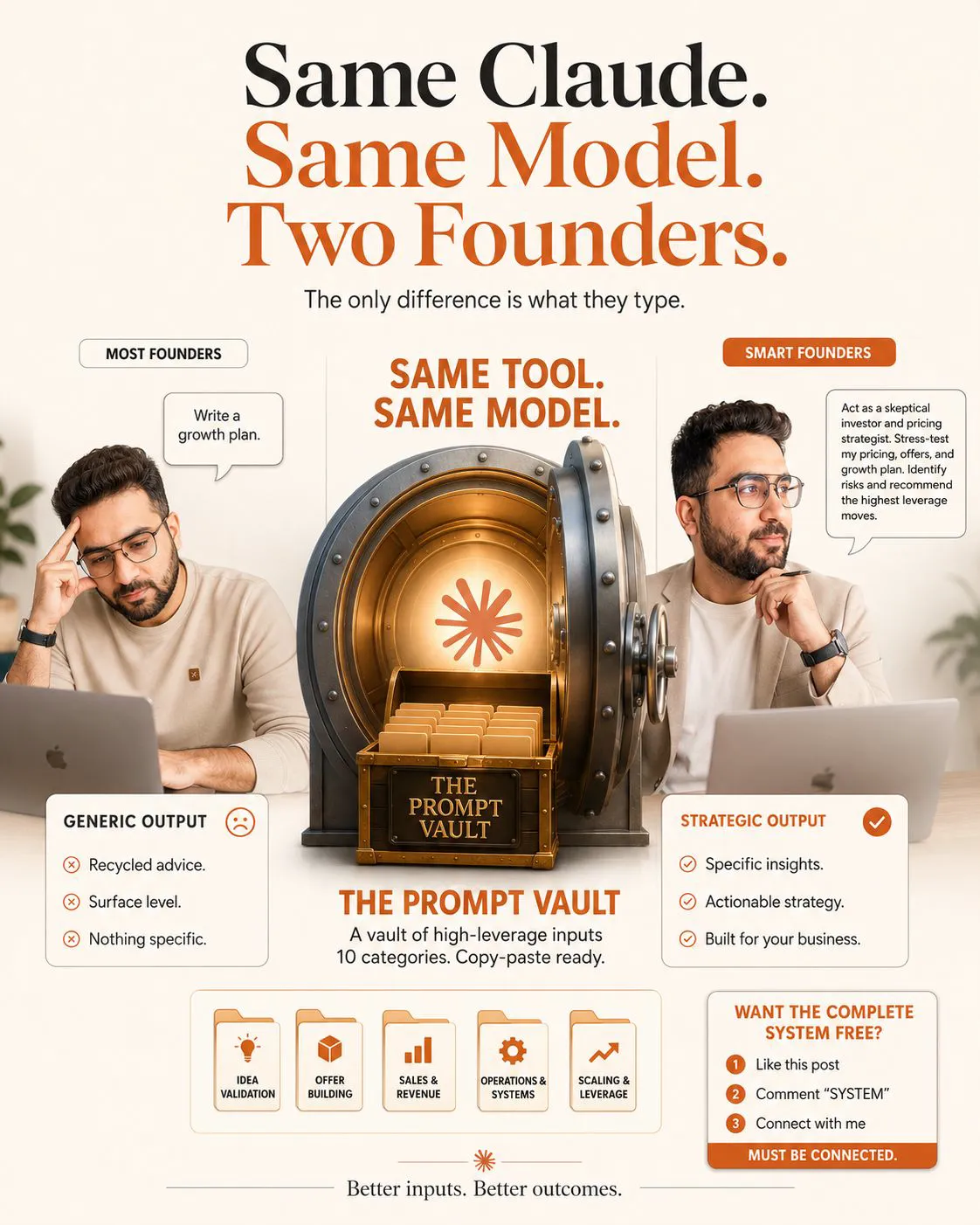
You type "How should I price my service?" into Claude and get five tidy paragraphs about value-based pricing, competitor research and tiered packages. None of it is wrong. None of it is about your business. Another founder asks the same model about the same decision and gets a pointed challenge to their plan, three risks they had not priced in and a test they can run on Monday. The model is the same. The input is not.
This guide gives founders the input structure that makes the difference, checked against Anthropic's own prompting documentation in November 2026, plus ten copy-paste prompts for real decisions, several of them about the two channels most small businesses argue over: search engine optimisation and Google Ads. If you want help turning this into a working system, my Claude consultant service covers it, and for the marketing decisions themselves see SEO consulting and Google Ads management.
TL;DR
- Generic input gets generic output. Anthropic's data shows the education level of a prompt and of Claude's answer are almost perfectly correlated.
- A strong founder prompt has six parts: a role, the real situation, the decision, the constraints, the output format and an instruction to challenge you.
- Put long documents first and the question last, give 3 to 5 examples of good output, and tell Claude why a rule matters.
- Run important decisions in three passes: the case for each option, a sceptic's attack, then the cheapest test you can run this week.
- Save the prompts that work as project instructions, so the next decision starts from a better base.
Why does Claude give founders generic answers?
Short answer: Because the prompt was generic. Anthropic's January 2026 Economic Index found that the education level of people's prompts and of Claude's responses are almost perfectly correlated, above 0.92. Claude answers at the level you ask, and without your business details it falls back on common advice.
That finding comes from Anthropic's Economic Index January 2026 report, which studied a privacy-preserving sample of Claude conversations. It is a correlation, not proof that better prompts cause better answers, but it matches what Anthropic tells developers directly.
The prompting best practices page puts it plainly: think of Claude as a brilliant new employee who lacks context on your norms and workflows. Its test is one any founder can run in a minute.
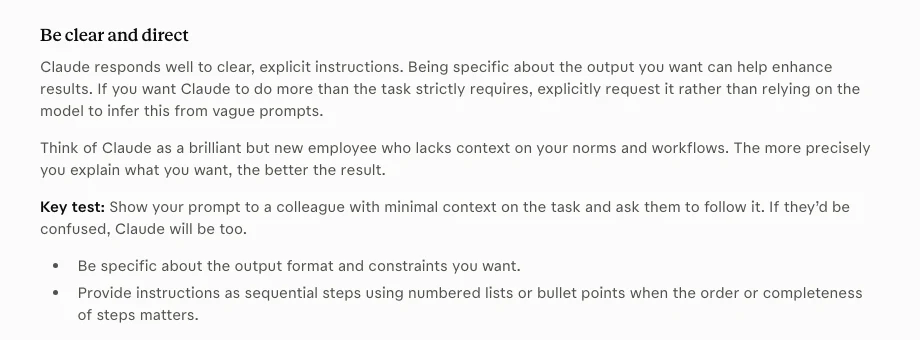
Hand your prompt to a colleague who knows nothing about the task. If they would need to ask five questions before starting, Claude needs those answers too. It just will not ask; it will guess.
What should every founder prompt include?
Short answer: Six parts: a role, the real situation with specifics, the decision you are making, your constraints, the format you want back, and an instruction to argue against your plan. The first five come from Anthropic's guidance; the sixth stops Claude simply agreeing with you.
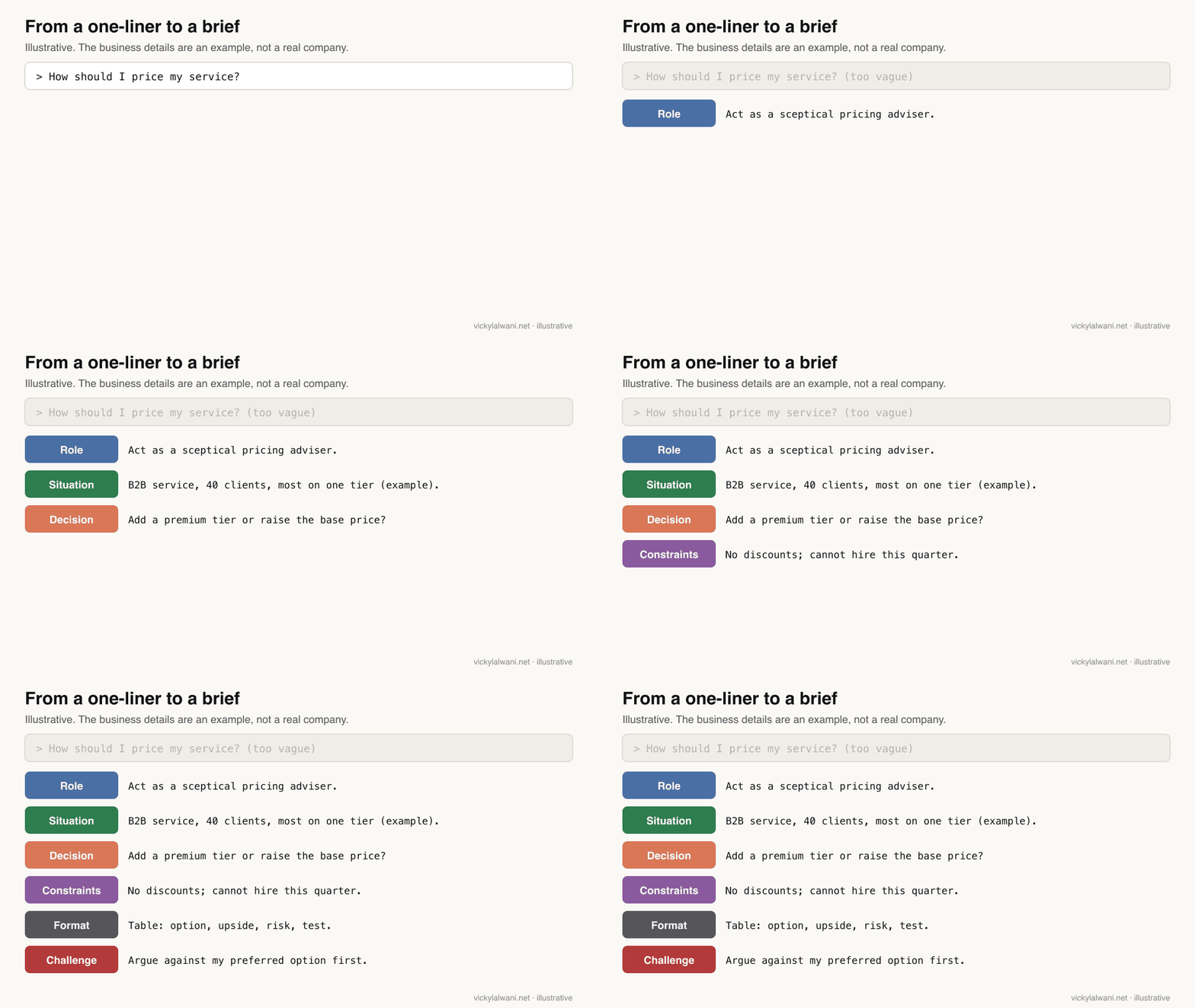
| Part | What to write | Example |
|---|---|---|
| Role | Who should answer | Sceptical pricing adviser |
| Situation | Facts only you know | Clients, margins, what failed |
| Decision | The choice, not the topic | Premium tier or price rise? |
| Constraints | Limits and red lines | No hiring, no discounts |
| Format | Shape of the answer | Table with a test per option |
| Challenge | Permission to disagree | Attack my preferred option |
Anthropic's guidance adds four habits that matter most for business decisions:
- Explain why. "Keep it under a page because my co-founder reads it on a phone" works better than "keep it short", because Claude can generalise from the reason.
- Show examples. Anthropic suggests 3 to 5 examples of the output you want, wrapped in tags so Claude can tell them from instructions.
- Separate the parts. Labels such as
<context>and<data>stop Claude mixing your numbers with your instructions. - Put long material first. With large documents, put them at the top and the question at the end; Anthropic says this can improve response quality by up to 30 percent in its tests.
Here is the master template. Fill in the brackets, delete what does not apply, and keep it.
<context>
[Paste or attach: what you sell, to whom, price points, last 3 months of numbers,
what you tried that did not work]
</context>

You are a [sceptical investor / pricing strategist / operations lead].

Decision: I am choosing between [option A] and [option B] by [date].
Constraints: [budget], [team size], [risks I will not take].
Why it matters: [what happens if we get this wrong].

Give me a table: option, best case, main risk, what must be true,
the cheapest way to test it this month.
Then argue against the option I currently prefer, which is [A or B].
If you need information I have not given, list it before answering.
Which Claude prompts should founders keep?
Short answer: Prompts for the decisions you face repeatedly: validating an idea, pricing, objections, choosing a marketing channel, budgeting a paid test, checking keyword and landing page fit, outreach, operating rhythm and a pre-mortem. Ten templates follow; each assumes you have pasted your own context first.
| # | Decision | Use it when |
|---|---|---|
| 1 | Idea validation | Before spending a quarter |
| 2 | Pricing tiers | Changing what you charge |
| 3 | Objections by buyer | Sales stall |
| 4 | SEO or Google Ads first | Choosing a channel |
| 5 | Paid search test plan | First Google Ads budget |
| 6 | Keyword and offer fit | Reviewing search terms |
| 7 | Landing page match | Clicks but no enquiries |
| 8 | Outreach check | Before sending a sequence |
| 9 | Weekly operating rhythm | The team grows |
| 10 | Pre-mortem | Any big commitment |
1. Idea validation.
Act as an early-stage investor who has seen this idea fail before.
Give the three most likely reasons it fails in the first year, ranked by likelihood,
with the evidence I would see early for each. Then the one experiment that would
kill the idea fastest if it is wrong.
2. Pricing tiers.
Act as a pricing strategist. Using my current prices and client mix above,
design three tiers. For each: who it is for, what is included, and why a buyer would
not simply pick the cheapest. Tell me if the middle option is not the obvious choice.
3. Objections by buyer type.
List the five objections each of my two buyer types is most likely to raise,
in their own words. For each, the answer that uses proof I actually have.
Mark any objection where I have no proof yet.
4. SEO or Google Ads first. Most founders ask this as a matter of taste. Ask it with numbers: your average sale, your margin, how fast you need enquiries and what you can spend. Organic search usually takes months to build; paid search can bring clicks within days but costs from the first click. My guide to SEO and PPC planning covers the trade-off.
Act as a sceptical marketing adviser. My average sale, margin, monthly budget and
how soon I need enquiries are above. Compare starting with SEO versus Google Ads
for the next six months: cost, time to first enquiry, what I learn, and what I own
at the end. Recommend one, then tell me what would make you change your mind.
5. Paid search test plan. Claude cannot see search volumes or costs unless you give it data, so paste a keyword planner export rather than asking it to guess.
<data>[paste a keyword planner or search terms export]</data>
Plan a first Google Ads test from this data only. Which 2 to 4 themes to start with,
which to leave out and why, how to know after 30 days whether to continue.
Flag every assumption that is not supported by the export.
6. Keyword and offer fit. Use it on a search terms report to see whether the words people type match what you sell. See keyword research with Claude and reducing wasted Google Ads spend for the full method.
<data>[paste search terms with clicks, cost and conversions]</data>
Group these terms by intent. For each group: does my offer above answer it,
partly answer it, or not at all? List terms that cost money and fit nothing I sell.
Do not recommend changes yet; I will check this by hand first.
7. Landing page match.
<page>[paste the landing page text]</page>
<ad>[paste the ad headlines and the keyword]</ad>
Read this as someone who just searched that keyword. Within five seconds, what do
they see that matches what they searched? What is missing? List the three changes
most likely to turn a visit into an enquiry, and what each assumes.
8. Outreach check.
Here is my outreach email and the profile of who receives it.
Mark every sentence that reads like a template or could be sent to anyone.
Rewrite only those sentences using a detail from the profile. Keep my voice.
9. Weekly operating rhythm.
We are [team size] people. Design a weekly rhythm: one meeting, one written update,
one number each person owns. Keep it under 90 minutes of meetings a week.
Show it as a table: day, what happens, who owns it, what gets decided.
10. Pre-mortem.
Imagine it is a year from now and this decision failed badly.
Write the story of how it failed, step by step, using my real constraints.
Then list the early warning signs I could check monthly.
How do you run a real decision through Claude?
Short answer: In three passes. First, ask for the strongest case for each option. Second, switch Claude to a sceptic and have it attack the option you prefer, listing what would have to be true. Third, ask for the cheapest way to test those assumptions this week.
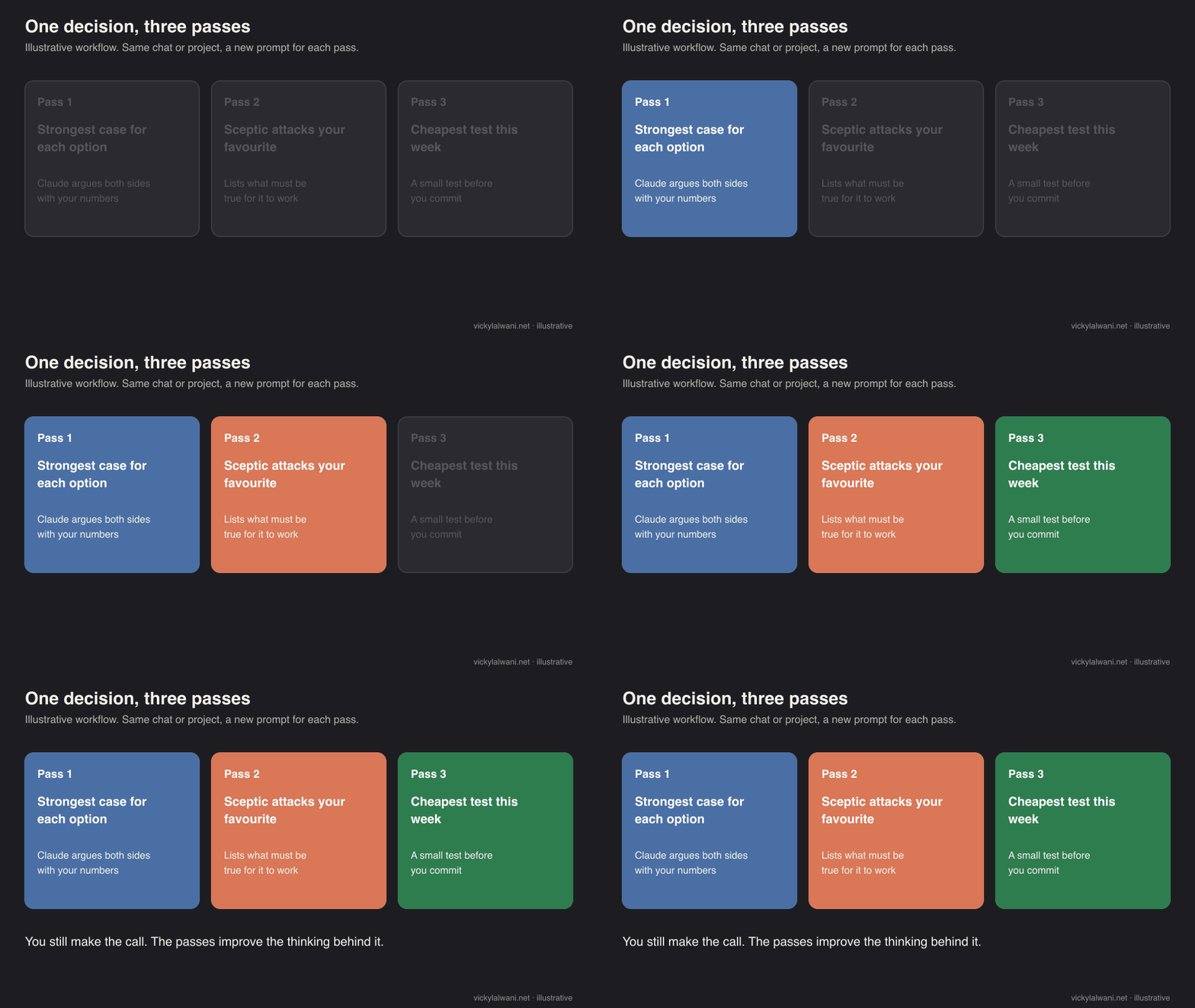
| Pass | Prompt starts with | You get |
|---|---|---|
| 1. Both cases | "Make the strongest case for each" | A fair comparison |
| 2. Sceptic | "Attack my preferred option" | Assumptions to test |
| 3. Test | "Cheapest test this week" | A small, cheap experiment |
The point is not to get an answer from the model. It is to turn a vague worry into a short list of assumptions and a test, before you commit money or months. For a growth example: should you add a second service line to your Google Ads account, or put the same budget into the one that already brings leads? Pass two usually surfaces the assumption that matters, such as whether the new service has enough search demand at all.
How do you save prompts so they keep working?
Short answer: Put your standing context and instructions in a Claude project, so every chat in it starts informed. Projects are available on every plan, including free accounts, which can create up to five. In Claude Code, a repeatable method can become a skill.
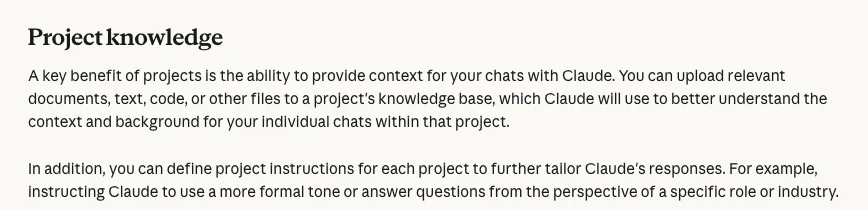
Anthropic's help article on projects describes two parts: project knowledge, where you upload documents, and project instructions, which tailor how Claude answers, for example from the perspective of a specific role. Put your offer, prices, customer notes and the master template there once.
| Where | What to keep there | Plan |
|---|---|---|
| Project knowledge | Offer, prices, customer notes | All plans |
| Project instructions | Role, tone, challenge rule | All plans |
| Claude Code skill | A repeatable method | Paid plans |
| A plain document | Your prompt library | Any |
The same article notes that a new version of projects is in beta, starting with Claude Code, and that existing projects are being moved across for some Pro, Max and Ultra users with instructions and files intact. If you work in Claude Code, the skills documentation explains how a saved method loads only when it is needed. For a deeper template, see my Claude prompting framework and how to train Claude on your writing style.
Do founders get better at prompting with practice?
Short answer: Anthropic's data suggests so. People who had used Claude for six months or more had a 10 percent higher success rate in their conversations, in the March 2026 Economic Index, and that gap was not explained by the tasks they chose.
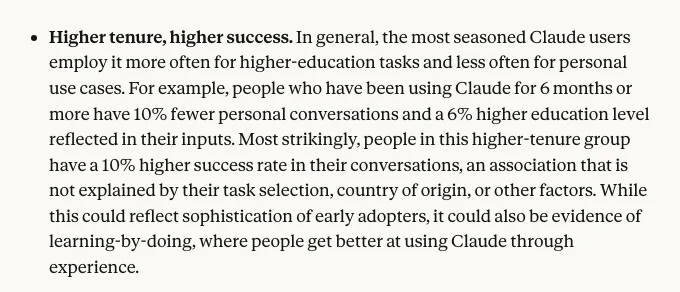
Anthropic is careful about the cause: it could be early adopters being more sophisticated, or learning by doing. The same reports track how people work with Claude. "Augmentation" means iterating, asking for feedback or learning; "automation" means handing over a task with little back-and-forth. After a period where delegation overtook it, thinking with Claude became the larger share again.
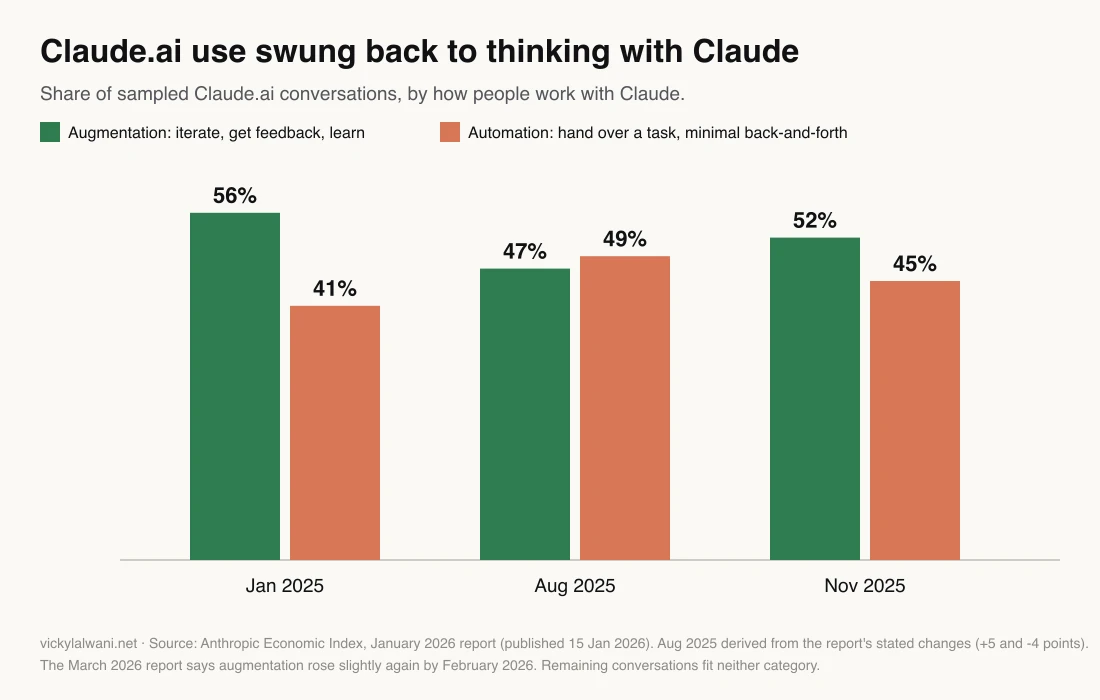
For a founder, the practical reading is simple: the three-pass method above is augmentation. You stay in the loop, and that is the kind of use Anthropic's data links to better outcomes over time.
How I write prompts in my own work
Short answer: I state the goal and the result I need, give the real data, ask Claude to challenge me, and ask for the answer in an order I can act on. On client ad accounts I add one more rule: audit and report first, nothing changes until I have checked it.
These habits come from my own prompts while building this site and running audits, not from a formula.
- Ask to be challenged. When I plan a content or channel bet, I tell Claude not to simply agree with my prediction and to challenge it with actual research. Without that line it tends to build on whatever I assumed.
- Ask for an order you can act on. For anything going to a client or a boss I ask for three parts: what is wrong, the sequence to fix it, and the action plan starting tomorrow.
- Correct with your own data. When an AI audit suggested pausing a keyword that was bringing conversions, the fix was pasting the account figures back and asking it to recheck, not arguing in general terms.
- Real search data, not guesses. For SEO topics I give Claude real keyword data and ask it to work from that, because a model asked to invent keywords will invent plausible ones.
The split matters. On my own site I give Claude a goal and leave the method open. On client accounts, every finding goes into a sheet, I check it by hand, and the client approves before anything changes.
What are the most common founder prompting mistakes?
Short answer: Asking about a topic instead of a decision, leaving out the numbers, accepting the first draft, letting Claude agree with you, and trusting figures it produced without data. Each has a one-line fix.
| Mistake | What you get | Fix |
|---|---|---|
| A topic, not a decision | An essay | Name the two options |
| No numbers | Common advice | Paste the real figures |
| First draft accepted | Average output | Push back on specifics |
| No challenge rule | Agreement | Ask it to argue against you |
| Market figures from memory | Plausible guesses | Give it data or check sources |
| Context retyped each time | Inconsistent answers | Use a project |
The fifth row deserves care. Claude can reason well about numbers you supply, but search volumes, costs per click and market sizes it produces from memory may be out of date or wrong. Verify any figure before it goes into a plan, and treat legal, tax and financial questions as a starting point for a qualified adviser, not a substitute.
What people say on X and Reddit
Short answer: Marketers on X keep making the same point from different angles: AI output improves when you connect it to real data and give it context, and the best prompts are specific about the product, the keyword and the audience. Reddit threads add the founder view on getting past generic or overly agreeable answers.
| Source | Date | Type | What it says |
|---|---|---|---|
| A marketing agency founder on X | 17 Oct 2026 | Vendor | AI guesses without your data |
| An SEO agency founder on X | 24 Aug 2026 | First-hand | Connect the data, not guesses |
| A growth marketer on X | 2 Mar 2026 | First-hand | Claude Code plus SEO data |
| A PPC practitioner on X | 10 Feb 2026 | Opinion | A context-rich negatives prompt |
| r/ClaudeAI | 8 Oct 2026 | First-hand | Five goal skills, files not chat |
| r/PPC | 17 Jun 2026 | Opinion | Context beats prompt wording |
| r/Entrepreneur | 22 Apr 2026 | First-hand | AI projects with no owner |
| r/Entrepreneur | 7 Mar 2026 | Opinion | Prompts need upkeep |
On X, a marketing agency founder who also sells SEO software argued that most people's AI assistant is guessing at their SEO because nobody gave it the real data; that is a vendor view, but it matches Anthropic's advice on context. An SEO agency founder described a keyword research process that starts by connecting a data source to Claude. A PPC practitioner shared a negative keyword prompt whose strength is its brackets for product, keyword and audience; the time saving it claims is theirs, not verified.
On Reddit, an r/ClaudeAI member who has used Claude as a quarterly goals coach for 18 months found one all-purpose coaching skill mediocre at everything, and split it into five, each writing a file the next one reads, so a weekly review scores them against targets they cannot quietly lower. In an r/PPC thread asking for the best Google Ads prompts, one reply summed up this whole guide: the biggest trick is not the wording but feeding the context with precision. Two r/Entrepreneur posts add a founder warning: a consultant who audits AI set-ups in founder businesses keeps finding projects with no owner, no success metric and no place in an existing workflow, and another thread argues that prompts need updating whenever the business context shifts.
Videos worth watching
Short answer: Anthropic's own prompting talks are the best starting point, and they are free. Start with the 2026 prompting playbook from the Claude channel, then the Prompting 101 session for a worked example.
"The prompting playbook" from the official Claude channel, May 2026. Anthropic's own video, so it features Claude; free to watch and not a paid course.
"Prompting 101" from Anthropic's official channel, July 2025. Builds one prompt step by step from a worked business example, much like the master template above.
| Video | Channel | Date | Covers |
|---|---|---|---|
| The prompting playbook | Claude (official) | May 2026 | Current prompting habits |
| Prompting 101 | Anthropic (official) | Jul 2025 | One prompt, built up |
| AI prompt engineering: A deep dive | Anthropic (official) | Sep 2024 | How Anthropic thinks |
| Use Claude Better Than 99% of People | Futurepedia | Aug 2026 | Beginner to advanced |
| Behind the prompt: tips for Claude.ai | Anthropic (official) | Aug 2023 | Basics (older) |
Where this advice is weak
Short answer: Anthropic's prompting guide is written mainly for developers, the Economic Index findings are correlations, and the ten templates are my suggestions rather than tested benchmarks. Use them as starting points and keep what works for your decisions.
- The best practices page targets people building on the API. The principles carry over to chat, but details such as system prompts work differently in the Claude apps.
- The 0.92 correlation and the 10 percent success gap are observational. Anthropic itself says they may reflect who the users are rather than how they prompt.
- The "up to 30 percent" gain from putting the question last applies to long, multi-document inputs in Anthropic's tests, not to every prompt.
- Claude can be wrong with confidence, especially on market figures, regulations and prices it did not get from you. Verify before you act.
- No prompt replaces knowing your customers. The model can only reason about what you tell it.
Want help turning prompts into decisions that bring enquiries?
A prompt library is only useful if it feeds real decisions: which channel to fund, which keywords to buy, which page to fix. I help founders set up Claude as a Claude consultant, and run the marketing work itself through SEO consulting and Google Ads management, with published prices. If you are mapping where AI fits in the wider business, start with a founder's plan for AI automation.
Pick one decision you have been putting off this week and write the input properly. That is the best test of everything above.
Sources
| Source | What it supports | Date | Link |
|---|---|---|---|
| Prompting best practices | New employee, why, examples, tags, long context | Read 18 Nov 2026 | platform.claude.com |
| Prompt engineering overview | When to prompt engineer | Read 18 Nov 2026 | platform.claude.com |
| Economic Index, January 2026 | Prompt and response correlation, usage shares | 15 Jan 2026 | anthropic.com |
| Economic Index, March 2026 | 10% higher success after 6 months | 24 Mar 2026 | anthropic.com |
| What are projects? | Knowledge, instructions, five on free, beta | Read 18 Nov 2026 | support.claude.com |
| Claude Code skills | Saved methods that load on demand | Read 18 Nov 2026 | code.claude.com |
| X, Reddit, YouTube | Practitioner and vendor views | Sep 2023 to Nov 2026 | Linked above |
This article expands on my post on LinkedIn ↗.
FAQ
What are the best Claude prompts for founders?
The best ones are built around a decision, not a topic: idea validation, pricing tiers, objections, choosing between SEO and Google Ads, a paid test plan and a pre-mortem. Each should include your real situation, constraints and an instruction for Claude to argue against your preferred option.
Why does Claude give me generic business advice?
Usually because the prompt was generic. Without your numbers, customers and constraints, Claude falls back on common advice. Anthropic's 2026 research found the education level of prompts and of Claude's responses are almost perfectly correlated.
What should a strategy prompt for Claude include?
A role, the real situation, the decision you are making, your constraints, the output format and a challenge instruction. Anthropic also recommends explaining why a rule matters, giving 3 to 5 examples and putting long documents before your question.
How do I stop Claude just agreeing with me?
Tell it to argue against the option you prefer and to list what would have to be true for your plan to work. Running a separate sceptic pass after the first answer works better than asking for balance in one go.
Can Claude help decide between SEO and Google Ads?
Yes, if you give it your average sale, margin, budget and how soon you need enquiries. It can compare cost, time to first enquiry and what you own afterwards. It cannot see search volumes or click costs unless you paste real data, so do not rely on figures it produces from memory.
Where should I save prompts that work in Claude?
In a Claude project: upload your business context as project knowledge and put your standing rules in project instructions. Projects are available on every plan, and free accounts can create up to five. In Claude Code, a repeatable method can be saved as a skill.
Can Claude replace a business adviser?
No. It can pressure-test your thinking and surface blind spots, but it only knows what you tell it and can be wrong with confidence. Use it to sharpen decisions and check legal, tax and financial points with a qualified professional.
Do I need a paid Claude plan for founder prompts?
No. The prompting techniques work on any plan, and free accounts can use projects, up to five of them. Paid plans add higher usage limits and features such as Claude Code, which you only need for file-based or automated work.