The best AI model for marketing is the cheapest one that passes a written check for that task. In November 2026, use Claude Haiku 5.5 or GPT-6 Luna for bulk, checkable work such as search term tagging and meta descriptions, Claude Sonnet 5.5 or GPT-6.2 Sol for clustering and briefs, and Claude Opus 5.5 or GPT-6.2 Astra for audits and strategy.
TL;DR
There is no single best AI model for marketing. There is a best model for each job. In November 2026 all three big vendors sell the same three tiers: a top model for judgement, a middle model for everyday work and a budget model for volume.
The budget tier (Claude Haiku 5.5, GPT-6 Luna, Gemini Flash-Lite) is far cheaper: Haiku 5.5 and Luna cost 40 to 80 times less per output token than the top tier (Claude Opus 5.5 and Fable 5.2, GPT-6.2 Astra). Use it for search term tagging, meta descriptions, ad headline variants and fixed-format digests, with a script checking every line.
Keep the top tier for work where a mistake costs money: Google Ads audits, technical SEO audits that join several data sources, and budget decisions between SEO and paid search. Test any switch on 20 real samples, run each test more than once, and note that Gemini 4 Argon and Carbon prices double on 1 December 2026.
Short answer: the best AI model for marketing is the cheapest model that passes a written quality check for that specific task. For most SEO and PPC teams that means a budget model for bulk, repetitive work, a middle model for clustering and briefs, and a top model for audits and strategy, with a person approving anything that goes live.
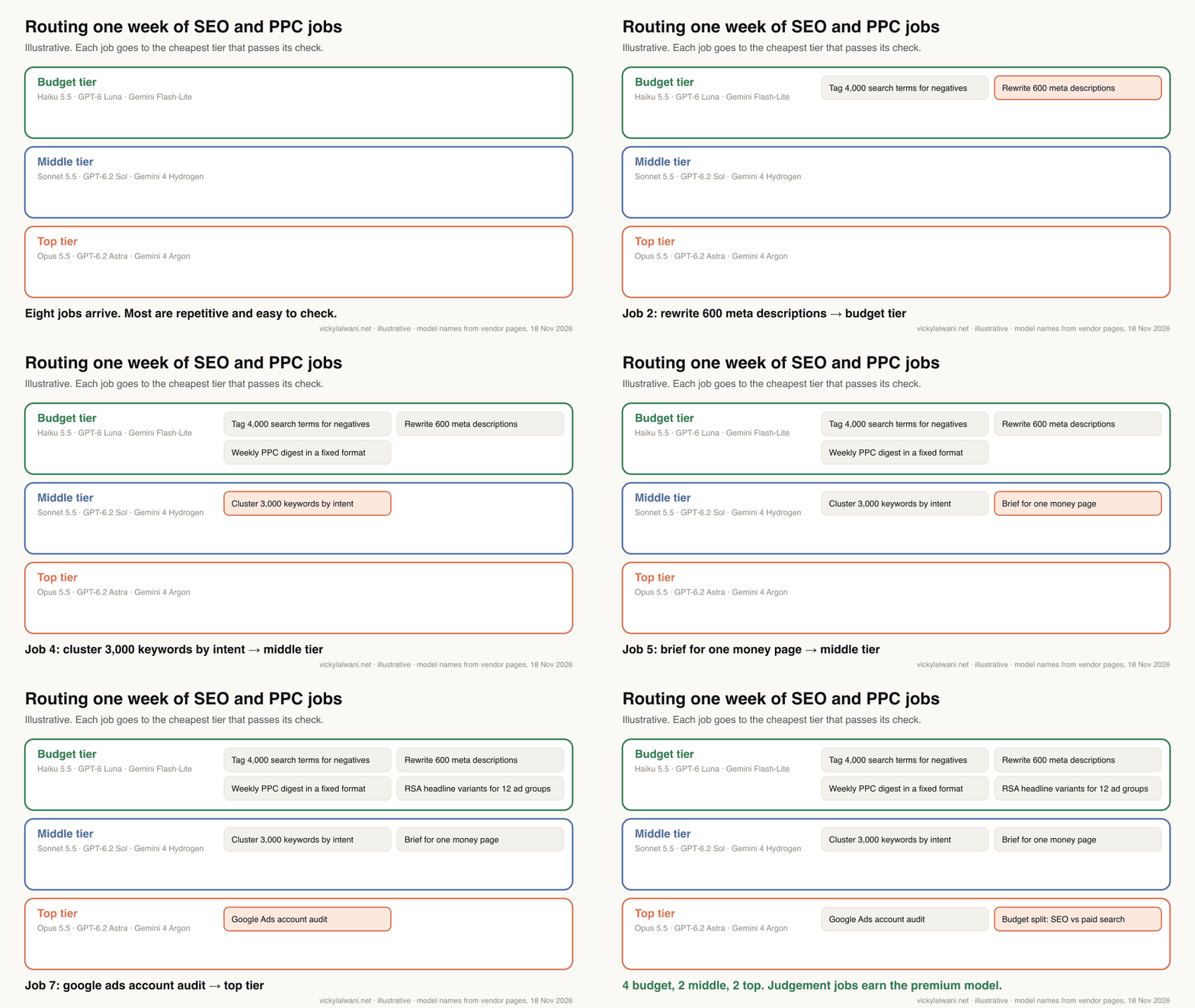
Picture a month of AI invoices where most of the spend went on rewriting meta descriptions and tagging search terms. Those jobs never needed the strongest reasoning model on the market, while the one account audit that did need it got the same model as everything else. That gap is what model routing fixes: sending each task to the right model on purpose, rather than to whichever model happens to be open.
This is the November 2026 update. Every model name and price below was read on the vendors' own pages on 18 November 2026, the day after OpenAI released GPT-6.2. If you want the routing built into your own SEO and paid search workflows, that is part of my AI automation work, and the search side sits with my SEO consultant and Google Ads management services.
Which AI models can marketers choose from in November 2026?
Short answer: Anthropic sells Claude Fable 5.2, Opus 5.5, Sonnet 5.5 and Haiku 5.5. OpenAI's featured API models are GPT-6.2 Astra, GPT-6.2 Sol, GPT-6.1 Terra and GPT-6 Luna. Google's are Gemini 4 Carbon, Argon and Hydrogen, plus the cheaper Gemini 3.x Flash and Flash-Lite models.
Prices are quoted per million tokens. A token is a small chunk of text. On Anthropic's current tokenizer, a million tokens is roughly 555,000 English words; other vendors count a little differently. Input is what you send (instructions, data, pages); output is what the model writes back, including any hidden "thinking" on reasoning models.
| Tier | Anthropic | OpenAI | |
|---|---|---|---|
| Top, rare use | Fable 5.2: $8 in, $40 out | GPT-6.2 Astra: $8 in, $40 out | Gemini 4 Carbon: $2 in, $10 out ($4, $20 from 1 Dec) |
| Top, default | Opus 5.5: $4 in, $20 out | Astra covers both top rows | Gemini 4 Argon: $2 in, $10 out ($4, $20 from 1 Dec) |
| Middle | Sonnet 5.5: $2 in, $10 out | GPT-6.2 Sol: $2 in, $10 out | Gemini 4 Hydrogen: $1.50 in, $7.50 out |
| Lower middle | None | GPT-6.1 Terra: $1 in, $5 out | Gemini 3.5 Flash-Lite: $0.30 in, $2.50 out |
| Budget | Haiku 5.5: $0.10 in, $0.50 out | GPT-6 Luna: $0.10 in, $0.50 out | Gemini 3.1 Flash-Lite: $0.25 in, $1.50 out |
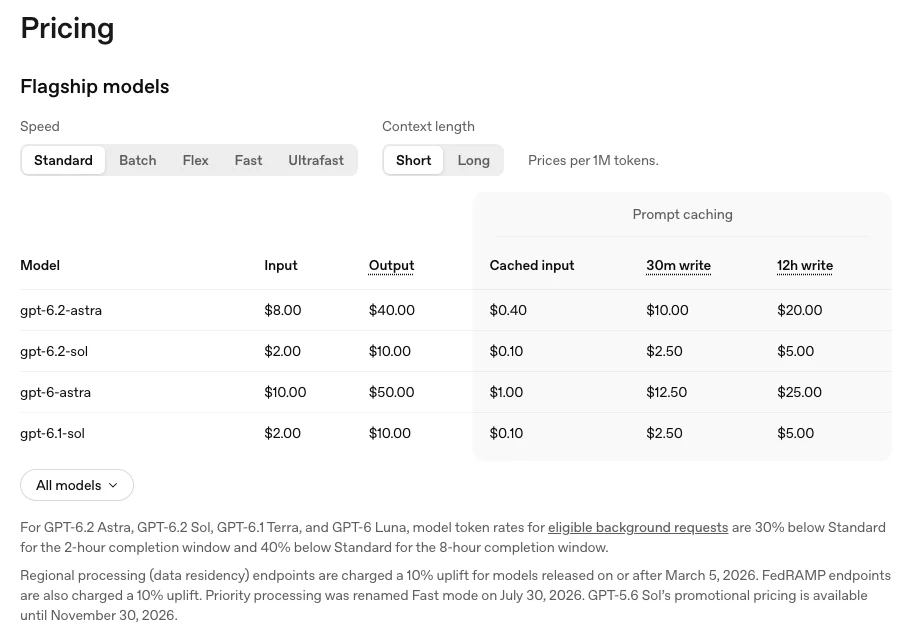
All prices are US dollars per million tokens at the standard API rate, read on Anthropic's pricing page, OpenAI's API pricing page and Google's Gemini API pricing page on 18 November 2026. Haiku 5.5's price applies to prompts up to 100,000 tokens; the GPT-6 family's applies up to 272,000.
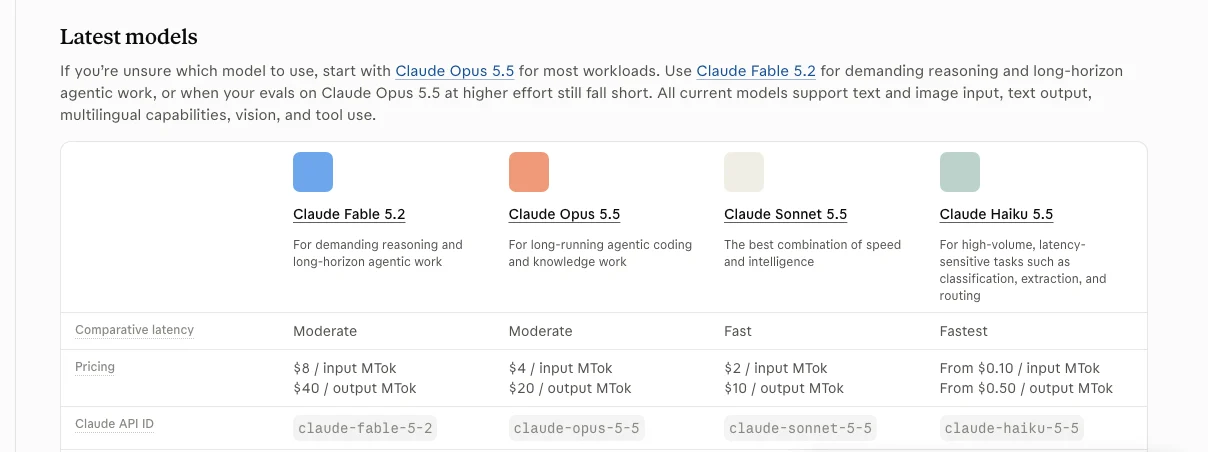
Three things changed since this article first went up. OpenAI released GPT-6.2 Astra and GPT-6.2 Sol on 17 November 2026. Anthropic's budget model, Haiku 5.5, launched on 7 October and costs around 75% less to run than Haiku 4.5 on average, by Anthropic's own figure. And Google's Gemini 4 Argon and Carbon launched at an introductory price that ends on 30 November.
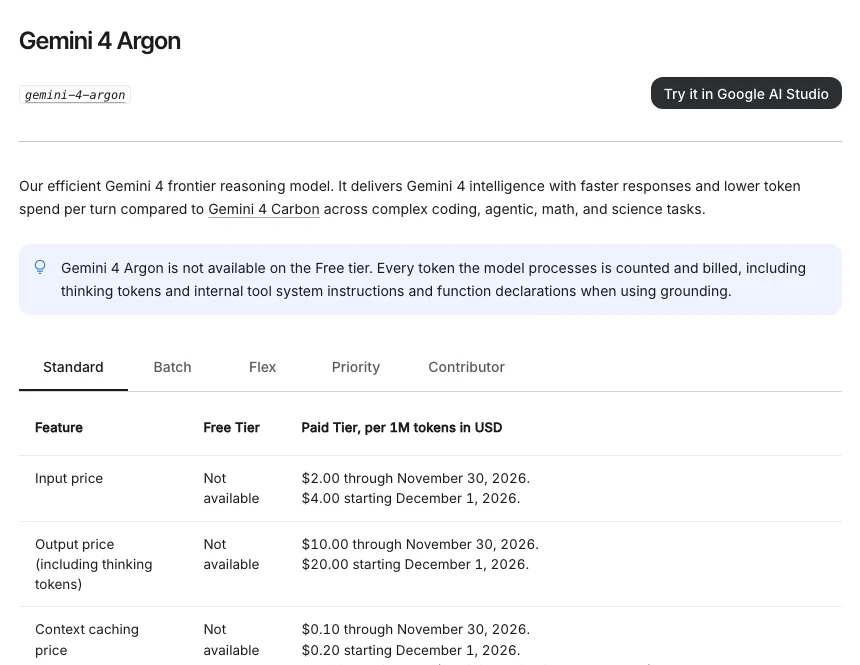
If you budgeted a Gemini 4 workflow on the launch price, redo the sum now. From 1 December, Argon costs the same per token as Claude Opus 5.5 ($4 in, $20 out), so choose it on how well it does your task, not on price.
What does each AI model cost for a real marketing job?
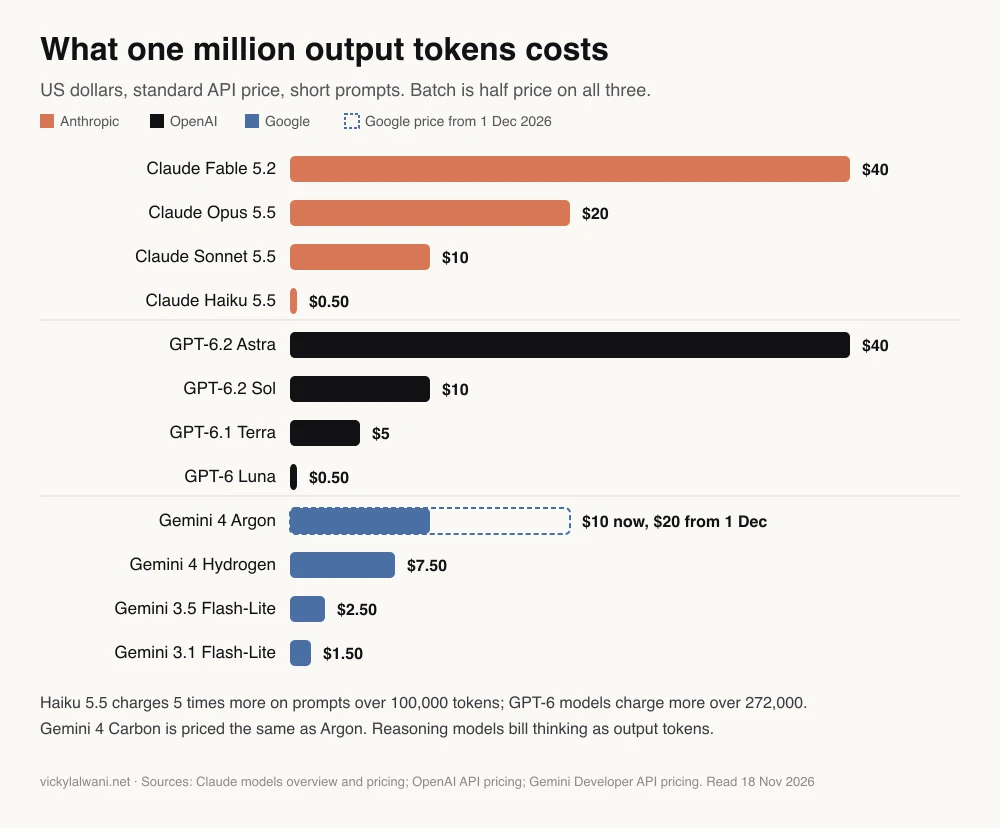
Short answer: as an example, rewriting 2,000 meta descriptions costs about $0.45 on Claude Haiku 5.5 or GPT-6 Luna, $9 on Sonnet 5.5 or GPT-6.2 Sol, $18 on Opus 5.5 and $36 on GPT-6.2 Astra or Claude Fable 5.2, before thinking tokens. Batch processing halves each figure.
Per-token prices are hard to feel, so here is one job priced across the lineup. The chart shows the output price, which is where most of the gap sits.
The worked example below assumes each meta description request sends 1,500 tokens (a page summary plus your rules) and gets 150 tokens back. That is 3 million input tokens and 300,000 output tokens for 2,000 pages. These are example volumes, not measurements.
| Model | Input cost | Output cost | Total (example) |
|---|---|---|---|
| Claude Haiku 5.5 | $0.30 | $0.15 | $0.45 |
| GPT-6 Luna | $0.30 | $0.15 | $0.45 |
| Gemini 3.1 Flash-Lite | $0.75 | $0.45 | $1.20 |
| Gemini 4 Hydrogen | $4.50 | $2.25 | $6.75 |
| Claude Sonnet 5.5 or GPT-6.2 Sol | $6.00 | $3.00 | $9.00 |
| Gemini 4 Argon from 1 Dec | $12.00 | $6.00 | $18.00 |
| Claude Opus 5.5 | $12.00 | $6.00 | $18.00 |
| GPT-6.2 Astra or Claude Fable 5.2 | $24.00 | $12.00 | $36.00 |
Two caveats keep this honest. Reasoning models bill their thinking as output tokens (Google's pricing page says so in its own column header), so the top models usually cost more than the table shows. And the money only matters at volume: $36 against $0.45 is trivial once, but a weekly job across 40 client sites turns it into a real line on the invoice.
The bigger cost is usually not the model at all. It is the person who fixes weak output afterwards, which is why the quality check matters more than the price list.
Which AI model should you use for each SEO task?
Short answer: use a budget model for bulk, checkable SEO work such as meta descriptions, alt text and schema drafts; a middle model for keyword clustering and content briefs; and a top model for technical audits that join crawl, Search Console and analytics data, or for deciding what to fix first.
The test for each row is simple: how easy is the output to check, and what does a mistake cost? A wrong meta description is cheap and obvious. A wrong conclusion in a technical audit can send a developer down the wrong path for a month.
| SEO task | Start on | Why | Check before use |
|---|---|---|---|
| Meta descriptions at scale | Budget | Short, repetitive, easy to read | Length, keyword, no invented claims |
| Image alt text | Budget | Describes what is there | Spot-check 10% |
| Schema JSON-LD drafts | Budget or middle | Fixed format | Rich Results Test |
| Keyword clustering by intent | Middle | Needs judgement on intent | Review mixed clusters |
| Content brief for a money page | Middle | Research plus structure | Your own SERP check |
| Full article draft | Middle or top | Facts and voice matter | Human edit, every claim sourced |
| Technical audit, several sources | Top | Joins crawl, GSC and GA4 | Confirm each finding in the tool |
| What to fix first | Top | Trade-offs, business context | You decide |
For the clustering and research side, my keyword research workflow with Claude shows the prompts and the data I feed in. Which Claude model to put on each of those steps has its own guide: which Claude model to use for marketing.
Which AI model should you use for each PPC and Google Ads task?
Short answer: tag search terms and draft responsive search ad headlines on a budget model with a script checking every line, cluster and write landing page notes on a middle model, and keep account audits, bidding questions and budget splits on a top model, with a person approving every change.
Paid search has one advantage for routing: many outputs can be checked by a machine. Google Ads Help says responsive search ad headlines support up to 30 characters and descriptions up to 90, with up to 15 headlines and 4 descriptions per ad. A ten-line script can reject anything over the limit before you ever read it.
| PPC task | Start on | Why | Check before use |
|---|---|---|---|
| Search term tagging for negatives | Budget | Classification at volume | You approve every negative |
| RSA headline and description variants | Budget | Short, rule-bound | 30 and 90 character limits |
| Weekly performance digest | Budget | Fixed format | Numbers match the platform |
| Ad group structure from keywords | Middle | Grouping by intent | No duplicate targeting |
| Landing page message match notes | Middle | Reads ad and page together | Open both yourself |
| Account audit | Top | Settings, data and context | Confirm in the account |
| Tracking and attribution diagnosis | Top | Easy to be confidently wrong | Test conversions live |
| Budget split, SEO vs paid search | Top | Strategy with real money | You decide |
On client ad accounts my own rule is the same whichever model does the analysis: audit first, put the findings in a sheet, check them by hand, and change nothing before the client approves. The model choice changes the cost of the first draft. It does not change who signs off.
Why is one AI model for everything a waste?
Short answer: because most marketing tasks are repetitive and easy to check, and a top model charges 40 times more per output token than a budget model for work the budget model can do. Using one model for everything also hides which tasks really need the expensive one.
Using a single top-tier model for every task is like sending a senior strategist to proofread headlines. It works, and you pay for reasoning you do not need. At low volume it hardly matters. When you generate hundreds of variants or run recurring jobs across several accounts, the cost adds up quickly.
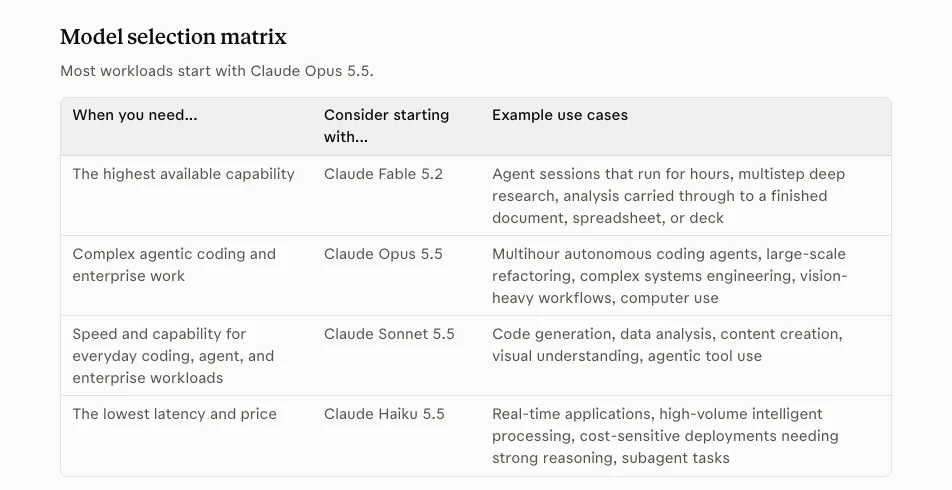
The vendors now say the same thing. Anthropic's guide to choosing a model offers two starting points: efficiency-first on Haiku 5.5 for high-volume, straightforward tasks, or capability-first on Opus 5.5 for complex reasoning. Its developer blog's model guide puts classification, routing, tagging and high-volume extraction on Haiku 5.5. OpenAI's models page describes GPT-6 Luna as its model for "cost-sensitive, high-volume workloads".
The exact split will vary by business. A team with strict compliance needs may keep more work on the stronger model, while a content team producing high volumes may move more down. What matters is that the decision is made per task type, written down and revisited, not left to whoever happens to be using the tool that day.
How do you test a cheaper AI model before you switch?
Short answer: run 20 real samples through both models, score them against a written checklist without knowing which model wrote which, run the test more than once, and compare cost per usable output rather than cost per token. Switch only if the cheaper model passes at the same rate.
A one-off comparison misleads. A practitioner on r/ClaudeAI who re-ran each step of a document pipeline on several Claude models saw the same model score 59 on one run and 98 on another on the same input, and concluded that one run proves nothing. Anthropic's own advice is to compare models on cost per completed task, not per token.
| Step | What to do | Why |
|---|---|---|
| 1. Pick samples | 20 real inputs, including awkward ones | Easy samples flatter cheap models |
| 2. Write the checklist | Accuracy, format, tone, length, banned claims | Stops "feels better" judgements |
| 3. Run both, twice | Same prompt, same data | Results vary run to run |
| 4. Score blind | Hide which model wrote each | Removes brand bias |
| 5. Price the passes | Cost divided by usable outputs | The real unit cost |
| 6. Write the rule | Task, model, effort, check, fallback | Makes it repeatable |
A prompt like this keeps the scoring step honest. Paste both sets of outputs in with the model names removed.
You are scoring two sets of marketing outputs, labelled A and B. You do not know which model wrote which.

Task: [for example, meta descriptions for the 20 pages listed below]
Checklist, one point each:
1. Accurate to the page summary, with no invented facts, prices or claims
2. Within [155] characters
3. Includes the target keyword naturally
4. Matches our tone rules: [paste rules]
5. Gives a reason to click

For every item in A and B, score each checklist line 0 or 1 and quote the words that failed.
Then give: total score for A, total score for B, and the items where both failed.
Do not pick a winner on style. Only count the checklist.
If you use a model to score, use a different and stronger one than either model you are testing, and still read a sample of its scores yourself. A second model agreeing with the first is not the same as being right.
What fallback rule keeps AI model routing safe?
Short answer: check every output from a cheaper model against rules a script can test, send only the failures one tier up, and send anything that fails twice to a person. Do not rely on the cheap model saying it is unsure, because its most expensive mistakes are the ones it makes confidently.
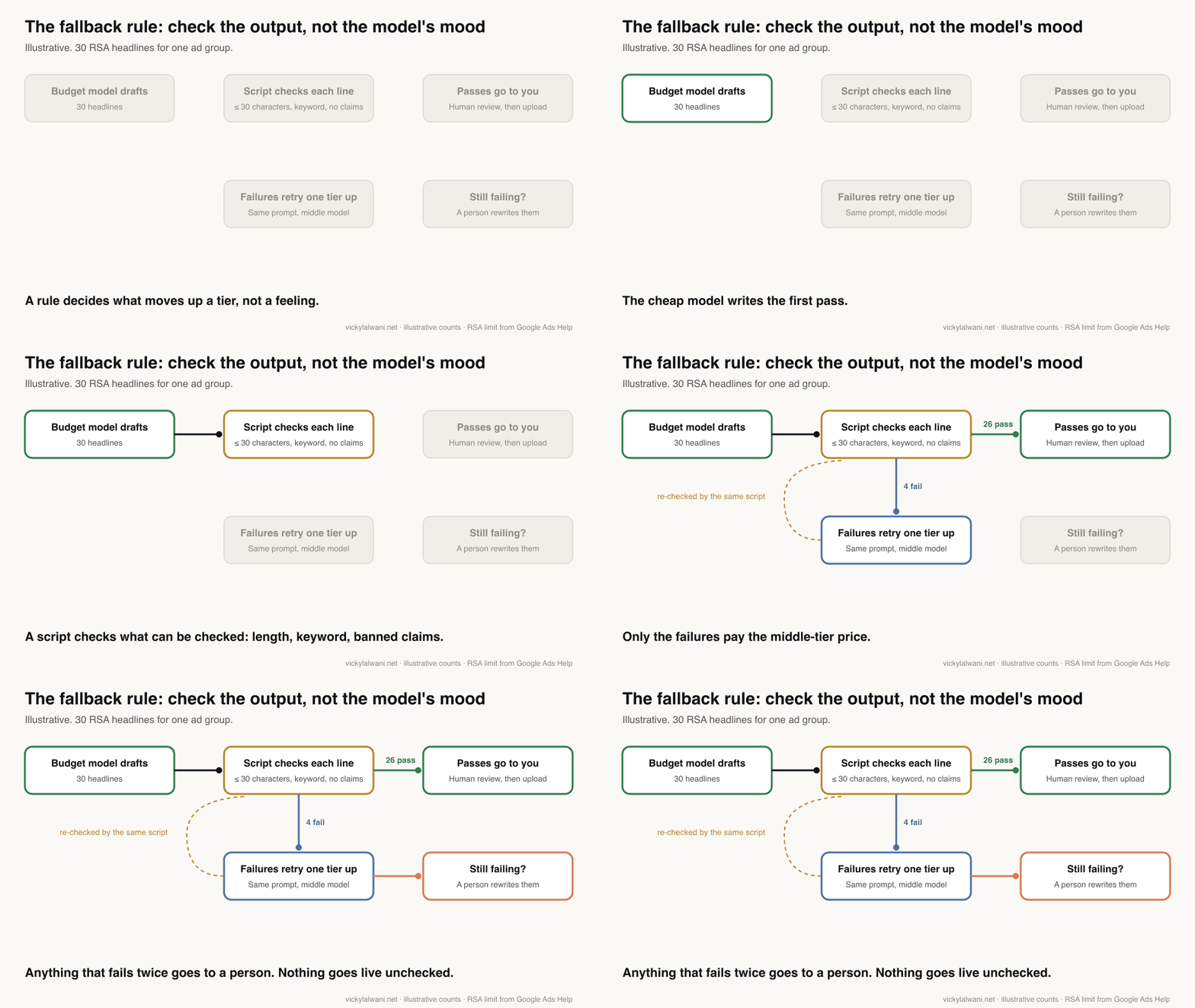
The same r/ClaudeAI test makes the point well: every cheaper model that failed did so by leaving something out, and nothing in the output warned about it. An "escalate when unsure" rule would never have fired. That is why the trigger should be a check on the output, such as a character count, a required keyword, a list of banned phrases, or numbers that must match the source export.
Anthropic reports a related result inside one model: running at low effort and re-running only the failures at high effort came out about 40% cheaper than running everything at high, at the same pass rate, in its internal tests. It labels those results directional, so measure on your own work.
| Rule | Applies to | Example |
|---|---|---|
| Test before switching | Every task type | 20 samples, two runs |
| Check by script first | Anything with hard limits | RSA lengths, JSON schema |
| Escalate failures only | Budget and middle tiers | 4 of 30 retried |
| Upgrade for risk | Client-facing, legal, numbers | Audits stay on top tier |
| Downgrade for volume | Repetitive, easy to check | Search term tagging |
| Budget by task | Monthly review | Spend per task type, not total |
Should you change the AI model or the effort setting first?
Short answer: try the effort setting first. Claude and the GPT-6 models both let you set how hard the model thinks, and Anthropic says tuning effort is often a better lever than switching models. Move up a model only when higher effort still falls short, because effort cannot add knowledge the model lacks.
Effort controls how long a reasoning model thinks before it answers. More thinking means more output tokens, so it costs more and takes longer. Anthropic's guide to choosing a model lists effort among the first criteria. Its developer blog adds that past high, one more effort level can cost as much as a bigger model, so test the next model up at a lower effort instead.
OpenAI's model pages list reasoning.effort levels for GPT-6 Luna and GPT-6.1 Terra from none to max. Haiku 5.5 is the first Haiku with an adjustable effort setting, according to Anthropic's launch thread.
| Symptom | Try first | Then |
|---|---|---|
| Good output, high cost | Lower effort | Next tier down |
| Misses obvious items | Higher effort | Next tier up |
| Wrong facts about your business | Better context file | Not a model problem |
| Outdated platform advice | Paste current docs in | Any model can be dated |
The third row matters most in practice. In an r/PPC thread comparing Claude and Gemini on campaign data, one practitioner said the bad assumptions stopped once they gave the model what is not in the export: conversion lag, attribution model, bid strategy and target, and the date range spelled out. No model upgrade fixes missing context.
How do caching and batch processing cut the AI bill?
Short answer: prompt caching makes repeated instructions and data far cheaper on every call, and batch processing halves the price for work that can wait up to 24 hours. For recurring SEO and PPC jobs these two often save more than switching models, without any change in quality.
Most marketing jobs resend the same block every time: your brand rules, the account brief, the list of banned claims. Caching stores that block so later calls read it cheaply. On Claude, cache reads cost 10% of the input price on most models and 5% on Opus 5.5 and Sonnet 5.5. On GPT-6.2 Sol, cached input is $0.10 against $2.00 uncached. In Anthropic's own measurements, caching was usually the largest single cost lever.
| Lever | Saving | Good for |
|---|---|---|
| Batch API (all three vendors) | 50% off | Overnight meta and ad copy runs |
| Prompt caching | Repeated input at 2.5% to 10% of price | Same brief, many calls |
| Lower effort | Fewer thinking tokens | Simple, checkable jobs |
| Shorter prompts over the threshold | Avoids long-prompt rates | Search Console exports |
That last row catches SEO teams out. Haiku 5.5 charges $0.10 in and $0.50 out only for prompts up to 100,000 tokens; above that every rate is five times higher for the whole request. GPT-6 models switch to higher rates above 272,000 input tokens. A large Search Console export can pass either line. As an example, splitting a 150,000-token export into two 75,000-token requests keeps Haiku 5.5 at its base price, and a short script that groups rows by page before the model sees them usually shrinks the input further.
Where does your client data go with each AI model?
Short answer: on the paid APIs, Anthropic and OpenAI say they do not train on your inputs by default, and Google's paid Gemini tier says the same. Google's free Gemini tier says your data is used to improve its products, so never send client data through a free key.
| Vendor | Paid API | Watch out for |
|---|---|---|
| Anthropic | Not used for training by default | Feedback you choose to send |
| OpenAI | Not used for training unless you opt in | Abuse logs kept up to 30 days |
| Google Gemini | Paid tier: not used to improve products | Free tier: used to improve products |
Sources: Anthropic's privacy centre on commercial products and training, OpenAI's data controls for the API, and the "used to improve our products" row on each model in Google's Gemini pricing page, all read 18 November 2026. Consumer chat plans have their own terms, and other providers, including lower-cost ones, set their own policies. Read the terms before sending client material anywhere, and this is not legal advice.
How do you build AI model routing into your agents?
Short answer: give each agent or automation a default model that matches its job, write the routing rules in the agent's instructions, and let a stronger model plan and review while cheaper models do the bulk work. Review the rules every quarter, because models and prices change every few months.
Routing works best when it is built into your workflow, not decided by hand each time. If you use named agents, each can carry a default model: a reporting agent on a budget model, a strategy agent on a top model. Anthropic describes the two common patterns as an executor that escalates hard decisions to an advisor, and an orchestrator that delegates bulk work to lower-cost workers.
That matches how I work: a thinking model plans the job and a separate agent executes it, with one Claude project per client so context never crosses accounts. It is not automatically cheaper, though. A practitioner who ran about 300 benchmarks found that on small jobs the top model alone can be cheaper than the top model plus helpers, while on coding tasks the split saved about 20 to 30% at the same quality.
Routing rules for this project. Follow them for every task.

Budget model ([Haiku 5.5 / GPT-6 Luna]): search term tagging, meta descriptions, alt text,
RSA variants, weekly digests. Every output goes through the check script before I see it.

Middle model ([Sonnet 5.5 / GPT-6.2 Sol]): keyword clustering, content briefs,
ad group structure, landing page notes.

Top model ([Opus 5.5 / GPT-6.2 Astra]): account audits, technical SEO audits that join
two or more data sources, budget recommendations, anything a client will read as advice.

Fallback: if a budget output fails the check, retry once on the middle model.
If it fails again, stop and list it for me. Never publish or change an account without my approval.
Log the model, effort and token count for each task in costs.csv.
The log line at the end is what turns this into a cost control. After a month you can see spend per task type, not just a total, and that is the number that tells you where to move work down. For more ways to trim the bill on the Claude side, see how to reduce Claude token usage without losing quality, and for the cheap-filter pattern in front of a bigger model, AI model routing with a cheap filter.
What people say on X and Reddit
Short answer: the vendors all now pitch a cheap tier for volume and a top tier for hard work. Practitioners on Reddit agree that splitting work saves money on bigger jobs, but warn that cheap models fail silently, results vary run to run, and missing context causes more bad answers than the model does.
| Who | What they said | Take it as | Link |
|---|---|---|---|
| Claude (official) | Haiku 5.5 launched; about 75% cheaper to run than Haiku 4.5 (7 Oct 2026) | Vendor | X post |
| Claude (official) | Haiku 5.5 is for high-volume work like summaries and classification (7 Oct 2026) | Vendor | X post |
| Anthropic developer account | Guide to Fable, Opus, Sonnet or Haiku; adjust effort before switching (9 Nov 2026) | Vendor | X post |
| OpenAI Developers | GPT-6 Sol and Luna launch at API prices 50% below GPT-5.6 (22 Sep 2026) | Vendor | X post |
| OpenAI Developers | GPT-6.2 Astra and Sol available in the API (17 Nov 2026) | Vendor | X post |
| Google (official) | Gemini 4 Argon launches at an introductory API price (13 Oct 2026) | Vendor | X post |
| A Google Search product lead | Gemini 4 Hydrogen is now the default model in AI Mode (12 Nov 2026) | Vendor staff | X post |
| r/ClaudeAI | About 300 benchmarks: cheaper helpers saved 20 to 30% on coding; small jobs can cost more (16 Nov 2026) | First-hand | Thread |
| r/ClaudeAI | Cheaper models failed by leaving things out; one run proves nothing (12 Nov 2026) | First-hand | Thread |
| r/ClaudeAI | Top model plans and reviews, cheaper models build; best of 13 runs 49% cheaper (14 Nov 2026) | First-hand, own free tool | Thread |
| r/PPC | Claude vs Gemini on campaign data; context in a file fixes most bad assumptions (30 Sep 2026) | First-hand | Thread |
| r/SEO | Agency AI content needs heavy clean-up; "a staffing problem disguised as a workflow problem" (8 Oct 2026) | Mixed | Thread |
The X posts are all from vendors or vendor staff, so read the savings claims as theirs. The Reddit threads are small tests by individuals, not controlled studies, but they agree on the two points that matter most: measure on your own work, and check what the cheap model left out.
Videos worth watching
Short answer: start with Anthropic's three-minute video on when to use each Claude model, then OpenAI's GPT-6.2 launch film and Google Cloud's Gemini 4 Argon demos. All three come from the vendors, so they show strengths, not limits.
Made by Anthropic's Claude channel, 11 November 2026. It promotes Anthropic's models. Useful for its section on splitting one job across models.
Made by OpenAI, 17 November 2026, the launch day. It promotes OpenAI's models. Short, and clear on which of the two is meant for everyday work.
Made by Google Cloud Tech, 13 October 2026. It promotes Google's model. The demos are developer-heavy, so watch the first few minutes for what Argon is for.
| Video | Channel | Date | What it covers |
|---|---|---|---|
| Fable 5.2 or Opus? When to use each model | Claude (Anthropic) | 11 Nov 2026 | Moving up or down a model |
| GPT-6.2 Astra and GPT-6.2 Sol | OpenAI | 17 Nov 2026 | The two new GPT-6.2 models |
| Gemini 4 Argon: 10 demos | Google Cloud Tech | 13 Oct 2026 | What Argon is built for |
| Introducing Claude Opus 5.5 | Claude (Anthropic) | 22 Sep 2026 | 20-second launch clip |
| Introducing Claude Sonnet 5.5 | Claude (Anthropic) | 28 Sep 2026 | Short launch clip |
| How AI Is Changing Google Search and SEO | Google Search Central | 1 May 2026 | AI Overviews and AI Mode for SEOs |
Where this advice is weak
- Prices move. Every price here was read on 18 November 2026. Gemini 4 rates double on 1 December, OpenAI changed its lineup the day before this update, and any vendor can change again next month.
- The tiers are not equal across vendors. Putting Sonnet 5.5, GPT-6.2 Sol and Gemini 4 Hydrogen in one "middle" row is a pricing grouping, not a claim that they perform the same on your work.
- The worked example ignores thinking tokens. Real costs on reasoning models are higher, by an amount that depends on the effort setting and the task.
- The Reddit tests are small. They are one person's workloads, mostly coding and documents, not marketing. They are useful as warnings, not as benchmarks.
- Subscription plans work differently. If your team uses the Claude, ChatGPT or Gemini apps rather than the API, you pay a seat price and the limits are usage caps, so the per-token sums above do not apply directly.
Sources
| Source | What it supports | Date | Link |
|---|---|---|---|
| Anthropic, Models overview | Claude lineup, prices, effort defaults | Read 18 Nov 2026 | Docs |
| Anthropic, Pricing | Haiku 100K threshold, caching, batch | Read 18 Nov 2026 | Docs |
| Anthropic, Choosing a model | Efficiency-first, effort, combining models | Read 18 Nov 2026 | Docs |
| Anthropic, Optimizing for cost and intelligence | Cost per task, caching, 40% re-run result | Read 18 Nov 2026 | Docs |
| Anthropic developer blog | Model by task, effort before switching | 9 Nov 2026 | Blog |
| OpenAI, API pricing | GPT-6.2, 6.1 and 6 prices, batch | Read 18 Nov 2026 | Docs |
| OpenAI, Models | Featured models and roles | Read 18 Nov 2026 | Docs |
| OpenAI, GPT-6 Luna | Effort levels, 272K threshold | Read 18 Nov 2026 | Docs |
| Google, Gemini API pricing | Gemini 4 prices, 1 Dec change, free tier data | Read 18 Nov 2026 | Docs |
| Google Ads Help | RSA 30 and 90 character limits | Read 18 Nov 2026 | Help |
| Anthropic Privacy Center | Commercial data not used for training | Read 18 Nov 2026 | Article |
| OpenAI, Data controls | API data and 30-day abuse logs | Read 18 Nov 2026 | Docs |
| X posts and Reddit threads | Launch claims and practitioner tests | Sep to Nov 2026 | Listed in the table above |
Want help choosing and wiring the models?
The winner in 2027 is not the team with the smartest model. It is the team with the right model on each task, a check on every output and a person signing off what goes live. I can set up that routing inside your SEO and paid search workflows, with the check scripts and the cost log. See my AI automation service, SEO consulting, Google Ads management and the rates on the pricing page. The CMO Guide 2027 has the wider plan this fits into.
Keep reading: which Claude model to use for marketing, AI model routing with a cheap filter, reduce Claude token usage and keyword research with Claude.
This article expands on my post on LinkedIn ↗.
FAQ
What is the best AI model for marketing in 2027?
There is no single best model. As of November 2026, use a budget model such as Claude Haiku 5.5 or GPT-6 Luna for bulk, checkable work, a middle model such as Claude Sonnet 5.5 or GPT-6.2 Sol for clustering and briefs, and a top model such as Claude Opus 5.5 or GPT-6.2 Astra for audits and strategy.
Which AI model is best for SEO tasks?
Meta descriptions, alt text and schema drafts run well on a budget model with a check on every line. Keyword clustering and content briefs suit a middle model. Technical audits that join crawl, Search Console and analytics data deserve a top model, with each finding confirmed in the tool.
Which AI model is best for Google Ads work?
Search term tagging and responsive search ad variants suit a budget model, because a script can check the 30-character headline and 90-character description limits. Account audits, tracking diagnosis and budget decisions belong on a top model, and a person should approve every change before it goes live.
How much cheaper are budget AI models?
On the standard API price in November 2026, Claude Haiku 5.5 and GPT-6 Luna charge $0.50 per million output tokens, against $20 for Claude Opus 5.5 and $40 for GPT-6.2 Astra or Claude Fable 5.2. That is 40 to 80 times cheaper on output, and batch processing halves every price.
Are Gemini 4 prices going up?
Yes. Google's pricing page lists Gemini 4 Argon and Gemini 4 Carbon at $2 per million input tokens and $10 output through 30 November 2026, then $4 and $20 from 1 December 2026. Gemini 4 Hydrogen stays at $1.50 input and $7.50 output.
How do I test whether a cheaper model is good enough?
Run 20 real samples through both models, score them against a written checklist without knowing which model wrote which, and repeat the test at least once. Compare the cost per usable output, not the cost per token, and switch only if the cheaper model passes at the same rate.
Should I change the model or the effort setting first?
Try the effort setting first. Anthropic says tuning effort is often a better lever than switching models, and Claude and the GPT-6 models both offer effort levels. Move up a model when higher effort still falls short, because effort cannot add knowledge the model does not have.
Is it safe to send client data to AI models?
On the paid APIs, Anthropic and OpenAI say they do not train on your inputs by default, and Google's paid Gemini tier says the same. Google's free Gemini tier says data is used to improve its products, so keep client data off free keys and read each provider's terms first.
Why does my Search Console export cost more on Claude Haiku 5.5?
Claude Haiku 5.5 charges five times its base rates when a single prompt is over 100,000 tokens, and the higher rate applies to the whole request. Split large exports into smaller requests, or group the rows with a script before the model reads them.