AI model routing means putting a small, cheap model in front of an expensive one. The cheap model labels every item, and only the uncertain or high-stakes cases go to the frontier model. In November 2026 a Claude Haiku 5.5 or GPT-6 Luna filter costs about a fortieth of Claude Opus 5.5 per token, so the share of items you escalate decides the bill.
TL;DR
AI model routing puts a cheap, fast model in front of an expensive one. The cheap model labels every item; only the uncertain or high-stakes items go to the frontier model. On a worked example of 10,000 search terms, sending 10% up costs about $15 against $140 for running everything on Claude Opus 5.5.
The saving depends on one number: the share of items you escalate. The risk depends on another: how often the filter wrongly dismisses something that mattered. Measure both on a sample you have already labelled by hand before you trust the filter with a live account.
Routing is not always a win. Anthropic's own measurements found multimodel setups beat a single model only in specific cases, and a filter that escalates almost everything costs more than no filter. Start with one high-volume, low-judgement job, such as search term review for negative keywords.
Short answer: AI model routing means a small, cheap model does the first pass on every request and passes only the hard or high-value cases to a stronger, more expensive model. It works best on high-volume marketing jobs where most items are easy to sort, such as search terms, inbound leads and reviews, and it only saves money if you measure the escalation share and the misses.
When teams first build with AI, they send everything to the best model available and then wonder why the bill climbs. Most of what they sent was easy. A search term like "plumber jobs" does not need a frontier model to know it will never become a customer. A term like "plumbing supplies wholesale" might, and that is where careful thought pays.
This November 2026 update covers the filter pattern itself: how to design it, how to set the escalation threshold, and where it goes wrong. If you want the task-by-task model map with every vendor's prices, that lives in my best AI model for marketing article and the free AI Marketing Model Routing Map. If you want a routing layer built around your own data, that is part of my AI automation work, and the paid search side sits with my Google Ads management service.
What is AI model routing?
Short answer: AI model routing is any design that sends each request to a different model on purpose. The three common shapes are a cheap filter that escalates unsure items, an executor that consults a stronger advisor on hard decisions, and an orchestrator that hands bulk work to cheaper workers.
Anthropic describes the idea plainly in its model guide: multimodel strategies pair a lower-cost model with a frontier model so that most tokens are billed at the lower rate. A token is a small chunk of text, and every model is priced per million of them.

| Shape | How it works | Best marketing fit |
|---|---|---|
| Cheap filter (cascade) | Budget model labels everything; unsure items go up | Search terms, leads, reviews, comments |
| Executor plus advisor | Working model asks a stronger one only on hard calls | Long agent runs, account audits |
| Orchestrator plus workers | Strong model plans, cheaper models do the bulk | Site-wide content audits, large crawls |
This article is about the first shape, because it is the one most marketing teams can build this month with a spreadsheet, a prompt and a small script. The other two need agent tooling and are worth it mainly for long, multi-step work.
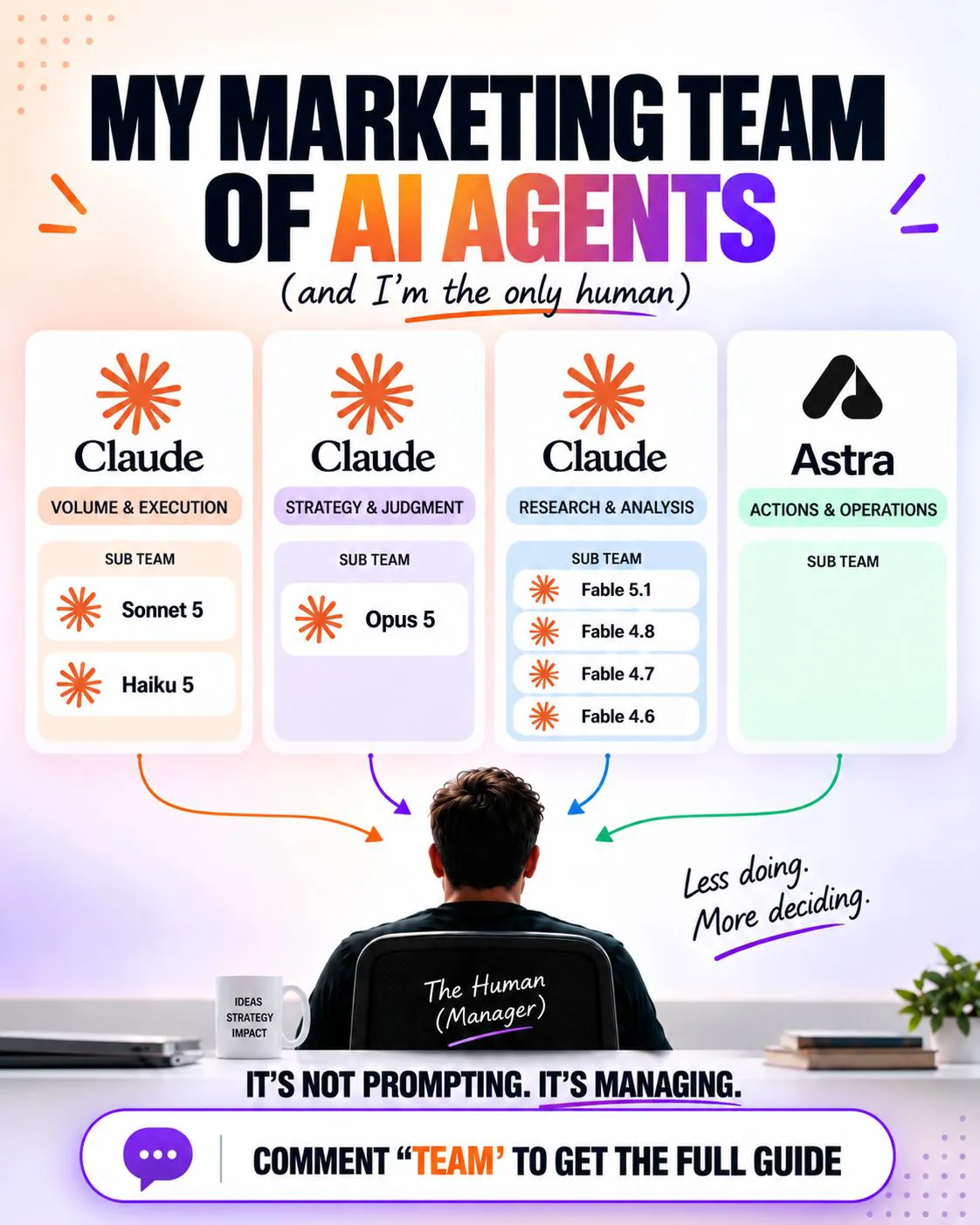
I split my own work in a similar way. One model plans, a separate agent executes, and a shared sheet acts as the task board and the approval gate between them. The routing is by job, not by habit.
Does a cheap filter actually save money?
Short answer: yes, when most items are easy and you escalate a small share. In a worked example of 10,000 search terms, Claude Haiku 5.5 as the filter plus Claude Opus 5.5 on 10% of terms costs about $14.75, against $140 for Opus on everything. Escalate everything and routing costs more than not routing.
The gap comes from list prices. On Anthropic's pricing page, read on 18 November 2026, Claude Haiku 5.5 costs $0.10 per million input tokens and $0.50 per million output tokens, while Claude Opus 5.5 costs $4 and $20. That is 40 times cheaper on both.
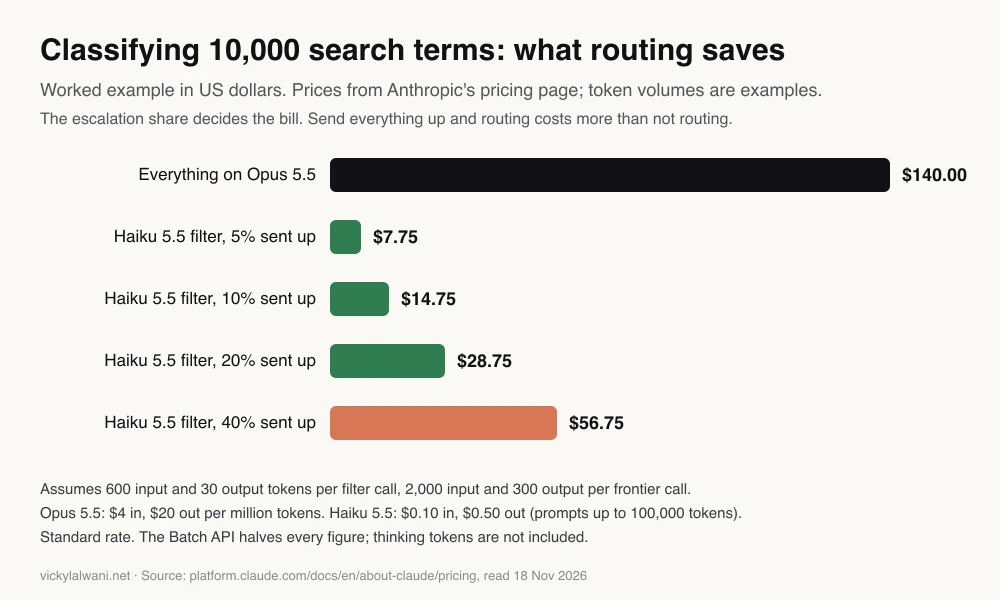
The example assumes each filter call sends 600 tokens (the term plus a short business description and labelling rules) and gets 30 back. Each frontier call sends 2,000 tokens, because the escalated terms get extra context such as landing page text and recent conversions, and gets 300 back. Re-do the sum with your own volumes.
| Setup (example) | Filter cost | Frontier cost | Total |
|---|---|---|---|
| Opus 5.5 on all 10,000 | None | $140.00 | $140.00 |
| Haiku 5.5, 5% sent up | $0.75 | $7.00 | $7.75 |
| Haiku 5.5, 10% sent up | $0.75 | $14.00 | $14.75 |
| Haiku 5.5, 20% sent up | $0.75 | $28.00 | $28.75 |
| Haiku 5.5, 40% sent up | $0.75 | $56.00 | $56.75 |
Two things in that table matter more than the totals. The filter itself is almost free, so the escalation share is the whole bill. And these numbers ignore the cost of mistakes, which is where the real money sits.
Anthropic makes the same point in its guide to optimising for cost and intelligence: the bill is decided by the tasks the cheaper model fails, because a failure bills its tokens, then the retry, then whatever it costs downstream. On a negative keyword list, the downstream cost of blocking a good term is lost leads, which never shows up on the AI invoice.
The same guide gives a useful sense of the quality gap. On the GPQA Diamond reasoning test, Claude Haiku 5.5 scored 85% against 91% for Opus 5.5 and Sonnet 5.5, at about a twentieth of Opus's cost per correct answer. For sorting search terms into three buckets, that gap is usually small. For judging whether a borderline term is a buyer, it is the whole point of escalating.
Which marketing jobs suit a cheap filter?
Short answer: jobs with high volume, a few clear labels and a small share of hard cases: search term review, inbound lead triage, review and comment sorting, and page-level content audits. Low-volume work, or work where every item needs judgement, rarely repays the extra moving parts.
| Job | Filter labels | What goes up | Human check |
|---|---|---|---|
| Search term review | Relevant, irrelevant, unsure | Unsure terms with spend | Approve negatives |
| Inbound leads | Spam, out of scope, real | Real leads for scoring and a reply draft | Before any reply sends |
| Reviews and comments | Praise, question, complaint | Complaints and urgent mentions | Every public response |
| Content audit | Fine, thin, outdated, broken | Pages flagged on money keywords | Before rewrites |
| RSA asset checks | Pass, fail on rules | Failures, for a rewrite | Before upload |
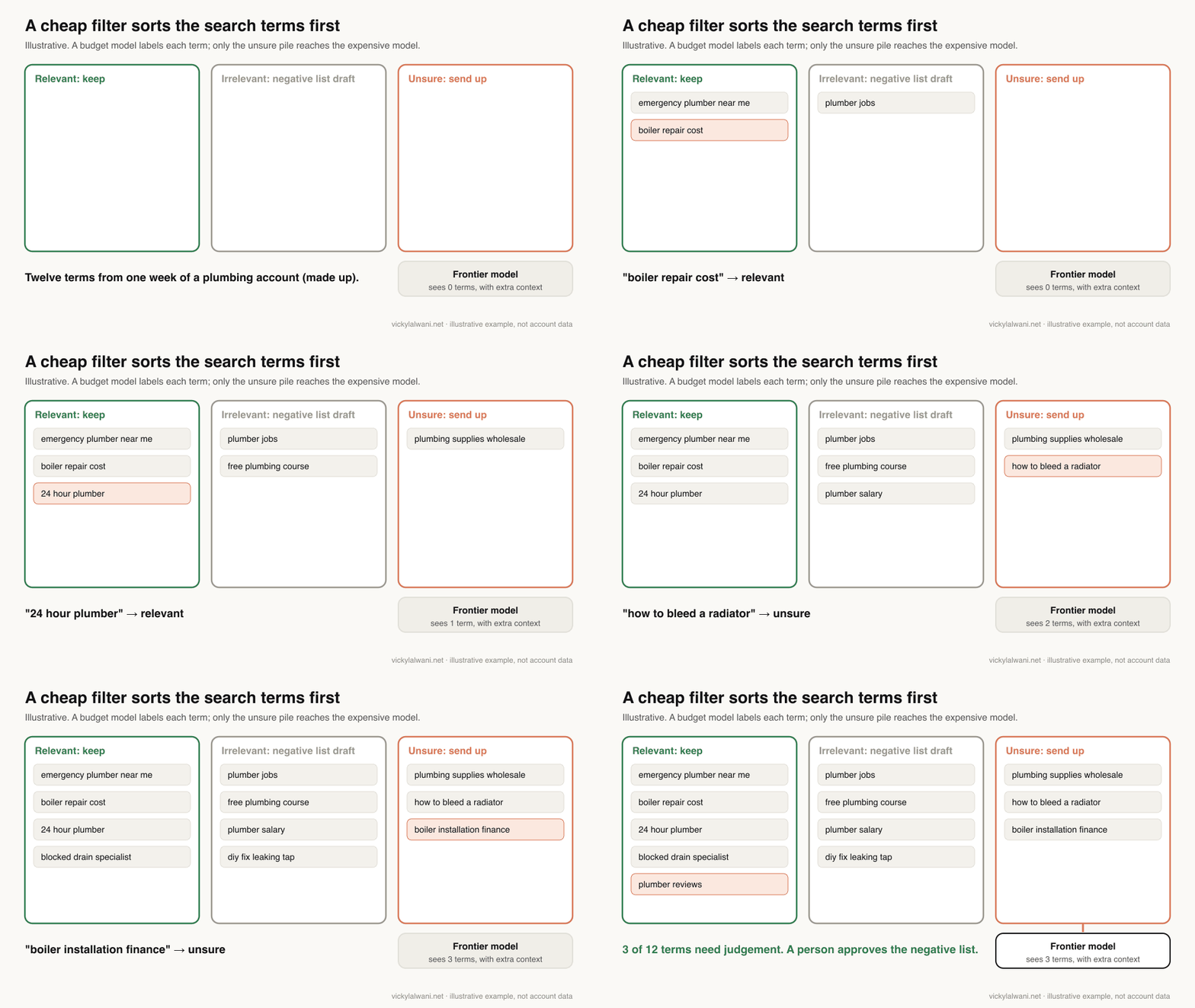
Search term review is the clearest fit. Google's search terms report lists the searches that triggered your ads, and most of them sort themselves. On r/PPC, one advertiser who has Claude scan search term reports and flag negatives for review had replies calling it a "high volume, low judgment" task, which is exactly the profile a filter is built for.
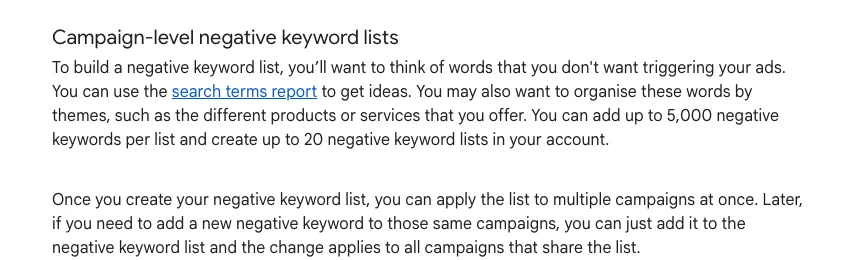
The output still has to fit how Google Ads works. Negative keywords do not match close variants, so you add synonyms and singular or plural forms yourself. A list holds up to 5,000 negative keywords, with up to 20 lists per account. Ask the filter for the exact match type and the variants, not just a yes or no.
Lead triage has one extra rule. Some filtering should not use a model at all. On one outreach project, the client pointed out that local rules did not allow marketing email to private individuals without consent. The first pass on that contact list became a plain rule that removes personal addresses before any model reads it. Put legal and policy rules in code, ahead of the filter.
How do you build a routing layer step by step?
Short answer: define three to five labels, write strict rules with examples, test the filter on a few hundred items you have already labelled, set an escalation threshold that keeps misses rare, then run it in shadow beside your current process before it touches a live account.
- Pick one job. Choose the highest-volume, lowest-judgement task you have. Search term review is a good first pick.
- Define the labels. Keep it to a few: relevant, irrelevant, unsure. "Unsure" is not a failure; it is the door to the expensive model.
- Put hard rules in code first. Brand terms, competitor names you bid on, consent rules and anything with a legal edge never reach the model.
- Write sharper instructions than you would for a big model. Small models follow rules well and infer poorly. Give your services, your exclusions and two examples of each label.
- Test on a labelled sample. Take 300 to 500 items you have already sorted by hand. Count where the filter disagrees with you, and which way.
- Set the threshold. Decide how confident the filter must be before it acts alone (next section).
- Run in shadow. For two to four weeks, let the filter suggest while your normal process decides. Compare.
- Monitor weekly. Sample the items the filter dismissed and track the escalation share.
Anthropic's own advice for any model change follows the same order: build a test set from real work, record cost per task beside the score, and run the winner in shadow on a slice of traffic before cutover. I do the same with agent workflows: I test them in my own workspace first and only move what works into a client's.
Here is a filter prompt you can adapt. It asks for a label, a confidence and the exact negative to add, so a script can act on the answer without guessing.
You label Google Ads search terms for one business. Reply with JSON only.

Business: [one paragraph: services, locations served, what you do NOT offer]
Never mark as irrelevant: [brand terms, core services, terms with conversions in the last 90 days]

For each search term return:
{"term": "...", "label": "relevant" | "irrelevant" | "unsure",
 "confidence": 0.0 to 1.0,
 "negative": "exact keyword to exclude, or empty",
 "match_type": "exact" | "phrase" | "broad" | "",
 "variants": ["singular or plural forms and synonyms to exclude too"],
 "reason": "under 12 words"}

Rules:
- Job seekers, courses, salary and DIY how-to searches are irrelevant unless listed above.
- Price, cost, finance and "near me" searches are relevant.
- If a term could be a buyer or could be research, label it unsure.
- If you are not sure, say unsure. Unsure is cheap; a wrong exclusion loses leads.

Search terms:
[paste 50 to 200 terms per request]
Keep each request well under 100,000 tokens. On Claude Haiku 5.5, a prompt over 100,000 tokens is billed at five times the base rates for the whole request. If the review can wait, Anthropic's Batch API takes 50% off every token and returns results within 24 hours.
How do you set the escalation threshold?
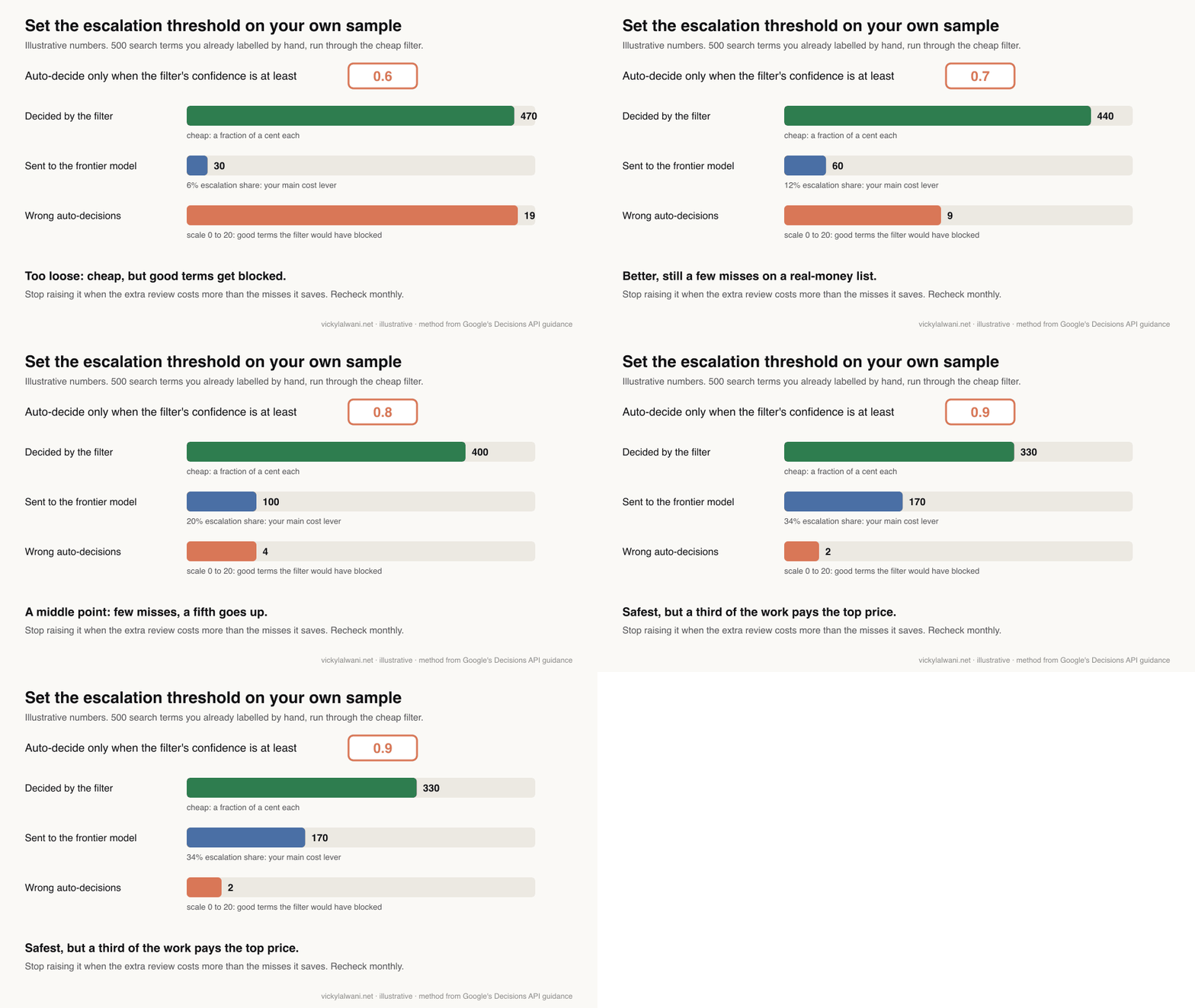
Short answer: run the filter on your labelled sample, then raise the confidence it needs before acting alone until the wrong automatic decisions are rare enough to accept. Stop when the extra escalations cost more than the misses they prevent, and recheck the setting monthly.
Google now sells a model built for exactly this step. Its Decisions API runs Gemini Decision 1, which answers yes or no, choice and score questions with calibrated probabilities and a confidence value, and generates no output tokens. On the Gemini API pricing page, its paid tier costs $0.10 per million input tokens with no output charge.
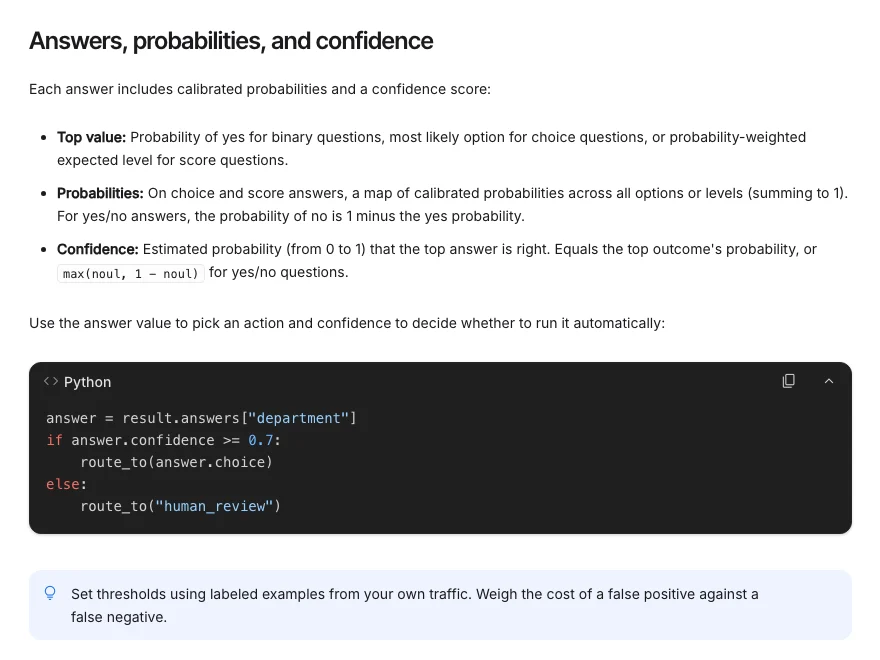
Google's guidance there is the right habit whatever model you use: set thresholds using labelled examples from your own traffic, and weigh the cost of a false positive against a false negative. For negative keywords, a false positive (blocking a buyer) usually costs far more than a false negative (one more wasted click), so lean towards escalating.
The same page warns that user-supplied text can argue for its own classification. That matters for lead and review triage, where the input is written by strangers. Keep explicit criteria in your instructions, test with a few hostile examples, and keep a person or a second check on anything that spends money or replies in public.
| Mistake type | Search terms example | Usual cost | Lean |
|---|---|---|---|
| False positive | Buyer term added as a negative | Lost leads, unseen | Escalate more |
| False negative | Junk term left running | A few wasted clicks | Catch it next week |
| Over-escalation | Easy terms sent up | Higher AI bill | Tighten rules |
Which models fit the filter and frontier roles in November 2026?
Short answer: for the filter, Claude Haiku 5.5 and GPT-6 Luna both cost $0.10 input and $0.50 output per million tokens, and Gemini Decision 1 costs $0.10 input with no output charge. For the escalated cases, Claude Sonnet 5.5 or Opus 5.5, GPT-6.2 Sol or Astra, and Gemini 4 Hydrogen or Argon are the usual picks.
| Role | Anthropic | OpenAI | |
|---|---|---|---|
| Filter | Haiku 5.5: $0.10 in, $0.50 out | GPT-6 Luna: $0.10 in, $0.50 out | Decision 1: $0.10 in, no output |
| Escalation | Sonnet 5.5: $2 in, $10 out | GPT-6.2 Sol: $2 in, $10 out | Gemini 4 Hydrogen: $1.50 in, $7.50 out |
| Hard cases | Opus 5.5: $4 in, $20 out | GPT-6.2 Astra: $8 in, $40 out | Gemini 4 Argon: $2 in, $10 out, then $4 and $20 from 1 Dec |
Prices are US dollars per million tokens at the standard rate, read on Anthropic's pricing page, OpenAI's API pricing page and Google's Gemini API pricing page on 18 November 2026. OpenAI describes GPT-6 Luna as its most efficient model for focused, high-volume tasks; Anthropic lists subagent tasks and high-volume processing among Haiku 5.5's uses.
Two practical notes. First, Google's Gemini 4 Argon and Carbon prices double on 1 December 2026, which is covered with the full lineup in the model-by-task article. Second, try the effort setting before switching model: Anthropic says tuning effort is often a better lever than switching models, and Haiku 5.5, Opus 5.5 and GPT-6 Luna all have effort levels.
What goes wrong with AI model routing?
Short answer: the filter is trusted without being measured, it is asked to do too much, it drifts as the account changes, or it is used on low-volume work where the saving is tiny. Each one is avoidable with a labelled test set, a weekly sample of dismissed items and a person approving changes.
- Trusting the filter unmeasured. In my own Claude work on a client's Google Ads audit, the AI flagged a keyword for pausing that was still bringing conversions. Since then every AI-sorted list I use carries a "Manual check" and a "Decision" column, and nothing changes in the account before approval.
- A filter that thinks too hard. If the filter prompt grows into a full analysis, you are paying for a second frontier model at a cheaper rate. Keep it to labels.
- Drift. New services, a new location or a seasonal offer change what "relevant" means. Update the business description whenever the account changes.
- Missing data. Google omits some low-volume search terms from the report for privacy, so no filter sees every query.
- Routing tiny jobs. On a few hundred items a month, run the strong model on everything and keep it simple.
- Words that look like junk. A thread on r/PPC warns to read the whole query before negating, because words like "free" or "template" can come from buyers. Tell the filter which of these words to mark unsure.
Anthropic's measurements are a useful brake on enthusiasm. In its tests, delegating to cheaper models came out ahead in only two situations: routine work with a long cost tail, and work too large for one context window. Where the work fitted in one context, a single model at lower effort did better. A search term filter is the first case; a single account audit usually is not.
For the wider picture of where AI saves money in paid search, my guide to reducing wasted Google Ads spend covers the checks a filter should feed, and human in the loop for Google Ads covers the approval step. Token habits that cut cost without any routing are in reducing Claude token usage.
Videos worth watching
Short answer: start with Google Cloud Tech's episode on choosing a model and a practitioner talk on cutting classification costs; both show the filter idea in practice. Vendor videos sell their own models, so take the model picks as examples, not verdicts.
Google Cloud Tech, 21 October 2026. A vendor channel discussing how to match models to tasks; it features Google's own models.
An AI evaluation practitioner's channel, 12 August 2026. Practical on classification costs; the description promotes a paid course.
| Video | Channel | Date | What it covers |
|---|---|---|---|
| Which model should I use? | Google Cloud Tech | 21 Oct 2026 | Matching models to tasks |
| Cut LLM classification costs by 90% | AI evals practitioner | 12 Aug 2026 | Cheaper classification |
| Fable 5.2 or Opus? | Claude | 11 Nov 2026 | When to use each Claude model |
| Building a custom evaluation | Google Cloud Tech | 12 Nov 2026 | Testing an agent on your data |
| 3 ways to design your agentic system | Google Cloud Tech | 5 Nov 2026 | Single, routed and multi-agent designs |
| What Comes After Loops? | OpenAI | 10 Nov 2026 | Agent architecture |
What people say on X and Reddit
Short answer: practitioners like splitting work across models, but the careful ones add two warnings: every classification call costs something, so routing can cost more than it saves, and cheap models fail on nuance that looks easy. On r/PPC the consensus is that AI can draft negatives, but a person reads the query first.
| Who | What they said | Take it as | Link |
|---|---|---|---|
| An AI engineering educator | Easy requests go to cheap models, but routing adds its own cost (7 Oct 2026) | Opinion | X post |
| A product and AI practitioner | Tested Haiku 5.5, Sonnet 5.5 and Opus 5.5 on planted bugs, with cost per model (8 Oct 2026) | First-hand | X post |
| A developer | Used a cheap model to fan out review across about 10,000 files (10 Oct 2026) | First-hand | X post |
| OpenRouter | Switching model at the decision point reduces self-preference bias (8 Jun 2026) | Vendor | X post |
| Claude (official) | Haiku 5.5 is built for high-volume classification and subagent work (7 Oct 2026) | Vendor | X post |
| r/PPC | Claude flags negatives for review; replies call it high volume, low judgement (18 Jul 2026) | First-hand | Thread |
| r/PPC | With AI Max on, far more distinct queries; you cannot negate a query before you see it (31 Aug 2026) | First-hand | Thread |
| r/PPC | Read the whole query before negating; a three-check rule before any exclusion (12 Nov 2026) | Opinion | Thread |
| r/ClaudeAI | A task-to-model routing table in the repo; easy-looking tasks can hide hard nuance (25 Jul 2026) | First-hand | Thread |
| r/MachineLearning | Weaker models near frontier on checkable tasks; retries can wipe out savings (10 Jun 2026) | Mixed | Thread |
The AI Max thread is worth a second look. If a broader matching setting multiplies the number of distinct queries an account sees, the volume case for a filter gets stronger, and so does the case for reviewing more often.
Where this advice is weak
- The cost example uses invented token volumes. Your prompts, context and output length will move every figure, and thinking tokens are not included.
- The threshold animation uses illustrative numbers. Only your own labelled sample can tell you where the threshold should sit.
- Vendor measurements, including Anthropic's GPQA figures and Google's calibration claims, come from the vendors. Treat them as starting points to test.
- Gemini Decision 1 and the Decisions API sit on Google's v1beta API, and the page says they do not support batch processing or context caching.
- Prices were read on 18 November 2026 and change often. Check the vendor pages before you budget.
Want a routing layer built around your account?
Short answer: start with one job this month, usually search term review, and measure the escalation share and the misses for four weeks. If you want help designing the filter, the threshold and the approval step around your own Google Ads data, that is what my AI automation service does.
My AI automation work covers the design, the testing on your labelled data and the weekly monitoring. If the bigger problem is the account itself, my Google Ads management service starts with an audit in a sheet that you approve before anything changes. Prices are on the pricing page, and the free AI Marketing Model Routing Map has the task table and budget framework.
Sources
| Source | What it supports | Date | Link |
|---|---|---|---|
| Anthropic, Pricing | Haiku 5.5, Sonnet 5.5, Opus 5.5 prices; 100K rule; batch 50% | Read 18 Nov 2026 | Page |
| Anthropic, Choosing a model | Combine models; effort before switching | Read 18 Nov 2026 | Page |
| Anthropic, Optimizing for cost and intelligence | Failures decide the bill; GPQA figures; shadow runs; when delegation wins | Read 18 Nov 2026 | Page |
| OpenAI, API pricing | GPT-6 Luna, GPT-6.2 Sol and Astra prices | Read 18 Nov 2026 | Page |
| OpenAI, GPT-6 Luna | Role: focused, high-volume tasks | Read 18 Nov 2026 | Page |
| Google, Gemini API pricing | Decision 1, Gemini 4 Hydrogen and Argon prices | Read 18 Nov 2026 | Page |
| Google, Decisions API | Confidence, thresholds, untrusted input, limits | Read 18 Nov 2026 | Page |
| Google Ads Help, negative keywords | No close variants for negatives | Read 18 Nov 2026 | Page |
| Google Ads Help, negative keyword lists | 5,000 per list, 20 lists | Read 18 Nov 2026 | Page |
| Google Ads Help, search terms report | Low-volume terms omitted for privacy | Read 18 Nov 2026 | Page |
| X and Reddit posts | Practitioner views, listed above | Jun to Nov 2026 | See table above |
This article expands on my post on LinkedIn ↗.
FAQ
What is AI model routing?
AI model routing is a design where a cheap, fast model handles the first pass on every request and passes only difficult or high-value cases to a more capable and more expensive model. It suits high-volume marketing jobs such as search term review, lead triage and review sorting.
How much can AI model routing save?
It depends on the share of items you escalate. In a worked example of 10,000 search terms at November 2026 list prices, a Claude Haiku 5.5 filter that sends 10% of terms to Claude Opus 5.5 costs about $14.75, against $140 for running Opus on everything. If almost everything is escalated, routing costs more than not routing.
Does routing reduce quality?
Not if the filter is tested and tuned towards escalating. The risk is a cheap model wrongly dismissing something important, such as a buyer search term added as a negative keyword. Measure its misses on a few hundred items you have already labelled by hand before you rely on it.
Which AI model is best as a cheap filter?
In November 2026, Claude Haiku 5.5 and GPT-6 Luna both cost $0.10 per million input tokens and $0.50 per million output tokens. Google's Gemini Decision 1 costs $0.10 per million input tokens with no output charge and returns a confidence value with each answer. Test each on your own labelled sample.
How do I set the escalation threshold?
Run the filter on a labelled sample and record its confidence for each item. Raise the confidence it needs before acting alone until wrong automatic decisions are rare enough to accept, and stop when extra escalations cost more than the misses they prevent. Recheck the setting monthly.
Can AI choose negative keywords in Google Ads?
AI can draft a negative keyword list, but a person should approve it before it goes live. Google Ads negative keywords do not match close variants, so the draft must include synonyms and plural forms, and each list holds up to 5,000 negative keywords with up to 20 lists per account.
Where does routing help marketers?
Anywhere there is high volume and a small share of items that need deep thought, such as search terms, inbound leads, reviews, comments and page-level content audits. Low-volume jobs rarely repay the extra setup, so run the strong model on everything there.
When should I not use AI model routing?
Skip it when volume is low, when every item needs judgement, or when the work is one dependent chain such as a single account audit. Anthropic's measurements found delegating to cheaper models came out ahead mainly on routine work with a long cost tail and on work too large for one context window.