AI prospecting works when AI researches companies and drafts, and a person decides who to contact. Check the law first: the Spam Act 2003 (ACMA) needs consent before marketing email, PECR (ICO) allows email to companies but not to individuals or sole traders without consent, and CAN-SPAM (FTC) applies to B2B email with strict opt-out rules. Never buy lists or scrape personal data.
TL;DR. AI prospecting works for an SEO or PPC consultant when AI does the research and a person decides who to contact and what to say. Check the email law for each market before the first send: Australia's Spam Act needs consent first, the UK's PECR lets you email companies but not individuals or sole traders without consent, and the US CAN-SPAM Act runs on opt-out but makes no exception for business email. Never buy lists or scrape personal contact details. Use AI to find a true, specific reason to write, block any generic draft, send from a separate warmed domain, and start with people who already know you.
You are an SEO or PPC consultant, or a small agency, and referrals have gone quiet. Content takes months. Someone suggests outbound: buy a tool, import a list, let AI write the emails. Six weeks later there are a handful of polite refusals, a sending domain with a damaged reputation, and possibly a breach of the email law in the country you wrote to.
The tools were never the problem. The missing pieces are the rules and the research. This guide, rewritten on 18 November 2026, sets out the consent rules as the regulators state them, then a build order for AI-assisted outreach that is aimed at winning SEO and PPC clients. If you want the research and checks built for you, my AI automation service covers it.
This is general information from the regulators' published guidance, not legal advice. Before you email people in a new country, check with a lawyer who knows that market.
What is AI prospecting, and what should it do for a consultant?
Short answer: AI prospecting is using AI to research companies, find a specific reason to contact them and draft a first message for a person to check. For an SEO or PPC consultant, the reason should be something true and visible about the prospect's search presence, such as their ads or their site, not a mail merge with their first name.
The useful split is simple. AI is good at reading public pages, summarising what it finds and drafting. A person is still better at deciding whether this company is a fit, whether the finding is worth a stranger's time, and whether you are allowed to email them at all.
| Job | AI does | You do |
|---|---|---|
| Who to look at | Shortlist by sector, area, ads | Decide the fit |
| Why now | Read their site and ads | Check the finding is true |
| First draft | Write 3 short versions | Pick, edit or bin |
| May I send? | Flag the market and type | Confirm consent rules |
| Replies | Sort and summarise | Answer every person |
What do the email consent laws say before you send?
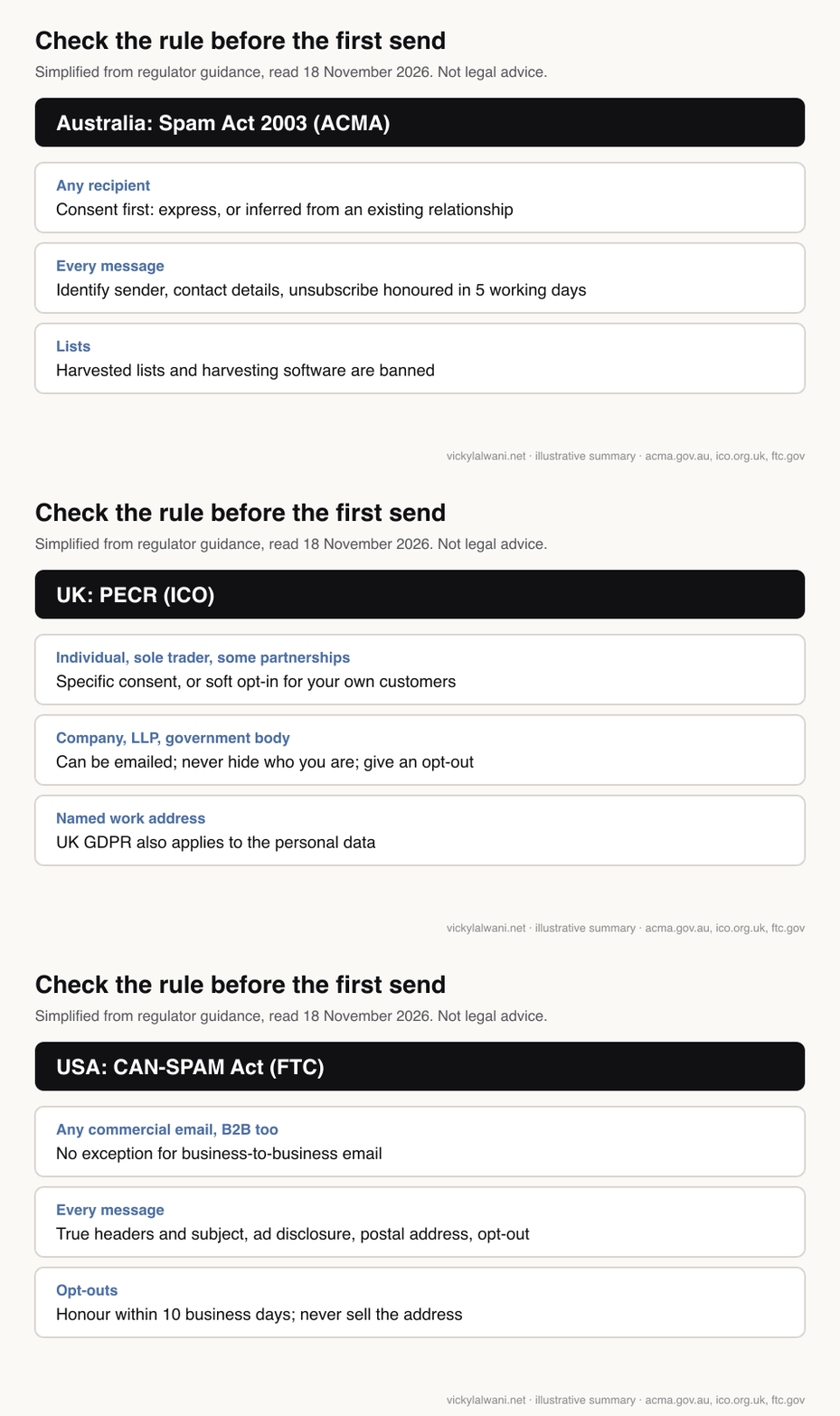
Short answer: They differ sharply. The Spam Act 2003, enforced by ACMA, requires consent before any marketing email. PECR, enforced by the ICO, requires consent for individuals and sole traders but allows email to companies. The CAN-SPAM Act, enforced by the FTC, has no prior-consent rule but applies to business email and sets strict content and opt-out rules.
| Law | Cold email to a company? | Must include | Opt-out |
|---|---|---|---|
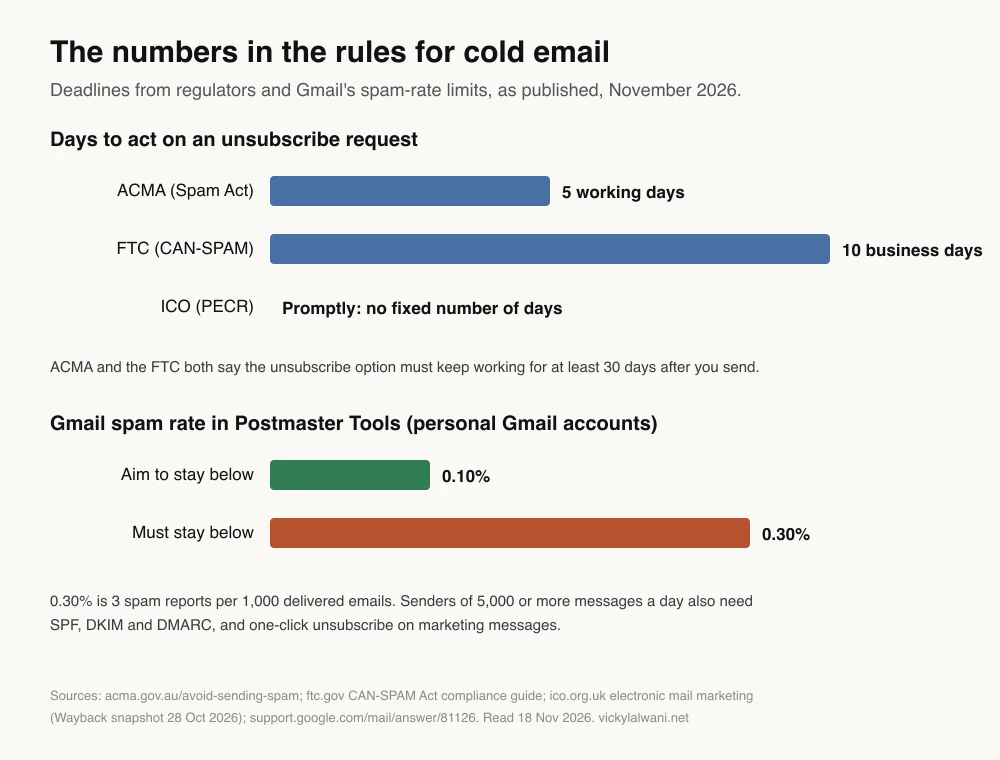
| Spam Act 2003 (ACMA) | Consent first | Sender, contact details | 5 working days |
| PECR (ICO) | Yes, to corporate bodies | Who you are, contact address | Promptly |
| CAN-SPAM (FTC) | Yes, with full compliance | Ad notice, postal address | 10 business days |
The Spam Act 2003 (ACMA)
For Australian recipients, ACMA's page Avoid sending spam says that if you plan to send marketing messages or emails, you must first have consent from the person who will receive them, even if someone else sends them for you. Consent is either express (a form, a ticked box, by phone or face to face) or inferred from an existing relationship where the marketing relates to that relationship.
Three details matter for outbound. You cannot send an email to ask for consent, because that email is itself marketing. It is up to you to prove consent, so keep a record of who gave it, when and how. And the page makes no exception for business addresses, so plan on consent first when you write to Australian companies.
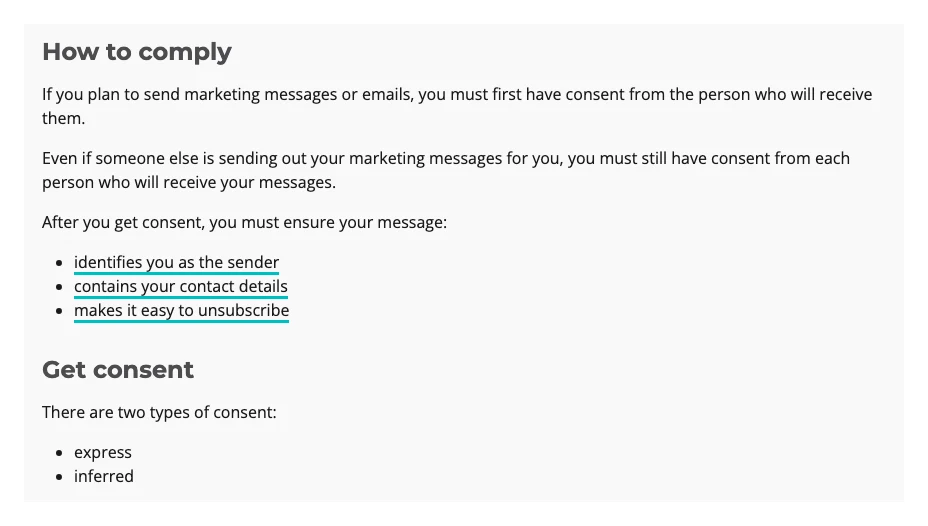
Every message must identify you, with your legal business name or your name and ABN, and contact details that stay correct for 30 days. The unsubscribe option must be clear, free, work for at least 30 days and be honoured within 5 working days. If someone tells you a published work address counts as consent, ACMA's business guidance does not say so; get legal advice before you rely on it.
PECR (ICO)
For UK recipients, the ICO's guidance on electronic mail marketing says you must not send marketing emails to individuals without specific consent, apart from the soft opt-in for your own previous customers. You can email corporate bodies: companies, limited liability partnerships, Scottish partnerships and government bodies.
The trap for consultants is that sole traders and some partnerships count as individuals, so many small local businesses, a typical SEO or PPC prospect, need consent. The ICO also says the soft opt-in does not apply to prospective customers or contacts from bought-in lists, and that the same rules apply to direct messages on social media. And when you email named employees at a company, the ICO says you may also need to consider data protection law, which means UK GDPR.
Two changes to watch. The ICO notes that the guidance is under review after the Data (Use and Access) Act 2025, and its summary of the PECR changes says the Act brings PECR enforcement and penalties into line with UK GDPR in most cases. Keep a do-not-email list and screen every new list against it, as the ICO's checklist asks.
The CAN-SPAM Act (FTC)
For US recipients, the FTC's CAN-SPAM compliance guide lists no prior-consent requirement, but it says plainly that the law makes no exception for business-to-business email. Each email in breach can carry a penalty of up to $53,088.
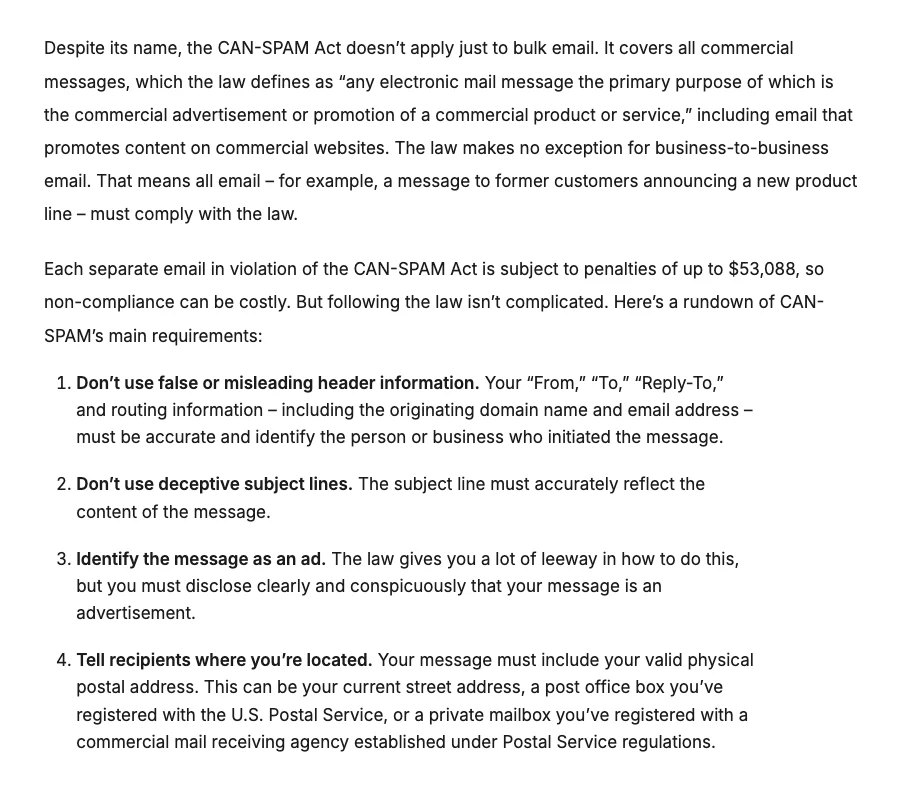
Every commercial email needs accurate header and sender details, a subject line that matches the content, a clear notice that it is an advertisement, your valid physical postal address and a clear way to opt out. Opt-outs must work for 30 days and be honoured within 10 business days, and you cannot sell or pass on the address afterwards. You stay responsible if a tool or agency sends for you.
Why not buy a list or scrape contact details?
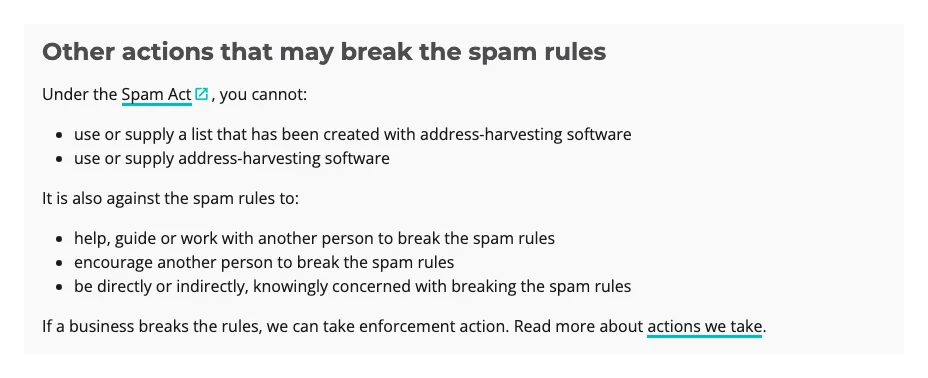
Short answer: Because all three regulators put the risk on you. ACMA bans using lists made with address-harvesting software, the ICO says the soft opt-in never covers bought-in lists, and the FTC lists harvesting addresses as an aggravated violation with criminal penalties. A bought list also gives you no reason to write.
ACMA tells businesses to take care when they buy or use a marketing list, because they remain responsible for consent for every address. Its page on common issues and mistakes adds that businesses cannot outsource their obligations by buying lists from external providers.
AI makes this easier to get wrong, not harder. Ask an agent to "find 500 local trades businesses with emails" and it will happily gather sole traders' personal addresses from directories and social profiles. On one client project, the client had to point out the local consent rules before anything was sent: my AI-built prospect list mixed company addresses with what could have been private individuals. We washed the list, kept one sheet per company, and the client reviewed every email before it went out. The lesson I took: ask about the rules for individuals versus businesses in each new market before any list is built.
| Source of names | Risk | Use it? |
|---|---|---|
| Bought contact list | Consent unproven | No |
| Scraped or harvested emails | Banned or aggravated | No |
| Past clients and old enquiries | Check consent or soft opt-in | Yes, first |
| People who opted in | Low, if recorded | Yes |
| Company research, no personal data | Low | Yes, for the reason |
Where do prospects come from without buying lists?
Short answer: Start with people who already know you: past clients, old enquiries and open quotes, then referrals and partners, then people who opt in through your content or events. Use AI to research companies, not to harvest people, and contact them only through a route the law in their market allows.
On a client project where the brief was "quick sales", the fastest revenue sat in data the business already held: win-back emails to past customers and chasing quotes that had gone quiet came before any cold outreach. For a consultant, the same list is old enquiries that never signed, past clients who paused, and partners such as web designers who see search problems every week.
- Your own history. Lapsed clients and old enquiries, checked against the consent or soft opt-in rule for their market.
- Referral partners. Web developers, accountants and agencies without a search specialist. One warm introduction beats a sequence.
- Opted-in audiences. A newsletter, a free audit request form or an event sign-up, with the consent wording and date saved.
- Company research for the reason. Public company pages, their ads and their site, used to write one specific note, sent only where the law allows it.
The research layer is where AI earns its keep for SEO and PPC prospects, because the evidence is public. Google's Ads Transparency Center shows a company's ads, and PageSpeed Insights tests any public page. A consultant who opens with "your three service ads all point to one generic page" is offering a free finding, not a pitch. My Google Ads and SEO service pages show the kind of work those findings lead to.
Research one company for an SEO and PPC prospecting note. Use only public
company pages: their website and Google's Ads Transparency Center.
Do not collect any person's name, email or phone number.

Company: [name and website]
Return:
1. What they sell and where (from their own site).
2. Up to 3 search findings a stranger could check in 2 minutes, each with
   the URL that proves it (for example: ads running for a service that has
   no matching page; location pages with old opening hours; a slow mobile
   home page in PageSpeed Insights).
3. The single strongest finding and why it may cost them leads.
4. Anything that suggests they are a sole trader or a very small business.
If you cannot verify a finding, say so and leave it out.
What is the build order for AI outbound prospecting?
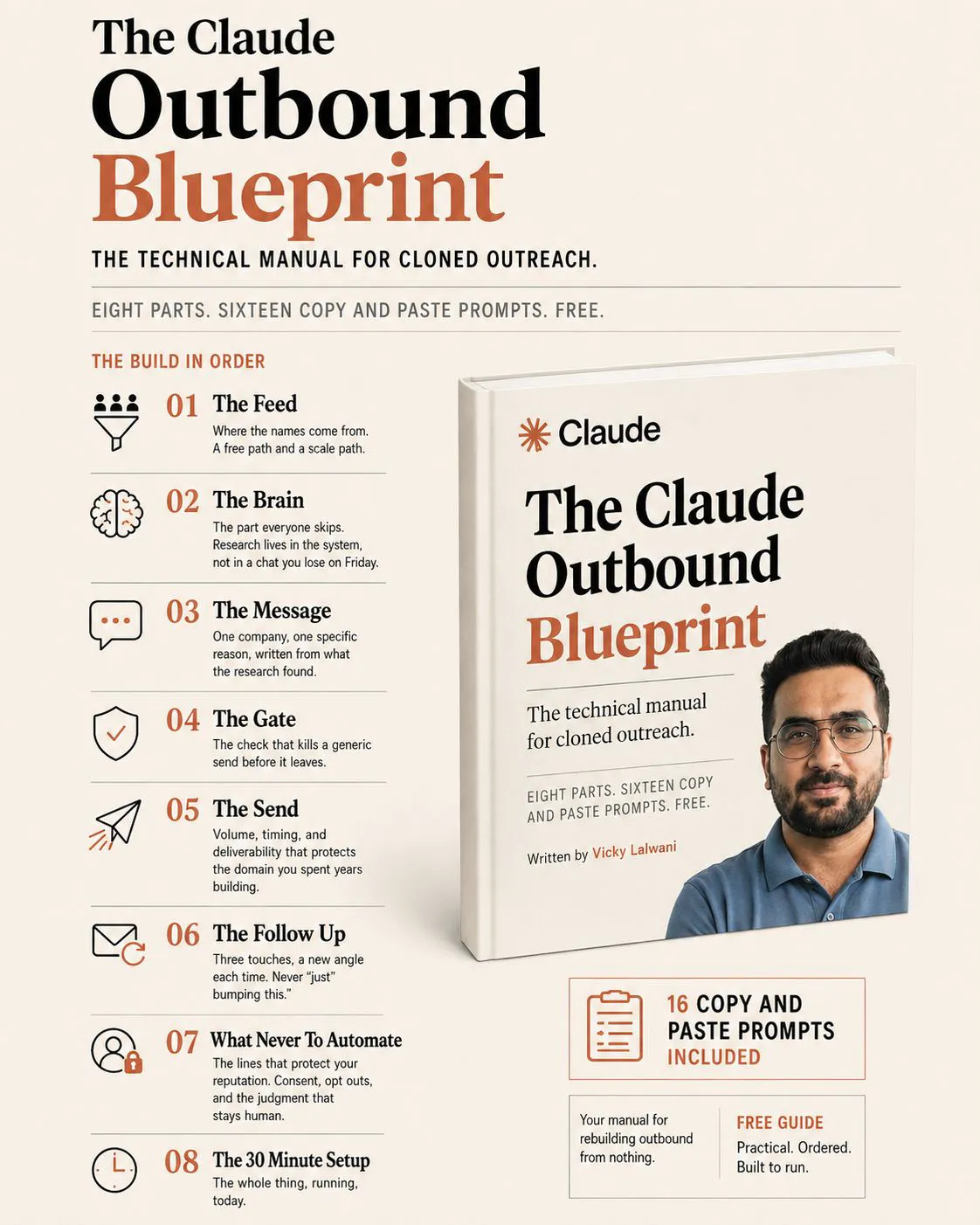
Short answer: Eight parts, in order: a lawful source of names, a research store you own, a message tied to one finding, a quality gate that blocks generic drafts, careful sending from a separate domain, short follow-ups with a new angle, a list of things never automated, and a small working version before you scale.
| Part | What it is | AI's role |
|---|---|---|
| 1. Source | Lawful, recorded | None; you decide |
| 2. Research store | One sheet per company | Fills findings |
| 3. Message | One finding, one ask | Drafts versions |
| 4. Gate | Tests before sending | Runs the checklist |
| 5. Send | Separate warmed domain | Schedules |
| 6. Follow-up | New angle each time | Drafts |
| 7. Never automate | Consent, opt-outs, judgement | None |
| 8. Small version | A few companies a day | Measures |
The research store is the part most stacks skip. Findings belong in a sheet or database you own, with the URL behind each one and the date checked, not in a chat someone loses on Friday. If you want to automate the research on a schedule, my guide to scheduled marketing automation shows how, and the founder's plan for AI automation covers where outbound fits among other jobs.
What does the quality gate check?
Short answer: Every draft must name something true and specific about this company, give one reason to write now, make sense to no other company with the name swapped, and carry the identity and opt-out details the market's law requires. If any test fails, the draft is blocked, not softened.
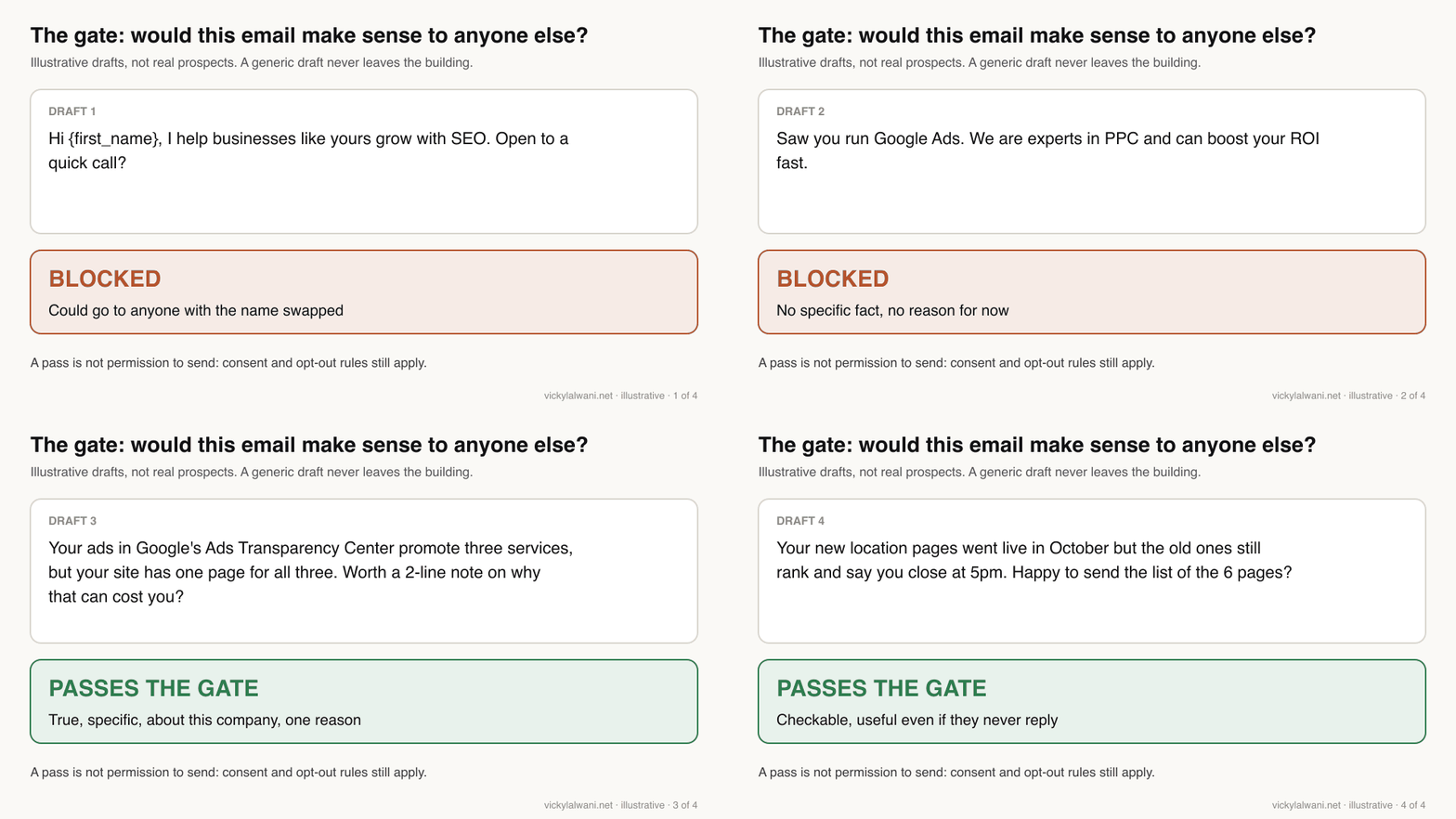
Act as the quality gate for this outreach draft. Answer each test with
PASS or FAIL and one line of evidence. Do not rewrite the draft.

1. Does it state a fact about this company that I can check at a URL?
2. Would it still make sense if sent to a different company? (must be NO)
3. Is there exactly one reason to write now, and one small ask?
4. Is it free of claims I cannot prove (guarantees, rankings, "experts")?
5. For the recipient's market, does it include what the law requires:
   sender identity, contact details, an opt-out, and for US recipients a
   postal address and an advertisement notice?
6. Is the recipient a company we are allowed to email in that market,
   or a sole trader or person who needs consent? If unsure, FAIL.

Verdict: SEND or BLOCK. Any FAIL means BLOCK.
A pass does not mean the email will land well. It means the email is defensible: true, specific and lawful. The final read is still yours.
How do you protect your sending domain?
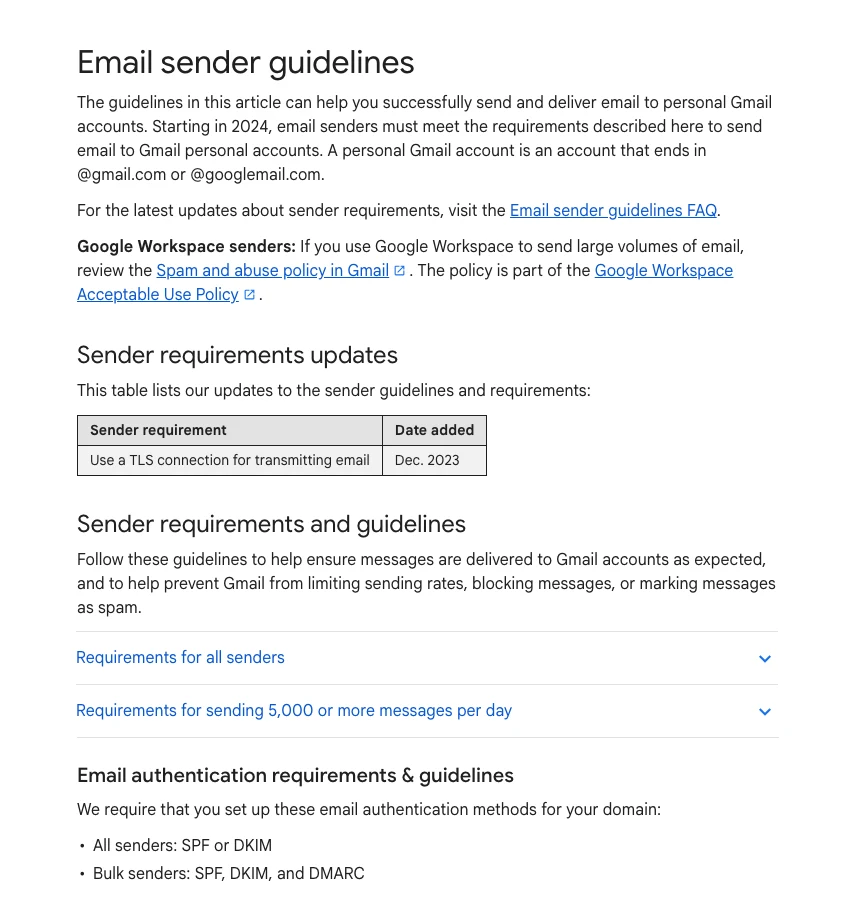
Short answer: Never send cold outreach from the domain your invoices and client emails use. Send from separate, clearly related domains, set up SPF, DKIM and DMARC, warm the mailboxes before any campaign, keep volumes low, and stop when bounces or spam reports rise. Gmail asks senders to keep the spam rate below 0.3%, ideally below 0.1%.
Google's email sender guidelines apply to mail sent to personal Gmail accounts: all senders need SPF or DKIM, and senders of 5,000 or more messages a day need SPF, DKIM and DMARC plus one-click unsubscribe on marketing messages. A spam rate of 0.3% is three reports per 1,000 emails, which a careless sequence can reach in a day.
On client outreach projects my rule is fixed: separate sending domains, never the main one, with mailboxes warmed for weeks before the first campaign. I also put a simple one-page site on each sending domain, so anyone who checks it sees a real business. One practical snag I have hit: a launch stalled because nobody on the marketing side had registrar or DNS access to the newly bought domains. Confirm who controls DNS before you buy.
| Setting | Default | What to choose |
|---|---|---|
| Sending domain | Main domain | Separate, related domain |
| Authentication | Often missing | SPF, DKIM and DMARC |
| New mailboxes | Send at once | Warm for weeks first |
| Daily volume | Tool maximum | Small, steady |
| First email | Links and images | Short plain text |
| Unsubscribe | Hidden or missing | Clear, honoured fast |
How many follow-ups, and how do you measure outbound honestly?
Short answer: Two or three follow-ups at most, each with a new, useful angle, never "just bumping this". Judge outbound by reply quality, conversations started, bounces, spam reports and unsubscribes, not by volume sent or open rates.
Each follow-up should add something: a second finding, a short example of how a similar fix is usually approached, or a plain close ("I will not write again"). Stop at once when someone opts out, and keep that record so they never reappear in a later list.
| Signal | Healthy | Act when |
|---|---|---|
| Real conversations | Rising slowly | Zero after weeks |
| Bounces | Rare | Rising: clean the list |
| Spam reports | Near zero | Near 0.1%: stop |
| Unsubscribes | Honoured fast | Any delay |
| Your own read | Glad to receive it | You would not be |
Review a sample of sent emails every week as if you were the recipient. If you would not be pleased to get it, tighten the gate rather than adding volume.
What should never be automated?
Short answer: Consent decisions, opt-out handling, the choice of who to contact, anything that touches a sensitive situation, and replies to real people. AI can draft and flag; a person decides and answers.
- Consent and market rules. An agent cannot tell a sole trader from a company reliably, or know the rule in a market you have not checked.
- Opt-outs. They must be honoured within the legal deadline and recorded. Automate the suppression, but a person owns the list.
- Who to contact. The fit decision and the "would this annoy them" decision stay with you.
- Replies. A prospect who answers deserves a person. Use AI to summarise the thread, not to hold the conversation.
- Final send approval. When outreach goes out under a client's name, the client should review the emails before they go, as one of mine did.
Where this advice is weak
Short answer: Law changes and this is not legal advice; the ICO's guidance is under review; regulators' pages are summaries, not the Acts; and the deliverability habits here are common practice, not guarantees.
- Not legal advice. The rules above are what each regulator's guidance page says on 18 November 2026. The Acts themselves contain detail these pages leave out.
- UK changes. The ICO says its email marketing guidance is under review after the Data (Use and Access) Act 2025. I read the guidance through an archived copy dated 28 October 2026, because the live site blocks automated readers.
- Other markets. Every other country has its own rules, and they do not follow these three. Check each market before the first send.
- Deliverability. Warm-up length, daily volumes and plain-text first emails are working habits shared by many senders, not published rules. Gmail's thresholds are the only hard numbers.
- Results. No reply rates or client outcomes are given, because I will not quote figures I cannot show you.
What people say on X and Reddit
Short answer: Cold email practitioners agree on separate warmed domains and on the uselessness of bought lists. The bigger split is speed: some show campaigns built in minutes with AI, while practitioners on r/coldemail report that AI enrichment repeats the same generic angles and that recipients can tell when they were scraped.
| Source | Date | Point | Type |
|---|---|---|---|
| A cold email agency founder on X | 22 Sep 2026 | Everything on secondary domains, 2 to 3 inboxes each, warmed first | Practitioner |
| The same founder on X | 15 Nov 2026 | Deliverability matters even to opted-in lists; cold is harder | Practitioner |
| A lead generation firm on X | 31 Oct 2026 | A bought list: 1,000 contacts, no reasons to reply | Vendor |
| A growth marketer on X | 31 Jul 2026 | A campaign built in minutes with Claude Code and a sending tool | Opinion |
| r/coldemail | 26 May 2026 | AI enrichment kept hitting the same generic angles; human research lifted replies | First-hand |
| r/coldemail | 29 May 2026 | A 3-day-old domain will land in spam; set up DNS, warm for weeks | First-hand |
| r/coldemail | 1 Jun 2026 | Bought lists are poor for niche markets; build your own | Opinion |
| r/coldemail | 23 Dec 2025 | A manager blocked cold email over data law; replies split by market | Opinion |
| r/coldemail | 25 Apr 2026 | Recipients can tell when they were scraped into a sequence | Opinion |
The r/coldemail thread on reply rates is the most useful for consultants: its author found AI enrichment kept producing the same generic angles, and only real research per prospect changed the replies. The fast-build post on X is a useful counterpoint: the tooling really is that quick now. What it does not show is the consent check or the research behind each message, which is exactly the part this guide argues should take the time.
Videos worth watching
Short answer: Start with the FTC's own short video on CAN-SPAM, then a UK explainer on PECR and UK GDPR for B2B email, and a law firm's breakdown of an ACMA penalty case. Vendor videos on infrastructure are useful but sell tools.
The FTC's official channel, 21 July 2011. The seven CAN-SPAM requirements. Old but from the regulator; check current penalty amounts in the written guide above.
A UK sales software company's channel, 6 October 2026. Corporate subscribers, sole traders and UK GDPR for B2B email. Made by a vendor.
An Australian law firm's channel, 7 July 2026. How routine order emails led to an ACMA penalty. The firm offers legal services.
| Video | Channel | Date | Covers |
|---|---|---|---|
| Complying with the CAN SPAM Act | FTC (official) | 21 Jul 2011 | The 7 requirements |
| Is Cold Email Legal in the UK? | A sales software vendor | 6 Oct 2026 | PECR and UK GDPR |
| ACMA Compliance Explained | An Australian law firm | 7 Jul 2026 | A Spam Act penalty |
| Cold Email Infrastructure | A sales training channel | 3 Nov 2026 | Domains, DMARC, warm-up |
| The 0.3% Spam Rate | An email API vendor | 17 Sep 2026 | Gmail sender rules |
| Deep-Personalized Cold Emails with Claude Code | A cold email tool vendor | 19 Apr 2026 | The volume approach; sells its tool |
Want help building the research layer?
Short answer: If you want AI to research prospects, draft notes and run the gate while you keep the decisions, my AI automation service builds that, with the consent checks for each market written in. Prices are on the pricing page.
Before you buy any tool, write your gate rules and test them by hand on twenty companies. If most drafts fail, the problem is the research, not the sending. And if you are weighing up how to sell your own search services, my comparison of freelance consultants and agencies covers how clients choose.
Sources
| Source | Supports | Date |
|---|---|---|
| ACMA: Avoid sending spam | Consent first, identity, 5 working days, harvesting ban, lists | Read 18 Nov 2026 |
| ACMA: common issues and mistakes | Cannot outsource obligations by buying lists | Read 18 Nov 2026 |
| ICO: Electronic mail marketing | Individuals, sole traders, corporate bodies, soft opt-in, social DMs | Archived 28 Oct 2026 |
| ICO: DUAA changes to PECR | Enforcement in line with UK GDPR | 19 Jun 2025 |
| FTC: CAN-SPAM compliance guide | No B2B exception, requirements, $53,088, 10 business days, harvesting | Read 18 Nov 2026 |
| Gmail: Email sender guidelines | SPF, DKIM, DMARC, 5,000 a day, 0.1% and 0.3% | Read 18 Nov 2026 |
| Google Ads Transparency Center | Public view of a company's ads | Read 18 Nov 2026 |
| PageSpeed Insights | Public page speed test | Read 18 Nov 2026 |
| X posts and Reddit threads above | Practitioner views | Jul 2026 to Nov 2026 |
| YouTube videos above | Explainers and vendor views | Jul 2011 to Nov 2026 |
This article expands on my post on LinkedIn ↗.
FAQ
What is AI prospecting?
AI prospecting is using AI to research companies, find a specific reason to contact them and draft a first message that a person checks before it is sent. It works when the research is real and a person decides who to contact; without that, it produces generic email faster.
Is cold email legal under the Spam Act 2003?
ACMA's guidance says you must have consent from each person before you send marketing emails, either express or inferred from an existing relationship, and it makes no exception for business addresses. You also cannot send an email to ask for consent, and every message needs your identity, contact details and an unsubscribe honoured within 5 working days.
Can I cold email businesses under PECR?
The ICO says you can send marketing emails to corporate bodies such as companies, LLPs and government bodies, as long as you say who you are and give a way to opt out. Sole traders and some partnerships count as individuals, so they need specific consent or the soft opt-in for your own customers.
Does the CAN-SPAM Act apply to B2B email?
Yes. The FTC says the law makes no exception for business-to-business email, so every commercial message needs accurate headers, an honest subject line, an advertisement notice, a physical postal address and an opt-out honoured within 10 business days. Each email in breach can carry a penalty of up to $53,088.
Is it legal to buy an email list for cold outreach?
Buying a list does not transfer the legal risk: ACMA says you are still responsible for consent for every address, the ICO says the soft opt-in never covers bought-in lists, and the FTC treats harvested addresses as an aggravated violation. A bought list also gives you no specific reason to write, so it rarely produces good conversations.
How can AI help an SEO or PPC consultant find clients?
AI can read a prospect's public pages and ads, list findings a stranger could check, such as ads with no matching landing page or slow mobile pages, and draft a short note around the strongest one. A person then checks the finding, confirms the consent rules for that market and decides whether to send.
Should cold email go out from my main domain?
No. Send from separate, clearly related domains with SPF, DKIM and DMARC set up, and warm the mailboxes before any campaign. Gmail asks senders to keep spam reports below 0.3% and ideally below 0.1%, and complaints on a cold domain should never reach the domain your clients and invoices use.
How many follow-up emails should I send?
Two or three at most, each adding something new, such as a second finding or a plain close. Stop at once when someone opts out, honour it within the legal deadline for their market, and keep a do-not-email list so they never reappear.
What should never be automated in outbound?
Consent decisions, opt-out handling, the choice of who to contact and replies to real people should stay with a person. AI can research, draft and flag risks, but it cannot reliably tell a sole trader from a company or know the rules of a market you have not checked.