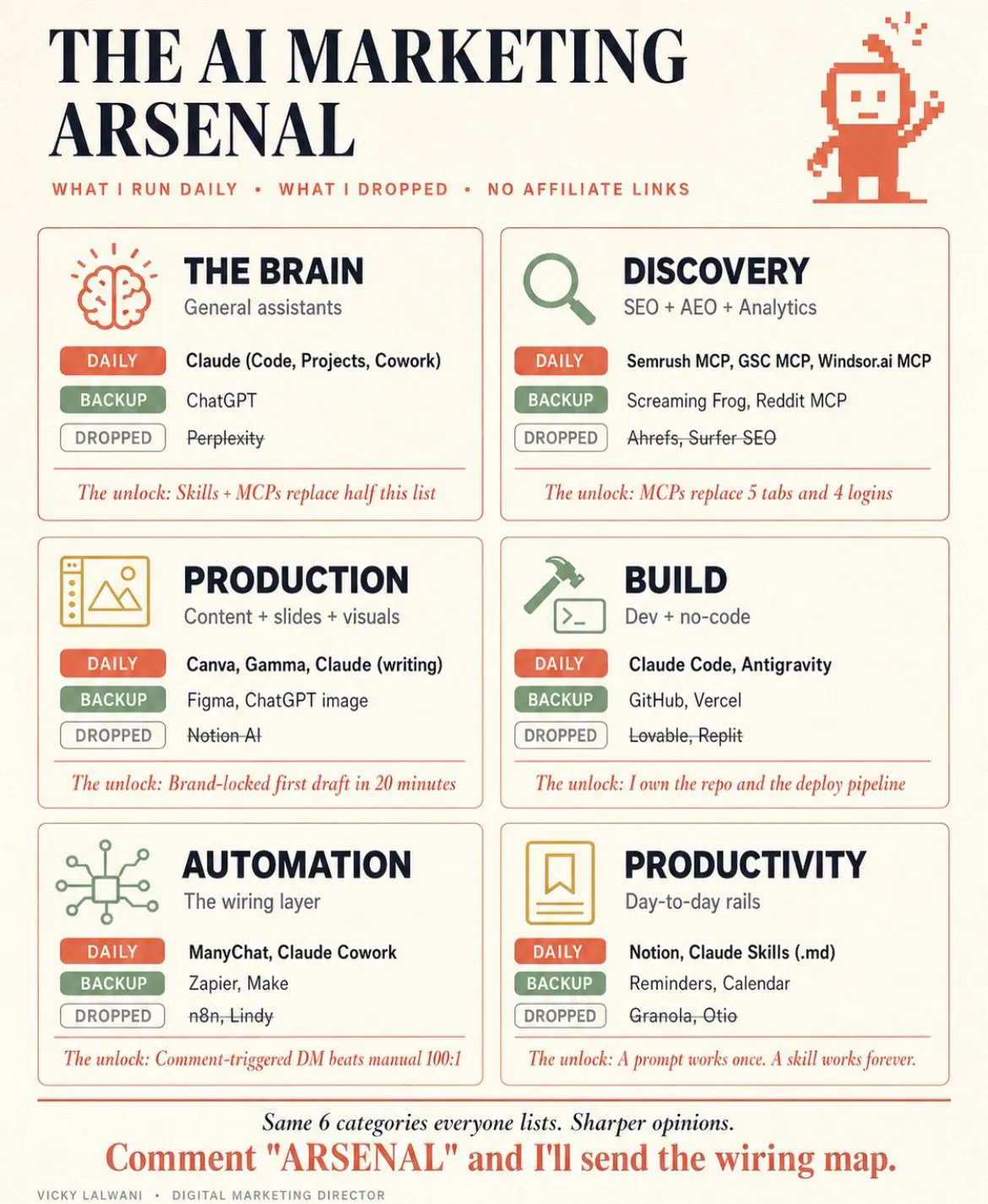
An AI marketing stack for search keeps Google Ads, GA4, Search Console and your CMS as systems of record, uses the AI already inside them, connects one assistant read-only through Google's official MCP servers, and replaces only the exporting and reformatting between tools. Judge each change by an SEO or PPC measure, not novelty.
TL;DR
An AI marketing stack for search is not a new set of tools. It is the AI layer you add on top of the systems that already hold the truth: Google Ads, GA4, Search Console and your website. Keep those, connect an AI assistant to them, and only replace the copying, exporting and reformatting in between.
Before you buy anything, check what Google already ships: AI Max for Search, Ads Advisor and Ask Advisor in Google Ads, and AI-powered report configuration in Search Console. Then connect an assistant read-only, through Google's official Google Ads and Google Analytics MCP servers.
Judge every change by search value: time to a weekly report, search terms reviewed, wasted spend found, pages refreshed from real query data. Gartner found marketers used only about half of their martech capabilities in 2025, so adding tools is rarely the fix.
Short answer: the AI marketing stack worth building in 2027 keeps Google Ads, GA4, Search Console and your CMS as the systems of record, uses the AI already inside them, adds one assistant connected read-only through official MCP servers, and replaces only the waiting between tools. Measure each change by what it does for SEO and paid search, not by how new it is.
You have a Google Ads account, a Search Console property, GA4, a website, a keyword tool and a reporting tool. Every week someone exports a search terms report, pastes it into a spreadsheet, filters it, decides on negatives and uploads them. Every month someone pulls numbers into slides. None of that work is strategy. It is the wait between deciding and shipping.
This page is about where AI removes that wait in SEO and PPC work, and where it does not. If you would rather have the audit and the connections done for you, that is what my AI automation work covers, alongside Google Ads management and SEO consulting. For a layer-by-layer build plan with skills and a seven-day start, read the companion piece on the marketing AI stack. This one is about deciding what to keep, connect or replace.
Every product fact below was checked against Google's own pages on 18 November 2026. Google changes these features often, so treat each row as correct on that date.
What is an AI marketing stack in 2026?
Short answer: it is the set of AI features, connections and assistants that sit around your search marketing systems of record. For most businesses that means the AI inside Google Ads and Search Console, a connection layer such as an MCP server, one general assistant such as Claude, ChatGPT or Gemini, and light automation for scheduled jobs.
Two terms first. A system of record is the tool that holds the official version of something: Google Ads holds spend and conversions, Search Console holds Google search queries, your CMS holds the live page. An MCP server (Model Context Protocol) is a small connector that lets an AI assistant read data from, and sometimes act in, another tool. If MCP is new to you, read what a marketing MCP server is first.
| Layer | Search examples | Change it? |
|---|---|---|
| Systems of record | Google Ads, GA4, Search Console, CMS | Keep |
| AI built into them | AI Max, Smart Bidding, Ads Advisor, Search Console AI configuration | Test with controls |
| Connection layer | Google Ads MCP, Google Analytics MCP, APIs | Add, read-only first |
| Assistant | Claude, ChatGPT or Gemini | Pick one, set it up well |
| Automation | Google Ads scripts, scheduled tasks, n8n | Add for repeat jobs |
| People | Strategy, offers, approvals | Never automate |
The mistake is treating the stack as a shopping list. A stack that wins search work has fewer tools, better connected, with a person approving anything that spends money or changes a page.
Which tools should you keep, connect or replace?
Short answer: keep anything that is a source of truth (ad platform, analytics, Search Console, CMS), connect your research and reporting tools to an assistant instead of exporting from them, and replace only the manual glue work: exports, reformatting, copy-and-paste uploads and slide building.
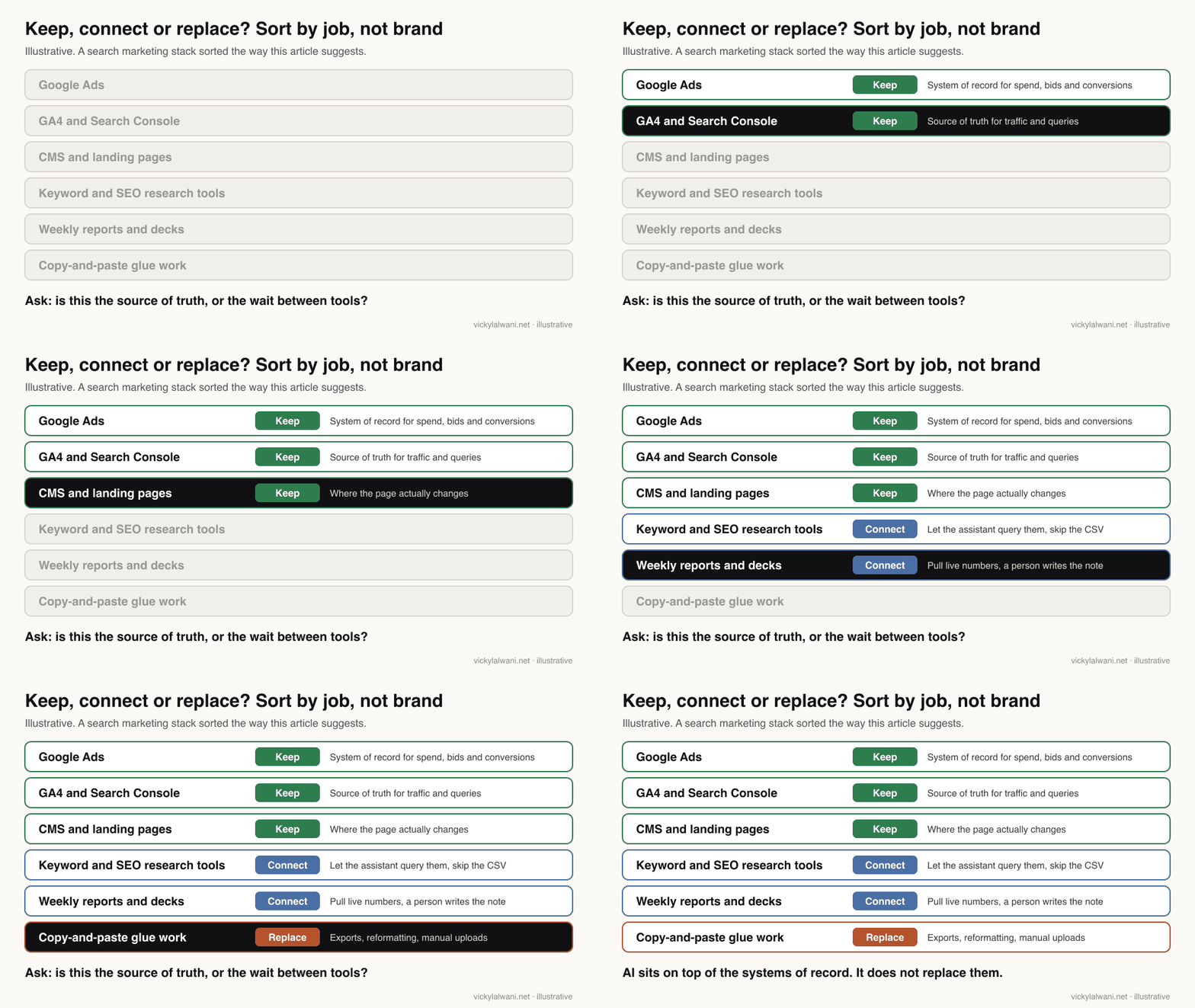
Map the stack by job. For each tool, write down three things: how many hours a week you spend in it, how much of that time is waiting, copying or reformatting, and what breaks if the data lives somewhere else. The tools with the highest share of waiting are your candidates.
| Job | Verdict | Why |
|---|---|---|
| Ad platform | Keep | Bids, budgets and conversions live here |
| GA4 and Search Console | Keep | The record of traffic and queries |
| CMS | Keep | Where pages actually change |
| Keyword and SEO research | Connect | Query it from the assistant, skip the CSV |
| Weekly reporting | Connect | Live numbers in, a person writes the note |
| Slide decks | Replace or connect | Mostly formatting work |
| Manual uploads | Replace | Scripts or Editor with an approved list |
One caution from the original version of this article still holds: run the old tool and the new workflow side by side for two weeks before you cancel anything. Product names and feature sets change fast, and some features shown in demos never reach your account.
What AI is already inside Google Ads and Search Console?
Short answer: quite a lot. Google Ads has AI Max for Search campaigns, Smart Bidding, Ads Advisor and the newer Ask Advisor, plus dashboards built from text prompts. Search Console has an experimental AI-powered configuration for the Performance report. Use these before paying for a separate tool that does the same job.
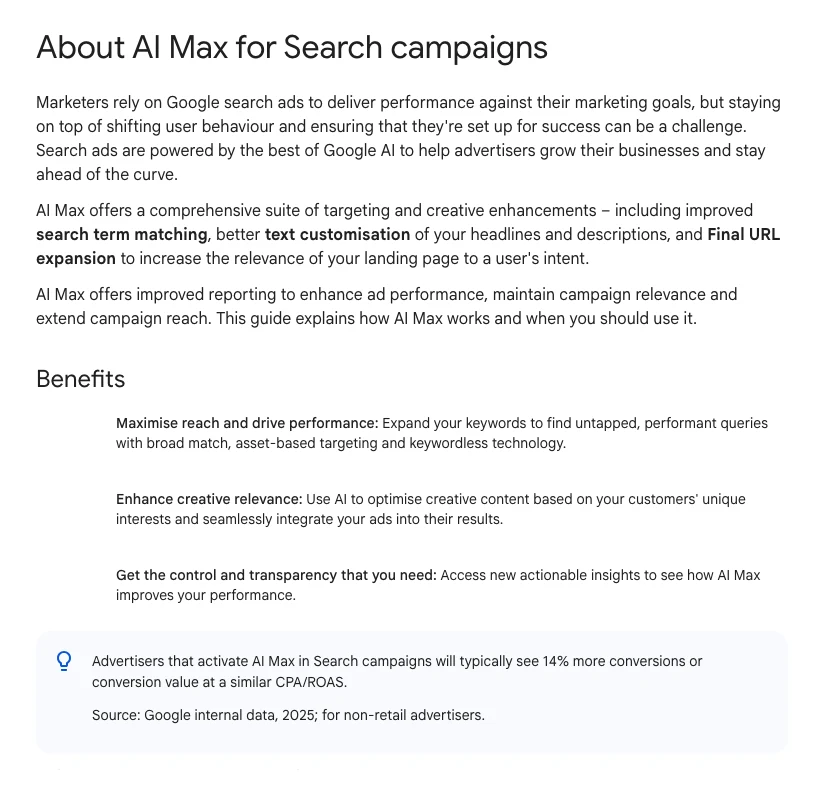
AI Max for Search campaigns adds broader search term matching, text customisation of headlines and descriptions, and final URL expansion (sending the click to the page Google thinks fits best). Google's help page says advertisers that activate AI Max typically see 14% more conversions or conversion value at a similar CPA or ROAS, citing Google internal data from 2025 for non-retail advertisers. That is Google's figure, not an independent test.
AI Max is no longer optional for everyone. Google's liaison account said in April 2026 that AI Max was moving out of beta, with a timeline for Dynamic Search Ads to transition to it. Search Engine Roundtable then reported Google's email that from 1 September 2026, campaigns using automatically created assets or the campaign-level broad match setting would be upgraded to AI Max. If your account used either, check which AI Max settings are now on.
Practitioners are split. On r/PPC, one advertiser reported that a single campaign went from about 30 distinct search queries a week to 955 with AI Max on, most of them unrelated. Another team listed what they did after a flood of new terms: brand exclusions, brand guidelines and a negative landing page list. AI inside the platform still needs a person reading the search terms.
Ads Advisor and Ask Advisor. Google Ads launched Ads Advisor, an agent inside Google Ads, in November 2025. In August 2026 Google described Ask Advisor as its in-product AI agent across Google's marketing platforms, with AI insight cards on the Google Ads homepage and dashboards built from text prompts, in beta for English-language accounts.
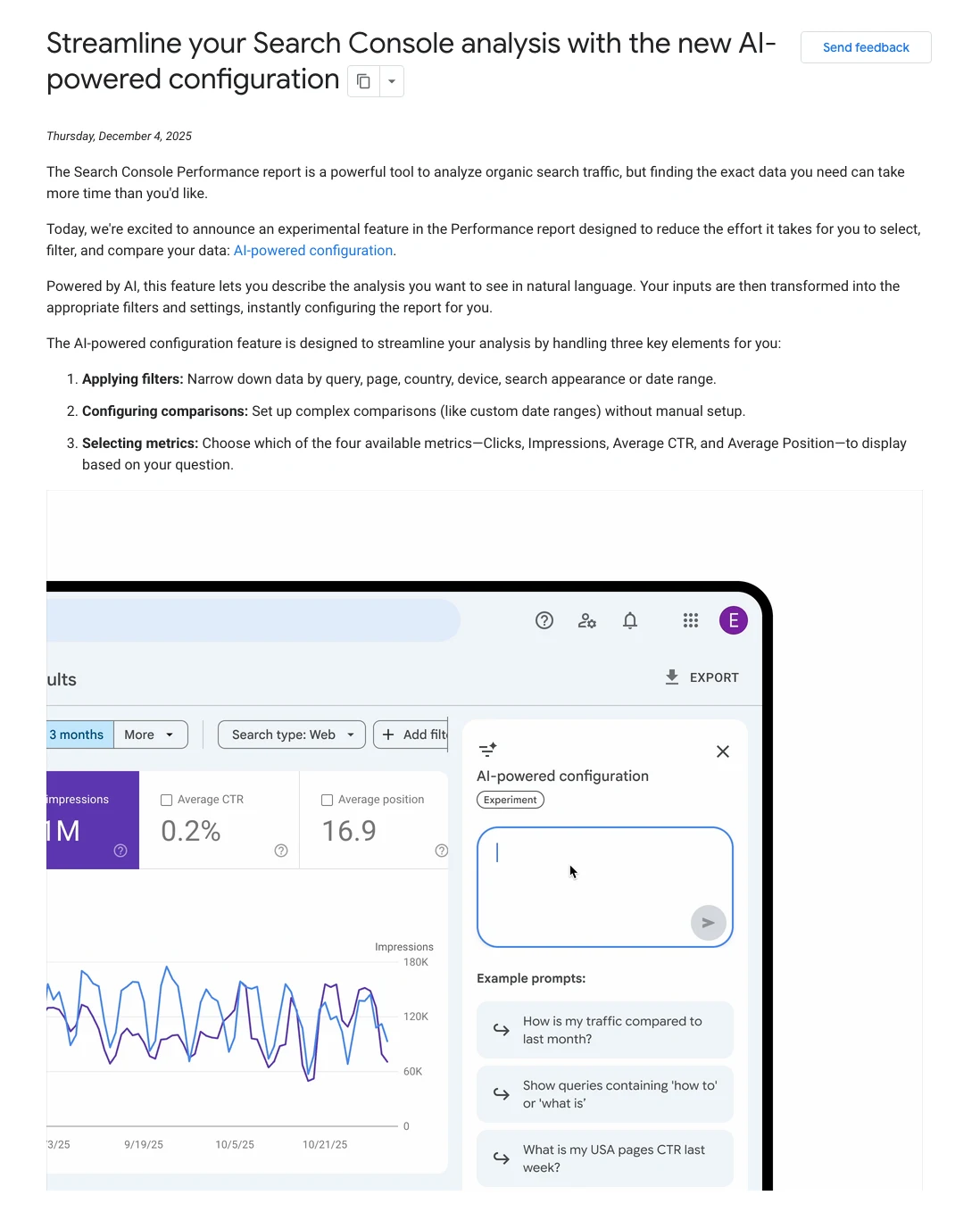
Search Console AI-powered configuration. Announced on 4 December 2025 as an experiment, it lets you describe the analysis you want and have Search Console set the filters, comparisons and metrics. Google's own limits: it works only on the Performance report for Search results, it can misread requests, and it cannot sort or export.
| Built-in feature | Where | Status, Nov 2026 | Check first |
|---|---|---|---|
| AI Max for Search | Google Ads | Out of beta | Search terms, brand settings |
| Ads Advisor | Google Ads | Live since Nov 2025 | What it changed, in history |
| Ask Advisor | Ads and Analytics | Beta, English accounts | Answers against your own report |
| Prompt dashboards | Google Ads | Beta | Date range and filters |
| AI configuration | Search Console | Experimental | The filters it applied |
The practical point: an outside AI tool that only summarises Google Ads performance now competes with a free feature inside Google Ads. Pay for an outside layer when it does something Google will not, such as combining Google Ads, GA4, Search Console and your CRM in one answer, or holding your own rules and history.
How do you connect an AI assistant to Google Ads, GA4 and Search Console?
Short answer: use Google's official MCP servers. The Google Ads MCP server reads account data and can create assets, upload videos and manage labels with a propose-and-confirm step, or run read-only. The Google Analytics MCP server is read-only. Search Console has no official Google MCP server, so use its read-only API scope or a community server.
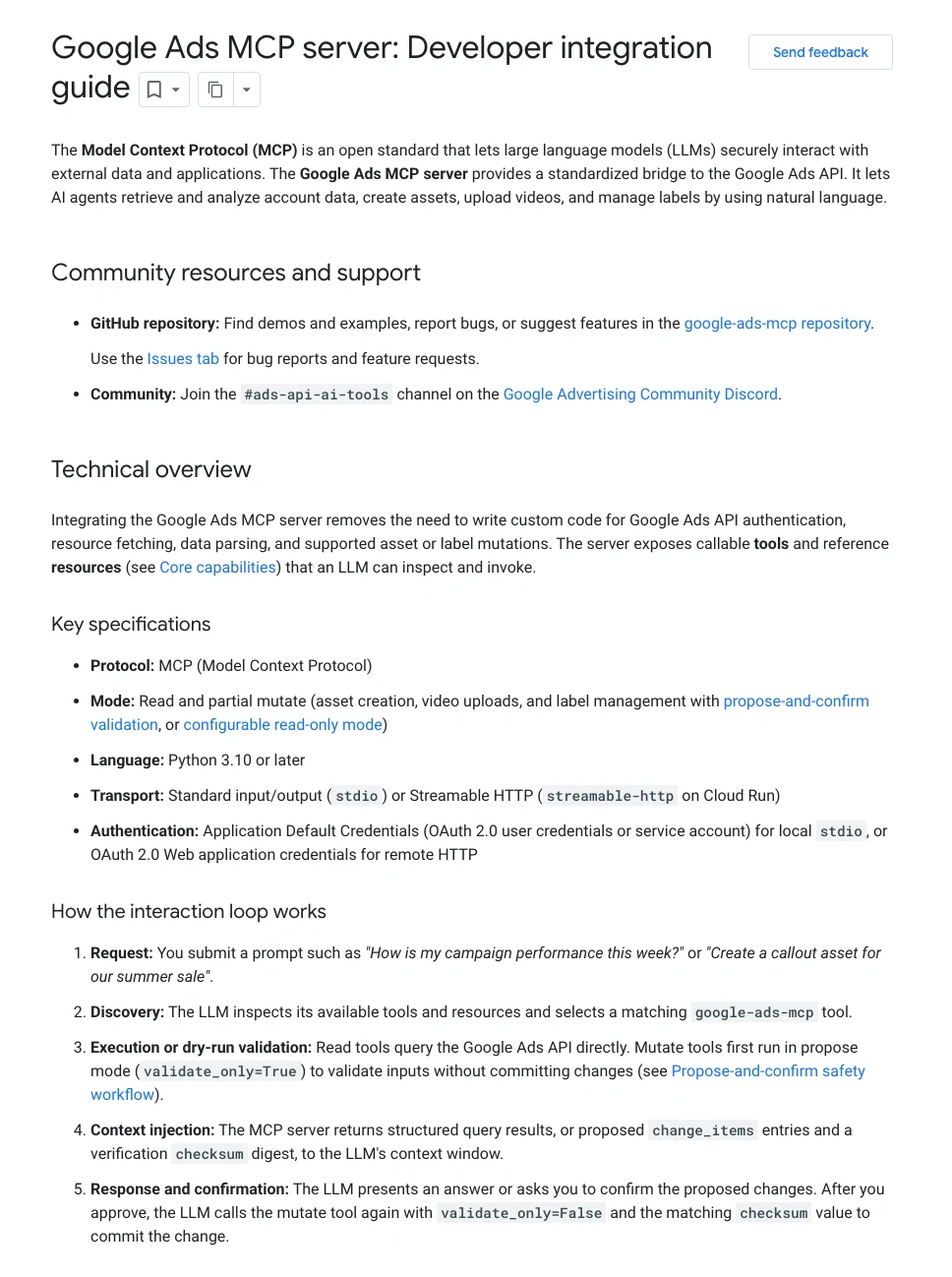
Google's developer guide describes the Google Ads MCP server's mode as "read and partial mutate", with a configurable read-only mode. Changes run first as a dry run, the assistant shows you what it would do, and only after you approve does it commit. You need a Google Cloud project with the Google Ads API enabled, and production accounts need Explorer, Basic or Standard API access.
The Google Analytics MCP server is described by Google as available for read requests only, using the analytics.readonly scope and at least the Viewer role. One analytics consultancy warned on X that its numbers come from the Data API and can differ from what you see in GA4's own screens, so check a few figures by hand before trusting a report.
| System | Official route | Can it change things? |
|---|---|---|
| Google Ads | Google Ads MCP server | Assets, videos, labels, after you confirm |
| GA4 | Google Analytics MCP server | No, read-only |
| Search Console | No official MCP; API | Read-only scope available |
| Meta Ads | Meta Ads MCP (beta) | Yes, campaigns and edits |
Connect read-only first, and connect as a user whose role you have checked. In my own client work, access is the thing that goes wrong most often: "I gave you access" turns out to be the wrong level, so I open the account on a shared screen and check the real role before anything is connected. For the step-by-step version, read how to connect Claude to Google Analytics safely.
Where does AI save the most time in SEO and PPC?
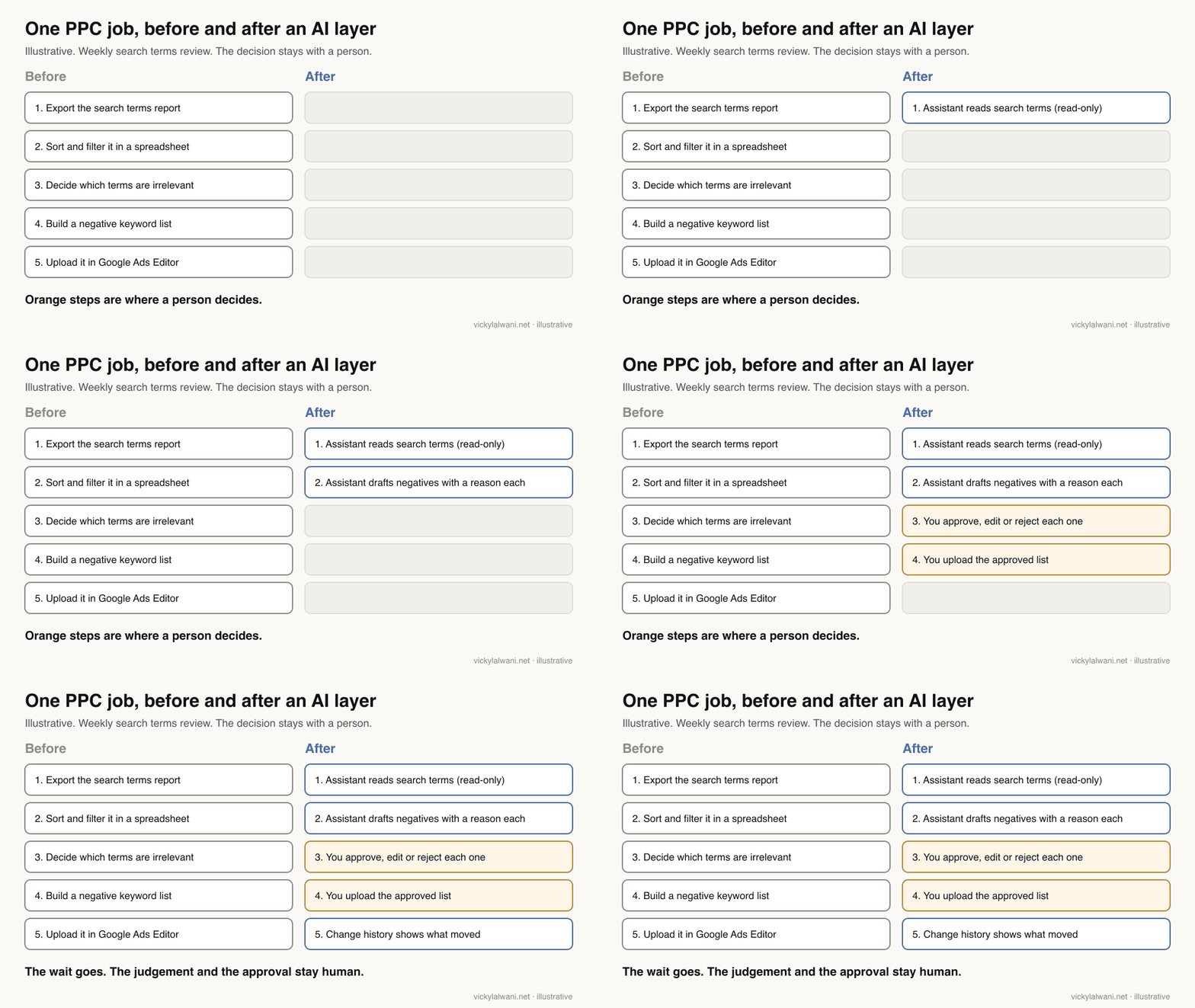
Short answer: in the jobs where most of the hours go on gathering and sorting, not deciding: search terms reviews, negative keyword drafts, weekly reporting, keyword clustering, Search Console query analysis and first drafts of briefs. The decision, the offer and the approval stay with a person.
| Job | Wait it removes | Who decides |
|---|---|---|
| Search terms review | Export, sort, filter | You approve negatives |
| Weekly PPC report | Pulling and pasting numbers | You write the note |
| Keyword clustering | Sorting thousands of rows | You pick the targets |
| Search Console analysis | Building filters and comparisons | You choose pages to fix |
| Content briefs | Gathering queries and competitors | You set the angle |
| Ad copy variants | Blank page | You check claims and policy |
An r/PPC thread on automating search term reviews describes the pattern well: a script exports terms to a sheet, rules score them, an agent groups them into waste, possible negatives and terms to watch, and the final call stays manual. The top reply runs the same review in Claude, with one project per client and a connector to the ad account. On r/googleads, a reply to "best AI tools for Google Ads in 2026" put it plainly: the assistants are decent helpers and bad decision makers.
On the SEO side, an r/TechSEO thread on which routine tasks people have automated lists daily reports combining Search Console, GA4 and paid SEO tools, plus scripts for scraping and report building. For the PPC split in more depth, see what to automate in PPC and what not to; for the SEO side, the SEO tool stack covers tool layers and November 2026 prices.
How do you judge a swap by search value, not novelty?
Short answer: write one measure before you start, tied to search results or search work: hours to a weekly report, share of search terms reviewed, wasted spend found per month, or pages refreshed from Search Console data. Run the new workflow for two weeks next to the old one and keep it only if the measure moves.
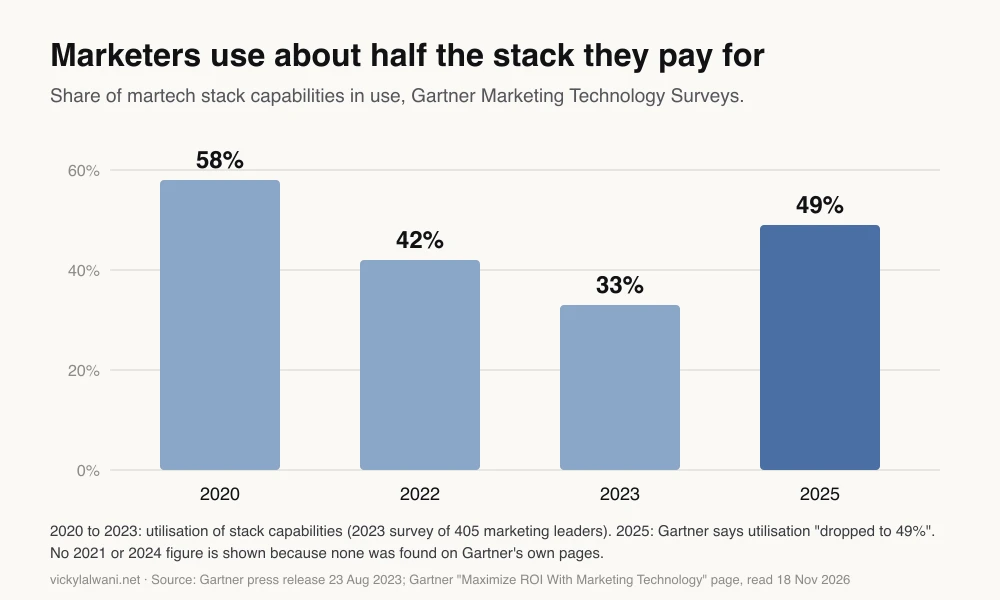
Most stacks do not need more tools. Gartner's surveys show marketers use only part of what they already pay for: utilisation of martech stack capabilities fell from 58% in 2020 to 42% in 2022 and 33% in 2023, and Gartner's 2025 survey page says utilisation has dropped to 49%, with martech nearly 22% of total marketing spend.
So the first question is not "which AI tool should we add?" but "what do we already pay for and not use?". Google Ads already contains AI features; your SEO tool may already have an API or MCP server included in your plan. Connect those before buying another subscription.
| Swap | Search measure | Keep it if |
|---|---|---|
| AI search terms review | Share of spend reviewed weekly | More reviewed, same accuracy |
| Connected reporting | Hours to the weekly report | Faster, numbers match the platform |
| Assistant keyword research | Queries mapped to pages | Better coverage, no invented volumes |
| Search Console analysis | Pages refreshed per month | Refreshes recover clicks |
| AI Max test | Conversions and search term quality | More conversions, clean terms |
Use a prompt like this to run the audit with your assistant, from a list you paste in:
Here is every marketing tool we pay for, with monthly cost, owner and what we use it for: [paste list].
For each tool, ask me how many hours a week we spend in it and how much of that time is exporting, copying, reformatting or waiting.
Then sort the tools into three groups: keep (it is a source of truth such as Google Ads, GA4, Search Console or the CMS), connect (an assistant could query it directly), and replace (it mostly moves or formats information).
For each tool in connect or replace, say which SEO or PPC measure would show the change worked, such as hours to the weekly report or share of search terms reviewed.
Do not recommend new tools. Flag anything where you are guessing.
What should stay human in an AI marketing stack?
Short answer: strategy, the offer, budget decisions, account access, anything that goes live, and the short note that explains a report. AI drafts and sorts; a person decides and approves.
My own working rules on client ad accounts are simple: audit first, put the findings in a sheet, check them by hand, and change nothing before approval. Campaigns stay in draft until every form and call button is measured, because an AI layer on top of broken tracking only produces confident wrong answers. I keep one Claude project per client, with its skills in a known place, so context never leaks between accounts.
| Keep human | Why |
|---|---|
| Offer and positioning | The assistant does not know your margins |
| Budget and bid strategy | Spends real money |
| Account access | Wrong roles cause most problems |
| Go-live approval | Undo is limited for some changes |
| Report commentary | Clients read the note, not the table |
A leaner stack is not the goal by itself. The goal is more time on positioning, offers, landing pages and the conversations with customers that no tool can have for you. If a swap saves hours and they go on more low-value tasks, nothing was gained.
How often should you review your AI marketing stack?
Short answer: every quarter, with a quick monthly check of anything Google upgrades automatically. Features in Google Ads, Search Console and the assistants change every few weeks, so a yearly review is too slow.
- List every tool you pay for, its owner and its cost.
- Mark each as a source of truth, a workflow tool or a nice-to-have.
- Check what Google added or auto-upgraded since the last review, such as AI Max settings.
- Pilot one swap in the workflow group, with a written search measure.
- Keep the old tool for two weeks as a fallback.
- Check what each connected assistant can read and change, and remove access nobody uses.
- Write the new process down so a colleague can repeat it.
Where this advice is weak
Short answer: the keep, connect and replace split is my judgement, Google's performance figures are Google's own, and the built-in features change faster than any article.
- The 14% AI Max figure is Google internal data for non-retail advertisers. The Reddit reports point the other way for some accounts. Neither is a controlled test of your account.
- Gartner's 2025 page does not publish its sample size, and its wording ("utilization has dropped to 49%") is a little different from the 2023 release. Read the chart as a direction, not a precise trend.
- Ask Advisor and prompt dashboards were in beta for English-language accounts in August 2026. Availability in your account may differ.
- Search Console AI configuration was announced for a limited set of sites; third-party reports say it later reached everyone, which I have not confirmed on a Google page.
- Large teams with data warehouses, CDPs and many brands need a different stack review. This page is written for small and mid-sized search marketing teams.
What people say on X and Reddit
Short answer: Google keeps shipping AI inside its own tools, practitioners use assistants for grunt work and keep the decisions, and the loudest "replace your stack" claims come from people selling something.
| Who | What they said | Take it as | Link |
|---|---|---|---|
| Google Ads (official) | Launches Ads Advisor, an agent inside Google Ads (12 Nov 2025) | Official | X post |
| Google Ads liaison | AI Max out of beta; Dynamic Search Ads move to it (15 Apr 2026) | Official | X post |
| Google Ads liaison | Dashboards in Google Ads and GA built from simple prompts (10 Aug 2026) | Official | X post |
| A Google Ads practitioner | Auto-created assets and campaign broad match to be upgraded to AI Max (5 Aug 2026) | First-hand | X post |
| A growth marketer | Claude Code with keyword APIs, a Search Console warehouse and CMS access (2 Mar 2026) | First-hand | X post |
| An analytics consultancy | GA4 MCP numbers can differ from GA4's screens (4 Aug 2025) | Expert | X post |
| An AI automation creator | Says a Claude Code agent replaces a paid SEO tool (12 Apr 2026) | Promotional | X post |
| r/PPC | Search terms review: script, scoring, agent first pass, manual final call (4 Jun 2026) | First-hand | Thread |
| r/PPC | One campaign: 30 queries a week without AI Max, 955 with it (31 Aug 2026) | First-hand, one account | Thread |
| r/PPC | AI Max flooded new terms; fixed with brand exclusions and guidelines (6 Jul 2026) | First-hand | Thread |
| r/googleads | Assistants are good helpers, bad decision makers (7 Jan 2026) | Opinion | Thread |
| r/TechSEO | Daily SEO reports combining Search Console, GA4 and paid tools (14 Oct 2026) | First-hand | Thread |
| r/TechSEO | Buyer wants API and MCP access, not another dashboard (5 May 2026) | Question | Thread |
Videos worth watching
Short answer: Google's own short videos on Ask Advisor, the Google Ads MCP server and Search Console's AI features show what is already in the stack before you add anything.
Made by Google Ads, 21 May 2026. It promotes Google's own agent. Under two minutes on what Ask Advisor is meant to do across Google's marketing products.
Made by Google's advertising developer team, 29 October 2025. It sells nothing and links to the open-source project. Recorded when the server was read-only; write tools came later.
Made by Google Search Central, 14 April 2026. It sells nothing. Covers the branded query split and the AI configuration tool in the Performance report.
| Video | Channel | Date | What it covers |
|---|---|---|---|
| Introducing Ask Advisor | Google Ads | 21 May 2026 | Google's in-product agent |
| Streamline your workflow with Ask Advisor in Google Ads | Google Ads | 9 Jul 2026 | Ask Advisor in daily use |
| How to Use AI Max for Search Campaigns in Google Ads [Guide] | Google Ads | 21 Apr 2026 | AI Max features |
| Introducing the Google Ads MCP Server | Google Advertising and Measurement Developers | 29 Oct 2025 | Assistant access to Ads data |
| Introducing the Google Analytics MCP Server | Google Analytics | 22 Jul 2025 | Assistant access to GA4 |
| AI Websites, Crawling and Search Console updates (Q1 '26) | Google Search Central | 14 Apr 2026 | Search Console AI features |
Want help deciding what to automate first?
The audit is the useful part: which tools are sources of truth, which can be connected, what Google already does inside your account, and which one change would save the most time on SEO and paid search work. My AI automation work starts with exactly that audit, then sets up the read-only connections, the skills and the approval steps. If the bigger gap is the account itself, see Google Ads management or SEO consulting. Rates are on the pricing page.
Keep reading: the marketing AI stack, layer by layer, the SEO tool stack, what a marketing MCP server is and what to automate in PPC.
Sources
| Source | What it supports | Date |
|---|---|---|
| Google Ads Help: About AI Max | Features; 14% claim, Google data | Read 18 Nov 2026 |
| Search Engine Roundtable | AI Max auto-upgrade from 1 Sep 2026 | 7 Aug 2026 |
| Google blog: Ads and Analytics AI updates | Ask Advisor, prompt dashboards, beta | 10 Aug 2026 |
| Google Search Central blog | Search Console AI configuration and limits | 4 Dec 2025 |
| Google Ads MCP server guide | Read and partial mutate; access levels | Read 18 Nov 2026 |
| Google Analytics MCP server | Read-only, Viewer role | Read 18 Nov 2026 |
| Gartner press release | 58%, 42%, 33% utilisation; 405 leaders | 23 Aug 2023 |
| Gartner martech page | 49% in 2025; martech about 22% of spend | Read 18 Nov 2026 |
| Meta Ads MCP server overview | Beta; can create and edit campaigns | Read 18 Nov 2026 |
| X, Reddit and YouTube | Practitioner and official views, linked above | Jul 2025 to Oct 2026 |
This article expands on my post on LinkedIn ↗.
FAQ
What is an AI marketing stack?
An AI marketing stack is the set of AI features, connections and assistants around your marketing systems of record. For search marketing that means the AI inside Google Ads and Search Console, a connection layer such as Google's MCP servers, one assistant such as Claude or ChatGPT, and light automation for repeat jobs.
Should I replace my marketing tools with AI?
Not the systems of record. Keep Google Ads, GA4, Search Console and your CMS, connect research and reporting tools to an assistant, and replace only the exporting, reformatting and manual uploads between them.
What AI features are already in Google Ads?
In November 2026 Google Ads includes AI Max for Search campaigns, Smart Bidding, Ads Advisor and Ask Advisor, plus dashboards built from text prompts. Ask Advisor and the prompt dashboards were in beta for English-language accounts in August 2026.
Does AI Max improve Google Ads results?
Google says advertisers that activate AI Max typically see 14% more conversions or conversion value at a similar CPA or ROAS, based on its own 2025 data for non-retail advertisers. Some advertisers on r/PPC report floods of irrelevant search terms, so test it with brand controls and read the search terms report.
Can Claude or ChatGPT connect to Google Ads?
Yes, through Google's official Google Ads MCP server, which reads account data and can create assets, upload videos and manage labels after you confirm each change. It can also run read-only, and production accounts need Google Ads API access.
Is there an official Search Console MCP server?
Google had not published one as of 18 November 2026. You can use the Search Console API with its read-only scope, a community MCP server, or Search Console's own experimental AI-powered configuration in the Performance report.
How do I decide which marketing tool to automate first?
Pick the job with the most hours spent waiting, exporting or reformatting, usually the search terms review or the weekly report. Write one measure before you start, such as hours to the weekly report, and keep the change only if it moves after two weeks.
How often should I review my AI marketing stack?
Review it every quarter, with a monthly check of anything Google upgraded automatically, such as AI Max settings. Features in Google Ads, Search Console and AI assistants change every few weeks.