An SEO tool stack is the set of tools and workflows that take you from crawl and search data to analysis, shipped fixes and measured results. Use one tool per job: Search Console and GA4 for measurement, a crawler, one keyword tool, Data Studio for reporting, an AI assistant connected over MCP, and a task sheet with owners. The free core covers most small sites.
TL;DR
An SEO tool stack is one tool per job, connected into a loop: data in, analysis, a task with an owner, a shipped fix, then measurement. The value is in the connections, not the number of logins.
The free core does most of the work: Google Search Console, GA4, Data Studio (the new name for Looker Studio since April 2026) and the free Screaming Frog crawler up to 500 URLs. Add one paid keyword tool when you need competitor and keyword data.
What changed in 2026: Search Console now reports impressions in AI Overviews and AI Mode, splits branded from non-branded queries, and lets you exclude a site from AI features. Most big tools now ship an MCP connection, so an AI assistant can read the data directly.
Jump to: What it is · 2026 changes · The layers · Cost · AI and MCP · Five steps · X and Reddit · Sources
You have a crawler licence, two keyword tools, a rank tracker, an AI visibility tracker on a free trial and a dashboard nobody opens. Each one produces a report. Rankings have not moved, because none of those reports turned into a fix that shipped.
For years a lot of SEO worked like that: crawl the site, write the report, hand it over, move on. I now think of SEO as a system, and I plan a tool stack as connected layers rather than a shopping list. This guide covers the layers, what each one costs in November 2026, where AI assistants fit, and what changed in Google's own tools this year. Facts were checked against Google, vendor pricing pages and published studies on 17 and 18 November 2026. If you would rather have someone design the stack and the workflow around your site, that is part of my SEO consultant service.
What is an SEO tool stack?
Short answer: the set of tools and workflows that take you from raw crawl and search data to analysis, shipped fixes and measured results. A good stack has one tool per job and a clear hand-off between them. A bad one has many tools and no hand-offs.
Checklists describe what to look at. A stack describes how information moves. The old pattern was audit, report, done. The pattern I work toward is crawl and search data, then AI-assisted analysis, then an execution system, then growth you can measure. Each stage hands something specific to the next, and nothing stalls in a document.
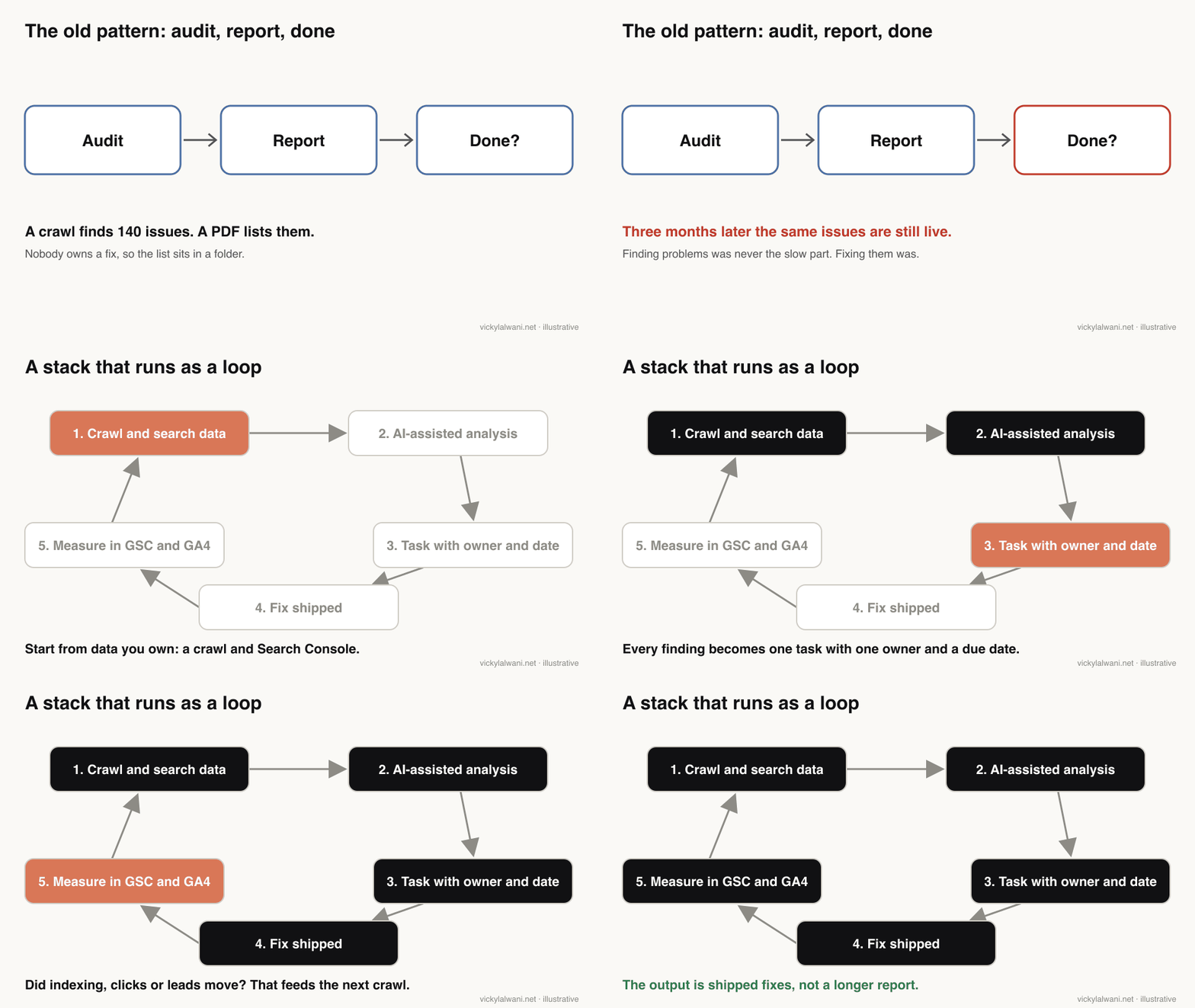
That loop is also why the cheapest stacks often beat the most expensive ones. A free crawler and Search Console, wired to a task sheet that a developer actually works from, will fix more than a premium suite whose exports nobody reads.
What changed in SEO tools in 2026?
Short answer: Google's own tools caught up. Search Console added AI feature reporting, a branded query filter, query groups and annotations, and Google published guidance that no third-party tool sees its ranking data. On the vendor side, Adobe bought Semrush, Looker Studio became Data Studio again, and MCP connections became standard.
| Date | Change | Why it matters |
|---|---|---|
| Oct 2025 | Search Console query groups | Similar queries grouped by AI |
| Nov 2025 | Custom chart annotations | Log fixes on the chart |
| Mar 2026 | Branded filter for all eligible sites | Brand vs non-brand, no regex |
| Apr 2026 | Looker Studio renamed Data Studio | Same free reporting tool |
| Apr 2026 | Adobe completes Semrush purchase | Watch pricing and roadmap |
| May 2026 | Screaming Frog adds its own MCP server | AI can drive crawls |
| Aug 2026 | Generative AI report for all sites | AI Overviews and AI Mode impressions |
| Aug 2026 | Search generative AI control | Opt a site out of AI features |
| Nov 2026 | Branded data in the Search Analytics API | Brand split in your own dashboards |
The sources: Google announced query groups on 27 October 2025, custom annotations of up to 120 characters on 17 November 2025, and the branded queries filter, which reached all eligible sites on 11 March 2026. The generative AI performance reports launched on 3 June 2026 and, by Google's note, reached all websites on 31 August 2026. On 16 November 2026 Google added branded classification, web multimodal data and multi-country filters to the Search Analytics API.
On the vendor side, Adobe completed its acquisition of Semrush on 28 April 2026, and Google reintroduced the Data Studio name for Looker Studio in April 2026. Screaming Frog's release history lists its own MCP server in version 24.0 (19 May 2026) and MCP debugging tools in version 25.0 (3 November 2026).
Which layers does an SEO tool stack need?
Short answer: seven jobs: measurement, technical crawling, research, AI search visibility, reporting, an AI workflow layer and execution. Most sites need one tool for each, and four of the seven can be free.
| Layer | The job | Typical tool | Cost |
|---|---|---|---|
| Measurement | Is Google showing my pages? | Search Console | Free |
| Measurement | Does search bring leads? | GA4 key events | Free |
| Technical | What is broken on the site? | Screaming Frog | Free to 500 URLs |
| Research | What do people search? | Semrush or Ahrefs | Paid |
| AI search | Do AI answers show us? | Search Console AI report | Free |
| Reporting | One view for the owner | Data Studio | Free |
| AI workflow | Who reads the exports? | Claude, ChatGPT or Gemini | Free to paid |
| Execution | Who ships the fix? | Task sheet or tracker | Free |
Measurement: Search Console and GA4
Search Console is the only tool in the stack that reports data from Google Search itself. Google's guidance on third-party SEO tools says it plainly: "Third-party tools don't have access to our internal ranking data." GA4 then answers the question Search Console cannot: whether a visit became an enquiry. Mark your form and call clicks as key events, the GA4 name for what used to be called conversions.
On client sites I set up Search Console and tracking on every live site before I trust any number, because a stack built on missing data only produces confident wrong answers. If your tracking needs work first, my analytics and tracking service starts there.
Technical: a crawler
A crawler finds broken links, redirect chains, missing titles, duplicate pages, canonical and noindex problems, and structured data errors. Pair it with Search Console's Page indexing report, which shows what Google actually did with each URL. For page speed, Google's Core Web Vitals targets are a Largest Contentful Paint within 2.5 seconds, an Interaction to Next Paint of 200 milliseconds or less, and a Cumulative Layout Shift of 0.1 or less, measured at the 75th percentile of visits.
Research: one keyword and competitor tool
Search Console tells you what you already rank for. A research tool tells you what you do not rank for yet, what competitors rank for, and roughly how hard each keyword is. Pick one. Semrush and Ahrefs overlap heavily, and paying for both is the most common duplicate I see in small business stacks.
Treat every third-party number as an estimate. I have had an AI agent pull keyword volumes that turned out to be far too low when checked against the source by hand. Since then, any number an AI or a tool pulls gets checked against the original before it goes into a plan.
AI search: start with Google's own report
Google's generative AI performance report shows how often your pages appeared in AI Overviews and AI Mode, by page, country, device and date. It reports impressions only, no clicks and no queries; clicks from AI features are counted in the normal Performance report under the Web search type, according to Google's AI features documentation.
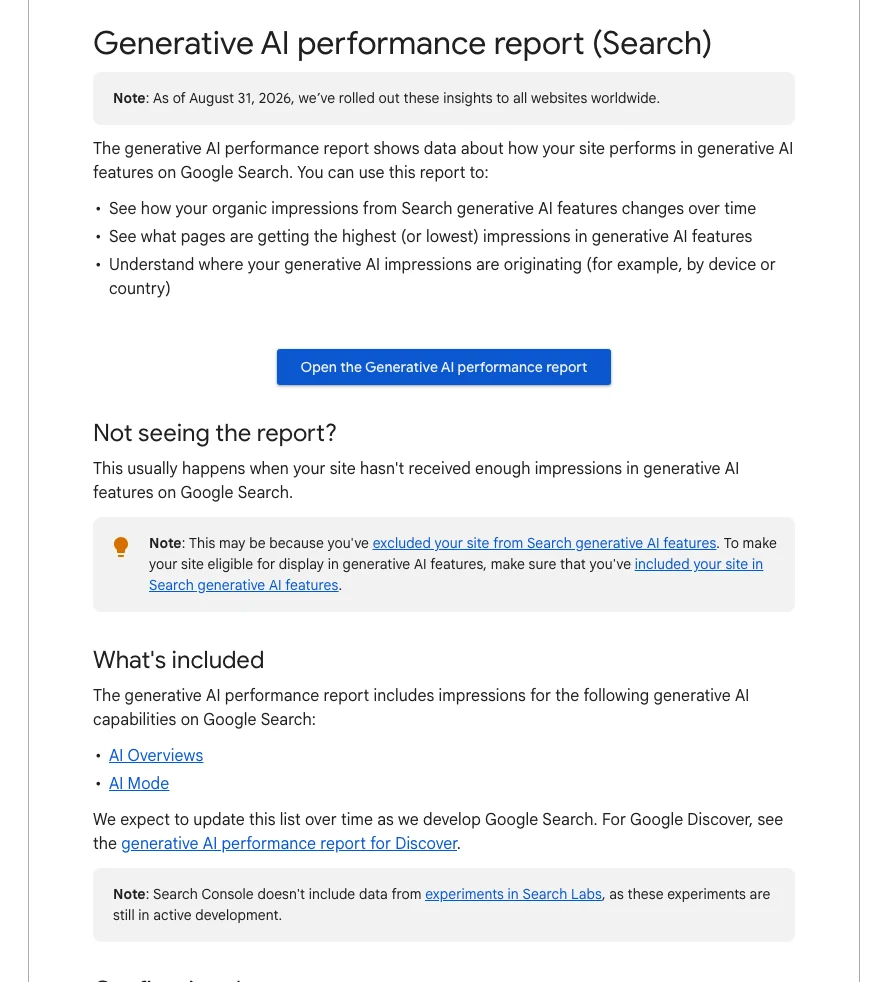
The same rollout added a Search generative AI control under Settings. Including your site is the default. Excluding it removes your links and content from AI Overviews, AI Mode and AI features in Discover, and Google says the setting is not used as a ranking signal for the rest of Search. Check that nobody switched it off by accident.
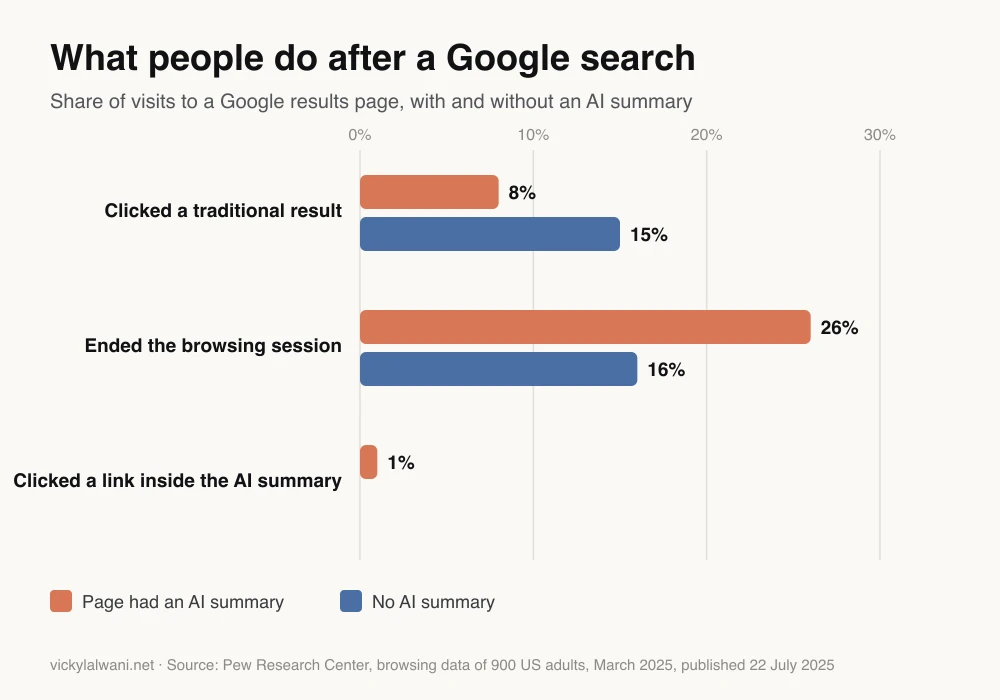
Why does this layer matter? Because a page can gain impressions and lose clicks at the same time. In Pew Research Center's study of real browsing data, people clicked a traditional result on 8% of visits when the page had an AI summary, against 15% without one.
Third-party AI visibility trackers (Semrush's AI Visibility, Ahrefs' Brand Radar and others) estimate how often a brand is named across ChatGPT, Gemini and other assistants. They can be useful, but Google's guide to optimising for generative AI features warns that "No third-party tool has access to our internal ranking or AI systems." For deeper AI search work, see my generative engine optimisation service.
Reporting: Data Studio
Data Studio connects to Search Console and GA4 for free and gives the business owner one page instead of four logins. I learned to put reliability before looks here: an AI-built dashboard I made once looked good but did not pull data consistently, so I moved the data layer to Looker Studio, as it was then called, and kept AI for the written summary. A report that is right and plain beats one that is pretty and wrong.
Execution: where the stack pays off
Spreadsheets for tracking, developer task sheets and simple automations make up the execution layer. Every finding becomes one row: the URL, the problem, the fix, the owner, the due date and how you will check it. Log the ship date as a Search Console annotation so the effect is visible on the chart later.
How much does an SEO tool stack cost in 2026?
Short answer: nothing for the free core, around $129 to $199 a month once you add one paid research suite, and several hundred a month for agency-level plans. Prices below were read on each vendor's page on 17 and 18 November 2026 and exclude tax.
| Tool | Entry price | Next tiers | AI or MCP |
|---|---|---|---|
| Search Console | Free | None | API; no Google MCP found |
| GA4 | Free | 360 for enterprise | Official Google MCP server |
| Data Studio | Free | Data Studio Pro | Not needed |
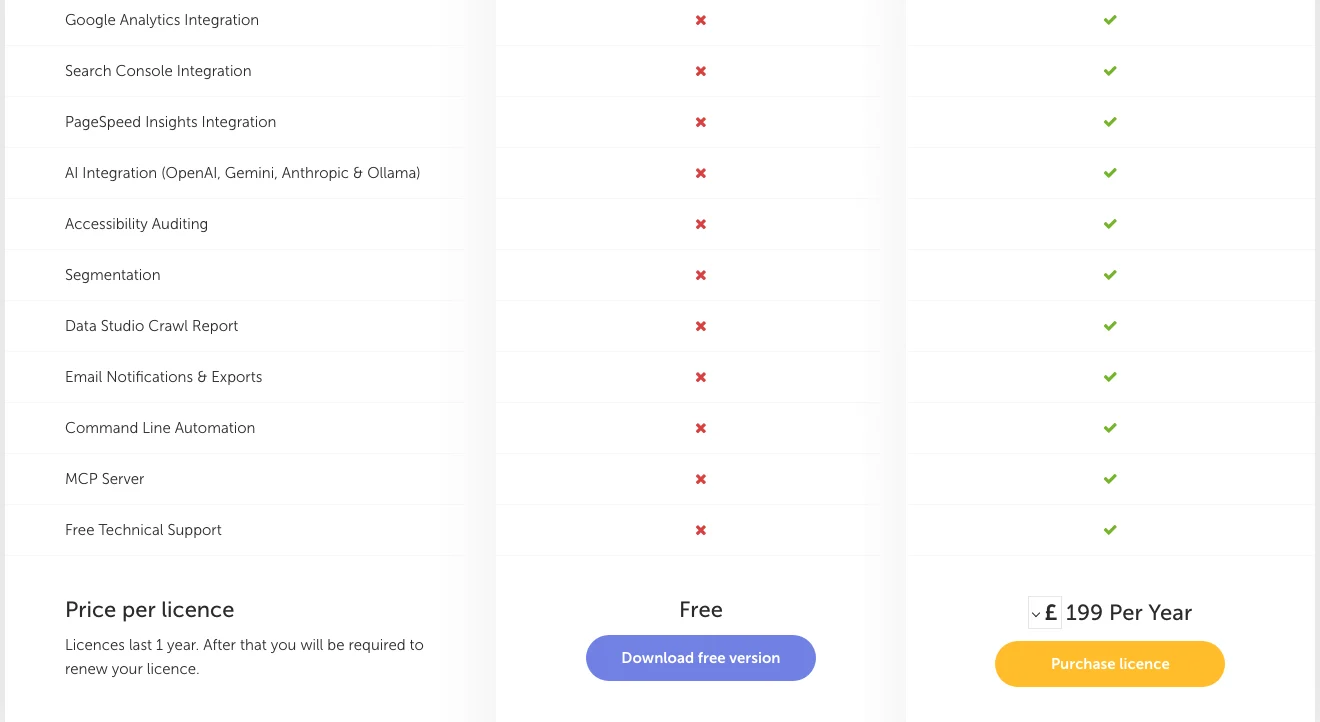
| Screaming Frog | Free to 500 URLs | £199 a year per licence | AI and MCP, paid only |
| Semrush | SEO $139 a month | $199, $299 a month | MCP from the $199 plan |
| Ahrefs | Starter $29 a month | Lite $129, Standard $249, Advanced $449 | API and MCP from Lite |
| Claude | Free | Pro $20 a month | Connectors on all plans |
Sources: Screaming Frog pricing, Semrush plans (annual billing saves up to 17%), Ahrefs plans (Ahrefs also has a free tier with limited Site Explorer and Site Audit access), Claude pricing ($17 a month billed yearly) and the official Google Analytics MCP server on GitHub. I could not find an official Google MCP server for Search Console in November 2026; the ones available are third-party.
Three example stacks, with prices from the table above:
| Stack | Who it suits | Tools | Example monthly cost |
|---|---|---|---|
| Free core | Site under 500 URLs | GSC, GA4, Data Studio, free crawler | $0 |
| Small business | One site, some competition | Free core, crawler licence, one suite, Claude Pro | About $170 to $240 |
| Agency | Many sites and markets | Higher suite tier, extra users, AI tracking | $300 and up |
The small business row adds £199 a year for the crawler (about £17 a month), Ahrefs Lite at $129 or Semrush's Starter at $199, and Claude Pro at $20. Currency and tax change the exact total, so treat it as an example. If you want my own fees next to these, they are on the pricing page.
Where do AI assistants and MCP fit?
Short answer: in a workflow layer on top of your data tools. The assistant reads exports or live connections, finds patterns and drafts a ranked fix list. It does not replace the data, and its output needs checking before anyone acts on it.
MCP (Model Context Protocol) is the standard that lets an assistant such as Claude call a tool directly instead of you pasting exports. In 2026 that covers most of a typical stack: Google's own GA4 server, Screaming Frog's MCP server, and the MCP access included in Ahrefs and Semrush plans. My guide to MCP servers for SEO covers which connections are worth setting up, and the Screaming Frog and Claude MCP article goes through the crawler side.
Introducing the Google Analytics MCP Server, from the official Google Analytics channel, 22 July 2025. A short demo of asking GA4 questions in plain language through any MCP client. Nothing for sale; set-up is on GitHub.
How I organise it: one Claude project per client, with the brief, the keyword map and the house rules in the project, and fresh exports added each month. A thinking model drafts the plan; I review it before anything is changed on a live site. For the full routine, see technical SEO audit automation.
A prompt that works with a crawl export and a Search Console export:
You are helping me prioritise SEO fixes. Use ONLY the two files attached:
1. crawl.csv (crawler export: URL, status, indexability, title, H1, canonical, word count)
2. gsc-pages.csv (Search Console Performance export by page, last 3 months)

Rules:
- Do not invent URLs, numbers or issues. If a field is missing, say so.
- Join the files on URL. Flag pages that are non-indexable but have impressions,
  pages with impressions but CTR far below the site average, and indexable pages
  with zero impressions.
- Output a table: URL | problem | evidence (the exact values) | proposed fix |
  effort (S/M/L) | owner (dev or content).
- Sort by likely impact: pages with the most impressions first.
- End with the five fixes you would ship this week and why.
Then check the evidence column against the files before anything goes to a developer. That one habit catches most AI mistakes.
How to build your SEO tool stack in five steps
Short answer: list the jobs, assign one tool per job, connect the data to an AI workflow layer, turn every finding into a task with an owner, and review the stack every quarter.
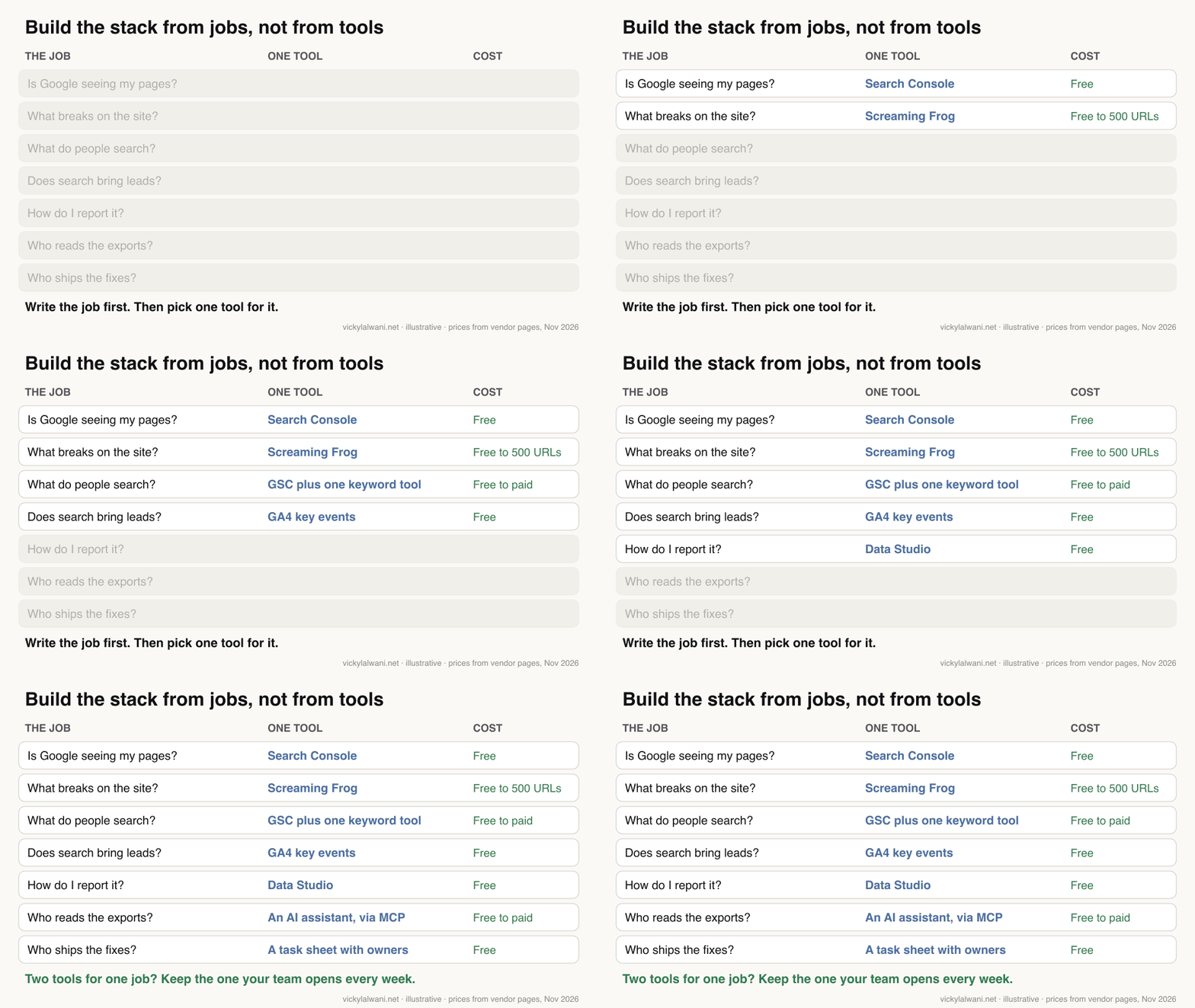
- List your jobs. Write down what you need done: find issues, find opportunities, produce content, track leads, report, ship fixes.
- Assign one tool per job. Remove duplicates. If two tools do the same thing, keep the one your team actually opens every week.
- Connect the layers. Decide which exports or MCP connections feed the AI workflow layer, and what format each output takes.
- Close the loop with execution. Every recommendation becomes a task with an owner, a due date and a way to check the result.
- Review the stack every quarter. Retire anything that no longer feeds a decision or a task, and check renewal dates before they auto-renew.
Keyword work follows the same pattern. My AI content calendar method shows how Search Console and keyword data turn into a dated plan without the assistant inventing topics.
What are the most common SEO tool stack mistakes?
Short answer: buying tools before defining workflows, trusting tool numbers as if they came from Google, and measuring rankings instead of leads.
| Mistake | What it costs | Fix |
|---|---|---|
| Tools before workflow | Reports nobody acts on | Write the job first |
| Two suites doing one job | Double the fees | Keep one |
| Tool estimates read as Google data | Wrong priorities | Check in Search Console |
| AI output not checked | Confident errors | Evidence column, human review |
| No developer capacity | Fixes never ship | Agree capacity first |
| Rankings as the only metric | No link to revenue | Track key events |
Watch the full chain: indexation, impressions, clicks, key events and revenue. I would not promise specific ranking or traffic gains from any stack. Tools give you speed and clarity; results still depend on content quality, authority and competition.
Which videos explain the 2026 changes best?
Short answer: start with Google's own Search Central updates, which cover the generative AI report, the AI control and the branded filter in under ten minutes each. Vendor videos are useful for set-up, but they sell their own tools.
Google Search Gen AI Reports, Search Profiles and more (Q2 '26), from the official Google Search Central channel, 18 June 2026. It covers the launch of the generative AI report, the new control and Google's notes on third-party SEO tools. Nothing for sale.
| Video | Channel | Date | What it covers |
|---|---|---|---|
| Search Console updates (Q1 '26) | Google Search Central | 14 Apr 2026 | Branded split, AI report configuration |
| Platform properties and AI features (Q4 '26) | Google Search Central | 26 Oct 2026 | AI report for all sites, multimodal |
| Introducing the Google Analytics MCP Server | Google Analytics | 22 Jul 2025 | GA4 data in plain language |
| Bot Analytics, free API access, and more | Ahrefs Product Updates | 22 Apr 2026 | API and MCP moved to Lite plans |
| Set up the Screaming Frog MCP in Claude Desktop | An SEO agency channel | 2 Jul 2026 | Two-minute install walkthrough |
| 7 Best AI Visibility Tools in 2026 | Semrush | 18 Aug 2026 | AI trackers by team size; ranks its own first |
The Semrush list has one line worth keeping whatever you buy: check whether a new tool fits the stack you already pay for before adding another subscription.
What people say on X and Reddit
Short answer: practitioners welcome MCP connections and Google's AI report, distrust third-party traffic estimates, and keep coming back to Search Console and GA4 as the numbers they trust. Vendors are labelled as such.
| Where | Date | What they say | Type |
|---|---|---|---|
| Screaming Frog on X | 19 May 2026 | Version 24 ships the Screaming Frog MCP | Vendor |
| An international SEO consultant on X | 19 May 2026 | The MCP cuts repetitive export and segmenting work | Opinion |
| Ahrefs on X | 30 Sep 2025 | Remote MCP server for ChatGPT, Claude and Copilot | Vendor |
| Semrush on X | 10 Nov 2026 | Turn an audit into an action plan with Claude | Vendor |
| An international SEO consultant on X | 3 Jun 2026 | AI report is a start; no queries or clicks | Opinion |
| A growth marketer on X | 19 Oct 2026 | Export the AI report and join it to GA4 | First-hand |
| A content consultant on X | 11 Nov 2026 | One broad platform, one content tool, one technical tool | Opinion |
| r/SEO | 1 May 2026 | MCP used for briefs and tracking updated pages | First-hand |
| r/TechSEO | 4 Nov 2026 | Local crawl data is the appeal; some prefer own crawlers | First-hand |
| r/SEO | 29 Oct 2026 | Tool estimates far below GA4 and Search Console | First-hand replies |
| r/SEO | 12 Oct 2026 | Semrush or Ahrefs: mostly comes down to the interface | Opinion |
The pattern across the r/SEO threads is the same point Google makes in its own guidance: third-party tools extrapolate, so the replies tell site owners to trust Search Console and GA4 first. A reply in another r/SEO thread on tool alternatives put it plainly: every SEO tool guesses somewhere, except real reporting tools like Search Console and Google Analytics. Moderators removed the original posts in several of these r/SEO threads; the replies are still readable.
The MCP threads are more positive, with a caveat I share: the connection saves time on pulling and joining data, and it does not replace reading the crawl yourself.
Where this advice is weak
Short answer: prices and features change monthly, AI visibility data is still young, and a very large or international site needs more than this stack.
- Prices were read on 17 and 18 November 2026. Semrush is now part of Adobe, and plan names have changed more than once this year.
- Google's generative AI report shows impressions, not clicks or queries, so you cannot yet tie an AI Overview appearance to a lead directly.
- The Pew figures are from March 2025 browsing data in the US; behaviour in other markets and in 2026 may differ.
- Sites with millions of URLs, log file analysis needs or many languages need enterprise crawlers and data warehousing, such as the Search Console bulk data export to BigQuery, which is beyond this guide.
Want a second pair of eyes on your SEO tool stack?
If you are paying for tools that do not turn into shipped fixes, I can review the stack, cut the duplicates and set up the loop from Search Console to a task list your developer works from. That is what my SEO consultant service covers, and my rates are on the pricing page. For frameworks and templates, browse my free guides.
Sources
| Source | What it supports | Date |
|---|---|---|
| Google: third-party SEO tools | Tools lack Google ranking data | Updated 5 Jun 2026 |
| Google: optimising for generative AI | No tool sees Google AI systems | May 2026 |
| Google: AI features and your website | AI clicks counted under Web | Read 18 Nov 2026 |
| Generative AI performance report | Impressions only; all sites 31 Aug 2026 | Read 18 Nov 2026 |
| Search generative AI control | Include is default; not a ranking signal | Read 18 Nov 2026 |
| Branded queries filter | All eligible sites 11 Mar 2026 | 20 Nov 2025 |
| Query groups | AI-grouped queries in Insights | 27 Oct 2025 |
| Custom annotations | Notes up to 120 characters | 17 Nov 2025 |
| Search Analytics API update | Branded data in the API | 16 Nov 2026 |
| web.dev: Core Web Vitals | LCP, INP, CLS thresholds | Read 18 Nov 2026 |
| Google Cloud: Data Studio returns | Looker Studio renamed; free and Pro | 11 Apr 2026 |
| Google Analytics MCP server | Official GA4 MCP | Read 18 Nov 2026 |
| Adobe news | Semrush acquisition completed | 28 Apr 2026 |
| Screaming Frog pricing | Free to 500 URLs; £199 a year | Read 18 Nov 2026 |
| Screaming Frog release history | MCP in v24.0; v25.0 on 3 Nov | Read 18 Nov 2026 |
| Semrush plans | $139, $199, $299 a month | Read 17 Nov 2026 |
| Ahrefs pricing | $29 to $449; API and MCP from Lite | Read 17 Nov 2026 |
| Claude pricing | Pro $20, or $17 billed yearly | Read 18 Nov 2026 |
| Pew Research Center | 8% vs 15% clicks with AI summary | 22 Jul 2025 |
| X, Reddit, YouTube | Practitioner views, tables above | Jul 2025 to Nov 2026 |
This article expands on my post on LinkedIn ↗.
FAQ
What is an SEO tool stack?
An SEO tool stack is the set of tools and workflows that take you from crawl and search data to analysis, shipped fixes and measured results. A good one has one tool per job and a clear hand-off between them, so findings turn into tasks rather than reports.
How many SEO tools do I need?
Fewer than most people think: one tool per job. Search Console, GA4, a crawler, one keyword tool, a reporting tool and a task sheet cover most sites; extra tools without a workflow only add tabs and fees.
What is the best free SEO tool stack?
Google Search Console, GA4, Data Studio (formerly Looker Studio) and the free version of Screaming Frog, which crawls up to 500 URLs. Together they cover indexing, search performance, leads, reporting and technical checks at no cost.
How much does an SEO tool stack cost in 2026?
The free core costs nothing. Adding a crawler licence (199 pounds a year), one research suite such as Ahrefs Lite at $129 a month or Semrush from $139 a month, and Claude Pro at $20 a month puts a small business stack at roughly $170 to $240 a month, before tax.
Do I need Semrush or Ahrefs if I have Search Console?
Search Console only shows queries you already appear for, using Google's own data. A research tool adds competitor data, keywords you do not rank for yet and difficulty estimates, but its traffic numbers are estimates that can differ widely from Search Console.
Where do AI assistants fit in an SEO tool stack?
They sit in a workflow layer on top of your data tools, reading exports or MCP connections, finding patterns and drafting a ranked fix list. Google Analytics, Screaming Frog, Ahrefs and Semrush all offer MCP connections in 2026, but every AI finding still needs checking against the source data.
Can Search Console show traffic from AI Overviews and AI Mode?
Yes, partly. Since 31 August 2026 every site can use the generative AI performance report, which shows impressions in AI Overviews and AI Mode by page, country, device and date. Clicks from those features are counted in the normal Performance report under the Web search type.
Is Looker Studio still free?
Yes. Google renamed Looker Studio back to Data Studio in April 2026, and the standard edition remains free, with a paid Data Studio Pro edition. Existing reports and data sources carried over to the new name.
What is the biggest mistake in building an SEO tool stack?
Stopping at the audit. A report that nobody turns into tasks with owners and due dates does not improve rankings or revenue, however good the tools that produced it.