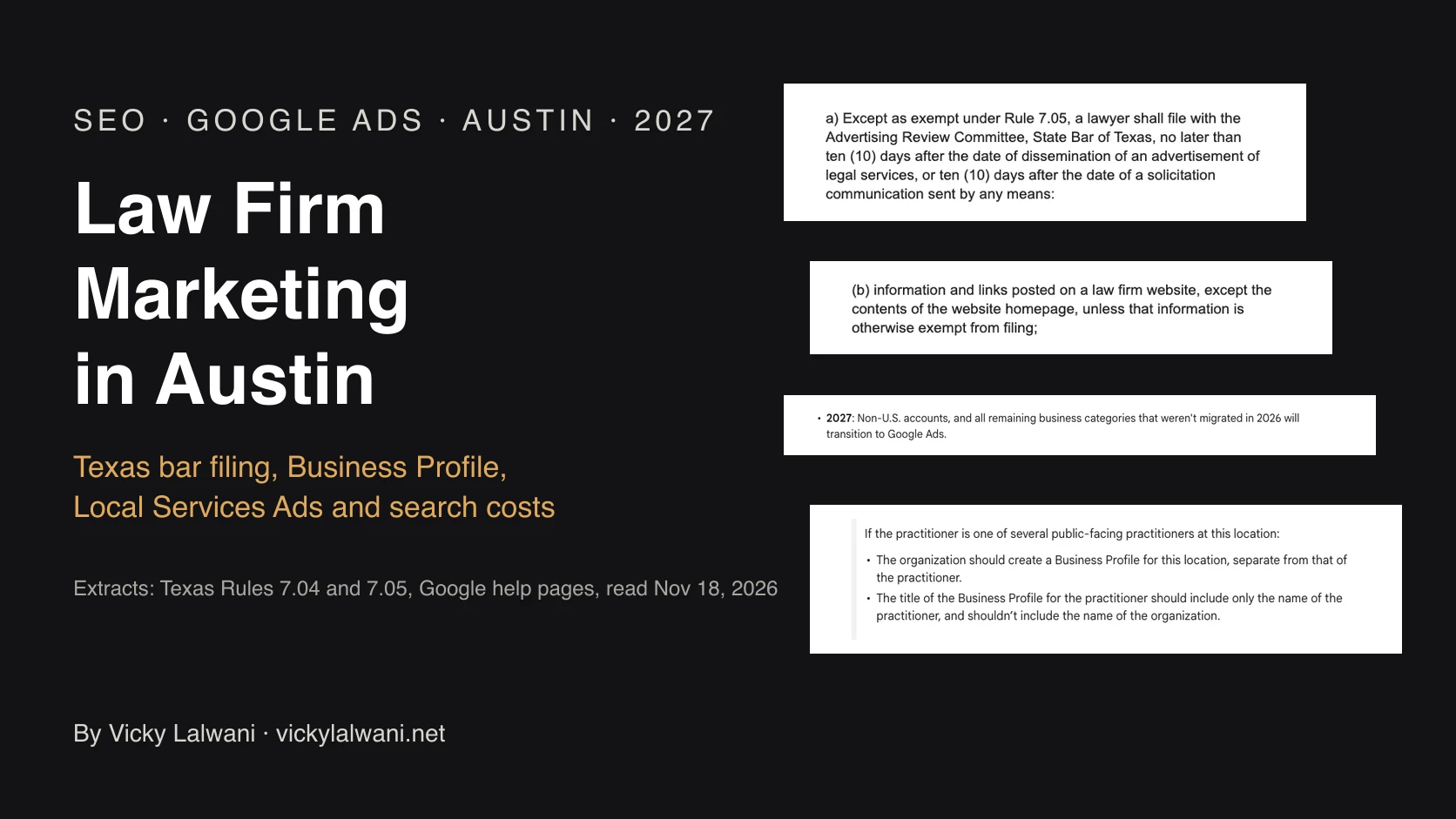
Law firm marketing in Austin works best as three jobs in order: make the firm easy to find on Google Maps and in search for the practice area and the part of the metro you serve, buy the most urgent searches with Google Ads or Local Services Ads, and answer every call fast. Texas adds a step most guides skip: under Rule 7.04 of the Texas Disciplinary Rules of Professional Conduct, most ads, including the website homepage, are filed with the State Bar Advertising Review Committee within 10 days of first use, unless a Rule 7.05 exemption applies. Legal search clicks are the most expensive of 23 US categories in the 2026 WordStream by LocaliQ benchmarks, at $9.87 a click and $131.63 a lead, so judge every channel on cost per signed case.
TL;DR
- The job: be found on Google Maps and in search for your practice area across the Austin metro, buy the most urgent searches with Google Ads or Local Services Ads, and answer every call fast. Judge it all on cost per signed case.
- The Texas step most guides skip: Rule 7.04 says most ads, including your website homepage, are filed with the State Bar Advertising Review Committee within 10 days of first use, unless Rule 7.05 exempts them.
- The cost: legal is the most expensive of 23 US categories in the 2026 WordStream by LocaliQ search benchmarks: $9.87 a click and $131.63 a lead on average.
- What changed in 2026: Local Services Ads are moving into Google Ads, with remaining categories due in 2027, and Google says AI Overviews and AI Mode need no special optimization beyond good SEO.
A partner at a small Austin family law firm opens Google on a Monday, types "divorce lawyer Round Rock" and sees three firms in the map pack, two Local Services Ads and an AI Overview. Their firm is in none of them. The website looks fine. The phone is quiet. That firm is made up; the situation is the one this guide is for.
I am Vicky Lalwani, an SEO and Google Ads consultant. I work remotely for US clients, with calls early or late in US time zones, and I have no Austin office. Law firm work has been part of my Google Ads work: multi-location firms run across Search, Local Services Ads and Meta. If you want that work done for your firm, my SEO consulting and Google Ads management for US businesses pages explain how it runs.
A note on evidence. Texas rule text comes from the Texas Center for Legal Ethics copy of Part VII of the Texas Disciplinary Rules of Professional Conduct, read on November 18, 2026. Google rules come from Google's own help pages, read the same day. I am not a lawyer and none of this is legal advice: your firm signs off on every ad, and filing stays with the firm. I have no Austin law firm case study to share, so this guide reports no client results. Where I write "I", it describes how I work in general.
Jump to: Channels · How people search · Texas rules · Business Profile · SEO · AI answers · Google Ads · LSA · Fix first · My audit · Agencies · Videos · X and Reddit · Weak spots · Sources
What does law firm marketing in Austin involve in 2027?
Short answer: three jobs in order: visibility on Google Maps and organic search for each practice area and part of the metro, paid search for the most urgent and valuable matters, and intake that answers fast. Texas adds a compliance step, because most ads are filed with the State Bar.
Most Austin law firm marketing pages from agencies list the same services: SEO, PPC, content, websites, reviews. That list is fine, but it hides the order. A firm that buys ads before its Business Profile and tracking work pays the most expensive clicks in search for calls it cannot measure. The table shows what each channel needs before it is worth paying for.
| Channel | How you pay | Needs first | Judge it on |
|---|---|---|---|
| Google Business Profile | Free | A real staffed office | Calls and direction requests |
| SEO pages | Time and content | Indexable site, one page per matter | Calls and forms from organic |
| Google Search ads | Per click | Call and form tracking | Cost per signed case |
| Local Services Ads | Per lead | License checks, someone to answer | Cost per qualified lead |
| AI answers | Content and mentions | Good SEO and a clear profile | Mentions and referral visits |
The rest of this guide takes each one in that order. If you want the whole plan in one file, the Austin Law Firm Marketing Playbook for 2027 is a free download that follows the same steps.
How do people in the Austin area search for a lawyer?
Short answer: they type the problem and the place, often with "near me", and pick from the map pack, Local Services Ads and the first results. Many search a suburb or county rather than "Austin", so one city page rarely covers the metro.
Google's US autocomplete is a quick, free signal of how people phrase a search. On November 18, 2026, typing "austin law firm seo" suggested "law firm seo austin tx", and "personal injury lawyer austin" suggested "personal injury lawyer austin tx", "best personal injury lawyer austin" and a Reddit variant. Broader phrases like "law firm marketing austin" returned no suggestions at all, which usually means low search volume. Autocomplete shows phrasing, not volume, so treat it as a hint.
Three habits follow from that. First, write pages in the searcher's words: "divorce lawyer", "DUI attorney", "car accident lawyer", not the firm's internal labels such as "family law practice group". Second, cover the places people name. The Austin metro spreads across Travis, Williamson and Hays counties, and someone in Round Rock, Cedar Park, Georgetown, Pflugerville, Kyle or San Marcos often searches their own town. Third, expect people to compare. In urgent matters they call two or three firms; in planned matters like estate planning they read reviews and fee pages first.
| Practice area | How people search | What usually leads |
|---|---|---|
| Personal injury | Urgent, mobile, "near me" | Search ads, LSA, fast intake |
| Criminal and DUI | Urgent, often at night | Call-focused ads, 24/7 answering |
| Family law | Private, over days | SEO pages, Maps, reviews |
| Estate planning | Planned, price-aware | SEO, fee pages, reviews |
| Immigration | Researched, often Spanish | Pages in both languages |
| Business law | Considered, B2B | SEO and referrals |
What do Texas lawyer advertising rules mean for your marketing?
Short answer: under Rule 7.04, an ad is filed with the State Bar Advertising Review Committee within 10 days of first use, with a copy, an application and a fee, unless Rule 7.05 exempts it. Website pages are exempt except the homepage, and every ad must name a responsible lawyer and their primary practice location under Rule 7.02.
None of the nine top-ranking Austin law firm marketing and SEO pages I could read in full on November 18, 2026 mentioned Rule 7.04, Rule 7.05 or the State Bar's Advertising Review Committee. Yet it is the rule that touches every campaign a Texas firm runs. Here is the text that matters, straight from the rules.
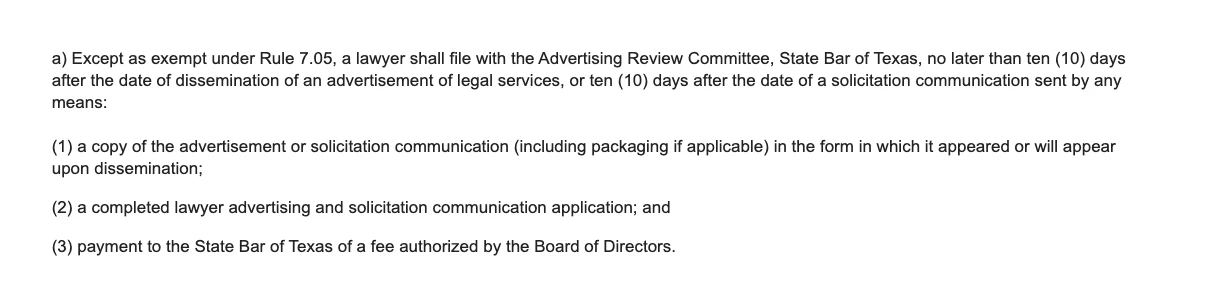
Pre-approval is optional under Rule 7.04(c): you can submit an ad at least 30 days before first use, and a finding of compliance then binds in your favor. The fee is set by the State Bar's board; the bar's Advertising Review pages list it as $100 per advertisement, but check the current amount in the Advertising Review portal before you file.

That one line changes how a Texas firm should plan its website. Practice area pages, attorney bios and blog posts are exempt from filing, though they must still comply with Rules 7.01 to 7.03. The homepage is not exempt. So a homepage redesign, or a new hero line written for SEO, can be a new filing. The Texas Center for Legal Ethics walks through the full exemption list in its June 2025 ethics question.
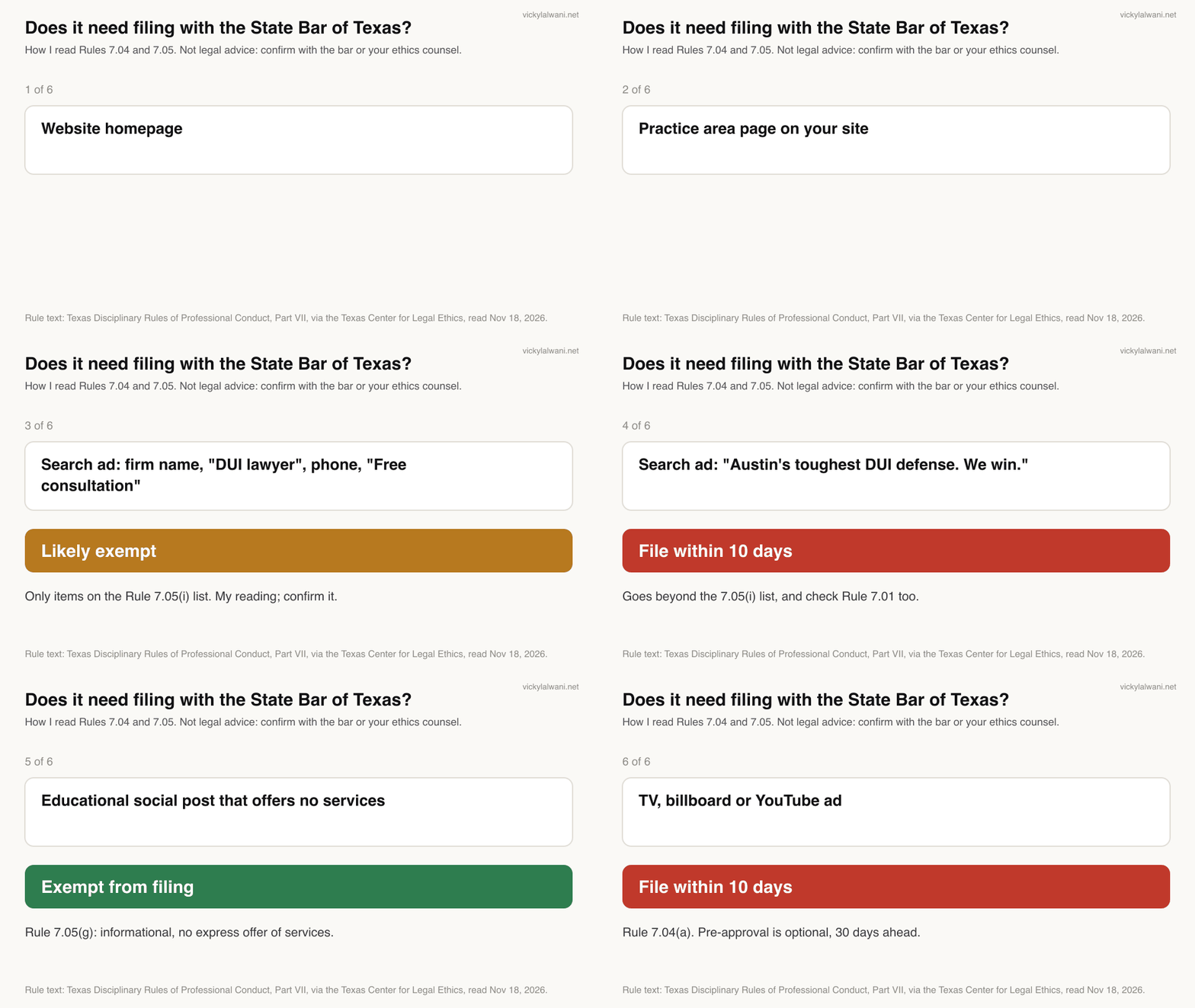
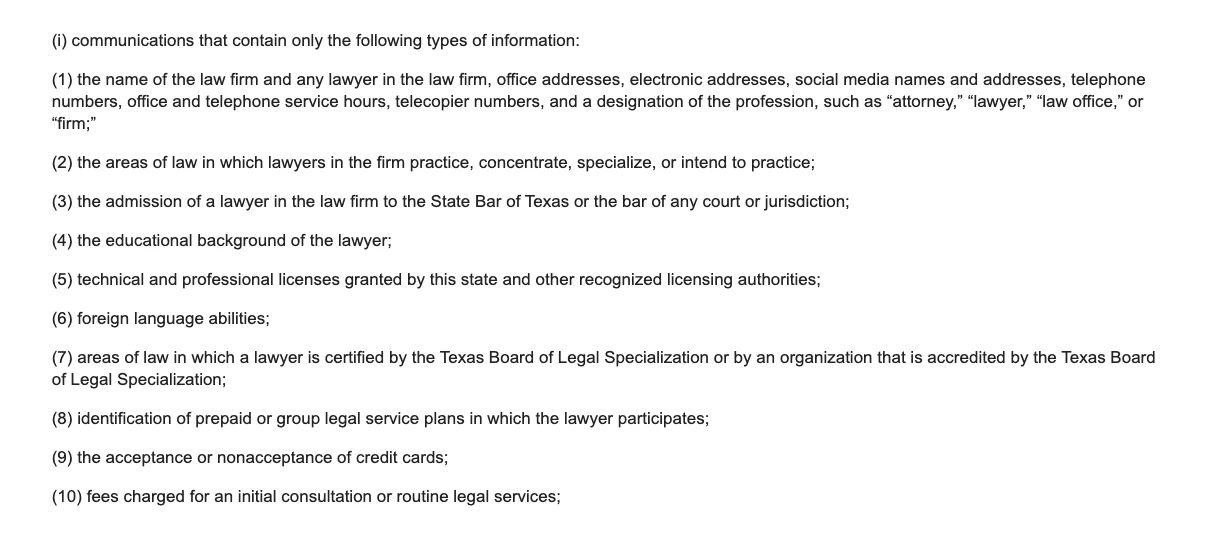
Search ads are the case the rules do not name. Rule 7.05(i) exempts communications that contain only listed items: the firm and lawyer names, contact details and hours, practice areas, bar admissions, Board certification, languages, and fees for an initial consultation, among others. My reading is that a text ad with only those items, such as firm name, "DUI lawyer", phone number and "free consultation", fits the exemption, and an ad that adds claims like "Austin's toughest DUI defense" does not. That is a reading, not a ruling, so ask the Advertising Review Department or your ethics counsel before you rely on it.
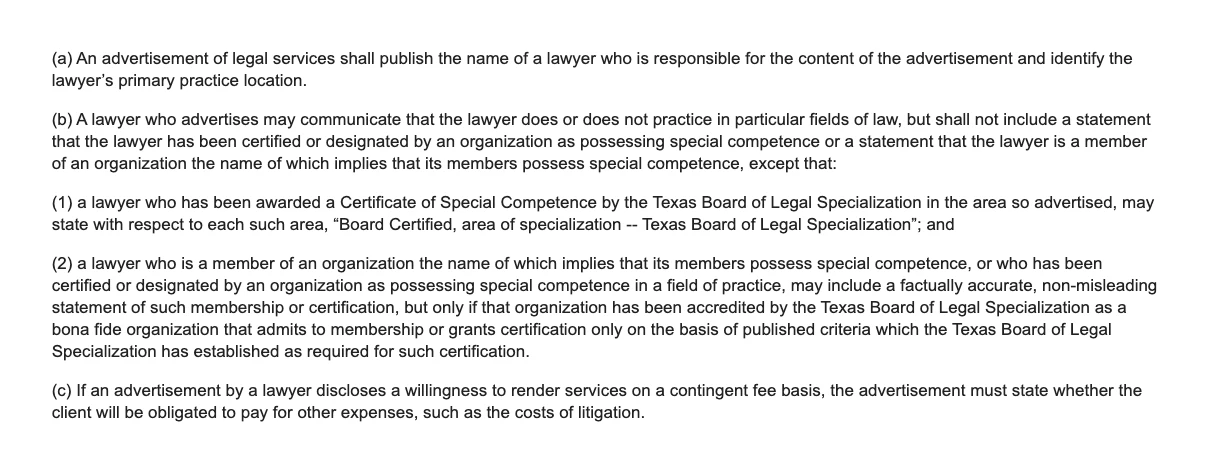
Three more rules shape the copy itself:
- Rule 7.02(a): an advertisement names a lawyer responsible for its content and that lawyer's primary practice location. Short ad formats rarely have room for this, so agree with your ethics counsel how the firm meets it before launch.
- Rule 7.02(b): no claim that a lawyer is certified or designated as having special competence, except the exact wording "Board Certified, area of specialization, Texas Board of Legal Specialization" for lawyers the Board has certified, or an accredited body's certification. Saying you practice or focus on an area is fine.
- Rule 7.02(c): an ad that offers contingent fee work must say whether the client also pays other expenses, such as litigation costs. That matters for "no fee unless we win" lines in personal injury ads.
- Rule 7.01: nothing false or misleading, no unjustified expectations from past results, and an actor who could be taken for the firm's lawyer can mislead unless a clear disclaimer fixes that.
Paid lead sources sit under Rule 7.03. Comment 13 allows paying a lead generator only if it does not recommend the lawyer or imply it analyzed the person's problem, and the payment fits the fee-sharing rules. Before you sign with any pay-per-lead or pay-per-case vendor, ask your ethics counsel to read its ads and its contract against that comment. On the Google side, the Google Ads legal requirements policy makes the advertiser responsible for following local law, so a Texas rule problem is your problem, not Google's.

| Asset | File it? | Rule |
|---|---|---|
| Website homepage | Yes, within 10 days | 7.04, 7.05(b) |
| Practice area and blog pages | No, but must comply | 7.05(b) |
| Search ad, listed items only | Likely not (my reading) | 7.05(i) |
| Search ad with claims | Yes | 7.04 |
| TV, radio, billboard, video | Yes | 7.04 |
| Educational social post | No, if no offer of services | 7.05(g) |
How should an Austin law firm set up Google Business Profile?
Short answer: one profile per staffed office, named exactly as the firm is known, with the right primary category. Lawyers who meet clients at that office can have their own practitioner profiles, but Google's guidelines rule out virtual offices and keyword-stuffed names.
For most Austin firms the map pack is the cheapest source of calls, and the Business Profile is what feeds it. Google treats lawyers as "individual practitioners", which has a few consequences that catch firms out:
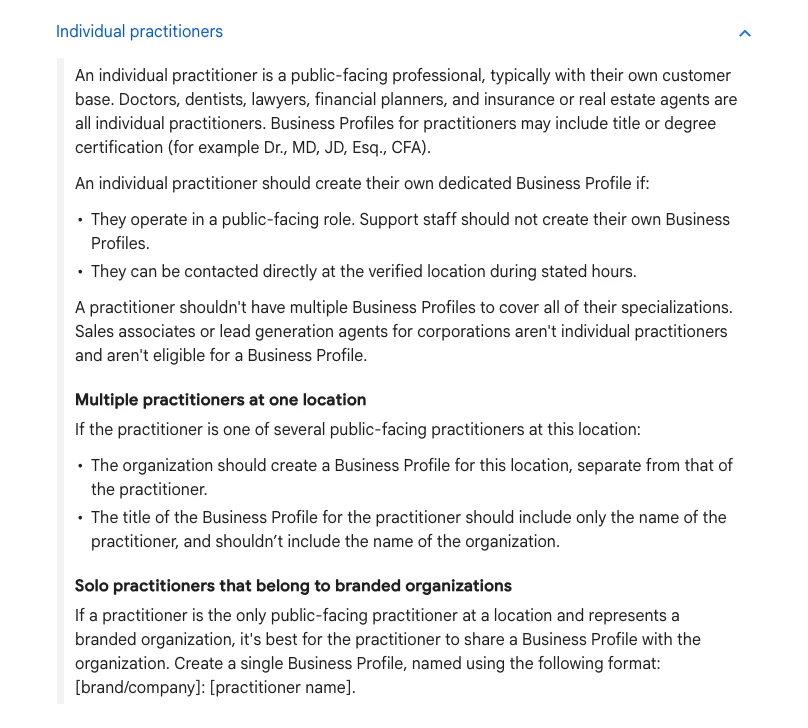
| Situation | What Google allows |
|---|---|
| Firm with one staffed office | One firm profile at that address |
| Several lawyers at that office | Firm profile plus one per public-facing lawyer |
| Solo lawyer under a firm brand | One shared profile: brand, then lawyer name |
| Satellite or virtual office | Not eligible unless staffed in stated hours |
| One lawyer, many practice areas | One profile, not one per specialty |
| Name with "Best Austin DUI Lawyer" | Not allowed; use the real name |
Coworking offices can qualify only with clear signage, customers received during business hours and the firm's own staff there, so an address that fails that test puts the profile at risk of suspension. Reviews matter here too: Google's review policy bans incentives for reviews and selectively asking happy customers, so ask every client at the same point in the matter.
What does SEO for an Austin law firm look like now?
Short answer: one strong page per practice area, written in the words people search, with pages for the parts of the metro you actually serve, fast mobile load, and answers to the questions clients ask before they call. Expect months, not weeks.
The Austin pages that rank for "law firm SEO" are mostly agency sales pages, and they agree on the basics: local SEO, content, reviews, links. Where a firm loses is often simpler. Three faults to check for: a single "Practice Areas" page covering six kinds of law, a homepage that tries to rank for everything, and no page for the county or suburb where most clients live.
- One page per matter type. "Car accident lawyer", "truck accident lawyer" and "slip and fall lawyer" are different searches with different case values. Each deserves its own page.
- Location pages only where you serve. A Round Rock page for a firm that takes Williamson County cases is useful. Twenty near-identical town pages are what Google's spam policies call doorway abuse.
- Answer first. Start each page with the answer a client wants: what the process is, how long it takes, what it costs, what to bring. Then the detail.
- Check Search Console monthly. Look at the queries each page shows for. When a page gets impressions for a question it does not answer, add the answer.
- Remember the homepage rule. Changes to homepage copy can trigger a new filing under Rule 7.04, so batch them.
I tell clients plainly that SEO takes six to nine months at minimum to show its full effect, which is why the paid channels further down carry the early months. The SEO consultant for US businesses page describes how I run this for US clients.
Do AI Overviews and AI Mode change legal SEO?
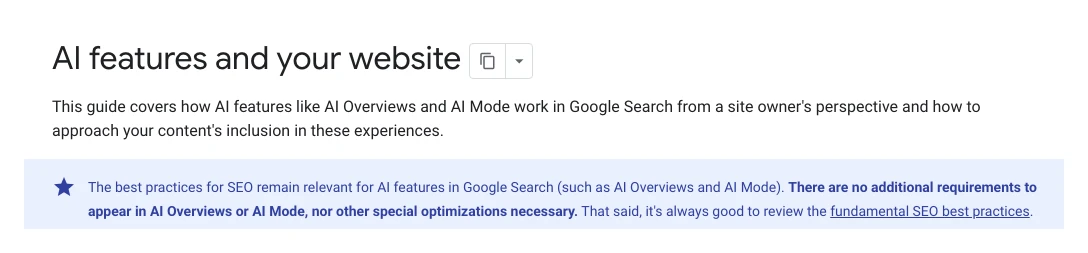
Short answer: not the basics. Google says there are no additional requirements to appear in AI Overviews or AI Mode beyond being indexed and eligible for a snippet. What changes is that pages which answer questions clearly get cited, and pages that only sell get skipped.
Legal questions such as "how long do I have to file a personal injury claim in Texas" are the kind of informational searches where AI answers often appear. Vendors publish very different figures for how often legal searches show an AI Overview, and the samples are small or undisclosed, so I do not quote a number. The practical point holds anyway: if a person reads an AI answer before they call, you want your firm's page to be the one it cites.
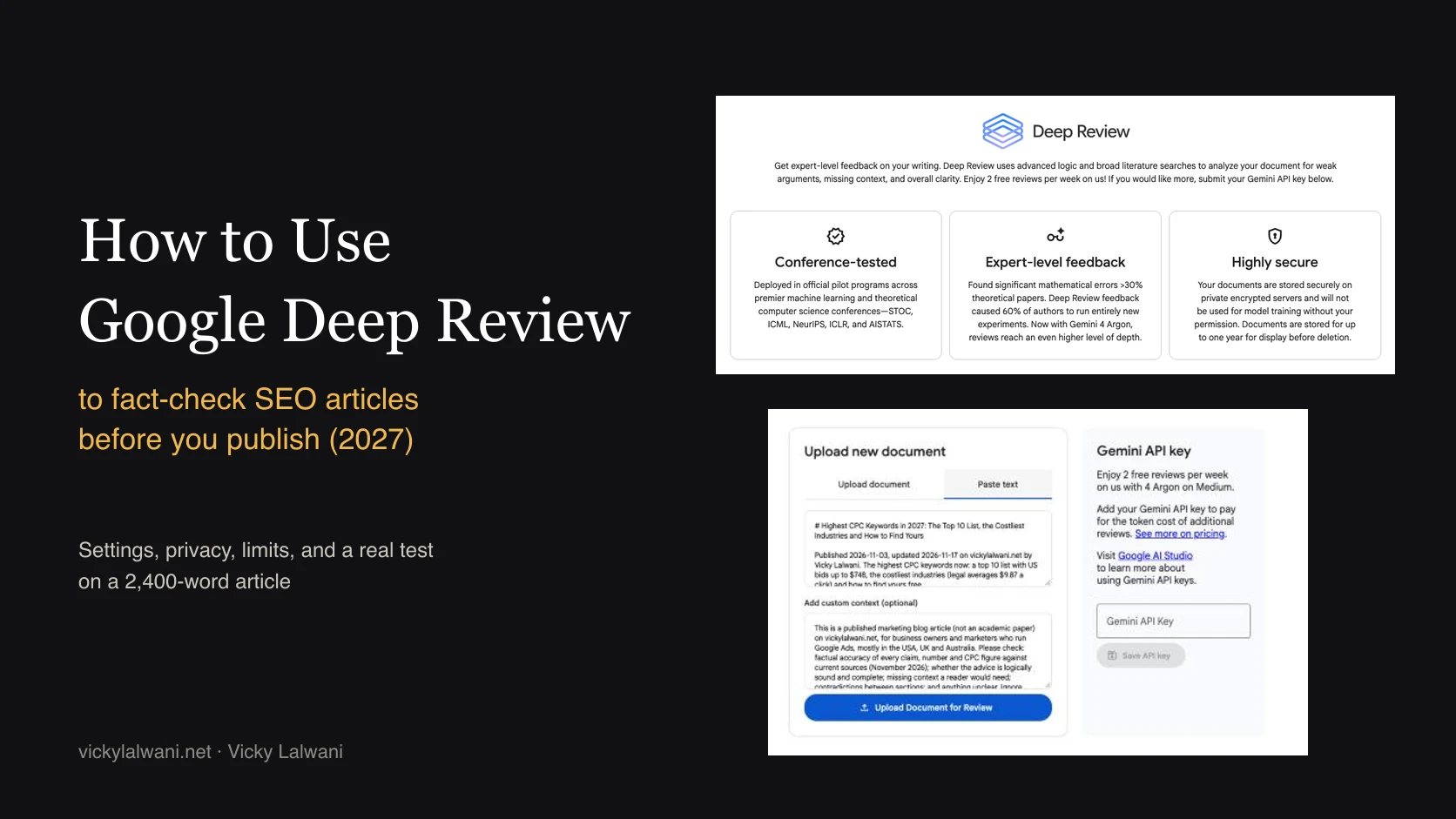
Google also launched generative AI reporting inside Search Console in 2026, covered in the Google Search Central video further down. For how AI tools pick which businesses to name, I ran 101 AI answers through a study: how ChatGPT and AI tools recommend businesses. The answers gave a specialism as the reason for 92% of picks and a location in the asked market for 55%, which is one more reason to keep practice areas and places clear on every page.
What do Google Ads cost for Austin law firms?
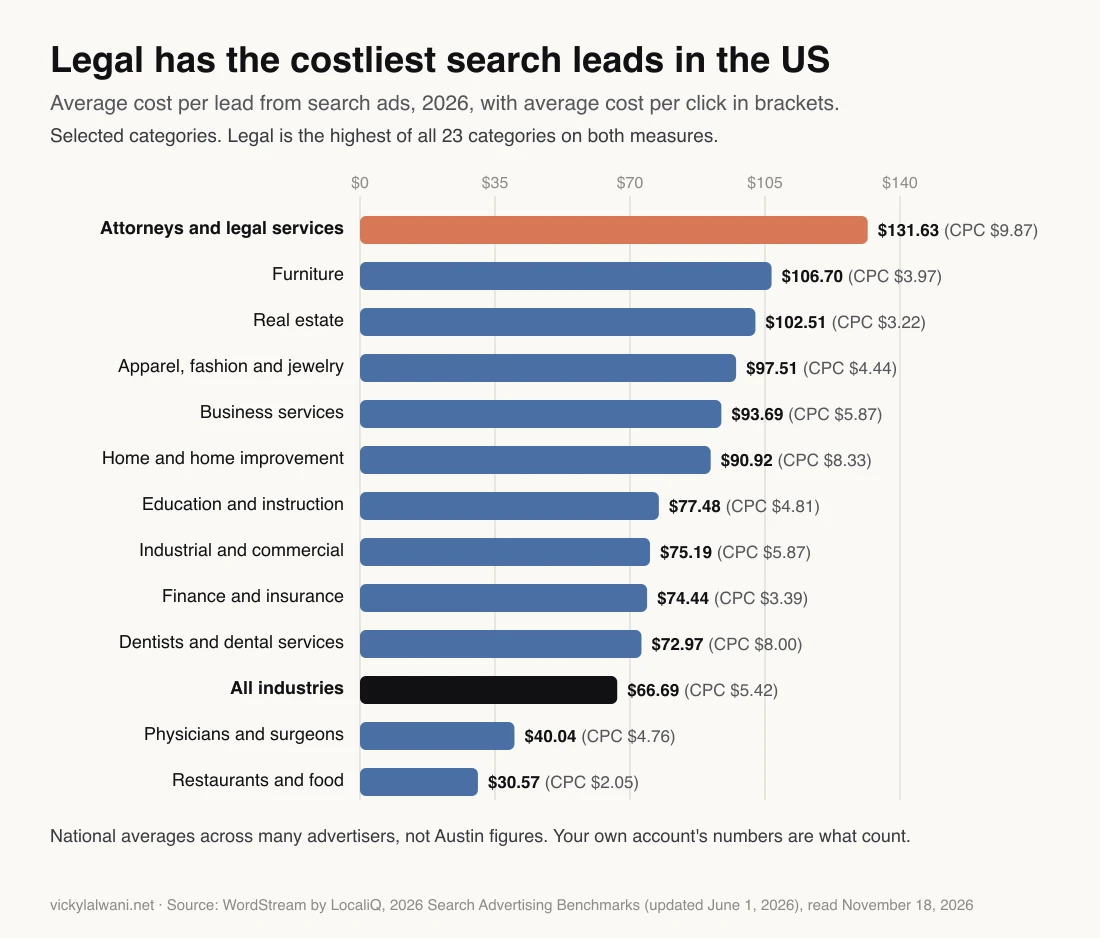
Short answer: more than in any other category. In the 2026 WordStream by LocaliQ benchmarks, attorneys and legal services averaged $9.87 a click and $131.63 a lead, the highest of 23 categories on both. These are national averages; Austin auctions for personal injury and criminal defense can run higher.
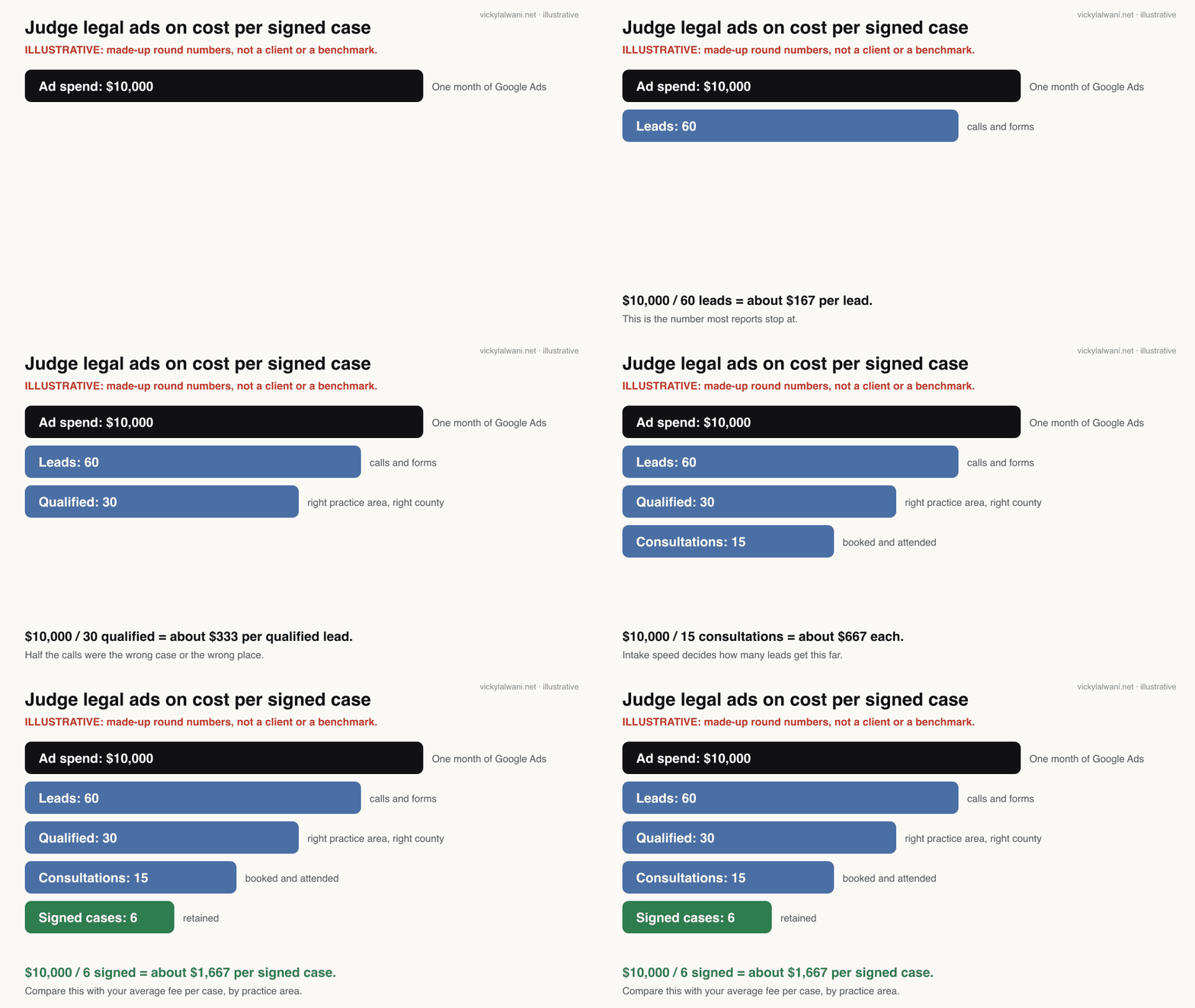
At those prices, a cost per lead is not enough. A form fill from someone wanting free advice and a call from an injured driver with a clear claim cost the same in Google Ads. The number that matters is cost per signed case, by practice area. The animation shows the arithmetic with made-up round numbers.
How I set up a Google Ads account for a law firm in a metro like Austin:
| Setting | What I choose | Why |
|---|---|---|
| Structure | One campaign per practice area | Budgets and case values differ |
| Location option | Presence: people in the area | Stops out-of-state clicks |
| Geography | Counties you take cases in | Matches where you practice |
| Negatives | Jobs, pro bono, law school, free | Removes searches that never sign |
| Calls | Tracked, ads in staffed hours | Unanswered calls waste the click |
| Conversions | Qualified calls and signed cases | Teaches bidding what a case is |
Google's location options default to people "in or regularly in" your area or who show interest in it; for a local firm I switch that to presence. The search terms report is where most legal waste hides, and my checklist for it is in how to reduce wasted spend in Google Ads. Measurement comes before any of this: if calls are not tracked by campaign, the account cannot learn. The conversion tracking audit lists the checks I run first.
Are Local Services Ads worth it for Austin lawyers?
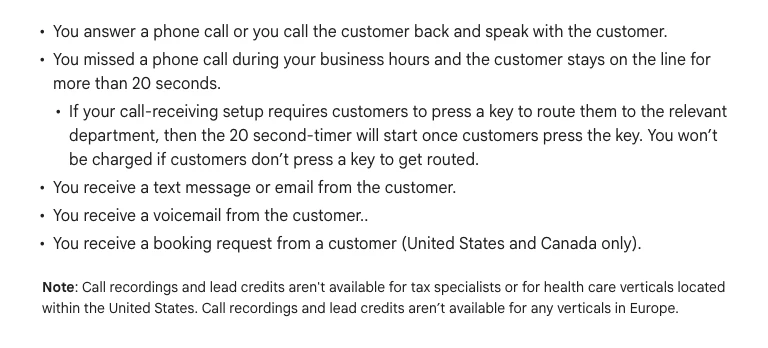
Short answer: often, as a first paid test, if someone answers every call live. You pay per lead, not per click, and a missed call during business hours is billed once the caller stays on the line for more than 20 seconds. The ads are moving into Google Ads, with remaining categories due in 2027.
Local Services Ads sit above the normal ads for searches like "divorce lawyer near me". Firms go through Google's screening and verification before ads run, and Google now shows a single Google Verified badge on profiles. In October 2026 Google told advertisers that featured professionals would no longer show on the ads and that headshots are optional, a change that mostly affects lawyers (Search Engine Roundtable report).
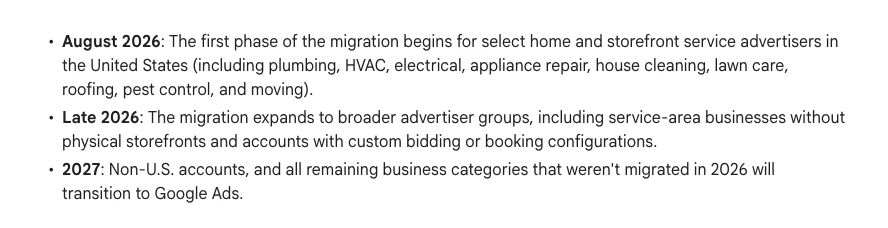
The move into Google Ads matters for planning. Google's timeline lists home and storefront services first, from August 2026, then broader groups in late 2026, and all remaining categories in 2027. Legal is not named, so most Austin firms should expect their turn by 2027. When it comes, manual cost-per-lead bids go, one campaign-level target replaces per-category targets, and past reports do not carry over, so download them first.
Practitioners on Reddit report the same two problems again and again: many calls are people wanting free advice, and a call answered by voicemail still costs money. One small transactional firm said it pays about $105 a lead in Texas and keeps lead quality up by switching off the practice areas that draw the worst calls. That is one firm's report, not a benchmark. My full comparison of the two products is in Local Services Ads vs Google Ads in the USA.
What an Austin law firm should fix first
Short answer: tracking and intake first, then the Business Profile, then Texas compliance on the homepage and ads, then the pages and campaigns. Spend rises only once you can see cost per signed case.
| Fix | Check | Why first |
|---|---|---|
| Call tracking | Every call source counted by campaign | Nothing else can be judged |
| Intake | Who answers, nights and weekends | Missed calls are paid for |
| Business Profile | Real office, real name, right category | Cheapest calls in Maps |
| Texas filing | Homepage and live ads filed or exempt | Rule 7.04, 10 days |
| Ad copy | Responsible lawyer, fee wording | Rules 7.01 and 7.02 |
| Practice pages | One page per matter type | Ranks and converts better |
| Location pages | Only where you take cases | Avoids doorway pages |
| Search terms | Weekly, with negatives | Legal clicks cost the most |
| Reviews | Ask every client, same stage | Google bans selective asking |
| Reporting | Signed cases by practice area | The number partners trust |
How I audit a law firm's marketing
Short answer: I check access and tracking live with the firm on a shared screen, then the Business Profile, then the search terms and the pages ads land on, and I put every finding in a sheet the firm approves before anything changes.
These are habits from my client work in general, not from an Austin engagement:
- Access first, live. "I gave you access" often turns out to be view-only, or an invite sent to the wrong address. I open the account on the call with the firm and fix the role there.
- Tracking before spend. Campaigns stay paused until every call button, form and tracked number reports to Google Ads. Where I cannot touch the site, I deploy through Google Tag Manager.
- Reconcile with the CRM. I compare tracked conversions with the leads the intake team logged. When they disagree, the CRM is usually right.
- Searcher words over firm words. Ads and page titles use what people type, such as the suburb or county name, not internal practice group labels.
- Quick wins first. Business Profile and listing clean-up come before slower SEO builds.
- Approval before anything goes live. Audit in a sheet, the firm checks it, then changes. For a Texas firm, ad copy also goes past whoever handles bar compliance.
- I say where my work ends. I am not a lawyer. Ethics questions go to the firm's ethics counsel, and filing with the bar stays with the firm.
Here is a prompt I use with an AI assistant to get a first pass at search terms before I review them by hand. It never changes the account.
You are reviewing a Google Ads search terms export for a law firm in the Austin, Texas metro.
Practice areas the firm takes: [list]. Counties it takes cases in: Travis, Williamson, Hays.
1. Flag search terms with clicks but no conversions that are clearly not cases: jobs, law school, pro bono or free legal aid, other practice areas, other states.
2. Group them by theme and propose one negative keyword per theme, with match type and level (campaign or shared list).
3. Check every proposed negative against the terms that DID convert and drop any that would block them.
4. List any ad text in the export that makes claims beyond firm name, practice area, contact details, languages, Board certification or consultation fee, so a lawyer can check it against Texas Rules 7.01, 7.02 and 7.05(i).
Output a table only. Do not suggest account changes beyond negatives.
For Austin legal marketing agencies: working with a white label partner
Short answer: a white label partner does the SEO or Google Ads work under your brand while you keep the client relationship, the reporting and the bar compliance sign-off. It works when access, reporting and who approves what are written down before the first change.
Austin has plenty of legal marketing agencies, and many of them hit the same wall: a run of new law firm clients and no in-house specialist for paid search or technical SEO. A white label partner fills that gap without the client ever dealing with a second vendor. What I agree with an agency before starting:
| Item | How it works |
|---|---|
| Access | Through your agency manager account |
| Client contact | You, unless you ask me to join a call |
| Reports | Unbranded, or in your template |
| Texas filing | The firm files; you track the deadlines |
| Ad approval | Your account lead, then the firm |
| Hours | Calls early or late in US Central time |
| Price | Hourly or monthly, published on the pricing page |
My rates are on the pricing page. For the channel detail behind the work, see Google Ads for US businesses and SEO for US businesses, and the law firm marketing USA page for the full practice area and state rules picture.
Videos worth watching
Short answer: three videos cover the Texas filing process, Google's 2026 Search Console updates for AI features, and Local Services Ads compared with search ads for lawyers.
From the Texas Young Lawyers Association, April 2023, part of its online attorney marketing guide. Sells nothing. It predates some 2026 changes, so check fees and screens against the current portal.
From Google Search Central, June 2026: generative AI performance reporting in Search Console and a control over how content is used in AI features. Google's own product.
From Justia, February 2026, a one-hour webinar for lawyers. Justia sells legal marketing services, and the video promotes its paid learning membership.
| Video | Channel | Date | What it covers |
|---|---|---|---|
| Getting an ad approved by the State Bar of Texas | Texas Young Lawyers Association | Apr 2023 | The Advertising Review process |
| Texas lawyer advertising rules explained | A Texas law professor's channel (talk by a lawyers' insurer) | Jul 2025 | Rule 7.01 and common grievances |
| Search gen AI reports, Q2 2026 | Google Search Central | Jun 2026 | AI reporting in Search Console |
| PPC and Local Services Ads for lawyers | Justia | Feb 2026 | Search ads vs LSA, pitfalls |
| LSA transition to Performance Max | Rotate Digital (agency) | Aug 2026 | What changes in the move |
| GEO vs SEO for law firms | Juris Digital (legal agency) | Nov 2026 | AI search tactics for firms |
What people say on X and Reddit
Short answer: Google's Ads Liaison account and PPC practitioners on X focused on the Local Services Ads move and the photo change for lawyers. On Reddit, lawyers in r/LawFirm mostly report poor lead quality from LSA and frustration with SEO vendors.
| Source | What they said | Type | Link |
|---|---|---|---|
| Google's Ads Liaison account | Local Services Ads are moving into the Google Ads interface. Jul 20, 2026 | Official | X post |
| Google's Ads Liaison account | Follow-up calls within 15 days of a lead are charged once. Aug 26, 2026 | Official | X post |
| A PPC agency owner on X | Big LSA change for lawyers: featured professionals gone, headshots optional. Oct 18, 2026 | First-hand | X post |
| Search Engine Roundtable's editor | Google expanded its help page on how LSA leads work. Oct 8, 2026 | Trade press | X post |
| Search Engine Roundtable's editor | Many changes to the LSA help document while the product moves. Aug 19, 2026 | Trade press | X post |
| A PPC agency owner on X | Rolling LSA into Performance Max makes sense; phased from August. Jul 20, 2026 | Opinion | X post |
| r/LawFirm | A family law solo pays about $30 a call but most callers want free advice. Jul 2026 | First-hand | Thread |
| r/LawFirm | A criminal defense lawyer pays for direction-seeking and price-shopping calls. May 2026 | First-hand | Thread |
| r/LawFirm | A lawyer in a major city stuck past page 10 asks if their SEO vendor is worth it. Sep 2026 | First-hand | Thread |
| r/LawFirm | A solo asks what to look for in a law firm SEO and Ads agency. Jan 2026 | Question | Thread |
| r/LawFirm | A firm suspects competitors of clicking its costly ads. Sep 2026 | First-hand | Thread |
The pattern in the Reddit threads is consistent: lawyers trust what they can measure. In the agency-vetting thread, the most upvoted reply, from someone who runs an agency, said to ask how leads are tracked, and another reply praised checking real analytics and Search Console data rather than a vendor's own charts.
Where this advice is weak
Short answer: no search volumes, no Austin-only cost data, no published migration date for legal LSA, and my reading of the search ad exemption is not a legal opinion.
- Semrush was not connected for this research, so I have no verified monthly search volumes or Austin cost per click. The keyword choices rest on Google autocomplete and the pages that rank.
- The cost figures are national averages across many advertisers. Austin personal injury and criminal defense auctions may cost more.
- The State Bar's own website did not load from my network on November 18, 2026, so the $100 fee is taken from the bar's published pages as indexed by search, not read directly.
- Google has not named a migration date for legal Local Services Ads; "remaining categories in 2027" is the closest official line.
- Whether a search ad fits Rule 7.05(i), and how short ads meet Rule 7.02(a), are questions for the Advertising Review Department or your ethics counsel.
Book a free audit for your Austin firm
If your firm is in Austin or anywhere in the metro and the phone is quieter than your rankings or ad spend suggest, I will review your Business Profile, website, tracking and Google Ads account and send you a short written list of what to fix first. The free audit call takes 30 minutes; prices are on the pricing page, and the work itself runs through my SEO consulting and Google Ads services. Prefer to work through it yourself first? Download the Austin Law Firm Marketing Playbook for 2027.
Sources
| Source | What it supports | Date read | Link |
|---|---|---|---|
| Texas Rule 7.04 | Filing within 10 days, pre-approval | Nov 18, 2026 | Rule |
| Texas Rule 7.05 | Exemptions, homepage, listed items | Nov 18, 2026 | Rule |
| Texas Rule 7.02 | Responsible lawyer, Board Certified, fees | Nov 18, 2026 | Rule |
| Texas Rule 7.01 | False or misleading communications | Nov 18, 2026 | Rule |
| Texas Rule 7.03 | Solicitation, lead generators | Nov 18, 2026 | Rule |
| Texas Center for Legal Ethics | Exemption list explained | Jun 2025 | Ethics question |
| State Bar of Texas | Advertising Review portal | Nov 18, 2026 | Portal |
| Google Business Profile Help | Practitioners, offices, names | Nov 18, 2026 | Guidelines |
| Google Search Central | AI features need no extra steps | Nov 18, 2026 | Docs |
| Google Ads Help | LSA migration timeline | Nov 18, 2026 | Help page |
| Local Services Ads Help | Valid leads, 20-second rule | Nov 18, 2026 | Help page |
| Local Services Ads Help | Google Verified badge | Nov 18, 2026 | Help page |
| Google Ads policy | Advertiser follows local law | Nov 18, 2026 | Policy |
| Google Ads Help | Location options | Nov 18, 2026 | Help page |
| Google Search Central | Doorway abuse in spam policies | Nov 18, 2026 | Policy |
| Google Maps content policy | No review incentives or selective asking | Nov 18, 2026 | Policy |
| WordStream by LocaliQ | Legal CPC and cost per lead, 2026 | Updated Jun 1, 2026 | Benchmarks |
| Search Engine Roundtable | LSA featured professionals change | Oct 19, 2026 | Report |
| X and Reddit | Official posts and practitioner reports | Jan to Oct 2026 | Linked in the table above |
| YouTube | Six videos | Apr 2023 to Nov 2026 | Linked in the videos table |
FAQ
What is law firm marketing in Austin?
Law firm marketing in Austin is the work of getting people in the Austin metro to find and hire a firm: Google Business Profile and SEO for organic and map results, Google Ads and Local Services Ads for urgent searches, and intake that answers every call. In Texas it also means filing most ads with the State Bar Advertising Review Committee within 10 days of first use.
Do Texas lawyers have to file their website with the State Bar?
Under Texas Rule 7.05(b), information and links on a law firm website are exempt from filing, except the contents of the homepage. The homepage is filed under Rule 7.04 unless another exemption applies, and every page must still comply with Rules 7.01 to 7.03.
Do Google search ads need to be filed with the State Bar of Texas?
The rules do not name search ads. Rule 7.05(i) exempts communications that contain only listed items such as the firm name, contact details, practice areas and initial consultation fees, so a text ad with only those items may be exempt. An ad with other claims likely needs filing within 10 days, so confirm with the Advertising Review Department or your ethics counsel.
How much do Google Ads cost for lawyers in Austin?
National 2026 benchmarks from WordStream by LocaliQ put attorneys and legal services at $9.87 a click and $131.63 a lead on average, the highest of 23 categories. Austin auctions for personal injury and criminal defense can cost more, so judge campaigns on cost per signed case by practice area rather than on cost per click.
Are Local Services Ads worth it for Austin law firms?
Local Services Ads are often worth a test if someone answers every call live, because you pay per lead rather than per click. A missed call during business hours is charged once the caller stays on the line more than 20 seconds, and many lawyers report free-advice calls, so limit the practice areas you list and track lead quality.
How long does SEO take for an Austin law firm?
SEO usually takes six to nine months at minimum to show its full effect for a law firm, longer in crowded practice areas like personal injury. Business Profile fixes and paid search can bring calls sooner while the practice area and location pages build up.
Can a law firm have more than one Google Business Profile in Austin?
A firm can have one profile for each staffed office, and lawyers who meet clients at that office can have their own practitioner profiles. Virtual offices and mail drops are not eligible, and a lawyer should not create separate profiles for each practice area.
Do AI Overviews need special optimization for law firm websites?
Google says there are no additional requirements to appear in AI Overviews or AI Mode beyond being indexed and eligible for a snippet. Pages that answer client questions clearly and accurately are the ones most likely to be cited.
Can an Austin legal marketing agency hire a white label SEO or Google Ads partner?
Yes. A white label partner works under the agency's brand through its manager account and reports, while the agency keeps the client relationship. For Texas firms, the firm still files ads with the State Bar, so agree who tracks those deadlines before work starts.