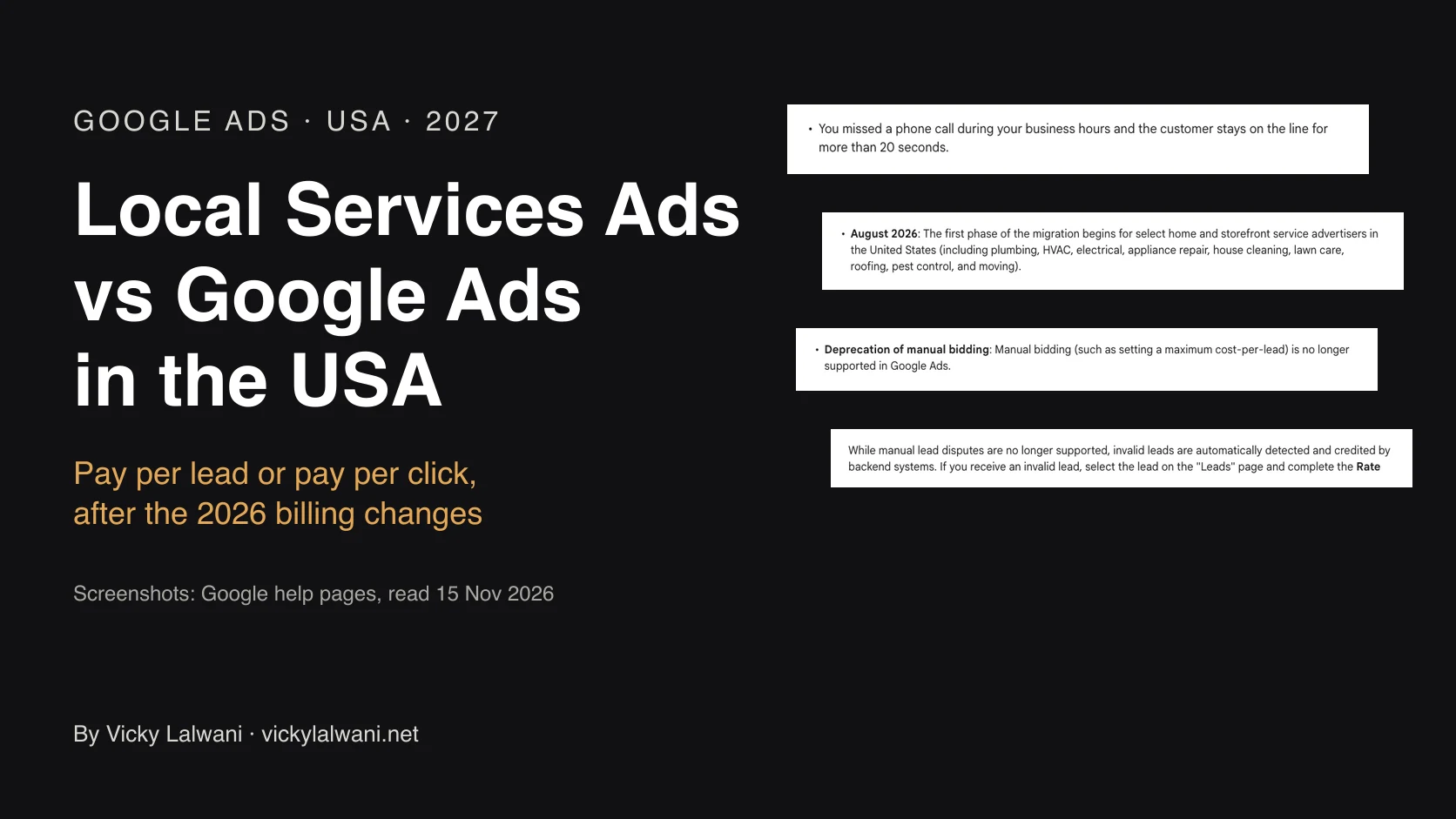
Local Services Ads charge a US business per lead, such as a call or a message, while Google Search ads charge per click. In one US vendor's benchmark of 888 home services contractors, Local Services Ads cost $53 per lead in February 2026. A separate set of 816 contractors paid $104 per lead across Google Ads a month earlier. Two things changed in 2026. A missed call during business hours is now billed if the caller stays on the line for more than 20 seconds, and a call that reaches voicemail counts as connected. Google is also moving accounts into Google Ads as a Performance Max campaign with pay per lead goals, starting in the USA. Run Local Services Ads first if someone answers your phone, and Search first if you need to control keywords and the page.
Do these three things first:
1. Check who picks up the phone. On Local Services Ads, a call nobody answers during your business hours is billed once the caller has waited more than 20 seconds. A call that reaches voicemail counts as connected.
2. Check where your account lives. Google is moving US Local Services Ads accounts into Google Ads. Past performance reports do not move with them, so save them now.
3. Compare on cost per booked job. A lead price and a click price are not the same unit. The fair comparison is further down.
New: running Performance Max as well? Performance Max for lead generation in the USA covers the qualified lead goal, the October 2026 channel controls and a five-point readiness test.
TL;DR
- The difference: with Local Services Ads you pay for valid leads, such as calls and messages. With Google Search ads you pay for each click.
- The 2026 billing change: a missed call in business hours is a valid lead if the caller stays on the line for more than 20 seconds.
- The 2026 platform change: accounts are moving into Google Ads as a Performance Max campaign with pay per lead goals. The USA goes first. Other countries follow in 2027.
- Which to run: Local Services Ads first if a person answers your phone and you have reviews. Search first if you need to choose the job, the keyword and the page. Both when the budget can feed both.
Jump to: The difference · Cost · Who qualifies · Missed calls · Bad leads · The move · Control · Which to run · Running both
Picture a three-truck heating and cooling company in Phoenix. The owner has one ad budget and two Google products to spend it on. One bills per phone call. The other bills per click. Last month's invoice also showed calls nobody remembers answering.
That company is made up. The decision is real, and two changes in 2026 made it harder. This guide covers both products for US businesses, in dollars, checked against Google's own help pages. If you would rather hand it over, I set up and manage Google Ads for US businesses.
A note on evidence. Platform rules come from Google's Local Services Help and Google Ads Help, read on November 14 and 15, 2026, and linked where I use them. This guide is research, not a case study: I am not reporting results from a Local Services Ads account of my own here. Where a line says "I", it comes from my Google Ads work for clients. I do not share client names or numbers. Every dollar figure is from a linked source or marked as an example.
Local Services Ads vs Google Ads: what is the difference?
Local Services Ads charge you per lead. Google Search ads charge you per click. A lead is a person who contacts you: a call, a message, a voicemail or a booking. A click is a visit to your page, whether or not the visitor ever calls. That one difference drives almost every other difference between the two.
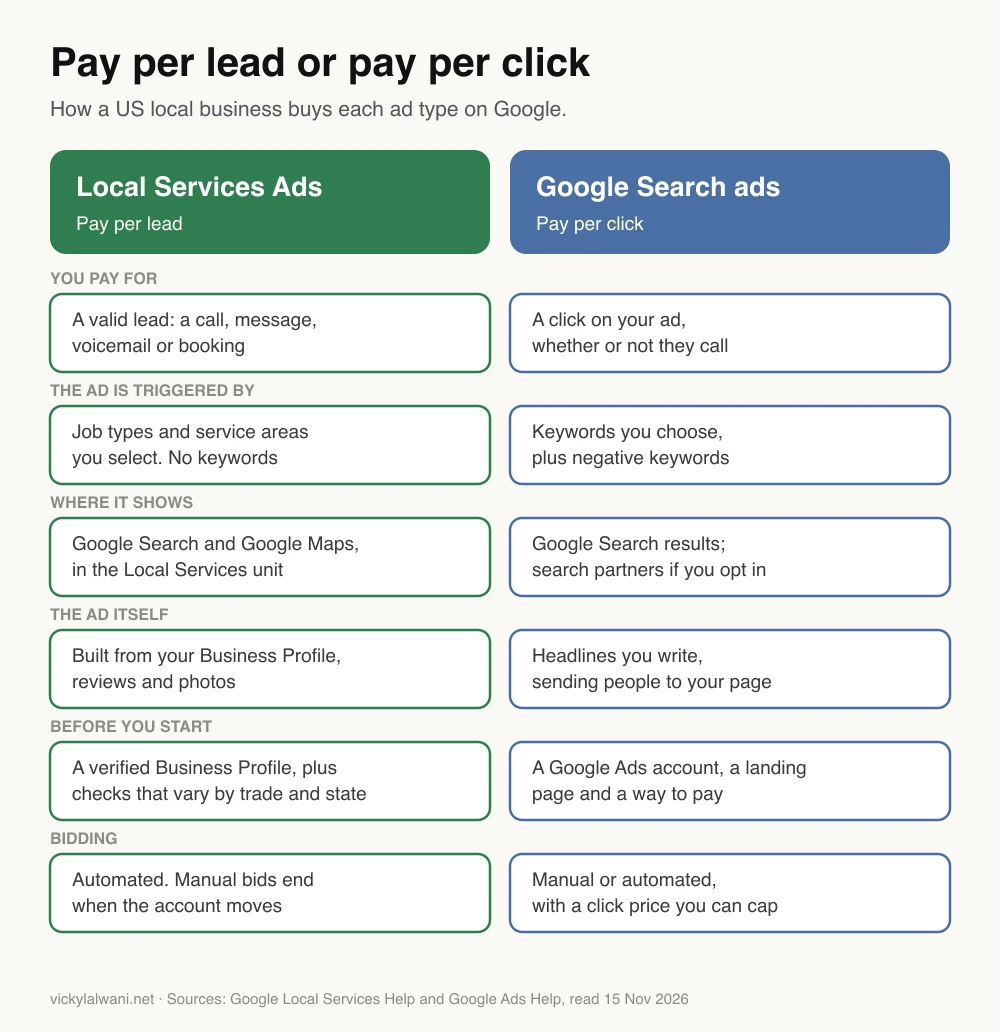
Local Services Ads (often shortened to LSA) are the listings with a business name, star rating and call button at the top of some local searches.
- You select job types and service areas. There are no keywords.
- The ad is built from your Google Business Profile, the free listing that shows your business on Google Search and Maps.
- They show only on Google Search and Google Maps.
Google Search ads are the text ads marked "Sponsored" in the results.
- You choose keywords, the words or phrases that match your ad to a search. You can also add negative keywords, which are words you do not want to show for.
- You write the headlines. The click goes to a landing page, the page on your site built for that ad.
- A call asset can put your phone number on the ad.
"Google Ads" is the platform that holds Search, Performance Max and the other campaign types. When people compare "Local Services Ads vs Google Ads", they nearly always mean Local Services Ads against Search ads. That is how I use the terms here.
| Local Services Ads | Google Search ads | |
|---|---|---|
| You pay for | A valid lead | A click |
| Targeting | Job types, service areas | Keywords, locations |
| Shows on | Search and Maps | Search results |
| Ad content | Your Business Profile | Text you write |
| Entry bar | Verification checks | An account and a page |
| Bad result | Automatic credit, maybe | No refund for a poor click |
What each one costs in the USA
Google's help pages give no price list for either product. In the largest dataset I found, home services contractors paid $53 per Local Services Ads lead in February 2026. A different set of contractors in the same vendor's data paid $104 per lead across Google Ads a month earlier. Both figures are from early 2026, before the billing change.
Google says lead prices vary with your location, the job type, the type of lead and your bidding mode. Message leads are typically priced lower than phone leads.
The one side by side dataset. SearchLight's Home Services LSA Benchmark tracked $6.72 million of Local Services Ads spend across 888 contractors and 126,650 leads in February 2026. It compares that with its January 2026 Google Ads benchmark of 816 contractors. The vendor is American, but its page does not state the country.
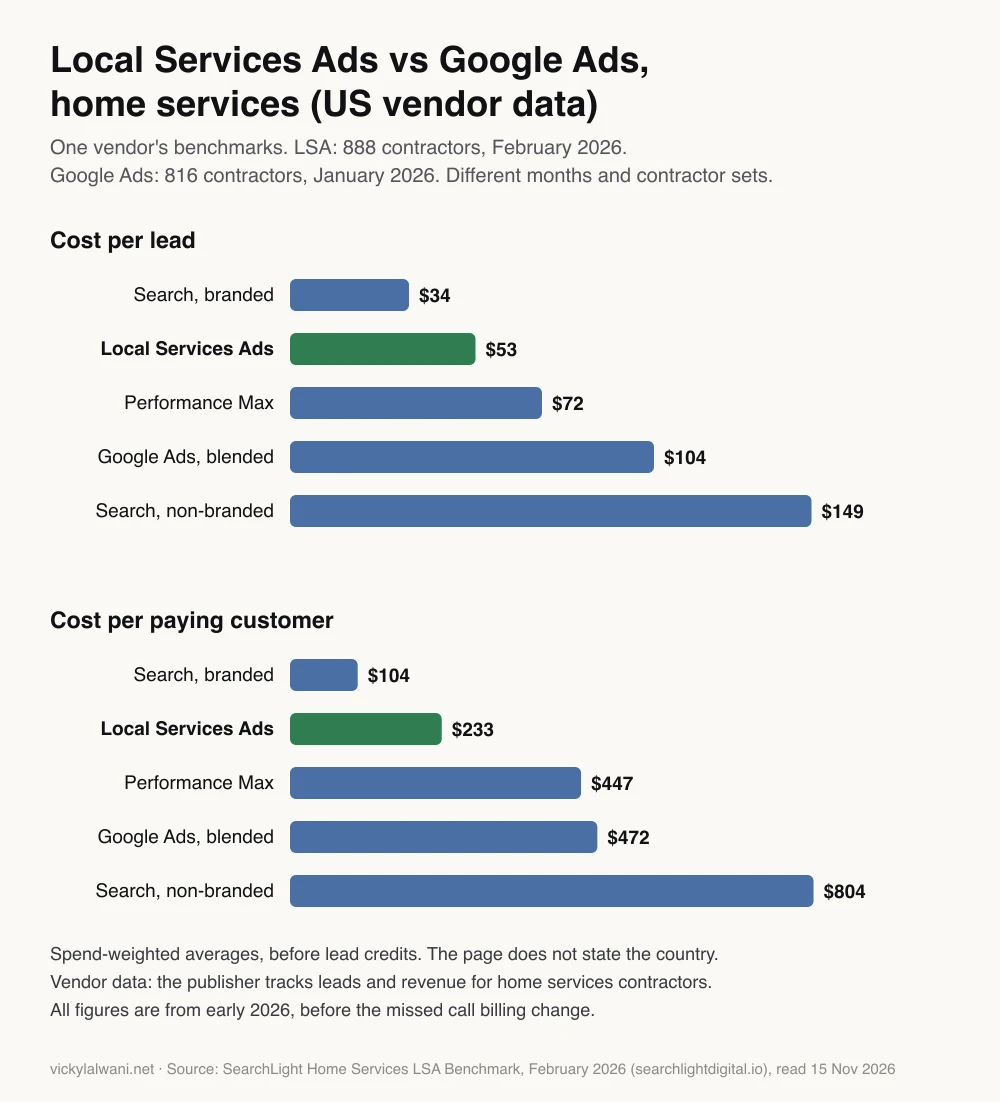
| Campaign type | Cost per lead | Leads that booked an appointment | Cost per customer |
|---|---|---|---|
| Search, branded | $34 | 55.3% | $104 |
| Local Services Ads | $53 | 43.9% | $233 |
| Performance Max | $72 | 32.2% | $447 |
| Google Ads, blended | $104 | 41.7% | $472 |
| Search, non-branded | $149 | 37.6% | $804 |
Branded Search means ads on searches for your own business name. Non-branded means searches like "ac repair near me".
Branded Search, the cheapest row, cost $34 a lead. Read that table with five cautions.
- It is one vendor's customers. The two sets of contractors and the two months are different.
- The page describes its figures as spend-weighted, and as gross spend before lead credits.
- Jobs from Local Services Ads were smaller: an average ticket of $1,826, against $2,465 on Google Ads.
- By trade, the same page shows $39 per lead for electrical, $51 for HVAC and $57 for plumbing.
- Cost per customer is not the lead price divided by the booking rate. SearchLight counts a customer only when a lead is matched to a paid job in the contractor's records, and fewer leads get that far than book an appointment.
Search prices by industry. For pay per click, LocaliQ's 2026 search advertising benchmarks put the cost per lead at $131.63 for attorneys and legal services, $90.92 for home and home improvement and $72.97 for dentists. The all-industry figure is $66.69.
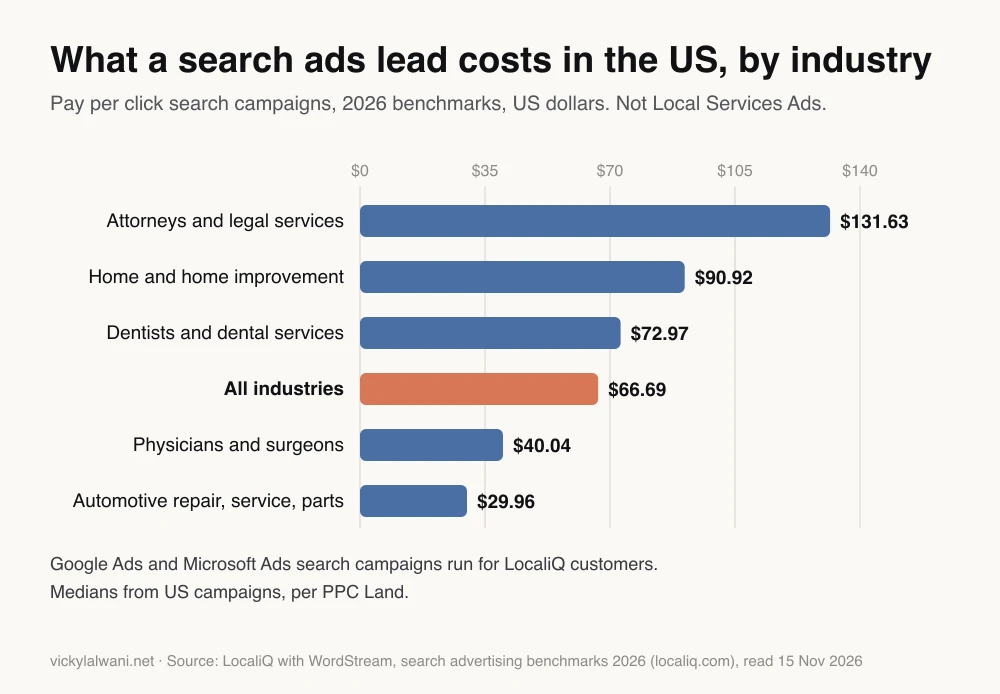
LocaliQ describes its sample as thousands of its customers' campaigns across Google Ads and Microsoft Ads. Trade press coverage of the underlying report gives 13,474 US search campaigns between April 2025 and March 2026, and says the figures are medians.
Dentists. In the one dental dataset I found, Local Services Ads sat between two search figures. A dental marketing agency's 90-day benchmark, May 27 to August 24, 2026, shows $57.44 per Local Services Ads lead across 46 practices. Paid search was $40 per lead across 142 practices, or $65 with branded campaigns left out. The agency calls the $65 figure the fairer comparison. All three figures are medians. The page does not state the country.
Lawyers. I found no measured Local Services Ads cost per lead for US law firms with a stated sample. Treat any figure you are quoted as an anecdote and ask where it came from.
How to compare a lead with a click. Bring both to the same unit: cost per booked job. Here is a worked example with made-up numbers.
- Search: $8 a click. If 8 in 100 clicks become a lead, a lead costs $100.
- Local Services Ads: $50 a lead.
- If 4 in 10 leads book on both, a booked job costs $250 from Search and $125 from Local Services Ads.
- Now change one thing. If Search leads book at 6 in 10 because the page explains your service first, the Search job costs about $167. The gap narrows.
This is cost per booked job. It will be lower than a cost per paying customer, because some booked jobs never turn into a paid one. Use your own click price, lead price and booking rate.
Who qualifies: Google Verified replaced Google Guaranteed
Since October 2025 there is one badge, Google Verified. It replaced Google Guaranteed, Google Screened and License Verified by Google. To run Local Services Ads you need a public, verified Google Business Profile and you must pass checks that vary by trade and state. Google says the process takes 3 to 4 weeks on average.
- What changed. Google announced the single badge on August 20, 2025, to start that October.
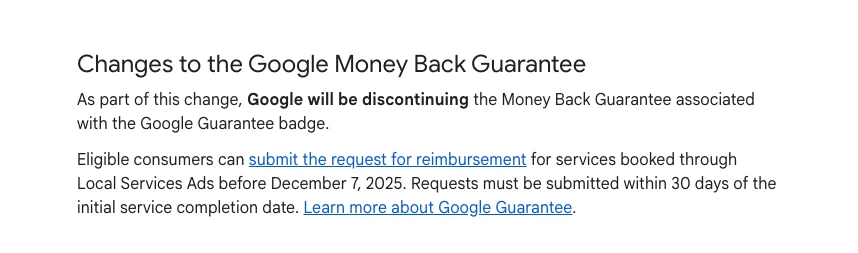
- The money back guarantee is gone. Google discontinued the Money Back Guarantee that came with the old Google Guarantee badge.
- What the checks are. Background, business registration, insurance and license checks, and minimum review requirements, depending on category and location. Google does not charge for the background check.
- How long. On average 3 to 4 weeks after you submit your documents.
- Not every category gets the badge. It is currently unavailable for auto, beauty and dining categories.
- Does the badge lift ranking? Google says the badge change did not affect ranking. Its ranking page does list the verification checks you have completed as part of profile quality, next to reviews and response time.
Google Search ads have no badge and no trade checks of this kind. You need a Google Ads account, a page to send clicks to and a way to pay. That is why Search is the faster start for a new business.
Plumbers, HVAC companies, roofers, electricians, dentists and lawyers are all on Google's US category list. Check your own category and state there before you plan around it.
The 2026 billing change: missed calls over 20 seconds are billed
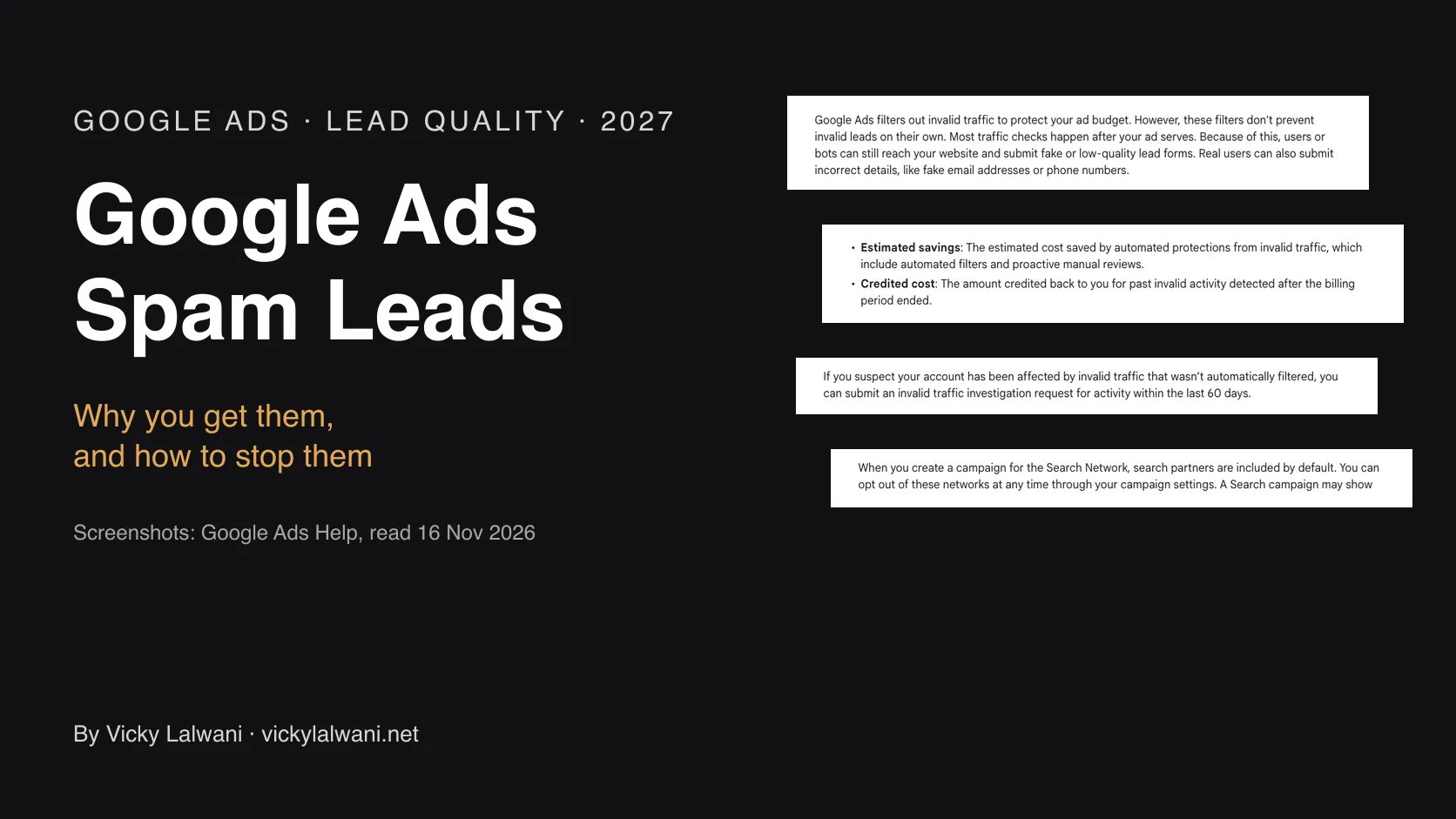
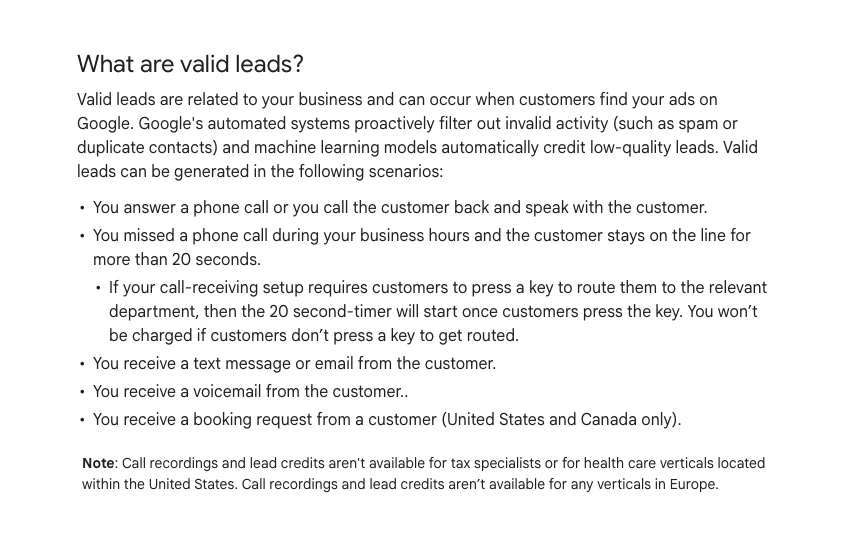
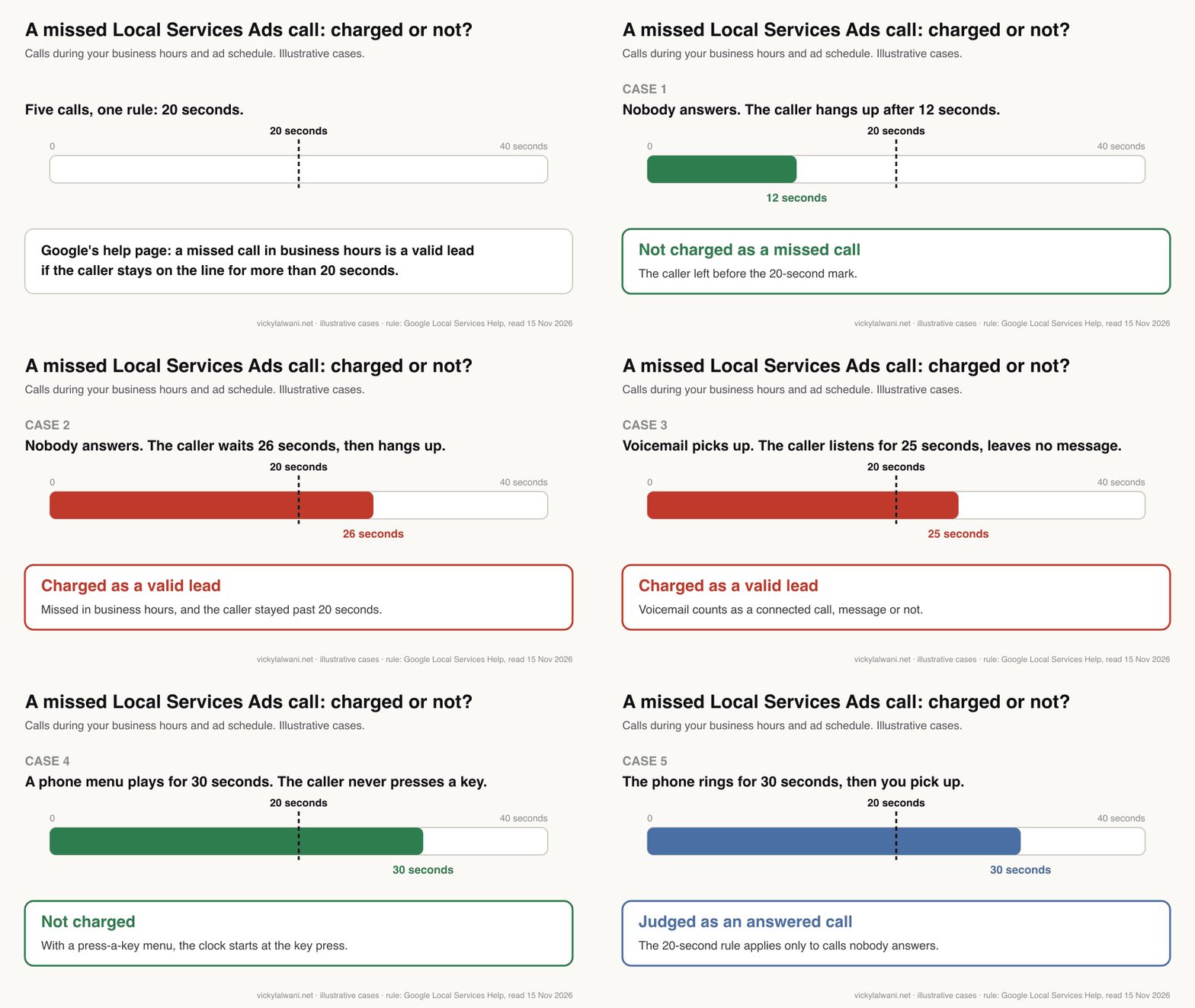
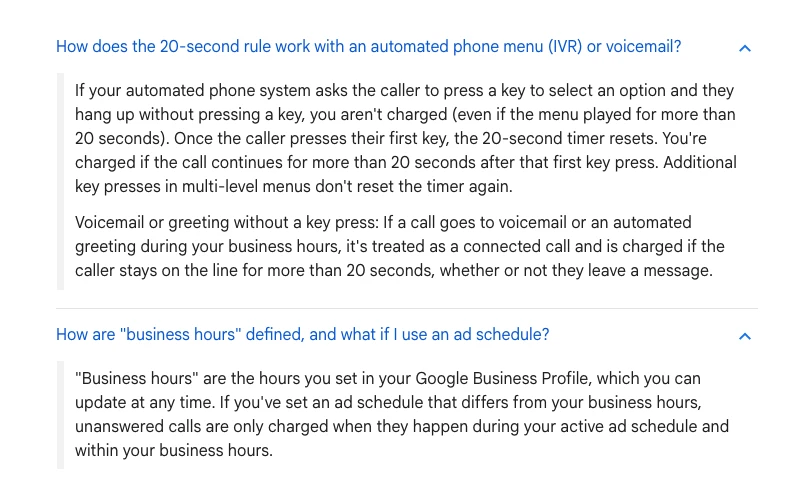
A call you miss during business hours now counts as a valid, billable lead if the caller stays on the line for more than 20 seconds. A call that reaches voicemail or a recorded greeting is treated as connected, and is billed after 20 seconds whether or not the caller leaves a message.
Where the date comes from. The rule is on Google's help page, but the page prints no start date. The date is in the email Google sent advertisers in late August, headed "Upcoming changes to lead charge policy". Search Engine Roundtable published a screenshot of it, and it names October 1, 2026. A second advertiser pasted the same email on Reddit the same day, with the same date. I am relying on those two copies for the date, not on a Google page.
| What happens | Billed? |
|---|---|
| Nobody answers; caller leaves before 20 seconds | Not as a missed call |
| Nobody answers; caller waits past 20 seconds | Yes |
| Voicemail or greeting; caller stays past 20 seconds | Yes, message or not |
| Phone menu; caller never presses a key | No |
| Phone menu; caller presses a key, stays 20 seconds more | Yes |
| You pick up after a long ring | Judged as an answered call |
| Same number contacts you again within 15 days | No second charge |
What counts as business hours. The hours on your Google Business Profile. If you also set an ad schedule, a missed call is only billed when it falls inside both.
The repeat contact rule was confirmed in public too. Google's Ads Liaison account said on August 26, 2026 that an advertiser is charged once for follow-up calls to the same person within 15 days.
What it can cost, as an example. Say 50 Local Services Ads calls arrive in business hours in a month and you answer 40. If 6 of the 10 missed callers wait past 20 seconds, and a lead is $50, that is $300 a month for calls nobody spoke to. Every number there is made up. Some of that was billable before the change, because a voicemail a caller leaves was already a valid lead. I found no public data on how long missed callers wait.
- A call tracking company's 2026 home services report says 52% of calls to home services businesses are answered by a person, and 65% of calls lasting longer than 15 seconds. The figures are averages across its own customers, and it sells call answering products.
- A phone system company's analysis of over 18 million missed calls, July to September 2026, found that 15% of callers left a voicemail. For home services it was 16%.
Both studies cover all calls, not Local Services Ads calls, and neither uses Google's 20-second mark.
What to do this week.
- Open your Google Business Profile and set the hours to when a person answers. Remember those hours show to customers too.
- Or keep the hours and narrow the ad schedule to staffed hours.
- Decide what happens to an overflow call: a second line, an answering service or a call back within minutes.
- I would not add spend to any lead channel until someone can call the lead back within minutes.
Shorter hours only stop the missed call charge. A caller who leaves a voicemail after hours is still a valid lead.
One caution. Answering more calls does not lower the bill, because an answered call is a valid lead too. PPC Land made this point in September. The gain is that you pay for a conversation, not for a ring.
Lead quality, credits and the end of manual disputes
You can no longer dispute a lead by hand. That was already true in the old dashboard, and it stays true after the move. Google reviews each charged lead for 30 days and credits poor quality, duplicate or invalid leads automatically. US health care advertisers and tax specialists get no lead credits and no call recordings at all.
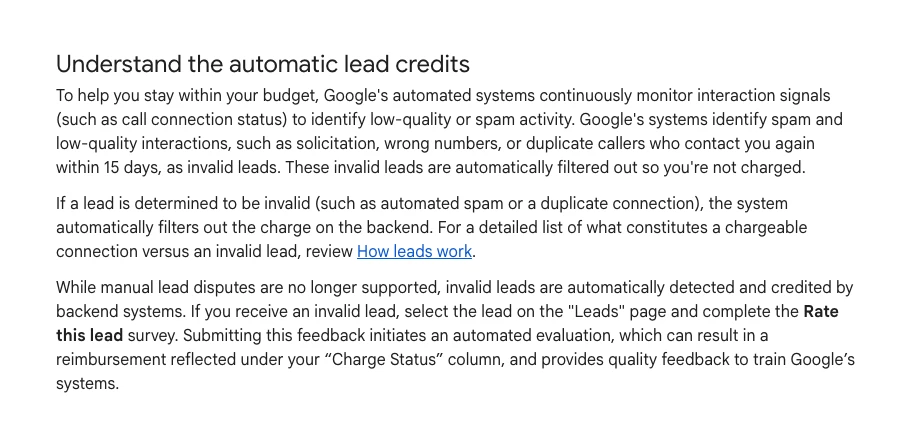
- Four statuses. Each lead shows as Charged, Not charged, In review or Credited.
- The route for a bad lead. Select the lead and complete the Rate this lead survey. Google says this starts an automated evaluation that can end in a reimbursement.
- What is not credited. Leads for a job type or an area you do not serve are no longer credited. Tighten your job types and service areas so they do not arrive.
- Dentists, doctors and tax firms. Call recordings and lead credits are not available for tax specialists or for health care verticals in the United States. Keep your own notes on what each call was.
What advertisers report is mixed. On Reddit, one advertiser described a $600 bill for three automated calls in one day, the first leads the account had received. A remodeler described a $240 charge for a job type they do not offer. Both are single accounts, not data. I found no measured figures on lead quality since the billing change.
Search has a different problem. A poor click is never refunded, and nobody rates it for you. What you get is control before the click: keywords, negative keywords and the page.
Local Services Ads are moving into Google Ads as Performance Max
Google is closing the separate Local Services Ads dashboard and moving accounts into Google Ads, as a Performance Max campaign with pay per lead goals. Billing stays per lead and the ads stay on Search and Maps. Phase one began in August 2026 for some US home and storefront services. Non-US accounts move in 2027.
Performance Max is Google's automated campaign type. The standard version runs across Search, YouTube, Gmail and Display. This version does not.
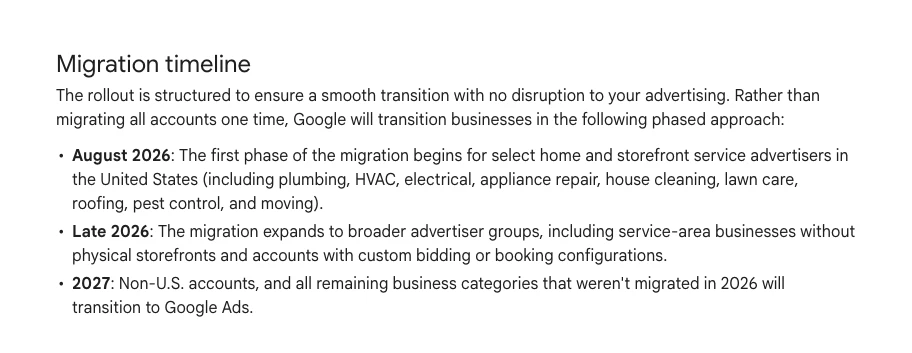
| Phase | When | Who |
|---|---|---|
| 1 | August 2026 | Select US home and storefront services: plumbing, HVAC, electrical, roofing and more |
| 2 | Late 2026 | Service-area businesses without a storefront, professional services, custom bidding or booking setups |
| 3 | 2027 | Non-US accounts, health care, locksmiths, garage door services |
The phase list is from Google's supported verticals page. No page I read gives a day for phase two. Google's phase list puts professional services in late 2026. Another Google page points to 2027. Neither names lawyers, so a law firm should wait for the 14-day email.
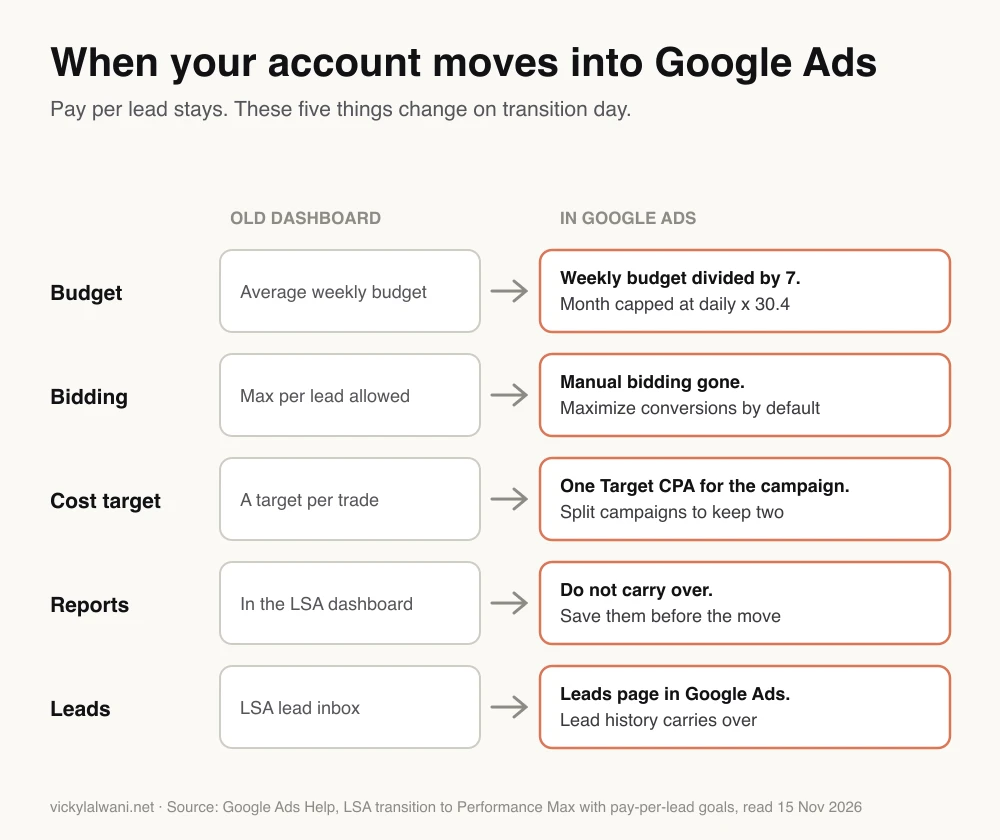
The changes that affect money:
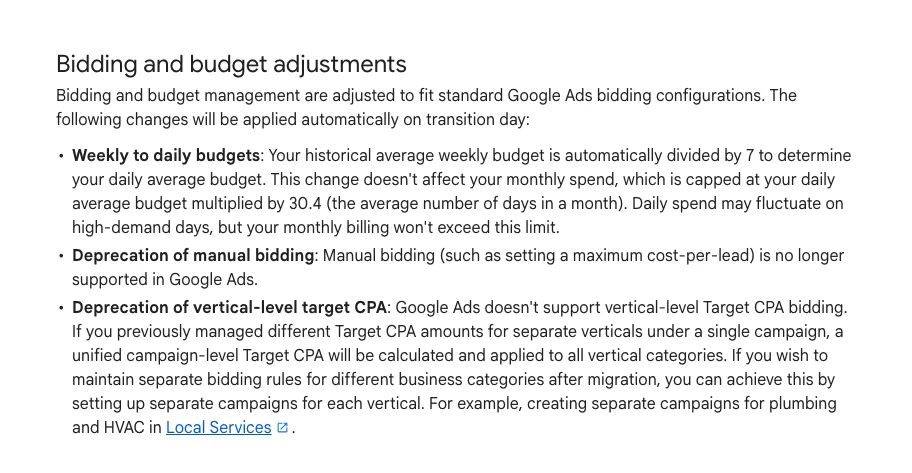
- Budget. Your average weekly budget is divided by 7 to make a daily budget. A month is capped at 30.4 times that. Example: $700 a week becomes $100 a day, and the cap stays $3,040.
- Bidding. Manual bidding, such as a maximum cost per lead, is not supported in Google Ads. The default is Maximize conversions, which tries to get the most leads for the budget.
- Cost target. Target CPA is the setting where you tell Google the cost per lead you want. Per-trade targets become one target for the campaign. Google says to set one only above 15 leads a month.
- Reports. Past impressions, clicks, weekly spend and ad-level reports do not carry over. Lead history does, including messages and older call recordings.
- Notice. An email 14 days before, a reminder 7 days later, and banners in the old dashboard.
- Dip. Google says to allow up to two weeks for performance to return to stable levels.
Before your account moves:
- Save your performance reports. Google says a download page is coming and suggests screenshots until then.
- Write down your weekly budget, bid mode, any per-trade targets, job types, service areas and ad schedule.
- Check that your Business Profile name, address and hours are right. They sync one way into Google Ads.
- After the move, open Goals, then Conversions, then Leads, and confirm new leads are arriving.
A new pay per lead campaign cannot be created inside Google Ads yet. Google says to keep using the Local Services page for that, and that creation in Google Ads comes later.
This seven-minute explainer is from a US digital agency, published September 8, 2026. Its description lists the move into Google Ads, direct bookings and charges for some missed calls. The channel promotes the agency's services.
What you can and cannot control on each
Local Services Ads give you a short list of levers: budget, job types, service areas, ad schedule and your profile. Search gives you those plus keywords, negative keywords, ad text, the landing page and a cap on the click price. Less control is why Local Services Ads are quicker to run and harder to steer.
| Control | Local Services Ads | Google Search ads |
|---|---|---|
| Which searches | Job types only | Keywords and negatives |
| Which job you promote | Not directly | Yes, per ad group |
| Ad wording | Callouts and photos | Headlines and descriptions |
| Where the click goes | Your profile, then a call | Your landing page |
| Price ceiling | None after the move | A maximum click bid, on manual bidding |
| Hours | Ad schedule | Ad schedule |
| Brand searches | Direct Business Search toggle | A branded campaign |
Direct Business Search shows your Local Services Ad on searches for your business name. Google says you are charged only for leads from new customers, because callers are asked whether they are returning.
Ranking is also outside your direct control. Google ranks Local Services Ads on your bid, your responsiveness and your profile quality: rating, number of reviews, response time, photos and checks completed. Missed calls can count against you.
For a trades business I would lead with the urgent small job, such as a repair or a leak, and run the big-ticket service in the background. On Search you can do that with keywords and a page. On Local Services Ads you can only turn job types on or off.
Which should you run? A decision table by business type and budget
Run Local Services Ads first if a person answers your phone, you have reviews and your trade is on Google's list. Run Search first if you are new, sell a considered job, or cannot staff the phone. Run both once the budget covers Google's suggested 10 leads a week on Local Services Ads with money left over.
The 10 is from Google's bidding page, which recommends a budget of at least 10 leads a week for its automated bid mode. At an example $50 a lead, that is $500 a week, about $2,170 a month.
This table is my recommendation, not a study. The reasons point to the evidence above.
| Business | Start with | Add next | Why |
|---|---|---|---|
| Plumber, HVAC or electrician with staffed phones | Local Services Ads | Search on your best jobs | Lower lead cost in the one large dataset |
| Same trades, phone often unanswered | Call answering | Local Services Ads | Missed calls over 20 seconds are billed |
| Roofer or remodeler | Search | Local Services Ads for repairs | You pick the job, keyword and page |
| Law firm | Search | Local Services Ads as a test | No cost data; the move to Google Ads is still ahead |
| Dentist | Search | Local Services Ads as a test | No credits or call recordings for US health care |
| New business, few reviews | Search | Local Services Ads after checks | Checks take weeks; ranking uses reviews |
| Budget for only one | One of them | The other at a review date | Split, neither gets enough leads to judge |
Three notes from my own account work:
- I only add another campaign type when the budget can feed it.
- On one account, I left Local Services Ads alone while the budget was too small to feed more than one campaign type.
- When that budget was due to grow, my plan was to add Local Services Ads and Performance Max next to the Search ads already running, with the smaller share going to Local Services Ads. I have no result to report from it.
Google's own advice is to run both. Its help page recommends running pay per lead campaigns alongside Search and other campaign types. Google sells both, so weigh that.
One study suggests neither ad shows on every search. An agency ran 100 US home services keywords five times each in May 2026. Local Services Ads appeared on about 28% of the 500 results pages and traditional Google Ads on about 8%. It measured which features appeared, not clicks or leads.
If you want this decision made against your own numbers, that is the work I do in Google Ads management. For trade-specific pages see home services, dental and law firm marketing in the USA.
How to run both without paying twice for the same customer
You pay twice when one customer touches both ads and you count them as two leads. The fix has five parts: staff the phone, give each source its own number, keep one lead list, match the list weekly on caller number, and judge both ad types on cost per booked job.
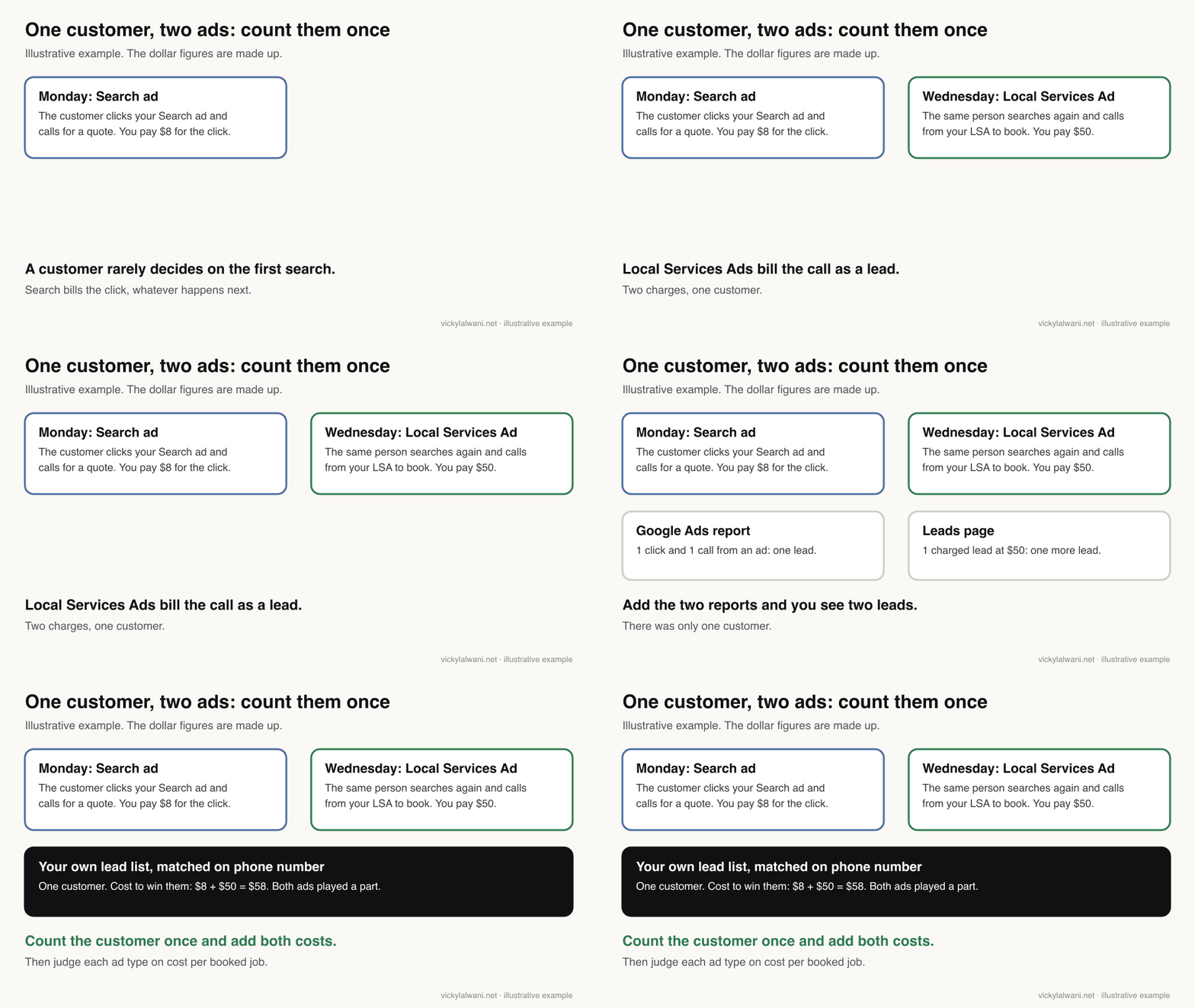
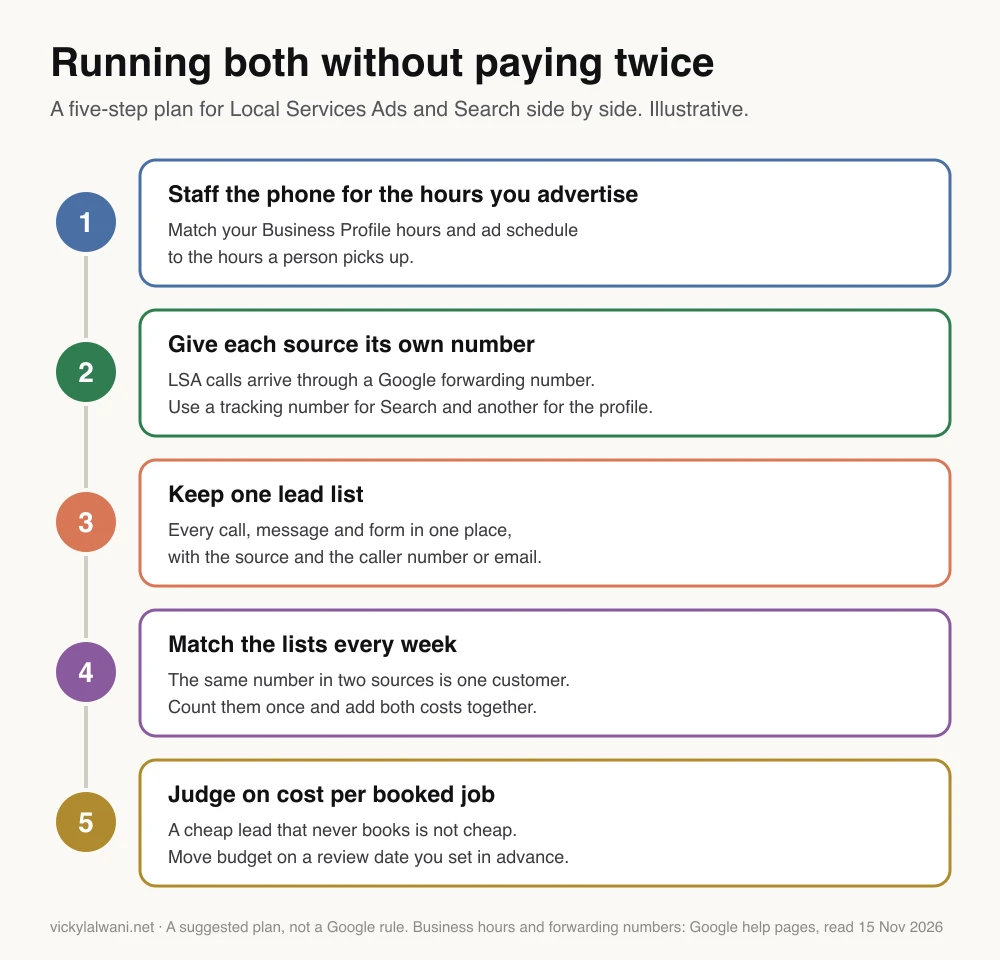
- Staff the phone for the hours you advertise. Set Business Profile hours and both ad schedules to match.
- Give each source its own number. Local Services Ads calls already arrive through a Google forwarding number. Call tracking does the same for Search, your profile and your site. The way I explain it: one destination number, a different tracking number for each source.
- Keep one lead list. Every call, message and form, with the source, the caller's number and what happened.
- Match the list weekly. The same caller number under two sources is one customer. Message leads hide the customer's number behind a Google number, so match those on name and job. Count each customer once and add both costs.
- Judge on cost per booked job. My rule for running two channels side by side is to agree a review date before we start.
Count calls properly on the Search side. A click on a call button is not a call. On one client account I checked this live with a Google account strategist: only calls that passed the minimum call length counted as conversions. A conversion is Google's word for an inquiry or sale. Google's call tracking page says the same: you set a minimum call length, and clicks on a number on a mobile site are only clicks.
On that same account, call tracking had lapsed. Asked whether to renew it, I said yes, and before any budget was added, because without it phone leads from ads are not measured. If yours is missing, start with tracking and analytics setup or my conversion tracking audit checklist.
Two settings that cut overlap.
- Decide who owns brand searches. Either turn on Direct Business Search or run a branded Search campaign. Running both means two ads for a person who already knows you.
- Keep Search on the jobs Local Services Ads cannot target. If you later put Search on a cost target, read when to switch to Target CPA first.
Videos worth watching
These six videos cover the 2026 changes from the agency side. I checked each title, channel and date. The summaries come from each video's own description. All six channels sell marketing services, so treat advice to "call us" as advertising.
This six-minute video is from a contractor marketing agency, published November 6, 2026. Its description says it covers what stays the same, five changes that affect cost and what happened when its client accounts moved. It offers a strategy call.
| Video | Channel | Date | What it covers |
|---|---|---|---|
| Google Is Changing Local Services Ads. Here's What You Need to Know | Ignite Visibility, US agency | Sep 8, 2026 | The move, bookings and missed call charges |
| Google Is Moving LSA Into Google Ads (What Changes for You) | Contractor Marketing Pros, agency | Nov 6, 2026 | What changed when client accounts moved |
| LSAs are Moving to Google Ads! What To Do | A channel about Local Services Ads | Sep 16, 2026 | Where migrated campaigns and leads sit |
| HUGE Changes To Google Local Service Ads vs Google Search Ads | TrafficSalad, agency | Oct 8, 2026 | What a Target CPA means before you set one |
| LSA transition to Performance Max campaign inside Google Ads | Rotate Digital, agency | Aug 6, 2026 | What changes, what stays, how to prepare |
| Google Just Killed the LSAs: What Every Contractor Needs to Know | Hook Agency, agency | Aug 14, 2026 | The end of the separate dashboard |
What people say on X and Reddit
Reaction splits two ways. Advertisers dislike paying for calls they did not answer and fear robocalls. Others reply that a business buying phone leads should answer the phone. I found no post with measured results from after the change.
On X. Each post below was checked through X's own embed service before I cited it. Three are from Google's Ads Liaison account.
| Who | What they said | Take it as | Link |
|---|---|---|---|
| Google's Ads Liaison account | Local Services Ads are moving into Google Ads. Jul 20, 2026 | Official | X post |
| Google's Ads Liaison account | One charge for follow-up calls within 15 days. Aug 26, 2026 | Official | X post |
| Google's Ads Liaison account | Booking now covers more than 500 partners, up from 20. Aug 25, 2026 | Official | X post |
| An X user who received the email | Posted Google's email on the new lead charges. Aug 25, 2026 | First-hand | X post |
| A paid search practitioner | The move makes sense: the product was already automated. Jul 20, 2026 | Opinion | X post |
| A paid search practitioner | Links the move to Google using AI to qualify call leads. Jul 20, 2026 | Opinion | X post |
| Search Engine Roundtable's editor | Google expanded its help page on how leads work. Oct 8, 2026 | Publication | X post |
On Reddit. Reddit blocks automated readers, so I read these threads through a public archive. Many replies come from freelancers and agencies looking for clients.
| Thread (title shortened) | Where and when | What it says | Take it as |
|---|---|---|---|
| Are Local Service Ads worth it for plumbers? | r/googleads, Oct 12, 2026 | A plumber plans to switch at about $700 a week. Replies: staff the phones first | First-hand, opinion |
| LSA billing for spam calls? | r/PPC, Oct 15, 2026 | $600 billed for three automated calls. Replies: rate each lead as spam, wait for credits | First-hand |
| LSA now bills unanswered calls over 20 seconds | r/PPC, Oct 28, 2026 | A profile open until 9pm with an office empty at 5pm has four billable hours a day | Opinion |
| LSA vs Google Ads for residential remodeling? | r/PPC, Aug 27, 2026 | Replies: Search gives more control; several say run both | First-hand, opinion |
| What cost per lead for HVAC in Orlando? | r/PPC, Sep 28, 2026 | Answers range from "$50 to $250" to about $50 on LSA and $150 on non-branded Search | Opinion |
| Anyone running local service ads? | r/PPC, Nov 13, 2026 | Setup paperwork is the slow part. Track answered calls and booked jobs | Opinion |
| Upcoming LSA change: charges for missed calls | r/PPC, Aug 25, 2026 | Some call it a money grab. Others ask why you would not answer a paid lead | Opinion |
Where they disagree: whether Local Services Ads or Search brings the better lead. One remodeler reports leads for work they do not offer. Others say Local Services Ads callers arrive warmer because they saw the reviews first. Neither side posted numbers in the threads I read.
Where this advice is weak
- This guide is research, not a case study: I am not reporting results from a Local Services Ads account of my own here. The decision table is judgment.
- The cost data is vendor data. The main benchmark is one company's customers in one month, before the billing change. The dental figure is one agency. There is no legal dataset.
- I found nothing that measures the new rule yet. I found no before and after figures on billed leads, spam or cost per lead since the change.
- The start date rests on a screenshot. The rule is on Google's page. The date is from Google's email to advertisers, as shown by a trade site and in an advertiser thread.
- The move is unfinished. Phase two has no day. Screens and settings may change as accounts migrate, and I described them from help pages, not from a migrated account.
- I have not watched the videos. I checked each title, channel and date, and the summaries use each video's own description.
- Rules differ by trade and state. Google's checks differ by trade and state. They are Google's rules for advertisers, not state law, and nothing here is legal advice. Ask your state licensing board what your trade needs.
Want a second pair of eyes on your account?
If you run a local service business in the USA and want this set up properly, I can help with three things: deciding the split between Local Services Ads and Search, preparing an account for the move into Google Ads, and tracking calls so one customer is counted once.
See Google Ads for US businesses, Google Ads management and tracking and analytics, or read how a freelance PPC consultant compares with an agency. More for US readers is on the USA page. To talk it through, get in touch.
Sources
| Source | What it supports | Date | Link |
|---|---|---|---|
| Google Local Services Help | Valid leads, 20-second rule, voicemail, business hours, 15 days, 30-day review | Read Nov 15, 2026 | How leads work |
| Google Ads Help | Same lead rules for pay per lead campaigns | Read Nov 15, 2026 | How leads work in Performance Max |
| Google Ads Help | The move: phases, budgets, bidding, reports, notice | Read Nov 15, 2026 | Transition, verticals and phases |
| Google Ads Help | Pay per lead campaigns: eligibility, targeting, best practices | Read Nov 15, 2026 | About, targeting, best practices, goals and leads |
| Google Ads Help | Automatic credits, no manual disputes | Read Nov 15, 2026 | Lead quality and budgets |
| Google Local Services Help | Credits, budget, bidding, ranking, job types | Read Nov 15, 2026 | Credits, budget, bidding, ranking, reach |
| Google Local Services Help | Google Verified badge, checks, US categories | Read Nov 15, 2026 | Badge, screening, requirements, getting started |
| Google blog | One badge replaces the older badges | Aug 20, 2025 | Google Verified |
| Google Ads Help | Pay per click, keywords, call assets, call conversions | Read Nov 15, 2026 | CPC, keywords, call assets, call tracking |
| Search Engine Roundtable | Screenshot of Google's email with the October 1, 2026 date; help page update | Aug 25 and Oct 8, 2026 | Email, help page |
| PPC Land | The move; missed call arithmetic; benchmark sample | Jul 20, Sep 25 and Jun 29, 2026 | Move, missed calls, benchmarks |
| SearchLight | Home services cost per lead: 888 contractors (LSA, Feb 2026), 816 contractors (Google Ads, Jan 2026) | Mar 2026 | Benchmark |
| LocaliQ with WordStream | US search cost per lead by industry | Updated Jun 1, 2026 | Benchmarks |
| Delmain | Dental cost per lead: 46 practices (LSA), 142 practices (search) | May 27 to Aug 24, 2026 | Dental benchmarks |
| Invoca | Share of home services calls answered by a person | 2026 report | Report |
| Quo | Share of missed callers who leave a voicemail | Jul to Sep 2026 | Analysis |
| WebFX | How often each ad type appeared on 500 searches | May 2026 | Study |
| X | Official and advertiser posts | Jul to Oct 2026 | Linked in the table above |
| First-hand reports and opinion | Aug to Nov 2026 | Linked in the table above | |
| YouTube | Six agency videos | Aug to Nov 2026 | Linked in the videos table |
FAQ
What is the difference between Local Services Ads and Google Ads?
Local Services Ads charge per lead and Google Search ads charge per click. With Local Services Ads you pay when a customer calls, messages or books, you target job types and service areas, and the ad is built from your Google Business Profile. With Search ads you pay for each click, choose keywords, write the ad and send people to your own landing page.
Which is better, Local Services Ads or Google Ads?
Neither is better for every US business. Local Services Ads suit a business that answers its phone, has reviews and is in an eligible trade, because you pay per lead. Google Search ads suit a new business or a considered, high-value job, because you control the keywords, the ad and the page. Compare them on cost per booked job, not on lead price against click price.
How much do Local Services Ads cost in the USA?
Google's help pages give no price list for Local Services Ads. Google says lead prices vary with location, job type, lead type and bidding mode. One US vendor's benchmark of 888 home services contractors put the average at $53 per lead in February 2026, with $39 for electrical, $51 for HVAC and $57 for plumbing. That is one vendor's data from early 2026, before the billing change.
Are Local Services Ads worth it?
Local Services Ads are worth it when a person answers your phone during the hours on your Google Business Profile and enough leads become paying jobs. In one US vendor's February 2026 benchmark of home services contractors, 43.9% of Local Services Ads leads booked an appointment. Since the 2026 billing change, a missed call over 20 seconds is billed, so they are a poor fit for a business that cannot pick up.
Does Google charge for missed calls on Local Services Ads?
Yes. Google's help page says a missed call during your business hours is a valid, billable Local Services Ads lead if the caller stays on the line for more than 20 seconds. Business hours are the hours on your Google Business Profile, combined with your ad schedule if you set one. Google's help page prints no start date. Google's email to advertisers, as published by Search Engine Roundtable, gave October 1, 2026.
Does voicemail count as a lead on Local Services Ads?
Yes. Google treats a Local Services Ads call that reaches voicemail or an automated greeting during business hours as a connected call. It is billed if the caller stays on the line for more than 20 seconds, whether or not they leave a message. With a press-a-key phone menu, the 20 seconds start only when the caller presses a key.
Can you still dispute Local Services Ads leads?
No. Google says manual lead disputes are no longer supported for Local Services Ads. It reviews charged leads for 30 days and credits poor quality, duplicate or invalid leads automatically. You can flag a lead with the "Rate this lead" survey, which starts an automated review. US health care advertisers and tax specialists do not get lead credits.
Are Local Services Ads moving to Google Ads?
Yes. Google is moving Local Services Ads accounts into Google Ads as a Performance Max campaign with pay per lead goals. Phase one began in August 2026 for some US home and storefront services. Phase two is due in late 2026 and non-US accounts move in 2027. Billing stays per lead and the ads still show only on Google Search and Maps.
Are Local Services Ads going away?
No. Local Services Ads are not going away, but the separate dashboard is. Google is moving each account into Google Ads, where it runs as a Performance Max campaign with pay per lead goals. Manual bidding ends, weekly budgets become daily budgets, and past performance reports do not carry over, so save them before your account moves.
What is the difference between Google Guaranteed and Google Verified?
Google Verified is the single badge that replaced Google Guaranteed, Google Screened and License Verified by Google on Local Services Ads from October 2025. The older Google Guarantee came with a money back guarantee for customers. Google discontinued that guarantee when it introduced Google Verified. Businesses that had already passed verification received the new badge automatically.
What are the requirements for Local Services Ads?
To run Local Services Ads in the USA you need a public, verified Google Business Profile and you must pass Google's screening. Depending on your category and state, that can include background, business registration, insurance and license checks and a minimum number of reviews. Google says the process takes 3 to 4 weeks on average after you submit your documents.
Can you run Local Services Ads and Google Ads at the same time?
Yes. You can run Local Services Ads and Google Search ads at the same time, and Google recommends it. To avoid counting one customer twice, give each source its own tracking number, keep one lead list and match it each week on caller number, or on name and job for message leads. Decide whether brand searches belong to Local Services Ads or to a branded Search campaign, not both.
Do Local Services Ads work for lawyers?
Lawyers are an eligible Local Services Ads category in the USA, but no measured cost per lead for law firms with a stated sample was found for this guide. Google's phase list puts professional services in late 2026, and another Google page points to 2027. A law firm should test Local Services Ads next to Search only when the phone is answered for every hour listed on its Google Business Profile.
Do Local Services Ads work for dentists?
Dentists are an eligible Local Services Ads category in the USA, with two limits. Google does not offer lead credits or call recordings to US health care advertisers. In one agency's 2026 benchmark, Local Services Ads cost $57.44 per lead across 46 dental practices. Paid search cost $40 across 142 practices, or $65 with branded campaigns left out. Test it with your own call tracking.
Is LSA better than PPC for plumbers, HVAC companies and roofers?
In the one large home services benchmark, Local Services Ads cost $53 per lead in February 2026. A different set of contractors paid $104 per lead across Google Ads in January 2026. Branded Search was cheaper still at $34. For roofers and remodelers, my suggestion is to start with Search, because you choose the keyword and the page. On Local Services Ads you can only switch job types on or off, and the ad can still show for general searches for your trade.