The highest CPC keywords right now are US legal searches such as truck accident attorney near me, where Keyword Planner's top-of-page bid reached $748.40 in October 2026 data, followed by cyber security, payroll software and B2B service terms. By industry, Attorneys and Legal Services had the highest average search CPC at $9.87 (USD) in the 2026 WordStream by LocaliQ benchmarks. Judge each keyword by the leads and revenue it brings, not its cost per click.
The most expensive single keywords in Google Ads are legal, marketing, cyber security and software terms, while legal, home services and dental have the highest average cost per click by industry. In the 2026 search benchmarks from WordStream by LocaliQ, Attorneys and Legal Services had the highest average cost per click at $9.87 (USD). Single US injury-law searches go much higher: in October 2026 data, Keyword Planner showed top-of-page bids up to $748.40 for truck accident searches (ppc.io).
Numbers like that scare most advertisers. But the cheapest click in your Google Ads account can be the most expensive traffic you buy, and the click that makes your finance lead wince might be the one you should fight hardest for. This is one of the most common mistakes I see in accounts I review. High CPC keywords are not a problem to solve. They are often a signal of where the money is.
Top 10 highest CPC keywords right now
| # | Keyword | Industry | Top of page bid, high (USD) |
|---|---|---|---|
| 1 | truck accident attorney near me | Legal | $748.40 |
| 2 | truck collision attorney | Legal | $748.40 |
| 3 | houston trucking accident attorney | Legal | $748.40 |
| 4 | oilfield injury attorneys | Legal | $673.56 |
| 5 | auto accident law firm near me | Legal | $651.23 |
| 6 | linkedin event ads | Marketing | $643.60 |
| 7 | security information and event management | Cyber security | $466.96 |
| 8 | soc 2 audit firm | Cyber security | $434.58 |
| 9 | best payroll software for startups | Software | $310.89 |
| 10 | network penetration testing services | Cyber security | $299.36 |
Source: ppc.io, US Google Keyword Planner data pulled 30 October 2026, keywords with 100 or more US searches a month, brand terms left out. ppc.io publishes up to five keywords per industry, so this table ranks the 10 highest bids across those industry lists; in the full pull, 22 keywords tied at $748.40. Each figure is Keyword Planner's top-of-page bid high range, roughly the 80th percentile of what advertisers paid for a top position, so real clicks can cost less or more, and $748.40 looks like a Keyword Planner cap. Checked 17 November 2026.
Jump to: Top 10 list · Highest CPC industries · Find yours in Keyword Planner · Why they cost more · Which to own
Highest CPC keywords in 2027 by industry
Many highest CPC keyword lists that still rank are from 2018 or 2020. Auction prices move every year, so start from the newest published data. The most recent industry benchmark I could verify is the 2026 report from WordStream by LocaliQ, published 26 May 2026 and updated 1 June 2026. It covers 13,474 US search campaigns run between April 2025 and March 2026, in US dollars. The figures it labels averages are campaign medians, so you can't divide one column by another to get a conversion rate. Treat it as a guide, not your price.
| Industry | Avg CPC (USD) | Avg cost per lead (USD) |
|---|---|---|
| Attorneys and legal services | $9.87 | $131.63 |
| Home and home improvement | $8.33 | $90.92 |
| Dentists and dental services | $8.00 | $72.97 |
| Personal services | $7.17 | $54.60 |
| Health and fitness | $6.17 | $67.36 |
| Business services | $5.87 | $93.69 |
| Industrial and commercial | $5.87 | $75.19 |
| Career and employment | $5.81 | $67.36 |
| All 23 industries | $5.42 | $66.69 |
Source: WordStream by LocaliQ, Search Advertising Benchmarks 2026. The eight highest of 23 industries by average CPC, checked 15 November 2026.
Two things stand out. Finance and insurance, often called the priciest niche, averaged only $3.39 a click here, because a few very costly terms sit among many cheaper ones. And legal is the one category where both the click and the lead cost the most. LocaliQ also notes that average CPC rose a little over the year.
The most expensive single keywords right now
Industry averages hide the outliers. Two current lists, both US data in US dollars:
- ppc.io, 30 October 2026. Keyword Planner's top-of-page bid high range reached $748.40 for searches such as truck accident attorney near me, with oilfield injury attorneys at $673.56 and SOC 2 audit firm at $434.58. The author notes $748.40 may be a Planner cap, and reports a median search CPC of $4.92 across their own managed accounts, which are mostly home and pool service businesses, nowhere near legal prices (ppc.io).
- Ahrefs, updated 3 November 2026. Its top 100 list, built on Ahrefs' own CPC estimates rather than Keyword Planner, shows many terms at exactly $100 a click, including accident lawyer searches, so read that figure as a ceiling in the data rather than a price (Ahrefs).
The lesson: a Keyword Planner high-range bid is roughly the 80th percentile of past top-of-page prices, not a ceiling. In ppc.io's own accounts, 177 of 330 matched keywords (54%) paid an average CPC above the Planner high range. Use these lists to see which markets are crowded, then check your own.
Why high CPC keywords cost more: intent
Consider someone searching for an emergency plumber in their city late at night. They are probably not researching. They have a problem, they need help now, and they are ready to call. Other advertisers know it, so the auction price is high.

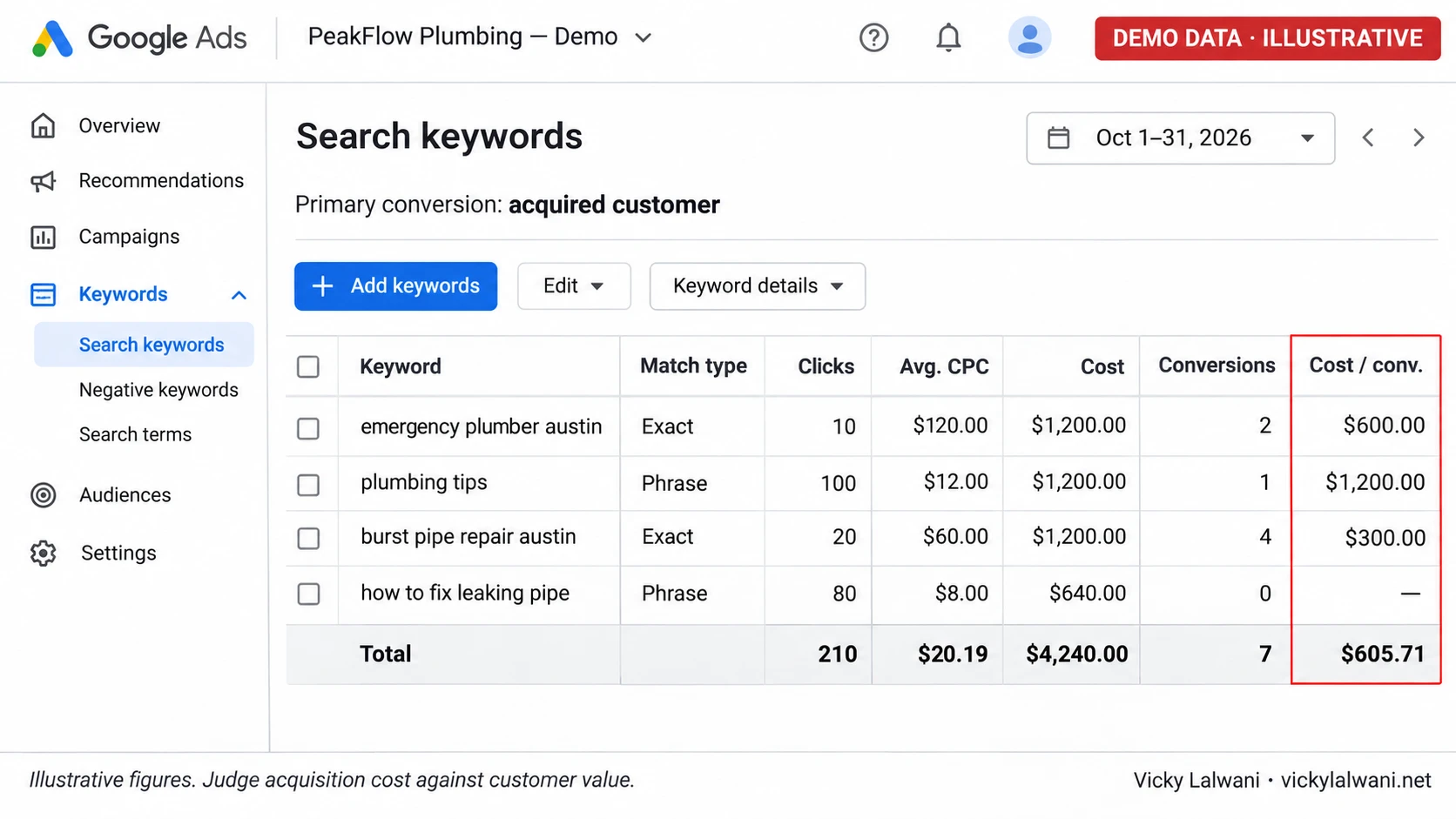
Compare that with searches like plumbing tips, how to fix a leaking pipe or best plumbing tools. Those clicks are cheaper because the person might never hire anyone. They are learning, browsing or planning a do-it-yourself fix. A dashboard full of those clicks looks busy. It does not fill a calendar.

What advertisers get wrong
I see teams obsess over lower cost per click, cheaper traffic, more clicks, more keywords and lower cost per session. Those are activity metrics. The better question is: which searches actually make us money?
A high-priced click that turns into a profitable customer is cheap. A low-priced click that does nothing is expensive, because every unit of spend produced nothing in return. Google Ads is not a cheap-click game. It is an intent game.
How to find your own high-CPC keywords in Keyword Planner
You don't need a list of the most expensive keywords on the internet. You need the expensive ones in your own market. Keyword Planner is free inside Google Ads, but Google says you must finish account setup, including billing details, before it gives keyword ideas (Google Ads Help).
- Open the tool. In Google Ads, go to Tools, then Keyword Planner, then Discover new keywords.
- Choose Start with keywords or Start with a website. Under Start with keywords, type your services; the optional website box is for your own site, and Google will try to drop ideas unrelated to it. To mine a competitor's page, use Start with a website instead. Google says a keyword plus a URL gives more ideas than a URL alone.
- Set your location and language. Bids are shown for the location you choose, so a national view can hide expensive city searches.
- Sort by Top of page bid (high range). Google defines it as roughly the 80th percentile of what advertisers have paid for a top-of-page position, and the low range as roughly the 20th percentile, using the last 30 days (Google Ads Help).
- Filter out the noise. Remove job, free, DIY and course searches, then group what's left by intent.
- Check against your own data. Save the shortlist to a plan. If you already run ads, sort your search terms report by average CPC and add conversions and conversion value, so you can see which expensive terms bring leads and which only bring clicks.
Treat every figure as an estimate. Google notes that real results depend on your bid, budget, ad quality, targeting and customer behaviour, and that some sensitive categories, such as health or finance, may not return data.
A five-step process for deciding which expensive keywords to own
- Find your highest-value search terms. Export the search terms report and sort by conversions and conversion value, not impressions. Include the terms that convert offline, if you track calls and booked jobs.
- Measure leads and revenue. Work out cost per qualified lead and cost per customer for each term group. Connect your CRM or call tracking if you can, because form fills alone can mislead.
- Protect impression share where it matters. For the searches that produce profit, check how much of the available demand you are winning and what is limiting it, whether budget or rank.
- Build landing pages for that intent. A buying-ready searcher needs a fast page with a clear phone number or form, proof and the next step. Do not send them to a generic homepage.
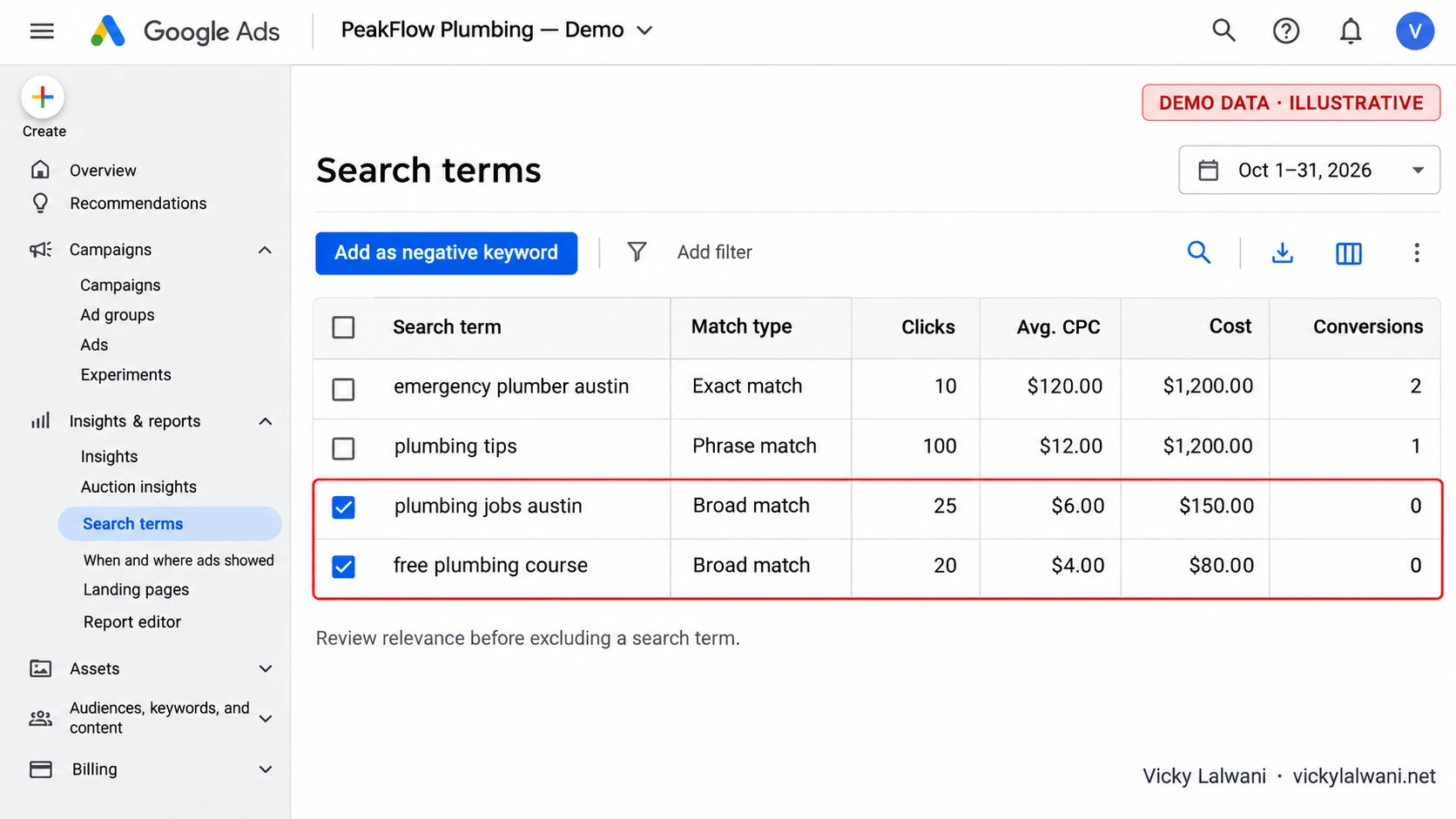
- Cut the cheap traffic that looks good but does not convert. Add negative keywords for research-style queries and pause terms that only produce clicks.
Check the economics before you bid up
This approach only works if the numbers hold. Before raising bids on an expensive term, confirm three things:
- The conversion tracking is accurate and counts the outcome you actually want.
- Your close rate and customer value support the cost per lead you are accepting.
- Your service area, hours and call handling can actually serve the demand. Paying for urgent calls and missing them wastes the most expensive clicks of all.
I also recommend testing instead of assuming. Give a promising expensive term a controlled budget for a set period, measure real leads and decide from the data.

The planning takeaway for 2027
When you review next year's budget, look at where spend sits by intent, not just by channel or campaign. If a large share goes to informational terms that never convert, move it toward the commercial terms you have been avoiding because of price. Sometimes the keyword everyone calls too expensive is the one worth owning.
If you want an account reviewed through this lens, my Google Ads management service starts with exactly this intent and revenue analysis. You can also see more practical frameworks in my free guides.
Need someone to run this for you? I am a freelance Google Ads consultant offering Google Ads management in the UK, including London, and Google Ads management in Australia.
Sources
| Source | Used for | Date |
|---|---|---|
| WordStream by LocaliQ | CPC and cost per lead by industry (USD) | Updated 1 Jun 2026 |
| ppc.io | Most expensive US keywords | 30 Oct 2026 |
| Ahrefs | Top 100 US keywords | Updated 3 Nov 2026 |
| Use Keyword Planner | Keyword Planner steps | Google Ads Help |
| Keyword Planner forecasts | Top of page bid definitions | Google Ads Help |
Keep reading: Reduce Wasted Ad Spend in Google Ads and Freelance PPC Consultant vs Agency.
This article expands on my post on LinkedIn ↗.
FAQ
What are the highest CPC keywords in 2027?
Heading into 2027, the most expensive single keywords in Google Ads are legal terms, especially injury and accident lawyer searches, followed by marketing, cyber security and software terms. By industry average, legal, home services and dental cost the most per click. In ppc.io's October 2026 US data, Keyword Planner's top-of-page bid high range reached $748.40 for truck accident attorney searches. Check your own market in Keyword Planner, because prices vary by location.
What is the most expensive keyword on Google?
Google doesn't publish one. In ppc.io's US Keyword Planner data from 30 October 2026, 22 keywords shared the top bid of $748.40, with truck accident attorney near me the most searched of them. That figure looks like a Keyword Planner cap, so the real top price may be higher. It is roughly the 80th percentile of past top-of-page prices, so actual clicks can cost less or more.
Which industry has the highest cost per click?
In the 2026 WordStream by LocaliQ search advertising benchmarks, Attorneys and Legal Services had the highest average cost per click at $9.87 (USD), ahead of Home and Home Improvement at $8.33 and Dentists and Dental Services at $8.00. The average across all 23 industries was $5.42.
How do I find high CPC keywords?
Open Keyword Planner in Google Ads, choose Discover new keywords, enter your service or a competitor's website, set your location and sort by Top of page bid (high range). If you already run ads, sort your search terms report by average CPC and add conversions, so you can see which expensive terms bring leads and which only bring clicks.
What does Top of page bid (high range) mean in Keyword Planner?
Google defines Top of page bid (high range) as roughly the 80th percentile of what advertisers have historically paid for a keyword's top-of-page bid, based on your location and Search Network settings, using the last 30 days. The low range is roughly the 20th percentile. Both are estimates, not the price you will pay.
What were the highest CPC keywords in 2020?
Semrush's list for 2020, published in November 2019, put insurance first among US niches at an average CPC of $17.55, with geico insurance its top US keyword at $83.24. It used Semrush's own CPC data, not Keyword Planner, so don't compare it directly with 2026 figures. Check a current source before you budget.
Are lists of the highest CPC keywords from 2020 still accurate?
No. Auction prices change every year, and the 2026 WordStream by LocaliQ benchmarks report that average search CPC rose a little over the previous year. Use a current source, such as those benchmarks or Keyword Planner for your own location, rather than a 2018 or 2020 list.
Are high CPC keywords the same in every country?
No. Keyword Planner shows bids for the location and network you choose, so the same keyword can cost far more in one country or city than another. Most published lists, including the top 10 above, are US data in US dollars. Set your own location before you judge a keyword.
Are high CPC AdSense keywords the same as high CPC Google Ads keywords?
No. A Google Ads CPC is what an advertiser pays for a click. High CPC AdSense keyword lists estimate what website publishers earn, which is only a share of what advertisers pay, so the figures are lower and not directly comparable.
Should I always bid on the most expensive keywords?
No. Expensive is only worth it when the intent is strong and the economics work. Check cost per lead, close rate and customer value before you commit budget.
How do I know if a cheap keyword is a waste?
Look at conversions and revenue by search term. If a term fills your reports with clicks and sessions but produces no leads, it is costing more than it appears.
What metric should I judge keywords by?
Use cost per qualified lead or customer and the revenue they generate, not cost per click or cost per session.