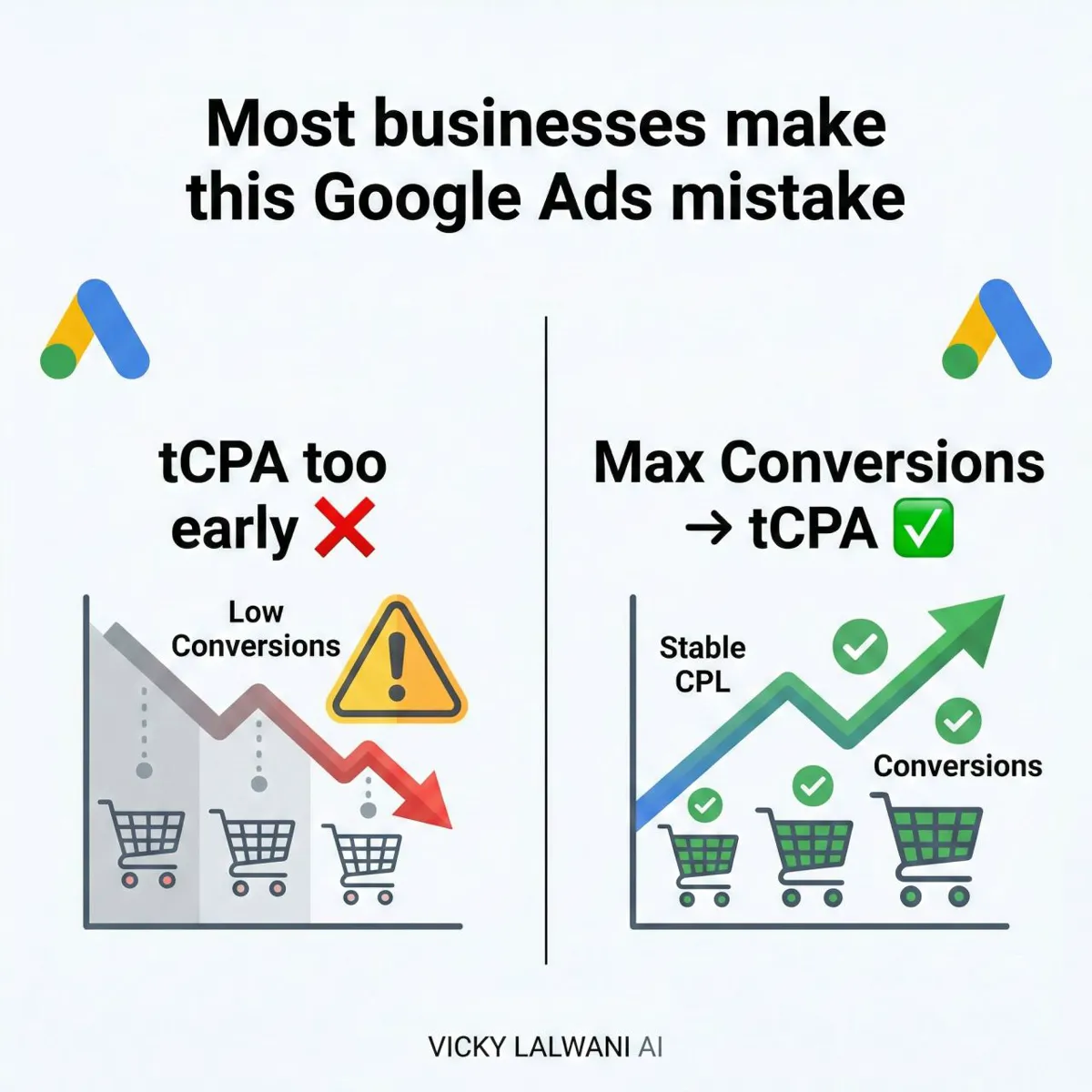
tCPA vs maximize conversions comes down to timing. Start with maximize conversions while data builds, let Google learn which searches convert, then move to target CPA once conversion volume is stable. Used too early, an aggressive tCPA throttles volume and pushes cost per lead up.
A pattern I see often: a few conversions come in, the account owner gets excited, and they set target CPA aggressively. Volume drops, cost per lead spikes, and the conclusion becomes "Google Ads does not work." In most of these cases the problem is not the platform. It is timing. If you are planning your account structure for 2027, the tCPA vs maximize conversions question is really about order: the sequence in which you apply bidding strategies matters as much as which ones you pick.
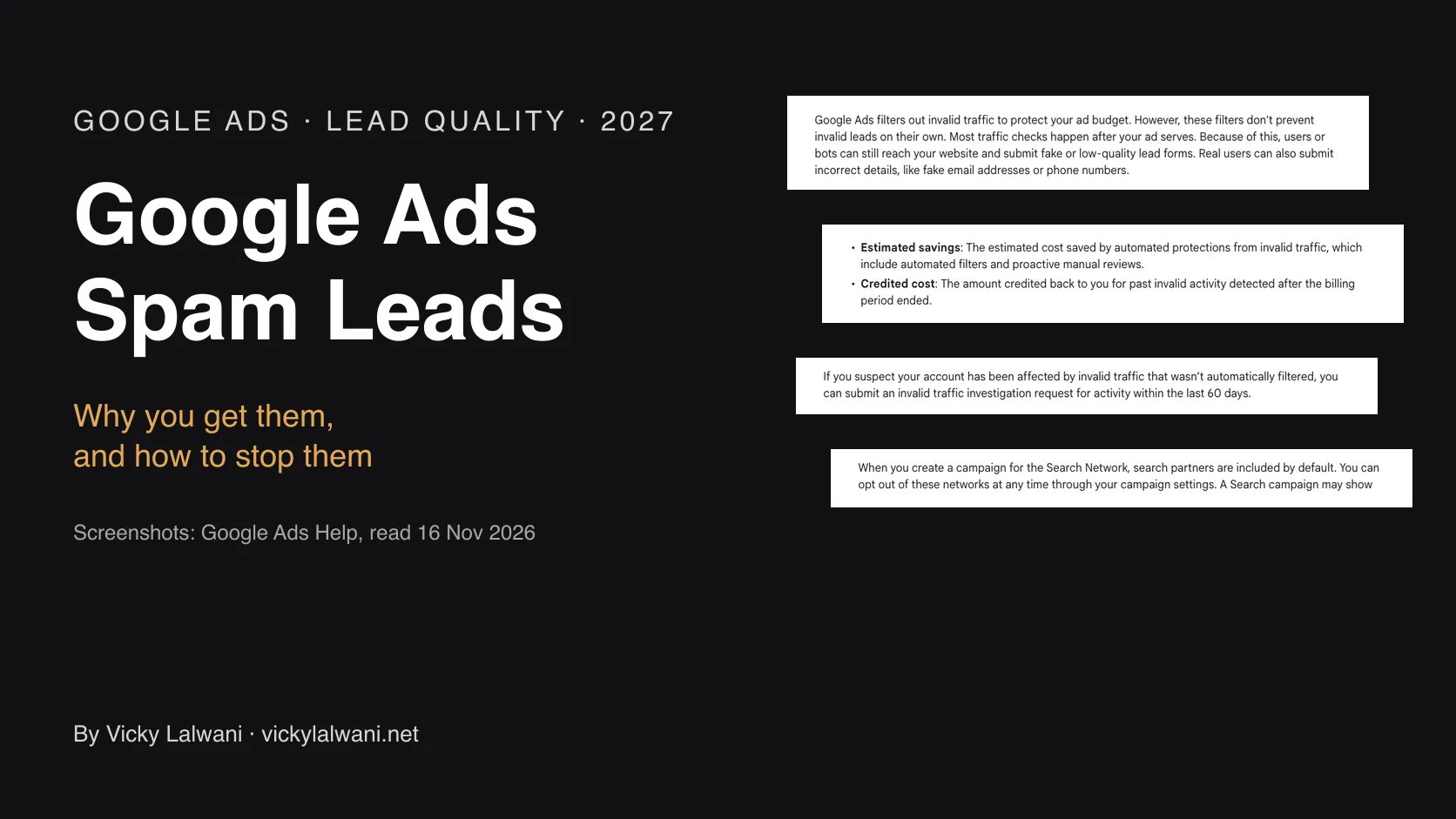
New: running Local Services Ads as well? Local Services Ads vs Google Ads in the USA covers the 2026 billing change and the single Target CPA after the move into Google Ads.
New: working with a few hundred pounds a month? Google Ads on a small budget in the UK covers structure, the settings to switch off and when a cost target makes sense.
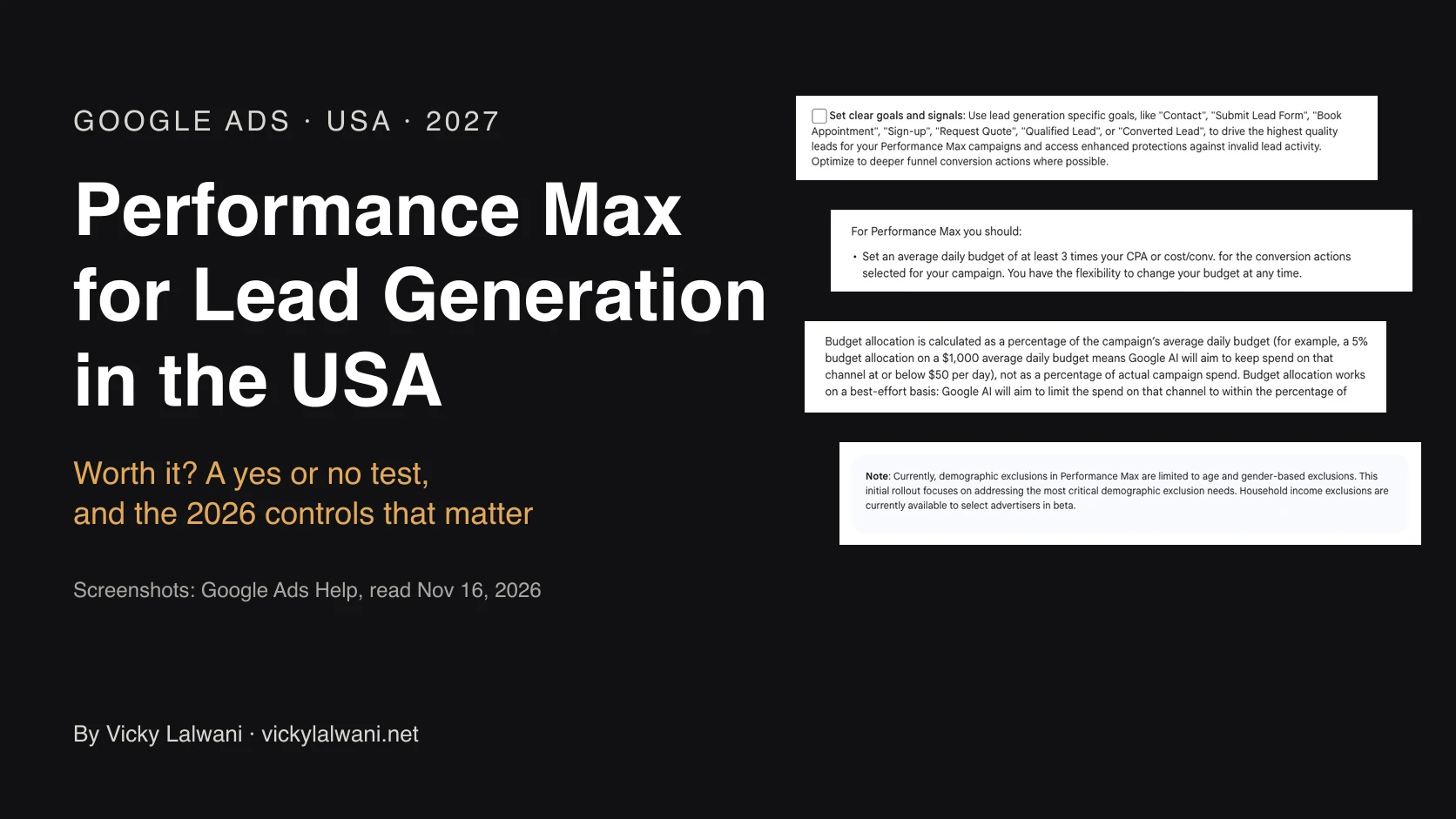
New: testing Performance Max for leads? Performance Max for lead generation in the USA covers the 15-conversion threshold, the 3x CPA budget and how long a fair test should run.
Why switching to a target too early backfires
Smart bidding works by predicting how likely each auction is to convert, then adjusting the bid. Those predictions need examples. When a campaign has only a handful of conversions, the model has little to learn from, so a tight target makes it cautious. It bids lower, enters fewer auctions, and impressions fall.
The chain reaction looks like this: a few conversions arrive, the target is set tightly, volume drops, cost per lead rises as fewer high-quality auctions are won, and the campaign looks broken. The target did not reveal a weak campaign. It created one.
tCPA vs maximize conversions: the sequence I use
I think of smart bidding as sequence, not control. Each strategy has a job.
- Maximize conversions is for learning. It spends your budget to find as many conversions as it can, which lets Google discover which searches, devices, locations and times produce results.
- Target CPA is for optimizing. Once the pattern is clear and volume is stable, a target tells the system what cost you can accept and trims the expensive tail.
In short: maximize conversions to learn, target CPA to optimize. Target CPA works best when it is used to guide results, not to force them.
What stable volume looks like before you switch
There is no magic number that applies to every account, so check Google's current documentation for its guidance on conversion thresholds. In practice I look for several signs together:
- Conversions are arriving consistently week after week, not in bursts.
- Conversion tracking is accurate, and the conversion action matches what the business actually values.
- The campaign is no longer in a learning state or recently changed in a major way.
- Cost per conversion has settled into a recognizable range, rather than swinging widely.
If tracking is shaky, fix that first. A smart bidding strategy can only optimize toward the signal you give it, and a wrong signal makes every later decision worse.
What Google's learning rule says now (checked 16 November 2026)
Google rewrote its help page on this in October 2026. It is now called About Smart Bidding learning, and three points in it matter for the target CPA vs maximize conversions decision.
- Learning status lasts seven days at most. Google says it "never lasts more than 7 days".
- Only three things trigger it: a bid strategy that is new or reactivated, campaigns, ad groups or keywords added to or removed from the strategy, or a significant change to the conversion goals or actions it optimizes to.
- Changing the target does not. Changes to budgets, targets, creatives or targeting settings do not trigger Learning status or remove the strategy's history. A new target applies from the next auction.
The end of Learning status is not the same as results settling. Google says performance typically converges to a new goal within 1 to 2 conversion cycles, and it recommends judging results over 2 conversion cycles or a 2 week window, whichever is longer, allowing for conversion delay. A conversion cycle is the time it takes for a click to turn into a conversion. If your leads usually arrive ten days after the click, that is roughly three weeks before you judge, not seven days.
The same page advises against making several target changes within one conversion cycle unless there is a clear business need. That is the official version of the advice further down this page: move the target in small steps and give each step time.
Google's About Target CPA bidding page adds two useful details. When a campaign has conversion history, the recommended target is the average CPA from the last 30 days, adjusted for conversion delays. And a target set too low "may cause you to forgo clicks that could result in conversions", which is the volume drop described above.
Low conversion volume: target CPA or maximize conversions?
The busiest threads in r/PPC and r/googleads this week asked exactly this: a lead generation account getting single figure form leads a month, choosing between target CPA and maximize conversions. Earlier in the month, an r/googleads thread asked which strategy to use with no conversion data at all.
Google's position is that you can start target CPA with no conversion history and that it works for campaigns of all sizes. But the same page recommends measuring performance over the last 30 days, including at least 30 conversions. With a handful of leads a month you cannot read a target with any confidence, because one good or bad week moves the average a long way.
At that volume, the order I use does not change:
- Fix the signal first. Count one conversion action that the business actually values, set as the primary goal. Google's learning page recommends optimizing to a single, consistent conversion goal. Page views and button clicks inflate the count and teach the system the wrong thing.
- Stay on maximize conversions while volume is low, and judge it over at least two conversion cycles or two weeks, whichever is longer, rather than day by day.
- Feed back what happened after the form. Importing offline outcomes such as qualified leads or sales gives the system more to learn from. If imports go missing or never match your CRM, the checks in Google Ads not tracking conversions come first.
- Add a target only once the 30 day picture is readable, starting near the recent actual CPA.
If budget is the real constraint, Google Ads on a small budget covers how to structure an account so the few conversions you get land in one place.
How I set the target CPA
When the data is ready, I set the target using three inputs.
- Recent data: the actual cost per conversion over a recent window, not an old best-case week.
- Acceptable CPL: the figure the business can afford while still making a profit on the customers who convert.
- Lead quality: how many leads become sales conversations or customers, not just how cheap the form fills are.
I start near the recent actual cost rather than a stretch figure. If the campaign holds volume, I tighten it in small steps. If volume falls, I ease off. Big jumps in either direction tend to unsettle the system and make results harder to read.
Common mistakes to avoid
Besides switching early, watch for these. Setting different targets across campaigns that share the same audience can cause them to compete. Changing the target every few days never gives the system time to learn. And optimizing for form fills when the real goal is qualified leads rewards the wrong behavior. Importing offline conversions, such as leads that turned into sales, is one of the strongest ways to fix this.
If you want an independent review of your bidding sequence, my Google Ads consultant service includes a bidding and tracking check. You can also pick up checklists in my free guides.
If you would rather hand the account over, see Google Ads consultant Sydney, Google Ads consultant London or the wider Google Ads Australia page.
Keep reading: High CPC Keywords and Reduce Wasted Ad Spend in Google Ads.
This article expands on my post on LinkedIn ↗.
FAQ
Should I start a new campaign on tCPA?
Usually not. A new campaign has little conversion history, so a target CPA gives the system too little to learn from and often restricts delivery. Begin with maximize conversions, then add a target once the data is steady.
How do I choose the right target CPA?
Base it on recent campaign data and the cost per lead you can accept, and check lead quality, not only cost. A cheap lead that never becomes a customer is not a good target to chase.
What if volume drops after I add a target?
Loosen the target toward your recent actual CPA, or return to maximize conversions for a while. Make changes gradually and allow the campaign time to settle before judging results.
Does changing the target CPA reset the learning period?
No. Google's About Smart Bidding learning page (checked 16 November 2026) says changes to budgets, targets, creatives or targeting settings do not trigger Learning status or remove history. A new or reactivated strategy, a change to the campaigns, ad groups or keywords in it, or a significant conversion goal change does. Google still advises against several target changes within one conversion cycle.
How long is the Google Ads learning period?
Learning status never lasts more than 7 days, according to Google. Results take longer to settle: Google says performance typically converges within 1 to 2 conversion cycles and recommends judging over 2 conversion cycles or 2 weeks, whichever is longer.
Can I use target CPA with very few conversions?
Google says target CPA can start with no conversion history. It also recommends evaluating performance over 30 days including at least 30 conversions. Below that, a target is hard to read, so I keep low volume accounts on maximize conversions and fix the conversion signal first.