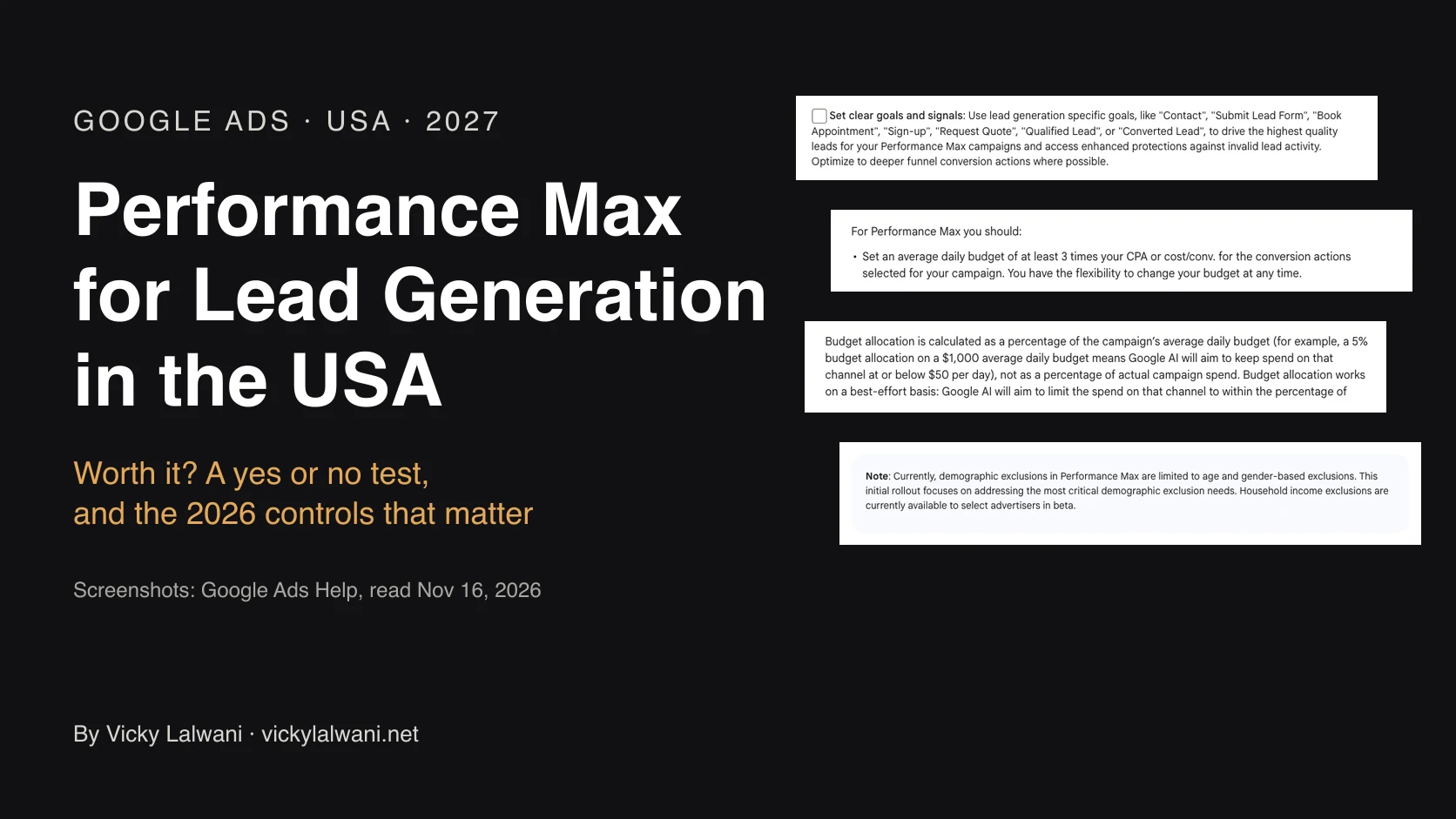
Performance Max is worth it for US lead generation only when the account is ready: it bids on qualified or converted leads rather than every form fill, gets about 15 of those a month, sends lead outcomes back from the CRM, and can fund a daily budget of at least 3 times its cost per lead on top of Search. Since October 2026 you can set the Display Network and Search partners to Low priority, and at a 0% allocation Google says it won't spend there. Household income exclusions are in beta for select advertisers. Most smaller accounts should run Search for two to three months first.
Do these three things first:
1. Check what Performance Max is bidding toward. In Goals, see which conversion actions are primary. If every form fill and call-button tap counts, fix that first.
2. Open the channel performance report. In the campaign, go to Insights and reports, then Channel performance, and see where spend and conversions went.
3. Look for channel priority in your settings. Since October 15, 2026, Google has been rolling out a control that lets you set the Display Network and Search partners to Low priority. At a 0% budget allocation, Google says it will not spend there.
TL;DR
- Worth it? Yes for a US lead generation account that bids on qualified leads, gets about 15 of them a month and can fund a daily budget of three times its cost per lead on top of Search. No for most accounts that are not there yet: start with Search.
- Why the junk leads: it chases whatever you count as a conversion. Google says to optimize to deeper funnel actions, such as a qualified lead.
- What changed in 2026: channel priority and budget caps (October 14), household income exclusions in beta for select advertisers, and channel definitions coming to standard Search reports in 2027.
- Budget: Google says a daily budget of at least 3 times your CPA. At $66.69 a lead, a 2026 US search benchmark, that is about $200 a day, or $6,080 a month.
Jump to: Worth it? · How it works · Junk leads · Qualified leads · 2026 controls · Household income · Channel report · Brand searches · PMax or Search · Fair test · CRM · LSA · Videos · X and Reddit
Picture a roofing company in Dallas that runs Google Search ads. A Google rep keeps suggesting Performance Max, so the owner tries it for a month: 40 form fills at $25 each, far cheaper than Search. Then the office manager reports that most of those people never answer the phone.
That company is made up. The pattern is not: it is the most common complaint in the Reddit threads I read for this guide. This article answers the question underneath it, in dollars and with Google's own rules: is Performance Max worth it for lead generation in the US right now, and if so, how do you set it up so it buys customers, not form fills? If you want help with your own account, I manage Google Ads for US businesses.
A note on evidence. Platform rules come from Google Ads Help and Google's Advertising Policies Help, read on November 16, 2026 and linked where I use them. This guide is research, not a case study. I have no Performance Max lead generation results of my own to report here. Where I write "I", it describes how I set up and judge accounts, not outcomes. Every dollar figure is either linked to its source or labeled as an example.
Is Performance Max worth it for lead generation in the USA?
Performance Max is worth it for US lead generation when five things are true: you bid on a qualified lead goal, you get about 15 of those a month, you can send lead outcomes back to Google, you can fund at least 3 times your cost per lead a day, and Search already covers your brand. Miss two or more and Search should come first.
Performance Max (PMax for short) is a Google Ads campaign type that buys ads across Google's inventory from one campaign. You give it a budget, a goal, images, videos and text, and Google decides where to show the ads. Lead generation means the campaign aims for inquiries, such as form fills, calls or booked appointments, rather than online sales.
| Check | Pass if | Where it comes from |
|---|---|---|
| 1. What you bid on | A qualified or converted lead goal | Google's lead gen guidance |
| 2. Volume | About 15 of those in 30 days | Google's lead gen guidance |
| 3. Feedback | Lead outcomes sent back, ideally daily | Google's lead gen guidance |
| 4. Budget | At least 3x your cost per lead a day | Google's budget step |
| 5. Brand | Brand and core terms run in Search | My test, from how PMax and Search interact |
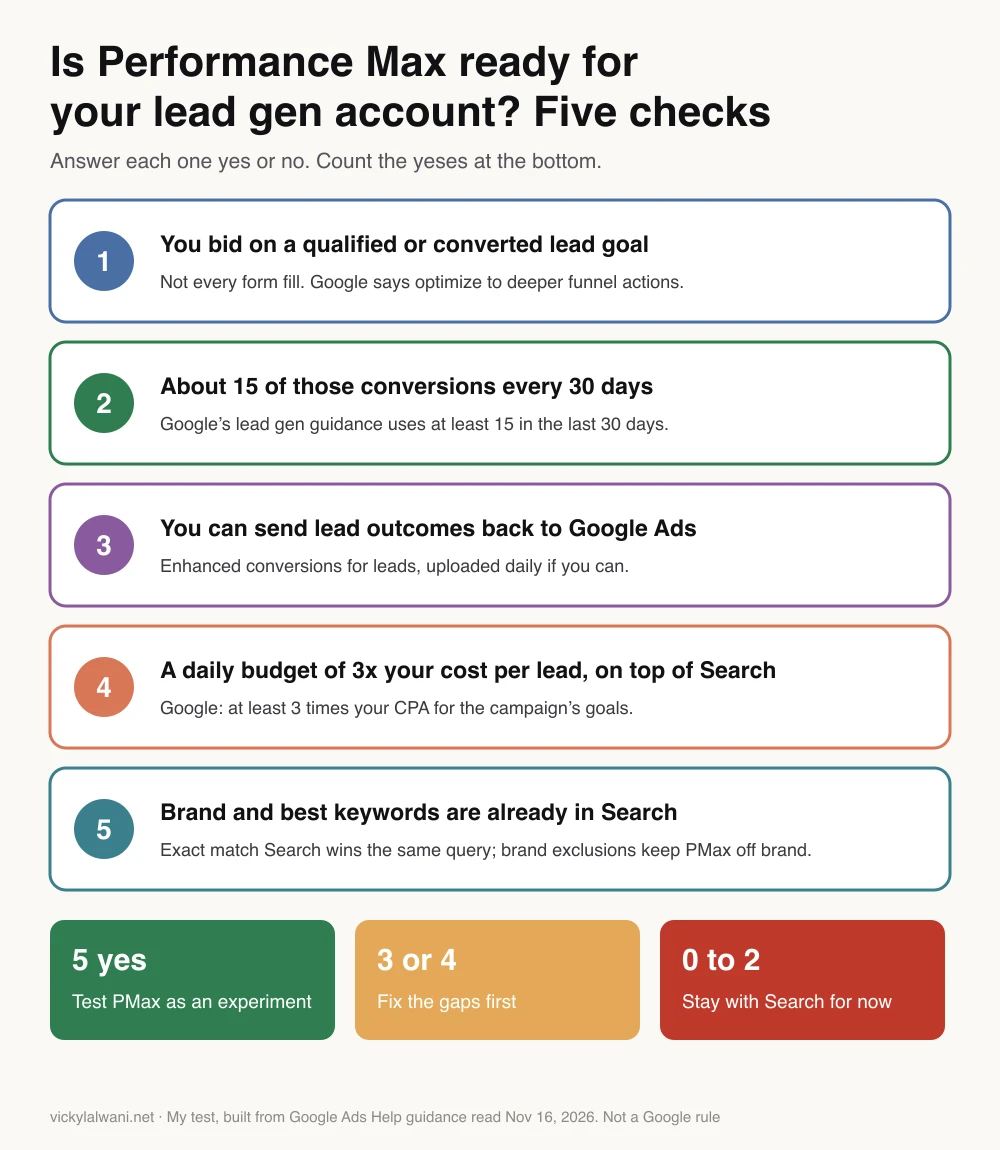
The 15 comes from Google's guide to high-quality leads, which asks for at least 15 conversions in the last 30 days on the action you bid toward. The same page says to upload lead results "ideally daily" and to pick an action that happens within 7 days of the click.
The test is mine, not Google's, and it leaves out creative quality and how fast your team calls leads back. Fail check 1 or check 3 and nothing else here will save the campaign.
How Performance Max decides where your leads come from
Performance Max serves ads on seven channels, and Google groups five of them (Search, YouTube, Maps, Gmail and Discover) into one block you cannot split. The Display Network and Search partners can be set separately. Google spends where it predicts the next conversion will come from.
| Channel | What it is | Can you limit it on its own? |
|---|---|---|
| Google Search | Search results pages | No, part of "Google channels" |
| YouTube | Video ads | No, part of "Google channels" |
| Maps | Google Maps and Waze | No, part of "Google channels" |
| Gmail | Ads in the inbox | No, part of "Google channels" |
| Discover | Google app feed | No, part of "Google channels" |
| Display Network | Sites and apps | Yes, Low priority and a cap |
| Search partners | Other search sites | Yes, Low priority and a cap |
The channel list comes from Google's definition of a Performance Max channel; the grouping and caps are still rolling out, so your account may not show them yet.
How it shares Search with your other campaigns. A Search campaign with a keyword that exactly matches the query, or is a spelling correction of it, is preferred over Performance Max. For everything else, Google picks the campaign with the higher Ad Rank, its score for each ad in each auction.
When I explain Performance Max to a client, I describe it by where it shows. If YouTube is bringing conversions, Google will push more of the budget to YouTube. That is the strength and the risk in one sentence: it follows what you count as a conversion, wherever that leads.
Why Performance Max brings junk leads
Performance Max brings junk leads because it optimizes to whatever you count as a conversion, and the cheapest form fills often come from placements where people tap by accident or bots fill forms. If every submit counts the same, the system learns to buy more of the cheapest submits. Reported cost per lead falls while customers fall too.
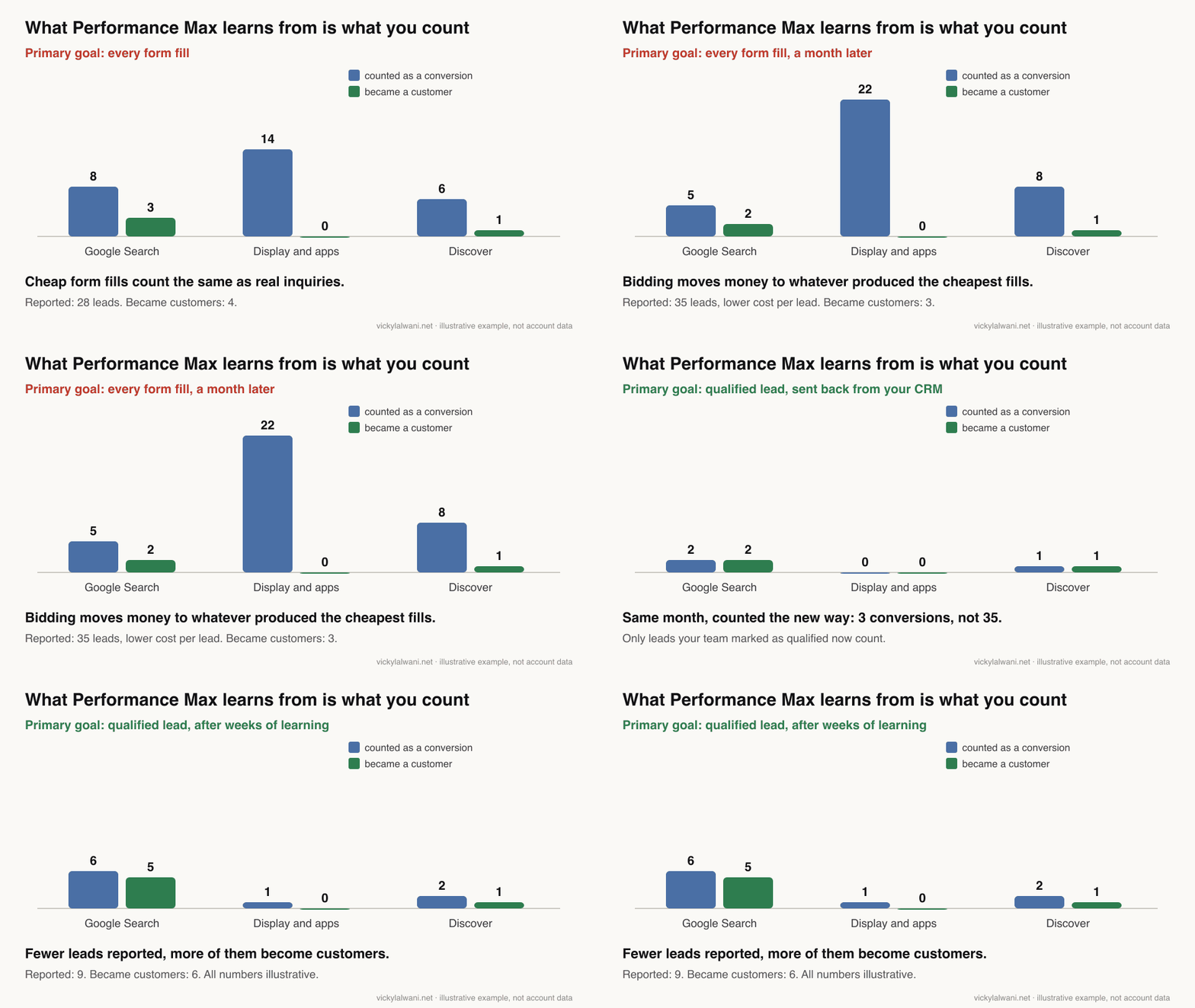
Practitioners describe the same loop. In threads from 2025 and 2026, advertisers report cost per lead that looks excellent in Google Ads next to a CRM (customer relationship management system, where your sales team tracks leads) full of fake names, wrong numbers and people who deny filling in anything. Most replies point to the same culprits:
- Display and app placements. Cheap reach, and the most common suspect when leads are fake.
- Call clicks counted as calls. A tap on a call button is not a phone call. One plumbing advertiser on Reddit found Performance Max "call" conversions almost never became real calls.
- A goal that is too shallow. Bidding toward "Submit lead form" with no quality signal means a bot submit that gets past Google's filters and a real inquiry look the same to bidding.
- Location set to people interested in your area, not people in it, so leads arrive from outside the area you serve.
Google's lead gen page suggests qualifying questions, reCAPTCHA and server-side validation on forms, and the location option "Presence: People in or regularly in your included locations" if leads come from outside your area.
I have seen the same problem on Meta. A lead campaign drifted toward low-budget inquiries because that was the signal it was given, and the plan there was to send back only the better form answers. The platform is different; the cause is the same.
Feed it qualified leads, not form fills
The single biggest fix is to make a qualified or converted lead your only primary goal. Google lists Qualified Lead and Converted Lead as lead goals, says to optimize to deeper funnel actions, and says lead goals like these give access to "enhanced protections against invalid lead activity". You then send those outcomes back from your CRM, ideally every day.
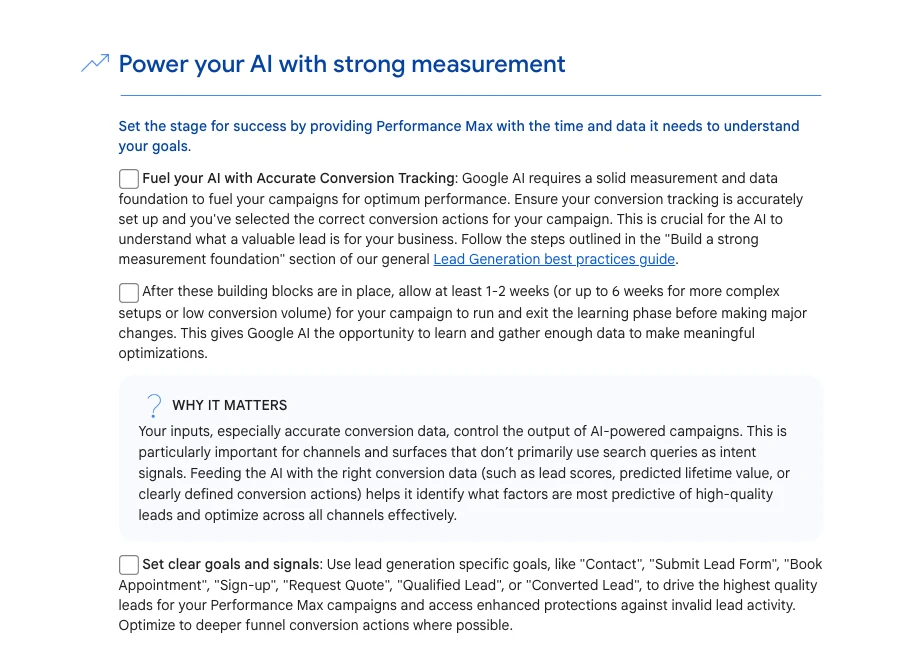
| Setting | Common setup | What to choose |
|---|---|---|
| Primary goal | Every form fill and call click | Qualified or converted lead only |
| Other actions | Also primary | Secondary: reported, not bid on |
| Calls | Taps on a call button | Calls over your length threshold |
| Lead data back | None | Enhanced conversions for leads |
| Upload timing | Monthly or never | Daily if you can |
| Funnel stages | Several in one goal | One stage per bid strategy |
- Primary or secondary. A primary action is used for bidding; a secondary action is reported in "All conversions" but left out of bidding. Google warns that putting a secondary action into a custom goal makes it count for bidding again.
- Enhanced conversions for leads. This is how you send lead outcomes back. Google calls offline conversion import a legacy feature and recommends enhanced conversions for leads, which matches leads using details such as an email address. Keep sending the GCLID (Google's click ID) when your form can capture it.
- No values? If you cannot give each lead a dollar value, Google recommends Target CPA bidding for qualified or converted leads. Target CPA is the bid strategy where you set the cost per acquisition you want.
- Values. If you can value leads, conversion value rules can adjust values by location, device or audience.
Before I judge a campaign, I ask the client which leads became customers. A click on a call button is not a call, so I count only calls that pass the minimum call length. Those two checks are where I start.
If your tracking is the problem, start with why Google Ads misses conversions and the 15-point tracking audit. Setting up qualified lead tracking is also the core of my analytics and tracking work.
Video: Paid Media Pros, an agency and training channel, July 2025. It sells a paid lead generation course. It predates the October 2026 channel controls.
The 2026 controls that change the answer
Five Performance Max changes were announced or reported between October 14 and November 15, 2026. The biggest for lead generation: channel priority lets you set Display and Search partners to Low, and a 0% allocation means Google won't spend there. Household income exclusions reached a Google help page in beta. Two other reported changes are not confirmed on Google's pages.
| Change | Date | Status on Nov 16, 2026 |
|---|---|---|
| Channel priority and budget caps | Oct 14 to 15, 2026 | On Google's page; rolling out |
| Display and partners opt-out box | Reported Oct 25, 2026 | Alpha; no Google page |
| Brand queries routed to Search | Reported Nov 3, 2026 | Not on Google's page now |
| Channel names in Search reports | Reported Nov 5, 2026 | On Google's page; 2027 |
| Household income exclusions | Documented Nov 12, 2026 | On Google's page; beta |
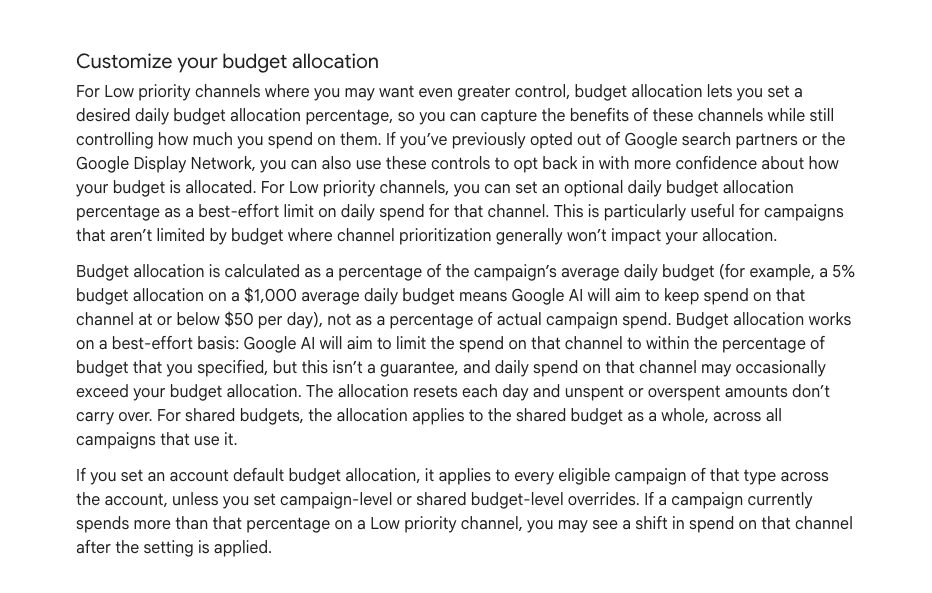
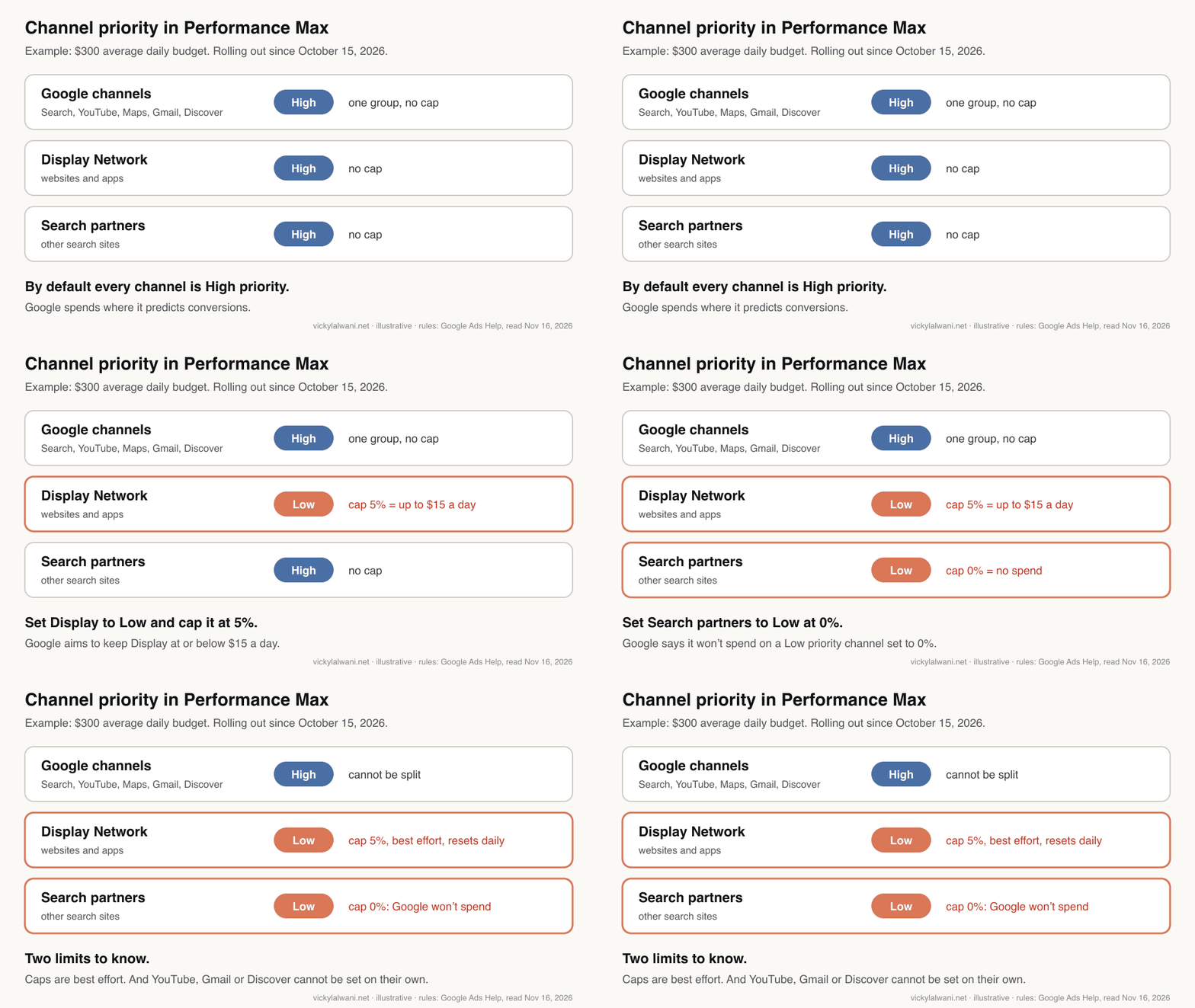
- Channel priority. Every channel starts at High. Low priority channels get money only after High priority channels. A cap on a Low channel is a best-effort limit, not a guarantee, and it resets each day. Google's example: 5% of a $1,000 daily budget means aiming for $50 a day or less.
- Where it does little. When a Target CPA campaign is not limited by budget, Google says priority levels generally do not change where spend goes; caps still apply. As Search Engine Journal put it, you get more channel control, but not as much as you think.
- The opt-out box. PPC Land reported a limited alpha with tick boxes to remove Search partners and Display. It has no Google page; Low priority at 0% is the documented route.
- Brand routing. Search Engine Roundtable reported that Google's documentation said Performance Max may filter out brand and navigational searches in favor of brand Search campaigns. On November 16, the sentence was not on that page. Treat it as reported, not confirmed.
- Reporting in 2027. Google says the channel definitions now used in Performance Max reports will reach standard Search and Shopping reports in 2027.
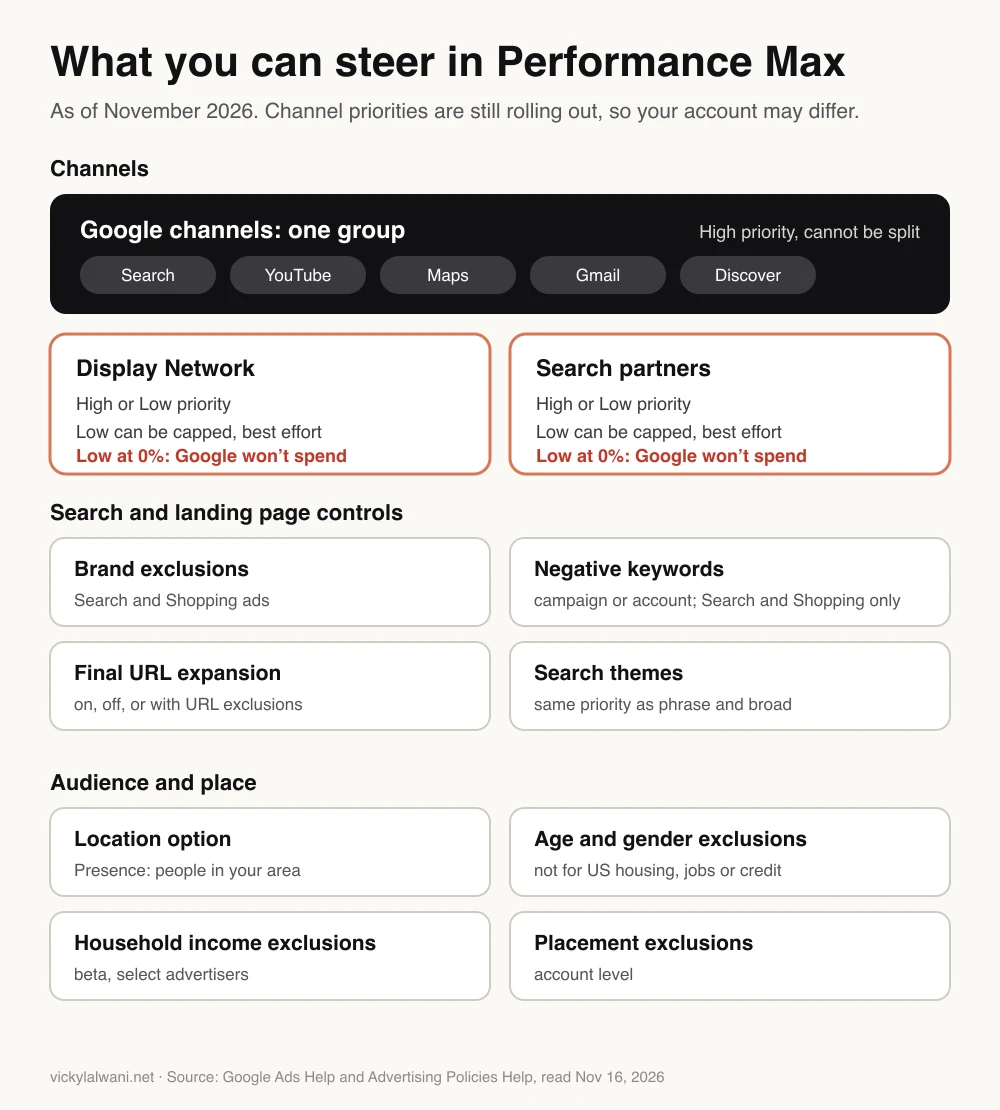
Two older controls still do a lot of the work. Negative keywords in Performance Max apply to Search and Shopping inventory only, at campaign or account level, and Google calls them "a highly restrictive control". And Final URL expansion lets Google send people to other pages on your site; turn it off, or exclude blog and policy pages, if leads land in the wrong place.
Household income exclusions and US targeting rules
Household income exclusions let a Performance Max campaign skip people in chosen income bands, from the top 10% to the lower 50%. On November 16, 2026, Google's setup page said they are "currently available to select advertisers in beta". The United States is one of 20 markets where Google offers household income at all.
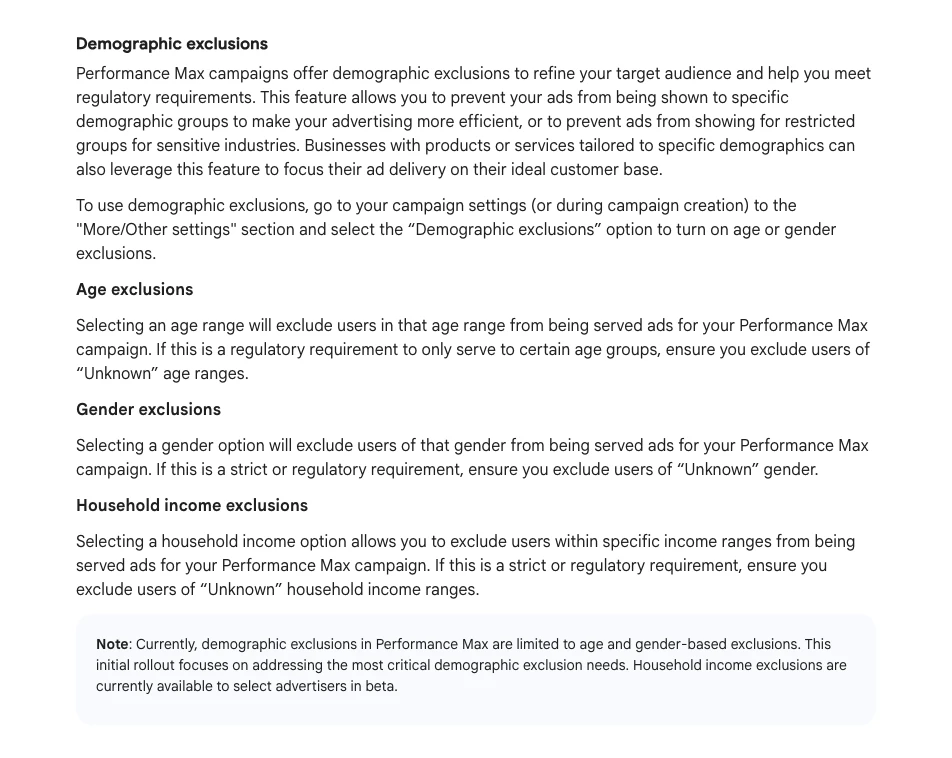
- The page contradicts itself. It describes household income exclusions, then says demographic exclusions in Performance Max "are limited to age and gender-based exclusions". PPC Land reported the change on November 15. Expect the wording to move.
- The bands. Top 10%, 11 to 20%, 21 to 30%, 31 to 40%, 41 to 50%, Lower 50% and Unknown. Google's list of household income markets includes the United States, Canada and Australia, and no European country.
- The Unknown band. Google says that if an exclusion is a strict or regulatory requirement, you should exclude "Unknown" too. Elsewhere it warns to exclude Unknown only if you are sure you want a narrow audience.
The US rule that matters more. If you advertise housing, jobs or consumer finance such as credit, Google's restricted targeting policy says that in the US and Canada you cannot target audiences by gender, age, parental status, marital status or ZIP code. The policy counts excluding people as targeting them. So under Google's policy, a mortgage broker, a staffing firm or a landlord cannot use Performance Max age or gender exclusions.
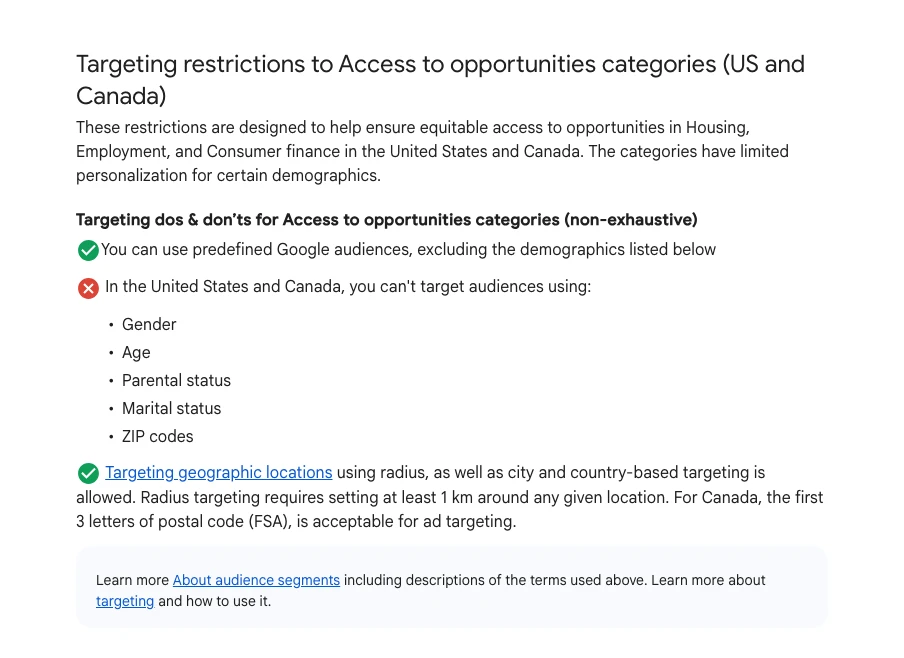
Household income is not on that list, and the policy page does not mention Performance Max. That silence is not permission: in those categories, ask your lawyer before excluding anyone by income. This is not legal advice.
Read the channel performance report before you judge
The channel performance report shows impressions, clicks, conversions and cost for each Performance Max channel, so it is where you find out whether your leads came from Search or from Display. Google adds a status for each channel, and after a big change it says to allow 1 to 2 weeks before reading the numbers.
- Where to find it. In the campaign, open Insights and reports, then Channel performance.
- What to compare. Put the channel split next to your CRM. If Display shows 30% of conversions and almost none of your closed jobs, that is your answer.
- A lead gen warning to watch. One status message reads that the campaign has a lead form goal but lead form assets are missing or disapproved.
- Tracking codes changed. Google now passes "m" for Maps, "gm" for Gmail and "dsc" for Discover instead of the old "x". If your CRM or GA4 filters read that placement value, update them or traffic will be mislabeled.
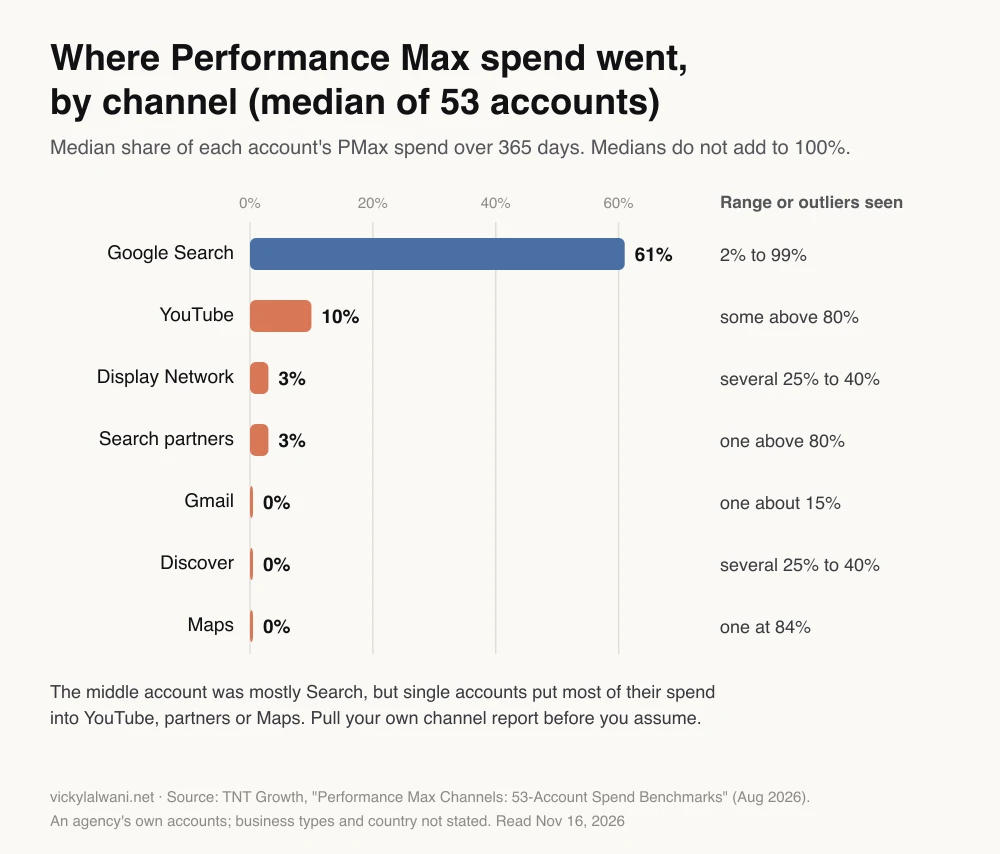
One agency's data from 53 accounts over 365 days found the median account put 61% of Performance Max spend into Search, 10% into YouTube and 3% each into Display and Search partners. But single accounts ranged from 2% to 99% on Search, one put more than 80% into Search partners, and one put 84% into Maps. The agency says the data does not prove which channel caused better results.
Google's counterargument, in its own tutorial: judge the campaign on total cost per conversion, because a channel with a high average cost can still deliver the cheapest next lead. That holds only if the conversions are real, which means a qualified lead goal.
Video: Google Ads, August 2025. Google's own product walkthrough. It says Search partners would be added to the report later; check your account for the current view.
Does Performance Max take your brand searches?
Yes, Performance Max can show on your brand searches unless you stop it. An exact match brand keyword in a Search campaign wins the same query, but studies find Performance Max still serving on searches your Search campaigns target. Google calls brand exclusions "the most effective way to control how your ads appear on searches for your brand".
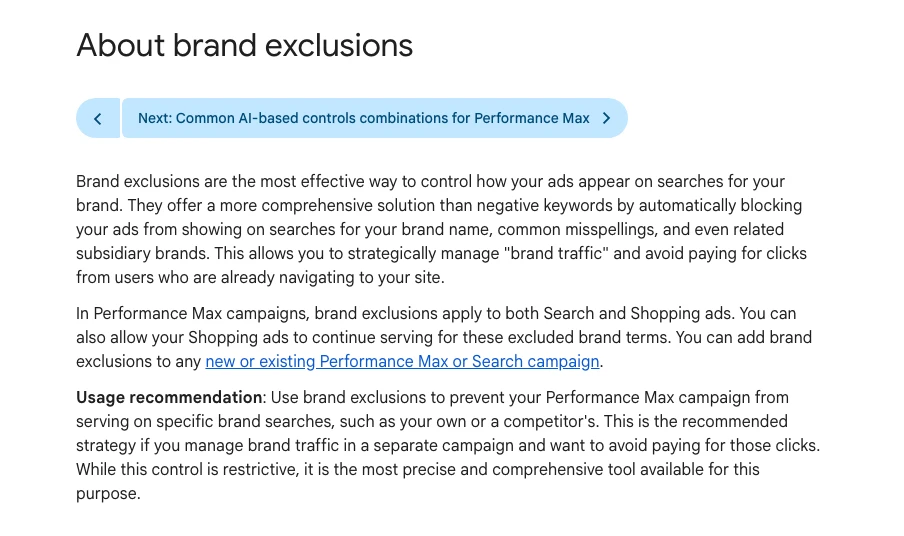
Why it matters: brand searchers already know you and would often call anyway. If Performance Max takes credit for them, its cost per lead looks better than it is.
The overlap is not small. An Adalysis study of more than 3,300 non-retail Performance Max campaigns found that, on search terms both campaign types served, Search had the higher conversion rate 84.18% of the time, yet Performance Max got more impressions 61% of the time. Optmyzr looked at 503 accounts in February 2025 and found a smaller gap: on conversion rate, Search was clearly better for 18.91% of overlapping terms, Performance Max for 6.17%, and there was no significant difference for 74.92%.
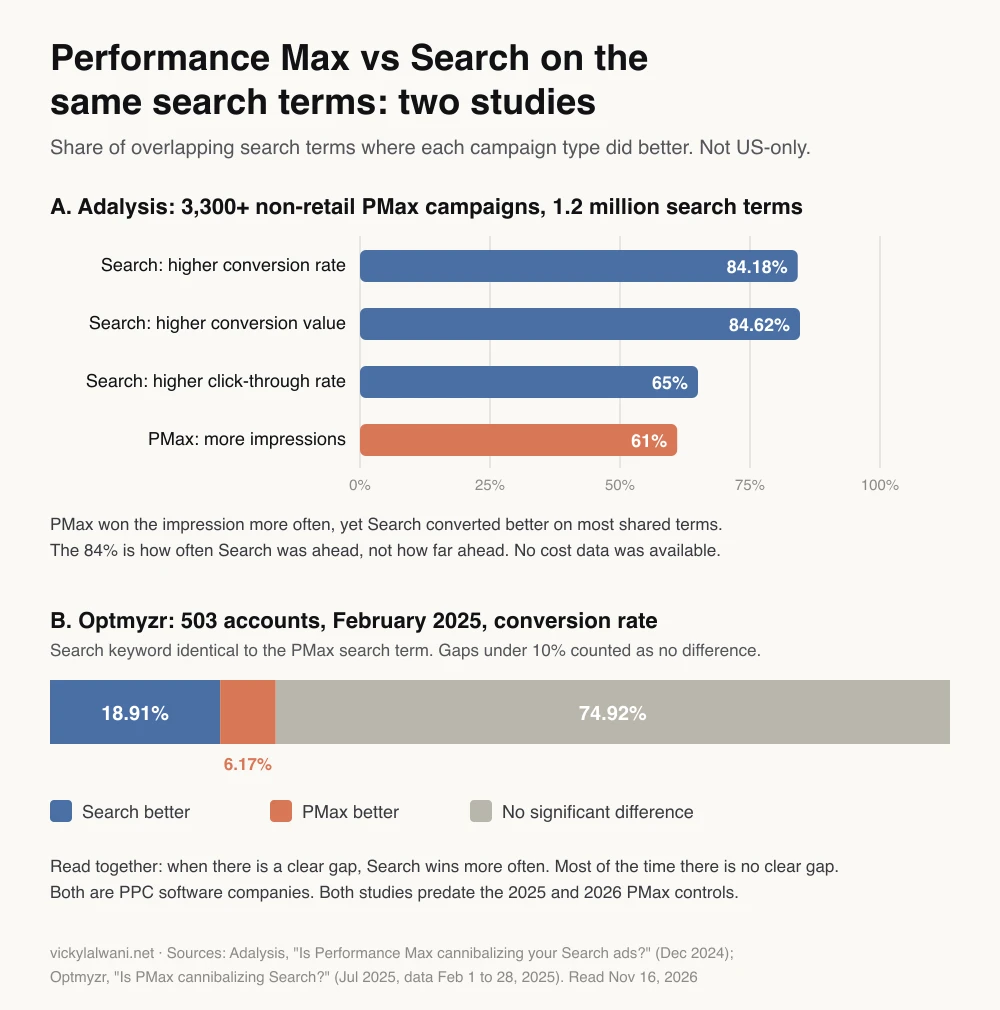
Read together: when there is a clear difference on the same search, Search usually wins it. Most of the time there is no clear difference. Neither study had cost data for Performance Max search terms, so neither tells you which is cheaper per lead.
What to do: run brand in its own Search campaign, add your brand list as a brand exclusion on Performance Max, and add your best non-brand terms as exact match keywords in Search.
Performance Max or Search on a smaller US budget
On a smaller US budget, start with Search. Google asks for a Performance Max daily budget of at least 3 times your cost per conversion, on top of what Search needs. At $66.69 a lead, a 2026 US benchmark for search campaigns, that is about $200 a day, or $6,080 a month, before Search gets a dollar.
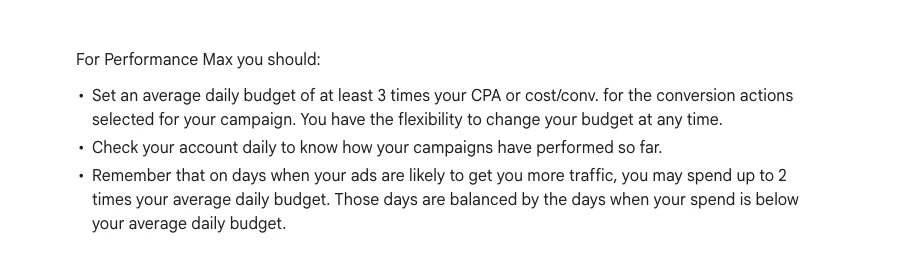
The $66.69 comes from WordStream by LocaliQ's 2026 benchmarks, as reported by PPC Land: medians from 13,474 US Google and Microsoft search campaigns, April 2025 to March 2026. It is a cost per lead for search campaigns, not for Performance Max, and a lead is not a qualified lead. Your qualified lead will cost more.
| Cost per lead | PMax daily budget at 3x | Monthly cap at 30.4 days |
|---|---|---|
| $66.69 (US, all industries) | About $200 | About $6,080 |
| $102.51 (US real estate) | About $308 | About $9,350 |
| $131.63 (US attorneys and legal) | About $395 | About $12,000 |
| $40 (your example) | $120 | $3,648 |
The first three costs are 2026 US search benchmarks from the same report. The monthly figure is the daily budget times 30.4, the most Google bills in a month. The last row is an example to replace with your own number.
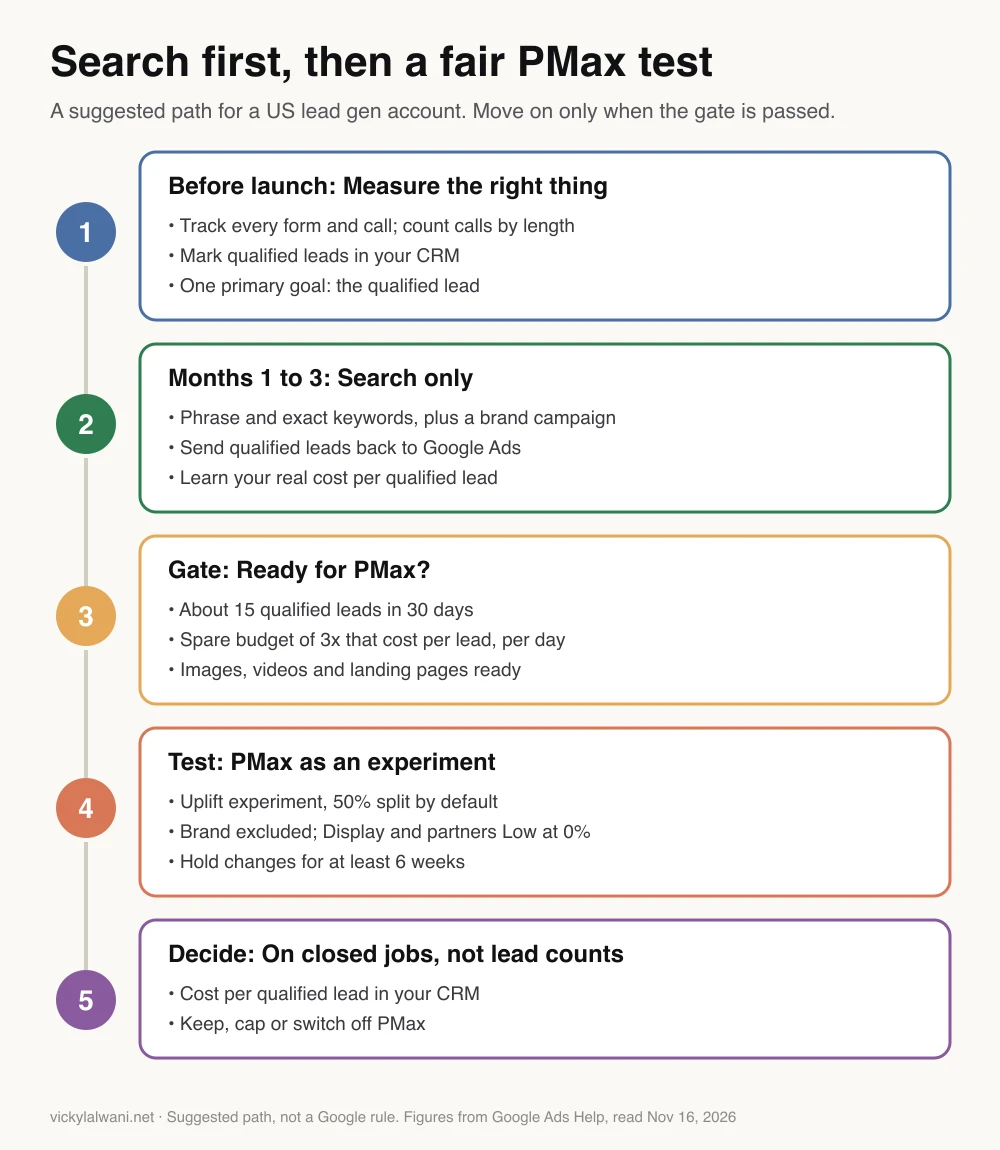
I usually run Search for two to three months before I add Performance Max. On one account with only a handful of conversions in the month, a Google account strategist advised waiting before starting Performance Max, and I parked it until more conversions came in. I do not add a campaign type until the budget can feed it.
Search first also suits US local services. Emergency jobs, such as a lockout, are searched and called within minutes; in a Reddit thread about a locksmith account, replies said to keep emergencies in Search with call ads. My home services and law firm pages cover those sectors.
Add Performance Max when you pass the readiness test, Search has run out of new searches to buy, and you have images and videos you are happy to show. If you upload no videos, Google may make them from your assets.
If AI tools help make the images and videos, I agree one rule with the client first: no invented staff, customers or premises, and samples are approved before anything runs.
What a fair Performance Max test needs
A fair Performance Max test runs long enough to learn and long enough to see which leads close. Google says to allow at least 1 to 2 weeks, "or up to 6 weeks for more complex setups or low conversion volume", before major changes. If your account is low volume, plan on at least 6 weeks, plus your sales cycle.
| Stage | What happens | How long |
|---|---|---|
| Set up | Goal, brand exclusion, channel caps | Before launch |
| Learn | Hold budget, bids and assets steady | 1 to 6 weeks |
| Read | Channel report next to the CRM | Weekly |
| Close | Wait for leads to become jobs | Your sales cycle |
| Decide | Keep, cap or switch off | After all of the above |
- Use an experiment. Google's uplift experiment measures what Performance Max adds next to your other campaigns. The traffic split is 50% by default. Google's experiments page gives no fixed minimum length, so set your own end date before you start.
- Judge on closed jobs. The test question is cost per qualified lead and cost per customer, not Google's lead count.
- Know the claim you are testing. Google says advertisers outside retail who adopt Performance Max see an average of 27% more conversions or value at a similar cost. That is Google's own global data from late 2023, with no method published and nothing specific to lead generation.
For when to move from Maximize conversions to a cost target during or after a test, see Target CPA vs Maximize Conversions.
How to compare Performance Max and Search leads in your CRM
To compare Performance Max and Search leads fairly, store the click ID and the campaign with every lead, then compare cost per qualified lead and cost per customer in your CRM, not cost per form fill in Google Ads. Without that, the cheaper-looking campaign usually wins the argument, whether or not it brought customers.
| Store with each lead | Why |
|---|---|
| GCLID (Google click ID) | Matches the lead to the click and campaign |
| UTM campaign tag | Separates PMax and Search in GA4 and the CRM |
| Lead status and date | Qualified, booked, won or lost |
| Job value, if known | Lets you compare value, not just counts |
| Call length, for calls | Separates real calls from taps |
A note on the new parameter. In November 2026 PPC Land reported a new ValueTrack value that marks clicks from AI Max (Google's query expansion for Search campaigns). Google's ValueTrack page lists it for AI Max for Search, and Performance Max is not on that page's list of supported campaigns. It helps you split Search clicks; it does not tag Performance Max clicks.
Calls need the same care. Google records a small share of US calls from call ads and call assets for some advertisers and plays callers a short notice. If you record calls yourself through a tracking tool, state consent laws differ; ask your lawyer which apply to you. Google's page is not legal advice, and neither is this one.
Watch the upload, too: uploaded conversions can go missing, as one advertiser reported in December 2025, so check uploaded counts against your CRM every week.
One way to set it up: a hidden form field for the GCLID, a CRM status your team updates when a lead qualifies, and a daily sync back to Google Ads. Setting this up is part of my tracking work.
Local Services Ads inside Performance Max: what it means for you
Local Services Ads are moving into Google Ads as a specialized Performance Max campaign type for pay-per-lead goals, starting with select US home and storefront services in August 2026. They still show only on Google Search and Maps. If you already run Performance Max, plan your brand, budget and call tracking for two Performance Max campaigns.
Google's transition page puts broader groups of advertisers in late 2026 and accounts outside the US in 2027. I covered the move, the billing change and how to run both without paying twice in Local Services Ads vs Google Ads in the USA, so I will not repeat it here.
One practical point: when two campaigns can answer the same local search, count each customer once. Give each source its own tracking number, and judge them together in the CRM.
Videos worth watching
Six more videos, checked on November 16, 2026. I read each description, not the full video, and most channels sell services.
| Video | Channel | Date | What it covers |
|---|---|---|---|
| Maximize Quality Leads with Google Ads | Google Ads | Sep 2025 | Google's case for importing qualified leads |
| How to Optimize Performance Max for Service Businesses | A consultant's training channel | Nov 2026 | Search terms, brand exclusion, asset tests |
| Google Ads Channel Priority: Change This Before February | Smarter Ecommerce, a software vendor | Oct 2026 | The new channel priority controls |
| Should you use Performance Max for lead generation | Teach Traffic, a training channel | Apr 2026 | Why bad conversion data breaks PMax |
| PMAX v.s Search Ads for Service Businesses? | Max Conversion, an agency | Feb 2026 | A pool company PMax vs Search case |
| LSA transition to Performance Max campaign | Rotate Digital, an agency | Aug 2026 | What changes as LSA moves into PMax |
The Smarter Ecommerce video is aimed at online stores, but its explanation of channel priority applies to lead generation. Its second half is about something else.
What people say on X and Reddit
Posts and threads from 2025 and 2026. Every X post was checked through X's public embed service, and every Reddit thread was read through the Arctic Shift archive, on November 16, 2026. Many Reddit replies come from freelancers and agencies looking for clients, so treat single comments as opinion.
| Where | Date | Type | What it says |
|---|---|---|---|
| Google Ads Liaison, X | Oct 14, 2026 | Official | Launches channel priority and caps |
| An agency partner, X | Oct 14, 2026 | Opinion | Finds the new controls confusing |
| A PPC consultant, X | Sep 14, 2026 | First-hand, vendor | PMax option to send clicks to a Business Profile page |
| An agency founder, X | Apr 13, 2026 | First-hand | New view of spend over time by channel |
| An advertiser, X | Dec 7, 2025 | First-hand | About 80% of offline uploads missing |
| Google Ads Liaison, X | Dec 8, 2025 | Official | Teams working on the upload issue |
| Google Ads, X | Nov 6, 2025 | Official | Channel reporting in all PMax campaigns |
| An agency owner, X | Mar 6, 2025 | Opinion | Channel data useful only with spend and conversions |
| Another agency owner, X | Mar 6, 2025 | Opinion | Expects no Search partners opt-out |
| Thread | Date | Type | What it says |
|---|---|---|---|
| r/googleads: do PMax leads convert like Search leads? | Aug 14, 2026 | Opinion | CRM results split both ways |
| r/PPC: B2B, PMax flooding account with junk | Jan 12, 2026 | First-hand | Over 90% junk, mostly from PMax |
| r/PPC: filtering junk without killing volume | Feb 18, 2026 | First-hand | Great CPL in Google, bots in the CRM |
| r/PPC: PMax for lead gen, how is it going? | Mar 27, 2025 | First-hand | Works for some sectors, not others |
| r/PPC: PMax for a plumbing business | Jul 12, 2025 | First-hand | Cheap leads, almost no real calls |
| r/PPC: PMax leads that are all fake | Aug 22, 2025 | First-hand | Real names, people deny submitting |
| r/PPC: PMax for AC repair in Los Angeles | Aug 25, 2025 | First-hand | Eight leads in five days, then none |
| r/PPC: Display and partners sneaking back | Nov 11, 2026 | First-hand, opinion | Keeps both at 0% in PMax |
On X: the controls arrived, and so did the doubts.
- The launch. Google's Ads Liaison account announced channel priority and budget allocation on October 14, 2026. The same day, an agency partner tried to explain them in a video and found it confusing. Read the help page before you change anything.
- Reporting first, control later. In March 2025 an agency owner said channel data would help only if it came with spend and conversions, and another predicted no Search partners opt-out. Google Ads announced channel reporting in all Performance Max campaigns that November, an agency founder later showed the spend-over-time view, and the 0% option arrived in October 2026.
- The feedback loop can break. One advertiser reported that about 80% of offline-uploaded conversions were missing and bidding was going wrong. The Liaison replied that teams were working on it with high priority. Google did not confirm the 80% figure.
- A new local option. A PPC consultant who sells services spotted an option to send Performance Max clicks to a Google-hosted page built from the Business Profile. Check how those leads would reach your CRM.
On Reddit: the same story, with a few exceptions.
- Cheap leads, wrong people. A B2B advertiser said more than 90% of leads were junk, mostly from Performance Max, while exact and phrase Search brought fewer but real ones. Another described a cost per lead that looked excellent in Google Ads next to a CRM full of bots.
- Fake but real-looking. One US advertiser received leads with real people's details, and those people said they never submitted anything, despite reCAPTCHA. Replies suggested checking placements and adding a hidden honeypot field.
- Local services. A plumbing advertiser said Search calls cost about $80 to $100 and mostly became jobs, while Performance Max "call" clicks almost never became calls. An AC repair advertiser in Los Angeles got eight leads in five days on $50 a day, then none.
- The exceptions. In a thread asking for CRM comparisons, one in-house B2B team found similar qualification rates and one consultant found booked rates of 20% against 22%, while an agency said Performance Max was always worse to closed deal. Another thread found B2B software and finance did well, and legal, medical and consulting did badly.
Most replies that offer a fix say the same thing: send back only qualified leads, then read the channel report. In a thread about the new controls, a dealership lead gen practitioner said they keep Display and Search partners at 0% because those channels never turned into real leads.
Where this advice is weak
- No US-only Performance Max data. The studies here are not US-only, and the only US dataset (the cost per lead benchmark) covers search campaigns, not Performance Max.
- The studies are dated and come from vendors. Adalysis and Optmyzr sell PPC software, and their data predates the 2025 and 2026 controls. The 53-account channel data is one agency's clients.
- Reddit skews negative. People post when things break. One thread asking for CRM comparisons got replies that ranged from "always worse" to slightly better than Search.
- Controls are moving. Channel priority is still rolling out, household income exclusions are in beta, and the brand routing sentence has appeared and disappeared. Re-check the help pages before you act.
- My experience is limited here. I have no Performance Max lead generation results of my own to report. The method sections describe how I set up and judge accounts.
- Nothing here is legal advice. For housing, jobs, credit or call recording, ask a lawyer.
Want a second pair of eyes on your Performance Max account?
I can check three things on your account: what Performance Max is bidding toward, where its leads come from by channel, and whether your CRM can send qualified leads back. Send me a note through the contact page. How I work with US advertisers is on the Google Ads management in the USA page, the wider service is PPC and Google Ads management, and my work for US businesses is on the USA page.
Sources
| Source | What it supports | Date | Link |
|---|---|---|---|
| Google Ads Help | What PMax is; how it shares Search | Read Nov 16, 2026 | About Performance Max, interactions |
| Google Ads Help | Lead gen goals, 15 conversions, learning time | Read Nov 16, 2026 | PMax lead gen, high-quality leads |
| Google Ads Help | Budget of 3x CPA | Read Nov 16, 2026 | Set your budget |
| Channel priority and caps | Oct 14, 2026; read Nov 16, 2026 | Help page, Google blog | |
| Google Ads Help | Channels, channel report, 2027 Search reports | Read Nov 16, 2026 | Channel definitions, channel report |
| Google Ads Help | Brand exclusions, negatives, Final URL expansion | Read Nov 16, 2026 | Brand exclusions, negatives, controls |
| Google Ads Help | Household income exclusions, income bands | Read Nov 16, 2026 | Campaign settings, demographics |
| Google Advertising Policies | US housing, jobs and credit targeting | Read Nov 16, 2026 | Restricted targeting |
| Google Ads Help | Goals, enhanced conversions for leads, value rules | Read Nov 16, 2026 | Goals, leads upgrade, value rules |
| Google Ads Help | Experiments and Google's 27% claim | Read Nov 16, 2026 | Experiments, uplift, claims |
| Google Ads Help | ValueTrack, call recording, LSA move | Read Nov 16, 2026 | ValueTrack, call recording, LSA, phases |
| PPC Land | Income exclusions, opt-out alpha, AI Max value, benchmarks | Jun to Nov 2026 | Income, alpha, still alpha, AI Max, CPL |
| Search Engine Roundtable | Brand routing, Search reports, income sighting, upload bug | Dec 2025 to Nov 2026 | Brand, reports, income, uploads |
| Search Engine Journal | Limits of channel control | Nov 11, 2026 | Column |
| Adalysis | 3,300+ non-retail PMax campaigns | Dec 2024 | Study |
| Optmyzr | 503 accounts, Feb 2025 data | Jul 2025 | Study |
| TNT Growth | PMax spend by channel, 53 accounts | Aug 2026 | Benchmarks |
| First-hand reports and opinion | 2025 to 2026 | Linked in the text | |
| X | Google accounts and practitioners | 2025 to 2026 | Linked in the text |
| YouTube | Eight videos, titles checked by oEmbed | Jul 2025 to Nov 2026 | Embedded and in the videos table |
FAQ
How do you use Performance Max for lead generation?
To use Performance Max for lead generation, make a qualified or converted lead your only primary conversion goal, send lead outcomes back from your CRM with enhanced conversions for leads, and set a daily budget of at least 3 times your cost per lead. Add your brand as a brand exclusion, set the location option to Presence, and judge results on closed jobs after at least 6 weeks.
Is Performance Max worth it for lead generation in the USA?
Performance Max is worth it for a US lead generation business that bids on qualified leads, gets about 15 of them a month, can send lead outcomes back to Google Ads and can fund 3 times its cost per lead a day on top of Search. If two or more of those are missing, a Search campaign is the better place to start.
Is PMax good for lead gen?
PMax can be good for lead gen when it learns from qualified leads rather than every form fill. Practitioners report junk leads most often when Performance Max bids toward raw form submits or call clicks. Google's own lead generation guidance says to optimize to deeper funnel actions such as a qualified or converted lead.
Why does Performance Max bring spam or junk leads?
Performance Max brings junk leads when it is rewarded for any form fill, because the cheapest fills often come from Display and app placements or bots. It then buys more of them. Fix the goal first: count only qualified leads as primary conversions, send them back from your CRM, and check the channel performance report for where leads came from.
How do you improve Performance Max lead quality?
To improve Performance Max lead quality, bid on a qualified lead goal, upload lead outcomes daily with enhanced conversions for leads, add qualifying questions and reCAPTCHA to forms, set the location option to Presence, and set the Display Network and Search partners to Low priority, at a 0% allocation if those channels bring no customers.
Performance Max vs Search campaign: which is better for leads?
A Search campaign is usually the better first choice for leads, because you choose the keywords and see search terms with their cost. An Adalysis study of more than 3,300 non-retail Performance Max campaigns found Search had the higher conversion rate on 84% of overlapping search terms. Optmyzr found no significant difference on most overlapping terms.
Should you run Performance Max and Search campaigns together?
You can run Performance Max and Search campaigns together, and Google designs Performance Max to complement Search. A Search keyword that exactly matches the query is preferred over Performance Max. Run brand in Search, add a brand exclusion to Performance Max, and compare both on cost per qualified lead in your CRM.
What is the minimum budget for Performance Max?
Google sets no fixed dollar minimum for Performance Max. Setup suggests Low, Medium and High daily budgets, and Google advises at least 3 times your cost per conversion. At $66.69 a lead, a 2026 US benchmark for search campaigns, that is about $200 a day, or about $6,080 a month at Google's 30.4-day monthly limit.
How long should a Performance Max lead gen test run?
A Performance Max lead gen test should run at least 6 weeks for most accounts. Google says to allow 1 to 2 weeks, or up to 6 weeks for complex setups or low conversion volume, before major changes. Add your sales cycle on top, so you can see which leads became customers before you decide.
Can you exclude Display and Search partners from Performance Max?
You can limit Display and Search partners in Performance Max with channel prioritization, rolling out since October 15, 2026. Set them to Low priority with a 0% budget allocation and Google says it won't spend there. A separate opt-out box is in a limited alpha with no Google help page.
What does the Performance Max channel report show?
The Performance Max channel performance report shows impressions, clicks, conversions, conversion value and cost for Search, YouTube, Display, Discover, Gmail, Maps and Search partners, with a status for each channel. Google says to allow 1 to 2 weeks after big changes before reading it. Find it under Insights and reports in the campaign.
How do Performance Max brand exclusions work?
Performance Max brand exclusions stop the campaign from serving on searches for brands on your list, including common misspellings. They apply to Search and Shopping ads. Google calls them the most effective way to control brand traffic and recommends them when you run brand in a separate Search campaign.
Can you add negative keywords to Performance Max?
Yes, you can add negative keywords to Performance Max at the campaign or account level. They apply to Search and Shopping inventory only, not to YouTube, Display or Discover. Google calls them a highly restrictive control and suggests using them for brand safety or clearly irrelevant terms.
Can you exclude household income in Performance Max in the US?
Household income exclusions in Performance Max are in beta for select advertisers, according to Google's help page on November 16, 2026. The United States is one of 20 markets with household income bands. US housing, employment and credit advertisers face separate targeting limits, so they should ask a lawyer before excluding anyone.
How will Google's shift to Performance Max change Local Services Ads?
Google is moving Local Services Ads into Google Ads as a specialized Performance Max campaign type for pay-per-lead goals, starting with select US home and storefront services in August 2026. The ads still show only on Search and Maps. Broader groups follow in late 2026 and accounts outside the US in 2027.