A Black Friday marketing strategy with ten days left should focus on tracking, the margin on your offer, paid search, Shopping promotions, retargeting and email. Upload sale ads now and keep them paused, plan for Cyber Monday on 30 November as well as Black Friday on 27 November, and work out break-even ROAS before you discount.
Black Friday is on Friday 27 November 2026 and Cyber Monday on 30 November. If you are reading this on 17 November, you have ten days. That is enough time to fix tracking, check the maths on your offer, get sale ads and promotions approved and warm up your email list. It is not enough time to rank a new page. This plan covers what still moves sales this year, in the order I would do it. If you want a hand with the paid search side, see my Google Ads and PPC consulting.
New: Meta began counting more conversions on 12 November 2026, 15 days before Black Friday. See what the Meta attribution changes mean for your reports.
TL;DR
With ten days left, spend your time on what can still change sales: tracking, the margin on your offer, paid search, Shopping promotions, retargeting and email. SEO and GEO work now pays off next year.
Upload sale ads now and keep them paused. Google says most ads are reviewed within one working day and Meta says most are reviewed within 24 hours, but neither promises it.
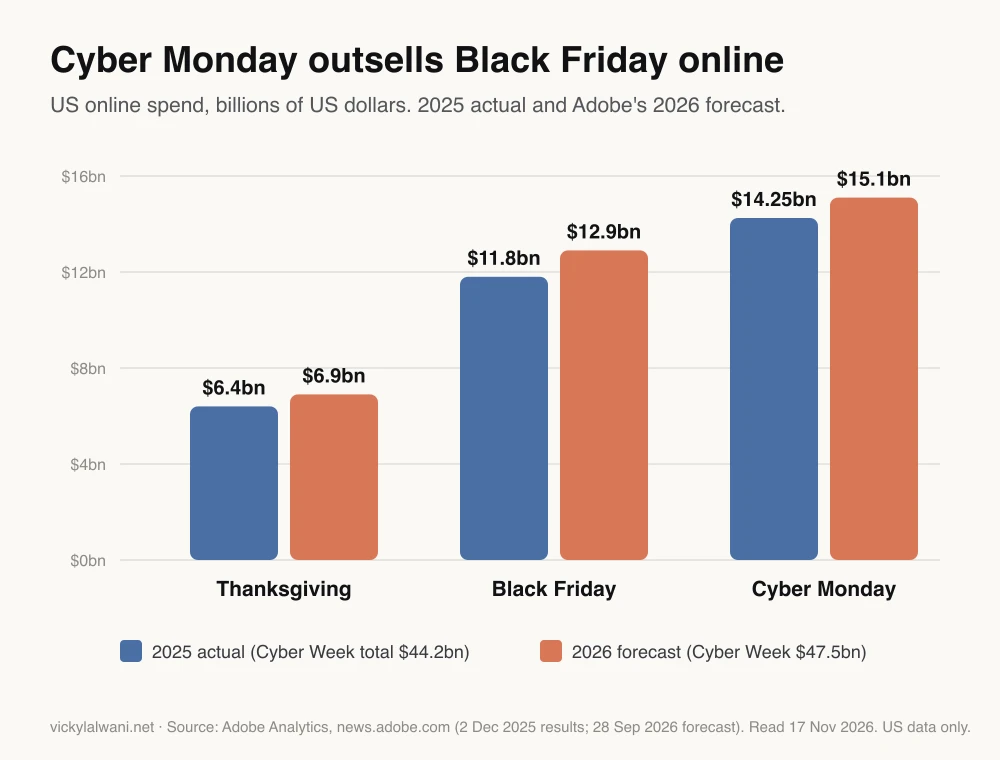
Plan for Cyber Monday as well as Black Friday. In the US, Adobe recorded $14.25bn of online spend on Cyber Monday 2025 against $11.8bn on Black Friday.
A 20% discount can halve your profit per sale. Work out break-even ROAS before you announce anything.
| Channel | Can it help this year? | Do this first |
|---|---|---|
| Conversion tracking | Yes, and it comes first | Test one real purchase or lead end to end |
| Google Ads Search | Yes | Upload sale ads paused; clear wasted search terms |
| Shopping and Merchant Center | Yes, if the feed is healthy | Submit promotions on a weekday, early |
| Meta Ads | Yes, with ads you have already tested | Retarget recent visitors; avoid big edits |
| Email and SMS | Yes | Early access for subscribers |
| SEO | Only pages already indexed | Update last year's sale page, keep the URL |
| GEO (AI answers) | Mostly next year | Put clear offer facts and dates on the page |
Every product fact below was checked against Google, Meta, Adobe or a regulator's own page on 17 November 2026, with links throughout and a sources table at the end. Money examples are illustrative unless a source is linked. If you want help with a specific channel, the Black Friday services page lists free strategy calls by service.
How many days are left, and what can still change?
Short answer: From 17 November there are ten days to Black Friday on 27 November and 13 to Cyber Monday on 30 November. Tracking, offers, ads, promotions, retargeting and email can all still change. New pages, new SEO content and untested creative mostly cannot.
| Date (2026) | What happens | Why it matters |
|---|---|---|
| Tue 17 Nov | Ten days to go | Last comfortable week for changes |
| Weekdays, 20 to 25 Nov | Review windows before the sale | Promotions get policy review in weekday hours |
| Thu 26 Nov | Thanksgiving in the US | Adobe forecasts $6.9bn of US online spend |
| Fri 27 Nov | Black Friday | Forecast $12.9bn US online |
| Sat 28 to Sun 29 Nov | Cyber weekend | Keep budgets and stock checks running |
| Mon 30 Nov | Cyber Monday | Forecast $15.1bn US online, the biggest day |
| Tue 1 Dec | Wind down | End sale ads, promotions and seasonality settings |
The forecast figures come from Adobe's 2026 US holiday forecast, published 28 September 2026. They are forecasts for the US only, not results.
Is your Black Friday discount profitable?
Short answer: Only if the profit left after the discount still pays for the ads. Work out break-even ROAS (return on ad spend, the sales value you get back per $1 of ads): selling price divided by profit before ads. In the example below, 20% off moves break-even ROAS from 2.5 to 4.0 and halves the profit per sale.
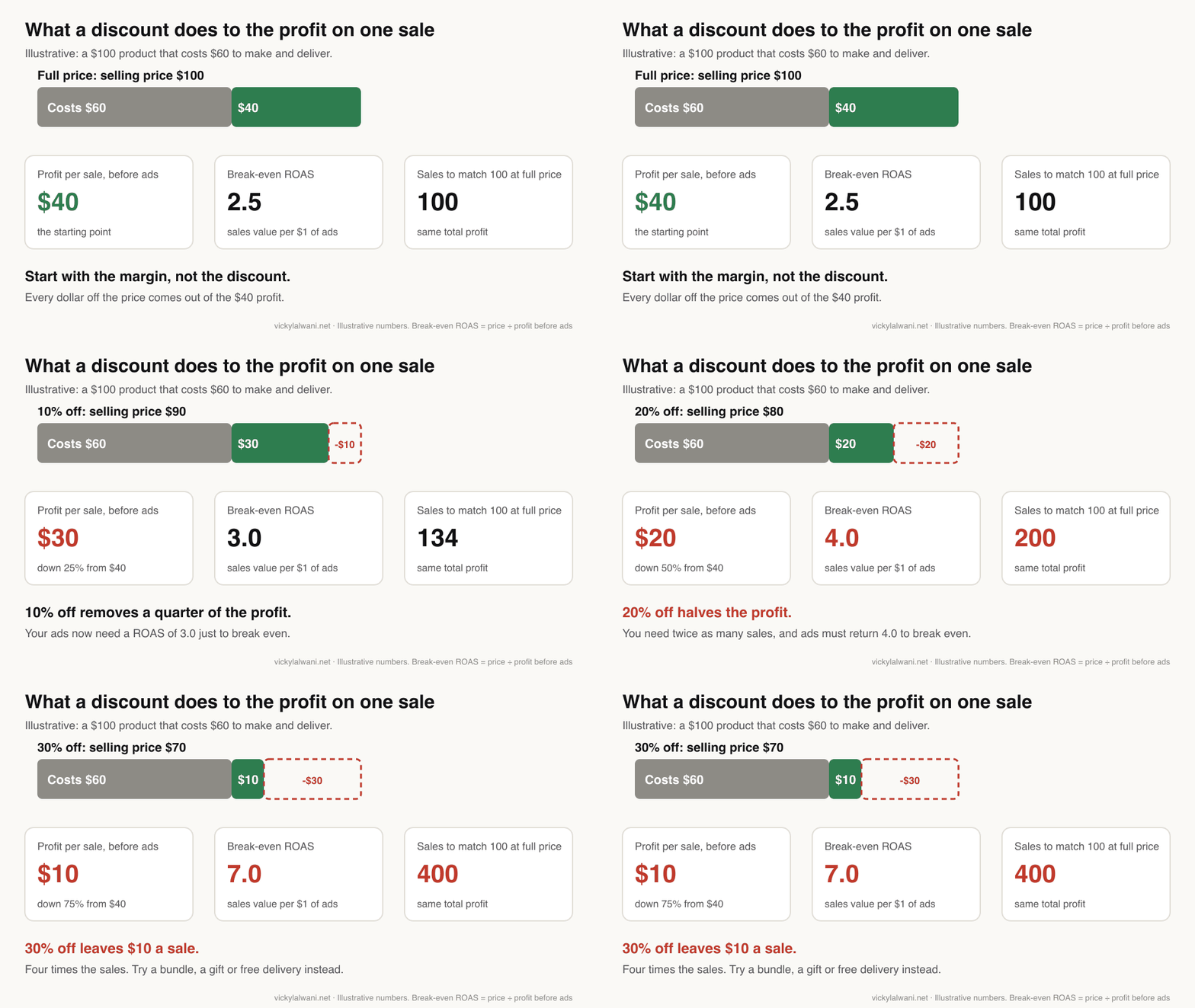
| Illustrative product | Full price | 10% off | 20% off |
|---|---|---|---|
| Selling price | $100 | $90 | $80 |
| Profit before ads | $40 | $30 | $20 |
| Break-even ROAS | 2.5 | 3.0 | 4.0 |
| Sales to match 100 at full price | 100 | 134 | 200 |
Check the sums: $4,000 of profit from 100 full-price sales needs 134 sales at $30 profit (4,000 divided by 30 is 133.3, rounded up) and 200 sales at $20. At 30% off, profit is $10 a sale, break-even ROAS is 7.0 and you need 400 sales. These are made-up numbers. Use your own costs, including delivery, payment fees and expected returns.
If the maths fails, change the offer rather than the budget. A bundle that pairs a best seller with a high-margin item, a free gift, free delivery over a threshold, or early access for subscribers can all feel generous without taking 20% off everything.
You are checking a Black Friday offer for profit. Use only the numbers I give you. If a number is missing, ask for it. Do not invent costs or conversion rates.

My numbers
- Full selling price: [amount]
- Cost to make or buy, deliver and process payment per sale: [amount]
- Expected return rate on discounted orders: [percent]
- Discount options I am considering: [for example 10%, 20%, a bundle, a free gift worth X at cost]
- My usual return on ad spend (ROAS) during sales: [number, or say "unknown"]

For each option, show each sum:
1. Selling price after discount and profit per sale before ads.
2. Break-even ROAS = selling price divided by profit before ads.
3. How many sales give the same total profit as 100 full-price sales.
4. Whether my usual ROAS clears break-even, yes or no.

End with a short table and one sentence on which option protects margin best. List every assumption.
What should you fix first, tracking or ads?
Short answer: Tracking. Smart Bidding on Google and Meta's delivery system learn from the conversions you record, so a broken purchase or lead tag gets expensive fastest in peak week. Place one real test order or lead and follow it into GA4, Google Ads and Meta Events Manager before you raise any budget.
I keep campaigns in draft until every purchase, form and call button is measured, and peak week is when that rule matters most. Common faults are covered in why Google Ads is not tracking conversions and how to plan conversion tracking with an event map.
Meta reporting needs extra care this year. A pixel setting called Measure conversions on customer devices lets Meta match more purchases on the shopper's own device. Meta's help page says it is on by default and "not active for people located in the EU and UK". It changes which conversions Meta can measure, not your real orders. PPC Land reports that it started on 12 November 2026, a date Meta's page does not state. So if Meta shows more purchases than last Black Friday, compare with your store or CRM orders before you celebrate.
| Check | Where | Pass when |
|---|---|---|
| Test purchase or lead | Your site, then each platform | It appears once, with the right value |
| Duplicate counting | GA4 and Google Ads conversions | One order is one conversion |
| Pixel and Conversions API | Meta Events Manager | Events match and are not double counted |
| Customer devices setting | Meta Events Manager, pixel settings | You know if it is on, and noted the date |
| Baseline | Store or CRM export | Four weeks of orders saved before the sale |
The 10-day Black Friday plan, day by day
Short answer: Spend 17 to 19 November on tracking and the offer, 20 to 23 November on uploading ads and promotions, 24 to 26 November on warming up email and retargeting audiences, then watch spend, stock and tracking every day from 27 to 30 November. Switch sale items off on 1 December.
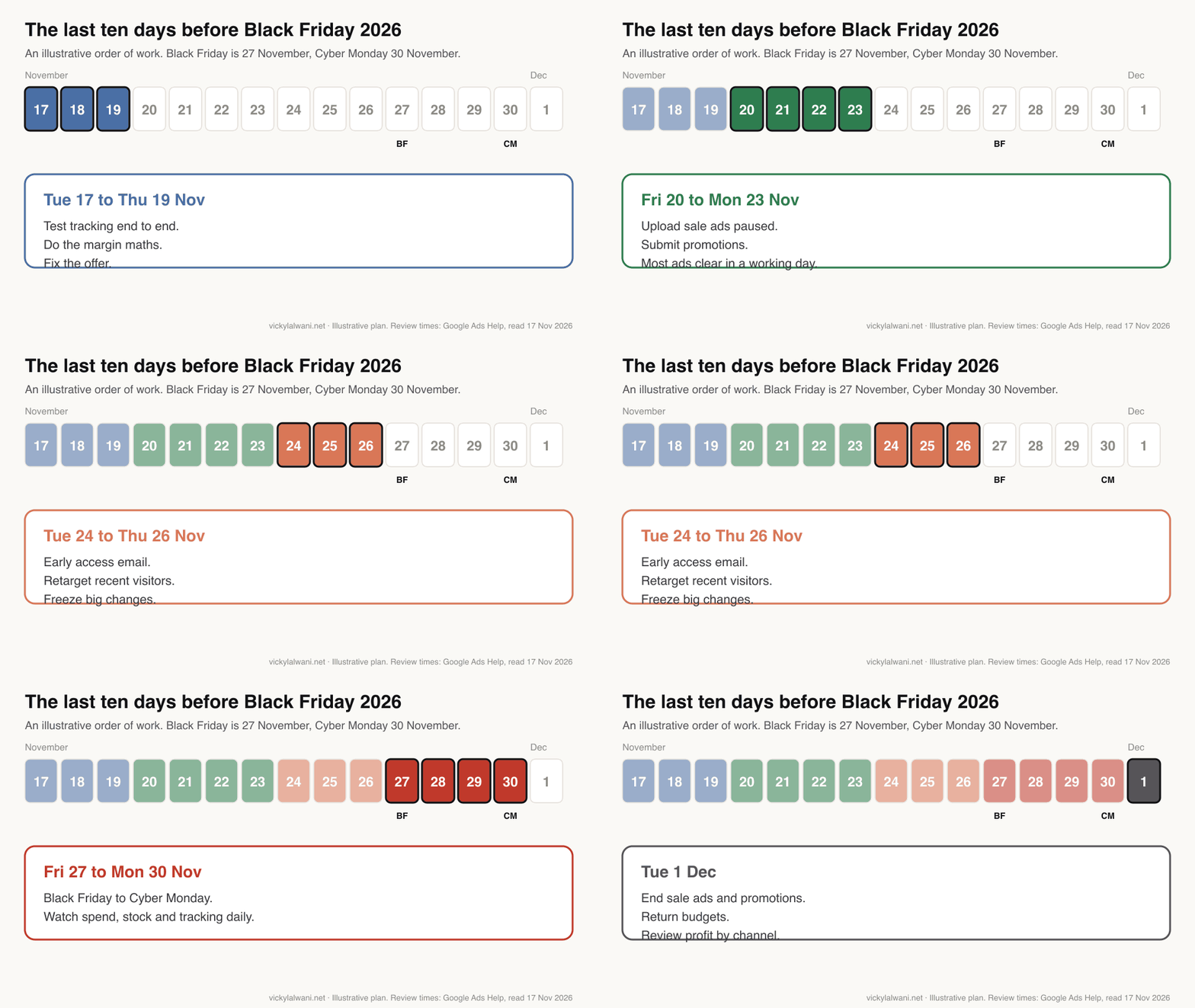
| When | Do this | Done when |
|---|---|---|
| 17 to 19 Nov | Test tracking; do the margin maths; confirm stock | One test sale recorded everywhere |
| 17 to 19 Nov | Review search terms; add negatives | Obvious waste blocked |
| 20 to 23 Nov | Upload sale ads and assets, paused | Status shows Eligible |
| 20 to 23 Nov | Submit Merchant Center promotions | Promotion approved, start date set |
| 24 to 26 Nov | Early access email; build retargeting audiences | Lists segmented, audiences filling |
| 24 to 26 Nov | Freeze big structural changes | No new campaigns from here |
| 27 to 30 Nov | Switch sale ads on; check spend, stock, tracking daily | A short daily log |
| 1 Dec | End sale ads, promotions and adjustments | Nothing still says Black Friday |
How do you set up Google Ads for Black Friday this late?
Short answer: Keep the structure you have. Add sale ads and promotion assets now, raise budgets in steps rather than rebuilding, and use a seasonality adjustment only if you expect a big jump in conversion rate over a short window. Google says seasonality adjustments are ideal for events of one to seven days.
Here is what Google's own help pages say about the settings that matter in peak week, read on 17 November 2026.
| Setting | What Google says | What to do |
|---|---|---|
| Ad review | Most ads reviewed within one working day | Upload now, paused |
| Seasonality adjustments | Ideal for one to seven days | Only for a big, short change |
| Daily budget | Up to 2x a day, 30.4x a month | Expect uneven daily spend |
| Campaign total budgets | Fixed total over 3 to 90 days | Useful for a 27 to 30 Nov campaign |
| Promotion assets | Black Friday shows 15 Oct to 15 Dec | Narrow the dates to your sale |
| Smart Bidding learning | Never lasts more than seven days | Avoid new campaigns this late |
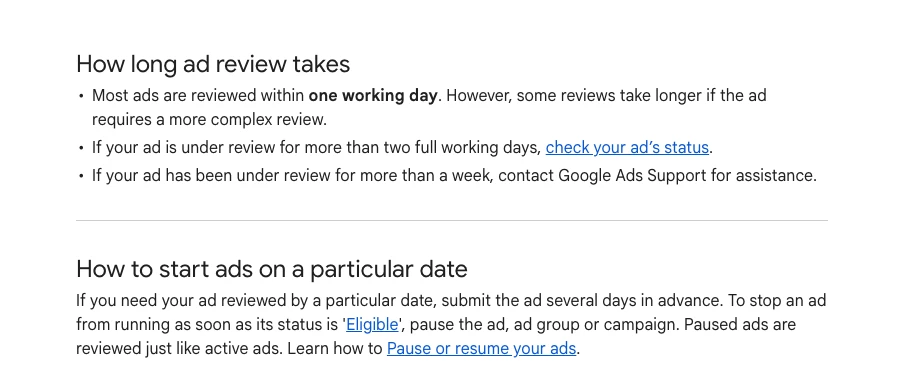
Ad approvals. Google's ad review page says most ads are reviewed within one working day, that complex reviews take longer, and that if you need an ad by a date you should "submit the ad several days in advance". Paused ads are reviewed just like active ones. So write your Black Friday ads this week, upload them paused, and switch them on when the sale starts.
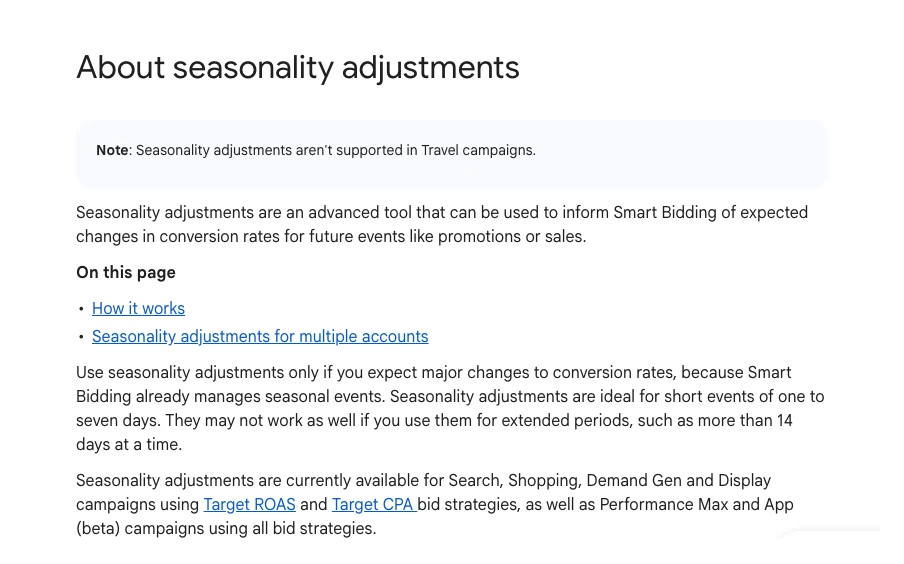
Seasonality adjustments. A seasonality adjustment tells Smart Bidding (Google's automated bidding) that you expect conversion rate to jump for a set period. Google's page says to use them only for major changes, because Smart Bidding already handles normal seasons, and that they may not work as well over more than 14 days. They work on Search, Shopping, Demand Gen and Display with Target CPA or Target ROAS, and on Performance Max with any bid strategy. If you use one, set it for the sale days only, with a conversion rate change you can justify from last year's data. Google says no negative adjustment is needed afterwards.
Budgets. A campaign can spend up to twice its average daily budget on a busy day but no more than 30.4 times it in a month. For a short sale, a campaign total budget sets one amount across a start and end date of 3 to 90 days, with no daily limits, on Search, Shopping, Performance Max, Demand Gen and YouTube. Google says you will never be charged more than the total. If your sale campaign only runs on certain days of the week, note the 1 June 2026 pacing change: campaigns that switch off whole days now pace towards the full monthly amount on the days they run.
Learning. Google's current Smart Bidding learning page says a Learning status never lasts more than seven days, and that budget and target changes never trigger it. New campaigns, new bid strategies and large keyword changes do. An older Google page on bid strategy statuses still lists setting changes as a trigger, so the two pages disagree. Either way, a new campaign launched on 25 November spends Black Friday learning, so add ads and budget to campaigns that already work.
If high click prices are what worries you, this guide to high CPC keywords covers what to do when competitors push bids up, and Target CPA vs Maximise conversions covers when to change bid strategy (not during peak week).
Shopping ads: Merchant Center promotions and sale prices
Short answer: Submit promotions as early as possible, on a weekday. Google reviews them for policy during weekday operating hours, then runs a second check at the start time that usually takes up to 12 hours and can take 24. Sale price strikethroughs only show when the discount and price history meet Google's rules.
| Item | Google's rule | For Black Friday |
|---|---|---|
| Promotion review | Weekday hours, then a check at start | Submit by Wed 25 Nov at the latest |
| Where promotions show | 13 countries incl. UK, US, Australia | Check your country is listed |
| Strikethrough discount | More than 5% and less than 90% | Deep cuts may not show |
| Price history, US | 5 days in last 30, or 15 in last 200 | Use a real former price |
| Price history, other markets | 30 days in the last 200 | Days need not be consecutive |
| Delivery estimates | A holiday adds a day | Set handling time honestly |
The "Wed 25 November" date is my reading, not Google's. Google's approval page gives no fixed lead time, only "as early as possible". A promotion starting on Friday needs its weekday policy review done before then, so leave at least two working days. Avoid big feed changes in the last few days, because a disapproval in peak week is hard to undo.
Meta Ads in the last ten days
Short answer: Run creative you have already tested, retarget recent visitors and cart abandoners, and avoid significant edits to ad sets that are working. Meta says most ads are reviewed within 24 hours and ad sets usually leave the learning phase after about 50 results in the week after the last significant edit.
That learning rule is why rebuilding a Meta campaign on Black Friday morning is risky. A significant edit, such as a big budget change, new creative or a new audience, can send an ad set back into learning, according to Meta's learning phase page. If you plan to spend more, raise budgets a few days before the sale in steps, rather than doubling them on the day.
Schedule sale ads now with a future start date. Meta's ad review page says most ads are reviewed within 24 hours and that an ad with a future start date is reviewed on submission, then starts on the day you set. For settings that quietly waste money, see the Meta Ads settings checklist, and if you want someone to look at the account, the Black Friday Meta Ads page explains what a free call covers.
| Audience | Message | When |
|---|---|---|
| Email subscribers | Early access before the public sale | 24 to 26 Nov |
| Cart and checkout abandoners | The offer, the end date, delivery cut-off | 27 to 30 Nov |
| Site visitors, last 30 days | Best sellers or the bundle | 25 to 30 Nov |
| Past buyers | A complementary product, not the same one | 27 Nov to 1 Dec |
Email, SEO and GEO: what is worth doing now?
Short answer: Email is worth doing now, because you own the list and can send this week. SEO and GEO are only worth light work on pages that already exist and are indexed: update last year's sale page, keep its URL, and add clear dates, terms and FAQs.
- Email: segment buyers, subscribers and recent browsers, give subscribers early access, and send a reminder before the sale ends. Say the real end date.
- SEO: a new page probably will not rank by 27 November. Improve the sale page you already have and link to it from the homepage and top categories.
- GEO (generative engine optimisation, being named in AI answers): put the offer, dates, delivery cut-offs and returns policy on the page in plain text, so AI tools that read your site can repeat the facts. Expect most of the benefit next year.
For next year's groundwork, the Black Friday SEO page lists what to keep after the sale ends.
Should you plan for Cyber Monday as well as Black Friday?
Short answer: Yes. In Adobe's US data, Cyber Monday is the biggest online shopping day: $14.25bn in 2025 against $11.8bn on Black Friday, and Adobe forecasts $15.1bn against $12.9bn for 2026. Keep budget, stock and staff for Monday 30 November, not just Friday.
| Adobe figure (US online) | 2025 actual | 2026 forecast |
|---|---|---|
| Cyber Week, 5 days | $44.2bn | $47.5bn |
| Mobile share | 57.5% on Cyber Monday | 57.4% of the season |
| Buy now, pay later | $1.03bn on Cyber Monday | $1.09bn on Cyber Monday |
| Peak discounts | Electronics 30.9% | Up to 30% in Cyber Week |
Two things follow for ads. More than half of online spend happens on phones, so test checkout on a phone before the sale. And Adobe expects discounts to peak during Cyber Week, so your offer competes with plenty of others: the discount alone is unlikely to stand out. Other sources measure differently. Shopify reported $14.6bn of sales by its merchants over the 2025 Black Friday to Cyber Monday weekend, a different panel from Adobe's, so do not compare the two directly. The 2025 season recap is in Adobe's January release.
Which sale pricing rules apply to your ads?
Short answer: Most markets ban fake "was" prices and fake urgency. A former price should be one you really charged, and a countdown should end when it says it ends. Your search ads must also stop showing an offer once it has ended. This is a summary of regulators' pages, not legal advice; check with a professional for your market.
| Market | What the regulator's page says | Source |
|---|---|---|
| European Union | Article 6a: a reduction must show the prior price | European Commission |
| United Kingdom | Show the total price; no fake time limits | CMA209, CMA207 |
| United States | A former price must be a real, regular price | FTC, 16 CFR 233 |
| United States | Fake reviews and testimonials banned | FTC, 16 CFR 465 |
| Australia | A "was" price must be recent and genuine | ACCC |
The UK guidance is the most specific about ads. The CMA's open letter on urgency and price claims includes a checklist line that search engine ads should keep accurately reflecting current offers, and another that sale prices should not continue past the end date. Its newer CMA207 guidance gives a countdown clock that restarts after the offer should have ended as an example of a banned practice. In the EU, the Commission's page confirms Article 6a has applied since 28 May 2022. The 30-day lowest prior price rule is in the directive text itself, which I could not open on 17 November, so read the directive or ask a professional before relying on it.
In practice: schedule every sale ad, promotion asset and Merchant Center promotion with an end date, and do not reuse "ends tonight" copy for an offer that continues next week.
Black Friday marketing ideas that do not rely on the deepest discount
Short answer: Early access for subscribers, bundles that lift order value, a free gift or free delivery threshold, a gift guide and, for service businesses, a time-limited extra you can actually deliver. Each protects margin better than a store-wide cut.
| Idea | Best for | Watch out for |
|---|---|---|
| Early access | Shops with an email list | Say when the public sale starts |
| Bundle | Shops with a high-margin add-on | Check stock of both items |
| Free gift over a spend level | Raising order value | Cost the gift at what you paid |
| Gift guide | Undecided buyers | Link each pick to a product page |
| Service extra | Service businesses | Only offer what you can deliver in December |
Service businesses can take part without a price cut. A free audit, an extra month of support or a set-up session works if it is real and limited. Ideas for the weeks after Black Friday are in Christmas marketing ideas for small businesses.
Using AI in peak week without inventing offers
Short answer: Use AI to draft ad variations and sort search terms, but paste in your exact offer and have a person check every claim. In my test of four AI tools, each one added at least one business claim that nobody supplied.
That test of ChatGPT, Claude, Gemini and Grok found invented details in every tool. During a sale, an invented detail could be a discount, a delivery date or a guarantee you do not offer, and an ad promising one is both a policy and a consumer law problem. Give the tool the offer, dates and exclusions in writing and ask it to use only those.
Write 10 Google Ads headlines (30 characters or fewer) and 4 descriptions (90 characters or fewer) for this Black Friday offer. Use only the facts below. Do not add discounts, delivery promises, guarantees or dates that are not listed. Mark any line you are unsure about.

Offer: [exact offer]
Dates: [start] to [end], [time zone]
Exclusions: [list]
Delivery cut-off for Christmas: [date, or "none stated"]
Tone: plain, no countdown language
Videos worth watching before Black Friday
Short answer: Start with Google Ads' own holiday retail episode and its Merchant Center episode, both from 2026. Then compare one Google Ads practitioner and one Meta practitioner, who disagree with Google on some points.
How to prepare your Google Ads retail campaigns for holiday shopping, from the official Google Ads channel, 16 September 2026. A Google retail specialist says Black Friday and Cyber Monday demand can run three to seven times a normal day, and covers new customer goals, budgets and Demand Gen. It is Google's own advice, so it favours using more Google products.
How to get your product data holiday ready on Google Merchant Center, from the official Google Ads channel, 19 August 2026. Covers feed health, sale prices, extra product images and promotion start and end dates. Some steps need weeks, so use it to pick the quick fixes.
| Video | From | What it covers |
|---|---|---|
| How to prepare your Google Ads retail campaigns for holiday shopping | Google Ads, Sep 2026, 25 min | Holiday retail campaigns, budgets, new customers |
| How to get your product data holiday ready on Google Merchant Center | Google Ads, Aug 2026, 28 min | Merchant Center feed, sale prices, promotions |
| How I run Black Friday in Google Ads: Prep, Execute and Cooldown | Agency founder channel, Oct 2026, 18 min | Prep, sale week bidding and a cool-down week |
| Black Friday & Cyber Monday Google Ads Masterclass 2025 | US agency channel, Oct 2025, 37 min | Last year's data by day, feed checks, lowering targets |
| Black Friday Meta Ads Strategy 2026: What to Do NOW | Freelance Meta ads channel, Oct 2026, 12 min | Margin first, budget steps, early access, retargeting |
Every video was checked on 17 November 2026. The practitioner channels sell agency or consulting services, so weigh their advice with that in mind.
What people say on X and Reddit
Short answer: Practitioners agree on keeping existing campaigns, lining up promotions and sale prices with the real sale dates, and judging the week on total revenue against total ad spend. They disagree on whether to use seasonality adjustments or simply raise budgets and lower targets.
| Where | Date | What it says |
|---|---|---|
| Google Ads liaison, X | 15 Jan 2026 | Campaign total budgets open for 3 to 90 day promotions |
| Search Engine Roundtable, X | 4 Nov 2026 | Google documents a promotion mode for short sales |
| Search Engine Roundtable, X | 27 May 2026 | Real-time policy reviews for search ads |
| A US agency founder, X | 23 Sep 2026 | Automated promotions are on by default; check them |
| A paid media practitioner, X | 24 Nov 2025 | CPMs rose on ads that mentioned Black Friday |
| An ecommerce agency owner, X | 13 Oct 2026 | Double the revenue, less profit: discount depth hurt |
| r/googleads | 13 Oct 2026 | Keep existing campaigns; both platforms claimed the same orders |
| r/PPC | 24 Nov 2025 | Seasonality adjustment vs stepped budget increases |
| r/PPC | 2 Dec 2025 | Target CPA ignored revenue; sale ROI fell to about 1.1 |
| r/PPC | 19 Oct 2025 | Set seasonality dates to the real sale days only |
| r/googleads | 4 Nov 2026 | Fix feed disapprovals on best sellers first |
Three threads stand out. In r/PPC, an account manager who inherited an ecommerce account on Target CPA reported a Black Friday ROI of about 1.1; replies pointed out that a cost-per-conversion target ignores order value, so a sitewide discount cuts return even when CPA holds. In r/googleads, an October 2026 thread on Black Week campaigns agreed on keeping existing campaigns rather than launching new ones, and one reply warned that Meta and Google both claimed the same orders. And an agency founder on X warned that Google's automated promotions are switched on by default, so check what they are showing alongside your own sale. These are first-hand reports and opinions, not tests, and several come from people who sell PPC services.
What should you do after Cyber Monday?
Short answer: On 1 December, end every sale ad, promotion asset, Merchant Center promotion and seasonality adjustment, return budgets to normal, then compare profit by channel against your store or CRM orders, not platform-reported revenue.
- Check that nothing still says Black Friday or Cyber Monday in ads, sitelinks, promotion assets or the site banner.
- Return budgets in steps. Some practitioners keep a short cool-down week of lower targets; Google says one is not needed. Pick one approach and note it.
- Compare Meta and Google reported sales with real orders. This year Meta can count more conversions than last year, so the comparison matters.
- Write down what worked while it is fresh, and roll the best message into your Christmas campaigns.
Where this advice is weak
- The sales figures are US data from Adobe. Other markets peak differently, and I could not verify a UK total from a primary source.
- Google gives no fixed lead time for Merchant Center promotions. The "two working days" margin is my judgement.
- Meta's on-device measurement started days ago. Nobody has clean data yet on how much it changes reported results.
- Two Google pages disagree on whether setting changes trigger a Learning status. I followed the newer page.
- The pricing rules table summarises regulators' pages. It is not legal advice, and I did not read the EU directive text itself.
Want a second pair of eyes before peak week?
If you would like someone to check tracking, budgets and sale ads before 27 November, I offer a free 30-minute call. See Google Ads and PPC consulting, Meta Ads management or analytics and tracking, or start from the Black Friday PPC page. Rates are on the pricing page. There is no discount code or countdown, just honest next steps.
Keep reading: Meta Ads attribution changes, Google Ads not tracking conversions and Christmas marketing ideas.
Sources
| Source | What it supports | Link |
|---|---|---|
| Google Ads Help | Ad review time; submit early | Ad review process |
| Google Ads Help | Seasonality adjustments | Seasonality adjustments |
| Google Ads Help | 2x daily, 30.4x monthly | Overdelivery |
| Google Ads Help | Campaign total budgets | Total budgets |
| Google Ads Help | Ad schedule pacing, 1 June 2026 | Pacing change |
| Google Ads Help | Promotion asset occasions | Promotion assets |
| Google Ads Help | Smart Bidding learning | Learning |
| Merchant Center Help | Promotion review timing | Approval process |
| Merchant Center Help | Promotion countries | Data specification |
| Merchant Center Help | Sale price annotations | Annotations |
| Merchant Center Help | Holiday delivery estimates | Delivery time |
| Meta Business Help | Customer devices setting | Meta help |
| PPC Land | 12 November start date | Report, 27 Oct 2026 |
| Meta Business Help | Ad review in 24 hours | Ads in review |
| Meta Business Help | Learning phase, about 50 results | Learning phase |
| Adobe | 2025 Cyber Week results | 2 Dec 2025 |
| Adobe | 2026 holiday forecast | 28 Sep 2026 |
| Adobe | 2025 season recap | Jan 2026 release |
| Shopify | 2025 BFCM merchant sales | 2 Dec 2025 |
| European Commission | Price Indication Directive | Commission page |
| CMA | Total price; fake urgency; ads | CMA209, CMA207, open letter |
| FTC (eCFR) | Former prices; fake reviews | Part 233, Part 465 |
| ACCC | Was/now prices | Price displays |
| YouTube (Google Ads channel) | Holiday retail and Merchant Center advice | Retail video, Merchant Center video |
| X and Reddit | Practitioner views | Linked in the table above |
All pages read on 17 November 2026. Social posts and videos were checked the same day.
FAQ
When should you start Black Friday marketing?
Ideally months ahead for SEO and creative testing. With ten days left you can still fix tracking, check the discount maths, upload sale ads and promotions and prepare email. Start with the jobs that change sales this month.
What is the best Black Friday marketing strategy for a late start?
Check the profit on your offer first, then test tracking, then spend where people are already looking to buy: paid search, Shopping, retargeting and email. Use ads and creative you have already tested rather than building new campaigns in the final week.
How long does Google Ads take to approve Black Friday ads?
Google Ads Help says most ads are reviewed within one working day, though complex reviews take longer. Google advises submitting ads several days before you need them, and paused ads are reviewed like active ones, so upload them paused now.
Should I use a seasonality adjustment for Black Friday in Google Ads?
Only if you expect a major, short jump in conversion rate. Google says seasonality adjustments are ideal for events of one to seven days and that Smart Bidding already handles normal seasons. Set it for the sale days only and remove nothing afterwards, because no negative adjustment is needed.
Should I increase my Google Ads budget for Black Friday?
Only if tracking works, you have stock and the discounted margin still pays for the click. Google can spend up to twice the average daily budget on a busy day, so raise budgets in steps and judge results on profit, not platform-reported conversions.
How early should Merchant Center promotions be submitted?
Google says to submit promotions as early as possible. Policy review happens in weekday operating hours, and a second check at the start time usually takes up to 12 hours and can take 24. For a Friday start, leave at least two working days.
Is Cyber Monday bigger than Black Friday?
For US online spend, yes. Adobe recorded $14.25bn on Cyber Monday 2025 against $11.8bn on Black Friday, and forecasts $15.1bn against $12.9bn for 2026. Keep budget and stock for Monday 30 November as well as the Friday.
Do Black Friday discounts need to be big?
No. A bundle, free gift, free delivery threshold or early access can protect margin. In an illustrative $100 product costing $60, 20% off halves profit per sale and needs twice as many sales to earn the same, so work out break-even ROAS first.
Can service businesses run Black Friday campaigns?
Yes, without cutting the price. Offer something real and time-limited that you can deliver in December, such as an audit or extra support. Avoid fake countdowns and inflated former prices, which many consumer regulators treat as misleading.
What should I do after Black Friday and Cyber Monday?
On 1 December, end every sale ad, promotion and seasonality adjustment and return budgets to normal. Then compare profit by channel against real orders, note what worked and carry the best message into Christmas campaigns.