An AI marketing audit uses a language model to read your Google Ads search terms, Search Console queries and GA4 landing pages together, against a written list of questions, so you can see where spend and rankings do not match buyer intent. The usual finding is not low traffic but the wrong traffic, and a person checks every finding before anything changes.
TL;DR
An AI marketing audit uses a language model to read your Google Ads, Search Console and GA4 data together, so you can see where spend and rankings do not match what buyers want. The usual finding is not too little traffic but the wrong traffic: clicks and rankings that never become customers.
The workflow has three steps: write the audit questions down first, have a strong reasoning model work through each export against them, then join the exports so the gaps between channels show up. Every finding becomes Stop, Fix or Double down.
Know the data limits before you trust the answer. Search Console tables stop at 1,000 rows, the search terms report leaves out low-volume searches for privacy, and an audit is only as good as the conversion tracking under it. A person checks every finding before anything changes.
Short answer: an AI marketing audit is a structured review in which an AI model analyses your ad, search and analytics data together against a fixed list of questions, to find where money and effort go to searches that never turn into customers. It speeds up the analysis; it does not replace the person who checks and acts on it.
A business pays for ads, publishes blogs, builds links and subscribes to a stack of SEO tools. Activity is high. Revenue is flat. The usual reaction is to do more of the same. The answer is rarely more activity, and an AI marketing audit is a fast way to show where the existing effort leaks.
It matters now because most 2027 budgets get set in the next few weeks, and carrying last year's assumptions forward carries last year's leaks forward too. This is the November 2026 update, with the data limits, connection options and model advice checked against Google's and Anthropic's own pages. If you would rather have the audit done for you, the paid search side sits with my Google Ads management, the organic side with my SEO consulting, and the repeatable workflow with my AI automation work.
What is an AI marketing audit?
Short answer: it is a review where a model reads several data sources at once (ad search terms, Search Console queries and pages, GA4 landing pages and key events, and ideally CRM leads) and looks for mismatches between what you pay for or rank for and what buyers actually want. The output is a ranked list of actions, not a summary.
The difference from a normal audit is speed and joins. A person can audit Google Ads, then Search Console, then GA4. A model can hold all three in view and spot that the page ranking best for a query is not the page the ads send that same query to, or that the ad group with the most spend lands on a page with no form.
| Audit type | Looks at | Misses |
|---|---|---|
| Google Ads audit | Settings, search terms, bids | What organic already wins |
| SEO audit | Crawl, rankings, pages | What paid already buys |
| Analytics audit | Tracking, events, reports | Why the traffic came |
| AI marketing audit | All three against one set of questions | Only what the data leaves out |
What it is not: a one-click score from a tool, or a chat where you paste a screenshot and ask "what is wrong?". Without the account's targets, history and business context, a model fills the gaps with general advice, and general advice is often dated.
Which data should you give the AI for a marketing audit?
Short answer: start with the Google Ads search terms report, Search Console queries and pages, GA4 landing pages with key events, and a list of real leads or sales from your CRM, all for the same date range. Add a short written brief on targets, bid strategy and what the business sells, because none of that is in the exports.
| Source | Export | Watch out for |
|---|---|---|
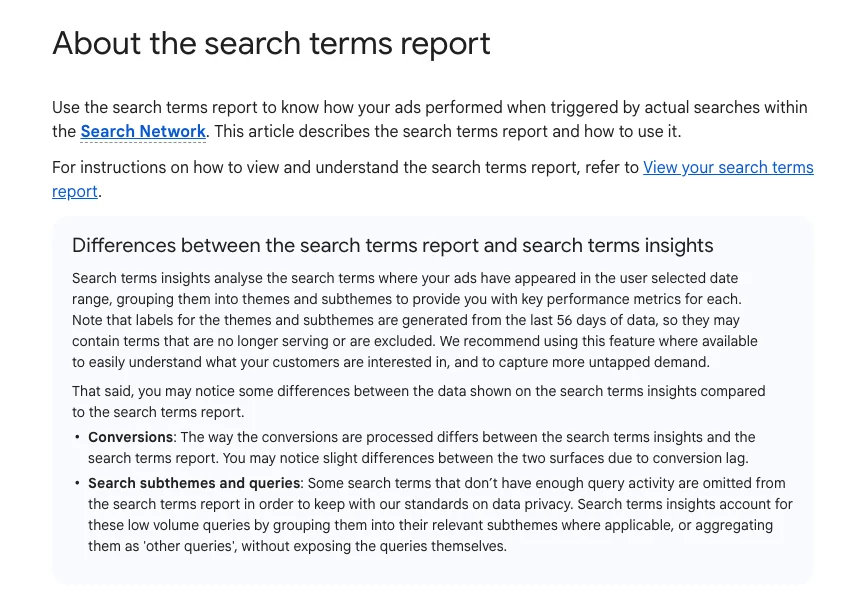
| Google Ads | Search terms with cost and conversions | Low-volume terms are hidden |
| Search Console | Queries and pages, same dates | Tables stop at 1,000 rows |
| GA4 | Landing pages with key events | Different attribution from Ads |
| CRM | Leads and sales by source | Often the truest number |
| Your brief | Targets, bid strategy, offer | The model cannot guess it |
Each source hides something, and the model will not know unless you tell it. Google Ads Help says the search terms report lists terms used by a significant number of people, and that searches without enough activity are omitted for privacy.
Search Console has a similar limit. Its help page says tables can show a maximum of 1,000 rows and that performance tables omit rare queries to protect privacy. The Search Console API returns up to 25,000 rows per request and 50,000 rows per day per search type. GA4's Data API returns 10,000 rows by default and up to 250,000 per request.

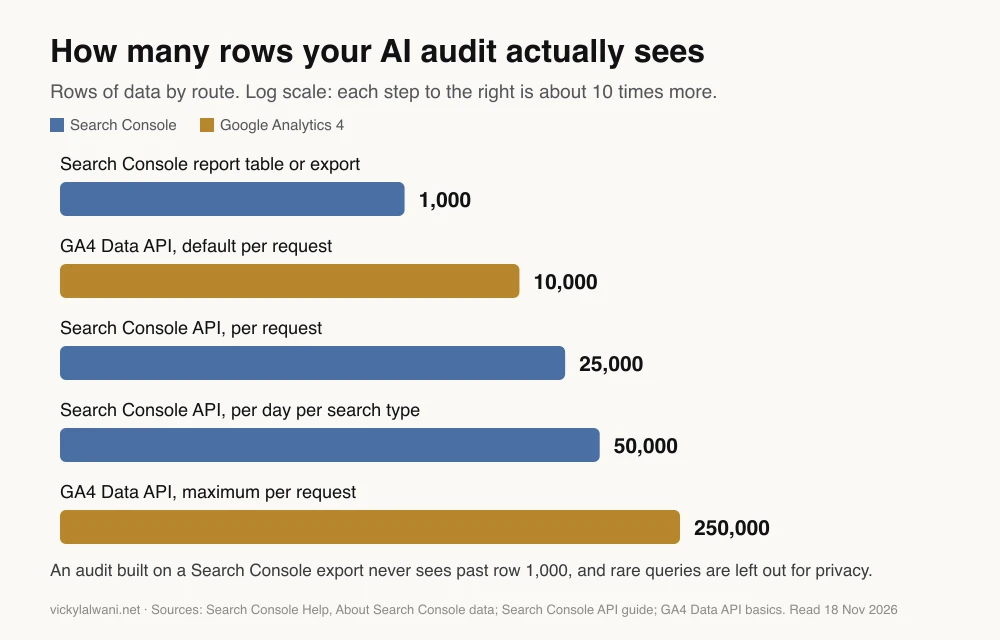
For a small site, the exports are enough. For a large one, the long tail of queries lives past row 1,000, so the audit should pull through the API or say plainly which slice of the data it saw. Strip anything private, such as names and email addresses in CRM exports, before uploading.
How does an AI marketing audit work in three steps?
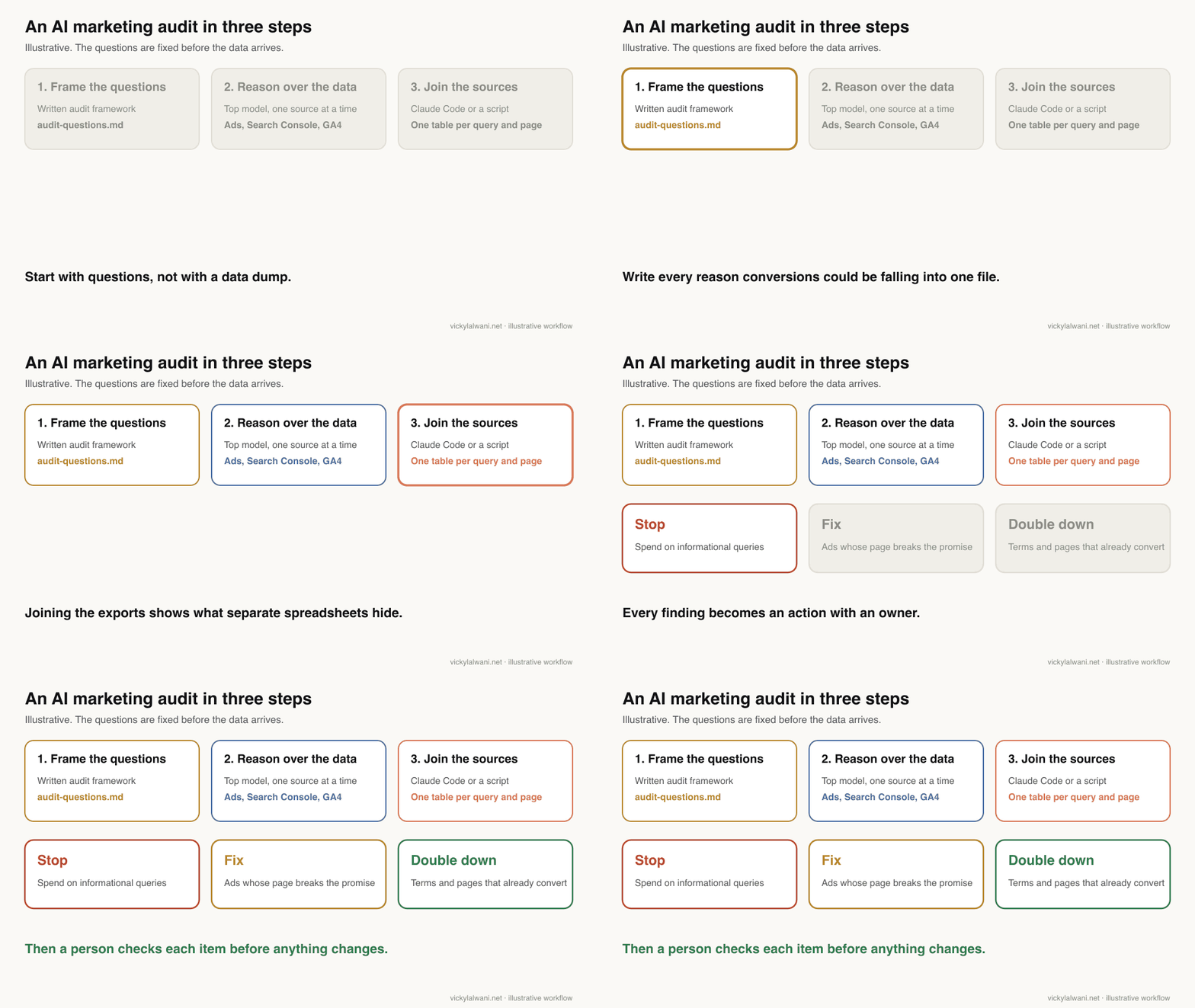
Short answer: first, write every possible reason conversions could be weak into an audit framework file. Second, give a strong reasoning model the framework and the exports, one source at a time. Third, join the sources with Claude Code or a script so cross-channel gaps show up. No single tool does all three well.
Step 1: organise the thinking
I start in a general chat assistant and brainstorm every reason conversions might be falling, then turn the list into a written audit framework in a plain markdown file. This keeps the later analysis honest, because the questions are fixed before the data arrives and the model cannot quietly change the question to fit what it finds.
Help me build an audit framework for a marketing account. Do not analyse any data yet.

Business: [what we sell, average order or job value, where we sell]
Goal: [leads / sales], judged by [CRM-qualified leads / revenue]
Channels: Google Ads search, organic search, [others]
Known facts: bid strategy [tCPA / tROAS / manual] with target [x], conversion actions [list],
attribution model [x], conversion lag about [x days], date range [x to y]

List every reason paid and organic search could bring traffic that does not convert.
Group them under: search intent, ad to page match, landing page, tracking, overlap between
paid and organic, budget allocation. For each, write the question to ask and the export
that would answer it. Output as markdown I can save as audit-questions.md.
Step 2: reason over the data
I give a top reasoning model the framework plus the exports from Google Ads, Search Console and analytics. Current Claude models think adaptively, deciding how much to reason based on an effort setting; the manual "extended thinking" switch of older models is no longer accepted on the latest ones. The point is not a summary. It is a model that works through the evidence and shows how it reached each conclusion.
This is the step that deserves a top-tier model, because a confident wrong answer costs real budget. My guide to which AI model to use for each marketing job explains why audits stay on the expensive tier while bulk tasks move down.
Attached: audit-questions.md and [search-terms.csv / gsc-queries.csv / ga4-landing-pages.csv].
Work through audit-questions.md one question at a time, using only the attached data.

For each question:
- Answer with the exact campaign, ad group, query or page involved
- Quote the rows that support the answer
- Say "not answerable from this data" when the data does not cover it
- Flag any number you had to estimate

Do not give general best-practice advice. Do not recommend changes yet.
Step 3: connect the sources
I use Claude Code inside an editor to join the exports into one picture, matched on query and landing page. This is where it finds what separate spreadsheets hide: the same query bought in ads and ranking first organically, or a high-spend ad group whose landing page gets almost no key events in GA4.
| How the data gets in | Best for | Limit |
|---|---|---|
| CSV exports | Small accounts, one-off audits | Row caps, manual refresh |
| Google Ads MCP server | Live Google Ads data | Exposes the account to the AI client |
| Google Analytics MCP server | Live GA4 data | Writes need extra permission |
| Search Console API | Large sites, long tail | 50,000 rows per day per type |
Google publishes an open-source Google Ads MCP server (MCP is the standard way to connect an AI app to another tool). Its README says it supports reporting queries and a small set of account changes that go through a two-step "Propose and Confirm" check, and warns that connecting it exposes your account data to the AI client. The Google Analytics MCP server does the same for GA4, where key events are what GA4 used to call conversions. For more on wiring these up, see MCP servers for SEO.
What does an AI marketing audit usually find?
Short answer: an intent gap. Paid campaigns buying informational searches, top organic pages ranking for the wrong intent, ads that send clicks to a page that breaks the ad's promise, the highest-spend ad group with the weakest return, and paid and organic competing for the same queries without anyone deciding who owns them.
Intent alignment is the match between what the searcher wants, what the ad or page promises, and what the business actually sells. Google uses the same idea: its Quality Score help defines ad relevance as how closely your ad matches the intent behind a user's search, alongside expected click-through rate and landing page experience.
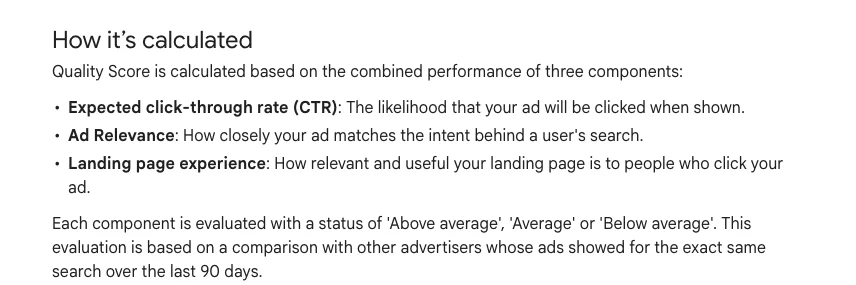
The same page says Quality Score is a diagnostic tool, not a performance indicator and not an input in the ad auction. Use it as a pointer to which ads and pages to look at, not as a number to chase.
| Pattern | Where it shows | Usual fix |
|---|---|---|
| Ads buying "how to" searches | Search terms with cost, no conversions | Negatives, tighter match |
| Top pages rank for the wrong intent | GSC queries vs page purpose | Retarget or split the page |
| Ad promise not on the page | Ad copy vs landing page | Better page or new final URL |
| Biggest spend, weakest return | Cost vs key events by ad group | Cut, restructure or rebid |
| Paid and organic overlap | Paid and organic report | Decide who owns the query |
| Internal words, not searcher words | Keywords vs real search terms | Use the customer's terms |
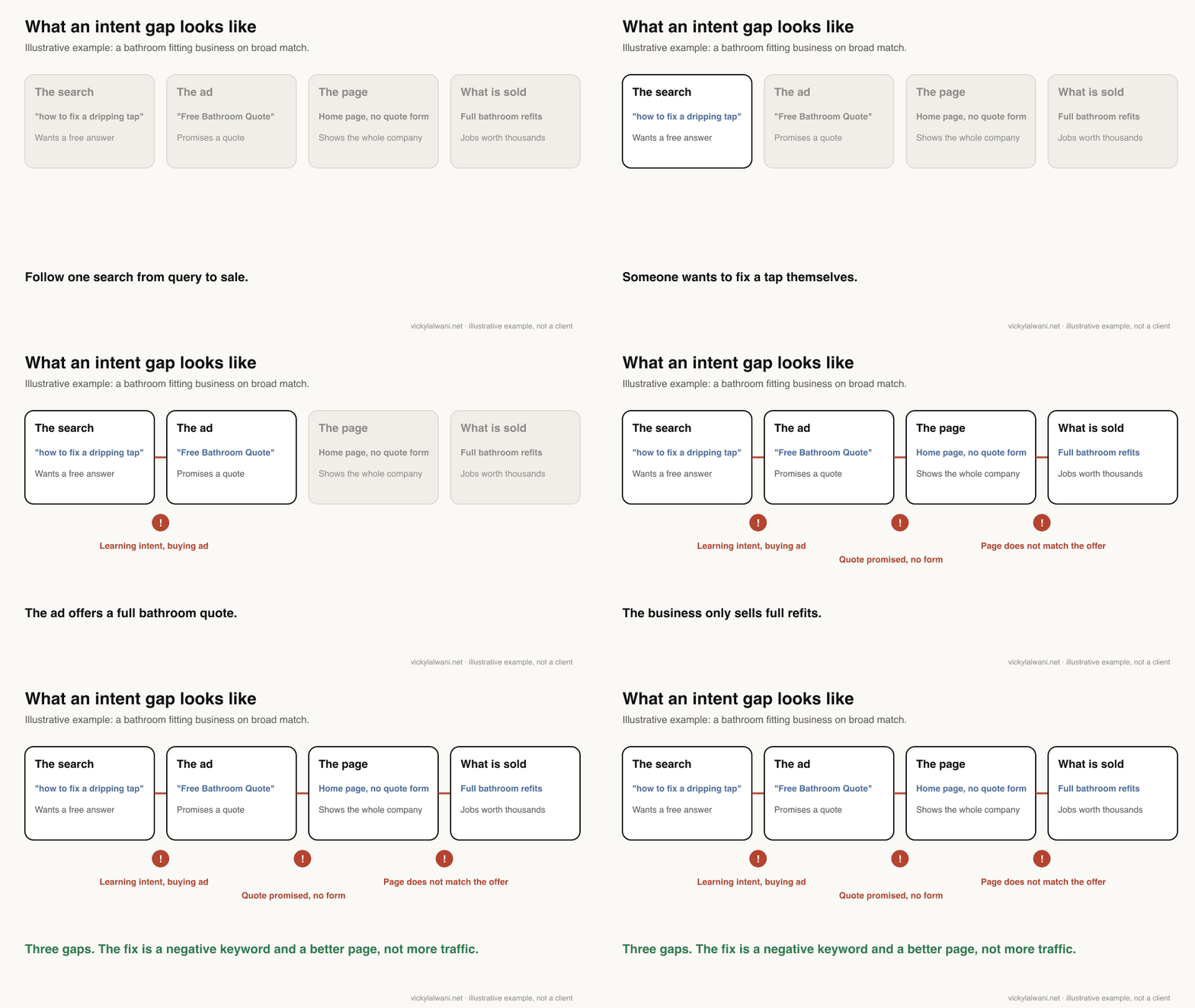
Notice that none of these are traffic problems. Traffic was there. What was missing was alignment. One version I check on every account is the plainest one: the business describes its service in its own internal terms while customers search in different words, so the ads and pages are written for the wrong vocabulary.
How do you find overlap between paid and organic search?
Short answer: link Search Console to Google Ads and open the paid and organic report, which shows your organic results next to your search ads for the same queries. Then decide who owns each query group: if a page already ranks well and converts, test lower paid bids there; if paid wins and organic is weak, that tells you which page to rebuild.
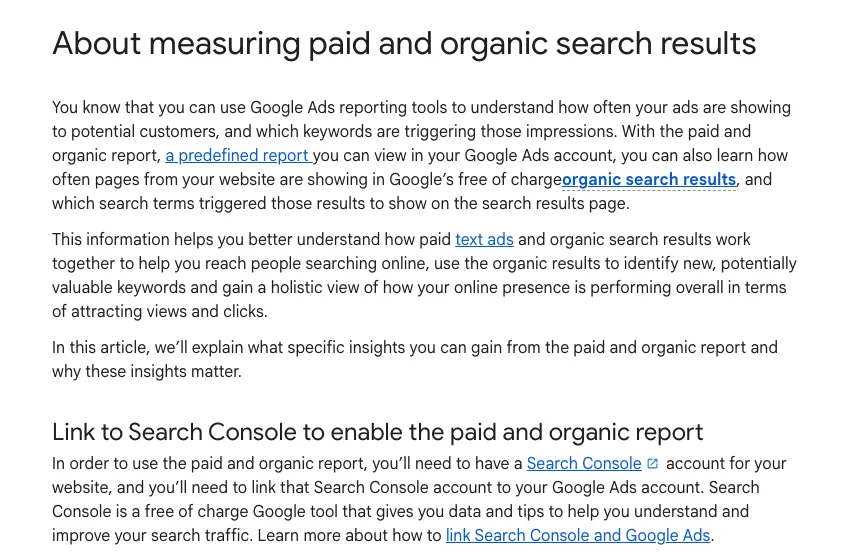
Google Ads Help says the report needs a Search Console account linked to Google Ads, and that it counts text ads only, not Shopping ads. If you cannot link the accounts, the AI can approximate the same view by joining the search terms export with the Search Console query export on the query text.
| What the join shows | What to test | Watch |
|---|---|---|
| Strong organic, strong paid | Lower paid bids on the query | Total clicks and leads |
| Weak organic, strong paid | Rebuild the organic page | Rankings over months |
| Strong organic, no paid | Leave it, or test brand defence | Competitor ads |
| Neither converts | Question the query entirely | Is it the right offer? |
Treat "lower paid bids" as a test with a date and a measure, not a conclusion. Paid ads can take clicks that organic results would never get, especially where ads and AI answers push organic listings down the page. If you are weighing the two channels for the first time, my comparison of SEO and Google Ads walks through the trade-off.
How do you turn audit findings into a fix list?
Short answer: ask the model to rank every issue by likely revenue impact and effort, naming the exact campaign, page or query, then sort the list into three buckets: Stop (spend or content attracting the wrong intent), Fix (ads and pages where the promise and destination do not match) and Double down (terms and pages that already convert).
| Bucket | Typical items | Who acts |
|---|---|---|
| Stop | Informational search terms, dead pages in ads | PPC manager |
| Fix | Final URLs, page headlines, forms | PPC plus web team |
| Double down | Converting terms, pages that rank and convert | PPC and SEO |
| Check first | Anything resting on doubtful tracking | Analytics owner |
Using your answers to audit-questions.md, build a fix list.

For each finding give: bucket (Stop, Fix, Double down, Check first), the exact campaign,
ad group, query or page, the evidence rows, likely impact (high, medium, low) with one line
of reasoning, effort (high, medium, low), and who would do it.

Put anything that depends on conversion tracking you have not verified under "Check first".
Mark severity honestly: "urgent" only for things that waste spend or block crawling or
conversions today. Sort by impact, then effort. Output as a table I can paste into a sheet.
The "mark severity honestly" line is there for a reason. On r/SEO, a practitioner who marked content problems as urgent in a free audit got the advice to reserve "urgent" for things that block crawling or indexing, and to give impact, effort and whether a developer is needed instead. Models tend to over-label urgency unless told not to.
Why must conversion tracking come before the audit?
Short answer: because every audit conclusion rests on which clicks became leads or sales. If conversion tracking double counts, misses forms or calls, or uses a different attribution model from the report next to it, the model will find patterns in measurement errors and you will cut the wrong things.
The classic trap is two systems that disagree. A Google Ads practitioner on X showed one account where Google Ads and GA4 reported different revenue for the same period, and explained that both were right because they use different attribution models. A model given both numbers without that context will call it a tracking fault.
| Check | How | If it fails |
|---|---|---|
| Every form and call counted once | Submit a test lead, watch it arrive | Fix before auditing |
| Primary conversions are real leads | Compare with CRM for a week | Demote soft actions |
| Ads and GA4 differences explained | Note the attribution of each | Tell the model |
| AI referrals labelled correctly | Check source and medium | Fix channel grouping |
My rule on any account is tracking before spend: campaigns stay in draft until every form and call button is measured, and an audit waits until the conversion numbers can be trusted. The detailed checks are in my conversion tracking audit checklist, and fixing the setup itself is part of my analytics and tracking work.
How do you keep a human in the loop?
Short answer: treat every AI finding as a claim to verify, not an instruction. Check it against the source data and the business context, change nothing in a live account without approval, and give the model the account's history and targets so it stops grading you against generic advice.
Models can be confidently wrong, especially when exports are incomplete or the account context is missing. In an r/PPC thread about using Claude for account management, one specialist described a client bringing in an AI-written audit that claimed the account was badly run, and spending an hour and a half feeding it the full data and change history, after which the model reversed its conclusions. Another reply in the same thread called it plainly a garbage-in, garbage-out situation.
My own working rule on client ad accounts is fixed: audit first, put the findings in a sheet, check each one by hand, and make no changes before the client approves. The Google Ads MCP server builds a similar brake into its design, with a propose step and a confirm step for every change it can make.
| Before you act on a finding | Why |
|---|---|
| Open the row in the platform itself | Exports can be stale or filtered |
| Check the date range matches | Mixed ranges create fake gaps |
| Ask what changed in the account | Recent edits explain odd numbers |
| Check the advice is current | Models repeat old platform rules |
| Get approval, then change | Someone owns the result |
Should you tell clients AI was used? On r/SEO, most replies to a consultant who used ChatGPT as a second layer of analysis said it was fine, and the more careful ones added a condition: validate every point and stay responsible for the recommendations. That is the standard to hold.
How often should you rerun an AI marketing audit?
Short answer: rerun the same framework every quarter, so the questions stay constant and only the data changes. Run it again sooner after a big change such as a new bid strategy, a site migration, a Google core update or a switch to AI Max for Search, which widens the searches your ads can match.
Keeping the framework fixed is what makes the audit useful over time: you can see whether the last round of fixes actually moved intent alignment, rather than reading a fresh opinion each quarter. Google Ads changes fast enough to justify the cadence. Google's Ads Liaison account announced in April 2026 that AI Max for Search was leaving beta and Dynamic Search Ads would move to it, which changes which search terms an account buys.
For the paid search side on its own, a weekly lighter check sits well alongside the quarterly audit: my PPC audit with Claude covers seven checks for live accounts. If organic traffic falls suddenly between audits, start with what to check first when website traffic drops.
What people say on X and Reddit
Short answer: practitioners find AI useful for analysis and a second opinion but weak at recommendations without context. They warn that platform numbers disagree for good reasons, that AI audits handed over by clients can alarm without evidence, and that the person signing off must validate every point.
| Who | What they said | Take it as | Link |
|---|---|---|---|
| A Google Ads freelancer | Ads and GA4 revenue differed; both right, different attribution (4 Jun 2026) | First-hand | X post |
| Google Ads Liaison | AI Max for Search out of beta; Dynamic Search Ads to transition (15 Apr 2026) | Official | X post |
| Google Ads Liaison | Performance Max reporting updates: channels, search terms, assets (30 Apr 2025) | Official | X post |
| Google Analytics (official) | Open-source MCP server connects GA data to AI models (8 Jan 2026) | Vendor | X post |
| Search Engine Roundtable's editor | New Google Ads help page on multi-source conversions, beta (16 Sep 2026) | Reporting | X post |
| r/PPC | Claude vs Gemini on campaign data; good at analysis, weaker at recommendations (30 Sep 2026) | First-hand | Thread |
| r/PPC | A client's AI audit reversed once it was fed the full data and change history (19 Sep 2026) | First-hand | Thread |
| r/PPC | Centralising ad data: normalise columns and conversion definitions first (28 Oct 2026) | Mixed, some vendors | Thread |
| r/SEO | AI as a second layer in an audit is fine if you validate it (6 Oct 2026) | Opinion | Thread |
| r/SEO | Save "urgent" for crawl or index blockers; show impact and effort (20 Oct 2026) | Opinion | Thread |
The most upvoted reply in the r/PPC Claude and Gemini thread made the sharpest point: the model's analysis was good, but its optimisation advice leaned on outdated articles. That is why the prompts above forbid general best-practice advice and ask for evidence rows instead.
Videos worth watching
Short answer: Google's own channels cover the three data sources this audit depends on: Search Console performance data, the Google Analytics MCP server and AI Max in Google Ads. None of them sells a third-party tool, though each promotes Google's products.
Made by Google Search Central, 4 December 2025. It does not sell anything. A walk through reading Search Console performance data, the organic half of the audit.
Made by the Google Analytics channel, 22 July 2025. It promotes Google's free open-source server. Shows how an AI app asks GA4 questions directly instead of working from exports.
Made by the Google Ads channel, 21 April 2026. It promotes AI Max. Worth watching to understand why search terms widen and why the search terms check matters more each quarter.
| Video | Channel | Date | What it covers |
|---|---|---|---|
| Analyzing performance on Google Search | Google Search Central | 4 Dec 2025 | Reading Search Console data |
| Introducing the Google Analytics MCP Server | Google Analytics | 22 Jul 2025 | GA4 data inside AI apps |
| How to Use AI Max for Search Campaigns | Google Ads | 21 Apr 2026 | How AI Max widens matching |
| Google Analytics MCP Setup Tutorial | Google Analytics | 3 Sep 2025 | Setting the server up |
| Performance reports in Search Console | Google Search Central | 8 Jan 2020 | The basics, still accurate |
| Link Search Console to Google Ads for the Paid and Organic Report | Paid Media Pros (agency) | 14 Dec 2020 | Linking for overlap data |
Where this advice is weak
- Small accounts have thin data. With a few hundred clicks a month, many search terms are hidden for privacy and patterns are noise. The audit then leans more on judgement than on data.
- Exports are snapshots. A model reading a CSV does not see what changed in the account last week, so recent edits can look like problems.
- Overlap tests can mislead. Lowering paid bids where organic ranks well can lose clicks that organic never captures, so measure total leads, not channel by channel.
- CRM data is often missing. Without it, the audit judges traffic by platform conversions, which may count soft actions rather than real enquiries.
- The workflow is the owner's, not a standard. Other good audit methods exist; this one suits search-led businesses where intent drives value.
Sources
| Source | What it supports | Date | Link |
|---|---|---|---|
| Google Ads Help, search terms report | Significant volume only; privacy omissions | Read 18 Nov 2026 | Help |
| Google Ads Help, Quality Score | Ad relevance and intent; diagnostic only | Read 18 Nov 2026 | Help |
| Google Ads Help, paid and organic | Search Console link; text ads only | Read 18 Nov 2026 | Help |
| Search Console Help, About the data | 1,000-row tables; rare queries omitted | Read 18 Nov 2026 | Help |
| Search Console API guide | 25,000 per request; 50,000 per day | Read 18 Nov 2026 | Docs |
| GA4 Data API basics | 10,000 default; 250,000 per request | Read 18 Nov 2026 | Docs |
| Google Ads MCP server | Reporting, Propose and Confirm, data exposure | v0.0.6, 2 Nov 2026 | GitHub |
| Google Analytics MCP server | GA4 tools; key events formerly conversions | Read 18 Nov 2026 | GitHub |
| Anthropic, Models overview | Adaptive thinking; extended thinking retired on new models | Read 18 Nov 2026 | Docs |
| X posts and Reddit threads | Practitioner views and official updates | Apr 2025 to Oct 2026 | Listed in the table above |
Want a second pair of eyes on your account?
An AI marketing audit is most useful when the questions are fixed, the data is complete, the tracking is trusted and a person who knows paid and organic search signs off each finding. I can run the audit across your Google Ads, Search Console and GA4 data, or build the framework and connected workflow so your team can rerun it every quarter. See Google Ads management, SEO consulting, AI automation and the rates on the pricing page. If you want agents that run checks like these on a schedule, that sits with my AI marketing agents service.
Keep reading: PPC audit with Claude, conversion tracking audit checklist, website traffic dropped suddenly and the best AI model for each marketing job.
This article expands on my post on LinkedIn ↗.
FAQ
What is an AI marketing audit?
An AI marketing audit is a structured review where an AI model analyses your Google Ads, Search Console and analytics data together against a fixed list of questions. It looks for mismatches between what you pay for or rank for and what buyers actually want, and ends in a ranked list of actions.
Which data should I give the AI for a marketing audit?
Start with the Google Ads search terms report, Search Console queries and pages, GA4 landing pages with key events and, if you can, leads or sales from your CRM, all for the same dates. Add a short brief on targets, bid strategy and what you sell, and remove personal data first.
Can AI replace a human marketing audit?
No. AI is fast at joining data and spotting patterns, but it can be confidently wrong when exports are incomplete or the account history is missing. A person should check every finding against the source data and the business before anything is changed.
Why are my Google Ads not converting even with good traffic?
Usually because of an intent gap: the ads buy searches from people who want information rather than to buy, or the landing page does not deliver what the ad promised. Check the search terms report for costly terms with no conversions, and open each landing page next to its ad.
How many rows of Search Console data can an AI audit see?
A Search Console report table or export shows at most 1,000 rows, and rare queries are left out for privacy. The Search Console API returns up to 25,000 rows per request and 50,000 rows per day per search type, so large sites should pull data through the API.
Can I connect Claude directly to Google Ads and GA4 for an audit?
Yes. Google publishes open-source MCP servers for Google Ads and Google Analytics that let an AI app query the data directly. The Google Ads server asks you to propose and then confirm any change, and connecting it exposes your account data to the AI client, so use an account you control.
How do I find overlap between paid and organic search?
Link Search Console to Google Ads and use the paid and organic report, which shows organic results next to your text ads for the same queries. Where a page already ranks and converts, test lower paid bids on that query and measure total leads, not each channel alone.
How often should I run an AI marketing audit?
Rerun the same audit framework every quarter so the questions stay constant and only the data changes. Run it sooner after a big change such as a new bid strategy, a site migration, a Google core update or switching campaigns to AI Max for Search.