The best AI voice agent platform depends on who will build it. Ready-made receptionists such as Reception and Goodcall cost $29 to $299 a month; build platforms such as Vapi, Retell, Bland and ElevenLabs Agents cost about $0.07 to $0.31 a minute plus extras; OpenAI, Deepgram and Twilio sell building blocks for developers. For calls from ads, pilot on your own scenarios and judge on booked appointments sent back to the ad account.
TL;DR
There is no single best AI voice agent platform; there are three kinds, and the right one depends on who will build and run it. Ready-made receptionists such as Reception, Goodcall and My AI Front Desk start at $29 to $99 a month. Build platforms such as Vapi, Retell, Bland and ElevenLabs Agents cost roughly $0.07 to $0.31 a minute. Building blocks from OpenAI, Deepgram and Twilio are cheaper per minute but need a developer.
The headline price per minute is rarely the bill. Language model, voice, phone line, concurrency, compliance add-ons and billing rules (minimum seconds, long prompts, hold time) all sit on top. Prices below were read on each vendor's own page on 18 November 2026.
If the calls come from your ads, judge the platform by booked appointments, not by how human it sounds. Feed bookings back to your ad account, because a chatty bot can pass a "call lasted over a minute" conversion rule without ever booking anyone.
Jump to: Three kinds · Comparison · Real cost · Calls from ads · Speed · Pilot · Vendor questions · Which fits
You are paying for clicks. Some of them turn into phone calls, and some of those calls arrive at 8:40 on a Tuesday evening when nobody is at the desk. An AI voice agent can answer them, book the job and leave a summary. The obvious question is which platform to use, and the honest answer is that the platforms have split into very different products since this article was first written.
This refresh compares the current options on price, speed, booking and control, with every price taken from the vendor's own page and dated. It also covers the part most comparisons skip: what happens to your ad account when a robot answers the calls your ads paid for. If you would rather have one built and wired into your calendar and CRM, that is what my AI chatbot and voice agent service does, and published rates are on my pricing page.
What kinds of AI voice agent platforms are there?
Short answer: three. Ready-made AI receptionists you switch on in an afternoon, build platforms where you or an agency design the agent, and building blocks (a voice model or voice layer) that a developer assembles into a phone system. They are priced and supported in completely different ways.
A voice agent is software that answers or makes phone calls in natural speech. Under the hood it chains speech-to-text (turning the caller's words into text), a language model (deciding what to say and do) and text-to-speech (speaking the reply), plus a phone line. Who owns each piece is what separates the three kinds.
| Kind | Examples | Who sets it up | Priced by |
|---|---|---|---|
| Ready-made receptionist | Reception, Goodcall, My AI Front Desk | The owner, from the website | Monthly plan |
| Build platform | Vapi, Retell, Bland, ElevenLabs Agents, Synthflow | An agency or in-house builder | Per minute or contract |
| Building blocks | OpenAI GPT-Live-1, Deepgram Voice Agent API, Twilio ConversationRelay | A developer | Per minute, parts billed apart |
A common mistake is comparing across kinds as if they were the same product. A $0.05 a minute voice model is not cheaper than a $29 receptionist if you then need weeks of developer time to connect it to a phone number, a calendar and a CRM.
How do the main platforms compare in November 2026?
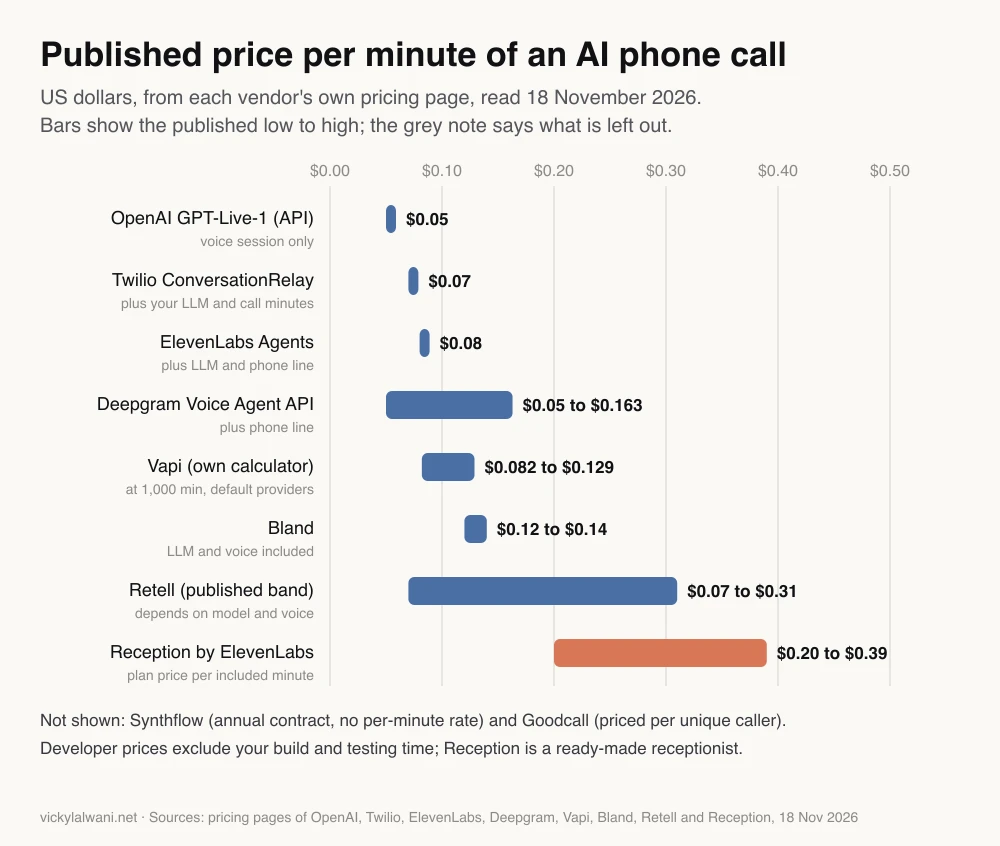
Short answer: Retell and Vapi are the most flexible per-minute build platforms, Bland bundles the model and voice into one rate, ElevenLabs Agents sells minutes inside monthly plans, Synthflow sells only annual enterprise contracts, and the ready-made receptionists trade control for a fixed monthly price.
All figures are US dollars from each vendor's pricing page, read on 18 November 2026. Vendors change these often, so treat the table as a snapshot and check the page before you sign.
| Platform | Published price | Billed on top | Best fit |
|---|---|---|---|
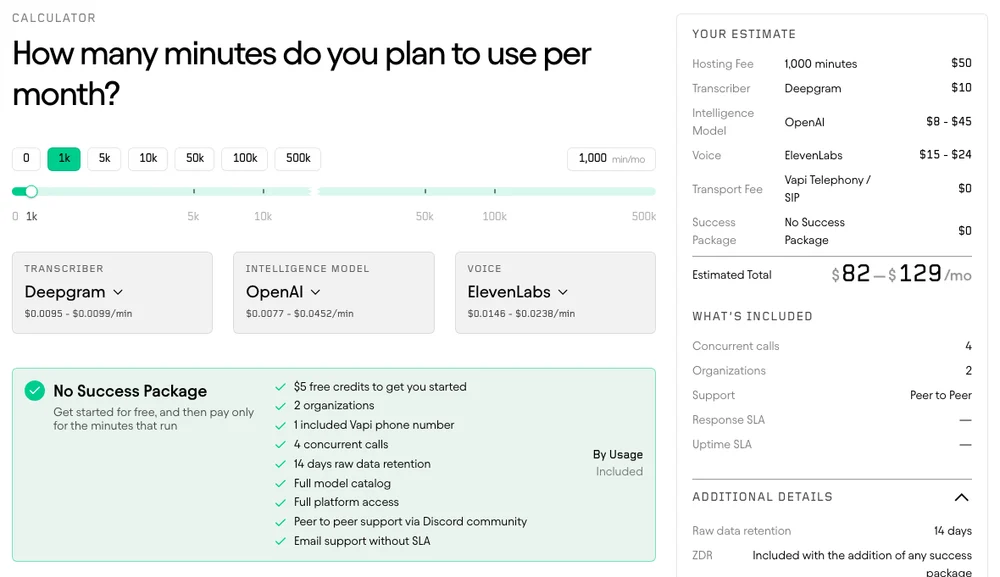
| Vapi | $0.05/min hosting, models at cost | Speech, model, voice, carrier | Builders who want every setting |
| Retell | $0.07 to $0.31/min | Add-ons, numbers, extra concurrency | Agencies wanting fast set-up |
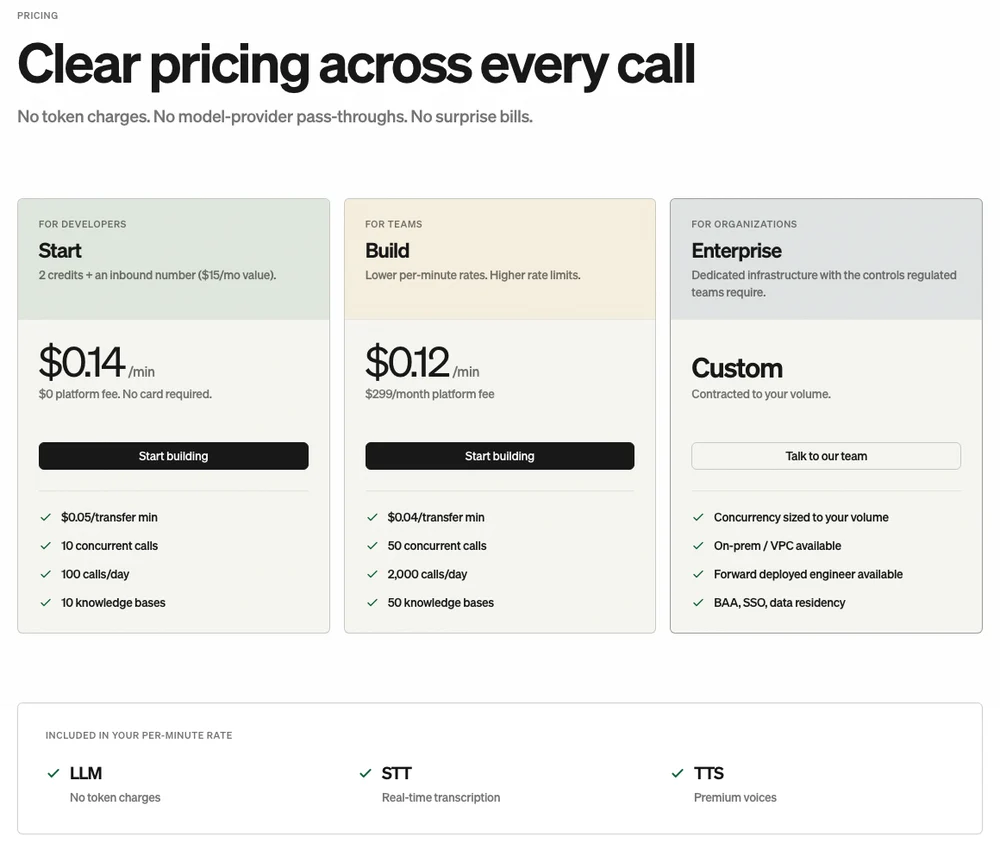
| Bland | $0.14/min, or $0.12 plus $299/month | Phone line, transfer minutes | Teams wanting one rate |
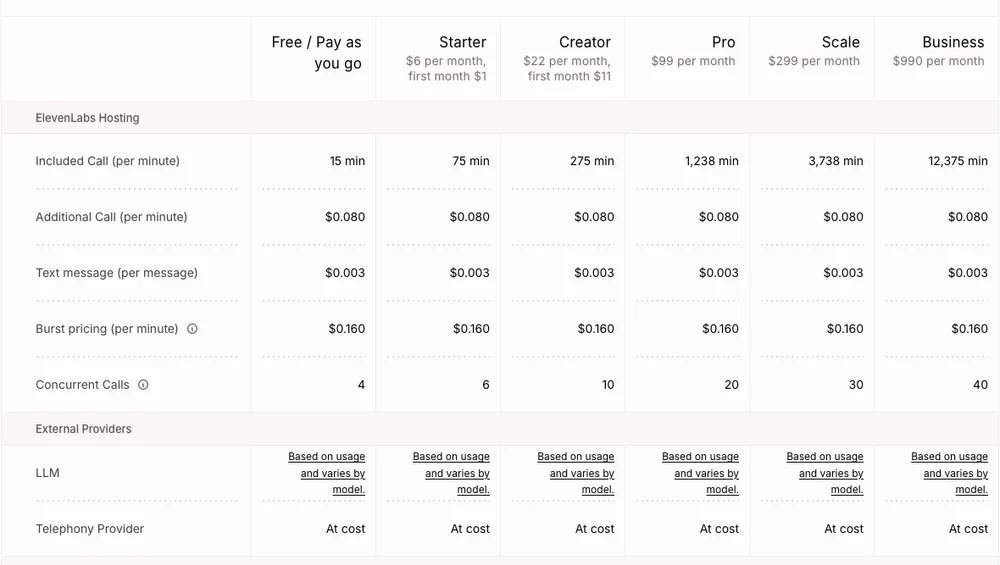
| ElevenLabs Agents | Plans $0 to $990/month, then $0.08/min | Language model, phone line | Voice quality, many languages |
| Synthflow | Annual contract only | Scoped in the contract | Mid-market and enterprise |
| Deepgram Voice Agent API | $0.05 to $0.163/min | Phone line, your build | Developers |
| Twilio ConversationRelay | $0.07/min | Your model, call minutes | Teams already on Twilio |
| OpenAI GPT-Live-1 | $0.05/min voice session | Backend model, tools, phone line | Developers |
| Reception (ElevenLabs) | $29 to $199/month | Overage $0.22 to $0.40/min | Small businesses |
| Goodcall | $79 to $299/month | Extra unique callers | Trades and local shops |
| My AI Front Desk | $99/month, 200 minutes | Overage credits | Owners wanting chat and SMS too |
A few details matter more than the headline. Vapi's usage-only plan allows 4 concurrent calls (calls happening at the same time) and keeps raw call data for 14 days; its paid support packages start at $29 a month, and HIPAA-eligible handling is a $2,000 a month add-on. Retell includes 20 concurrent calls and charges $8 a month for each extra one. Bland's Start plan caps you at 100 calls a day. Goodcall charges per unique customer rather than per minute, which suits businesses whose callers ring more than once.
Two newer entrants change the picture for small businesses. In September 2026 ElevenLabs launched Reception, an AI receptionist built on its ElevenAgents platform, set up by pasting in your website. Its pricing page says it does not yet support HIPAA, so it is not a fit for every clinic. OpenAI's GPT-Live-1 arrived in the API the same month: a full-duplex voice model, meaning it can listen and speak at the same time, which is what makes interruptions feel natural.
What does an AI voice agent really cost per minute?
Short answer: for a build platform, plan on roughly $0.08 to $0.15 a minute for a sensible set-up before the phone line, and up to $0.31 with premium models and voices. Ready-made receptionists work out at about $0.20 to $0.40 per included minute, but bundle the number, set-up and support.
The language model is the biggest swing. On Retell's page the model alone ranges from $0.0032 a minute for the smallest models to $0.384 a minute for the fastest premium option, while its voice infrastructure is a flat $0.055. A practitioner who tracks these prices put it plainly in r/AI_Agents in November 2026: switching models moved a typical stack from about $0.086 to $0.150 a minute.
Here is a worked example for 1,000 minutes a month (an example volume, roughly 400 calls of two and a half minutes). Every figure comes from the linked pricing pages; your own model and voice choices will move them.
| Platform | 1,000 minutes (example) | Still to add |
|---|---|---|
| Vapi, default providers | $82 to $129 | Support plan if wanted |
| Retell, published band | $70 to $310 | Phone number $2/month |
| Bland Start | $140 | Carrier minutes |
| ElevenLabs Agents Pro | $99 (1,238 min included) | Language model, carrier |
| Deepgram Voice Agent, Standard | $75 | Carrier, developer time |
| Reception Premium | $199 (1,000 min included) | Overage at $0.22/min |
Then come the billing rules that rarely make the comparison sites. These are all from the vendors' own pages:
| Rule | Where | Effect |
|---|---|---|
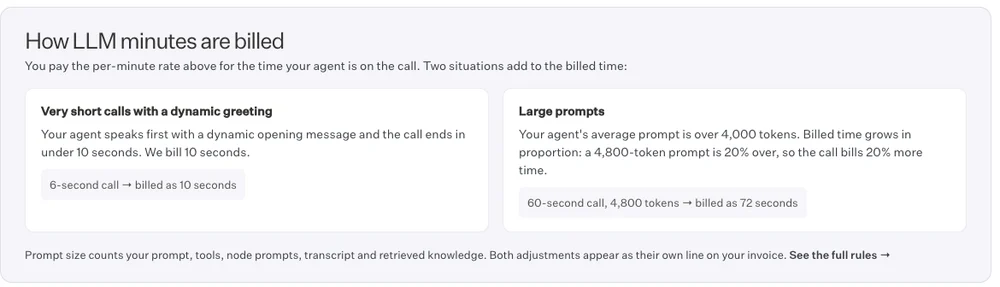
| Calls under 10 seconds billed as 10 | Retell | Hang-ups cost more |
| Prompts over 4,000 tokens bill extra time | Retell | Long scripts raise the rate |
| Silence and hold time are billed | Retell | Hold music costs money |
| Burst minutes above your call limit | ElevenLabs $0.16, Retell +$0.10 | Busy hours cost more |
| Transfer minutes | Bland $0.04 to $0.05 | Handover to staff is billed |
| Compliance add-on | Vapi HIPAA $2,000/month | Health data costs more |
Two vendors take the opposite approach on purpose. Bland's page says its per-minute rate covers the language model, transcription and voice, with no token charges; the phone line is still separate. ElevenLabs puts minutes inside monthly plans, but its plans list the language model as billed on top, so included minutes are not free minutes.
Why do calls from ads need extra care?
Short answer: because your ad platform learns from what you call a conversion. If a call counts as a conversion just for lasting a minute, an AI agent that keeps people talking will look like a success to the bidding system even when nobody books. Import booked appointments instead.
Paid calls are not answered as often as owners think. Invoca's August 2026 benchmark reported that only 56% of business calls reached a live person across the industries it measured. And speed matters: a Harvard Business Review study found firms that contacted web leads within an hour were nearly seven times as likely to qualify them as those that waited longer. It is from 2011 and about web leads, but the direction has not changed.
That is the case for a voice agent. The catch is measurement. Google Ads can count a call as a conversion in two ways: by having Google's AI analyse call recordings, or by counting calls that last longer than a minimum duration you set. Recording analysis is only available in a few countries, so most accounts fall back to duration.
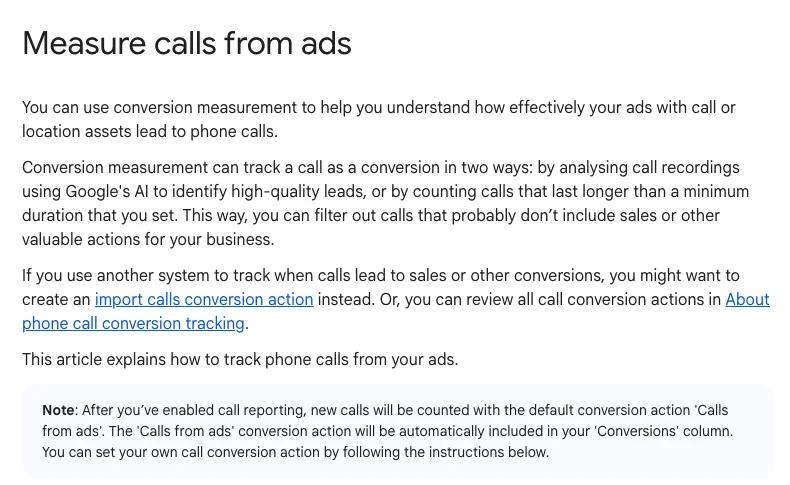
A human receptionist who chats for two minutes with a wrong number is rare. An AI agent that politely asks five qualifying questions to someone who will never buy is normal. Both pass a 60-second rule. The fix is to send the outcome back: Google's own page suggests an import calls conversion action when another system knows which calls became sales, and a voice agent that writes bookings into your CRM is exactly that system.
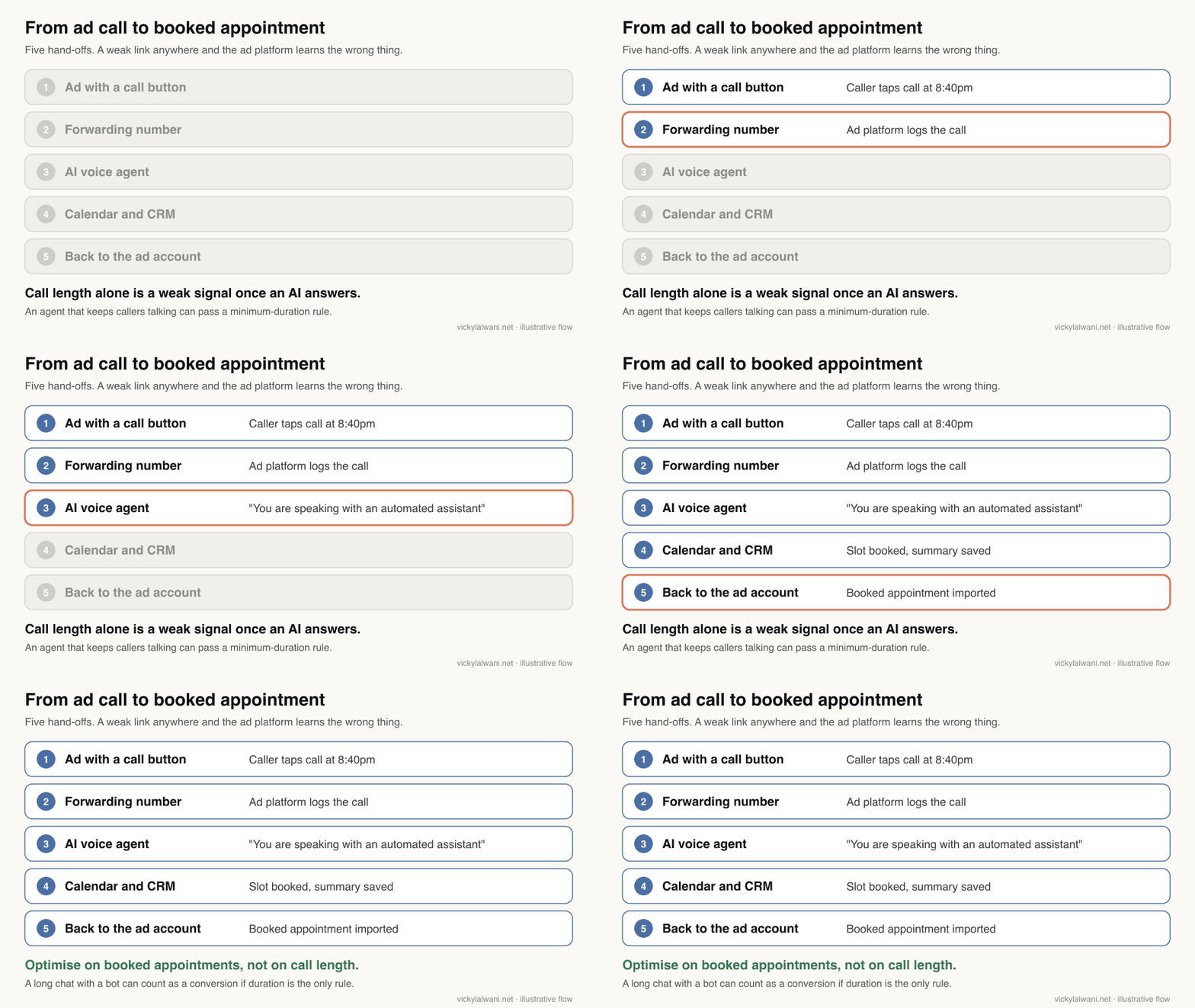
Before any campaign goes live I keep it in draft until every form and call button is measured, and an AI agent does not change that rule. Check four things on day one:
- The forwarding number in your ads still reaches the agent, and the agent's number is not a second untracked line.
- Every booking the agent makes lands in the calendar and the CRM with the call's source.
- Booked or qualified calls are sent back to the ad account as the conversion you optimise for.
- Spam and wrong-number calls are tagged, so they do not train bidding.
I have had a business owner ask whether call tracking was the AI receptionist. It is not: call tracking tells you which ad or listing made the phone ring, and the agent answers it. You usually need both. The same speed logic applies to form leads: if paid enquiries are emailed to someone who replies hours later, an outbound agent that calls each new form lead from the business's own number within minutes is one fix, and a fast person is another. Speed is the point, not the AI. My Google Ads management covers the tracking side, and two related guides go deeper: after-hours call answering for clinics and what to check before an AI receptionist answers dental patients.
How fast does a voice agent need to respond?
Short answer: fast enough that the caller never wonders whether the line dropped, which in practice means well under a second from the end of their sentence to the start of the reply, on your busiest hour, not in the demo.
People are remarkably consistent about this. A study of turn-taking across ten languages found every one minimises silence between speakers, with average gaps varying only within a narrow band of a fraction of a second. A two-second pause after every question breaks that rhythm, and callers start talking over the agent.
Vendor figures are marketing until you measure them. Twilio advertises under 0.5 seconds median latency for ConversationRelay; other vendors make similar claims. One practitioner in r/AI_Agents suggested the right test: time from the end of the caller's speech to the first meaningful audio, at the typical call and the slowest one in twenty, plus whether the agent can be interrupted.
| What slows a reply | What to try |
|---|---|
| A large, slow language model | A smaller model for the call itself |
| Long prompts and knowledge bases | Trim the script; fetch facts only when asked |
| Calendar or CRM lookups | A short spoken holding line while it checks |
| Premium voices | Test a faster voice model |
| Servers far from callers | Ask where calls are processed |
Speed is not only about tech. AI voices also need testing in every language and accent your callers use. When I had AI voiceover made for video ads in a non-English language, a native speaker found it unnatural on first playback, and in August 2026 a news outlet reported an AI receptionist used by family doctors struggling with regional accents. Put a native speaker on the pilot calls.
How do you run a fair pilot?
Short answer: write ten to twenty realistic call scenarios before you see any demo, run the same ones on two or three platforms, and score each on whether the right thing happened: booking in the diary, correct handover, honest disclosure. Then compare cost per booked appointment.
Demos are scripted, recorded on clean audio and rehearsed. Real callers interrupt, mumble, change their mind and call from a car. So never judge a platform by its demo; judge it by your own scenarios.
- Pick two or three platforms of the same kind (see the table above).
- Write the scenarios, including the awkward ones and at least two that start from your ads.
- Run each scenario on each platform, from a mobile phone, in a noisy room at least once.
- Score outcomes, then check every "booked" call against the real calendar.
- Price the winner at your expected monthly minutes, with every add-on.
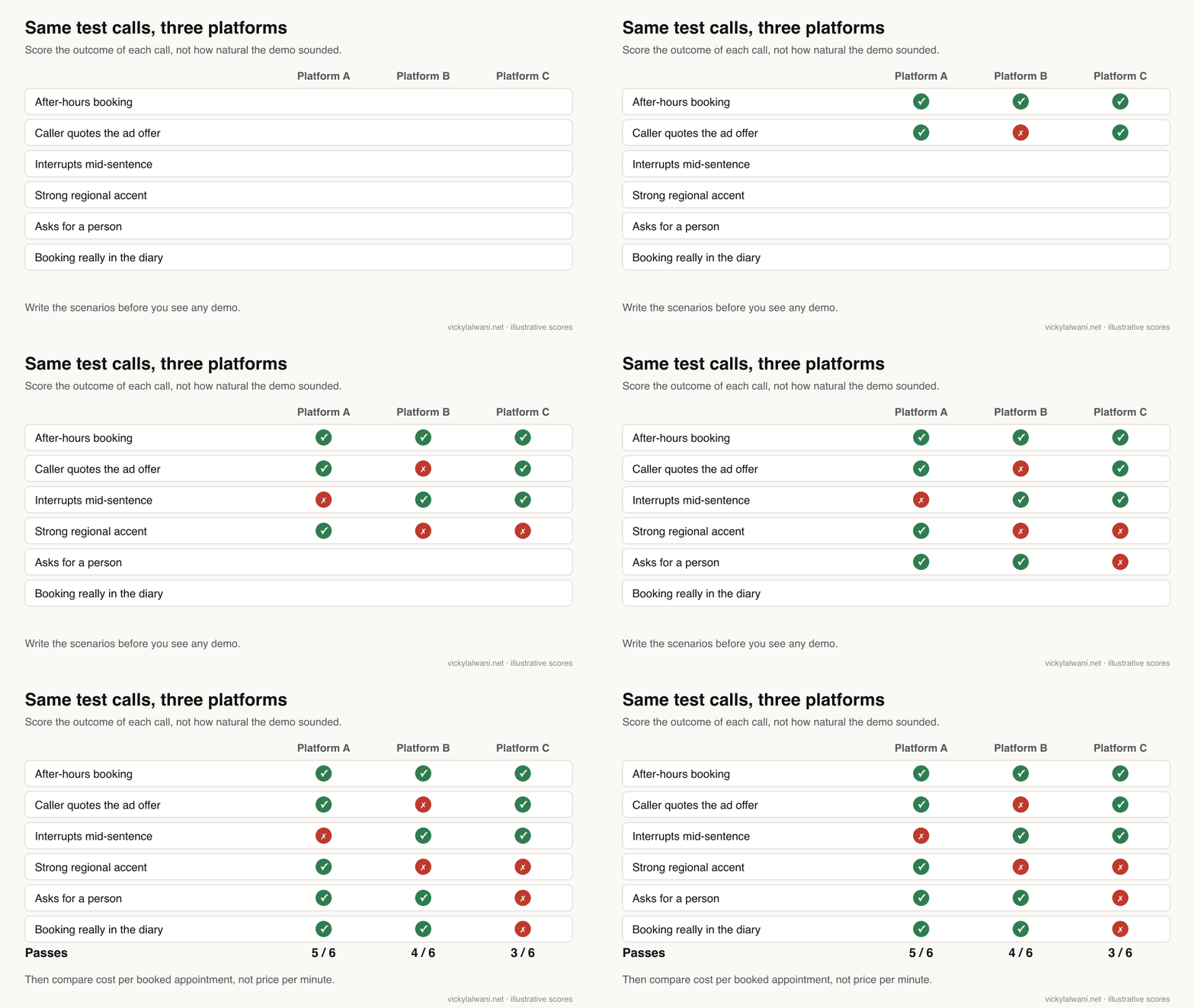
That last row is not paranoia. A tester in r/AI_Agents described call summaries reporting a booking that never happened, because the closing pleasantries sounded like a confirmation. Ask for the transcript line that proves it.
Use this prompt with Claude or ChatGPT to draft the scenarios. Paste in your services, hours and the offer in your ads:
You are helping me test AI voice agents for my business before I buy one.
Business: [what you do, where, opening hours]
Services and prices callers ask about: [list]
Current ad offer: [the exact offer in my ads]
What the agent may do: [book these appointment types / take messages / transfer to this number]
What it must never do: [quote prices not on this list, give advice, promise outcomes]

Write 15 test call scenarios as short scripts for a human tester. Include:
- 3 routine bookings, one of them after hours
- 2 callers who quote the ad offer, one getting it slightly wrong
- 2 callers who interrupt or change their mind mid-booking
- 2 callers who ask for a person straight away
- 1 caller with a strong accent and 1 calling from a noisy place
- 2 questions the agent must not answer
- 1 wrong number and 1 spam-style call
For each, give the opening line, what the tester says next, and the correct outcome I should check for.
On rollout, practitioners in r/AI_Agents gave sensible advice: pick one call type, send a small share of it to the agent, and compare with the same shifts the week before. After hours is the obvious first call type, because the alternative is voicemail.
Which questions should you ask every vendor?
Short answer: what exactly is in the quoted price, how calls are billed (increments, minimums, hold time), how many calls can run at once, how you export recordings if you leave, where data is stored and for how long, and how the agent tells callers it is automated.
| Question | Why it matters |
|---|---|
| What is billed on top of the per-minute rate? | Model, voice and carrier can double it |
| What is the billing increment and minimum? | Short calls can bill as more |
| How many calls at once, and what above that? | Busy hours trigger burst rates |
| Can I export recordings and transcripts? | Leaving should not lose history |
| How long are recordings kept, and where? | Privacy and your own reviews |
| How are model changes announced? | A silent update changes behaviour |
| What happens when the system is down? | Calls need a fallback number |
| How does the agent disclose it is AI? | Policies and trust both require it |
Disclosure is not optional for anyone building on Claude: Anthropic's usage policy says consumer-facing AI agents must tell people they are interacting with AI, at least at the start of each session. Local laws can add more, especially for outbound calls and recording, so take advice for your market. Callers mostly mind being misled, as several owners said in a 72-comment r/smallbusiness thread: say it in the first line, keep the call under a minute, and make clear a person still decides the price.
Vendors who answer plainly and in writing are usually easier to work with later. If answers stay vague during the sale, expect the same during support. And whatever you choose, nothing goes live until someone has approved the script and listened to the test calls.
Which AI voice agent platform fits which business?
Short answer: a solo owner or small team should start with a ready-made receptionist; a business with an agency or builder should use Retell, Vapi, Bland or ElevenLabs Agents; a company with developers and high volume can assemble its own on OpenAI, Deepgram or Twilio; a large contact centre should talk to enterprise vendors such as Synthflow.
| Your situation | Start with | Watch out for |
|---|---|---|
| Solo trade, missed calls on jobs | Goodcall or Reception | Limited booking integrations |
| Clinic or office, after hours | Reception or a build platform | Health data and HIPAA status |
| Agency building for clients | Retell or Vapi | Add-on and model costs |
| Wants one predictable rate | Bland | Daily call caps on Start |
| Many languages, voice quality | ElevenLabs Agents | Model billed on top |
| In-house developers | OpenAI, Deepgram or Twilio | Build and upkeep time |
| Large contact centre | Synthflow or similar | Annual contract |
Whichever you pick, set a review rhythm after launch. Listen to a sample of calls each week, tag the failures, and feed them back into the script. Platforms improve, but your own call patterns matter most, and a short weekly review keeps quality from drifting. If you sell homes or invest in property, the same logic applies to speed to lead on missed calls.
Which videos are worth watching before you choose?
Short answer: the two official launch videos show where the market moved in September 2026, and one builder's side-by-side test of three platforms is the most useful independent watch. Treat every vendor video as a pitch.
GPT-Live-1 is now in the API, from OpenAI's official channel, 11 September 2026. A short launch clip for the full-duplex voice model; it sells OpenAI's API.
Introducing Reception, powered by ElevenAgents, from ElevenLabs' official channel, 16 September 2026. A 33-second product launch for the small-business receptionist; it is an advert.
ElevenLabs vs Vapi vs Retell AI: I Built the Same AI Receptionist on All 3, from an AI automation builder's channel, 15 September 2026. About 17 minutes building one receptionist three ways; the channel sells its own services.
| Video | Channel | Date | What it covers |
|---|---|---|---|
| How Much Does an AI Voice Agent Actually Cost in 2026? | CloudTalk (vendor) | 19 Jun 2026 | Cost of Vapi, Retell, Synthflow, Bland |
| Voice Agent Pipeline Explained | LiveKit (vendor) | 3 Feb 2026 | Speech, model and voice steps |
| Reduce the Latency of your Voice Agent | LiveKit (vendor) | 13 Apr 2026 | Where delay comes from |
| GPT-Live-1.1 has new voices and better accents | OpenAI (official) | 15 Oct 2026 | Voices and accents update |
| Tips for building with Twilio ConversationRelay | TwilioDevs (official) | 13 Feb 2025 | Building on Twilio's voice layer |
What people say on X and Reddit
Short answer: builders agree the real bill depends on the model and the billing rules, not the headline rate. Callers in small-business threads are split: many dislike bots, but most dislike unanswered phones more, and almost everyone says to disclose the AI up front.
| Where | Date | What they say | Type |
|---|---|---|---|
| OpenAI Developers on X | 10 Sep 2026 | GPT-Live-1 now in the API | Vendor |
| OpenAI Developers on X | 10 Sep 2026 | Own test: 83.6% of support tasks done first time | Vendor |
| ElevenLabs on X | 16 Sep 2026 | Launches Reception for small businesses | Vendor |
| Dexerto on X | 25 Aug 2026 | AI receptionist struggles with accents | News |
| Vonage Developer on X | 26 May 2026 | Start-up receptionist rescuing missed calls | Vendor |
| A healthcare voice AI vendor on X | 18 Jun 2026 | Practices pay for demand, then miss the call | Vendor |
| A podcaster on X, marked #ad | 11 Nov 2026 | Sponsored AI receptionist demo | Sponsored |
| r/AI_Agents | 16 Nov 2026 | The model is the swing factor in cost | First-hand |
| r/AI_Agents | 11 Nov 2026 | Hold and hang-ups dominate outbound cost | First-hand |
| r/AI_Agents | 1 Aug 2026 | Pauses, not voices, make bots jarring | Opinion |
| r/AI_Agents | 13 Nov 2026 | Roll out one call type, small share first | First-hand |
| r/smallbusiness | 18 Oct 2026 | Disclose first, keep it under a minute | Mixed |
| r/smallbusiness | 2 Nov 2026 | Write the after-hours path first | First-hand |
| r/smallbusiness | 10 Aug 2026 | Some callers prefer voicemail to a bot | Mixed |
Two things stand out. The cost threads are written by builders, often selling something, so their figures lean optimistic. And the owner threads include blunt replies from customers who say they would rather pay a competitor with real people. An AI agent that hides what it is makes that worse; one that is honest, quick and offers a person tends to be accepted.
Where this advice is weak
- Prices are snapshots from 18 November 2026. Several vendors changed pricing during 2026, and promotions (such as ElevenLabs' $1 first month) end.
- Per-minute ranges are the vendors' own. I have not measured each platform's latency or accuracy side by side, so none is ranked as "best".
- The worked 1,000-minute example ignores set-up, testing and agency time, which often cost more than the minutes in the first months.
- Prices are in US dollars, and carrier rates vary a lot by country and number type.
- Recording, disclosure and outbound calling rules differ by country. This is not legal advice; check the rules where your callers are.
- Reddit and X views are a small, self-selected sample, and many posters sell voice tools.
Want help choosing one and wiring it to your ads?
Short answer: start with one call type, usually after hours, pilot two platforms on your own scenarios, and connect bookings back to your ad account before you scale.
I help businesses pick the right kind of voice agent, write the script and rules, connect it to the calendar and CRM, and test it with real scenarios before it answers a paying customer. That is my AI chatbot and voice agent service. If the calls come from Google Ads, my Google Ads management makes sure bidding learns from booked appointments, and the conversion tracking audit checklist shows what to check first. Rates are on the pricing page.
Sources
| Source | What it supports | Date |
|---|---|---|
| Vapi pricing | Hosting fee, calculator, plans, add-ons | Read 18 Nov 2026 |
| Retell pricing | Band, components, billing rules | Read 18 Nov 2026 |
| Bland pricing | Plans, caps, what is included | Read 18 Nov 2026 |
| ElevenLabs Agents pricing | Plans, included minutes, burst rate | Read 18 Nov 2026 |
| Synthflow pricing | Annual contract, no per-minute rate | Read 18 Nov 2026 |
| Deepgram pricing | Voice Agent API rates | Read 18 Nov 2026 |
| Twilio Voice pricing | ConversationRelay $0.07/min | Current as of Oct 2026 |
| Twilio ConversationRelay | Latency claim, bring your own model | Read 18 Nov 2026 |
| OpenAI GPT-Live-1 model page | $0.05/min, backend billed apart | Read 18 Nov 2026 |
| Reception pricing | Plans, overage, HIPAA status | Read 18 Nov 2026 |
| Goodcall pricing | Per unique customer plans | Read 18 Nov 2026 |
| My AI Front Desk pricing | $99 plan with 200 minutes | Read 18 Nov 2026 |
| Google Ads Help: measure calls from ads | Duration and AI recording rules | Read 18 Nov 2026 |
| Invoca call answer rate | 56% answered by a person | Aug 2026 |
| Harvard Business Review | Contact within an hour, nearly 7x | Mar 2011 |
| Turn-taking in 10 languages (PNAS) | People minimise silence between turns | 2009 |
| Anthropic usage policy | AI agents must disclose they are AI | Read 18 Nov 2026 |
| X, Reddit and YouTube | Linked in the sections above | Feb 2025 to Nov 2026 |
This article expands on my post on LinkedIn ↗.
FAQ
What is the best AI voice agent platform?
There is no single best one; it depends on who will build and run it. Small businesses usually do best with a ready-made receptionist such as Reception or Goodcall, agencies with Retell or Vapi, and developer teams with OpenAI, Deepgram or Twilio building blocks.
How much does an AI voice agent cost per minute?
Build platforms publish roughly $0.07 to $0.31 a minute in November 2026, and a sensible set-up usually lands near $0.08 to $0.15 before the phone line. Ready-made receptionists work out at about $0.20 to $0.40 per included minute but bundle the number and set-up.
Is Vapi or Retell cheaper?
It depends on the model and voice you choose. Vapi charges $0.05 a minute for hosting plus providers at cost, and its own calculator shows $82 to $129 for 1,000 minutes; Retell publishes a band of $0.07 to $0.31 a minute, so compare both on your exact stack.
Why is my AI voice agent bill higher than the advertised rate?
Because the language model, voice, phone line, extra concurrent calls and add-ons are often billed separately. Billing rules such as minimum call lengths, extra time for long prompts and charging for hold time also add up.
Should an AI voice agent answer calls from my Google Ads?
It can, especially after hours, but change how you count conversions first. If calls count just for lasting a minimum time, an AI agent that keeps callers talking will look like a success, so import booked appointments as the conversion instead.
How fast should an AI voice agent respond?
Well under a second from the end of the caller's sentence to the start of the reply, measured on your busiest hour rather than in a demo. Test both the typical call and the slowest calls, and check the agent can be interrupted.
Do I have to tell callers they are talking to AI?
Yes, you should say it in the first sentence. Anthropic's usage policy requires consumer-facing AI agents to disclose that they are AI, and local laws may add rules on recording and outbound calls.
How do I test an AI voice agent before buying?
Write 10 to 20 realistic call scenarios before seeing a demo, run the same ones on two or three platforms and score outcomes. Check every booking the agent claims against your real calendar, then compare cost per booked appointment.
What is the difference between call tracking and an AI receptionist?
Call tracking shows which ad, listing or page made the phone ring; an AI receptionist answers the call. Most businesses that advertise need both, and they are set up separately.