In the AI workflows vs agents choice, build a workflow when you can write the steps down, the task repeats and a mistake is costly. Build an agent only when the next step depends on what it finds and the work is read-only or easy to undo. For SEO and PPC, most jobs are workflows or hybrids with one AI judgement step and a human approval.
TL;DR
In the AI workflows vs agents decision, a workflow follows steps you define and an agent chooses its own. For SEO and paid search, most jobs are workflows: the weekly search terms review, the monthly report, audit triage, budget alerts. Agents earn their place where the next step depends on what they find, such as working out why conversions dropped overnight.
The design that works best is usually a hybrid: a fixed pipeline with one AI judgement step and a person approving anything that spends money. Gartner expects over 40% of agentic AI projects to be cancelled by the end of 2027, often because the use case never needed an agent.
Short answer: build a workflow when you can write the steps down, the task runs often and a mistake is costly. Build an agent only when the path depends on what it discovers, the work is read-only or easy to undo, and a person can check the result quickly. In SEO and PPC, that makes agents the exception, not the default.
A vendor demo shows an "autonomous PPC agent" that audits the account, rewrites ads and moves budget while you sleep. It looks impressive. Then you ask what happens when it misreads a conversion, and nobody can tell you which step it took or why. That is the real cost of building an agent for a job that needed a workflow.
This page is the decision guide for SEO and paid search: a five-question test, twelve common tasks sorted, the hybrid most teams should build and the guardrails an agent needs before it touches an ad account. If you want agents designed and run safely on your accounts, that is what my AI marketing agents service does.
If you are still turning prompts into repeatable jobs, start with AI marketing workflows for SEO and PPC: it covers the seven-part workflow spec and the ladder from saved prompt to agent with approval. This article picks up at the top of that ladder and asks one question: does this job need an agent at all? Product facts were checked on 18 November 2026.
What is the difference between an AI workflow and an AI agent?
Short answer: a workflow runs AI and tools through steps you fixed in advance. An agent decides its own steps and which tools to use, in a loop, until it judges the job done. Workflows are predictable and cheap to debug; agents are flexible but cost more and can compound their own errors.
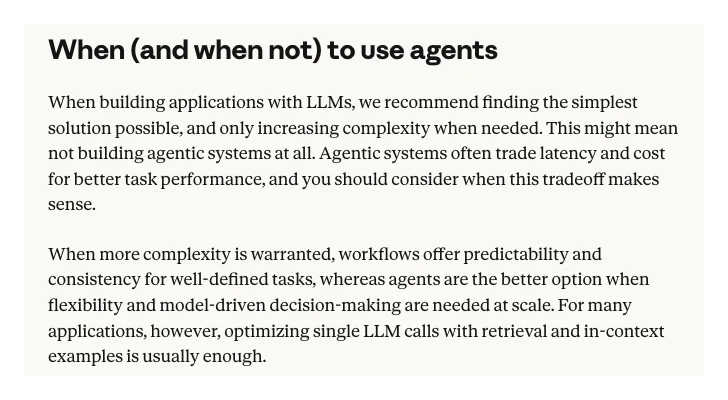
Anthropic's guide Building effective agents (December 2024) draws the line most of the industry now uses. Workflows are "orchestrated through predefined code paths". Agents "dynamically direct their own processes and tool usage". The guide recommends the simplest solution possible, and notes that this "might mean not building agentic systems at all".
| Question | Workflow | Agent |
|---|---|---|
| Who picks the next step? | You, in advance | The model, at run time |
| Same input, same output? | Nearly always | Not guaranteed |
| Cost per run | Low, known | Higher, variable |
| When it breaks | One step to check | A whole run to trace |
| Best for | Repeatable jobs | Open-ended problems |
The page now carries a note that much of the tooling has changed since 2024, pointing to Anthropic's Managed Agents. The definitions and the advice to start simple still stand, and other vendors reach the same place. OpenAI's practical guide to building agents (April 2025) says agents suit complex decisions, rules that are hard to maintain and heavy use of unstructured data, and that otherwise "a deterministic solution may suffice".
Why do most SEO and PPC tasks need a workflow, not an agent?
Short answer: because most SEO and paid search work repeats on a schedule, follows known steps and touches money or live pages. Those are exactly the conditions where predictability beats flexibility. Gartner found that many use cases sold as agentic "don't require agentic implementations".
Gartner's June 2025 forecast is blunt: over 40% of agentic AI projects will be cancelled by the end of 2027, because of rising costs, unclear value or weak risk controls. It also estimates only about 130 of the thousands of vendors calling themselves agentic offer real agents. Rebranding chatbots and assistants as agents, it says, is "agent washing".
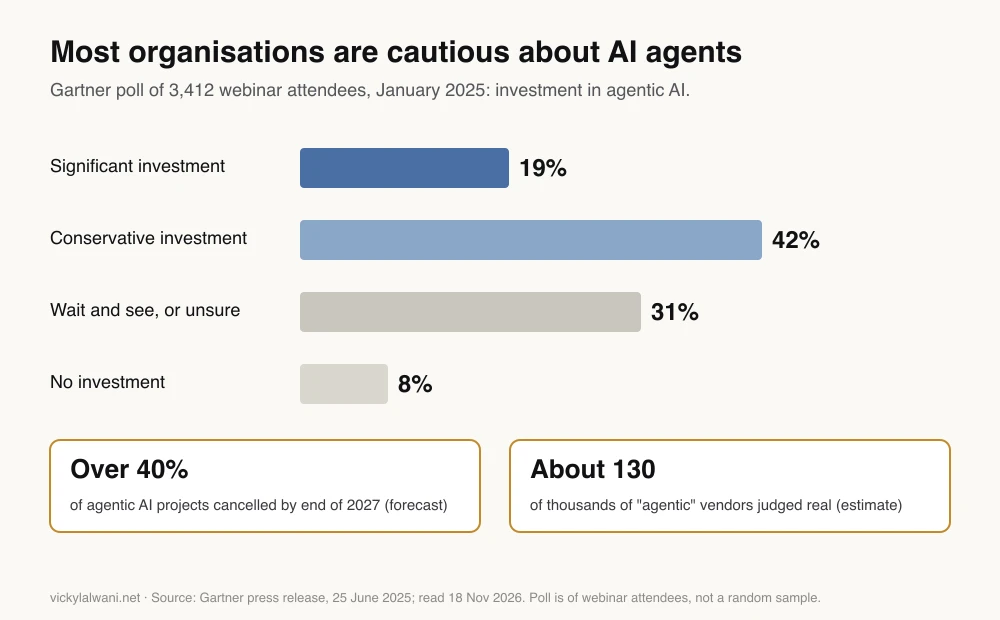
The same release gives the most useful one-line rule I have found: use agents "when decisions are needed, automation for routine workflows and assistants for simple retrieval". Most of a paid search week is routine. Most of an SEO audit is routine. The decisions are a small part of the job, and that is where the AI should sit.
There is a cost argument too. Anthropic notes agentic systems "trade latency and cost for better task performance", and that their autonomy means "the potential for compounding errors". A weekly report that runs 52 times a year pays that cost 52 times.
How do you decide between a workflow and an agent?
Short answer: ask five questions. Can you write the steps down? Does the next step depend on what it finds? Can a mistake be undone cheaply? How often does it run? Can a person check the output fast? Mostly workflow answers mean a workflow; build an agent only when the path is unknown and mistakes are cheap.
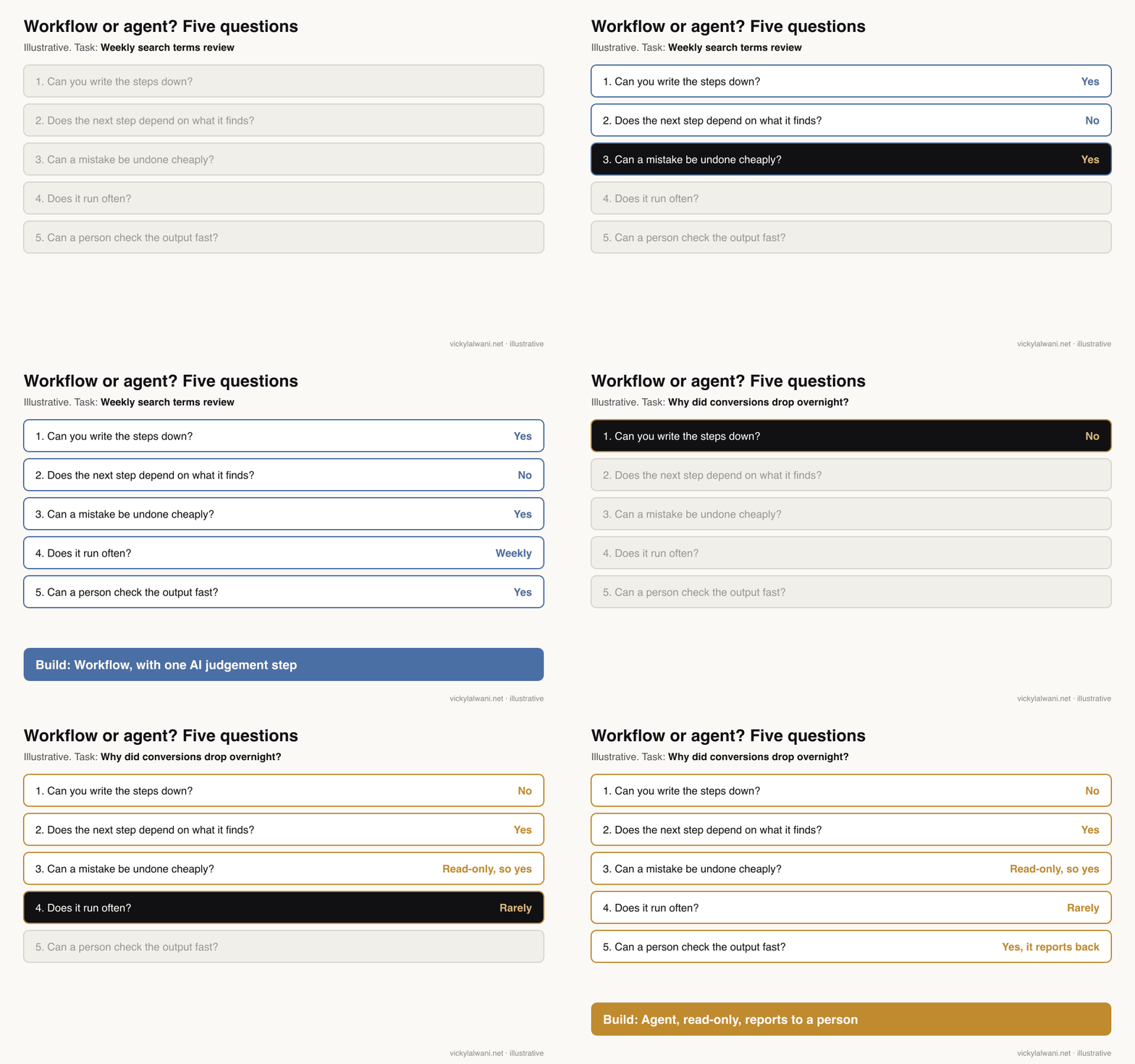
| Question | Points to workflow | Points to agent |
|---|---|---|
| Can you write the steps? | Yes | No, it depends |
| Does the path branch on findings? | Rarely | Constantly |
| Cost of a mistake? | Spends money, live page | Read-only, reversible |
| How often does it run? | Daily or weekly | Occasionally |
| Can a person check it fast? | Needs a fixed format | Yes, it reports back |
The first four questions come from the original version of this article. The fifth is new, and it matters most. An agent is only safe when its work can be reviewed quickly, because you will review more of its runs than you expect. If checking the output takes as long as doing the job, you have built an expensive way to do the job twice.
Paste this prompt into Claude or ChatGPT with a task description to get a first answer. Treat it as a second opinion, not a verdict.
I run SEO and paid search. Help me decide whether this task should be a fixed workflow, a workflow with one AI step, or an agent.

TASK: [describe it, e.g. "review last week's search terms and propose negatives"]
HOW OFTEN: [daily / weekly / monthly / rarely]
WHAT IT TOUCHES: [read-only data / drafts only / live spend or pages]

Answer these five questions, one line each:
1. Can the steps be written down in advance?
2. Does the next step depend on what it finds?
3. Can a mistake be undone cheaply?
4. How often will it run, and what does each run cost?
5. Can a person check the output in under five minutes?

Then recommend ONE of: fixed workflow / workflow with one AI step / read-only agent / agent with approval.
Name the single step where AI judgement is needed, and the step where a person must approve.
If you are unsure, say so. Do not recommend an agent just because it is possible.
Which SEO and PPC tasks fit a workflow, a hybrid or an agent?
Short answer: reporting, alerts, uploads and audit triage are workflows. Search terms reviews, ad copy and content briefs are hybrids with one AI step. Investigating an unexplained drop, researching a new market and tracing a tracking fault can justify an agent, read-only and reporting to a person.
| Task | Build | Why |
|---|---|---|
| Weekly performance report | Workflow | Same steps every week |
| Budget pacing alert | Workflow, no AI | A rule is enough |
| Search terms review | Hybrid | One judgement step |
| Negative keyword upload | Workflow plus approval | Spends money |
| Bid changes | Leave to Smart Bidding | Google already automates |
| Ad copy variants | Hybrid | Draft, check, approve |
| Technical SEO audit triage | Workflow | Crawl, sort, rank |
| Content refresh briefs | Hybrid | Data fixed, writing judged |
| Competitor research | Hybrid | Collect fixed, read flexible |
| Why did conversions drop? | Read-only agent | Path depends on findings |
| New market keyword research | Agent, then human check | Open-ended search |
| Tracking fault diagnosis | Read-only agent | Many possible causes |
On bids: Google's Smart Bidding already sets bids in each auction from signals an outside tool cannot see. An external agent changing bids on top of it adds risk without adding information. Spend your effort on the conversion data Smart Bidding learns from instead.
On research: agents are good at open-ended digging, and bad at telling you when their data is wrong. An agent asked to pull keyword volumes can misread a location setting or the tool itself and return numbers that look plausible. Spot-check agent-pulled data against the source before anyone uses it.
What does the hybrid look like in practice?
Short answer: a fixed pipeline with one box where the model judges, and one box where a person approves. If you can draw the job as a one-page flowchart, only the box that says "work out what this means" needs AI. Everything else stays predictable.
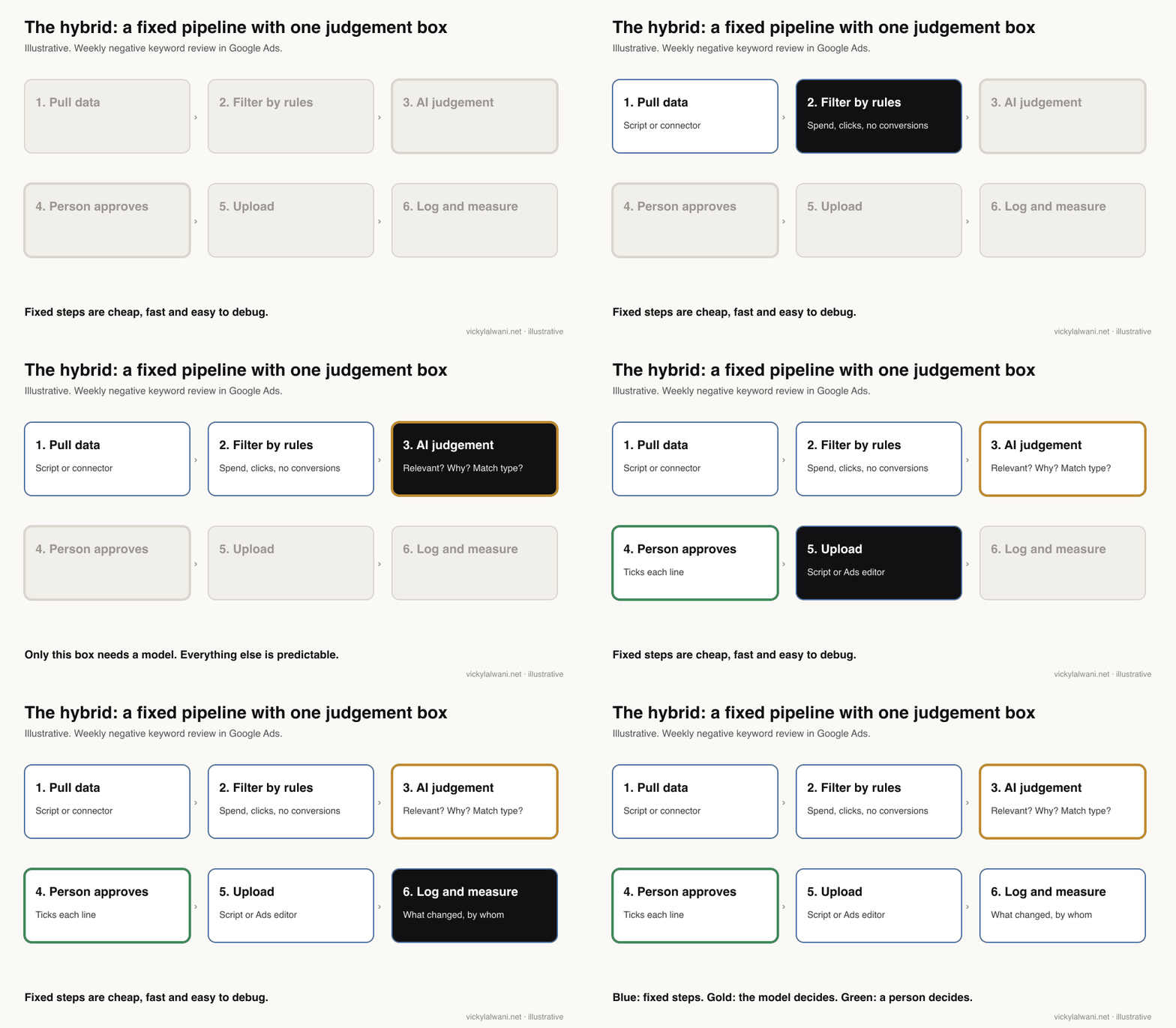
Anthropic's guide names the patterns most hybrids use. They map neatly onto marketing work.
| Pattern | What it does | Marketing use |
|---|---|---|
| Prompt chaining | Steps in order, with checks | Brief, draft, brand check |
| Routing | Sorts input to the right path | Lead or query type |
| Parallel checks | Several views at once | Ad policy and brand review |
| Orchestrator and workers | Splits unknown subtasks | Multi-site audit |
| Evaluator and optimiser | Drafts, critiques, redrafts | Headlines against rules |
Practitioners land in the same place. In an r/n8n thread, someone ran one daily report through a scheduled workflow and through an agent for 30 days: the workflow delivered every day, the agent missed four. The replies agreed on a pattern: keep the trigger, data and formatting fixed, and let the model handle only "the middle decision layer".
A pattern worth copying: plan in one place and execute in another. A thinking model writes the plan and the checks, and a separate agent or script carries it out, so planning mistakes are caught before anything is built. And when a client sends me a new "AI agent" product, my first question is whether the same job could run as a workflow on a model they already pay for. Many such products are a thin layer over the same underlying models.
What do the platforms' own agents change?
Short answer: Google now has an agent inside Google Ads, Anthropic sells hosted agents that run on schedules, and Google's own Google Ads connector asks a person to confirm before it changes anything. The line between workflow and agent is blurring, but the approval step is not going away.
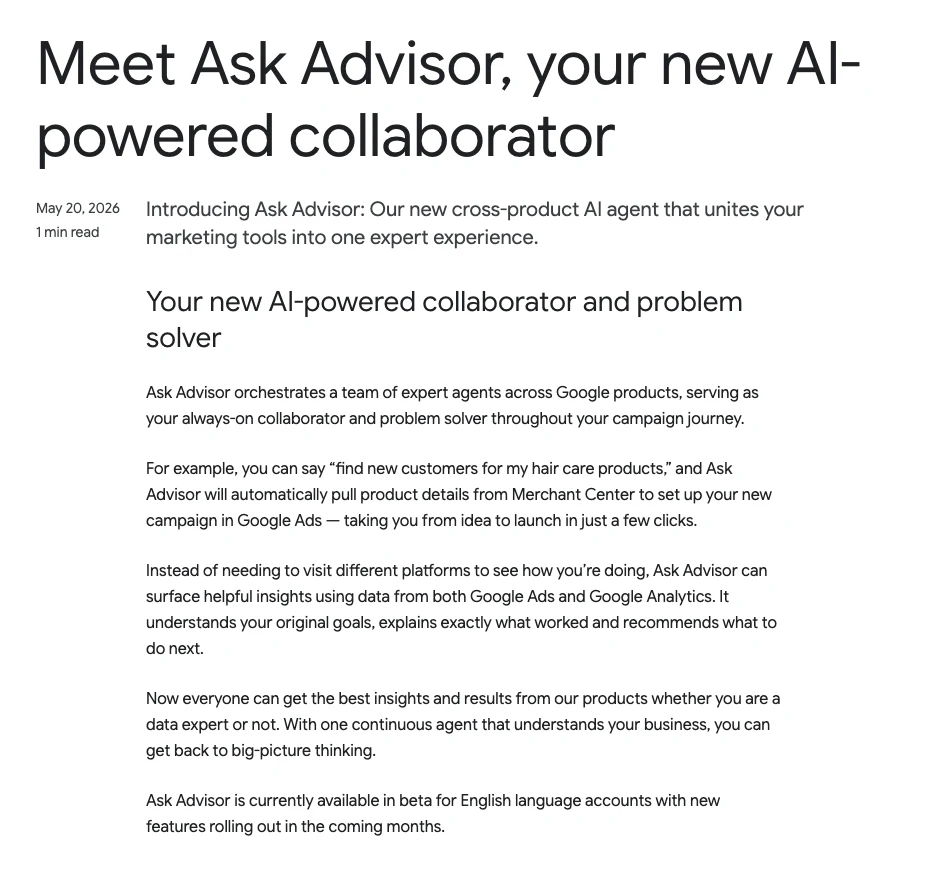
Google introduced Ads Advisor in November 2025, then folded its agents into Ask Advisor in May 2026: one assistant across Google Ads, Google Analytics and Google Marketing Platform, with a Merchant Center agent joining. Google's post says it is in beta for English-language accounts, with features rolling out over the coming months.
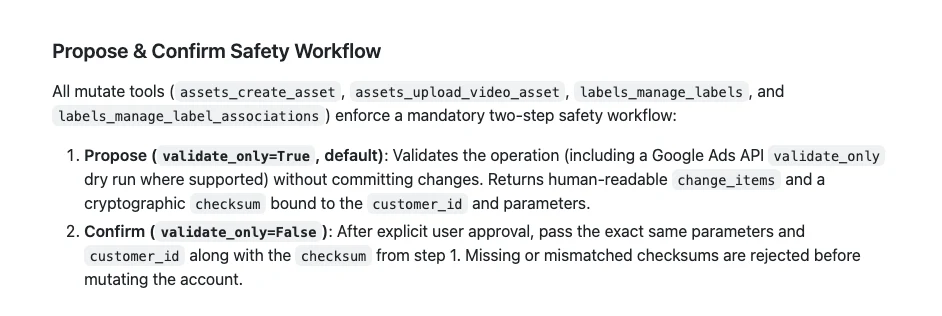
For teams building their own, Google publishes an official Google Ads MCP server, a connector that lets assistants such as Claude read an account. Its version 0.0.6 (2 November 2026) added asset and label changes behind a two-step "propose and confirm" flow: the tool shows the change first, and only commits it after explicit user approval. It can also run strictly read-only.
On the agent side, Anthropic's hosted agents can now run on a schedule (June 2026), and its dynamic workflows (October 2026, public beta) have a lead agent write a plan that other agents run in phases. In other words, agents now run inside workflows, and workflows now contain agents. The five questions still decide which parts get freedom.
What guardrails does an agent need before it touches an ad account?
Short answer: read-only access first, a human approval for anything that spends money or changes a live page, limits on retries and actions, its own scoped credentials, and a log of every action. OpenAI names two triggers for handing back to a person: too many failures and any high-risk action.
| Guardrail | Stops | Example |
|---|---|---|
| Read-only first | Accidental changes | Read-only connector mode |
| Propose, then confirm | Unreviewed edits | Approve each change |
| Failure limit | Loops and guessing | Stop after three retries |
| High-risk list | Costly mistakes | Budgets, bids, pausing |
| Scoped credentials | Wide blast radius | One key per agent |
| Action log | Silent changes | Who, what, when |
| Right success signal | Chasing cheap results | Qualified leads, not form fills |
The last row is the one teams miss. An r/PPC team found its paid media agent lowered cost per acquisition while sending fewer good leads down the funnel: it chased the easy signal it was given. Replies agreed the agent did exactly what it was told. Feed it qualified leads or closed revenue from your CRM, and keep a person in the loop when spend moves a lot. My guides to human in the loop for Google Ads and AI agents for PPC go deeper on approvals.
Keep high-risk channels out of an agent's hands until there is a safe, tested route for them. That applies to new email sending domains and automated messaging as much as to ad spend.
How should you start: workflow first, agent later?
Short answer: start every job as a workflow, log where it breaks or needs a person, and promote only those steps to agent behaviour, with limits and approval. Re-measure cost and reliability after each change. Most teams find at least one agent that should have been a workflow.
- Write the steps. If you cannot, that is your candidate for an agent step.
- Run it as a workflow for a month. Log every run where a person had to step in.
- Promote one step. Give it a model, a clear output format and a failure limit.
- Keep the edges fixed. Trigger, data pull, formatting and upload stay predictable.
- Re-measure. Compare cost per run, misses and review time before and after.
| Measure | Workflow | After adding agent step |
|---|---|---|
| Runs delivered on time | Record it | Should not fall |
| Cost per run | Record it | Rise must be justified |
| Minutes to review | Record it | Should fall |
| Human fixes needed | Record it | Should fall |
If you want one personal agent for your own inbox and research, while shared jobs stay as workflows, n8n Nod for marketers shows where each fits.
What people say on X and Reddit
Short answer: the agent builders' own advice is "don't build agents for everything", platforms are shipping agents with approval steps, and practitioners who tested both report that fixed workflows win on reliability for repeatable jobs, while agents help with the messy middle.
| Who, on X | What they said | Type | Post |
|---|---|---|---|
| AI Engineer conference (official) | Core ideas of Anthropic's agents talk: don't build agents for everything, keep it simple (4 Apr 2025) | Official | Post |
| A developer educator | Calls "Building Effective Agents" the post that launched a thousand ships (24 Jan 2025) | Opinion | Post |
| Google Ads (official) | Introduces Ads Advisor, an agent inside Google Ads that can take action in campaigns (12 Nov 2025) | Official | Post |
| Google's Ads liaison | Ads Advisor and Analytics Advisor: conversational agents from question to analysis (12 Nov 2025) | Official | Post |
| Claude (official) | Scheduled deployments run an agent on a set schedule, such as a daily digest (10 Jun 2026) | Official | Post |
| Claude developers (official) | Dynamic workflows: a lead agent writes a plan that runs across many agents in phases (9 Oct 2026) | Official | Post |
| A startup operator | Gave each business agent its own inbox and scoped API key (19 Jul 2026) | First-hand | Post |
| Community | What the thread says | Type | Link |
|---|---|---|---|
| r/n8n | Same invoice-routing job built both ways; the agent worked but the fixed version won on consistency, debugging and cost (24 Apr 2026) | First-hand | Thread |
| r/n8n | One daily report for 30 days: scheduled workflow 30 of 30, agent 26 of 30; replies keep AI to the middle step (14 Apr 2026) | First-hand, names a vendor | Thread |
| r/PPC | "The eval was harder than the agent": a paid media agent chased cheap conversions, not pipeline (14 Sep 2026) | First-hand | Thread |
| r/AI_Agents | Who owns an automation when it breaks? Replies: silent wrong results need a named owner and a pause rule (17 Nov 2026) | Opinion | Thread |
| r/SEO | Biggest challenges with AI agents for SEO; top reply: SEOs use AI to speed up tasks, the processes have not changed (28 Oct 2026) | Opinion | Thread |
Videos worth watching
Short answer: Anthropic's conference talk is the clearest case for simple designs, Anthropic's follow-up covers what changed, and Google Cloud's short explainer shows what an agent is made of.
Published by the AI Engineer conference channel, 4 April 2025, about 15 minutes. Recorded at the AI Engineer Summit in New York: an Anthropic engineer's talk behind the guide: don't build agents for everything, and keep them simple. It sells nothing directly.
Made by Anthropic, 17 October 2025, about 19 minutes. A follow-up conversation on what changed since the original guide, including skills and when simple designs still win.
Made by Google Cloud Tech, 10 June 2026, about eight minutes. A short explainer of what an agent is made of; it uses Google's own tools.
| Video | Channel | Date | What it covers |
|---|---|---|---|
| How We Build Effective Agents (Anthropic talk) | AI Engineer | 4 Apr 2025 | When not to build agents |
| Building more effective AI agents | Anthropic | 17 Oct 2025 | Agents a year on |
| AI agents explained: Build your first agent in 8 minutes | Google Cloud Tech | 10 Jun 2026 | Parts of an agent |
| 10 AI Agents Fought Over a Google Ads Account | A PPC automation channel | 16 Feb 2026 | Agents debating one account; promotes its setup guide |
| I Let AI Agents Run My SEO. Here's what happened | An SEO affiliate channel | 17 Aug 2026 | SEO agents; promotes the creator's agency |
Where this advice is weak
Short answer: the forecasts are about enterprise AI in general, the r/n8n comparison is one person's 30 days, agent tools improve every few months, and very large ad accounts may justify agents earlier than a typical lead-generation account.
- Forecasts are not results. Gartner's 40% figure is a prediction, and its poll is of webinar attendees.
- Small samples. The workflow-versus-agent tests on Reddit are single, self-reported experiments.
- Tools move. Ask Advisor, Managed Agents and the Google Ads MCP server all changed during 2026. Check current docs before you design around a feature.
- Scale changes the maths. An account with thousands of campaigns may find agent-style triage pays off sooner than a small account would.
- No client figures. The task sorting is guidance from research and working habits, not measured results. I do not publish client numbers.
Want agents built where they actually help?
The useful work is the sorting: which jobs stay as workflows, which step gets AI judgement, which tasks justify an agent, and where a person signs off. My AI marketing agents service starts with that audit, then builds the workflows and agents with read-only access, approvals and logs. If the gap is the account or the site itself, see Google Ads management or SEO consulting. Rates are on the pricing page.
Keep reading: AI marketing workflows for SEO and PPC, AI agents for PPC and human in the loop for Google Ads.
Sources
| Source | What it supports | Date |
|---|---|---|
| Anthropic: Building effective agents | Definitions; patterns; start simple | 19 Dec 2024 |
| OpenAI: Practical guide to agents | When to build; human triggers | Apr 2025 |
| Gartner press release | 40% cancelled; poll; 130 vendors | 25 Jun 2025 |
| Google: Meet Ask Advisor | Agent across Ads, Analytics; beta | 20 May 2026 |
| Google Ads MCP server | Propose and confirm; read-only | Read 18 Nov 2026 |
| Google Ads MCP releases | v0.0.6 write tools | 2 Nov 2026 |
| Google Ads Help: Smart Bidding | Auction-time bidding | Read 18 Nov 2026 |
| X, Reddit and YouTube | Practitioner views, linked above | Jan 2025 to Nov 2026 |
This article expands on my post on LinkedIn ↗.
FAQ
What is the difference between an AI workflow and an AI agent?
An AI workflow runs a model and tools through steps you define in advance, so the same input gives nearly the same output. An AI agent decides its own steps and tools in a loop until it judges the job done, which makes it flexible but costlier and harder to debug.
When should I use an AI agent instead of a workflow?
Use an agent when the next step depends on what it finds, the work is read-only or easy to undo, and a person can check the result quickly. If you can write the steps down and the task runs every week, a workflow is cheaper and more reliable.
Should Google Ads tasks be workflows or agents?
Most Google Ads tasks are workflows: reports, budget alerts, search terms reviews and negative keyword uploads. Bids are already automated by Smart Bidding, so an outside agent adds risk there; agents fit open-ended jobs such as investigating an unexplained drop in conversions with read-only access.
Can AI agents do SEO?
Agents help with open-ended SEO research, such as exploring a new market or tracing why traffic fell, as long as a person checks their data. Routine SEO work such as audit triage, Search Console reports and refresh briefs runs better as a workflow with one AI step.
What is a hybrid AI workflow?
A hybrid is a fixed pipeline with one step where a model makes a judgement and one step where a person approves. In a weekly search terms review, the data pull, filters and upload are fixed, the model judges relevance, and the account owner approves each negative keyword.
Why do agentic AI projects fail?
Gartner expects over 40% of agentic AI projects to be cancelled by the end of 2027 because of rising costs, unclear business value or weak risk controls. Many use cases sold as agentic do not need an agent at all, and a workflow would have been cheaper and easier to fix.
What guardrails does an AI agent need in an ad account?
Start with read-only access, require a person to approve anything that spends money or changes a live page, set limits on retries and actions, give each agent its own scoped credentials and log every action. Also feed it the right success signal, such as qualified leads rather than raw form fills.
Can I start with a workflow and upgrade to an agent later?
Yes, and it is usually the best path. Run the job as a workflow, log where it breaks or needs a person, then give only that step agent behaviour with a clear output format, a failure limit and an approval, and compare cost and reliability before and after.