Marketing strategy vs plan is the difference between knowing where to focus and knowing what to do next. A strategy decides which customers, channels and searches matter, what to ignore and why. A plan turns that into tasks, owners, budgets and dates. In search marketing, the strategy chooses the buyers and searches worth winning; the SEO and Google Ads plans become keyword groups, pages, campaigns and budgets that trace back to it.
TL;DR
A marketing strategy decides where to focus, what to ignore and why. A marketing plan turns that into tasks, owners, budgets and dates. Teams with plans but no shared strategy stay busy and still pull in different directions.
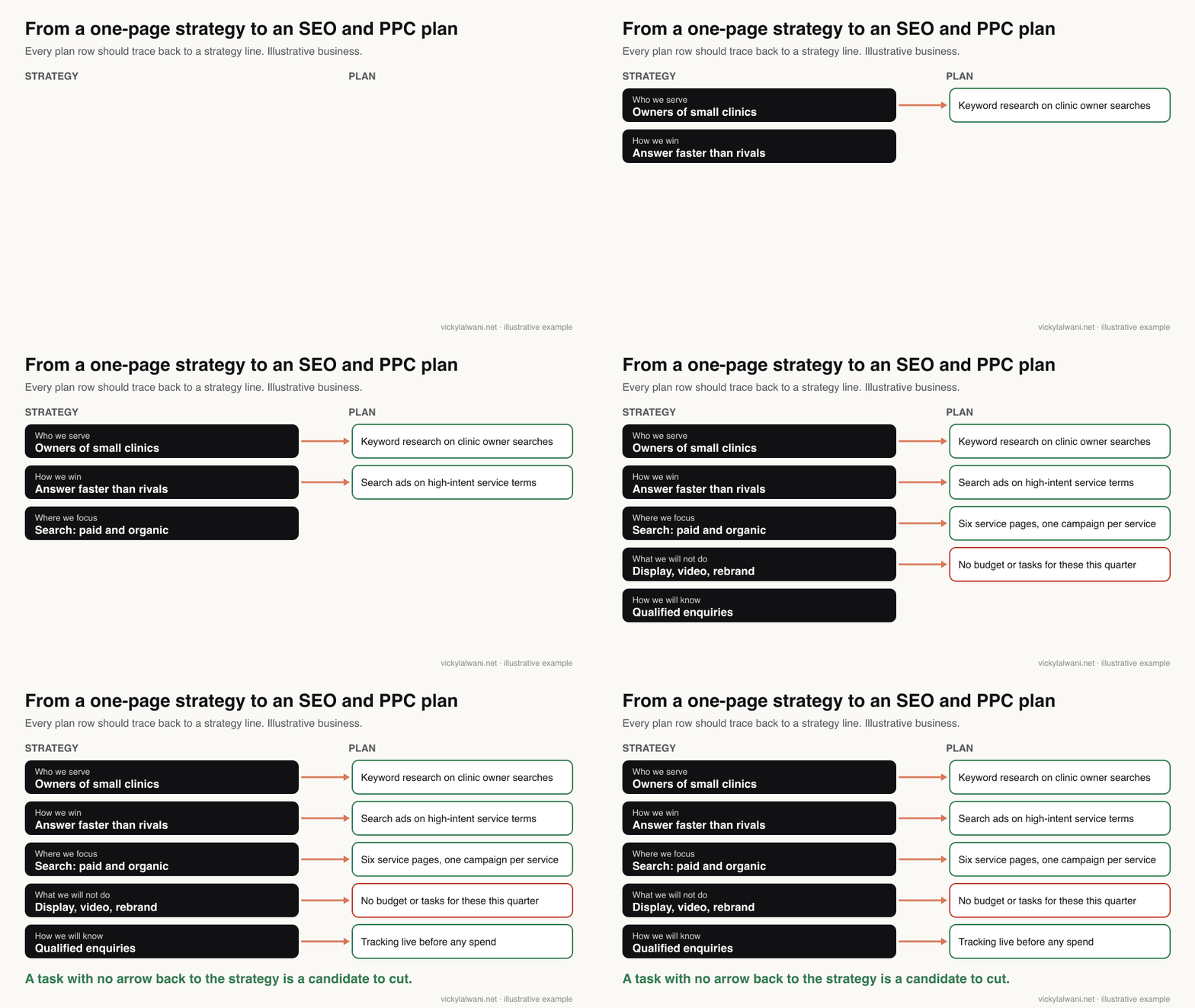
In search marketing the difference is concrete. The strategy chooses which customers, services and searches matter; the SEO plan and the Google Ads plan then become keyword groups, pages, campaigns, budgets and a calendar. A task that does not trace back to a strategy line is a candidate to cut.
Plan to the real clock. Google says SEO changes can take hours or several months to show, Smart Bidding needs one to two conversion cycles to settle, and budgets are flat for most companies, so the strategy has to say what you will stop funding.
Jump to: The difference · Why teams stall · One-page strategy · SEO plan · Google Ads plan · SEO and PPC together · Review rhythm
I used to think our problem was execution. I was wrong. In one team meeting the room was full of smart people with sharp opinions. Reports were clean, tasks were moving, campaigns were running. Yet the tension was obvious: different priorities, conflicting suggestions, the same debate every week.
No one was lazy and no one was careless. We were not misaligned on effort. We were misaligned on strategy. Everyone had a plan. No one had the same answer to one question: how do we win?
This guide explains marketing strategy vs plan in practical terms, then shows what changes when you apply it to the two channels I work in most, SEO and paid search. Facts about Google's tools and timelines were checked on 18 November 2026. If you want a second pair of eyes on your search strategy, that is the starting point of my SEO consultant service and my Google Ads management.
Marketing strategy vs plan: what is the difference?
Short answer: a strategy answers "where do we focus, what do we ignore, and why?" A plan answers "what happens next, who owns it, what does it cost and when is it due?" You need both, and the strategy has to come first.
Plans keep people busy. Strategy keeps people aligned. A plan without a strategy is a list of reasonable activities with no rule for choosing between them, so every request looks equally valid.
| Strategy | Plan | |
|---|---|---|
| Question | Where and how do we win? | What do we do next? |
| Length | One page | As long as the work needs |
| Changes | When the facts change | Every week or month |
| Owner | Decision makers | The people doing the work |
| Key word | No | When |
| In search | Which buyers and searches matter | Keywords, pages, campaigns, budgets |
This is the trap for experienced teams. Activity looks like progress. Dashboards stay green. But if two people can read the same report and draw opposite conclusions about what to do next, the problem is not the report.
Why do busy marketing teams still stall?
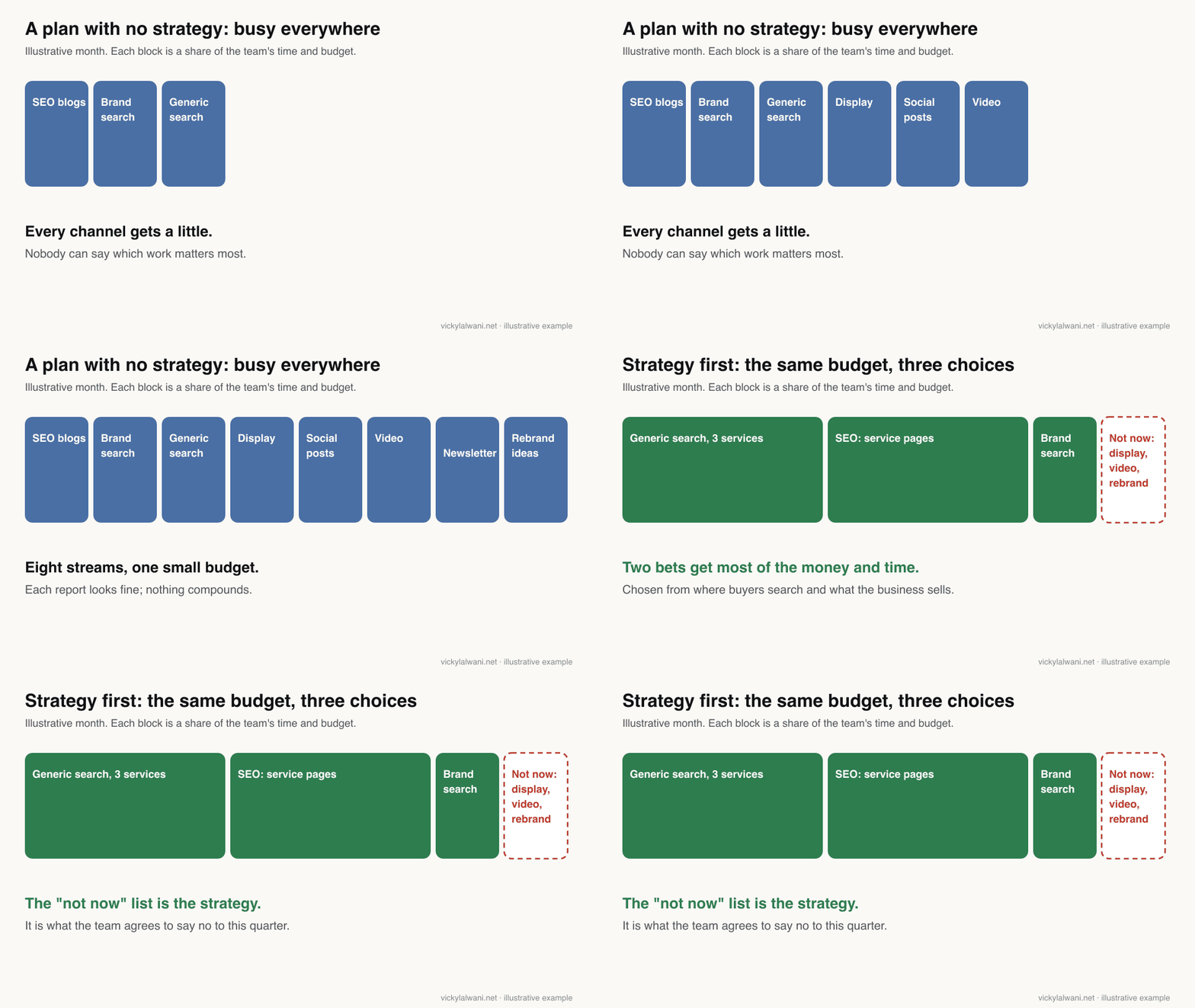
Short answer: because a plan spreads a fixed budget across everything that sounds sensible. Without a shared rule for what to ignore, each channel gets a little, nothing gets enough to work, and every meeting reopens the same debate.
The money is not growing to cover the gap. Gartner's annual survey of marketing leaders puts the average marketing budget at 7.8% of company revenue in 2026, up only slightly from 7.7% in 2025 and well below the 9.5% reported for 2022. In 2023, 71% of marketing leaders said they lacked the budget to fully execute their strategy; in 2024 the figure was 64%.
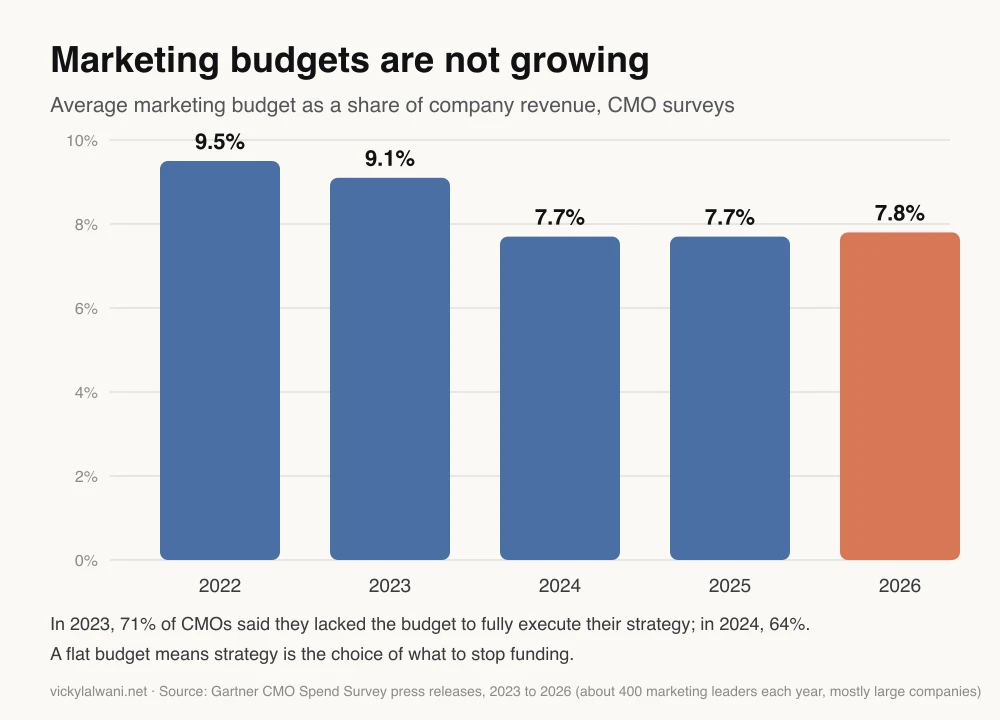
Those surveys cover mostly large companies, but the lesson travels to any size. When the budget is flat, a strategy is mainly a decision about what to stop funding. Without that decision, the plan grows and the money per activity shrinks.
How do you know your team lacks a strategy?
- If the budget were cut in half, what would we protect first?
- Which request did we say no to last month, and why?
- Can every person on the team explain our focus in one sentence?
- When two reports disagree, who decides, and on what basis?
If the answers differ from person to person, you have found the real source of the weekly debate.
How do you write a one-page marketing strategy?
Short answer: answer five questions on one page: who we serve, how we win, where we focus, what we will not do, and how we will know. The fourth is the hardest and the most important.
| Line | What it means | Search example |
|---|---|---|
| Who we serve | A specific customer, not a market | Owners of small clinics |
| How we win | What we do better for them | Faster answers, clearer prices |
| Where we focus | Two or three channels or offers | Paid and organic search |
| What we will not do | This quarter's "no" list | No display, video or rebrand |
| How we will know | A few measures tied to revenue | Qualified enquiries, not clicks |
Saying no is what turns a list of preferences into a strategy. If nothing is excluded, nothing has been chosen. The examples in the third column are illustrative; yours should come from your own customers and sales data.
Hold one session with the people who make decisions and leave with the page written. If you use an AI assistant to help, give it your facts and ask it to challenge you, not to invent the strategy:
I am writing a one-page marketing strategy. Here are my facts:
- What we sell and to whom: [products or services, typical customer]
- Where enquiries and sales came from last year: [channels, rough share]
- Budget and team time available: [amounts]
- What the business needs this year: [revenue or lead goal]

Draft five short lines: who we serve, how we win, where we focus (max three channels or offers), what we will not do this quarter, how we will know (max three measures tied to revenue or qualified leads).
Then list the three weakest assumptions in the draft and the data that would test each one.
Use only the facts above. If something is missing, ask me instead of guessing.
Write the result where everyone can see it, and use it to say no in meetings. A strategy that lives in one person's head is a preference.
How does strategy change an SEO plan?
Short answer: the strategy decides which customers, services and questions the site must win; the SEO plan then turns those into keyword groups, pages, technical fixes and a publishing calendar. Without the strategy, SEO plans become long lists of keywords and fixes with no order.
Weak SEO plans often start with a tool export: hundreds of keywords sorted by volume. A practitioner on X made the same point about agency proposals: lists of technical fixes and "100 keywords" lose to proposals built around the business opportunity. The strategy line "who we serve" should choose the keywords, not the other way round.
| Strategy line | SEO plan item |
|---|---|
| Who we serve | Keyword research in the customer's words |
| How we win | Pages that answer better than competitors |
| Where we focus | Service pages before blog posts |
| What we will not do | No content outside the focus topics |
| How we will know | Enquiries from organic landing pages |
Two habits belong in every SEO plan. First, use the words searchers type, not the words the business uses internally: a service name your team likes is worthless if nobody searches it. Second, check every number in the plan against its source, especially when an AI tool helped build it. Search volumes and difficulty scores are estimates, and an unchecked figure can steer a whole quarter of work.
The plan also needs an honest clock. Google's own SEO starter guide says some changes take effect in a few hours and others take several months, and suggests waiting a few weeks before judging whether a change helped. Google's Search Liaison account has also declined to give fixed recovery timeframes on X.

So set SEO expectations in months, not weeks, and put quick wins first: a clean Business Profile, accurate listings and fixes to pages that already rank. Slow builds such as new content clusters go into the plan with a review date, not a promise.
For the hands-on side of turning a strategy into keyword groups, see keyword research with Claude, and for what a first engagement looks like, what an SEO consultant does on day one.
How does strategy change a Google Ads plan?
Short answer: the strategy picks the services, audiences and searches worth paying for and the result that counts as success; the Google Ads plan turns them into campaigns, budgets, bid strategies, tracking and a test calendar sized to what the budget can actually learn.
Paid search punishes a missing strategy faster than SEO does, because every unfocused click costs money. A plan that spreads a small budget across many campaigns gives none of them enough clicks to learn from. A consultant on X shared the arithmetic from three sales calls in one week: a modest monthly budget at a high cost per click buys about a hundred clicks, and a hundred clicks produce only a handful of leads.
Three Google facts belong in every Google Ads plan:
| Fact | What Google says | Plan for it |
|---|---|---|
| Daily budgets | A day can spend up to 2x; a month no more than 30.4x | Budget by month, not day |
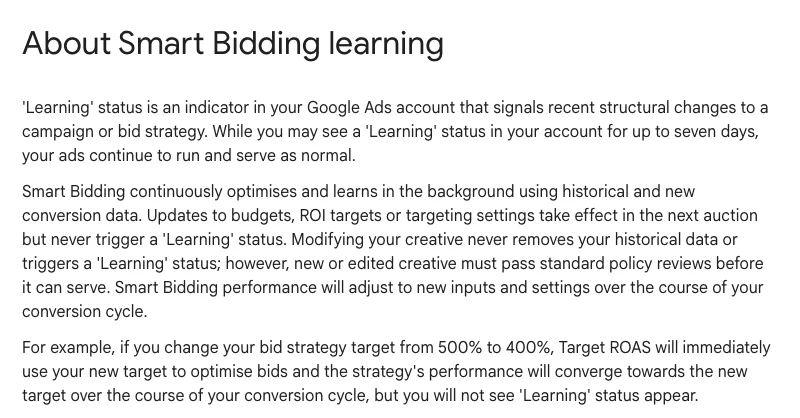
| Smart Bidding learning | Status up to 7 days; 1 to 2 conversion cycles to settle | No judgement in week one |
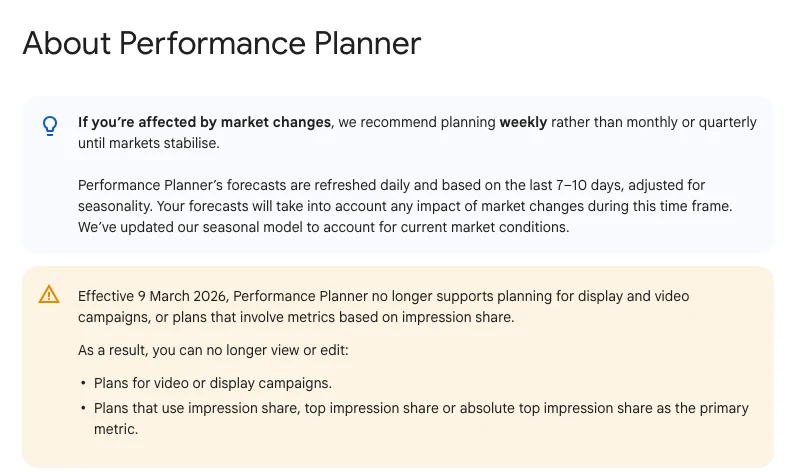
| Forecasts | Monthly and quarterly, from the last 7 to 10 days | Use ranges, review often |
The budget rule comes from Google's help page on average daily budgets: a campaign may spend up to twice its average daily budget on a busy day, but no more than 30.4 times it in a month. The learning rule comes from Google's page on Smart Bidding learning, which says the "Learning" status can show for up to seven days after major structural changes, and that performance adjusts over the course of your conversion cycle. Changes to budgets and targets do not trigger it.
For forecasts, Performance Planner projects monthly and quarterly results for Search, Shopping, Performance Max, Demand Gen and App campaigns. Since 9 March 2026 it no longer plans display or video campaigns, and it needs some history: for Search, at least one conversion and recent spend. Google also recommends planning weekly rather than monthly or quarterly while markets are unsettled.
A sound Google Ads plan follows a few fixed habits that only make sense once the strategy is set:
- Tracking before spend. Campaigns stay in draft until every form and call that counts as success is measured. If "how we will know" is qualified enquiries, the plan must measure enquiries, not clicks.
- Broad first, then narrow. A discovery period to learn which searches convert, then tighter keywords around what worked.
- Tests with an end date. When two channels or campaigns compete, they run side by side and the weaker one is cut on a date agreed in advance.
- Approval before anything goes live, and a short note on every report: where we are, what we are doing, what is next.
For the weekly mechanics of a managed account, see the 15 jobs of Google Ads management.
How do SEO and paid search plans fit together?
Short answer: one strategy, two plans on different clocks. Paid search tests messages and keywords within weeks; SEO builds pages that keep working for months. Each plan should feed the other.
| Paid search plan | SEO plan | |
|---|---|---|
| First results | Days to weeks | Weeks to months |
| Main cost | Clicks | Time and content |
| Best at | Testing offers and keywords | Compounding demand |
| Feeds the other | Converting terms for SEO | Landing pages for ads |
| Stops when | The budget stops | Slowly, if neglected |
In practice, the search terms report in Google Ads shows which phrases bring enquiries, and those phrases become SEO priorities. In the other direction, the service pages built for SEO become better landing pages for ads. The strategy decides which services both plans serve, so they do not compete for the same budget with different goals.
How often should you review strategy and plan?
Short answer: the plan weekly and monthly, the strategy each quarter or when the facts change. Revisiting the strategy every week is a sign it was never agreed.
| When | What to review | Search example |
|---|---|---|
| Weekly | Plan tasks and blockers | Search terms, negatives, budget pace |
| Monthly | Plan results against measures | Enquiries by campaign and page |
| Quarterly | The strategy page | Keep, cut or add a focus |
| When facts change | The strategy page | New service, price or competitor |
Once we slowed down and clarified direction before tasks, meetings became shorter and decisions easier. The tension did not disappear; it became productive. People still disagreed, but about how to reach the same goal, not about what the goal was.
Which videos explain strategy vs plan well?
Short answer: start with Harvard Business Review's short case that a plan is not a strategy, then Semrush on SEO strategy before tactics, then Google's own explanation of how budgets and targets steer bidding.
A Plan Is Not a Strategy, from Harvard Business Review's channel, 29 June 2022. A strategy professor argues that comprehensive plans of goals, initiatives and budgets feel safe but are not strategy, which is a choice about where to play and how to win. It mentions a book but is not a sales pitch.
SEO Strategy Basics for Beginners, from Semrush's official channel, 1 February 2024. Goals, obstacles and strengths before tactics. Semrush sells SEO software and promotes a free course.
Google Ads Bidding Update: How to Maintain Predictable Performance, from the official Google Ads channel, 12 June 2026. Three minutes on why targets and budgets are planning decisions, not defaults. Google sells the ads.
| Video | Channel | Date | What it covers |
|---|---|---|---|
| How to guide campaign spend with budget and bidding controls | Google Ads | 15 Oct 2026 | Total budgets, channel priorities (44 min) |
| I Reverse Engineered the Perfect Marketing Plan | HubSpot Marketing | 19 Feb 2026 | A plan worked back from revenue |
| SEO in 2026: How I'd Rank in Google in the AI Era | Ahrefs | 18 Mar 2026 | Where to focus SEO effort now |
| Google Ads Forecasting Made Easy | Surfside PPC | 30 Mar 2025 | Forecasting before launch; sells a course |
What people say on X and Reddit
Short answer: practitioners agree that plans fail on untested assumptions and that SEO and PPC work needs budget maths and honest timelines before tasks. Google's own accounts keep pushing advertisers to set targets and budgets deliberately.
| Where | Date | What they say | Type |
|---|---|---|---|
| Google's Ads Liaison account on X | 14 Oct 2026 | New controls for where budget goes | Official |
| Google's Ads Liaison account on X | 15 Jan 2026 | Campaign total budgets for set periods | Official |
| Google's Search Liaison account on X | 9 Feb 2024 | No fixed SEO recovery timeframe | Official |
| An SEO agency founder on X | 4 Nov 2026 | Pitch the opportunity, not 100 keywords | Opinion |
| A Google Ads consultant on X | 10 Feb 2026 | Small budgets buy few clicks; do the maths | First-hand |
| An operations account on X | 12 Feb 2026 | A clarity problem, not a time problem | Opinion |
| r/digital_marketing | 28 Jul 2026 | Plans stack best-case assumptions | Opinion |
| r/PPC | 15 Oct 2025 | How practitioners forecast before spend | First-hand |
| r/PPC | 10 Jun 2026 | Do not game the learning phase | First-hand |
| r/SEO | 3 Nov 2026 | Owners, timelines, outcomes in money | First-hand |
| r/marketing | 4 May 2026 | Forecast in best, expected, worst ranges | First-hand |
| r/marketing | 1 Jul 2026 | Define success before the task list | First-hand |
The r/digital_marketing thread is the clearest description of the problem in this article: strategy sessions feel aligned, then execution slips because the plan stacks best-case assumptions, and the strategy is treated as a one-off document instead of being reviewed. In r/PPC, an advertiser planning to feed Smart Bidding cheap conversions to get through learning was told to bid on the keywords they actually want from day one, which is a strategy decision dressed as a tactic. In r/SEO, people advising on a large pitch said buyers care about process, owners, timelines and money outcomes, and warned against promising a percentage of growth.
The r/marketing thread from a newly promoted head of marketing shows the same pattern from the inside: the most useful replies said to define what success looks like and agree priorities with the boss before building a weekly task list.
Where this advice is weak
- The budget figures come from surveys of mostly large companies; small businesses may have very different shares and constraints.
- A one-page strategy is a simplification. Regulated industries, large brands and multi-market businesses need more depth behind each line.
- Google's timelines describe its systems, not your results. SEO and Smart Bidding can take longer than the minimums for reasons outside the plan, such as competition and conversion volume.
- The team story at the top is my own experience; other teams stall for reasons strategy will not fix, such as missing skills or broken tracking.
Want help turning strategy into an SEO and PPC plan?
Short answer: I start with the one-page strategy, check tracking, then build the SEO and Google Ads plans from it, with dates, budgets and review points.
For organic search, see my SEO consultant service; for paid search, my Google Ads management. Rates are on the pricing page. If you are choosing who should run the work, read freelance PPC consultant vs agency. Where AI agents can take on parts of the plan, my AI marketing agent consulting covers that.
You can have perfect plans and still go nowhere. With a clear strategy, even imperfect plans move you forward. Start with strategy, then plan carefully to get there.
Sources
| Source | What it supports | Date |
|---|---|---|
| Gartner 2026 CMO Spend Survey | 7.8% of revenue in 2026, 7.7% in 2025 | 11 May 2026 |
| Gartner 2025 CMO Spend Survey | 7.7% in 2025 and 2024 | 12 May 2025 |
| Gartner 2024 CMO Spend Survey | 7.7% from 9.1%; 64% lack budget | 13 May 2024 |
| Gartner 2023 CMO Spend Survey | 9.1% in 2023, 9.5% in 2022; 71% lack budget | 22 May 2023 |
| Google SEO starter guide | Hours to several months; wait weeks to judge | Read 18 Nov 2026 |
| Google Ads: average daily budget | Up to 2x a day; 30.4x a month | Read 18 Nov 2026 |
| Google Ads: Smart Bidding learning | Up to 7 days; conversion cycle | Read 18 Nov 2026 |
| Google Ads: Performance Planner | Supported campaigns; 9 Mar 2026 change | Read 18 Nov 2026 |
| X, Reddit and YouTube | Practitioner views | Jun 2022 to Nov 2026, linked above |
This article expands on my post on LinkedIn ↗.
FAQ
What is the difference between a marketing strategy and a marketing plan?
A marketing strategy sets direction: who you serve, where you focus, what you will not do and how you will measure success. A marketing plan turns that direction into tasks, owners, budgets and dates. You need both, but the strategy comes first.
How do I know my marketing team is misaligned on strategy?
Common signs are the same debate every week, smart people making conflicting suggestions, and lots of activity with no shared answer to how you win. Ask each person what you would protect if the budget halved; different answers mean there is no agreed strategy.
What goes in a one-page marketing strategy?
Five lines: who we serve, how we win, where we focus, what we will not do this quarter, and how we will know. The "will not do" line matters most, because a strategy that excludes nothing has not chosen anything.
How long does it take to write a marketing strategy?
A useful first version can be written in one working session with the people who make decisions. Keep it to a page, then review it each quarter or when the facts change, such as a new service, price or competitor.
What is the difference between an SEO strategy and an SEO plan?
An SEO strategy decides which customers, services and questions the site must win. The SEO plan turns that into keyword groups, pages, technical fixes and a publishing calendar with review dates.
How long should an SEO plan run before judging results?
Months rather than weeks. Google's SEO starter guide says some changes take effect in hours and others take several months, and suggests waiting a few weeks before judging whether a change helped.
How should strategy shape a Google Ads plan?
The strategy picks the services, searches and result worth paying for. The Google Ads plan then sets campaigns, monthly budgets, bid strategies, tracking and tests sized to what the budget can learn, with each campaign tracing back to a strategy line.
How long is the Google Ads learning period?
Google says the Learning status can show for up to seven days after major structural changes, and that Smart Bidding performance adjusts over the course of your conversion cycle. Changes to budgets and targets do not trigger it.
How often should a marketing strategy be reviewed?
Review the plan weekly and monthly and the strategy each quarter or when the facts change. Reopening the strategy every week usually means it was never agreed in the first place.