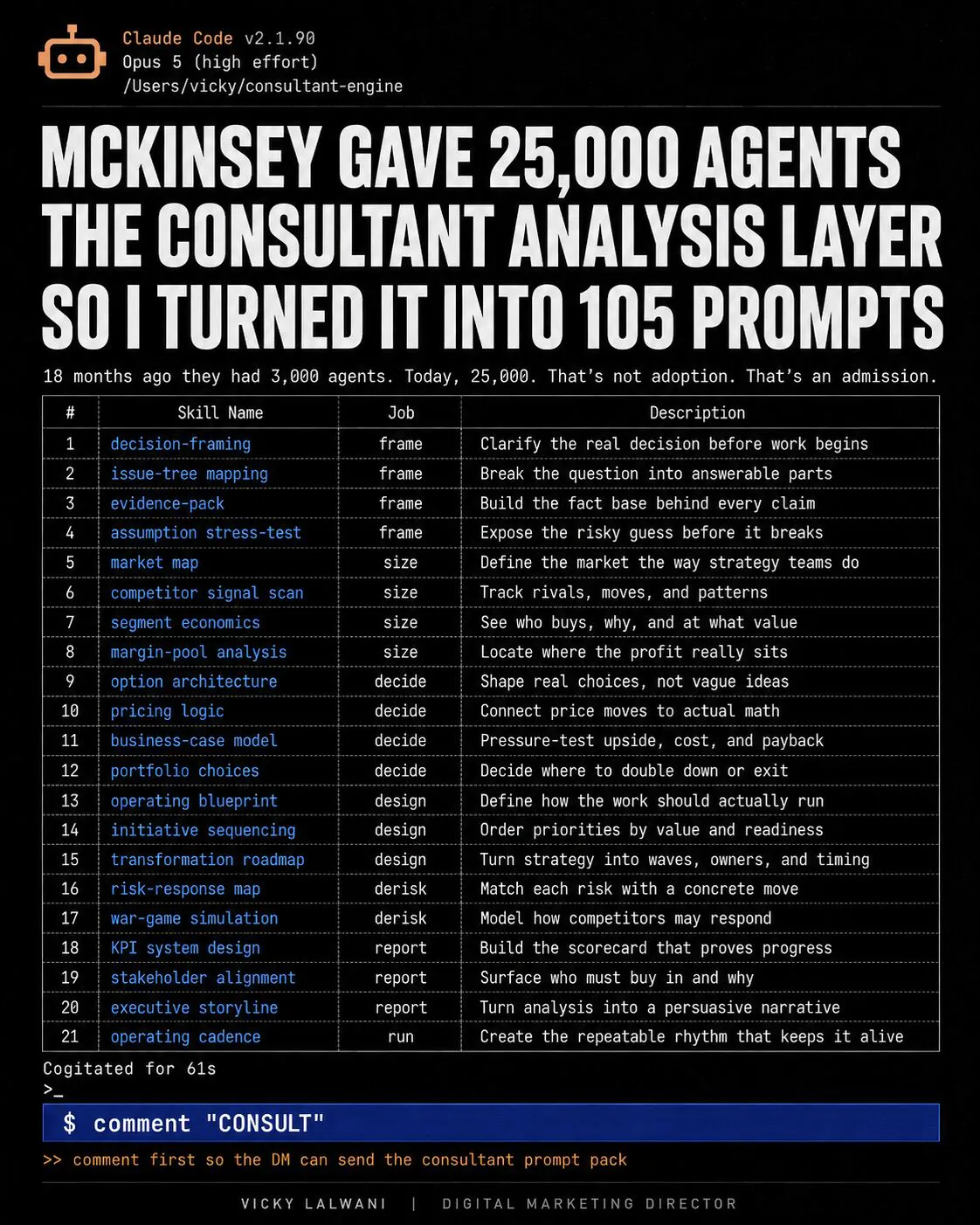
AI consulting analysis, such as SEO audits, keyword research, search terms reviews and report drafts, can now be drafted by AI in minutes. In SEO and PPC the value moves to the operating layer: tracking checked live, priorities set by margin and lead quality, safe changes in the live account, and someone accountable for the result.
TL;DR
AI consulting has two halves. The analysis half (the audit, the keyword research, the competitor scan, the first draft of the report) can now be drafted by an AI assistant in minutes. The operating half (checking tracking before spend, ranking fixes by margin and lead quality, owning the change, and getting it past the people who can block it) still needs a person who is accountable.
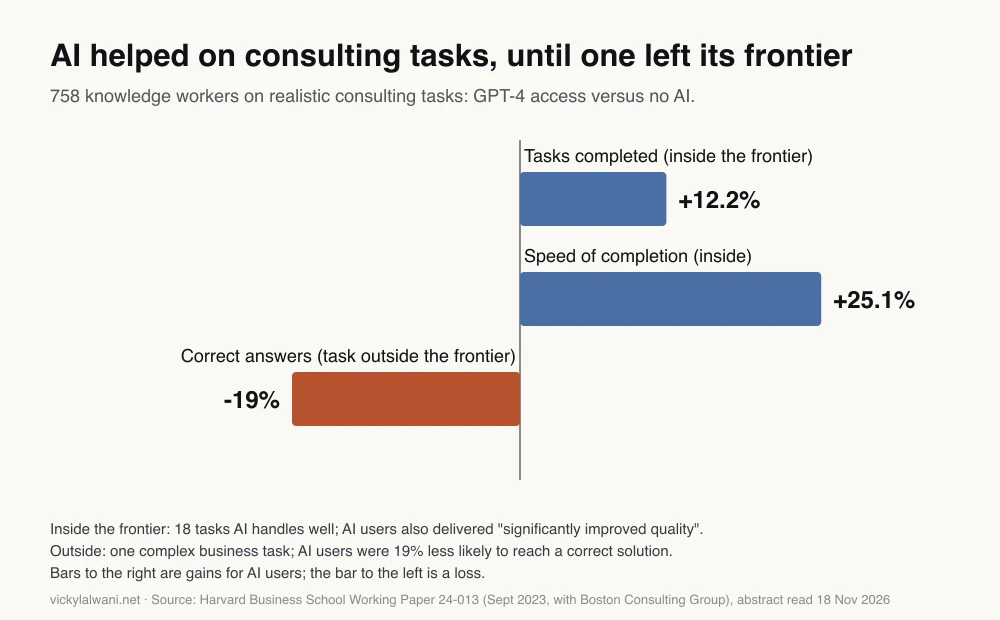
The evidence backs the split. In a Harvard Business School experiment with Boston Consulting Group, people using AI finished 12.2% more consulting tasks and worked 25.1% faster, but on one task outside the AI's comfort zone they were 19% less likely to get the right answer.
For SEO and paid search, use AI for the cheap half, then pay for judgement, implementation and accountability. Test any AI analysis against the last audit you paid for before you decide what to buy next.
Short answer: in 2027, pay an SEO or PPC consultant for the parts AI cannot own: verifying tracking and access, choosing which fix matters for your margin, making the change safely in the account, and being answerable for the result. Let AI draft the analysis, check it against your data, and stop paying for assembly.
You asked for an SEO audit or a Google Ads review. A week later you have a long document full of charts, checks and recommendations. Then someone on your team pastes your account export into Claude or ChatGPT and gets something similar back in four minutes. The obvious question follows: what were you paying for?
That question is fair, and the honest answer is that part of a traditional consulting invoice was assembly. This page sorts the parts AI now drafts from the parts still worth paying for, using SEO and paid search as the worked example. If you want AI built into that work properly, that is what my AI automation service covers. If you want a person to own the account, see Google Ads management or SEO consulting.
Every product fact and study figure below was checked against its source on 18 November 2026. Where a claim could not be checked, it is labelled.
What does AI consulting mean in 2026?
Short answer: the phrase covers three different things: consultants who build AI systems for your team, consultants who use AI to do their own analysis faster, and AI tools that produce the analysis with no consultant at all. Each needs a different buying decision, so name which one you are paying for.
| Meaning | What you get | Judge it by |
|---|---|---|
| AI built for you | Skills, connections, scheduled checks | Hours saved, errors caught |
| Consultant using AI | Faster audits and reports | Decisions, not page count |
| AI with no consultant | A draft audit in minutes | Whether it uses your data |
The third option is now real for search marketing. Practitioners on X share Claude skills that claim to audit a whole Google Ads account in under five minutes, and one agency account posted "RIP" to paid Google Ads audits on that basis (both linked in the social section below). Treat the timing claims as marketing, but the direction is right: the drafting part of an audit has become very cheap.
How much of an SEO or PPC engagement can AI draft now?
Short answer: most of the analysis: site crawl triage, keyword clustering, a first pass on search terms, competitor scans and the first draft of a report. Very little of the operating work: proving tracking is right, ranking fixes by business value, making changes safely and getting them approved.
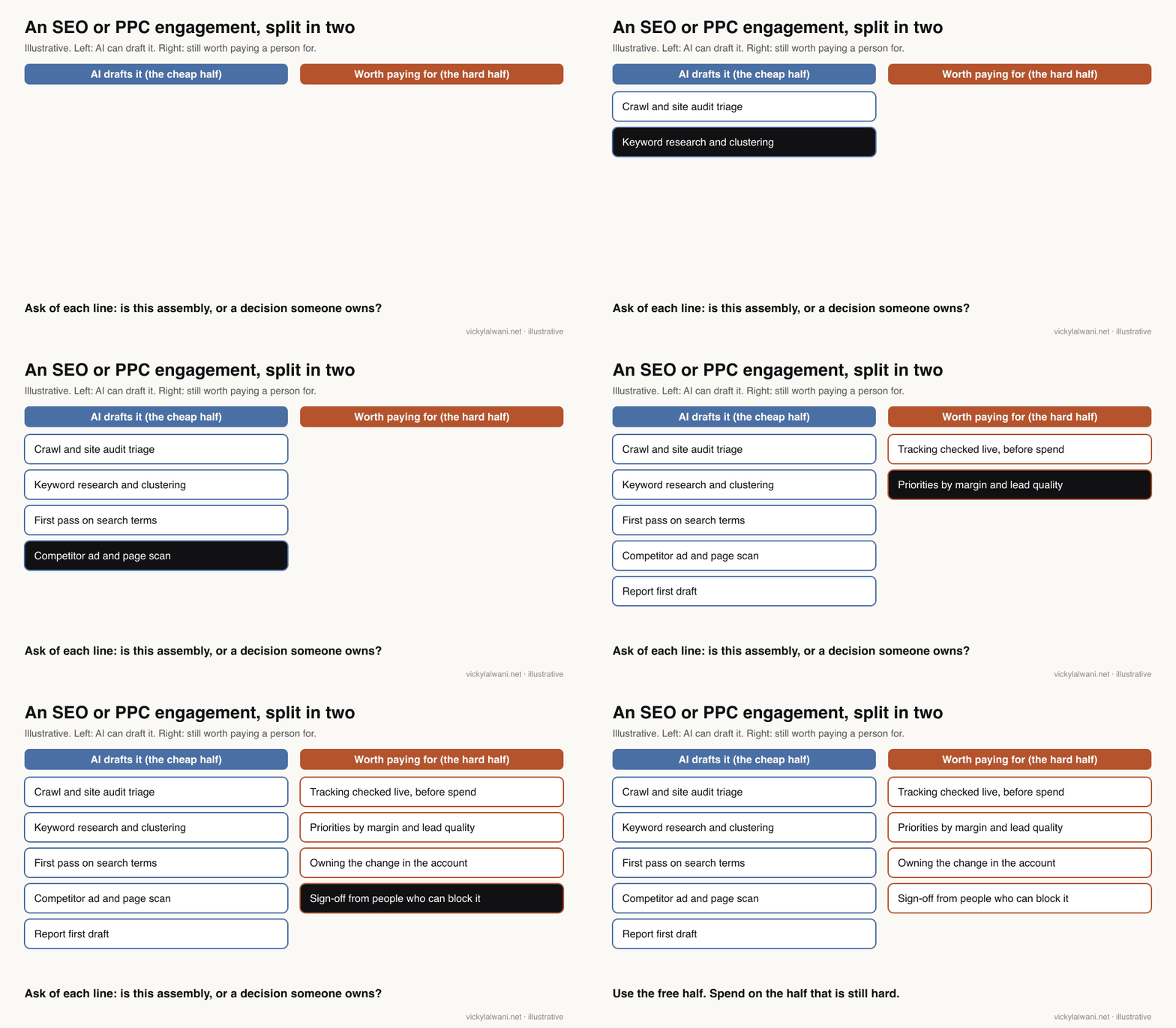
A useful way to see it is line by line. Take the parts of a typical audit and ask of each one: is this assembly, or is it a decision somebody has to own?
| Engagement line | AI drafts it? | Why a person still matters |
|---|---|---|
| Site crawl triage | Yes | Which errors cost money |
| Keyword research | Yes | Which terms your buyers use |
| Search terms review | First pass | Final call on each negative |
| Competitor scan | Yes | What to copy, what to ignore |
| Report draft | Yes | The note on what happens next |
| Tracking check | Partly | Test forms and calls live |
| Priorities | Suggests | Margin, capacity, lead quality |
| Implementation | Drafts | Who changes the live account |
| Sign-off | No | People who can block it |
The earlier version of this article described a seven-stage analysis layer: frame, size, decide, design, de-risk, report and run. It still holds, and it maps neatly onto search work. The difference in 2027 is where the stage ends: AI drafts each stage, and a person signs it off.
| Stage | In SEO and PPC | Who signs off |
|---|---|---|
| Frame | Which goal: leads, sales, calls | Owner and consultant |
| Size | Search demand, share of clicks | Consultant checks data |
| Decide | Which channel, which pages | Owner |
| Design | Campaign and site structure | Consultant |
| De-risk | Tracking, budgets, brand terms | Consultant |
| Report | Monthly results and next steps | Consultant writes the note |
| Run | Weekly checks and changes | Whoever owns the account |
For a full worked example of the checks an AI can run on a live account, see the companion piece on running a PPC audit with Claude. This page is about what you buy around those checks.
What does the research say about AI doing consulting work?
Short answer: it helps a lot on tasks inside what AI does well and hurts on tasks just outside it. In the best-known field experiment, people using GPT-4 completed 12.2% more consulting tasks and were 25.1% faster, yet were 19% less likely to reach a correct answer on a task chosen to sit outside AI's abilities.
The study is Harvard Business School Working Paper 24-013, run with Boston Consulting Group and later published in a peer-reviewed management journal in 2026. It put 758 knowledge workers through realistic consulting tasks, with and without AI. The authors call the uneven result a "jagged technological frontier": AI can be excellent on one task and misleading on the next, even when both look equally hard.
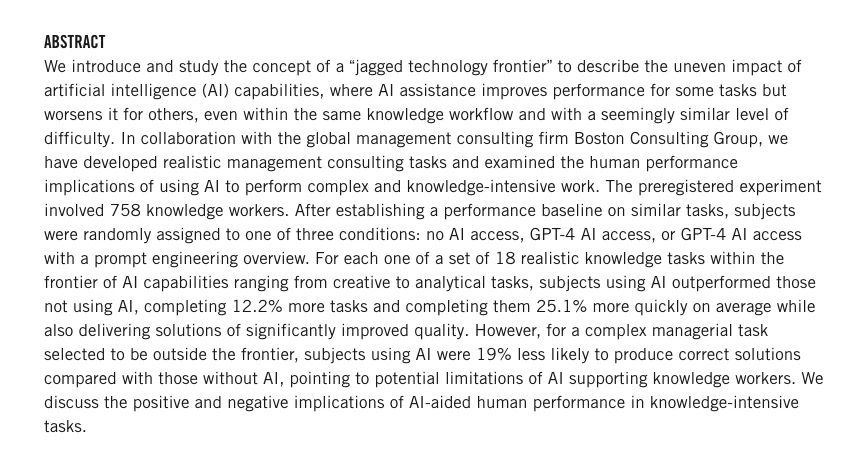
Search marketing has the same jagged edge. Summarising a search terms report, clustering keywords or drafting ad copy sits well inside the frontier. Deciding whether a drop in leads is a tracking fault, a bidding change, a competitor or a seasonal dip often sits outside it, because the answer depends on things the data does not show: a form that broke on Tuesday, a sales team that stopped calling back, a new competitor in one suburb.
| Usually inside the frontier | Often outside it |
|---|---|
| Clustering a long keyword list | Which cluster earns margin |
| Flagging irrelevant search terms | Whether broad match is still exploring |
| Listing crawl errors | Which error costs leads |
| Drafting headlines | What the offer should be |
| Summarising a month | Why leads fell |
The practical lesson is not "trust AI less". It is to know which side of the edge a question sits on before you accept the answer.
Why is consulting analysis getting cheaper?
Short answer: because the large firms are automating it themselves. McKinsey's global managing partner said in January 2026 that the firm had about 40,000 people and 20,000 AI agents, and that about a third of its revenue now comes from work where it underwrites outcomes rather than selling advice.
Both figures come from the Harvard Business Review IdeaCast episode of 6 January 2026. In the transcript the firm describes moving away from "pure advisory work" and a fee-for-service model towards a model where it agrees a business case with the client and shares the outcome. The agent count is the firm's own claim and changes month to month; treat it as a direction, not an audited number.
When the biggest consulting firm in the world says its agents now do much of the search and synthesis, the price of a document falls for everyone. Smaller consultants and agencies feel it first, because their audits were mostly assembly. What holds its value is the part tied to an outcome: did the leads, sales or calls actually move?
The same pressure is showing up in other professional services. An AI news account on X shared a Financial Times report that a large firm pushed its own auditor to cut fees to reflect AI savings. That is a second-hand report and is not verified here, but it shows buyers are already asking the question.
What is still worth paying an SEO or PPC consultant for?
Short answer: six things: access and tracking checked live, priorities set by your margin and lead quality, judgement on the questions outside AI's frontier, safe implementation in the live account, a second view on Google's own automated advice, and someone accountable for the result.
1. Access and tracking, checked live. In my own work, access and measurement block more projects than strategy does. Someone says the account is shared and the role turns out to be view-only or wrong. I check the real role on a shared screen before anything else, and campaigns stay in draft until every form and call button is measured. An AI can read a tag report; it cannot fill in your contact form and watch the conversion arrive.
2. Priorities by business value. An AI audit tends to list everything at once. A consultant should tell you which three fixes matter this month for your margin, your sales team's capacity and the quality of leads, and which forty can wait.
3. Judgement outside the frontier. Is the cost per lead up because of tracking, bidding, competition or the season? Is broad match still finding new buyers, or wasting money? These questions need context from outside the export.
4. Owning the change. Somebody has to change the live account or the live page, with a way back if it goes wrong. On client accounts my rule is the same every time: audit first, put the findings in a sheet, check them by hand, and change nothing before approval. The Google Ads automation with Claude guide explains how to sort changes by how hard they are to undo.
5. A second view on Google's own AI advice. Google Ads already gives you a free automated audit: recommendations and an optimisation score. Google describes the score as an estimate of how well your account is set to perform, from 0 to 100%. That measures setup against Google's suggestions, not profit. A PPC consultant on X described a client's new in-house marketer calling an account under-optimised because the score was low, and the meeting going downhill from there. Knowing when to ignore a recommendation is part of the job.
6. Accountability. Someone whose name sits on the result, who explains a bad month in plain words and says what happens next. Every report I send carries a short human note: where we are, what we are doing, what is next.
If the bigger question is who should hold that accountability, read freelance PPC consultant vs agency. If you want to see how an SEO engagement starts in practice, read what an SEO consultant does on day one.
How do you test AI analysis against your last paid audit?
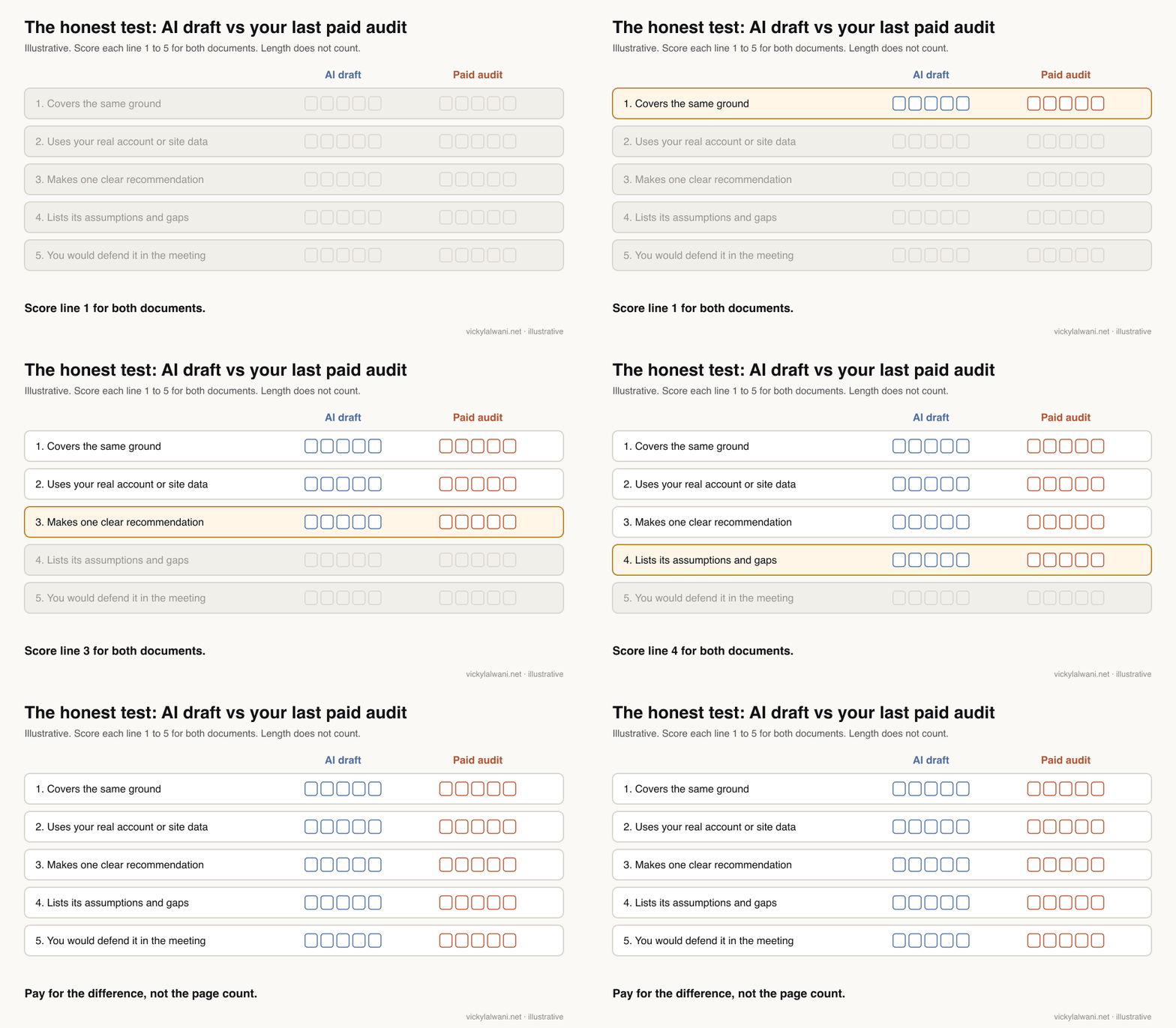
Short answer: pick one live decision, give an AI assistant the same data your last consultant had, ask for the same deliverable, then score both documents on five lines: coverage, use of your real data, one clear recommendation, stated assumptions, and whether you would defend it in a meeting.
- Pick one decision in flight. For example: should we move budget from Performance Max to Search, or which twenty pages should we refresh first?
- Give the same inputs. The same exports, date range and goals the consultant had. No more, no less.
- Ask for the same deliverable. Use the prompt below.
- Score both on the same five lines. Length and design do not score.
- Check three facts in each. Pick three numbers at random and trace them back to the account or Search Console.
You are reviewing a [Google Ads account / website's organic search] for a [business type].
Goal: [leads / sales / calls]. Main constraint: [budget, staff, season].

Data attached: [search terms export, campaign report, Search Console pages report, crawl export].
Date range: [dates]. Use only this data and say "not in the data" when something is missing.

Deliver:
1. The three changes that would most improve [goal] in the next 30 days, ranked.
2. For each: the evidence (quote the rows), the expected effect, the risk, and how to undo it.
3. What you would NOT change yet, and why.
4. Your assumptions, listed separately from facts.
5. Three questions you need answered by a person before acting.
Keep it under one page.
| Line to score | What good looks like |
|---|---|
| Coverage | Same ground, no padding |
| Real data | Quotes your rows, not averages |
| Recommendation | One clear first move |
| Assumptions | Listed apart from facts |
| Defensible | You would present it |
If the AI draft scores level with your last paid audit, stop paying for that kind of document. If it falls short on assumptions, priorities or defensibility, that gap is what a consultant is for.
How do you stop AI analysis from being confidently wrong?
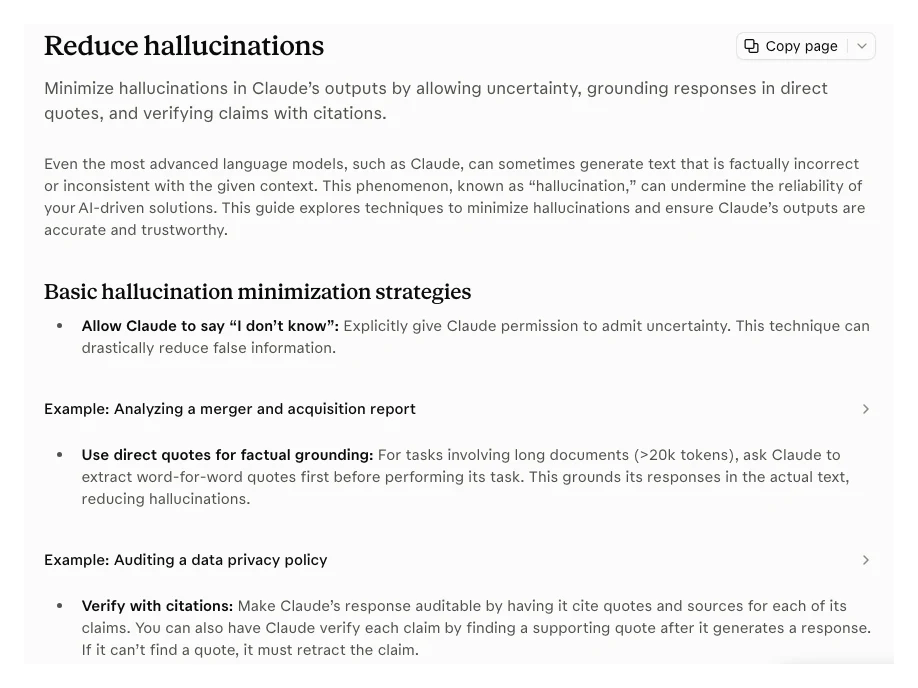
Short answer: give the model permission to say it does not know, make it quote the rows behind each claim, restrict it to the data you supplied, and have a person check every number before it reaches a client, a board or a live page. Anthropic and Google both say this in their own guidance.
Anthropic's documentation on reducing hallucinations lists three basic moves: allow Claude to say "I don't know", ask for word-for-word quotes before the analysis, and make it cite a source for each claim and retract any claim it cannot support. It also says these techniques reduce errors but do not remove them.
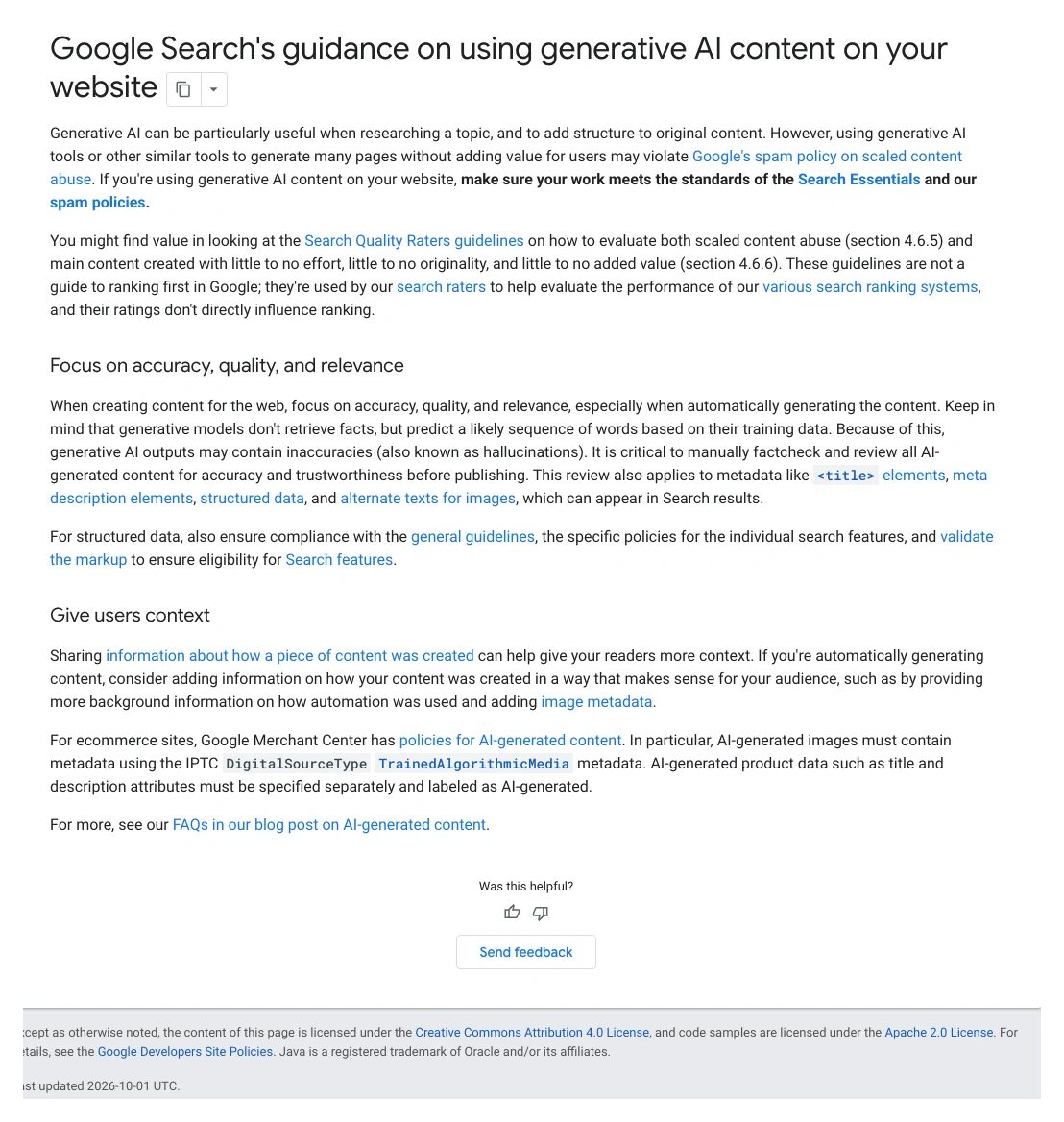
For SEO the stakes are public. Google's guidance on using generative AI content on your website (last updated 1 October 2026) says it is critical to fact-check and review all AI-generated content before publishing, including titles, meta descriptions, structured data and image alt text. It also warns that generating many pages without adding value may breach its spam policy on scaled content abuse.
| Check | How |
|---|---|
| Numbers | Trace three back to the source |
| Quotes | Each claim cites a row |
| Gaps | "Not in the data" is allowed |
| Ranges | Sizes as ranges, not points |
| Counter-case | Ask for the best argument against |
| Human read | Before anything goes live |
A cheap analysis that is wrong is not a saving. It is a cost you find later, usually in the ad account.
What should you ask before hiring an AI consultant?
Short answer: ask what data they will work from, who approves changes, how they check AI output, what access they need on day one, and which single measure will show the work paid off. Be wary of anyone who sells prompts alone or promises that AI replaces your team.
| Ask | Good answer | Red flag |
|---|---|---|
| What data? | Your account, Search Console, CRM | "We have a framework" |
| Who approves? | You, before anything goes live | "The agent handles it" |
| How is output checked? | A person traces the numbers | "The model is very accurate" |
| Access on day one? | Read-only first | Admin everywhere at once |
| Measure? | Leads, sales or hours saved | Number of reports delivered |
One more test: ask them to show where their own AI got something wrong and how they caught it. Anyone who has done this work for real has an answer.
How should you budget for AI consulting in 2027?
Short answer: spend less on documents and more on outcomes. Use AI, or a short paid audit, for the analysis; pay for monthly management or a one-off build where a person owns the result; and judge every line by a search measure such as cost per qualified lead or organic leads.
| Buy | When it fits | Judge it by |
|---|---|---|
| One-off audit | You will run the fixes | Three clear priorities |
| Monthly management | You want an owner | Cost per qualified lead |
| AI build | Repeat work eats hours | Hours and errors saved |
| Hourly advice | Second opinion on AI work | Decisions made |
My rates for each are on the pricing page. Whoever you hire, ask for the AI part to be shown openly. If AI did the drafting, you should not be billed as if a person spent days on it.
What people say on X and Reddit
Short answer: practitioners agree AI makes audits fast and cheap, and many sell that speed. The sharper threads are from consultants dealing with clients who now check their work with ChatGPT, and they point the same way as this article: the value is in judgement and context, not in the document.
| Who, on X | What they said | Type | Post |
|---|---|---|---|
| A PPC consultant | A client's new in-house marketer called an account under-optimised because the optimisation score was low (12 Jul 2025) | First-hand | Post |
| A direct-to-consumer agency account | "RIP" to paid Google Ads audits: a Claude skill that audits an account in four minutes (25 Jun 2026) | Vendor, promotional | Post |
| An AI automation creator | A Claude skill for a full Google Ads audit in under five minutes, inside Cowork (30 Mar 2026) | Promotional | Post |
| A Google Ads consultant | Nine copy-paste prompts for an account audit and a 90-day plan; prefers Claude for audits (22 Apr 2026) | Opinion, promotional | Post |
| A former Google employee | After auditing over 1,000 accounts, the same four mistakes keep appearing, and none is the bid strategy (25 Sep 2026) | First-hand claim | Post |
| An AI news account | Shares a Financial Times report of a firm pressing its auditor to cut fees for AI savings (6 Feb 2026) | News share, not verified | Post |
| Digital Content Next | A "gold rush" of firms claiming they can get brands cited by AI (7 Apr 2026) | Publication | Post |
| Community | What the thread says | Type | Link |
|---|---|---|---|
| r/PPC | Clients paste reports into ChatGPT and return with questions it has no context for; one fix is a live view of the real numbers (17 Aug 2026) | First-hand | Thread |
| r/PPC | A client forwards ChatGPT analysis of every report; top reply suggests a one-page decision memo and a short call (20 Aug 2026) | First-hand | Thread |
| r/googleads | AI tools are good for variations and grunt work, poor at strategy; Google Ads is already an AI tool (7 Jan 2026) | Opinion | Thread |
| r/PPC | Asked which AI workflow they would never do by hand again, practitioners named search term reviews; one reply says AI misses much of the work because it lacks industry nuance (20 Jul 2026) | First-hand | Thread |
The most useful idea in these threads came from r/PPC. When a client keeps running reports through ChatGPT, the problem is usually that they cannot tell which decision the report asks them to make. The suggested fix is a short decision memo on top: what changed, the likely cause, the one action recommended, the trade-off, who owns it and when it will be reviewed. That is the consultant's job in one paragraph, and it is the part no chatbot can write without the account context.
Videos worth watching
Short answer: start with Anthropic's own short video on why models hallucinate, then a news explainer on what AI means for the big consulting firms, and the long interview with the study's authors if you want the evidence behind the jagged frontier.
Made by Claude (Anthropic's official channel), 15 April 2026, about five minutes. It sells nothing directly, though it is the vendor explaining its own product's limits.
Made by The Economist, 11 August 2025, about seven minutes. A news explainer; it sells nothing. Useful background on why consulting fees are under pressure.
Made by CXOTalk, 22 January 2024, about an hour. Two of the study's authors discuss the jagged frontier; it promotes the show's newsletter only.
| Video | Channel | Date | What it covers |
|---|---|---|---|
| Why do AI models hallucinate? | Claude | 15 Apr 2026 | Why confident errors happen |
| Is McKinsey losing its crown to AI? | The Economist | 11 Aug 2025 | Consulting fees and AI |
| How to Use Generative AI in Consulting | CXOTalk | 22 Jan 2024 | The jagged frontier study |
| Does Google Search use SEO scores? | Google Search Central | 15 Aug 2023 | Why tool scores are not rankings |
| AI Just Broke This Google Ads Account | A Google Ads coaching channel | 24 Sep 2026 | When automation goes wrong |
| What's the deal with the Google Ads Optimisation Score? | A Google Ads training channel | 17 May 2023 | Reading the score with care |
Where this advice is weak
Short answer: the main study is from 2023 and used GPT-4, the consulting-firm figures are the firm's own, and the line between the cheap half and the hard half moves every few months as models improve.
- Old model, new tools. The Harvard and BCG experiment used GPT-4. Current models handle more tasks well, so some of today's "outside the frontier" work will move inside it. The principle (check which side a task sits on) should last longer than the numbers.
- Self-reported figures. The agent count and revenue share come from a podcast interview with the firm's leader, not an audited report.
- Small accounts differ. For a very small budget, a careful AI audit plus a few hours of human review may be all the consulting you need.
- Vendor claims on X. The "audit in four minutes" posts are promotional and were not tested here.
- My bias. I sell SEO, PPC and AI automation work, so I have a reason to say people still matter. The test in this article is there so you can check that for yourself.
Want a second opinion on your AI analysis?
If you already have an AI-drafted audit, or a paid one you are not sure about, I can check it against your live data and tell you which three changes are worth making first. For search work, that sits under SEO consulting or Google Ads management. If you want the analysis layer built into your own team, with skills, read-only connections and approval steps, that is AI automation, and Claude-specific setup is covered by my Claude consultant service. Rates are on the pricing page.
Keep reading: PPC audit with Claude, Google Ads automation with Claude, freelance PPC consultant vs agency and what an SEO consultant does on day one.
Sources
| Source | What it supports | Date |
|---|---|---|
| HBS Working Paper 24-013 | 758 workers; 12.2%, 25.1%, 19% | Sept 2023, read 18 Nov 2026 |
| HBR IdeaCast episode 1060 | Agents and humans; outcome-based fees | 6 Jan 2026 |
| Google Ads Help: optimisation score | Estimate of setup, 0 to 100% | Read 18 Nov 2026 |
| Claude docs: reduce hallucinations | Say "I don't know", quotes, citations | Read 18 Nov 2026 |
| Google Search Central: generative AI content | Fact-check AI content; scaled content abuse | Updated 1 Oct 2026 |
| X, Reddit and YouTube | Practitioner views, linked above | Jul 2025 to Oct 2026 |
This article expands on my post on LinkedIn ↗.
FAQ
What is AI consulting?
AI consulting covers three things: consultants who build AI systems for your team, consultants who use AI to do their analysis faster, and AI tools that draft the analysis with no consultant. For SEO and PPC, the useful version pairs AI-drafted analysis with a person who checks it and owns the result.
Can AI replace an SEO or PPC consultant?
AI can now draft most of the analysis in an SEO or Google Ads audit, such as crawl triage, keyword clustering and a first pass on search terms. It cannot check tracking live, rank fixes by your margin, make changes safely in the account or be accountable for the outcome.
What is still worth paying a consultant for in 2027?
Pay for access and tracking checked live, priorities set by margin and lead quality, judgement on questions the data cannot answer, safe implementation in the live account, and accountability for the result. Stop paying for documents that are mostly assembly.
How do I test AI analysis against a paid audit?
Give an AI assistant the same data and goal your last consultant had, ask for the same deliverable, then score both documents on coverage, use of real data, one clear recommendation, stated assumptions and whether you would defend it. Trace three numbers in each back to the source.
How accurate is AI for consulting work?
A Harvard Business School study with Boston Consulting Group found people using GPT-4 completed 12.2% more tasks and worked 25.1% faster on tasks AI handles well. On one task outside that range they were 19% less likely to reach a correct answer.
Is a Google Ads optimisation score a good audit?
No. Google describes optimisation score as an estimate of how well an account is set to perform, from 0 to 100%, based on its own recommendations. It measures setup against Google's suggestions, not profit or lead quality.
How do I stop AI analysis from inventing numbers?
Allow the model to say "I don't know", make it quote the rows behind each claim, restrict it to the data you supplied and have a person check numbers before anything goes live. Anthropic's documentation lists these steps and says they reduce errors but do not remove them.
What should I ask an AI consultant before hiring?
Ask which data they will use, who approves changes, how a person checks AI output, what access they need on day one and which measure will show the work paid off. Be wary of anyone selling prompts alone or wanting admin access everywhere at once.