AI strategy for CEOs means deciding which business outcomes AI must improve, rebuilding one or two leadership routines around it and setting clear rules for data, actions and approvals. In PwC's 2026 Global CEO Survey only 12% of CEOs saw both cost and revenue gains from AI, so the work is in changing routines, not buying tools.
TL;DR
An AI strategy for business leaders is a plan to change how the company runs, not a budget line for tools. Most firms are not there yet: in PwC's 2026 Global CEO Survey, only 12% of 4,454 CEOs said AI had delivered both cost and revenue benefits, and 56% had seen no significant financial benefit.
Start with one leadership routine, such as the weekly business review, and rebuild it so the numbers arrive checked and ready to read. Write down what AI may see, what it may do alone and where a person must approve. Review at day 90 and keep only what earned its place.
For marketing, the strategy has to cover two shifts that land on the leader's desk: Google's AI Overviews and AI Mode are reported inside normal Search Console traffic, and Google Ads now offers channel priority and budget allocation controls, with a change to Search campaigns from February 2027.
Short answer: AI strategy for CEOs means deciding which business outcomes AI must improve, rebuilding one or two leadership routines around it, and setting clear rules for data, actions and approvals. The aim is a company where leaders see the whole business without status meetings and grow revenue without growing headcount at the same pace.
The biggest mistake leaders make is treating AI as a department project. A budget gets approved, a tool gets bought, and a year later the company runs exactly as before. For anyone planning 2027, a proper AI strategy starts from a different question: how does this company need to run if AI is part of the operating model?
This is the November 2026 update, with current survey figures and the Google changes that affect marketing budgets. If your leadership team wants help setting up the systems, my Claude consultant service covers the instructions, connections and routines. If the pressure is on growth, the search side sits with my SEO consultant and Google Ads management services.
What should an AI strategy for business leaders include in 2027?
Short answer: five things on one page: the three business outcomes AI must improve, the first two routines to rebuild and who owns each, the rules on data and approvals, the measures you will report to the board, and a review date about 90 days out.
| Part | What to write | Example |
|---|---|---|
| Outcomes | Three results AI must move | Decision speed, cost to serve, lead response time |
| First routines | Two workflows and their owners | Weekly business review; lead follow-up |
| Rules | What AI may read, do alone, never do | Drafts only; a person approves spend |
| Measures | Plain numbers for the board | Hours saved on reporting |
| Review | A date to keep, change or stop | Day 90 |
A plan this short forces choices. It also gives the board something it can check, which a list of tools never does.
When I wrote a six-month plan for one client, I broke it into quarters, each with action points and measures, so every quarter ended in a review. The same structure works for AI: a plan without a review date tends to drift into a tool list.
Why are most companies not seeing returns from AI yet?
Short answer: because most are still piloting rather than changing how work is done. PwC found only 12% of CEOs saw both cost and revenue gains from AI, while Gartner found marketing leaders put 15.3% of their budgets into AI but only 30% report mature AI readiness.
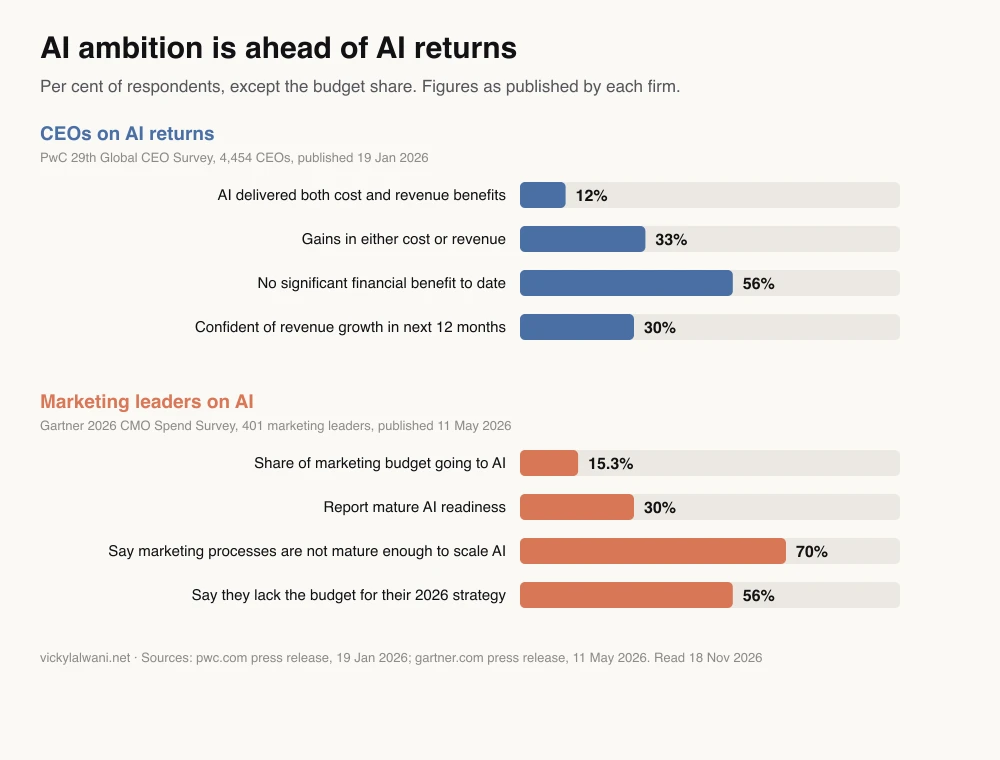
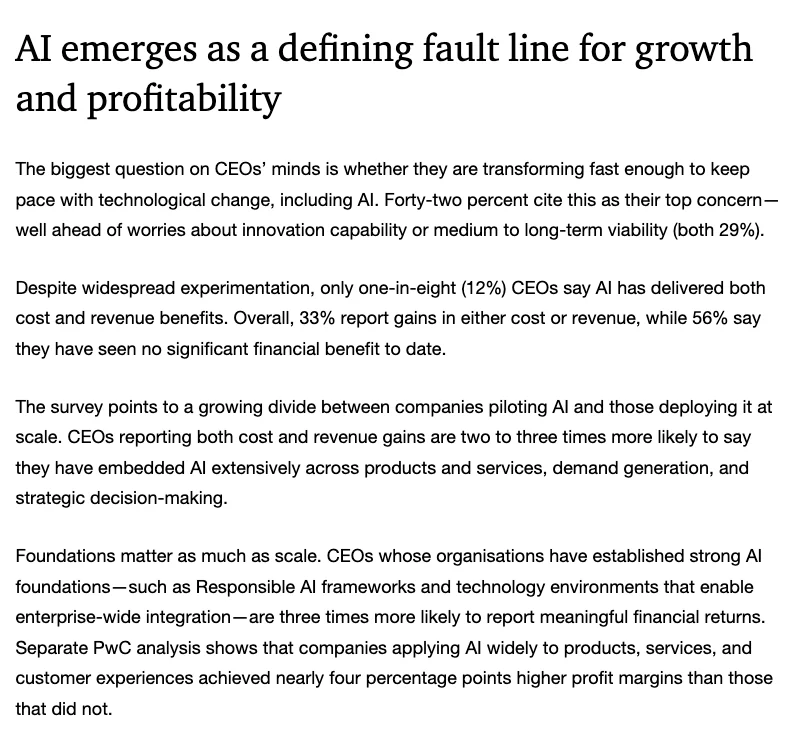
PwC's 29th Global CEO Survey asked 4,454 CEOs in 95 countries and territories, between 30 September and 10 November 2025. Only one in eight said AI had delivered both cost and revenue benefits. A third reported gains in either, and 56% had seen no significant financial benefit to date.
The useful part is what separates the 12%. PwC says CEOs reporting both gains are two to three times more likely to have embedded AI extensively across products and services, demand generation and strategic decision-making. Firms with strong foundations, such as responsible AI frameworks and technology that connects across the business, were three times more likely to report meaningful returns.
Marketing shows the same gap from the other side. Gartner's 2026 CMO Spend Survey of 401 marketing leaders found 15.3% of marketing budgets going to AI, while 70% said their marketing processes are not mature enough to implement and scale it. Marketing budgets sat at 7.8% of company revenue, almost flat on 2025.
Put together, the message for a CEO is plain. Spending on AI is not the hard part. Changing the routines, data and approvals around it is, and that is a leadership job.
Where does AI deliver value across the business first?
Short answer: in four places where leaders feel the pain every week: decision speed, visibility across the company, growing revenue without matching headcount, and early warning on problems. Start where the pain is obvious, not with a company-wide transformation.
| Area | What AI does | Marketing example |
|---|---|---|
| Decision speed | Summaries arrive ready to read | Weekly spend, leads and cost per lead in one page |
| Visibility | One view instead of three updates | Ads, analytics and CRM leads side by side |
| Revenue per person | Repetitive work moves to AI | First-pass search term review, report drafts |
| Early warning | Scheduled checks flag issues | Tracking breaks, spend spikes, form failures |
The CEO's job does not shrink in this picture. A chief executive still sets strategy, owns revenue and growth, designs the organisation and reports to the board. Each of those involves gathering information, making a decision and communicating it. AI is strong at the first and third steps, which frees the leader to concentrate on the second.
Before building a reporting dashboard for one client, I asked which projects mattered most and agreed the one headline number first. A leadership view built without that answer becomes another screen nobody opens.
How do you build the first routine: the Monday brief?
Short answer: connect the four or five sources the leadership team already asks about, have AI draft one page on what changed and why, have a named owner check every number, and send it before the weekly meeting. The meeting then decides instead of chasing updates.
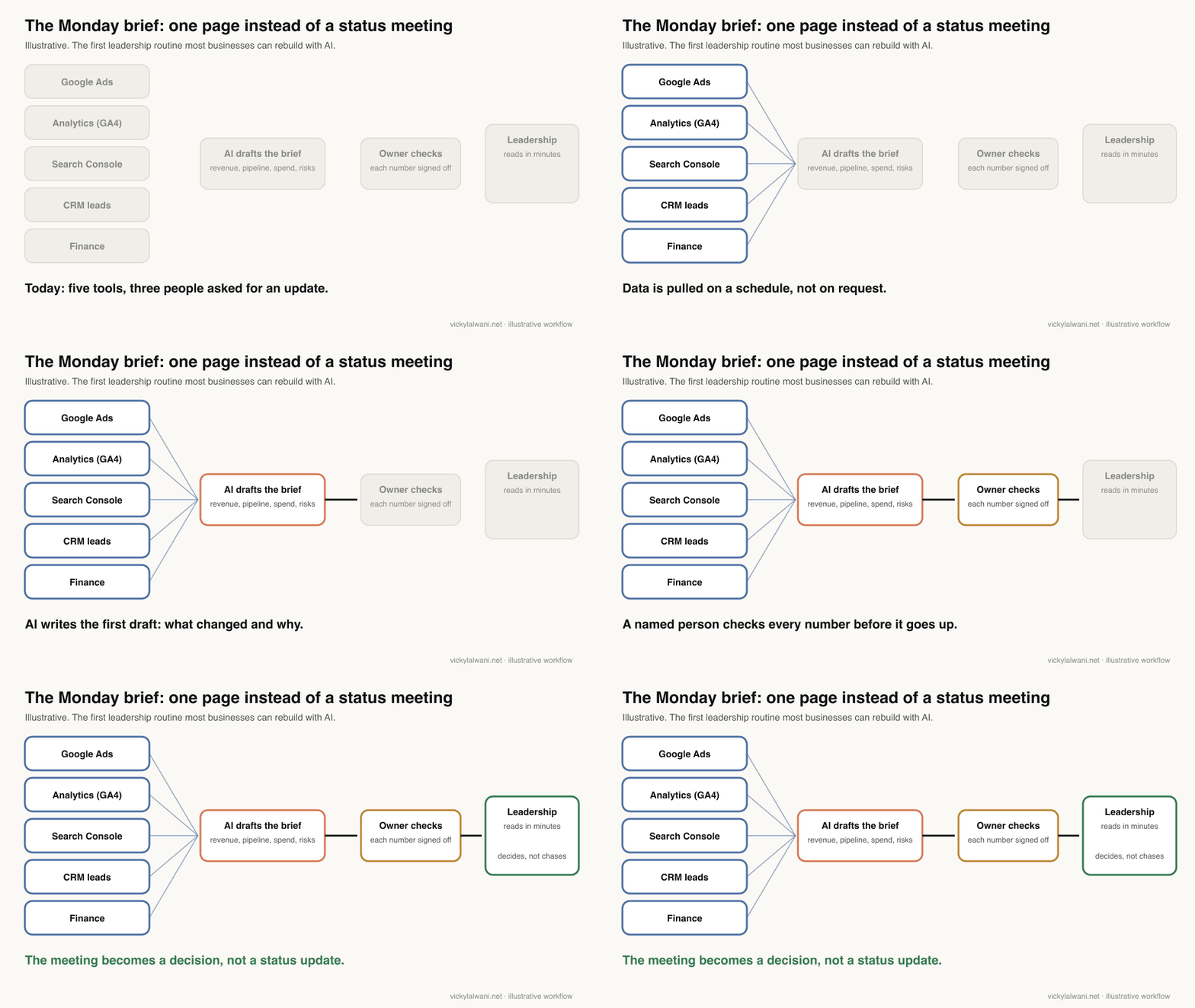
- Map where leaders are the glue. List every task where a senior person copies information between tools or chases an update. Those are your candidates.
- Write down how decisions get made. Goals, definitions of success, thresholds that should trigger action. If it lives only in someone's head, the system cannot use it.
- Connect the sources read-only first. Ads, analytics, Search Console, CRM and finance. Read access is enough for a brief.
- Give each number an owner. Marketing signs off spend and leads, finance signs off revenue. AI drafts; people sign.
- Keep the format fixed. Same sections every week, so changes stand out.
Here is a starting prompt for the draft. Paste it into a project that holds your goals and definitions.
You write the Monday leadership brief. One page, plain English, no adjectives.

Sources attached: [ads export, analytics summary, Search Console summary, CRM leads, finance summary]
Our goals and definitions: [paste: targets, what counts as a qualified lead, cost per lead limit]

Sections, in this order:
1. What changed since last week (five bullets, each with the number and the week before)
2. Why it changed, where the data shows a cause. Say "unknown" when it does not.
3. Risks: anything past a threshold in our definitions
4. Decisions needed this week, each with a recommended option and the owner
5. Numbers you could not check, listed separately

Do not invent figures. Do not recommend spend changes without the data that supports them.
If you want the reporting side built properly, my guide to automating an executive marketing dashboard covers the data plumbing, and AI marketing systems for CMOs covers what to automate inside the marketing team.
What does AI change in marketing, SEO and paid search decisions?
Short answer: three things a leader should ask about this quarter: how AI search features show up in your search traffic, how your Google Ads campaigns split budget across channels before the February 2027 change, and whether AI-driven ad settings such as AI Max are on and checked against lead quality.
Search traffic from AI features is not reported separately. Google's Search Central guide says sites appearing in AI Overviews and AI Mode are included in the overall search traffic in Search Console, under the "Web" search type. It also says there are no extra requirements to appear in them beyond normal SEO best practice.
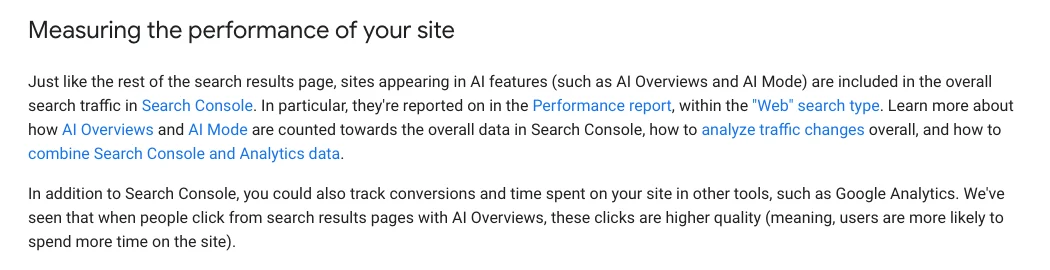
For a CEO, that means a fall in organic clicks is not by itself proof that SEO stopped working. Ask the team for leads and revenue from organic search, not just clicks. On r/SEO, practitioners explaining AI Overview traffic drops to clients said conversions often held while clicks fell. My checklist on how to appear in Google AI Overviews covers what the team can actually change.
Google Ads budget controls are changing. On 14 October 2026 Google announced channel prioritisation and budget allocation controls for Search, Shopping, Performance Max and Demand Gen. Advertisers can mark channels high or low priority and cap low-priority channels at a share of the daily budget.
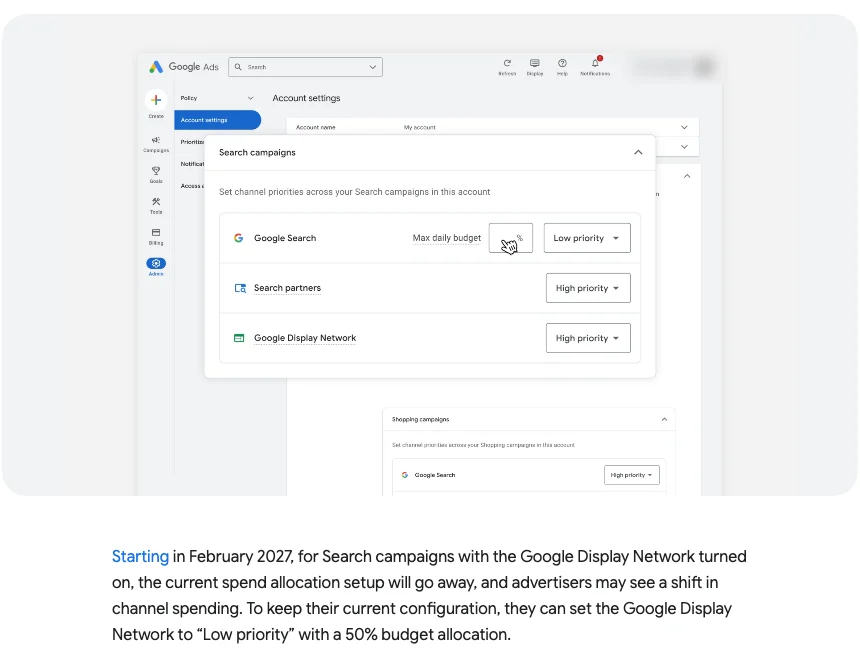
The date to put in the plan: from February 2027, Search campaigns with the Google Display Network turned on lose the current spend allocation setup, and Google says advertisers may see spending shift between channels. Ask your paid search team which campaigns this affects and what setting they will choose.
AI-driven ad settings need a lead-quality check. Google describes AI Max for Search campaigns as a set of targeting and creative features that expand keywords with broad match and keywordless technology. That can find new demand, and it can also find junk. The leader's question is simple: are the extra conversions real leads in the CRM?
| Decision | Question to ask the team | Evidence to see |
|---|---|---|
| SEO budget | Are organic leads down, or only clicks? | Search Console plus CRM leads |
| Paid channel mix | Which channels are high priority, and why? | Spend and leads by channel |
| Feb 2027 change | Which Search campaigns use the Display Network? | Campaign list and chosen setting |
| AI Max | Are new conversions real leads? | Search terms and CRM match |
| AI tools spend | What did it replace or speed up? | Hours saved, cost per lead |
For the planning side of these decisions, my article on marketing strategy versus a marketing plan shows how to turn them into an SEO and paid search plan with owners and dates.
What rules should leaders set for AI?
Short answer: three rules cover most risk: what data AI may see, what it may do on its own, and what always needs a person's approval. Anything that spends money, changes a live ad account or speaks to customers should need approval until the team has evidence it can be trusted.
| Rule | Safe default | Loosen when |
|---|---|---|
| Data AI may see | Read-only access, business accounts | Access is logged and owned by the company |
| Actions alone | Drafts, summaries, checks | A task passes review for weeks |
| Needs approval | Spend, live ads, customer messages | Rarely; keep a person here |
| Tool ownership | Company account and company email | Never on personal accounts |
These are the rules I work to with clients. Campaigns stay in draft until the owner has reviewed them on a shared screen. On one outreach project, the client's CEO reviews every email before it is sent. AI tools are bought on the company's own account, so the business owns them. And I test a new agent workflow in my own workspace first, and only move what works into a client's.
On client ad accounts I go one step further: the AI audit goes into a sheet, I check it by hand against the account, and nothing changes before approval. AI drafts are fast; they are not yet trustworthy enough to skip that step on someone else's money.
What are the most common AI strategy mistakes?
Short answer: buying tools before defining the problem, giving the project to someone without authority to change processes, expecting one prompt to fix a broken workflow, skipping human review on anything that touches customers or money, and measuring activity instead of outcomes.
- Tools before problems. A subscription is easy to approve and hard to turn into a changed routine.
- No authority. The person running AI must be able to change how a process works, not just suggest it.
- Prompts as a fix for broken processes. If the data is wrong or the owner unclear, AI only makes the confusion faster.
- No human review. Customer messages, live ads and budget changes need a person until proven otherwise.
- Vanity measures. Number of prompts or seats says nothing about the business.
The best counter-example I have seen came from a business owner, not a strategist. When I offered to build AI products for their company, they parked the idea until sales were moving, and they defined success in physical terms: more cars outside and more people in the shop. That is the right order. AI serves the outcome; it is not the outcome.
None of this is about replacing people. It is about letting people make decisions faster, with better information, and scaling without a matching rise in cost.
How should you measure AI at board level?
Short answer: report a few plain measures tied to money and time, such as hours saved on reporting, time from lead to first reply, cost per qualified lead and revenue per employee. Skip tool usage counts. Compare each against the quarter before the change.
| Measure | Why the board cares | Where it comes from |
|---|---|---|
| Hours saved on reporting | Senior time back | Before and after timesheets |
| Lead to first reply | Speed wins deals | CRM timestamps |
| Cost per qualified lead | Marketing efficiency | Ad spend over CRM leads |
| Revenue per employee | Scale without headcount | Finance |
| AI drafts approved unchanged | Trust in the system | Review log |
Treat training as part of the plan. Teams that understand why a workflow changed adopt it faster and spot errors earlier. Leadership attention in the first quarter matters more than the size of the budget.
What does a 90-day AI plan look like?
Short answer: two weeks to map where leaders are the glue, two weeks to write the rules, four weeks to rebuild one routine end to end, four weeks to measure, then a decision at day 90 to keep, change or stop. One owner, one routine, one review date.
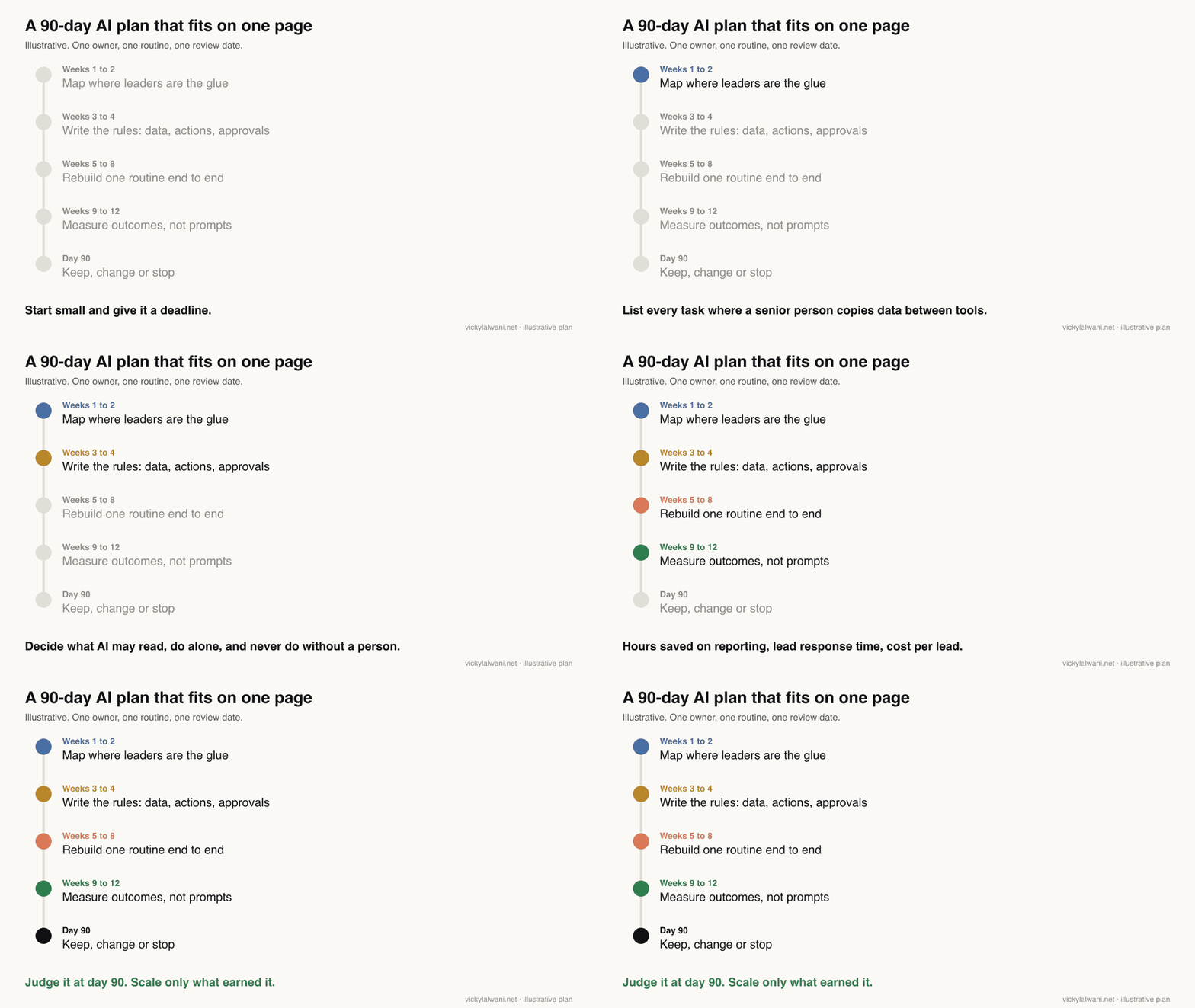
An advantage built on structure is hard for competitors to copy quickly, because it takes months of learning what to automate and what to keep human. PwC's survey adds a warning about time: CEOs reported spending 47% of their time on issues with a horizon under a year, and 16% on decisions more than five years out. A 90-day plan fits the first habit while building toward the second.
Videos worth watching
Short answer: McKinsey's short talk on the CEO's agenda and Harvard Business Review's piece on how AI changes strategy are the most useful for leaders; Google Search Central's quarterly update covers the search side. None of the three sells a product directly.
McKinsey & Company, 27 October 2026. Consulting firm thought leadership; no product pitch.
Harvard Business Review, 9 October 2026. On how strategy work and leadership skills change with AI.
Google Search Central, 26 October 2026. Google's own quarterly update on Search and AI features.
| Video | Channel | Date | What it covers |
|---|---|---|---|
| The CEO's Agenda for the Agentic Age | McKinsey & Company | 27 Oct 2026 | Leadership priorities |
| How AI Is Changing Strategy | Harvard Business Review | 9 Oct 2026 | Strategy skills |
| Google Search news, Q4 2026 | Google Search Central | 26 Oct 2026 | AI features in Search |
| The Economics of Enterprise AI | McKinsey & Company | 20 Oct 2026 | Costs and returns |
| Driving Agentic Transformation | McKinsey & Company | 8 Nov 2026 | Large-scale change |
| Google Marketing Live 2026 in 15 minutes | Google Ads | 20 May 2026 | Ads product launches |
What people say on X and Reddit
Short answer: consultancies and analysts on X agree the gap is the operating model, not the tools. On Reddit, business owners and SEO and PPC practitioners are more sceptical: AI search has cut clicks but not always leads, and automated ad suggestions still need someone who knows what good looks like.
| Who | What they said | Take it as | Link |
|---|---|---|---|
| McKinsey & Company | AI changes work faster than organisations change around it (25 Sep 2026) | Opinion | X post |
| McKinsey & Company | AI is open to all; advantage comes from redesigned operating models (31 Jul 2026) | Opinion | X post |
| An enterprise software CEO | After meeting IT leaders: gains need an operating model fix, not just tools (8 Jul 2026) | First-hand | X post |
| An enterprise IT analyst | The governance question is who owns the decision (14 Apr 2026) | Opinion | X post |
| Gartner | CMOs put 15.3% of budgets into AI; 30% ready to scale (11 May 2026) | Analyst | X post |
| Google Ads Liaison | Channel prioritisation and budget allocation controls rolling out (14 Oct 2026) | Vendor | X post |
| A PPC agency owner | Google Ads suggested cutting a budget; the suggestion did not make sense (7 Aug 2026) | First-hand | X post |
| r/SEO | Explaining AI Overview traffic drops: conversions held for many (5 Oct 2026) | Mixed | Thread |
| r/SEO | Traffic slightly down, rankings steady, leads up (29 Oct 2026) | First-hand | Thread |
| r/smallbusiness | Owners on AI: some customers walk away from AI bots, others save days of admin (18 Nov 2026) | Mixed | Thread |
| r/PPC | Running a PPC team without running accounts: own the conversion definitions (13 Jul 2026) | Opinion | Thread |
| r/Entrepreneur | Simplest AI search plan: answer real customer questions, keep details consistent (26 May 2026) | Opinion | Thread |
The r/PPC thread is the one most leaders should read. Its advice to own the conversion definitions and tracking, even when someone else runs the accounts, is the same rule as giving every number in the Monday brief an owner.
Where this advice is weak
- The PwC and Gartner figures are survey answers, not audited results. Gartner's sample is mostly large firms with over $1 billion in revenue, so smaller businesses may differ.
- The PwC survey closed in November 2025. Its 2027 edition may show a different picture.
- Google's February 2027 Search campaign change and the new controls are rolling out over months, so check your own account before acting.
- The 90-day plan and the Monday brief are illustrative structures, not a measured method. Adjust the timings to the size of the business.
- AI search reporting may change. Today Google reports AI Overviews and AI Mode inside normal Search Console data; that could change.
Want help turning this into a plan?
Short answer: pick one weekly routine, rebuild it this month and let the results decide what you build next. If you want a second pair of eyes on the plan, or someone to set up the systems, that is what my Claude consultant service does.
My Claude consultant service sets up the instructions, connections and routines around your business. If growth is the pressing problem, start with SEO or Google Ads management, where AI already does much of the first-pass work. Prices are on the pricing page, and The CMO Guide 2027 is free.
Sources
| Source | What it supports | Date | Link |
|---|---|---|---|
| PwC 2026 Global CEO Survey | 12%, 33%, 56%, 30%; foundations; time horizon | 19 Jan 2026 | Press release |
| Gartner 2026 CMO Spend Survey | 15.3% of budgets to AI; 30% ready; 70%; 7.8% | 11 May 2026 | Press release |
| Google Search Central | AI features in Search Console data; no extra requirements | Updated 10 Dec 2025 | Page |
| Google Ads and Commerce blog | Channel priority and budget allocation; February 2027 change | 14 Oct 2026 | Post |
| Google Ads Help, AI Max | What AI Max for Search does | Read 18 Nov 2026 | Page |
| X and Reddit posts | Practitioner and analyst views, listed above | Apr to Nov 2026 | See table above |
This article expands on my post on LinkedIn ↗.
FAQ
What should a CEO do first with AI?
Pick one recurring leadership routine, such as the weekly business review, and rebuild it so the numbers arrive checked and ready to read without a meeting. Prove the value there over about 90 days before expanding to a second routine.
What should an AI strategy for business leaders include?
It should fit on one page: three business outcomes AI must improve, the first two routines to rebuild and who owns each, rules on what AI may see and do, plain board measures and a review date. Tool choices come after those decisions, not before.
Is AI paying off for most companies yet?
Not yet for most. In PwC's 2026 Global CEO Survey of 4,454 CEOs, only 12% said AI had delivered both cost and revenue benefits and 56% had seen no significant financial benefit. Companies that embedded AI widely, including in demand generation and decision-making, were more likely to report gains.
Will AI replace the CEO?
No. AI can gather information and draft options faster, but direction, trade-offs and accountability stay with leadership. The real risk is being outpaced by leaders who rebuild their routines first.
Is AI strategy a marketing problem?
No. It touches strategy, revenue, operations, hiring and board reporting, and treating it as a marketing or IT project is a common mistake. Marketing is often where the first measurable wins appear, such as faster lead follow-up and cheaper reporting.
How does AI search affect a company's SEO numbers?
Google reports traffic from AI Overviews and AI Mode inside normal Search Console data, under the Web search type, so it is not split out. A fall in organic clicks is not proof SEO stopped working; leaders should ask for organic leads and revenue, not just clicks.
What is changing in Google Ads budgets in 2027?
Google announced channel prioritisation and budget allocation controls on 14 October 2026 for Search, Shopping, Performance Max and Demand Gen. From February 2027, Search campaigns with the Google Display Network on lose the current spend allocation setup, so ask your team which campaigns are affected.
How should a board measure AI?
Use a few plain measures tied to time and money, such as hours saved on reporting, time from lead to first reply, cost per qualified lead and revenue per employee. Compare each with the quarter before the change and ignore counts of prompts or seats.