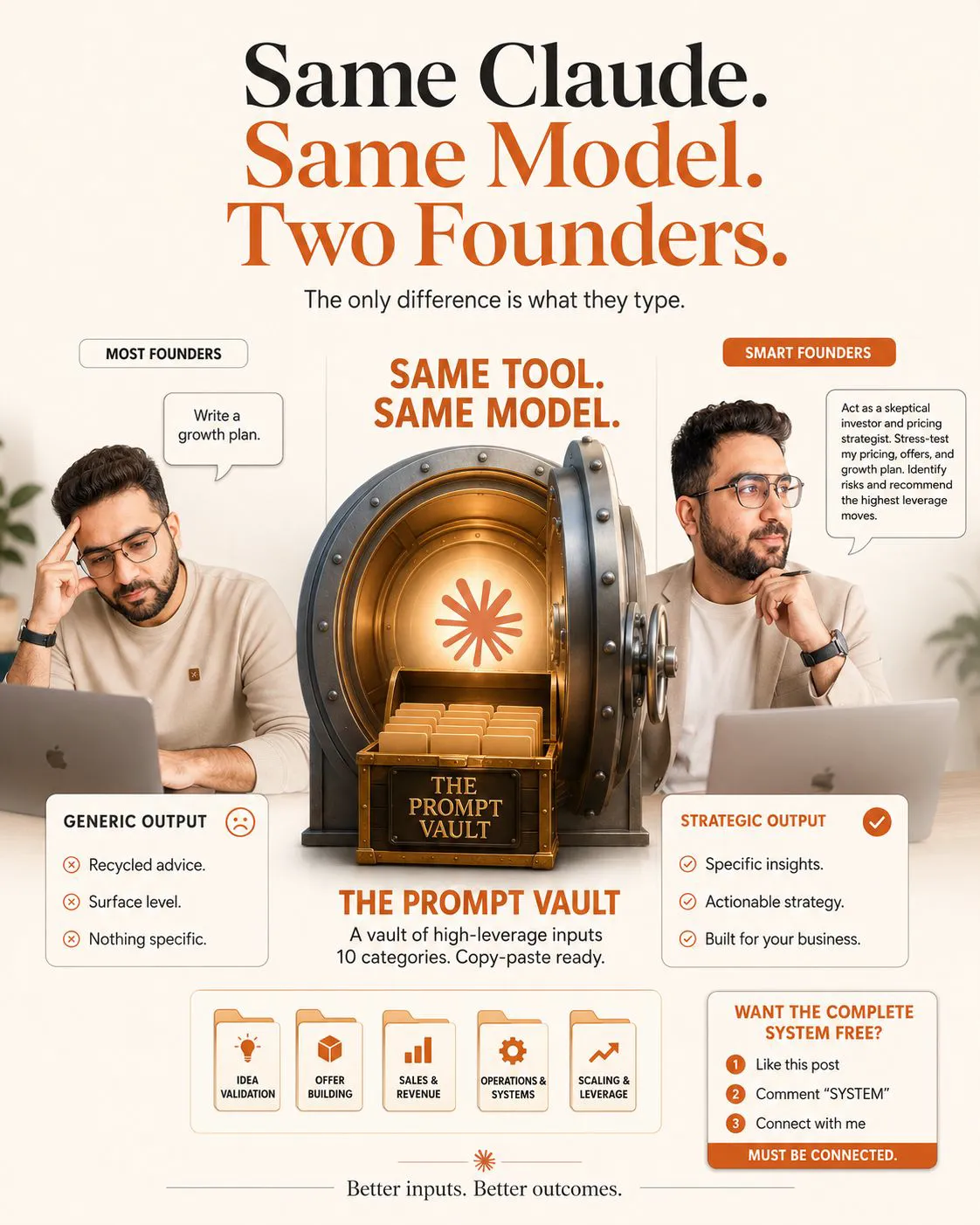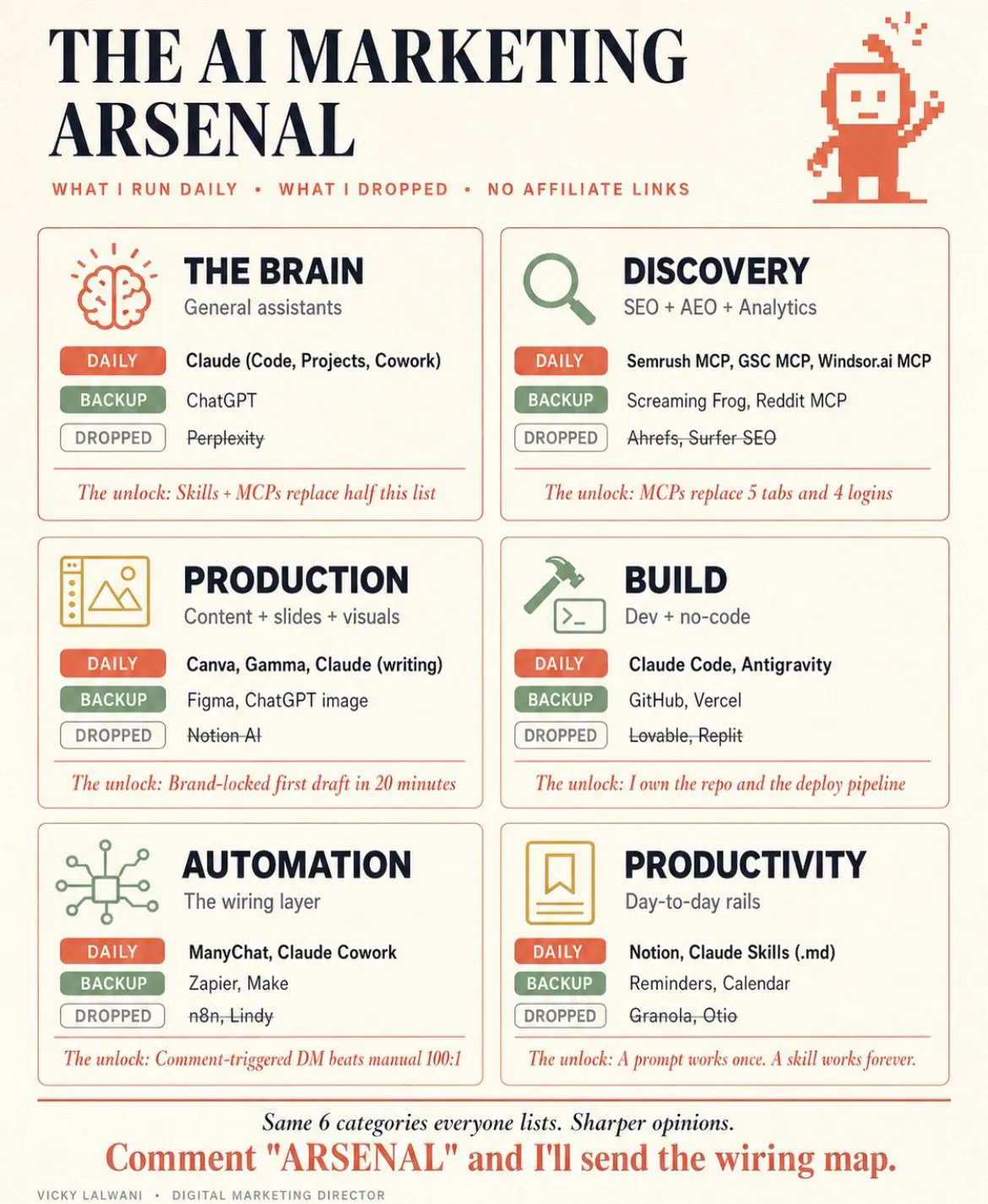
How to brief AI: give it what you would give a capable new hire. State the situation, the decision the output supports, the reader, what good looks like, the facts and samples to use and the limits, then ask it to raise questions first. A one-line prompt makes the model guess all of these; a short brief gets a draft you can edit and send.
TL;DR
To brief AI well, give it what you would give a capable new hire on day one: the situation, the decision the work supports, who will read it, what good looks like, the facts and samples to use, the limits, and an invitation to ask questions first. A one-line prompt makes the model guess all seven, and its guesses are the generic answer people complain about.
Anthropic, OpenAI and Google all give the same core advice in their current guides, and Anthropic's own usage data shows output tracks the sophistication of what people put in. Write the brief once, save it where your team can reuse it, and fix the brief rather than the draft when the answer misses.
Short answer: how to brief AI: state the situation, the decision the output supports, the reader, the format and length, the facts it must use, the limits, and ask it to raise questions before it starts. That takes a minute or two to write and turns a generic first draft into one you can edit and send.
The pattern is familiar. A chief executive asks an assistant for a board update and gets something bland. A marketing director asks for a campaign summary and gets a list anyone could have written. A founder asks for an investor note and gets corporate filler. All three conclude the model is weak. Usually the model had nothing specific to work with.
Leaders already know how to brief. You brief an agency, a new hire, a board. This page shows how to apply that habit to Claude, ChatGPT and Gemini, with a Google Ads board summary and an SEO content brief as worked examples. If you want a team-wide briefing standard built for you, that is part of my Claude consulting work, and the same discipline runs through my Google Ads and SEO services. Vendor guidance was checked on 18 November 2026.
What does it mean to brief AI rather than prompt it?
Short answer: a prompt is a request; a brief is a request plus the context a capable stranger would need to do it well. The three big vendors now say the same thing in their own guides: be specific, give context and say what good output looks like.
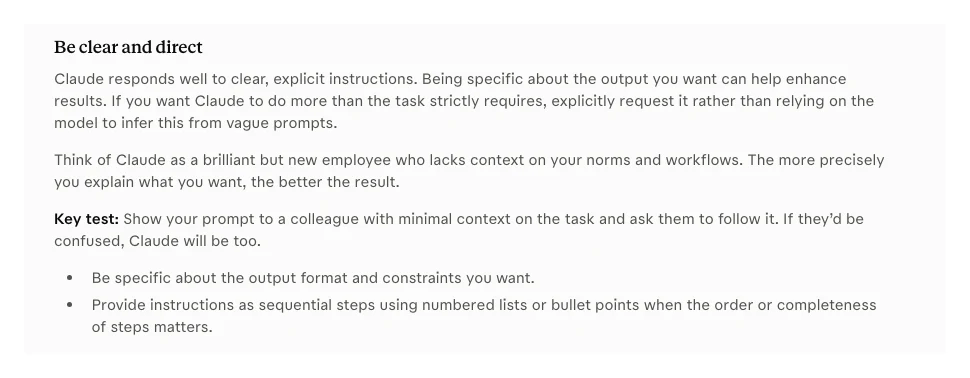
Search engines trained a habit of short, compressed queries, because they match words against an index. An assistant does not know your company, your numbers or your standards unless you say so. Anthropic's prompting best practices put it plainly: think of Claude as "a brilliant but new employee who lacks context on your norms and workflows". Its test is a good one for any leader: show your prompt to a colleague with little context on the task, and if they would be confused, Claude will be too.
| Vendor | Core advice | Source date |
|---|---|---|
| Anthropic | New employee; explain why; give examples | Read 18 Nov 2026 |
| OpenAI | Clear, specific, enough context; refine | Updated Oct 2026 |
| Persona, task, context, format | Guide dated Dec 2025 |
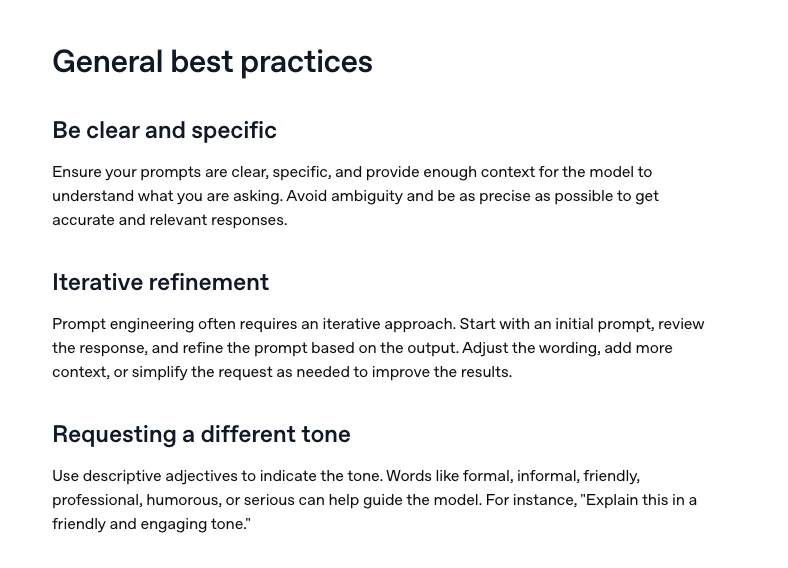
OpenAI's prompt engineering best practices for ChatGPT ask for prompts that are clear, specific and give "enough context for the model to understand what you are asking", then refine based on the output. Google's Gemini for Workspace prompting guide names four areas (persona, task, context and format) and says the verb in the task is the most important part. Anthropic adds one point leaders often skip: explain why. A rule with its reason behind it lets the model handle cases you did not foresee.
Why do one-line prompts get generic answers?
Short answer: because the model fills every gap with the most typical answer. Anthropic's June 2026 Economic Index found the reading level of people's prompts and of Claude's answers move together (a correlation of 0.87), and that answers rise furthest above the prompt where people describe what they want instead of supplying material.
Anthropic's Economic Index report of June 2026 estimated, for each conversation, the years of education needed to understand the prompt and the answer. Where people describe something to be built, such as an image, a game or a website, Claude's answer sits well above the level of the request. For audience-facing writing such as blogs and email the gap is close to zero, which Anthropic suggests may be because those prompts usually include draft language or source material in the same register as the output.
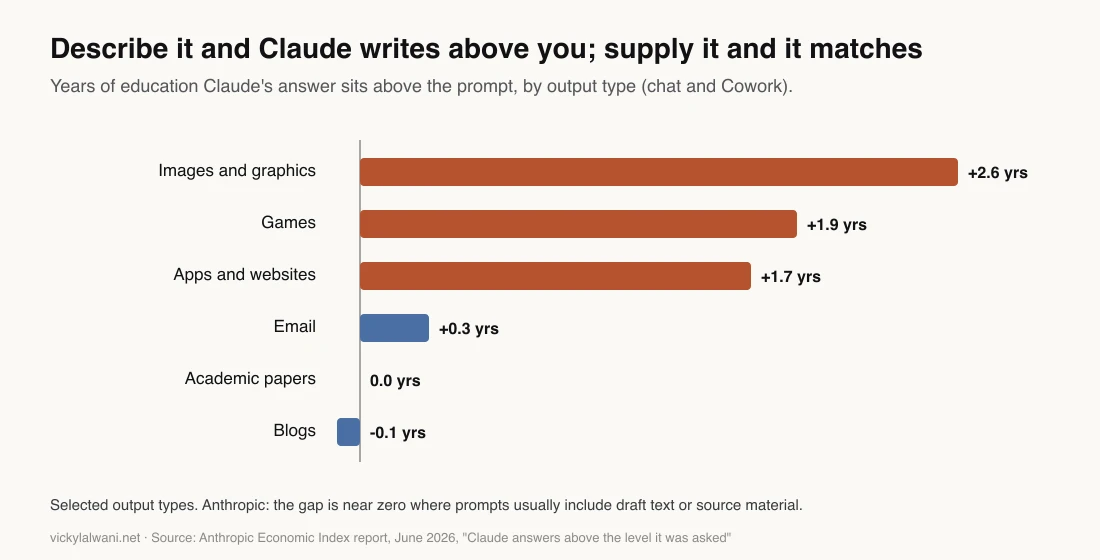
Read that as a briefing lesson. When you hand over the material, the output stays close to what you gave it. When you only describe, the model invents the rest, in its own register. The March 2026 report adds a second hint: people who had used Claude for six months or more had a higher success rate in their conversations, still about 4 percentage points higher after controlling for task, model and country. Anthropic's "intriguing potential explanation" is that these users have better learned to extract what they want. Briefing is a skill that improves with practice, not a trick.
A thread on r/ChatGPT made the content version of the same point: generic AI content is a problem of brands with no point of view, and AI just helps them "say nothing... faster" (r/ChatGPT, July 2026).
What goes in a good AI brief?
Short answer: seven parts: situation, the decision it supports, the reader, what good looks like, the facts and samples to use, the limits, and questions first. Most briefs need five to fifteen lines; add more only where the task has real constraints.
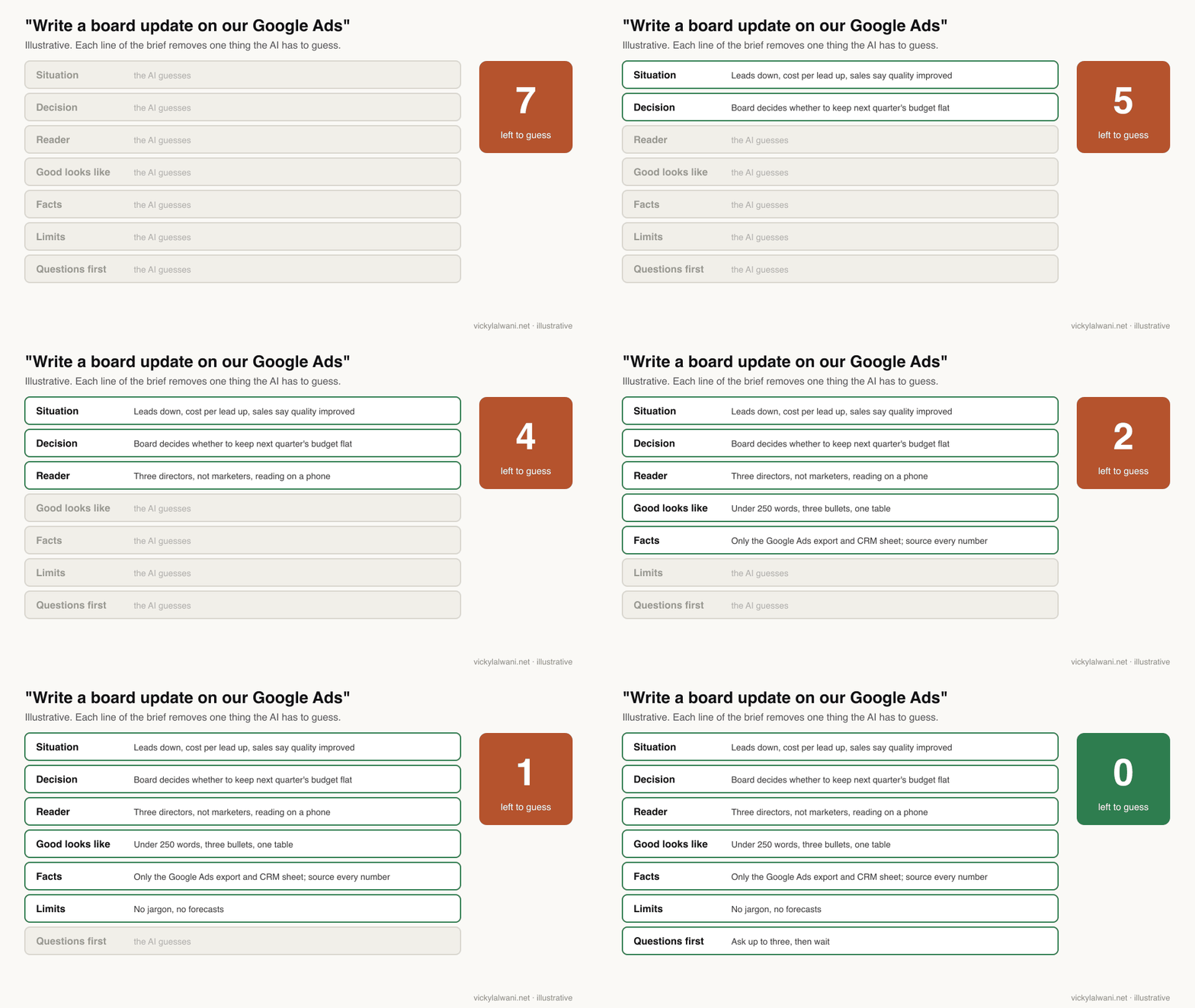
| Part | Answers | Google Ads example |
|---|---|---|
| Situation | What is going on? | Leads down, cost per lead up |
| Decision | What is it for? | Board decides next quarter's budget |
| Reader | Who reads it? | Directors, not marketers |
| Good looks like | Format, length | Under 250 words, one table |
| Facts and samples | What to use | Export, CRM sheet, last report |
| Limits | What not to do | No jargon, no forecasts |
| Questions first | What is unclear? | Ask up to three, then wait |
Two parts carry most of the weight. "Decision" changes the whole shape of the answer: a summary to help a board decide reads differently from one that defends the account. "Facts and samples" is where generic answers are won or lost. My own prompts are usually goal first and method open, which works for research and site work. For client accounts I learned to add the facts. When an AI audit of a client's Google Ads account came back with recommendations that did not match the account (a keyword flagged for pausing that was bringing in conversions, an ad group that was already off), the problem was not the model. It had not been told what was already decided.
Current facts matter as much as complete ones. On one client call the owner spotted an old offer figure in a plan I had sent; it had carried over from earlier context in a chat, while the new creative showed the current offer. Since then the rule is to paste the current figures into the brief and tell the model to use only those, not whatever it remembers from earlier in the conversation.
If you already brief agencies, you already know most of this. The fields map almost one to one:
| Agency brief field | AI brief line |
|---|---|
| Background | Situation |
| Objective | Decision it supports |
| Target audience | Reader |
| Deliverables | What good looks like |
| Assets and past work | Facts and samples |
| Mandatories | Limits |
| Briefing Q and A | Questions first |
When I briefed a client's web developer on changes to a live site, the same discipline applied: a written change document, the one priority stated first, urgent separated from not urgent, and a check with the owner before anything irreversible went live. Briefing a model is the same habit pointed at a new kind of colleague.
How do you brief AI for a Google Ads board update?
Short answer: attach the Google Ads export and the CRM lead sheet, say which decision the board is making, name the reader, fix the length and table, and tell the model to name the source of every number and say when it cannot work one out. Then ask it to raise up to three questions before writing.
The one-line version, "write a board update on our Google Ads", produces a confident page of general statements. Here is the brief version. Square brackets are yours to fill.
Situation: We run Google Ads for [business type] in [market]. Last month leads
fell and cost per lead rose. Sales say lead quality improved.

Decision: The board will decide whether to keep next quarter's Google Ads budget
flat. Help them decide; do not defend the account.

Reader: Three directors who are not marketers. They read this on a phone before
the meeting.

Good looks like: Under 250 words. Three bullets: what happened, why, what we
propose. Then one table comparing last month with the month before: spend,
leads, cost per lead, qualified leads.

Facts: Use only the attached Google Ads export and the CRM lead sheet. After each
number, name the file and the column it came from. If a number cannot be worked
out from these files, say so. Do not estimate.

Limits: Explain any term in five words or fewer (for example "cost per lead:
spend divided by leads"). No forecasts of next month's results.

Before you write: ask me up to three questions that would change the answer most.
Wait for my answers.
Two lines in that brief came from my own client work. When an AI audit came back too generic to show anyone, I stopped asking for a better audit and asked for three things instead: what is wrong, the order to fix it, and the action plan from tomorrow. And when the findings arrived, I asked for them in a sheet with "Manual check" and "Decision" columns, so a person signs off each line. The source-per-number rule does the same job in a board summary: anything the model cannot trace is visible before the directors see it.
A PPC practitioner on X shared a negative keyword prompt built the same way, starting with the product, the keyword, its match type and the audience's awareness level before asking for anything (post, February 2026). The time saving they claim is theirs and not tested here, but the structure is the point. For more Google Ads examples, see the Claude prompting framework, which works through negative keywords and ad copy step by step.
How do you brief AI for an SEO content brief?
Short answer: give it the Search Console queries for the page, notes on what customers actually ask, the reader (a writer who does not know your business), the sections to keep and cut, and limits such as no ranking promises and no invented statistics. Ask for the writer's brief, not the article.
Leaders often ask AI to "write an SEO article", get something long and empty, and blame SEO. A better job for the model is the brief a good writer needs, built from your own data.
Situation: Our service page for [service] has lost clicks over the last three
months. The attached Search Console export lists its queries for this period and
the previous one.

Job: Write a brief for a freelance writer who will refresh the page. Do not write
the page itself.

Reader: A capable writer who has never worked with us.

Good looks like: One page. The queries to answer (from the export only), the
questions customers ask (from the attached sales call notes), sections to keep,
sections to cut, three internal links to include, and a word range.

Limits: No ranking promises. No statistics or customer stories that are not in
the attached files. British spelling.

Before you start: list anything in the files you find unclear and what you
would assume.
The SEO side of this, choosing which pages to refresh and why, is covered in Claude skills for SEO. The briefing side is what turns a Search Console export into something a writer or an agency can act on.
Should the AI ask you questions before it starts?
Short answer: yes, for anything longer than a few paragraphs or anything that will be sent to someone. Ask for a small number of questions, the ones that would change the answer most, and tell it to state its assumptions where you have no answer.
A popular r/ChatGPT tip says the same: if results feel generic, ask the model to put up to five questions to you first. One reply sharpened it to "only the 3 questions that would change the answer the most", and added that when you do not know, ask it to pick something sensible and tell you what it assumed (r/ChatGPT, October 2026). The assumptions list is the part leaders should read first: it shows exactly where the brief was thin.
When the output misses, edit the brief and run it again rather than piling on follow-up corrections. Follow-ups bury the instruction that mattered under a long conversation, and an earlier turn can keep steering the answer. A reply on r/ClaudeAI suggested a neat test: start a fresh chat with only the failing prompt, and if it behaves there, the problem was the conversation, not the prompt (r/ClaudeAI, May 2026). My own version of this: when a long AI-written article read as a wall of text, my feedback was a reader's reaction ("too much text, not conversational"), and the fix was to write it into the standing rules as short paragraphs, plain words and visuals, so every later brief carried it.
Where should a brief live so you only write it once?
Short answer: in the project or skill feature of the tool you use. Claude and ChatGPT projects hold standing instructions and files for every chat inside them, and skills hold a repeatable method. Google is moving Gems on personal accounts to skills from November 2026.
| Tool | Where the brief lives | Note, November 2026 |
|---|---|---|
| Claude | Project instructions and knowledge | New project version in beta |
| ChatGPT | Project instructions | Override global custom instructions |
| Gemini | Gems | Moving to skills on personal accounts |
| Any of them | A skill for a repeat job | Loads when the task matches |
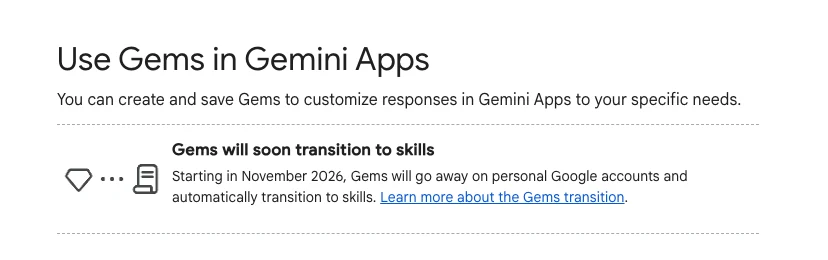
Claude's help page on projects describes project knowledge plus project instructions for each project, and says a new version of projects is rolling out in stages, starting with Claude Code. OpenAI's Projects in ChatGPT page says project instructions apply only within that project and override your global custom instructions. Google's Gems help page now carries a notice that Gems will go away on personal Google accounts from November 2026 and move to skills, so check where your saved Gems end up before you rely on them.
Put the stable parts (situation, reader, limits, voice) in the project, and keep the task-specific parts (this month's decision, this export) in the message. For the brand voice part, the AI brand guidelines file shows what to write and where it lives in each tool. A content writer on X gave the same advice: one project per job, with reference documents and instructions, instead of starting from scratch each time (post, November 2026).
How is briefing an AI agent different from briefing a chat?
Short answer: a chat brief can be completed in conversation; an agent brief has to carry everything up front, because the agent works without you. Anthropic found the median blog-producing conversation in chat or Cowork took 13 rounds of back-and-forth, while the median in Claude Code was a single human prompt.
That figure from the June 2026 Economic Index is the clearest argument for briefing well. In chat, the 13 rounds are where the missing context arrives. With an agent, the first message is often the only one, so the brief needs the stop rules, the data it may touch and what "done" means. Anthropic's January 2026 report also tracked "directive" conversations, where people hand over a whole task with little back-and-forth: 27% in January 2025, 39% in August 2025, then 32% in November 2025. Delegation is common and uneven, and the brief is what makes it work.
I hit this when handing work from Claude to another AI agent that had no context. What I asked for was a hand-off pack: the Markdown files with the background, the task list, and the expected outcome of each task. Later, a shared brief file replaced the long prompt I had been pasting into each daily run. For the full agent version, including what an agent may do alone and where approval sits, see tasks to delegate to AI agents; for one practitioner's view, a post on r/AI_Agents argues the real skill gap in agentic AI is delegation, not prompting (r/AI_Agents, September 2026).
How do you make briefing a habit across a leadership team?
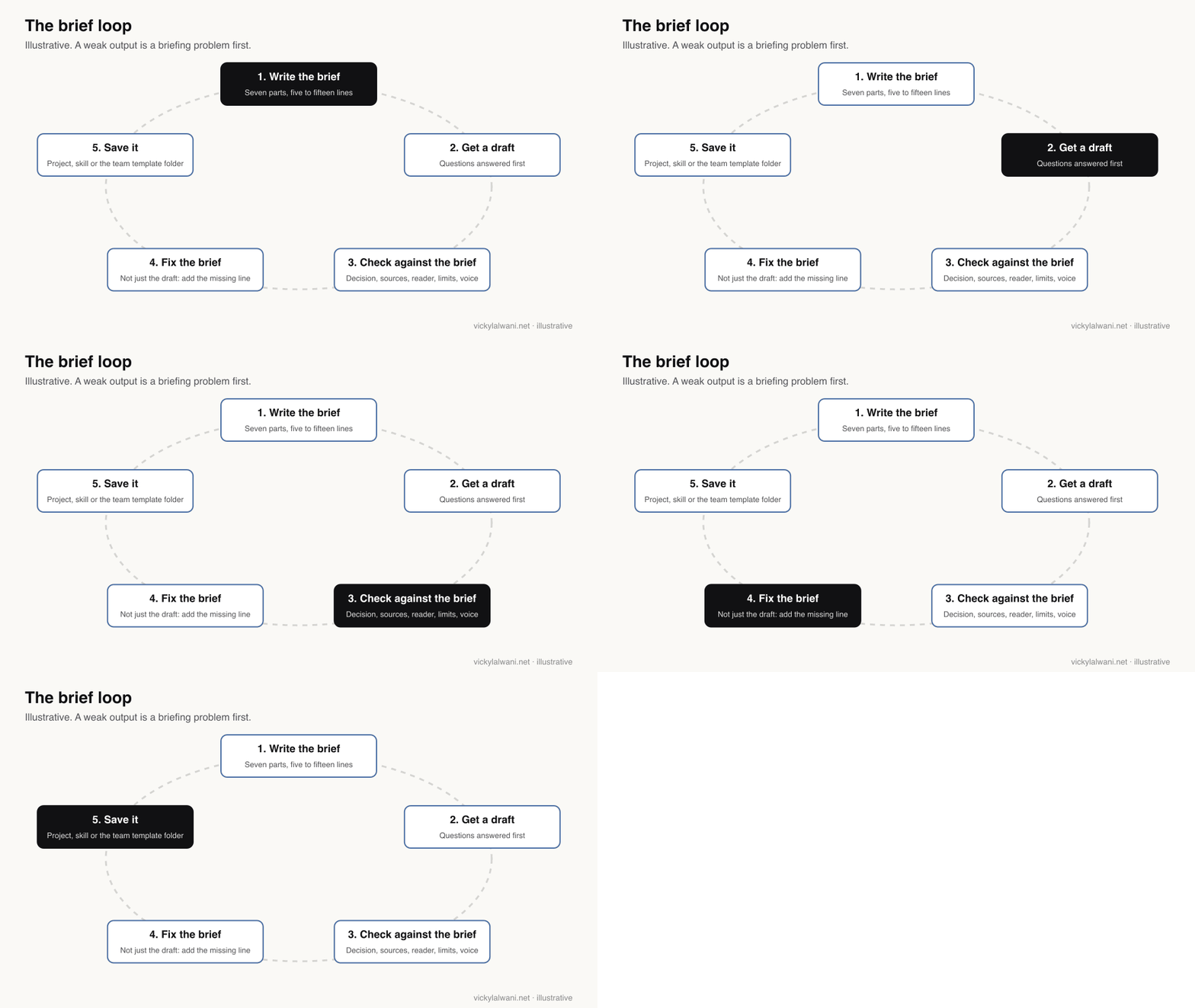
Short answer: agree one short brief template, keep a folder of good examples, treat a weak output as a briefing problem first, and review the template each quarter. Check every output against the brief before it goes anywhere.
| Check | If it fails |
|---|---|
| Does it help the decision? | Sharpen the decision line |
| Can every number be traced? | Add the source rule |
| Does it suit the reader? | Describe the reader better |
| Is it within the limits? | Add the missing limit |
| Does it sound like you? | Add a sample |
Samples are the cheapest fix for voice. When a retail client began working with me, they shared folders of photos, videos, past ad texts and their target audience, and approved every ad themselves at the start. That is a brief in physical form: material to copy and a person who judges the result. Anthropic's guidance says the same about examples: a few well-chosen ones are among the most reliable ways to steer format, tone and structure.
When a team shares one structure, quality stops depending on who happens to be best at prompting, and new joiners get usable output in their first week. If you want ten ready-made decision briefs to start the folder, Claude prompts for founders has them.
What people say on X and Reddit
Short answer: the "context engineering" framing that took off in 2025 is the same idea as briefing, and practitioners in 2026 keep landing on the same fixes: load business context first, ask questions first, and keep reusable instructions in projects.
| Source | Date | Point | Type |
|---|---|---|---|
| An e-commerce platform CEO on X | 19 Jun 2025 | Prefers "context engineering": providing all the context for the task to be plausibly solvable | Opinion |
| An AI researcher on X | 25 Jun 2025 | Prompts sound like short task descriptions; real work is filling the context window well | Opinion |
| A Claude tips account on X | 19 Apr 2026 | Start with a context brief: goal, background, what you tried, where you are stuck | Opinion |
| A blogger on X | 18 Oct 2026 | Weak Claude SEO answers come from vague prompts and missing business context | Opinion |
| A PPC practitioner on X | 10 Feb 2026 | Negative keyword prompt that starts with product, keyword, match type and audience | First-hand; time claim not verified |
| A content writer on X | 15 Nov 2026 | Use projects with reference documents and instructions, one per job | Opinion |
| A marketer on X | 5 Nov 2026 | Review prompt with product, audience and evidence slots; asks for a sceptical editor | Opinion |
| r/ChatGPT | 16 Oct 2026 | If results feel generic, have it ask you questions first; reply: ask what it assumed | First-hand |
| r/ChatGPT | 9 Jul 2026 | Generic AI content comes from brands with no point of view | Opinion |
| r/ClaudeAI | 17 May 2026 | Standing preferences such as asking clarifying questions; reply: test a failing prompt in a fresh chat | First-hand |
| r/AI_Agents | 13 Nov 2026 | Team rule "take numbers only from named sources"; reply asks how old chat estimates are kept out | First-hand, AI services firm |
| r/AI_Agents | 8 Sep 2026 | The real skill gap with agents is delegation, not prompting | Opinion |
Videos worth watching
Short answer: Anthropic's Prompting 101 talk is the best single explanation of briefing in practice; the AI Fluency trailer frames delegation and description for non-technical leaders.
Made by Anthropic, 31 July 2025, about 25 minutes. Two Anthropic staff build a prompt step by step from a real task, adding context, examples and structure; it sells nothing directly.
Made by Anthropic, 12 June 2025, a short trailer for its free AI Fluency course, which treats delegation and clear description as core skills. Promotes the free course.
| Video | Channel | Date | What it covers |
|---|---|---|---|
| Prompting 101 | Code w/ Claude | Anthropic | 31 Jul 2025 | Building a prompt step by step |
| AI Fluency: Framework & Foundations Course Trailer | Anthropic | 12 Jun 2025 | Delegation and description |
| How AI Is Changing Strategy, and 4 Skills Leaders Need Next | Harvard Business Review | 9 Oct 2026 | Leadership skills for AI |
| Getting started with Claude.ai | Anthropic | 2 Dec 2025 | Projects and basics |
| 5 Claude Prompts Every Google Ads Advertiser Should Use | Ecomclips | 12 Aug 2026 | Google Ads prompts |
| Claude Chat & Cowork Fundamentals | DataCamp | 16 Nov 2026 | From first prompt to first skill |
Where this advice is weak
Short answer: the vendor guides are general, the usage data is correlational and mostly from one vendor, and a perfect brief still does not make a model's facts reliable.
- The Economic Index findings show patterns, not cause and effect. Anthropic itself notes that experienced users may differ in other ways, and that survivorship may play a part.
- Most of the data comes from Claude. OpenAI's and Google's guides agree on the principles, but I have not seen comparable published usage data from them.
- A good brief reduces invented detail; it does not remove it. Every number in a board update still needs checking against the source before it goes out.
- Product features move. Projects in Claude are changing version and Gems are moving to skills; check the linked help pages before you set up a team.
- The worked examples are templates, not tested results. Adjust them to your data and your readers.
Want help turning briefs into a team standard?
Short answer: if you want a briefing template, project setup and example folder built around your leadership team's real work, my Claude consulting covers it.
The work starts with the two or three documents a team writes most often, such as the monthly Google Ads summary or an SEO brief for writers, and builds the brief, the project and the review checklist around them. Prices are on the pricing page. If the bigger problem is the accounts themselves, see Google Ads management or SEO consulting. Related reading: the Claude prompting framework, tasks to delegate to AI agents and the AI brand guidelines file.
Sources
| Source | What it supports | Date |
|---|---|---|
| Anthropic: Prompting best practices | New employee; colleague test; why; examples | Read 18 Nov 2026 |
| OpenAI: Prompting best practices | Clear, specific, context; refine | Read 18 Nov 2026 |
| Google: Gemini prompting guide (PDF) | Persona, task, context, format | Dec 2025 |
| Anthropic Economic Index, June 2026 | 0.87 correlation; gaps; 13 rounds vs 1 | 26 Jun 2026 |
| Anthropic Economic Index, March 2026 | Experienced users more successful | 24 Mar 2026 |
| Anthropic Economic Index, January 2026 | Directive share 27%, 39%, 32% | 15 Jan 2026 |
| Claude Help: Projects | Instructions, knowledge, new version | Read 18 Nov 2026 |
| OpenAI Help: Projects in ChatGPT | Project instructions override global | Read 18 Nov 2026 |
| Gemini Help: Use Gems | Gems moving to skills | Read 18 Nov 2026 |
| X, Reddit and YouTube | Practitioner views, linked above | Jun 2025 to Nov 2026 |
This article expands on my post on LinkedIn ↗.
FAQ
How do you brief AI properly?
Give the AI what you would give a capable new hire: the situation, the decision the output supports, the reader, what good looks like, the facts and samples to use, the limits, and an invitation to ask questions first. Anthropic, OpenAI and Google all recommend specific requests with enough context in their current prompting guides.
What is the difference between a prompt and a brief?
A prompt is a request; a brief is a request plus the context a capable stranger would need to do it well. The model is the same, but the brief removes the guesses that produce generic answers.
How long should an AI brief be?
Usually five to fifteen lines. Cover the situation, decision, reader, format, facts, limits and questions; add more only when the task has real constraints, such as compliance rules or a fixed data source.
Why does AI give generic answers?
Because it fills every missing detail with the most typical answer. Anthropic's June 2026 Economic Index found the sophistication of Claude's answers tracks the prompt, and that answers drift furthest from the request when people describe what they want instead of supplying material.
Should I ask the AI to ask me questions first?
Yes, for anything longer than a few paragraphs or anything that will be sent to someone. Ask for the few questions that would change the answer most, and tell it to state its assumptions where you have no answer.
Does briefing work the same in Claude, ChatGPT and Gemini?
Yes. Anthropic, OpenAI and Google give the same core advice: be specific, give context and describe the output you want. Where you save the brief differs: projects in Claude and ChatGPT, and skills, which Google is moving Gems on personal accounts to from November 2026.
How do I brief AI for a Google Ads report?
Attach the Google Ads export and the CRM lead sheet, state the decision the report supports, name the reader, fix the length and table, and ask the AI to name the source of every number and say when it cannot work one out. Check every number before it is sent.
How is briefing an AI agent different from briefing a chat?
An agent works without you, so the brief must carry everything up front: what done means, what data it may touch and when to stop and ask. Anthropic found the median blog-producing conversation in chat took 13 rounds, while the median in Claude Code was a single prompt.