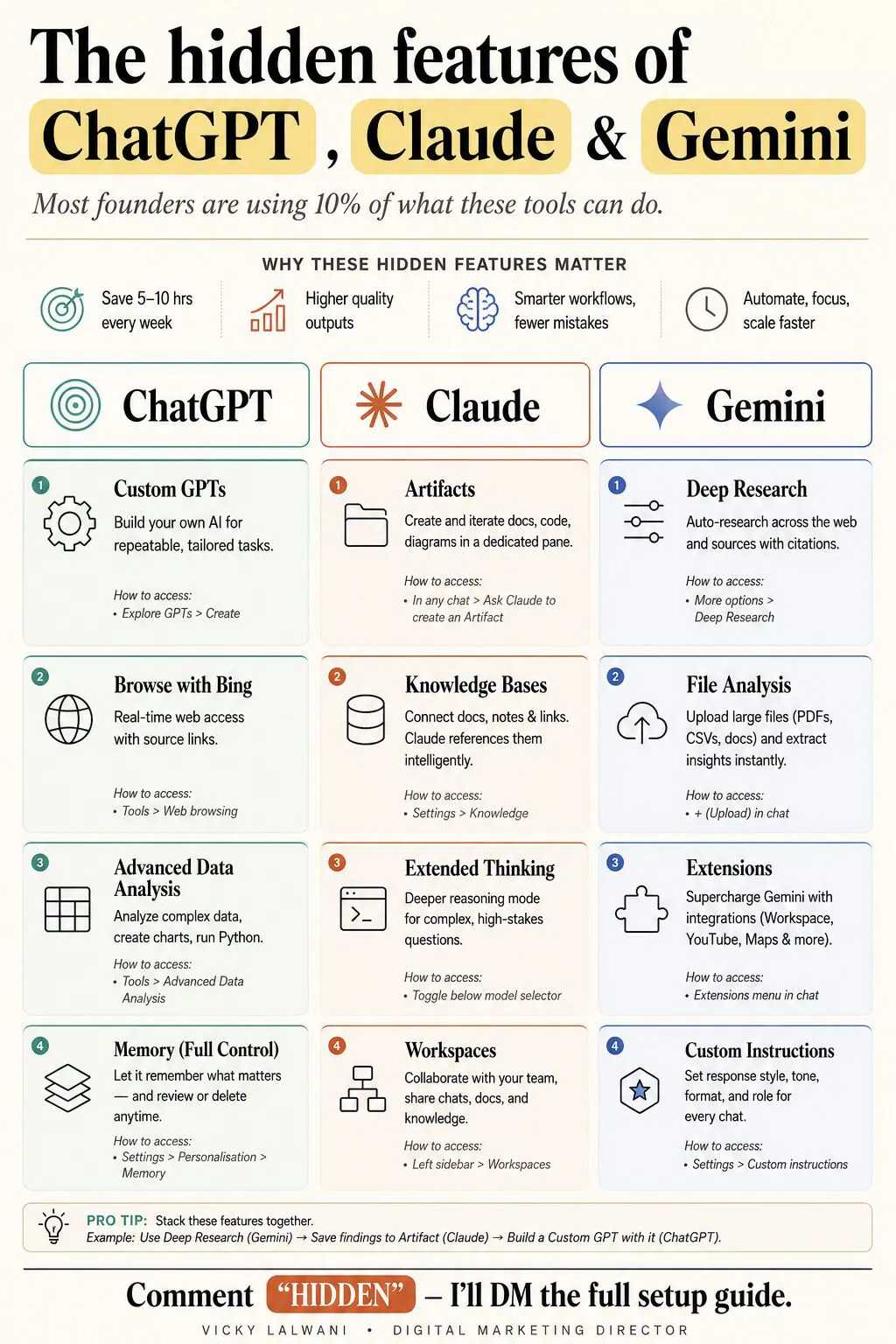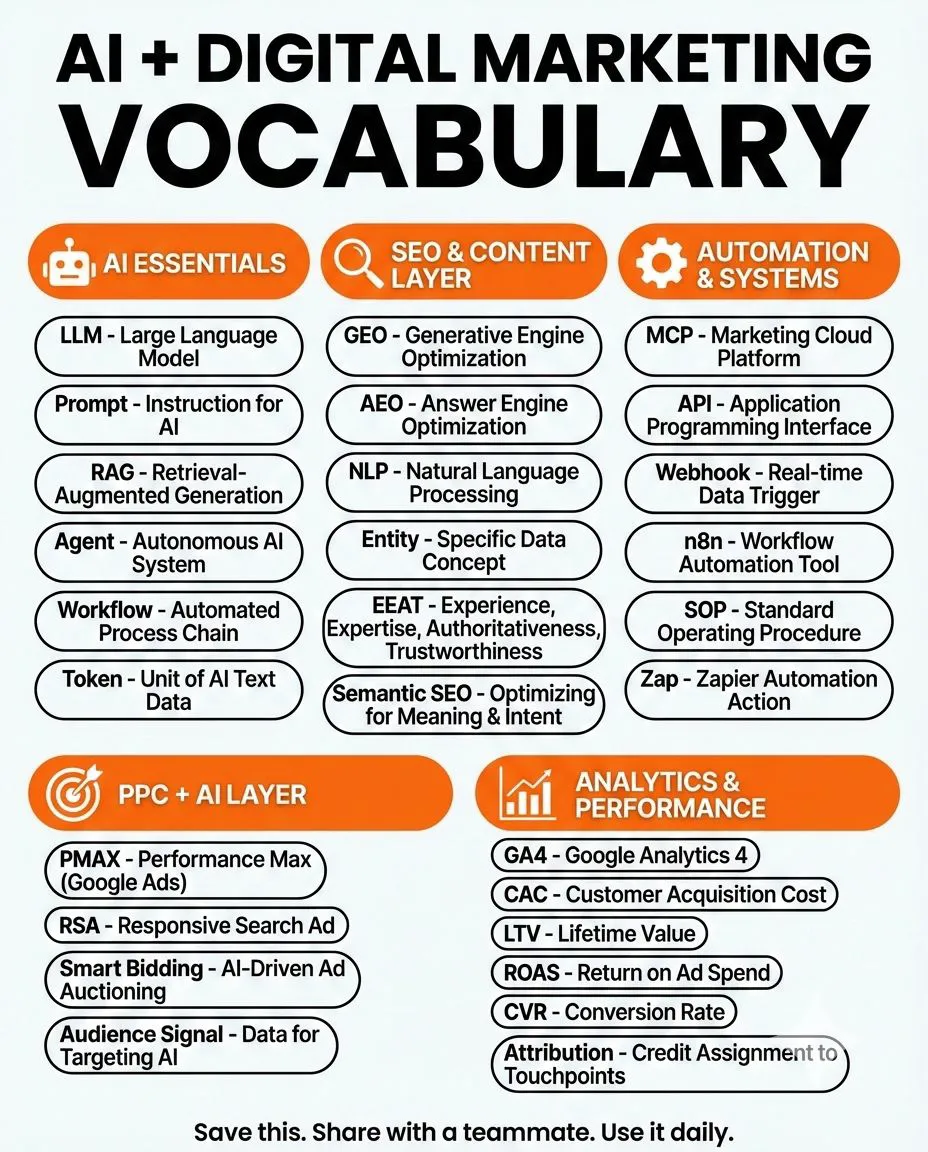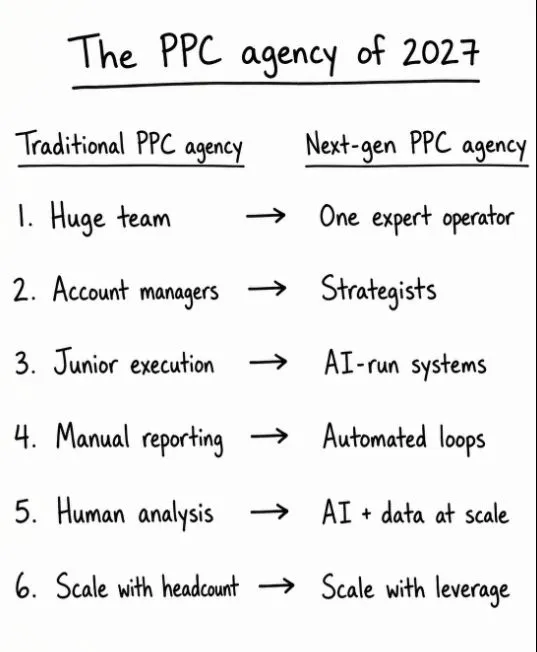
The future of PPC agencies is smaller, more senior teams running AI systems. Google now automates bidding, query matching and ad text by default, so routine hours shrink while tracking, targets, budget split and approvals still need an experienced person.
It is renewal time. Your PPC agency's fee is the same as last year, the monthly deck looks the same, and the account manager has changed twice. Meanwhile Google now writes the ads, picks the search terms and sets the bids, and offers an agent inside the account that will make changes when you click approve. So what, exactly, are you paying the agency to do in 2027?
This article looks at how AI is changing paid search work in late 2026, using the platforms' own announcements and the latest agency surveys, and what that means for anyone choosing a PPC partner. The short version: the work that used to justify a large team is being automated, and the work that decides results is not. If you want one senior person running your account with a system behind them, that is my Google Ads management service.
TL;DR
- Google now automates most of the buying: AI Max is on by default in new Search campaigns, and Dynamic Search Ads are being folded into it from February 2027.
- Agencies feel it. In a 2026 survey, 87.3% of agency professionals said the traditional agency model is broken or heading that way, and 65.3% of agencies had clients take work in-house in the past year.
- What gets automated is routine hours: reporting, search term reviews, pacing checks and first drafts. What does not is tracking, targets, budget split, approvals and judgement.
- The PPC team that fits 2027 is smaller and more senior, with an AI system doing the routine checks daily and a person approving every change.
- Ask any provider what is automated, who checks it, which default AI settings are on in your account and how results are measured against your CRM.
What is changing for PPC agencies in 2027?
Short answer: Three things at once. Google is automating more of the account by default, agents can now act inside ad accounts with approval, and agency economics are under pressure as clients bring work in-house. Together they shrink the routine hours agencies used to bill for, and raise the value of senior judgement.
Start with the platform. New Search campaigns have AI Max turned on by default, which lets Google match queries beyond your keywords and rewrite ad text from your site. Google says older settings were auto-upgraded to AI Max from September 2026, and the Dynamic Search Ads sunset and auto-upgrade begins in February 2027. Each step moves a decision that a junior used to make by hand into Google's system.
| Change | When | What it does to agency work |
|---|---|---|
| AI Max on by default | New Search campaigns now | Query matching and ad text partly automated |
| Legacy settings auto-upgrade | From Sep 2026 | Fewer manual set-ups to bill for |
| DSA sunset | From Feb 2027 | Migration work, then less upkeep |
| Ask Advisor (beta) | Rolling out | Changes made by an agent, with approval |
| Google Ads MCP server | Available | Outside AI tools can read accounts |
| Google Ads API agent skills | Available | Ready-made skills for AI agents |
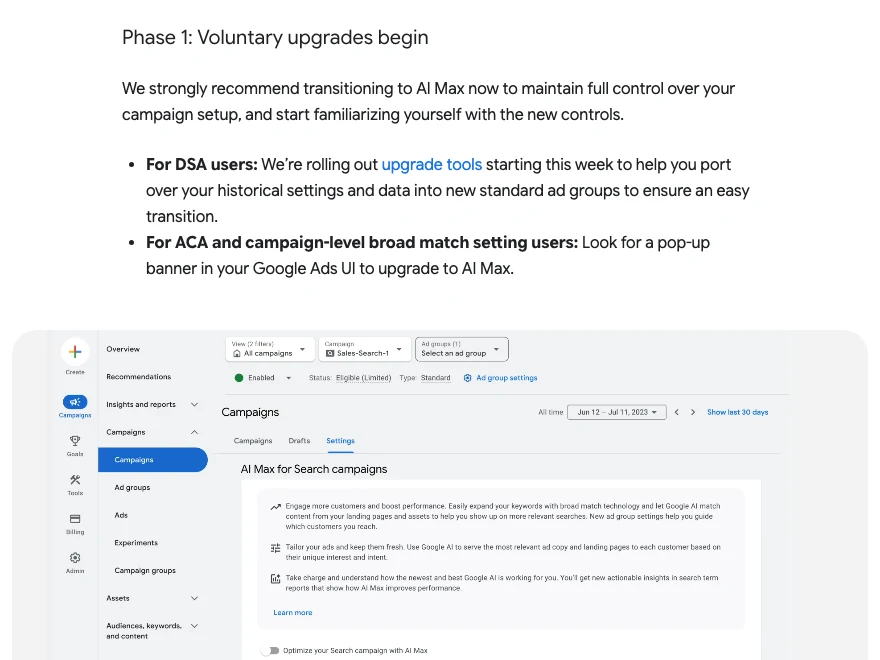
For the platform side in more depth, including what Meta automates and how far to trust the platforms' own figures, see my guide to AI for paid media. This article stays on the people side: who does the work, and how you should pay for it.
What do the numbers say about agencies and AI?
Short answer: They point one way. In Basis's April 2026 survey, AI is used at more than 99% of agencies, 59.2% of staff use it daily, 9 in 10 think it threatens their main revenue, and fewer than half feel optimistic about digital advertising. Gartner's 2026 survey shows marketing budgets flat at 7.8% of company revenue.
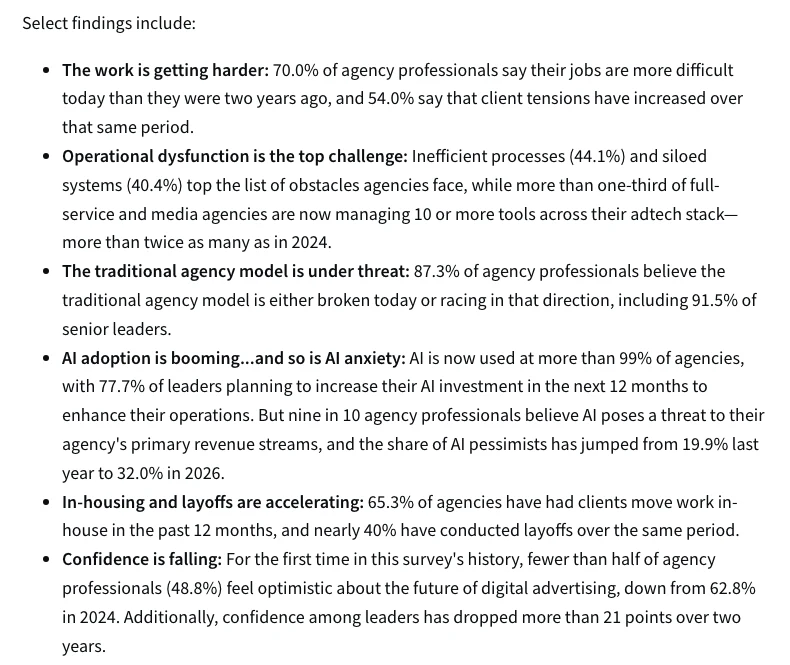
The Basis 2026 Advertising Agency Report surveyed 213 people at agencies. Its headline findings: 87.3% believe the traditional agency model is broken or heading that way, 65.3% of agencies had clients move work in-house in the past 12 months, and nearly 40% made layoffs. The share of AI pessimists rose from 19.9% to 32.0% in a year.
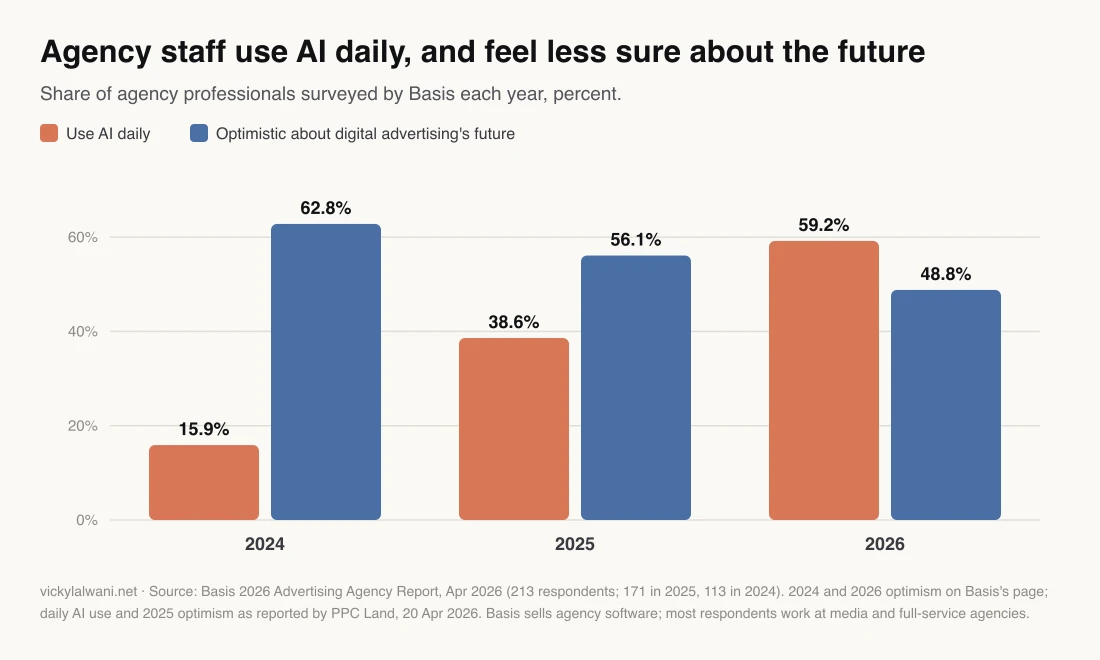
Two details explain the anxiety. PPC Land's report on the survey notes that AI is used most for ideation, research and drafting, and least for media planning (29.1%) and buying strategy (22.1%). And it quotes the report's own logic: when a 20-hour task becomes a 2-hour task, billing by time and headcount stops making sense.
| Finding | Figure | Source |
|---|---|---|
| Agency model broken or heading that way | 87.3% | Basis, Apr 2026 |
| AI seen as a threat to main revenue | 9 in 10 | Basis, Apr 2026 |
| Agencies with clients moving work in-house | 65.3% | Basis, Apr 2026 |
| Marketing budget, share of revenue | 7.8% (7.7% in 2025) | Gartner, May 2026 |
| Marketing budget going to AI | 15.3% | Gartner, May 2026 |
| Marketing budget going to agencies | 19.2% | Gartner via MediaPost |
The Gartner 2026 CMO Spend Survey of 401 marketing leaders adds the buyer's view: 56% say they lack the budget to deliver their 2026 strategy. MediaPost's report on the same survey says CMOs keep shifting money towards paid media and away from agencies and technology. In plain terms, clients want more media for the same money, and less of it spent on fees.
Which PPC jobs does AI do now, and which still need a person?
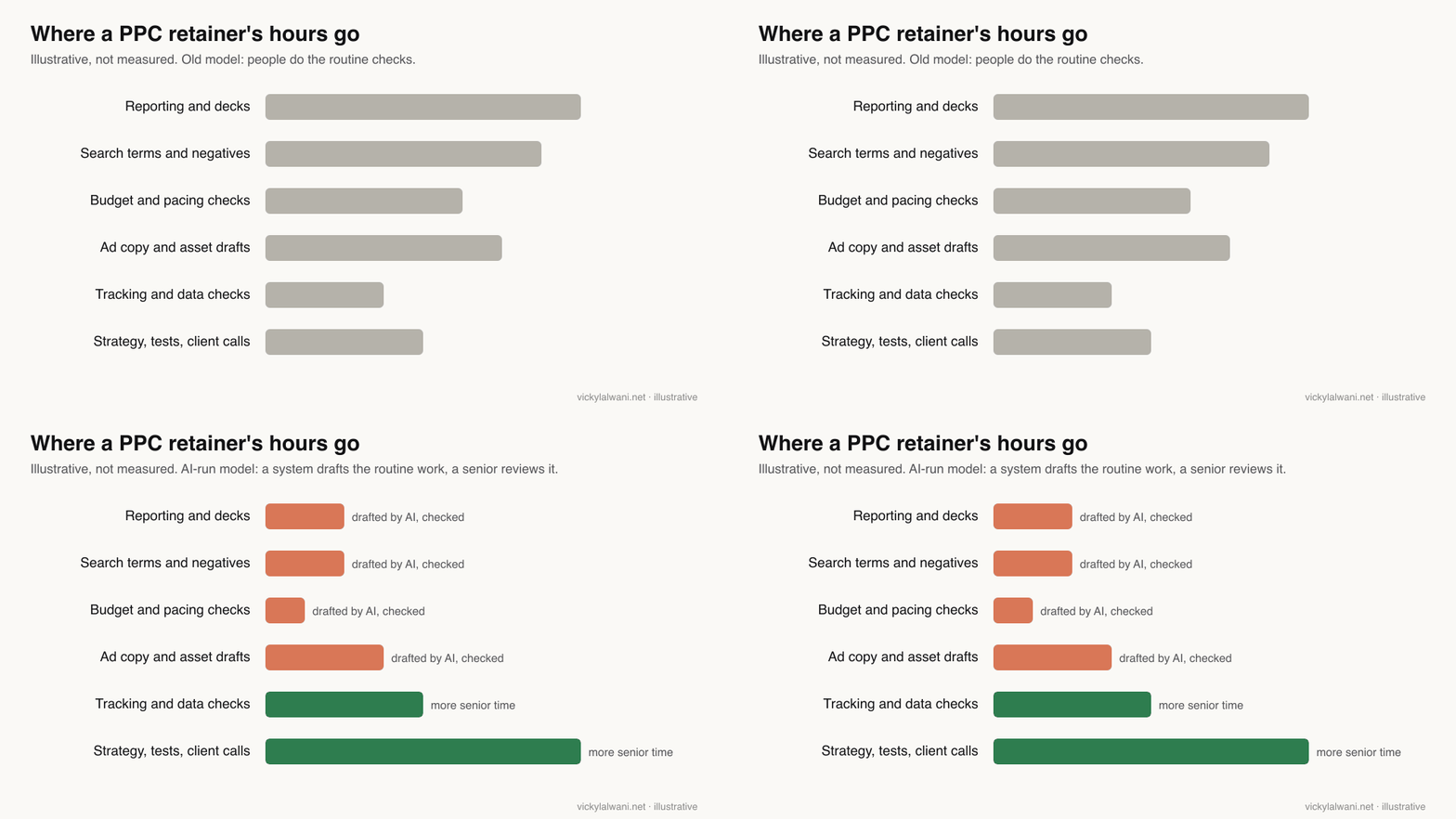
Short answer: AI now does, or drafts, most of the routine work: bids, query matching, ad text variations, search term reviews, pacing checks and reports. People still own conversion tracking, what a lead is worth, the budget split between channels, approvals, policy and claims, and the conversation with the business.
| Job | Who does it in 2027 | The human part |
|---|---|---|
| Bidding | Smart Bidding | Set a target that matches margin |
| Query matching | AI Max, broad match | Exclusions, brand rules, review terms |
| Ad copy variations | Google and your AI drafts | Offer, claims, final approval |
| Search terms review | An AI agent drafts it | Approve negatives, spot new intent |
| Pacing and anomalies | Scripts and agents, daily | Decide what to do about it |
| Weekly report | Drafted automatically | A short note: where, what, next |
| Conversion tracking | Person | What counts, and checking it fires |
| Budget split by channel | Person | Platforms each ask for more |
| Tests and strategy | Person | Which bet to make next |
Anthropic's own growth marketing team is a good example of the new split. The company says one of its marketers built a custom slash command that drafts responsive search ads from campaign data and checks them against skills for brand voice and product accuracy, then exports an upload-ready file. The copy still goes through manual review before upload. I explain how commands like that work in my Claude slash commands cheat sheet.
From my own work, the last three rows are where projects actually stall. In my call notes, account access and measurement problems block more work than strategy does. An AI system cannot fix a tag nobody installed or an invite that only gave view access.
Will AI replace PPC agencies?
Short answer: It will replace a way of working, not the need for expertise. Billing for hours of routine checks is the part under threat, because those hours are shrinking. Agencies that sell senior judgement, clean measurement and fast decisions have a future; agencies that sell headcount will struggle to justify the fee.
The earlier version of this article made the same bet, and the 2026 survey data points the same way. AI does not replace a PPC strategist. You still need someone who has run real accounts, watched a budget bleed and knows what a healthy search terms report looks like. What changes is how much surrounding work a person must do by hand.
Practitioners say the same in their own words. One r/PPC reply put it simply: the job description is changing, from operating the platform to understanding the business. Another thread on auditing accounts with AI landed on a practical middle: AI is fine for repeatable checks, while anything that needs judgement is still unreliable without a person.
Video: a PPC agency founder's channel, 1 June 2026. A practitioner view of the PPC role when Google Ads is fully AI-driven; the channel promotes the founder's own agency.
What does a good PPC team look like in 2027?
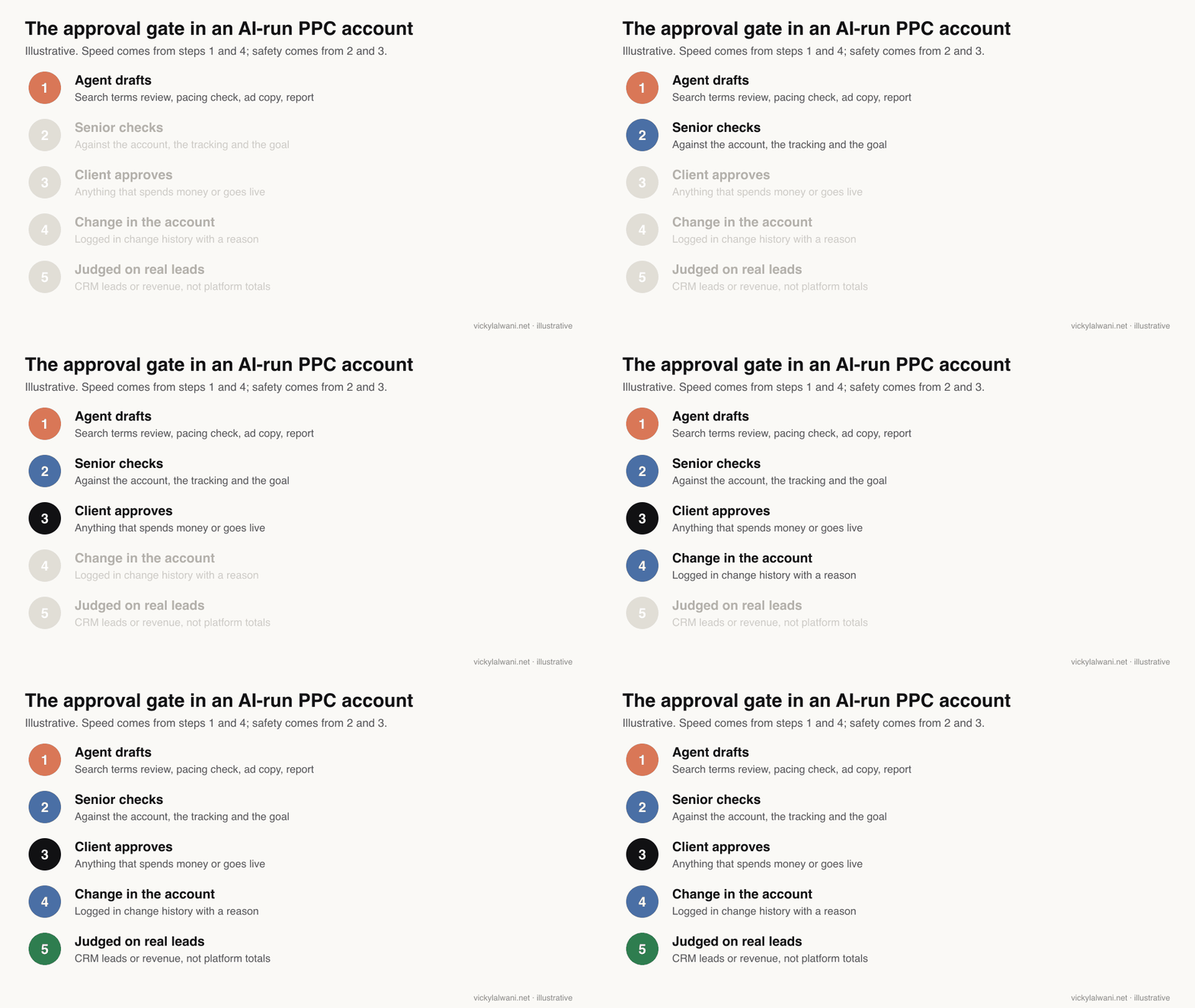
Short answer: Smaller and more senior. One experienced operator, or a small senior team, runs a repeatable system that does the routine checks every day, and approves every change that spends money or goes live. You get faster detection of problems and the person making decisions is the person you talk to.
| Old model | 2027 model |
|---|---|
| Large team, junior execution | One senior operator plus a system |
| Account manager relays messages | The decision-maker talks to you |
| Waste found at the monthly review | Waste flagged daily, fixed with approval |
| Search terms sampled | Search terms reviewed in full |
| Reports built by hand | Reports drafted, a person adds the note |
| Scale by adding people | Scale by adding checks to the system |
Here is how I run accounts, so you can compare it with any provider. Tracking comes before spend: campaigns stay in draft until every form and call is measured. Broad match runs as a discovery phase for about a month, then I narrow to exact and phrase on the terms that convert. When platforms run side by side, the loser is cut at a date set in advance. Every report carries a short human note: where we are, what we are doing, what is next. And nothing goes live without approval.
The AI side follows the same discipline. I keep one Claude project per client, and split the work: a thinking model plans, a separate agent executes, and I review. For how that kind of overnight set-up works with approvals, see human in the loop AI for Google Ads, and for the agent stack itself, AI agents for PPC.
How should PPC agency pricing change?
Short answer: Pricing should follow the work that is left. As routine hours shrink, pay for senior time, a defined scope and outcomes you can check in your CRM. Be careful with percentage-of-spend fees now that Google's defaults can push spend up, because the fee rises with it.
| Model | How it works | Watch out for in 2027 |
|---|---|---|
| Hourly | Pay for time used | Ask what the hours are spent on |
| Fixed retainer | Set fee, set scope | Scope that silently shrinks |
| % of ad spend | Fee tracks budget | AI defaults raising spend and fee |
| Performance share | Fee tracks results | Who defines and measures a result |
Whatever the model, ask what share of the fee pays for senior attention and what pays for routine work a system now does. A fair provider can answer that without a slide deck. My own prices are on the pricing page, and I compare freelancers and agencies on cost and fit in freelance PPC consultant vs agency, so I will not repeat that here.
What should you ask a PPC agency in 2027?
Short answer: Ask who makes decisions on your account, what is automated and who checks it, which default AI settings are on, who can approve changes made by agents, how tracking is verified and how results are reported against your CRM. Good answers name specific tasks, people and checks.
| Question | A good answer | A red flag |
|---|---|---|
| Who works on my account? | A named senior, with experience | "The team" |
| What is automated? | Specific tasks and a review step | "AI does everything" |
| Is AI Max on? Auto-apply? | Checked, with a reason | Not sure |
| Who approves agent changes? | A person, logged | Changes appear unexplained |
| How fast is waste found? | Daily flags, weekly fixes | Monthly review |
| How is tracking checked? | Tested before launch | Trust the platform |
| What do reports measure? | CRM leads or revenue | Clicks and platform conversions |
The default settings question matters more than it used to. Google's auto-apply recommendations can change an account without anyone logging in, and Ask Advisor implements suggested changes with your approval. Note that Google says Ask Advisor is not available in manager (MCC) accounts, which is how most agencies work, so ask who in your own account has the right to approve its suggestions.
Video: Google Ads official channel, 21 May 2026. Google's launch video for its own product; it shows the approval step but is promotional.
What are the risks of a lean, AI-run PPC model?
Short answer: Four main ones: everything depends on one person, errors can repeat at machine speed, automation can optimise efficiently towards the wrong goal, and connecting AI tools to ad accounts creates new access and data risks. Each one is manageable if the provider can tell you how they cover it.
- Key-person risk. If one senior is the team, ask about holiday and sickness cover, and make sure you own the account and the access, not the provider.
- Errors at speed. A wrong rule in an agent runs every day. Ask for change history with reasons, and a human check before anything that spends money.
- The wrong goal. Platform AI optimises to the conversion you send it. If form spam counts as a lead, the system will buy more spam. Check results against your CRM.
- Access and data. MCP servers and agents need account access. Ask what each tool can read and change, and who holds the keys.
A good provider also says where their specialism ends. If your problem is a slow website or a sales team that never calls leads back, better ads will not fix it, and you should hear that early.
What people say on X and Reddit
Short answer: Google's accounts promote agents and AI Max as the way forward, while practitioners are split: some report pressure from Google to opt into automation and odd recommendations, others say the job is shifting towards business understanding. Commentators predict staffing problems for agencies that sell production hours.
| Post or thread | Where | Date | Type | What it says |
|---|---|---|---|---|
| Meet Ads Advisor, your Google Ads agent | X, Google Ads (official) | 12 Nov 2025 | Vendor | An agent that takes action in campaigns |
| AI Max out of beta; DSA timeline | X, Google Ads Liaison | 15 Apr 2026 | Official | Transition roadmap from DSA to AI Max |
| The great merge continues | X, a Google Ads practitioner | 5 Aug 2026 | First-hand | Auto-created assets and broad match upgrade to AI Max |
| Google suggested reducing budget | X, a PPC agency owner | 7 Aug 2026 | First-hand | A first, and the suggestion made no sense |
| Ask Advisor shared memory, coming soon | X, Google Ads (official) | 24 Aug 2026 | Vendor | Goals and past decisions carried across tools |
| Agencies may have a staffing problem | X, an AI commentator | 10 Nov 2026 | Opinion | AI agents can run most of ad production |
| Future of PPC management and AI agents | r/PPC | 18 Feb 2026 | Discussion | Keep control of budgets; agents for ops |
| A bit worried about the future in PPC | r/PPC | 27 Feb 2026 | First-hand | Job shifting to business understanding |
| How to audit PPC accounts with AI | r/PPC | 30 Oct 2026 | Discussion | Fine for repeatable checks; scripts more reliable |
| Google reps pushing AI Max | r/PPC | 10 Nov 2026 | First-hand | Tested AI Max, performed poorly for a client |
Reddit threads are credited by community only, and individuals on X are described by type. One X post names a person; that name is not repeated here.
Videos worth watching
Short answer: Watch Google's own Ask Advisor and AI Max videos to see what the platform automates, then two practitioner views on what the PPC job becomes. The table notes who made each and whether they sell something.
| Video | Channel | Date | What it covers |
|---|---|---|---|
| Introducing Ask Advisor | Google Ads (official) | 21 May 2026 | The in-account agent |
| AI Max for Search Campaigns | Google Ads (official) | 12 Jun 2025 | What AI Max does |
| RIP DSA: The Dynamic Search Ads to AI Max Migration Survival Guide | Smarter Ecommerce (smec) | 12 May 2026 | DSA migration; vendor |
| When Google Ads Is 100% AI Driven, This Is the PPC Job | A PPC agency founder | 1 Jun 2026 | The PPC role in an AI-run account |
| Google Ads Expert: AI Is Making PPC HARDER, Not Easier | A Google Ads coaching podcast | 31 Jul 2026 | Why AI makes PPC harder |
| How a PPC agency is becoming AI-first | A PPC training channel | 16 Nov 2026 | An agency moving to AI-first |
Where is this advice weak?
Short answer: The survey data comes mostly from larger media agencies and from vendors with something to sell, the platform features are still changing, and the lean model has not been tested at scale against large agencies on equal terms. Treat this as a direction, not a forecast.
- Who was surveyed. Basis sells agency software and surveyed 213 people, many at media and full-service agencies. Search-only PPC shops may differ. The daily-use trend comes from a trade write-up of the gated report.
- Gartner's sample is mostly companies with more than $1 billion in revenue, in North America and Europe. Small businesses buy differently.
- Moving dates. Google has already moved the DSA deadline once. Check the dates on Google's page before you plan a migration.
- My bias. I sell the lean, senior model this article describes. Weigh that, and ask any agency the same questions.
Want a senior operator on your account?
Short answer: If you want one experienced person making the decisions on your Google Ads, with an AI system doing the daily checks and nothing going live without your approval, that is how I work. Start with an audit of what is automated in your account today.
See my Google Ads management service for what is included, and the pricing page for published rates. If you are still deciding between a freelancer and an agency, read freelance PPC consultant vs agency first. The free guides show how I run accounts.
Sources
| Source | What it supports | Date |
|---|---|---|
| Google Ads Help: AI Max | On by default in new Search campaigns | Read 18 Nov 2026 |
| Google Ads blog: DSA to AI Max | Sep 2026 auto-upgrades, Feb 2027 DSA sunset | 15 Apr 2026, updated |
| Google Ads Help: Ask Advisor | Beta, changes with approval, not in MCC | Read 18 Nov 2026 |
| Google Ads Help: auto-apply | Recommendations applied automatically | Read 18 Nov 2026 |
| GitHub: Google Ads MCP server | Agent access to accounts | Read 18 Nov 2026 |
| Google for Developers: agent skills | Google Ads API skills for agents | Read 18 Nov 2026 |
| Basis 2026 Advertising Agency Report | 87.3%, 99%, 9 in 10, 65.3%, 40%, 48.8% | Apr 2026 |
| PPC Land on the Basis report | Daily AI use trend, task split, 20 to 2 hours | 20 Apr 2026 |
| Gartner 2026 CMO Spend Survey | 7.8% of revenue, 15.3% to AI, 56% short | 11 May 2026 |
| MediaPost on the Gartner survey | 19.2% of budget to agencies | 11 May 2026 |
| Claude blog: Anthropic marketing | /rsa command, manual review | 26 Jan 2026 |
| X posts and Reddit threads above | Vendor and practitioner views | Nov 2025 to Nov 2026 |
This article expands on my post on LinkedIn ↗.
FAQ
What is the future of PPC agencies?
PPC agencies are moving from large teams billing for routine hours to smaller, senior teams running AI systems. Google now automates much of the buying, and a 2026 Basis survey found 87.3% of agency professionals think the traditional model is broken or heading that way.
Will AI replace PPC managers?
Not the judgement part of the job. AI and Google's own automation now handle bids, query matching, drafts and routine checks, but someone still has to set targets, verify tracking, split budgets between channels and approve changes.
Is it still worth hiring a PPC agency in 2027?
Yes, if the agency sells senior judgement and clean measurement rather than headcount. Ask who makes the decisions on your account, what is automated, who checks it and how results are reported against your CRM.
How can I tell if a PPC provider uses AI well?
Ask which tasks are automated and what the review step is, how often waste is flagged, which Google defaults such as AI Max and auto-apply are on in your account, and who approves changes made by agents.
What is AI Max and why does it matter for agencies?
AI Max is a Google Ads feature for Search campaigns that expands query matching and customises ad text. It is on by default in new Search campaigns, and Dynamic Search Ads move into it from February 2027, so less of the set-up is manual work.
Should I pay a PPC agency a percentage of ad spend?
Be careful. Google's automated defaults can increase spend, and a percentage fee rises with it whether or not results improve. Fixed scope, hourly or outcome-based fees measured in your CRM are easier to judge.
Is a smaller PPC team a worse service?
Not if a senior person stays close to the account and an AI system handles routine checks daily. The real tests are who makes decisions, how fast problems are found, and how holidays and sickness are covered.
Can Google Ads Ask Advisor replace an agency?
No. Ask Advisor is a beta agent inside Google Ads that suggests changes and makes them with your approval, but it works for Google's platform only and is not available in manager accounts. It does not set your targets or check your CRM.