Speed to lead is the time between a motivated seller reaching out and getting a real conversation with a buyer. For real estate investors paying for Google Ads, Meta leads and direct mail, a missed call often means the seller talks to the next buyer first. Sizing the loss takes four numbers: missed calls, the serious share, your close rate and your profit per deal.
TL;DR
Speed to lead is the time from a seller's first call or form to a real conversation. The best-known research, a Harvard Business Review study from March 2011, found firms that tried to reach a web lead within an hour were nearly seven times as likely to qualify it as those that waited longer.
Size your own leak with four numbers: missed calls a week, the share from serious sellers, your close rate and your profit per deal. Because one deal is worth so much, a handful of missed calls a week adds up fast.
A missed call also misleads your ads. If Google Ads counts every long call as a conversion, it keeps buying calls that went to voicemail. Import appointments and contracts as qualified and converted leads so bidding learns which sellers became deals.
The fix is a response ladder: an instant text back, a first conversation within minutes (person or voice agent), a booked walkthrough, and the outcome sent back to Google Ads and Meta. I build the Google Ads side and the chatbot and text side.
Real estate investors are very good at generating seller leads. They run Google Ads on "sell my house fast" searches, Meta lead forms, direct mail and sometimes cold outreach, and they track cost per lead closely. What many never track is what happens in the first minutes after the phone rings.
The lead generation works. The response does not. A motivated seller with an inherited house or a tight deadline is often calling several buyers that afternoon, and the one who has the first real conversation tends to get the walkthrough.
This guide is for investors and wholesalers who pay for leads. It covers how to size the cost of missed calls, what the research does and does not say, and how to build a reply system that also feeds your ad accounts. If you run a clinic rather than an investing business, my after hours call answering guide covers the same problem for appointment-based practices. I help investors with Google Ads for seller leads and chatbots and text-back flows that qualify sellers.
What is speed to lead, and why does it decide investor deals?
Short answer: Speed to lead is how quickly a new lead gets a real conversation with you. For investors it decides deals because sellers often contact several buyers at once. In the HBR research, contact within an hour made qualification nearly seven times as likely, and more than 60 times as likely as waiting 24 hours or more.
A real conversation means a person, or a well-built voice agent, talking with the seller about the property. An automatic "thanks, we will be in touch" email is not speed to lead. It is a receipt.
Most businesses are slow. The same HBR audit of 2,241 US companies sent each one a web enquiry: 37% replied within an hour, 16% within one to 24 hours, 24% took longer than 24 hours, and 23% never replied at all. Among those that replied within 30 days, the average was 42 hours.
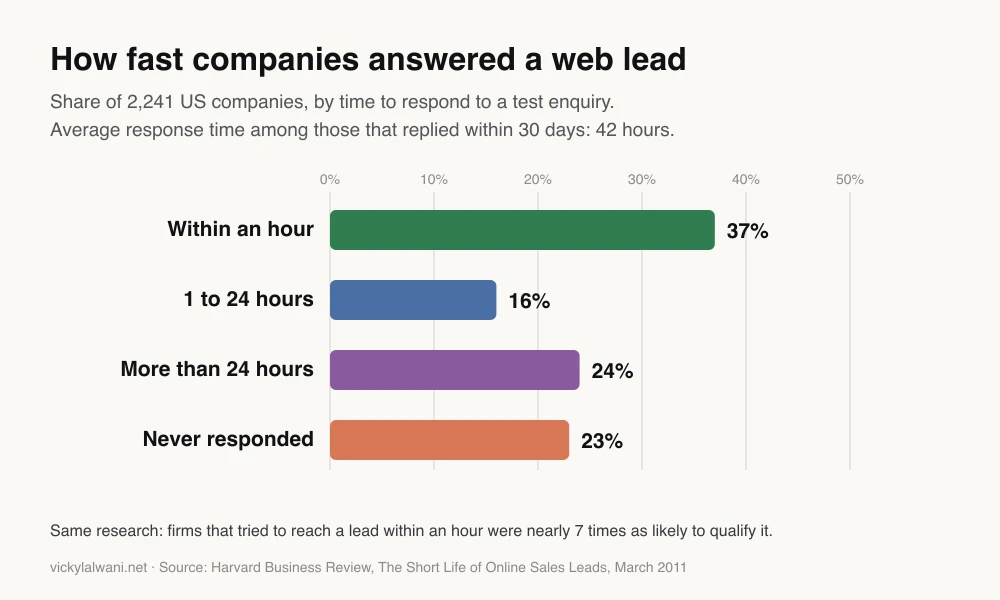
Be honest about the limits. That research is from 2011, covers web leads at US companies in general, and is not about real estate. It is still the most careful public study, and nothing since has shown that slower replies win.
You will also see a "391% more conversions if you call within a minute" figure credited to Harvard. It is not in the HBR article. It is usually traced to a lead management software vendor, and secondary sources describe its baseline in different ways. I would not quote it to anyone.
How do you size the cost of missed seller calls?
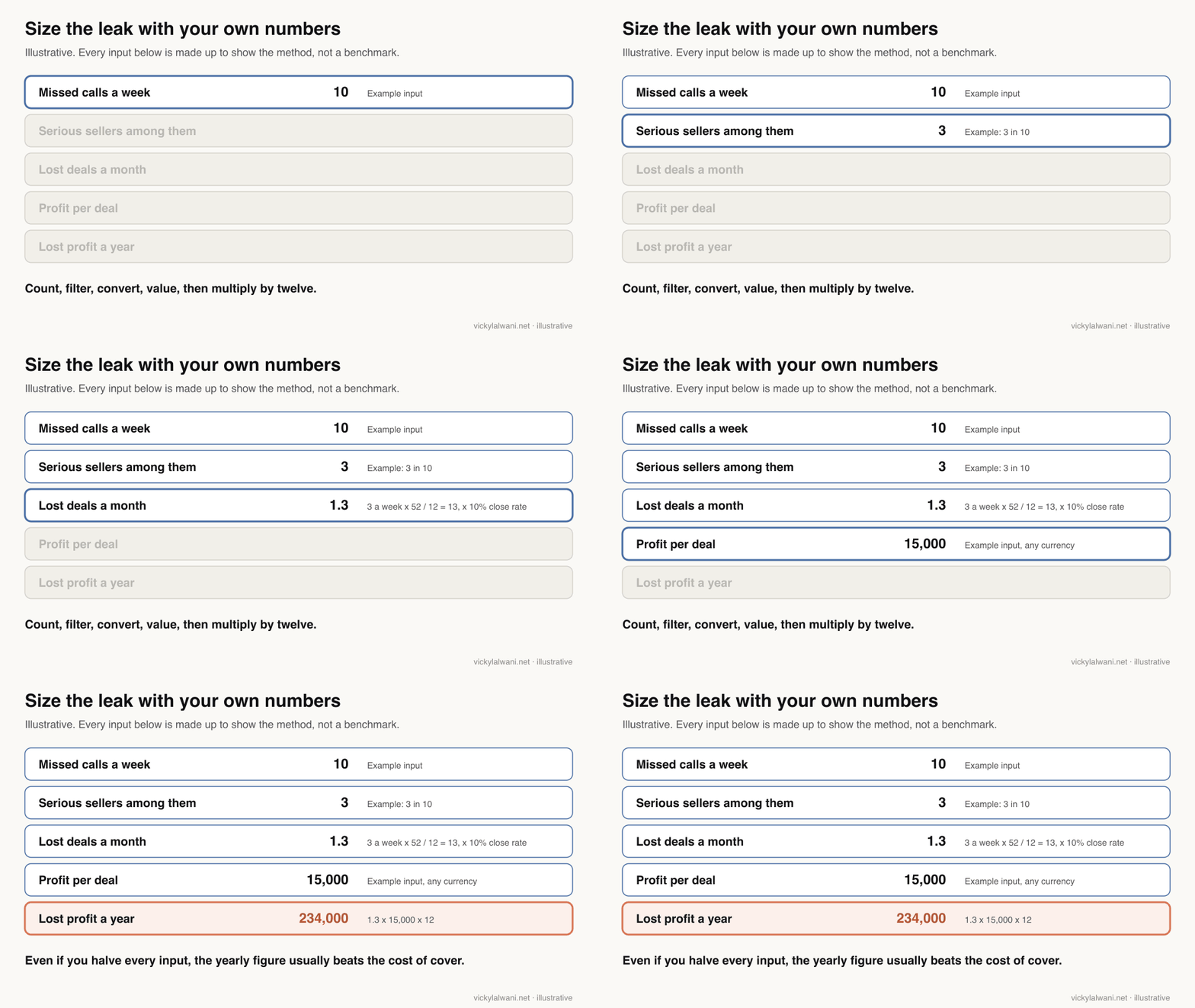
Short answer: Count the calls you could not answer in a typical week, estimate how many were serious sellers, multiply by your close rate to get lost deals, then by your average profit per deal and by twelve. Use your own numbers; they vary widely by market and lead source.
- Missed calls a week. From your phone system, call tracking tool or the Google Ads call details report.
- Serious sellers. The share of callers who own a property, want to sell and fit your buy box. Listen to a sample of answered calls to estimate it.
- Close rate. Of serious sellers you do speak to, how many become a signed contract.
- Profit per deal. Your average assignment fee or net profit, after costs.
- Multiply. Weekly serious missed calls x 52 / 12 x close rate x profit per deal x 12 gives the yearly figure.
| Input | Example value | Where to get yours |
|---|---|---|
| Missed calls a week | 10 (example) | Phone or call tracking log |
| Serious share | 3 in 10 (example) | Sample of answered calls |
| Close rate | 10% (example) | CRM: contracts / conversations |
| Profit per deal | 15,000 (example) | Closed deals, last 12 months |
| Lost profit a year | 234,000 (example) | The sum above |
The point is not the example figure. It is that a business with large deal values can lose more to unanswered calls in a year than it spends on the marketing that produced them. That is why response time is worth fixing before you add another lead source.
Industry call data backs up how common the gap is. Across ten industries, Invoca (August 2026) found 56% of business calls reached a live person. In a CallRail consumer survey (September 2025), 21% of people said they immediately call another business when nobody answers. Interestingly, the January 2025 CallRail benchmark put the real estate missed-call rate at only 9%, far below healthcare at 32%. CallRail does not split investors from other real estate businesses, so a small investing team out on viewings may look very different. Measure your own.
Why do missed calls also hurt your Google Ads results?
Short answer: Because Google Ads learns from what you count. If any call longer than a set time counts as a conversion, a call that went to voicemail can look like a win, and Smart Bidding buys more calls like it. Feed back appointments and contracts so the system learns from sellers who became deals.
Google is moving away from call length alone. Its AI-qualified call leads page says call recording is now on by default so Google AI can judge each call for signs of intent, such as asking about a specific service, and only qualified calls count as conversions. If a call cannot be recorded, it falls back to the call length you set.
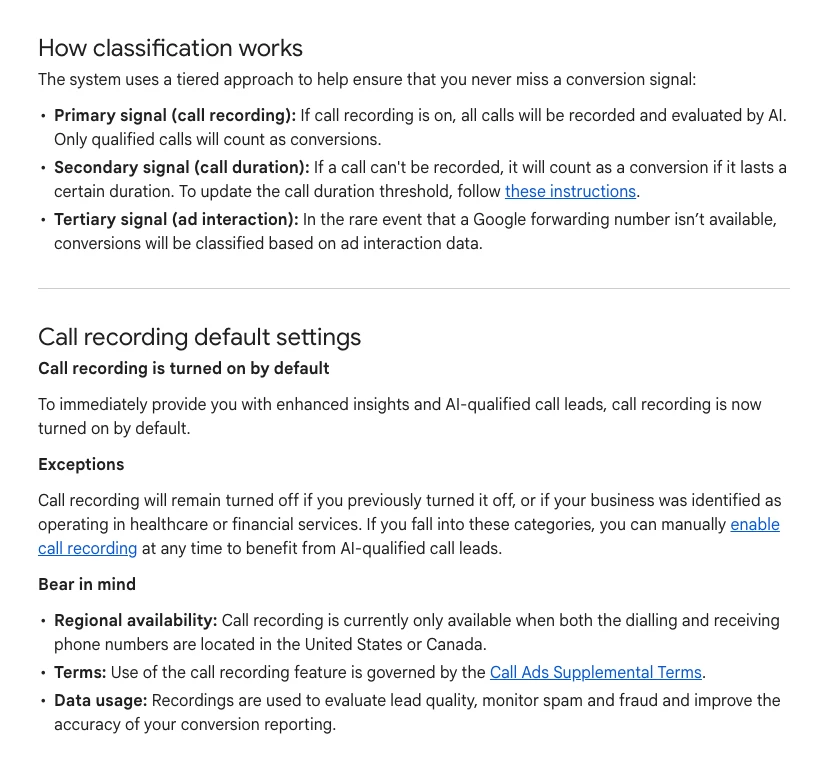
Two limits apply. Recording only works when both the caller and your number are in the United States or Canada. And it judges the call, not the outcome: a seller can sound keen and still never sign. So it helps, but it does not replace your own deal data.
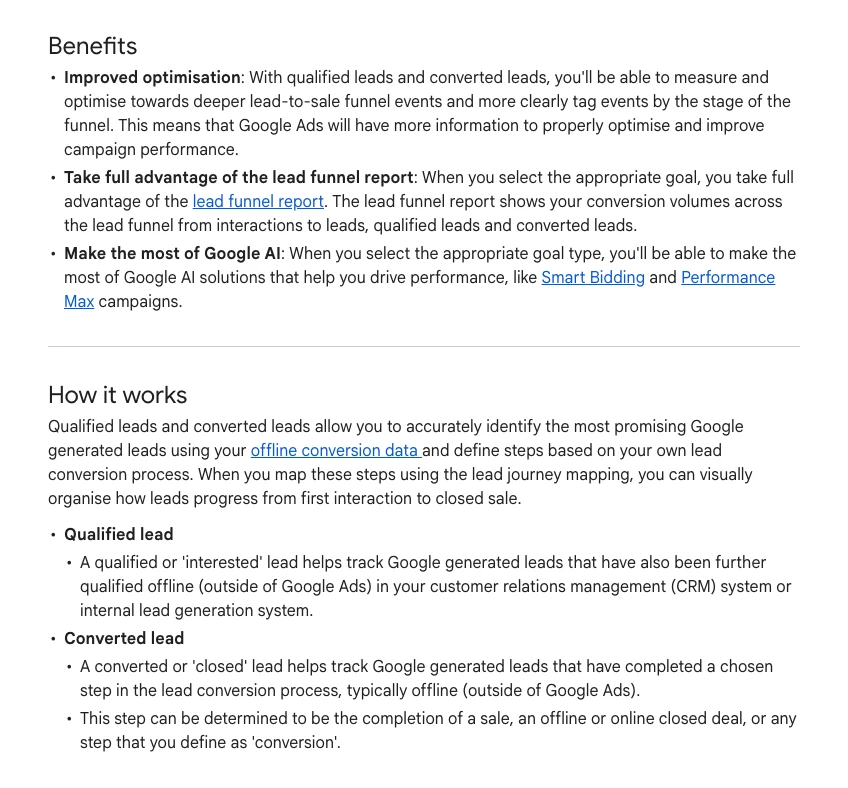
For that, Google's qualified and converted leads goals let you import stages from your CRM: a qualified lead (for example, a seller who fits your buy box and booked a walkthrough) and a converted lead (a signed contract or closed deal). Google says choosing the right goal lets Smart Bidding and Performance Max optimise for these outcomes rather than lead volume.
Timing matters for investors, because deals take a while. Google's offline conversion imports FAQ says conversions with a GCLID (the click ID on ad clicks) can be uploaded up to 90 days after the click, and those matched on customer data up to 63 days. A closing that happens months later may miss the window, so also import an earlier stage, such as appointment set or offer made, that happens within weeks.
| Stage | Investor example | Upload within |
|---|---|---|
| Lead | Call or form from an ad | Tracked live |
| Qualified lead | Fits buy box, walkthrough booked | Days |
| Offer made | Written offer sent | Weeks |
| Converted lead | Contract signed | 63 or 90 days max |
One habit from my own work: put every lead source into one system. Forms, calls, chats and calendar bookings go into one CRM, and the conversions the ad platforms report are checked against the leads the CRM actually holds. When the two disagree, the gap is usually in tracking, not in the ads. My guide to missing conversions covers how to find it.
Why do the usual fixes fall short?
Short answer: Virtual assistants, answering services and voicemail each solve part of the problem. None of them, on their own, gives a fast, consistent, qualified conversation at every hour, which is what wins the seller.
| Fix | What it does well | Where it falls short |
|---|---|---|
| Virtual assistant | Human, can qualify | Hours, turnover, training |
| Answering service | Picks up every call | Takes a message, rarely books |
| Voicemail | Free | Many sellers never leave one |
| Callback next morning | Personal | The seller has talked to others |
When good leads are not turning into deals, my view is that the answer is usually a follow-up system, not more leads. Pouring more budget into a slow response only buys more of the same waste.
What does a speed-to-lead system for investors look like?
Short answer: Five rungs: an instant text back on every missed call, a first real conversation within minutes, a booked walkthrough or call, a summary for your acquisitions manager, and the outcome sent back to Google Ads and Meta. Each rung can be a person or a tool.
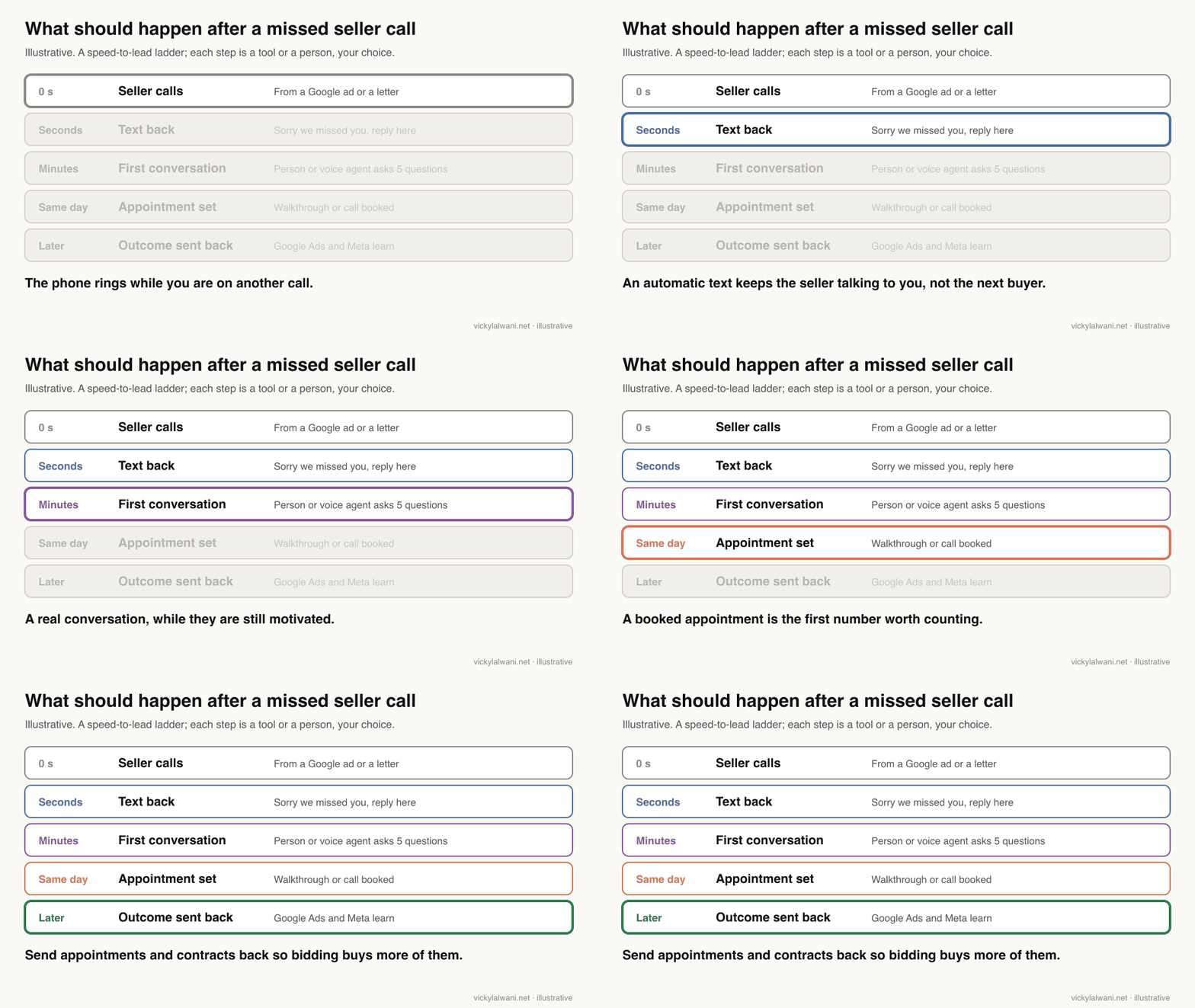
| Rung | Tool examples | What to check |
|---|---|---|
| Text back | CRM or phone system feature | Consent, one text per caller |
| First conversation | Person, VA or voice agent | Minutes, not hours |
| Book | Calendar link or live booking | Real slots, same day |
| Hand over | CRM summary | Answers, source, next step |
| Feed back | Offline imports, CRM to Meta | Stages within upload windows |
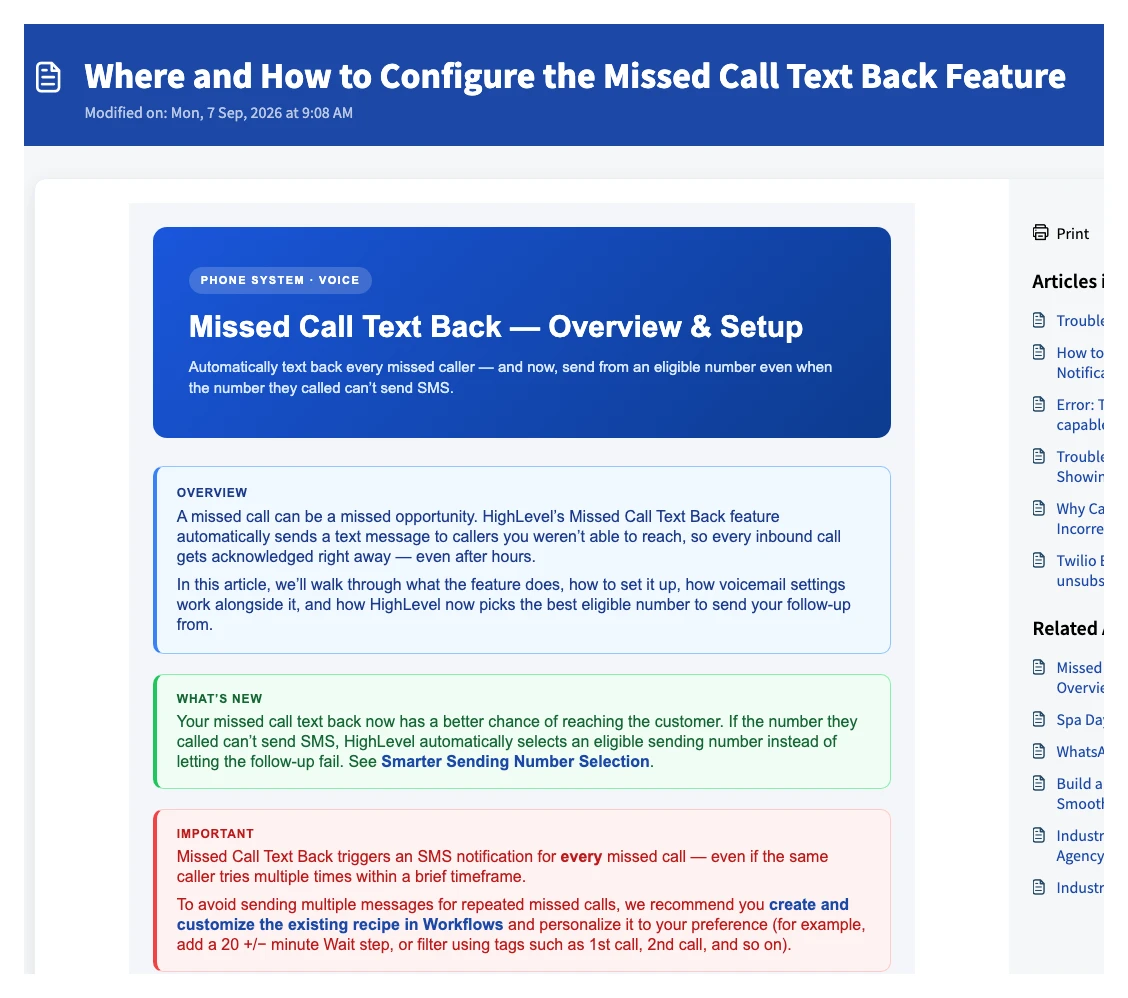
For the first rung, HighLevel's Missed Call Text Back article (modified 7 September 2026) describes an automatic text to every missed caller, a recommended ring timeout of 10 to 20 seconds before a call counts as missed, and a warning that repeat callers get a text each time unless you add a wait step or filters in a workflow. Many phone systems and CRMs have a similar feature.
For forms, connect Google lead form assets by webhook rather than downloading them: Google's download leads page says leads expire after 60 days. For Meta lead forms, Meta's respond to leads page recommends an integrated CRM, says faster follow-up can improve lead quality, and offers lead nurturing chats on Messenger, Instagram and WhatsApp. My Meta lead ads guide covers the booking side.
For the first conversation, a voice agent can now answer, ask your questions and book. Compare platforms carefully; my AI voice agent platform comparison lists what to test. The same choice comes up in clinics, where my AI receptionist guide for dental clinics covers what to check before a voice agent answers patients. For website visitors who will not call, a chatbot on your landing page or WhatsApp can ask the same questions in text.
Which questions should the first response ask a seller?
Short answer: Five, in a natural order: the property address, its condition, the seller's timeline, the reason for selling and the asking price. Decide in advance which answers mean book today, nurture or not a fit, so the first response can act without waiting for you.
Write the questions in plain language before you choose a tool. Whether a person, a text bot or a voice agent asks them, the rules for what happens next should be the same. Use this prompt to draft them, then edit every line yourself.
You are helping a real estate investor write the first-response script for motivated seller leads
from Google Ads, Meta lead forms and direct mail. The script is used by a person, a text bot or a voice agent.

Market: [area, property types we buy]
What makes a lead worth an appointment: [condition, timeline, motivation, price range]
What we never do on the first contact: [make an offer, give legal or tax advice, pressure]
Booking: [calendar link or who calls back, and how fast]

Write:
1. A missed-call text (under 300 characters) that sounds like a local buyer, not a call centre, and asks one easy question.
2. Five qualification questions in a natural order: property address, condition, timeline, reason for selling, asking price.
3. Rules for which answers mean "book a walkthrough today", "nurture" or "not a fit".
4. A handover summary template for the acquisitions manager: answers, source (Google Ads keyword, Meta form, mail piece), time of first reply, next step.
Keep it short and plain. Flag anything that could break consent rules for texting or recording calls.
Speed alone is not enough. Sellers who fill in several forms get several instant texts, so the reply that wins usually mentions their property and situation. Pull the city, property type or reason from the form into the first message.
Keep a human path for anything complex: probate, divorce, tenants in place, or a seller in distress. Automation should speed up the first response, not replace your judgement on deals.
How do you track response speed as a metric?
Short answer: Add one number to cost per lead and cost per deal: time to first real conversation. Log it for every call and form for a month, then compare it with which leads booked appointments. If fast replies book more often, you have the business case for better cover.
| Metric | How to measure | Why it matters |
|---|---|---|
| Missed call rate | Missed / all inbound | Size of the leak |
| Time to first conversation | CRM timestamps | The speed-to-lead number |
| Appointment rate by speed | Booked / leads, by reply time | Proves the case |
| Cost per appointment | Spend / appointments | Better than cost per lead |
| Cost per contract | Spend / contracts | The number that pays |
If fast replies do not book more often, your qualification may be the real issue, or your lead source. Either answer is useful, and both beat guessing.
Videos worth watching
Short answer: Watch Google's own session on feeding first-party data into lead gen, then a practitioner view of Google PPC for motivated seller leads. The second channel sells training, so weigh it as one view.
Made by Google Ads, published 17 September 2026. Covers enhanced conversions for leads and sending offline outcomes back to Google Ads. Official channel.
Made by The REI Inbound Strategist, a channel focused on inbound marketing for investors, published 6 January 2025. A practitioner walkthrough of Google PPC for seller leads; the channel promotes its own services.
| Video | Channel | Date | What it covers |
|---|---|---|---|
| Better lead gen with first-party data | Google Ads | Sep 2026 | Offline outcomes |
| Google PPC for motivated seller leads | The REI Inbound Strategist | Jan 2025 | Seller lead PPC |
| Optimizing value-based bidding for lead gen | Google Ads | Aug 2024 | Values by stage |
| Feed AI better data for better leads | Google Ads | Apr 2026 | Short, lead quality |
| Google PPC for wholesaling and motivated sellers | The REI Inbound Strategist | Sep 2024 | Campaign setup |
What do people say on X and Reddit?
Short answer: Investors and PPC managers agree speed matters, but a lot of the loudest speed-to-lead claims online are misquoted statistics or sales pitches for text-back tools. The useful threads are about tracking calls to revenue and the real cost of virtual assistants.
| Post or thread | Where and when | Type | What it says |
|---|---|---|---|
| Harvard 391% speed to lead claim | Cold email account on X, Feb 2026 | Opinion | Misattributes a vendor figure to HBR |
| Every lead called within 60 seconds | Business author on X, Jan 2025 | Opinion | One owner's anecdote, no data shown |
| Missed call text back as a business idea | Founder account on X, Apr 2026 | Opinion | Unsourced 35% missed-call claim |
| Use conversion actions for the journey | Google Ads on X, May 2026 | Vendor | Map lead stages for Google AI |
| Lead forms with qualification questions | Search news editor on X, Oct 2026 | News | Google lead forms add lead scoring |
| Lead gen is more than form fills | Agency account on X, Oct 2026 | Opinion | Feed later stages back into bidding |
| Speed to lead: getting to sellers first | r/WholesaleRealestate, Jun 2026 | First-hand | Contact rate drops after minutes; be first and relevant |
| Six months of voice AI on investor leads | r/realestateinvesting, Mar 2026 | First-hand | Script matters more than tech; disclosure questions |
| 37 VAs in five years of wholesaling | r/WholesaleRealestate, Feb 2026 | First-hand | Wrong hires burn leads; replies suspect a pitch |
| What AI voice agents change for wholesalers | r/WholesaleRealestate, Dec 2025 | Vendor | Replies call it a sales post |
| Call conversion imports only match some calls | r/PPC, Nov 2026 | First-hand | Short calls and caller ID gaps drop silently |
| From call tracking to revenue tracking | r/PPC, Sep 2026 | First-hand | Tie revenue to the call or upload a sale action |
Three things stand out. Investors in r/WholesaleRealestate agree that speed matters but add a condition: the fast reply has to sound like someone who read the seller's details, because a generic instant text gets ignored. An investor who used a voice agent for six months said the script mattered more than the technology, and replies raised the question of telling callers they are speaking to AI. And PPC managers in r/PPC warn that call conversion imports never match every call, so check match rates before trusting the numbers.
Treat these as signals, not proof. Single posts describe single businesses, and several posters sell the tools they praise.
Where is this advice weak?
Short answer: The best response time research is from 2011 and not about real estate, most call data comes from vendors that sell call tools, and your market's rules on texting and recording calls may limit what you can automate. Your own numbers are the only reliable guide.
- Harvard Business Review's figures are from 2011 and cover web leads at US companies in general.
- Invoca and CallRail sell call software; their methods are only partly published and their definitions differ.
- Google's AI-qualified call leads only work when both numbers are in the United States or Canada.
- Texting sellers and recording calls are regulated differently by country and state. Check the rules for your market and get legal advice; this article is not legal advice.
- The worked example uses made-up inputs. Do not quote its result as a benchmark.
Want a second pair of eyes on your seller leads?
Short answer: If you pay for seller leads and suspect you lose them after the click, I can map missed calls and reply times, set up the text-back and chatbot layer, and feed appointments and contracts back into Google Ads. See Google Ads management, AI chatbot builds or pricing.
If you plan to scale marketing spend in 2027, fix response first. More leads into a slow response system only increase the waste. Get in touch about your seller lead campaigns.
Sources
| Source | What it supports | Date | Link |
|---|---|---|---|
| Harvard Business Review | Response times, 7x and 60x | Mar 2011 | Short life of online leads |
| Invoca | 56% of calls answered | 19 Aug 2026 | Call answer rate |
| CallRail | Missed-call rate by industry | 15 Jan 2025 | Benchmark release |
| CallRail | Consumer survey, 1,000 people | 25 Sep 2025 | Survey post |
| Google Ads Help | AI-qualified calls, US and Canada | Read 18 Nov 2026 | AI-qualified calls |
| Google Ads Help | Qualified and converted leads | Read 18 Nov 2026 | Lead goals |
| Google Ads Help | Upload windows, 90 and 63 days | Read 18 Nov 2026 | Offline imports FAQ |
| Google Ads Help | Lead form leads expire at 60 days | Read 18 Nov 2026 | Download leads |
| Google Ads Help | Call details and missed status | Read 18 Nov 2026 | Call details |
| Meta Help Centre | CRM, follow-up speed, nurturing | Read 18 Nov 2026 | Respond to leads |
| HighLevel Help | Missed call text back | 7 Sep 2026 | Text back setup |
| X and Reddit | Practitioner views | Jan 2025 to Nov 2026 | Linked in the table above |
This article expands on my post on LinkedIn ↗.
FAQ
What is speed to lead in real estate?
Speed to lead is the time between a seller or buyer reaching out and getting a real conversation with you. For real estate investors it matters because motivated sellers often contact several buyers at once, and the first useful conversation tends to win the appointment.
How fast should a real estate investor respond to a lead?
Within minutes where you can, and well within an hour. Harvard Business Review research from 2011 found firms that tried to contact web leads within an hour were nearly seven times as likely to qualify them as firms that waited longer.
How do I estimate what missed calls cost my investing business?
Count missed calls a week, estimate the share from serious sellers, convert that to a monthly figure, then multiply by your close rate, your average profit per deal and twelve. Use your own numbers, since they vary widely by market and lead source.
Is the 391% speed to lead statistic from Harvard?
No. The Harvard Business Review article on online sales leads reports a nearly sevenfold advantage for contact within an hour, not 391%. The 391% figure is usually traced to a lead management software vendor, and its baseline is described inconsistently.
Are virtual assistants or answering services good enough for seller calls?
They help with coverage, but many only take messages, work limited hours or cannot qualify against your buy box. What matters is whether the seller gets a real conversation and a booked next step while they are still motivated.
What is a missed call text back for investors?
It is an automatic text sent to a seller whose call you could not answer, usually with an apology and one easy question. Tools such as HighLevel include it; set it up so repeat callers do not get several texts and check texting consent rules in your market.
How do I stop Google Ads buying seller calls that never become deals?
Import qualified and converted leads from your CRM, such as booked walkthroughs and signed contracts, as offline conversions. Google accepts click-based uploads for up to 90 days, so also import an earlier stage that happens within weeks.
What should an automated call system do for real estate investors?
Answer or text back quickly, ask your qualifying questions, capture property details, book a call or walkthrough and pass a clear summary to your acquisitions manager. Always keep a human path for complex or sensitive situations.