Learn AI or marketing first? Learn marketing first, then add AI to the jobs you already understand, starting within the first month. AI makes execution faster, but diagnosing what is wrong with a campaign still comes from marketing experience. The SEO and paid search skills that still pay are search intent, conversion tracking, reading search terms and knowing what a lead is worth; Google says optimising for its AI search features is still SEO.
TL;DR
Learn marketing first, then AI, but start using AI on real marketing work from the first month rather than "later". AI makes execution faster; the diagnosis of what is wrong with a campaign still comes from marketing experience.
Employers want both. In Microsoft and LinkedIn's 2024 Work Trend Index, 66% of leaders said they would not hire someone without AI skills. In Microsoft's 2026 edition, AI users named quality control of AI output (50%) and critical thinking (46%) as the human skills that matter most.
The SEO and paid search skills that still pay are the ones AI depends on: search intent, conversion tracking, reading search terms, and knowing what a lead or sale is worth. Google says optimising for its AI search features is "still SEO".
Short answer: learn marketing first. Spend your first months inside real accounts learning intent, tracking, search terms and the economics of a lead, and add AI to jobs you already understand so you can tell when its answer is wrong. If you already work in marketing, add AI now, one weekly task at a time. If you come from AI or engineering, get hands-on with a real budget before you sell marketing.
A client meeting made the answer clear to me. Two people pitched the same client. One had learned marketing recently after a technical career, and brought an impressive demo: a clean dashboard and AI-powered everything. The other was an experienced marketer with no demo at all, just an ad account export and an AI assistant. The client asked the first one a simple question: what problem does this solve for me? There was no answer. The second person had the answer before the meeting began.
That is the whole argument of this page, tested against what employers, Google and practitioners say in late 2026. If you would rather hire that second kind of marketer for your Google Ads, that is what my Google Ads management service is.
Should you learn AI or marketing first?
Short answer: marketing first, because you cannot check an AI answer about a campaign you do not understand. But the gap between the two has shrunk to weeks, not years: employers now expect AI skills from day one, so learn the fundamentals and use AI on them at the same time.
The evidence cuts both ways, and it is worth being honest about that. In the 2024 Work Trend Index, a survey of 31,000 people in 31 countries, 66% of leaders said they would not hire someone without AI skills, and 71% said they would rather hire a less experienced candidate with AI skills than a more experienced one without. That argues for learning AI early.
The 2026 edition points the other way on what makes someone valuable once hired. Microsoft's 2026 Work Trend Index surveyed 20,000 AI users in 10 markets between February and April 2026. Asked which human skills matter more as AI takes on work, they put quality control of AI output (50%) and critical thinking (46%) at the top, and 86% said they treat AI output as a starting point, not a final answer.
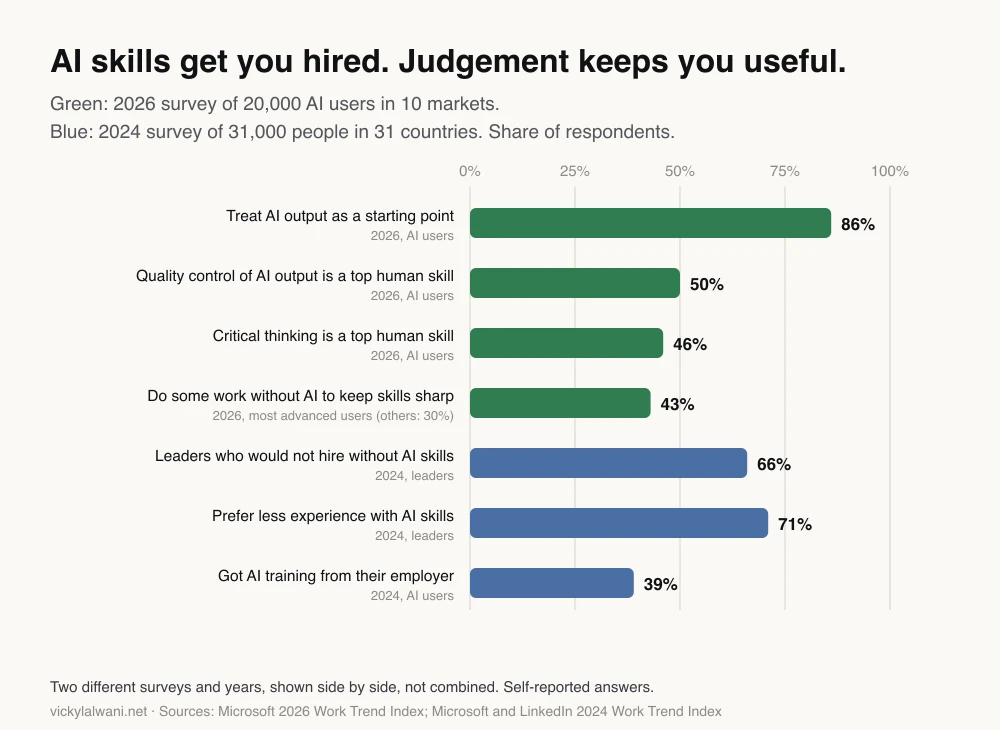
Put together: AI skills get you through the door, and judgement is what keeps you useful once you are in. Quality control of a marketing output is marketing knowledge. You cannot judge whether an AI's negative keyword list is right if you have never read a search terms report.
| Your starting point | Learn first | Then |
|---|---|---|
| New to marketing | Fundamentals on a real account | AI on those same jobs |
| Marketer, little AI | One weekly task with AI | Skills and routines |
| Engineer or AI builder | Hands-on with real budgets | Build tools marketers use |
| Hiring for a team | Test diagnosis, not demos | Train the tools in-house |
Which SEO skills still matter when AI writes the content?
Short answer: the skills Google's own guidance still rewards: understanding search intent, producing content with first-hand value rather than commodity summaries, reading Search Console data, and the technical basics of crawling and indexing. Google says optimising for its AI features is "still SEO", with no special requirements for AI Overviews or AI Mode.
In May 2026 Google published a guide to optimising for generative AI features in Search. Its first answer is that SEO best practices "continue to be relevant", because AI Overviews and AI Mode are rooted in Google's core ranking systems. On AEO and GEO, it says that from Google's point of view, optimising for AI search is optimising for search, and thus still SEO.
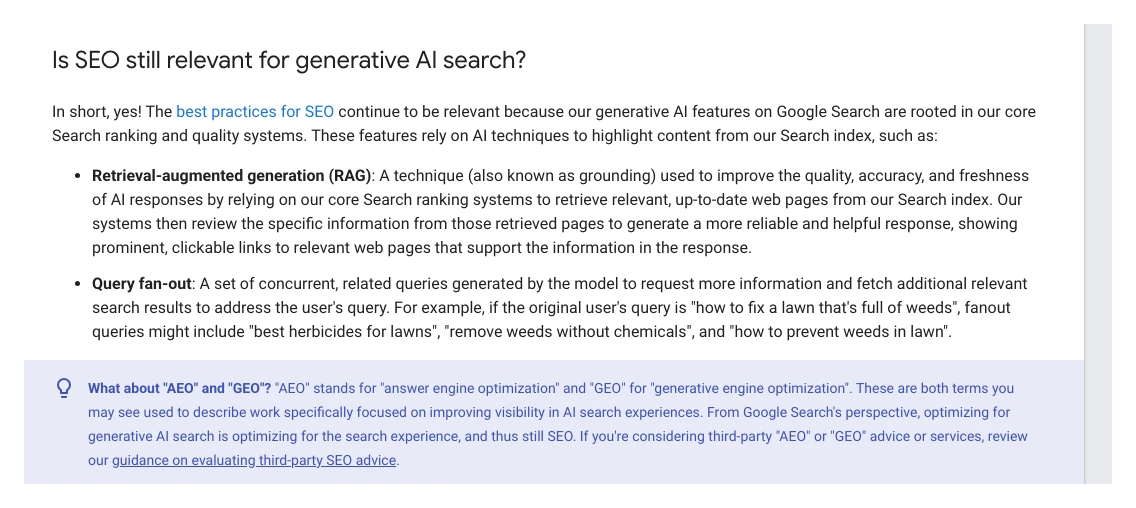
The same guide asks for "non-commodity" content: a unique point of view and first-hand experience, not a summary of what is already online. That is a marketing skill, not an AI one. AI can draft the summary in seconds; only someone who has done the work can add what the summary lacks.
There is also a downside risk that only fundamentals protect you from. Google's guidance on generative AI content says that using AI to generate many pages without adding value may break its spam policy on scaled content abuse. A junior who knows how to prompt but not how search works is the person most likely to publish fifty thin pages because a manager asked for volume.
| SEO skill | Why AI does not replace it | How to practise |
|---|---|---|
| Search intent | AI guesses; data shows | Read the results page for 20 queries |
| Search Console | AI misreads totals | Weekly queries and pages review |
| First-hand content | AI cannot have experience | Write from your own work |
| Technical basics | AI cannot see your server | Fix one crawl issue a week |
| Spam policy sense | AI will happily scale | Read the policy once a year |
For where these skills lead in practice, how to appear in Google AI Overviews applies them to AI search, and my SEO consulting page shows how I run them for clients.
Which paid search skills still matter with AI bidding and AI Max?
Short answer: conversion tracking, reading search terms, matching the ad and landing page to intent, and knowing what a lead or sale is worth. Google's AI runs the auctions, but Smart Bidding needs conversion tracking switched on, and AI Max adds its own rows to the search terms report that someone has to read.
Google Ads now automates much of what juniors used to do by hand. Smart Bidding sets bids in every auction, and AI Max for Search campaigns expands matching with broad match and keywordless technology. Google's Ads Liaison account announced on 15 April 2026 that AI Max was leaving beta and that Dynamic Search Ads would move to it.
None of that removes the human job. It moves it. According to Google's Smart Bidding help page, you need conversion tracking enabled before you can use Smart Bidding at all. If the tracking counts the wrong thing, the AI optimises hard towards the wrong thing.

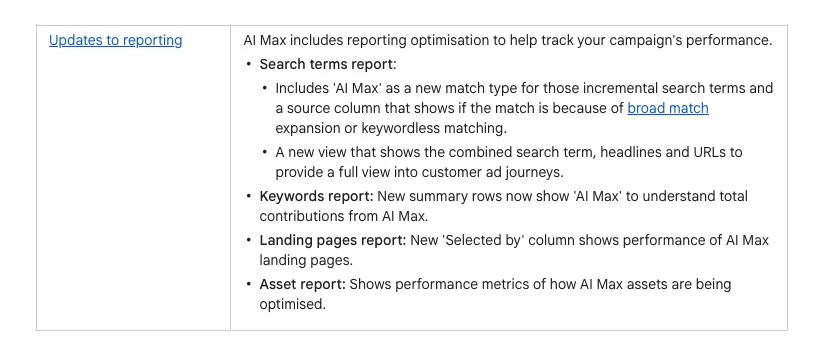
And the search terms report did not go away; it grew. The AI Max help page says the report now shows "AI Max" as a match type, with a column for whether a match came from broad match expansion or keywordless matching. Someone still has to read those rows and decide what does not belong.
| Paid search skill | What AI does | What you still decide |
|---|---|---|
| Conversion tracking | Optimises to it | What counts as a conversion |
| Search terms | Expands matching | What to exclude |
| Ad and page match | Writes variants | Which promise fits the intent |
| Unit economics | Hits a target | What the target should be |
| Testing | Rotates assets | What to test and when to stop |
Two habits from my own accounts show why this is judgement, not tooling. I keep new campaigns in draft until every form and call button is measured, because tracking set up after launch wastes the first weeks of data. And I rename things in the words searchers use, not the words a business uses internally, which no AI will suggest unless someone tells it how customers talk. Finding wasted Google Ads spend walks through the search terms side step by step.
What should a marketer learn about AI, and in what order?
Short answer: pick one weekly job you already do well, run it with AI and compare the result with your own; then learn to check outputs against the source; then turn the version that holds up into a reusable skill or routine. Learn by shipping real work, not by collecting tools.
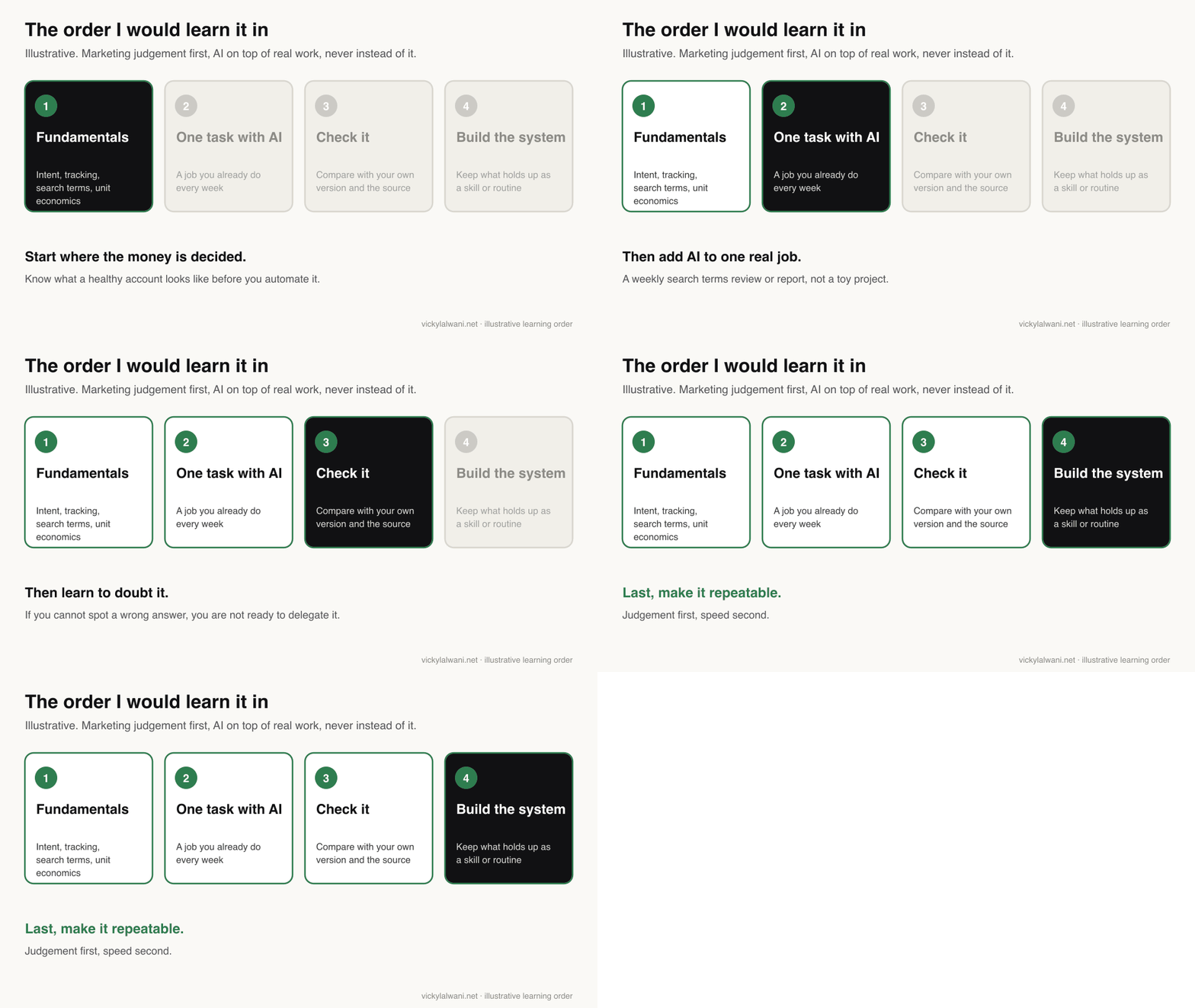
| Month | Focus | Proof you are done |
|---|---|---|
| 1 | One weekly task with AI | Output you would send |
| 2 | Checking and data | You catch its errors |
| 3 | Skills and routines | The task runs the same each week |
Free official courses cover the AI vocabulary. Anthropic's Claude Academy has a four-hour AI Fluency course on delegating and checking AI work, and Google's Skillshop hosts Google Ads training and certifications. For SEO, Google's SEO Starter Guide is still the best free foundation. If you are training a whole team, my Claude training curriculum for marketing teams sets out the four weeks.
A starter prompt for month one, using a job most marketers already do:
Here is last week's search terms report for one campaign, as a CSV.
1. Group the terms by intent: ready to buy, researching, wrong service, job seekers, other.
2. For each group, show clicks, cost and conversions.
3. List terms you think are wrong for [service] and explain why in one line each.
4. Do not decide exclusions. Give me the total cost of all rows so I can check it against the platform.
Then do the same review by hand and compare. Where the two disagree is where you learn, about the account and about the AI. For my own learning, I spend about an hour a day trying AI tools and keep only what holds up on real client work.
What if you come from an AI or technical background?
Short answer: get hands-on with real budgets and real clients before you sell marketing. You will build faster than most marketers, but without knowing margins, sales cycles and what a good lead looks like, you cannot evaluate what your tools produce.
The clearest statement of this came from a former software engineer on r/PPC who manages their own Google Ads through Claude with read and write access. Their advice: if you have never run a campaign and do not understand paid search at a structural level, do not hand Claude the keys, because you will get plausible recommendations and no way to check them. They found it most useful for people who already run their own ads.
The reverse path is open, and technical people often build the better tools. But it takes longer than people expect. Spend time inside real accounts and client calls; learn how budgets get approved and why a lead that looks good in the platform never closes in the CRM. Even a small test budget teaches more than a course, a point an r/PPC reply made to an SEO asking whether to skip Google Ads and go straight to newer ad platforms.
Should you hire a marketer who learned AI or an AI specialist?
Short answer: for marketing results, hire the marketer who has learned AI, and test it by asking them to diagnose a real account, not to demo a tool. Pair them with a technical builder if you need custom tools, with clear ownership of strategy and review.
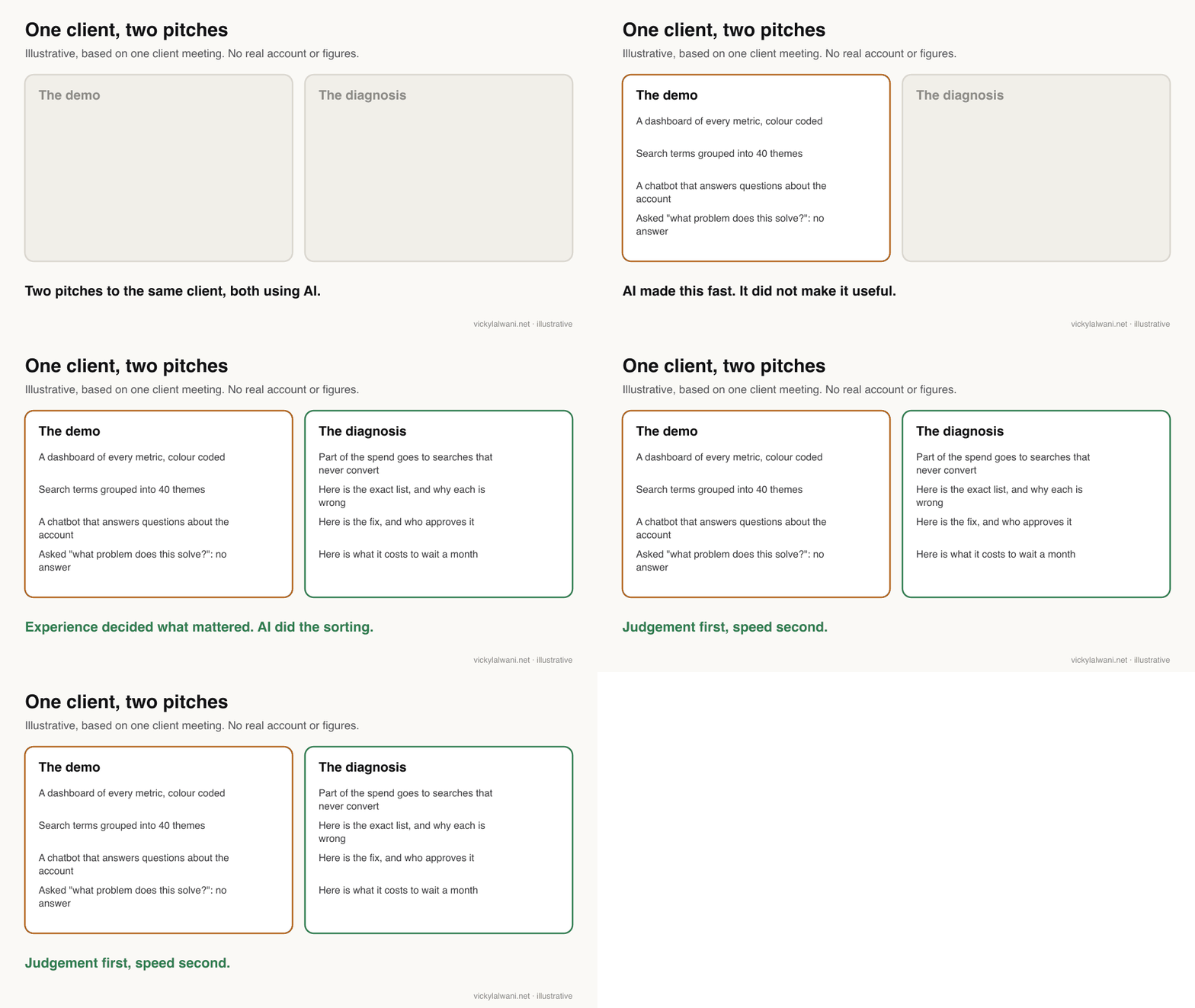
When I evaluate a person or a vendor, I ask them to talk through a real problem rather than demonstrate a feature. These questions work with or without AI in the room:
- What would you check first in this account, and why?
- What would make you say the data is wrong?
- What would you not automate, and what do you review by hand?
- Where does your expertise end, and who would you bring in?
- How would you explain the finding to someone who does not care about the tool?
| Signal | Marketer who learned AI | AI specialist |
|---|---|---|
| Opens with | A finding | A demo |
| Checks numbers | Against the platform | Against the model |
| Best at | Diagnosis, priorities | Building tools |
| Risk | Slower to automate | Confident wrong answers |
The risk in the last row is real. I have seen an agent-built Google Ads plan go to a reviewer without a person checking it, and its search volumes were far too low. The reviewer's first question was what a person had added. Since then every plan gets a human check and a short note before it goes anywhere. When I trained a junior marketer, I had them rebuild a campaign from scratch by hand, and we reviewed it together the next day before anything was published.
If you are weighing who to hire for paid search specifically, freelance PPC consultant or agency covers that decision, and the future of PPC agencies covers how the work itself is changing.
How do you keep marketing skills sharp while using AI?
Short answer: do some work without AI on purpose, decide before each task what AI should and should not do, and keep reading raw data yourself. Microsoft's 2026 research found the most advanced AI users do both more often than others.
In the 2026 Work Trend Index, the most advanced AI users were more likely than others to do some work without AI to keep their skills sharp (43% against 30%), and to pause before starting work to decide what AI should do versus a person (53% against 33%). They use AI more, and they protect their own judgement more.
- One manual audit a month. Read a search terms report or a Search Console export yourself, start to finish.
- Decide before you delegate. Write one line: what AI does here, what I decide.
- Check one number every time. Any total an AI gives you, compare with the platform.
- Keep talking to customers. The words people use are the best keyword and ad copy research there is.
Which parts of paid search to hand over, and which to keep, is set out in what to automate in PPC.
What people say on X and Reddit
Short answer: practitioners mostly say the same thing: AI takes the repetitive work, while strategy, intent, message match and checking the numbers stay human. The worry is real too: some say AI is removing the junior work that used to train strategists.
| Who | What they said | Take it as | Link |
|---|---|---|---|
| An SEO agency founder on X, 15 May 2026 | Google's guide: SEO is still the foundation for AI search | Opinion | Post |
| An international SEO consultant on X, 15 May 2026 | Google published official guidance on AI search; SEO still relevant | Reporting | Post |
| Google's Ads Liaison on X, 15 Apr 2026 | AI Max leaves beta; Dynamic Search Ads move to it | Official | Post |
| A PPC consultant on X, 12 Jul 2025 | A new in-house marketer judged an account by its optimisation score | First-hand | Post |
| A content and AEO consultant on X, 11 Nov 2026 | Tools will not save a broken strategy | Opinion | Post |
| r/PPC, 29 Oct 2026 | How are you preparing for AI's impact on your PPC career? | Opinion | Thread |
| r/PPC, 21 Apr 2026 | Claude managing Google Ads helps operators, not beginners | First-hand | Thread |
| r/PPC, 27 Feb 2026 | In-house PPC worried; replies name message match as the human skill | Opinion | Thread |
| r/PPC, 3 Mar 2026 | What to learn if starting today | Opinion | Thread |
| r/digital_marketing, 4 Nov 2026 | Which skill made the biggest career difference | First-hand | Thread |
| r/PPC, 30 Oct 2026 | AI audits of PPC accounts disappoint without training | First-hand | Thread |
The October r/PPC thread on careers is the most useful read. The top reply says AI can handle bidding and keywords but not why a client targets a certain audience or how its seasons work, and that they are learning attribution beyond last click. Another reply puts the whole debate in one line: better to be the PPC person who knows what they are doing and uses AI than one who does not and thinks AI covers it.
The sharpest worry is in the March thread on what to learn: one reply argues that AI is removing the bottom rungs of the ladder, the grunt work through which people used to learn strategy. Other replies say to learn unit economics, intent, analytics and conversion rate work first. In the r/digital_marketing thread, the answers that got specific were about reading analytics well enough to see which channel brings paying customers, and interviewing customers.
The X post from a PPC consultant is a small, telling story: a client's new in-house marketing expert opened an audit meeting by calling the account under-optimised because Google's optimisation score was low. That is what it looks like when someone learns the tool's signals before the fundamentals.
Videos worth watching
Short answer: start with Google's own channels, because they explain what the platforms actually reward, and sell nothing beyond the platform.
Made by Google Search Central on 8 January 2026. Google's search team discusses SEO, AI optimisation and third-party "GEO" advice; it sells nothing beyond Google Search itself.
Made by Google Ads on 21 April 2026. Google's own guide to AI Max; useful for seeing which controls remain with the advertiser, though it naturally presents the feature favourably.
| Video | Channel | Date | What it covers |
|---|---|---|---|
| Thoughts on SEO and SEO for AI, part 1 | Google Search Central | 17 Dec 2025 | SEO and AI search |
| AI Max for Search campaigns | Google Ads | 12 Jun 2025 | AI Max overview |
| AI Fluency course trailer | Anthropic | 12 Jun 2025 | Delegating and checking AI |
| What will happen to marketing in the age of AI? | TED | 12 Dec 2023 | Marketing roles and AI |
Where this advice is weak
Short answer: the survey figures are self-reported and come from a software vendor, the 2024 hiring figures are two years old, and "learn marketing first" is my judgement from client work, not a measured outcome.
- The Work Trend Index is published by Microsoft, which sells AI tools. The 2026 sample is AI users only, so it says nothing about people who do not use AI.
- The 2024 hiring figures predate today's agents. The 2026 edition, as far as I read it, does not repeat the hiring question.
- Google's guidance describes Google Search. Other AI assistants have their own systems, though the same fundamentals tend to help.
- If AI keeps removing junior tasks, the classic way of learning marketing by doing grunt work may need replacing with deliberate practice, which is harder to organise.
- The opening story is one meeting. It shows the pattern; it does not prove it.
Want a marketer who already uses AI on your account?
Short answer: that is how I work: marketing diagnosis first, with AI doing the sorting, drafting and checking underneath. I run Google Ads management and SEO consulting that way, and every change is checked by a person before it goes live.
My rates are on the pricing page. If you want AI agents built into your own marketing team instead, see AI marketing agents.
Sources
| Source | What it supports | Date | Link |
|---|---|---|---|
| Microsoft 2026 Work Trend Index | 50%, 46%, 86%, 43% vs 30%, 53% vs 33% | Read 18 Nov 2026 | Open |
| Microsoft and LinkedIn 2024 Work Trend Index | 66%, 71%, 39%; 31,000 people | 8 May 2024 | Open |
| Microsoft news release, 2024 | Survey size and countries | 8 May 2024 | Open |
| Google: generative AI features guide | SEO still relevant; AEO and GEO still SEO; non-commodity content | Updated 10 Jul 2026 | Open |
| Google: generative AI content | Scaled content risk | Updated 1 Oct 2026 | Open |
| Google: spam policies | Scaled content abuse | Updated 28 Aug 2026 | Open |
| Google SEO Starter Guide | Free SEO foundation | Read 18 Nov 2026 | Open |
| Google Ads Help: Smart Bidding | Conversion tracking required | Read 18 Nov 2026 | Open |
| Google Ads Help: AI Max | Search term matching; AI Max in search terms report | Read 18 Nov 2026 | Open |
| Google Skillshop | Google Ads training and certifications | Read 18 Nov 2026 | Open |
| Claude Academy | AI Fluency course, 4 hours | Read 18 Nov 2026 | Open |
| Reddit and X posts | What practitioners report | See table above | Linked above |
This article expands on my post on LinkedIn ↗.
FAQ
Should I learn AI or marketing first?
Learn marketing first, but start using AI on real marketing work within the first month. You need marketing knowledge to judge whether an AI answer about a campaign is right, and employers increasingly expect AI skills from day one.
Can AI replace marketing experience?
No. AI speeds up sorting, drafting and analysis, but knowing which problem matters, what the data really means and what a client can act on still comes from experience. In Microsoft's 2026 Work Trend Index, AI users ranked quality control of AI output and critical thinking as the most important human skills.
Do employers want marketers with AI skills?
Yes. In the 2024 Work Trend Index from Microsoft and LinkedIn, 66% of leaders said they would not hire someone without AI skills and 71% preferred a less experienced candidate with AI skills. Those figures are from 2024, so treat them as a direction rather than today's exact number.
Is SEO still worth learning with AI search?
Yes. Google's guide to generative AI features says SEO best practices remain relevant because AI Overviews and AI Mode are rooted in its core ranking systems, and that optimising for AI search is still SEO. First-hand, non-commodity content and technical basics matter more, not less.
Which paid search skills still matter with AI bidding?
Conversion tracking, reading search terms, matching ads and landing pages to intent, and knowing what a lead or sale is worth. Google Ads Smart Bidding needs conversion tracking enabled, and AI Max adds its own rows to the search terms report that someone has to review.
How should a marketer start learning AI?
Pick one job you do every week, such as a search terms review or a monthly report, run it with AI and compare the output with your own. Then practise checking AI answers against the source, and turn the version that holds up into a reusable routine.
Should I hire a marketer who knows AI or an AI specialist?
For marketing results, hire the marketer who has learned AI, and test them by asking for a diagnosis of a real account rather than a tool demo. Add a technical builder if you need custom tools, with clear ownership of strategy and review.
Can someone from a technical background become a good marketer?
Yes, but it takes hands-on time with real budgets and clients. Without knowing margins, sales cycles and which leads close, a technical marketer cannot evaluate what their AI tools recommend, however good the tools are.
How do I keep my marketing skills sharp while using AI?
Do some work without AI on purpose, such as one manual audit a month, decide before each task what AI should do, and check at least one number in every AI output against the platform. Microsoft's 2026 research found the most advanced AI users do this more often than others.