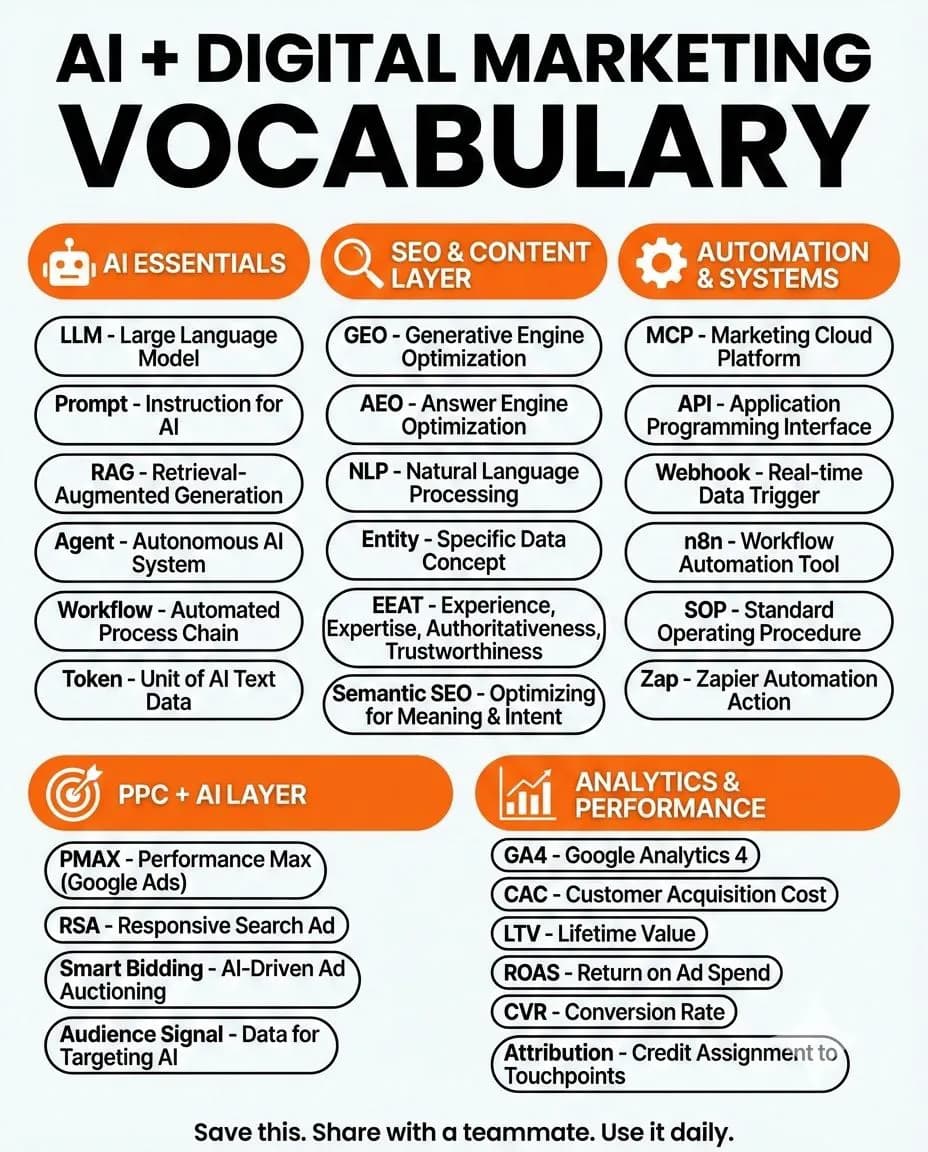
An AI marketing glossary gives your team one meaning for the words behind AI search, paid media and reporting. The key terms in November 2026: AEO and GEO (Google calls both "still SEO"), AI Overviews and AI Mode, MCP and skills for connecting AI tools, AI Max and Performance Max in Google Ads, and Advantage+ and Andromeda at Meta.
You are in a strategy call and someone says the agency will "turn on AI Max, feed Andromeda more creative and sort the GEO side with an MCP". Half the room nods. Nobody wants to ask which of those words are products, which are techniques and which are marketing labels.
This AI marketing glossary fixes that. Each term gets one plain sentence, the fact that matters as of November 2026 where there is one, and a link to the article on this site that covers it properly. It is the hub for everything I write about AI search, paid media and AI tools, so it links widely. If you would rather have someone apply these terms to your own site, my SEO consulting and generative engine optimisation work start exactly here.
TL;DR
Six groups cover almost every AI term in marketing: AI search, models, agents and tools, Google Ads automation, Meta automation and measurement. Learn the group your work touches first.
AEO and GEO are labels, not products. Google's own guide says optimising for its AI features is "still SEO" (updated 10 July 2026). ChatGPT and other assistants publish far less about how they pick sources.
MCP, connectors and skills are how AI tools reach your data and repeat your method. MCP is an open standard Anthropic introduced in November 2024 and handed to the Linux Foundation's Agentic AI Foundation in December 2025.
In paid media the AI is already inside the platforms: AI Max and Performance Max at Google, Advantage+ and the Andromeda retrieval system at Meta. Your inputs, tracking and approvals decide whether they help.
What is an AI marketing glossary for?
Short answer: An AI marketing glossary gives a team one shared meaning for the words that now run search, paid media and reporting. It stops a brief saying "use AI for SEO" when it means three different jobs, and it lets you spot when a vendor sells an old idea under a new acronym.
On client and agency calls, AI search is rarely asked about by name. The question arrives as "how do we get more leads", and the AI vocabulary is what I bring to the answer. A shared glossary is how the rest of the team keeps up without nodding along.
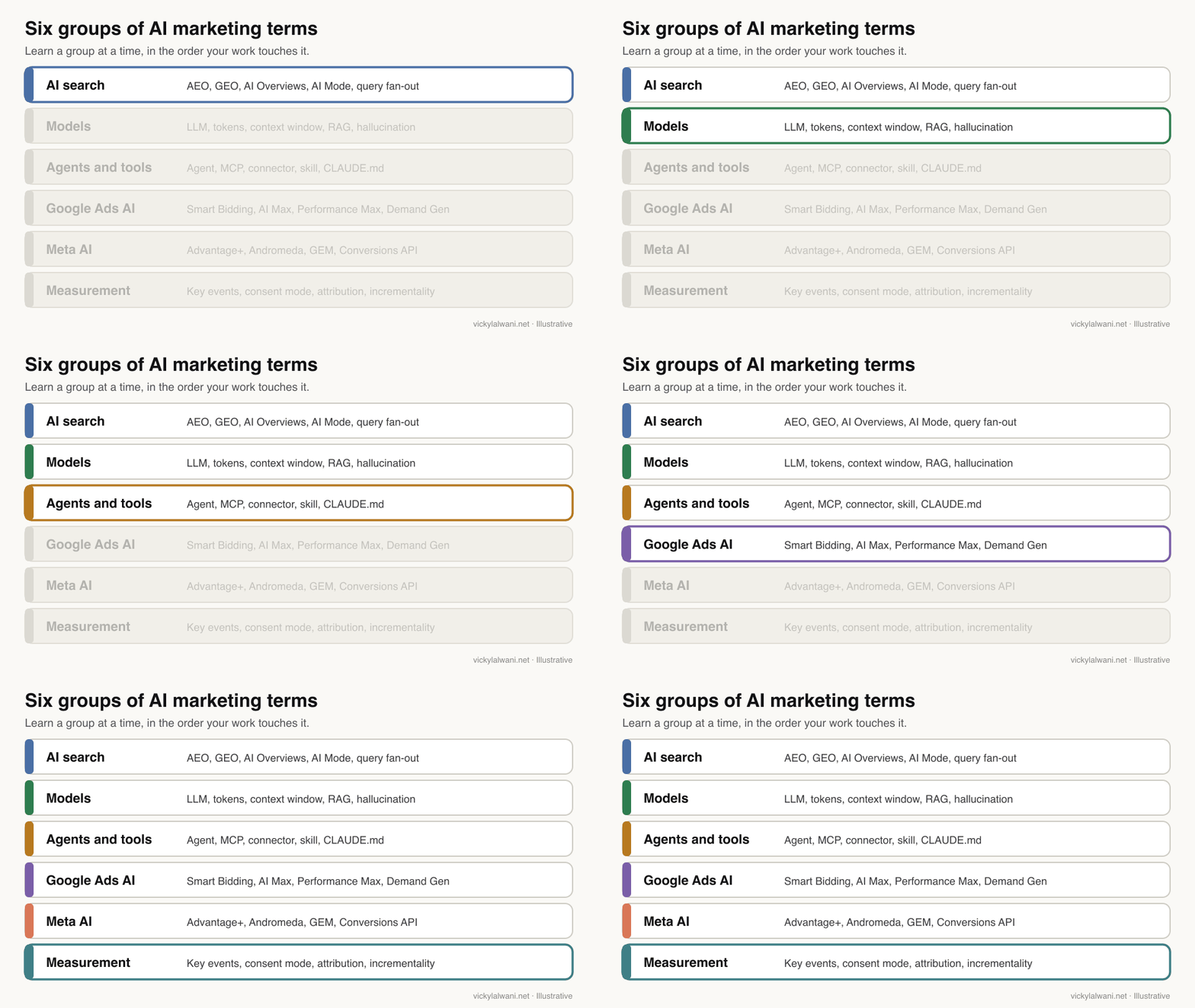
| Group | Who needs it most | Start with |
|---|---|---|
| AI search | SEO, content, founders | AI Overviews, GEO |
| Models | Anyone using AI daily | Context window, hallucination |
| Agents and tools | Ops, analysts, leads | MCP, skills |
| Google Ads AI | PPC managers | AI Max, Smart Bidding |
| Meta AI | Paid social | Advantage+, Andromeda |
| Measurement | Everyone who reports | Key events, consent mode |
AI search terms: AEO, GEO, AI Overviews and AI Mode
Short answer: AEO and GEO are names for work aimed at being used in AI answers. AI Overviews and AI Mode are Google's AI answer features, and Google says they run on its normal ranking systems, so the same SEO basics apply. Other assistants, such as ChatGPT, document less about how they choose sources.
AEO (answer engine optimisation): shaping pages so a search feature or AI assistant can lift them as the direct answer to a question. Read how to optimise your website for AI search.
GEO (generative engine optimisation): work aimed at being used and cited when an AI model writes an answer. The term comes from a November 2023 research paper, later accepted at KDD 2024. Read what generative engine optimisation is.
AI Overviews: AI-written summaries at the top of some Google results, with links to the pages they draw on, expanded in Search from May 2024. Read how to appear in Google AI Overviews.
AI Mode: Google's chat-style search for longer, multi-step questions, which Google began rolling out to everyone in the US in May 2025. Read Google AI Mode SEO.
Query fan-out: the AI splits one question into several related searches and combines what it finds, which is why one page can be cited for a question it never names. Google defines it in its generative AI guide. Read how to structure pages for AI search.
RAG (retrieval augmented generation), or grounding: the model fetches real documents first and writes its answer from them, instead of from memory alone. Read how to build an AI SEO system.
AI citation: a link or named mention of your page or brand inside an AI answer, the visibility measure GEO work tracks. Read how to run an AI citation audit.
Search generative AI control: a Search Console setting that decides whether your site can appear in Google's generative AI features; it is on by default and rolled out to all sites on 31 August 2026. Read the Search Console generative AI guide.
Generative AI performance report: the Search Console report that shows impressions in AI Overviews and AI Mode, available to all sites since 31 August 2026. Read how to read the generative AI report.
llms.txt: a proposed text file that lists a site's key pages for language models; Google says Search itself does not use it, though other tools may read it. Read what matters more than llms.txt.
AI crawlers: the bots AI companies use to read your site, such as OAI-SearchBot for ChatGPT search and PerplexityBot, each controlled in robots.txt. Read which AI crawlers to allow.
Zero-click search: a search that ends without a visit to any website because the answer sits on the results page. Read what to check when traffic drops.
AI recommendations: when ChatGPT or another assistant names a business in reply to a "who should I use" question. Read how ChatGPT recommends businesses and how to get recommended by ChatGPT.
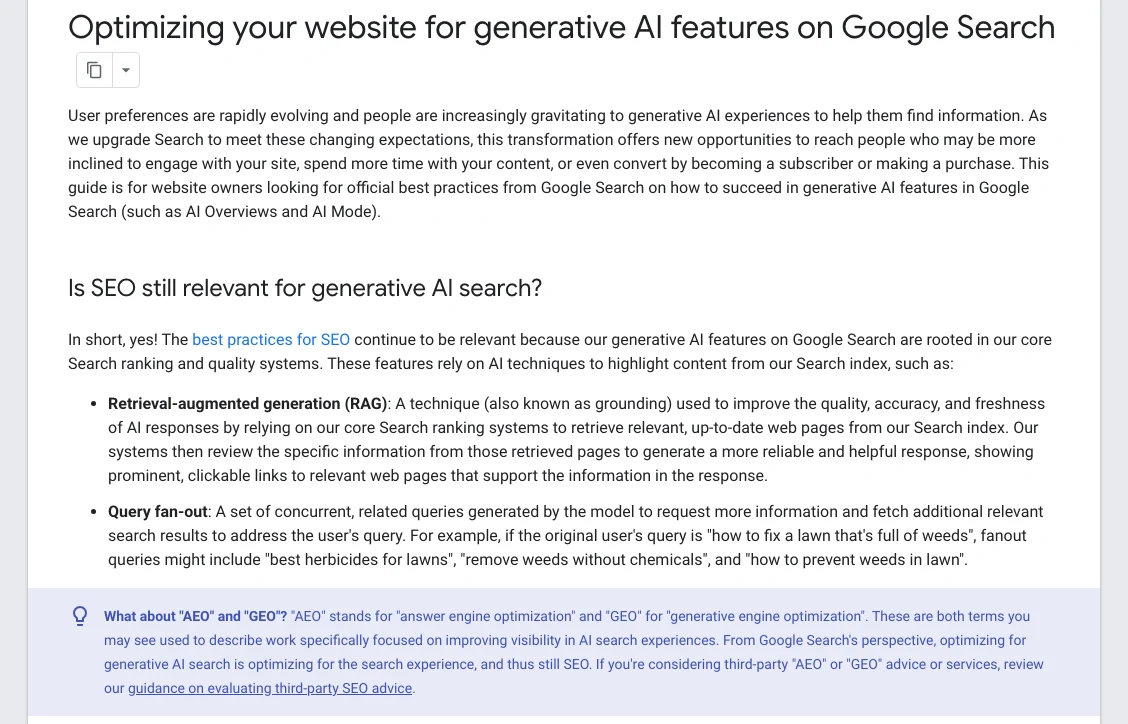
Google's position on the acronyms is unusually direct. Its guide says AEO and GEO are terms for visibility work in AI search and that, from Google Search's point of view, this "is optimizing for the search experience, and thus still SEO". The same page lists chunking content into small pieces and creating llms.txt files as tactics you can ignore for Google.
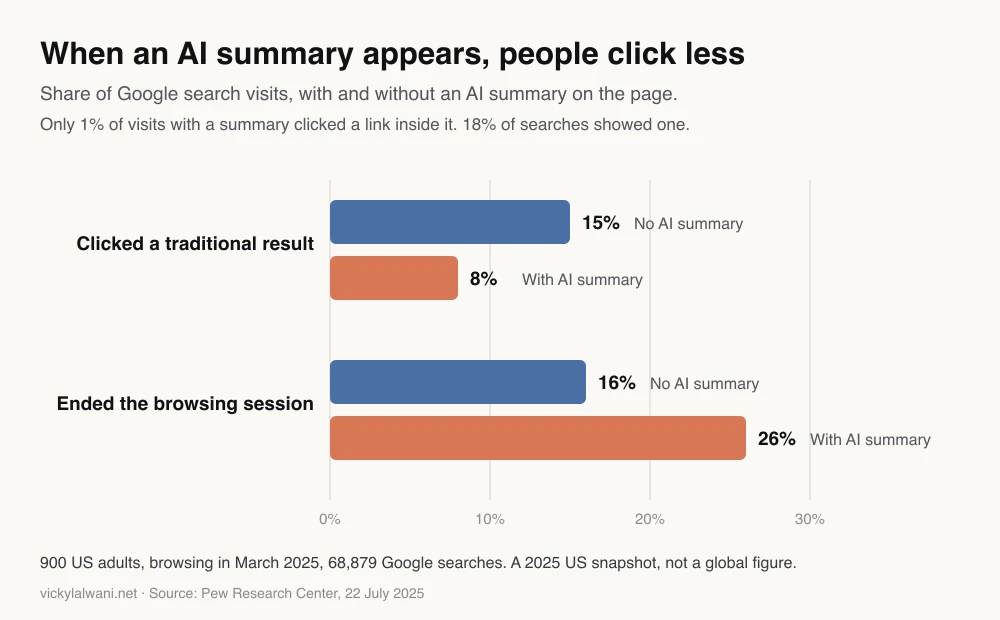
The reason these terms matter commercially is clicks. In Pew Research Center's tracking of 900 US adults, visits to a Google results page with an AI summary ended in a click on a normal result 8% of the time, against 15% without one.
| Label | Aims at | Main measure |
|---|---|---|
| SEO | Ranking and clicks in search | Clicks, rankings, leads |
| AEO | Being the quoted answer | Answer boxes, AI answers |
| GEO | Being cited by AI models | Citations, brand mentions |
| Google's view | All three, for Google Search | "Still SEO" |
Model terms: LLM, tokens, context window and more
Short answer: The model terms explain why AI output can be fluent and still wrong, why long chats get worse and why costs vary so much. Most problems marketers blame on "the AI" are a context window, a missing source or the wrong model for the job.
LLM (large language model): the model behind ChatGPT, Claude or Gemini, which predicts likely text from patterns it learned, so it can sound sure and still be wrong. Read the best AI model for marketing.
Prompt: the instruction you give a model, which works best when it states the task, the context, the limits and the format you want back. Read a four-part prompting framework.
Token: the small chunk of text a model reads and writes, and the unit AI services bill by. Read how to reduce token usage.
Context window: how much text a model can hold in one conversation, including your files; past a point, early instructions start to slip. Read context window management.
Hallucination: a confident answer the model made up, such as a search volume or a statistic with no source behind it. Read keyword research with real data.
Model routing: sending each task to the cheapest model that passes a written check, and only hard tasks to the most expensive one. Read AI model routing.
The hallucination entry is the one I would pin to the wall. I have seen an AI agent produce search volumes far below what the source showed when checked by hand, which is why every number in an AI-drafted plan should be traced back to the export it came from before anyone sees it.
Agent terms: MCP, connectors, skills and agents
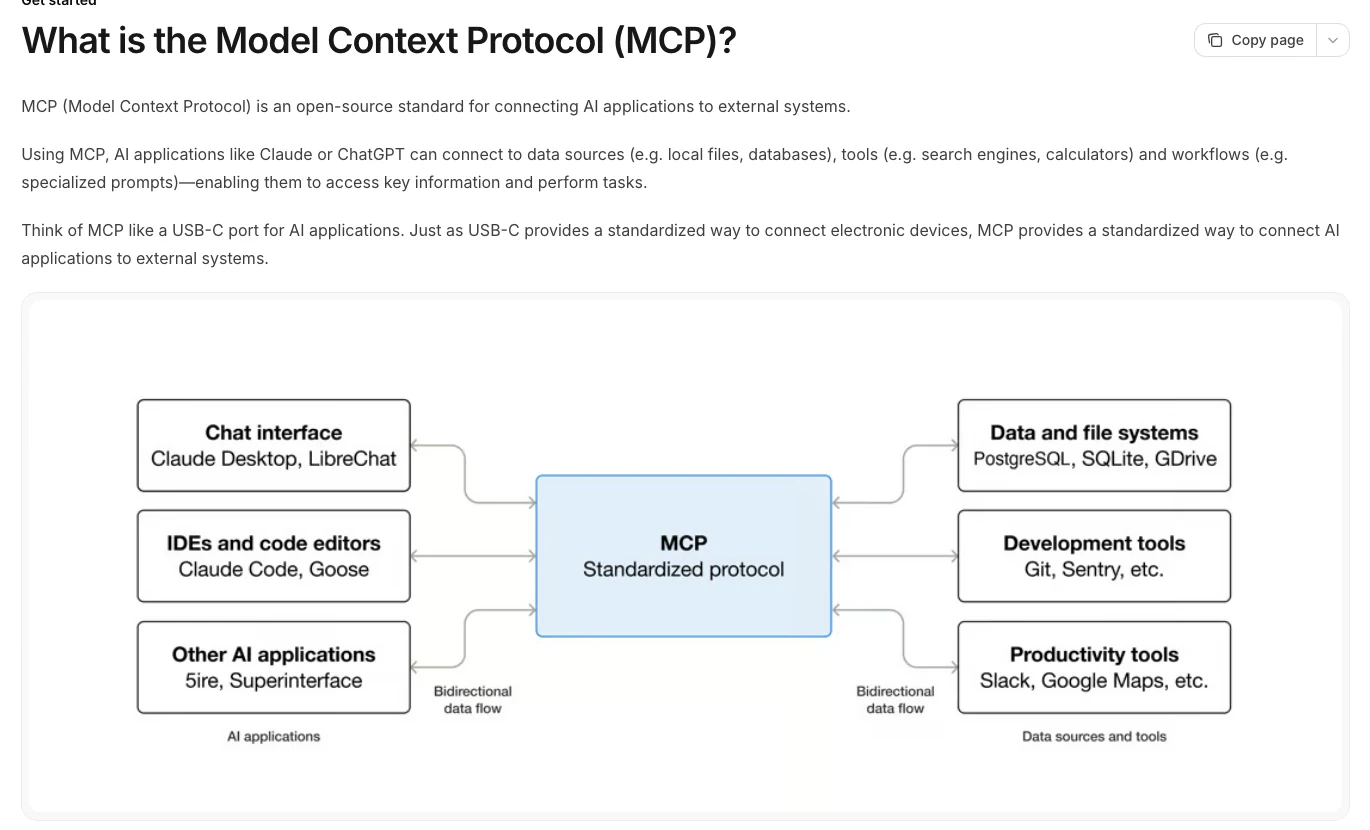
Short answer: An agent is AI that decides its own steps and uses tools. MCP is the open standard that connects AI apps to those tools, connectors are ready-made MCP links inside an app, and skills are saved instructions that teach the AI a method. Together they turn a chat into a repeatable workflow.
AI agent: a system where the model directs its own steps and tool use to finish a task, as Anthropic puts it in its December 2024 guide to agents. Read AI workflows vs agents.
AI workflow: a fixed sequence of AI and tool steps that runs the same way every time, cheaper and easier to check than an agent. Read AI marketing workflows.
Human in the loop: a person approves each change an AI drafts before it goes live. Read human in the loop AI for Google Ads.
MCP (Model Context Protocol): an open standard for connecting AI apps to tools and data, which Anthropic introduced in November 2024 and donated to the Agentic AI Foundation in December 2025. Read what a marketing MCP server is.
MCP server: the program that exposes one tool, such as Google Ads or GA4, to any AI app that speaks MCP. Read MCP servers for SEO.
MCP tool: a single action an MCP server offers, with a name and a description the model reads to decide when to use it. Read MCP tools for AI agents.
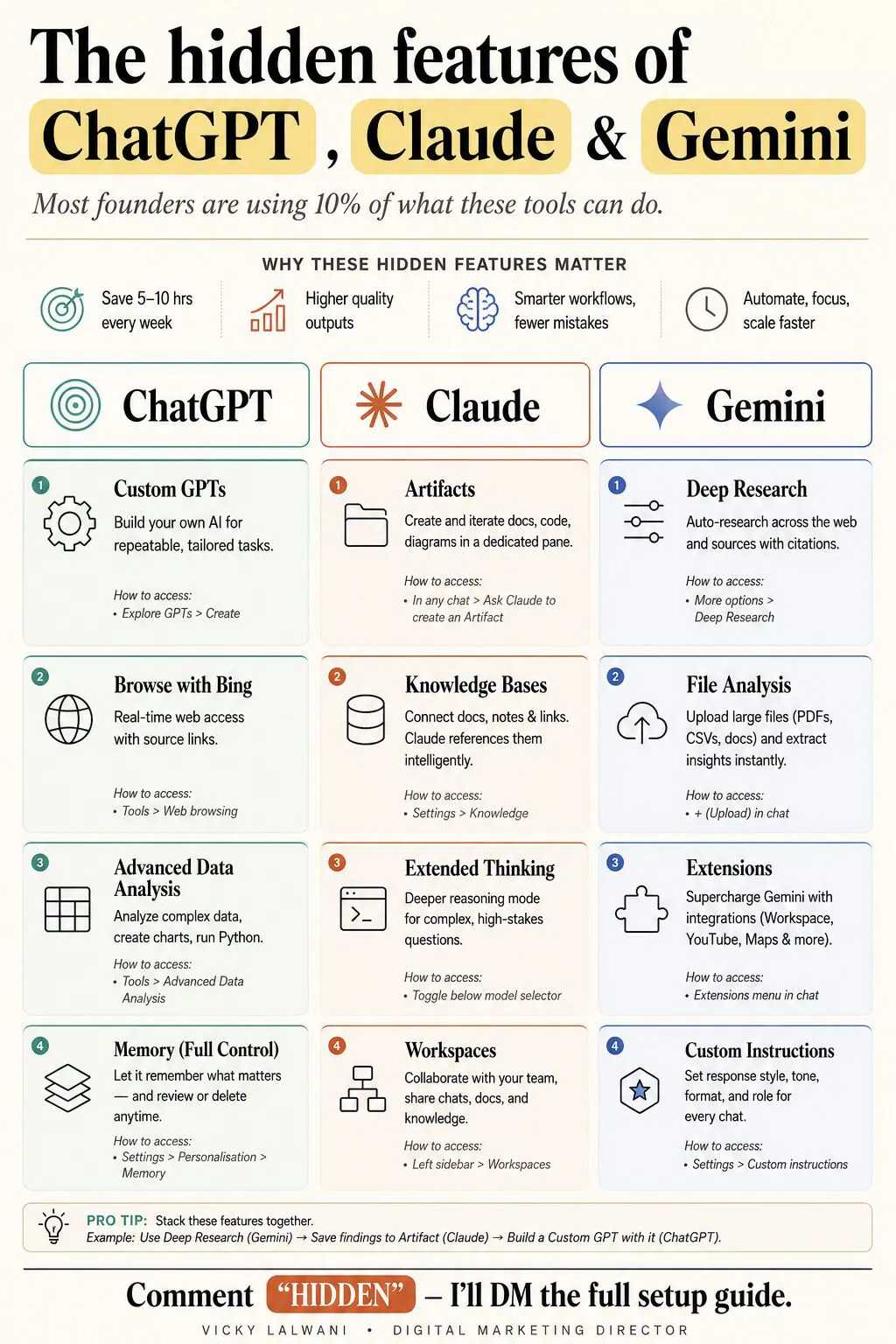
Connector: a ready-made link inside Claude or ChatGPT to a service such as HubSpot or Semrush, usually built on MCP. Read Claude MCP connectors for marketing.
Skill: a folder with a SKILL.md file that teaches the AI one job, loaded only when a request matches it; Claude Skills launched in October 2025. Read Claude skills for SEO and Claude skills for Google Ads.
Slash command: a skill you start by typing / and its name, such as /ppc-audit. Read the Claude slash commands cheat sheet.
Plugin: a bundle of skills and connectors packaged for one role, installed in one step. Read Claude plugins for marketing.
CLAUDE.md and AGENTS.md: plain text files of standing rules a coding agent reads at the start of every session; AGENTS.md is the open format several tools share. Read the Claude MD file for marketing.
Subagent: a helper agent with its own context that the main agent hands one part of a job to. Read the Claude subagents tutorial.
Scheduled task: a saved prompt that runs on a timetable, such as a Monday report, without you starting it. Read the Claude morning briefing.
Claude Code: Anthropic's agent that reads and edits files and runs commands, used for scripts, site changes and data work. Read the Claude Code SEO workflow.
Cowork: Claude's mode for longer jobs on your files and apps, which became part of the main Claude app on 16 September 2026. Read Claude Cowork for Google Ads.
Prompt injection: hidden instructions inside a page, email or tool description that try to make an AI do something you did not ask. Read the security notes on MCP tools.
WebMCP: a draft web standard that lets a page offer named actions, such as "book a table", to AI agents in the browser; it is a W3C Community Group draft, not a finished standard. Read WebMCP for SEO.
Agentic commerce: an AI agent finds, compares and buys or books on someone's behalf, which puts weight on clean forms, baskets and checkout pages. Read how to optimise a website for AI agents.
| Term | Answers the question | Example |
|---|---|---|
| Connector or MCP | What can the AI reach? | GA4, Google Ads, a CRM |
| Skill | How should it do the job? | A search term audit |
| CLAUDE.md | What rules always apply? | Banned claims, markets |
| Scheduled task | When does it run? | Monday 8am report |
| Human in the loop | Who says yes? | You approve each change |
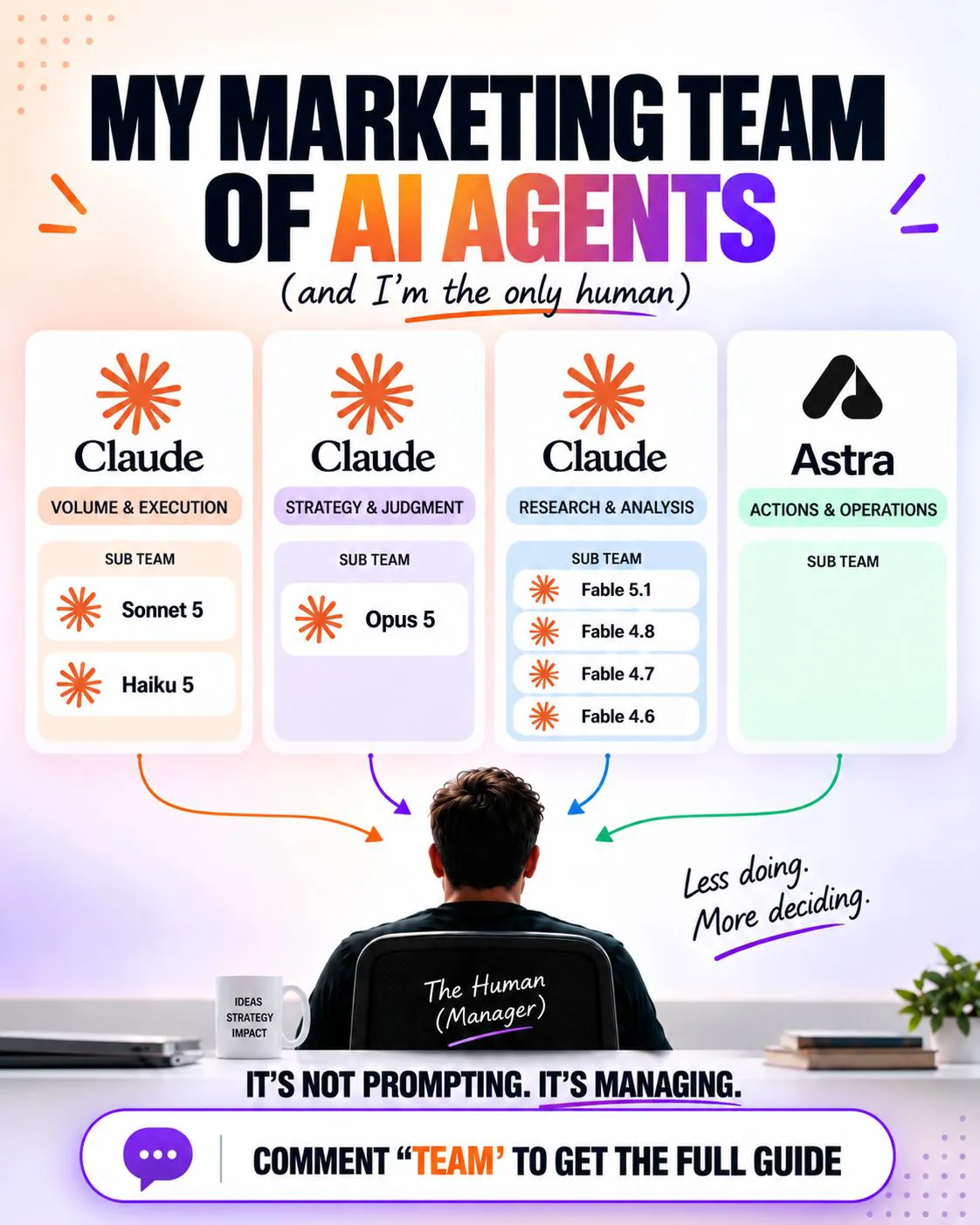
In my own work this maps to a simple habit: one Claude project per client, skills kept in one known place, a thinking model that plans and a separate agent that executes, and nothing going live without approval.
Google Ads AI terms: AI Max, Performance Max and Smart Bidding
Short answer: Smart Bidding sets bids, AI Max widens and rewrites Search campaigns, Performance Max buys across all of Google's inventory from one campaign, and Demand Gen runs image and video ads. All of them learn from your conversion data, so the tracking matters more than the settings.
Smart Bidding: Google's automated bid strategies that set a bid in each auction to win conversions or conversion value, such as Target CPA and Maximise conversions. Read Target CPA vs Maximise conversions.
Broad match: the widest keyword match type, which lets Google show your ad for searches related to the meaning of your keyword. Read how to reduce wasted ad spend.
AI Max for Search: an optimisation layer inside Search campaigns that adds search term matching, text customisation and final URL expansion; it is on by default in new Search campaigns, and Dynamic Search Ads are being moved to it. Read AI for paid media.
Performance Max (PMax): a goal-based campaign that reaches Search, YouTube, Display, Discover, Gmail and Maps from one campaign, using your assets and signals. Read Performance Max for lead generation.
Demand Gen: a campaign type for image and video ads on YouTube, Shorts, Discover, Gmail, Maps and the Display Network, aimed at people before they search. Read the Google Marketing Live changes.
Responsive search ad (RSA): a Search ad where you supply up to 15 headlines and 4 descriptions and Google picks the mix for each search. Read ad copywriting frameworks.
Audience signal: a hint you give Performance Max about who is likely to convert, such as a customer list; a starting point, not a limit. Read Google Ads Customer Match.
Customer Match: uploading contact details your customers gave you so Google can match them to signed-in users for targeting, exclusion or bidding. Read three ways to use Customer Match.
Ads Advisor: Google's AI agent inside Google Ads that suggests and makes changes, and asks for approval before acting. Read overnight agents with a human in the loop.
Google Ads MCP server: Google's open-source MCP server that lets an AI assistant query a Google Ads account. Read the marketing MCP guide and AI agents for PPC.
Ads in AI Overviews and AI Mode: ads placed inside Google's AI answers where available; broad match, AI Max, Shopping and Performance Max campaigns can reach the longer questions, while exact and phrase match reach only plainly commercial ones. Read ads in AI Mode.
Two habits from client work apply to every term above. Campaigns stay in draft until every form and call button is measured, and broad match runs as a discovery phase before the terms that convert move to exact and phrase match.
Meta AI terms: Advantage+, Andromeda and the Conversions API
Short answer: Advantage+ is Meta's name for automated audience, budget, placement and creative settings. Andromeda is the system that picks which ads are considered for each person, and GEM helps rank them. The Conversions API sends conversions from your server so those systems learn from real results.
Advantage+ campaign: a Meta campaign with Advantage+ audience, Advantage+ campaign budget and Advantage+ placements all switched on, which is how Meta's developer docs define it. Read the Meta ads settings checklist.
Advantage+ audience: Meta finds the audience itself and treats your age, interest and lookalike inputs as suggestions. Read which audience controls still bind.
Advantage+ creative: automatic edits Meta can make to your ads, such as adding product tags or summaries, some of which can start switched on. Read the Meta ad creative process.
Andromeda: Meta's ads retrieval system, the first stage that narrows every eligible ad down to a short list for each person; Meta says its October 2026 version scores over one billion ads per second. Read why Andromeda rewards creative variety.
GEM: Meta's Generative Ads Recommendation Model, which Meta says lifted ad clicks on Facebook by 3.5% in the fourth quarter of 2025 (Meta, January 2026). Read AI for paid media.
Conversions API (CAPI): sends conversion events from your server or CRM to Meta, alongside the browser pixel, with a shared event ID so each sale is counted once. Read Meta ads attribution changes.
Event Match Quality: Meta's score from 0 to 10 for how well your conversion events can be matched to people. Read the conversion tracking audit.
Incremental attribution: an optional Meta attribution model that counts only the conversions Meta estimates its ads caused. Read what counts as a Meta conversion now.
Meta business AI and Ads MCP: Meta's assistant in Ads Manager and its MCP connection for AI tools, both built by the company that sells the ads. Read Meta Ads Manager AI reporting.
| Job | Google name | Meta name |
|---|---|---|
| Automatic bids | Smart Bidding | Highest volume, cost per result goal |
| Budget moved to what works | Performance Max | Advantage+ campaign budget |
| Wider reach | Broad match, AI Max | Advantage+ audience |
| All placements | Performance Max | Advantage+ placements |
| Auto creative | Text customisation | Advantage+ creative |
| Server data | Enhanced conversions | Conversions API |
| In-platform agent | Ads Advisor | Business AI assistant |
For ChatGPT, which now sells ads too, read the ChatGPT ads strategy.
Measurement terms: key events, consent mode and attribution
Short answer: Measurement terms decide what the AI in each platform learns from. Key events mark what matters in GA4, consent mode adjusts tags to each visitor's choice, enhanced conversions and the Conversions API fill gaps, and attribution rules explain why every platform claims a different total.
Key event: an action GA4 treats as important to your business; GA4 renamed these from conversions, and a Google Ads conversion is now built from one. Read the conversion tracking event map.
Consent mode: Google's way of telling its tags whether a visitor accepted ad and analytics storage, so they adjust what they collect. Read where consent mode fits.
Enhanced conversions: sends a hashed copy of first-party data, such as an email address, with a conversion so Google can match more of them. Read why Google Ads is not tracking conversions.
Attribution: the rules that give credit for a conversion to the clicks and views before it, which is why Google, Meta and GA4 rarely agree. Read one cross-channel report.
Deduplication: making sure one action sent by both the browser and the server is counted once. Read the 15-check tracking audit.
Incrementality: the share of results that would not have happened without the ads, measured with lift tests that hold back a control group. Read the paid media audit.
Marketing mix modelling (MMM): a statistical model that estimates each channel's effect from spend and sales over time; Google's open-source version is Meridian. Read how far to trust platform figures.
Data Studio: Google's free reporting tool, called Looker Studio until it was renamed in April 2026. Read Looker Studio alternatives for PPC.
Google Tag Manager: the container that holds your tracking tags so you can change them without editing the site. Read Google tag vs Google Tag Manager.
A measurement gap that comes up on client calls is AI search leads landing in the wrong bucket, for example a lead from ChatGPT reported as Google Ads. Fix the tracking before you judge whether AEO, GEO or AI Max "worked".
Which AI marketing terms changed meaning in 2026?
Short answer: Several familiar names changed in 2026: Looker Studio became Data Studio, some Search campaigns were moved into AI Max with Dynamic Search Ads to follow, Cowork became part of the main Claude app, and Meta narrowed what a click means for attribution. Old briefs and old training decks often still use the previous names.
| You may hear | Now called or now means | Since |
|---|---|---|
| Looker Studio | Data Studio | April 2026 |
| Auto-created assets, campaign broad match | AI Max for Search | Sept 2026 |
| Dynamic Search Ads | AI Max for Search | From Feb 2027 |
| Claude Cowork as a separate app | Part of Claude | 16 Sept 2026 |
| GA4 conversions | Key events | Rename in GA4 |
| Meta "click" in attribution | Link click only | March 2026 |
| Custom commands in Claude Code | Skills | Per current docs |
Dates come from Google Cloud, the Google Ads blog, Anthropic and Meta. The skills change is covered in the slash commands guide.
How do you turn this glossary into your team's own?
Short answer: Keep only the terms your stack uses, add a one-line example from your own accounts next to each, and agree who owns each tool. Review it every quarter, because product names in this space change several times a year.
- Map your tools to the six groups and delete terms you never touch.
- Add a real example: "AI Max is on in campaign X, off in Y, and here is why."
- Name an owner for each connector, skill and automated campaign.
- Write the approval rule beside every term that can spend money or reach a customer.
- Recheck the list against vendor documentation each quarter.
This prompt drafts a first version from your own notes. Paste it into Claude or ChatGPT with a list of your tools.
You are helping a marketing team build its own AI glossary.

Here is our tool list and how we use each one: [paste tools, platforms, campaigns, AI apps]

Rules:
- Only include terms that appear in our tool list or that a person on our team would hear in a vendor call about these tools.
- Group terms under: AI search, models, agents and tools, Google Ads AI, Meta AI, measurement.
- For each term write one plain sentence a new hire would understand, then "In our setup:" with one line about how we use it.
- Mark any term where you are unsure of the current product name with [CHECK].
- Do not invent features, dates or figures. If you are not sure, say so.
- End with a list of terms that can spend money or reach customers, so we can add an approval rule to each.
| Team member | Terms to know first |
|---|---|
| Founder or CMO | GEO, AI Overviews, attribution, agent |
| SEO or content | AEO, query fan-out, AI crawlers, skill |
| PPC manager | AI Max, Smart Bidding, PMax, enhanced conversions |
| Paid social | Advantage+, Andromeda, Conversions API |
| Analyst | Key events, consent mode, MMM, MCP |
Videos worth watching
Short answer: Three official videos explain the biggest terms from the source: Google Search Central on SEO, AI Overviews and GEO, Anthropic on MCP, and Google Ads on AI Max. The table adds three more official explainers.
Google Search Central, 8 January 2026. Google's own view of the SEO, AIO and GEO labels; it sells nothing but naturally presents Google's position.
Anthropic, 16 June 2025. How MCP works, from the company that created it.
Google Ads, 21 April 2026. Setting up AI Max, from the platform that sells it, so pair it with an independent view before switching it on.
| Video | Channel | Date | What it covers |
|---|---|---|---|
| SEO, AIO, GEO and your site | Google Search Central | 8 Jan 2026 | The AI search labels |
| Search Gen AI reports (Q2 2026) | Google Search Central | 18 Jun 2026 | The Generative AI report |
| The Model Context Protocol (MCP) | Anthropic | 16 Jun 2025 | What MCP is |
| What are skills? | Claude | 26 Feb 2026 | Skills explained |
| How to use AI Max for Search | Google Ads | 21 Apr 2026 | AI Max setup |
| Advantage+ sales campaigns | Meta for Business | 10 Feb 2026 | Advantage+ basics |
What people say on X and Reddit
Short answer: Official accounts announce the terms; practitioners argue about what they mean in practice. The recurring threads are whether AI citations without a brand name are worth anything, whether AI Max suits high-ticket accounts, and what "Andromeda 2.0" actually changes.
| Post | Date | Point | Type |
|---|---|---|---|
| An Anthropic developer relations lead | 25 Nov 2024 | MCP launched as an open standard | Vendor |
| Google Ads | 12 Nov 2025 | Ads Advisor introduced as an agent | Vendor |
| Google Ads Liaison | 15 Apr 2026 | AI Max out of beta; DSA timeline | Official |
| Search Engine Roundtable's editor | 31 Aug 2026 | AI reports and control roll out | First-hand news |
| A paid social commentator | 28 Oct 2026 | Meta's rebuilt layers explained | Opinion |
| Reddit thread | Date | Recurring theme | Type |
|---|---|---|---|
| r/SEO: cited 700 times, named five | 13 Sep 2026 | Citations without the brand name | First-hand |
| r/SEO: what do you use MCP for? | 1 May 2026 | Real MCP uses in SEO | First-hand |
| r/PPC: AI Max this month | 15 Nov 2026 | Good on cheap products, poor on high-ticket | First-hand |
| r/FacebookAds: my take on Andromeda 2.0 | 30 Oct 2026 | Reading Meta's engineering post | First-hand |
| r/FacebookAds: all ads in one ad set now? | 10 Nov 2026 | "2.0" is a nickname, not a setting | Opinion |
Every X post was checked through X's embed service on 18 November 2026 and every Reddit thread through the Arctic Shift archive. Accounts named after a person are described by role, and Reddit is credited by community.
Where this advice is weak
Short answer: A glossary dates fast. Product names, defaults and rollout dates here were checked on 18 November 2026 and some will change within months. Several figures are vendor claims, and AEO and GEO have no official definition outside Google's own framing.
- Meta's Andromeda and GEM figures and Google's AI Max claims are the platforms' own numbers, not independent tests.
- The Pew figures are a US snapshot from March 2025; click behaviour in other markets and in AI Mode may differ.
- Google says AEO and GEO are "still SEO" for Google Search. That does not tell you how ChatGPT, Perplexity or Claude pick sources, which they document far less.
- Definitions are simplified on purpose. Read the linked article before you change a live setting.
Want help turning these terms into rankings and leads?
Short answer: If you want this vocabulary applied to your own site and accounts, my SEO consulting covers AI search visibility, tracking and the content changes that get pages cited, and generative engine optimisation focuses on AI answers specifically.
For paid media, the same terms sit inside my Google Ads management, and rates are on the pricing page. If you are starting from scratch, read what generative engine optimisation is, then how to structure pages for AI search, what a marketing MCP is and AI for paid media.
Sources
| Source | What it supports | Date | Link |
|---|---|---|---|
| Google Search Central | AEO and GEO "still SEO", RAG, query fan-out, llms.txt | Updated 10 Jul 2026 | AI guide |
| Google Search Central | AI Overviews and AI Mode basics | Read 18 Nov 2026 | AI features |
| Google blog | AI Overviews expansion | 14 May 2024 | I/O 2024 |
| Google blog | AI Mode US rollout | 20 May 2025 | I/O 2025 |
| arXiv | GEO paper, KDD 2024 | 16 Nov 2023 | 2311.09735 |
| Search Console Help | Generative AI control | 31 Aug 2026 | 16908024 |
| Search Console Help | Generative AI report | 31 Aug 2026 | 16984139 |
| Pew Research Center | Click rates with AI summaries | 22 Jul 2025 | Pew |
| Anthropic | Agents vs workflows | 19 Dec 2024 | Building agents |
| Anthropic | MCP launch | 25 Nov 2024 | MCP |
| Anthropic | MCP to Agentic AI Foundation | 9 Dec 2025 | AAIF |
| MCP docs | MCP definition | Read 18 Nov 2026 | modelcontextprotocol.io |
| Anthropic | Skills launch | 16 Oct 2025 | Skills |
| Anthropic | Cowork part of Claude | 16 Sep 2026 | One Claude |
| AGENTS.md | Open format | Read 18 Nov 2026 | agents.md |
| W3C Community Group | WebMCP draft | Read 18 Nov 2026 | WebMCP |
| Google Ads Help | AI Max layer and defaults | Read 18 Nov 2026 | 15909989 |
| Google Ads blog | DSA moving to AI Max | 15 Apr 2026, upd. 11 Jun | DSA upgrade |
| Google Ads Help | Performance Max | Read 18 Nov 2026 | 10724817 |
| Google Ads Help | Demand Gen | Read 18 Nov 2026 | 13695777 |
| Google Ads Help | Smart Bidding | Read 18 Nov 2026 | 7065882 |
| Google Ads Help | Enhanced conversions | Read 18 Nov 2026 | 9888656 |
| Google blog | Ads Advisor asks approval | 21 Apr 2026 | Ads Advisor |
| GitHub | Google Ads MCP server | Read 18 Nov 2026 | google-ads-mcp |
| Meta for Developers | Advantage+ definition | Read 18 Nov 2026 | Advantage+ |
| Meta Engineering | Andromeda retrieval, figures | 28 Oct 2026 | Andromeda |
| Meta newsroom | GEM click lift | 28 Jan 2026 | AI drives performance |
| Meta for Business | Link-click attribution | 3 Mar 2026 | Click attribution |
| Analytics Help | Key events vs conversions | Read 18 Nov 2026 | 13965727 |
| Google for Developers | Consent mode | Read 18 Nov 2026 | Consent mode |
| Google for Developers | Meridian MMM | Read 18 Nov 2026 | Meridian |
| Google Cloud | Looker Studio renamed | Apr 2026 | Data Studio |
| YouTube (oEmbed checked) | Videos | 2025 to 2026 | See videos section |
| X (oEmbed checked), Reddit (Arctic Shift) | Posts and threads | Nov 2024 to Nov 2026 | See social section |
This article expands on my post on LinkedIn ↗.
FAQ
What is the difference between AEO and GEO?
AEO (answer engine optimisation) aims to make a page the direct answer to a question, while GEO (generative engine optimisation) aims to get a page used and cited when an AI model writes an answer. They overlap heavily, and Google says that for its own AI features both are still SEO.
Is GEO different from SEO?
For Google Search, no: Google's generative AI guide, updated in July 2026, says optimising for AI Overviews and AI Mode is still SEO and runs on its core ranking systems. For ChatGPT, Perplexity and other assistants the picture is less clear, because they publish much less about how they choose sources.
What does MCP mean in marketing?
MCP, the Model Context Protocol, is an open standard that lets AI apps such as Claude or ChatGPT connect to tools like Google Ads, GA4 or a CRM. Anthropic introduced it in November 2024 and donated it to the Agentic AI Foundation in December 2025.
What is the difference between an AI agent and an AI workflow?
An AI workflow runs fixed steps in the same order every time, while an AI agent decides its own steps and which tools to use. Workflows are cheaper and easier to check, so most marketing jobs should start as workflows with a person approving the output.
What are Claude skills?
Claude skills are folders with a SKILL.md file that teach Claude one job, such as a search term audit or a title rewrite. Claude loads a skill only when your request matches it, so the method stays the same each time without retyping it.
What is AI Max in Google Ads?
AI Max for Search is an optimisation layer inside Search campaigns, not a new campaign type. It adds search term matching, text customisation and final URL expansion, is on by default in new Search campaigns, and is replacing Dynamic Search Ads.
What is Meta Andromeda?
Andromeda is Meta's ads retrieval system, the first stage of ad delivery that narrows every eligible ad down to a short list for each person before ranking. Meta described a new version in October 2026; "Andromeda 2.0" is a community nickname, not a setting you switch on.
Is Performance Max the same as Advantage+?
No, but they do similar jobs on different platforms. Performance Max is a Google Ads campaign that reaches all Google inventory from one campaign, while an Advantage+ campaign is a Meta campaign with automated audience, budget and placements switched on.
How often should a team update its AI marketing glossary?
Review it every quarter. In 2026 alone Looker Studio was renamed Data Studio, some Search campaigns moved into AI Max, Cowork became part of the main Claude app and Meta changed what counts as a click, so names and defaults date quickly.