A Claude subagent is a separate worker with its own context, instructions and tools that does one side task and returns a summary. Anthropic's October 2026 guide says one agent with skills often beats a team of subagents, so start there and add a read-only subagent only for bulky output, parallel research or independent checks.
You ask Claude Code to review last month's search terms export and suggest negative keywords. It reads every row, then the landing pages, then the campaign notes. Twenty minutes later the session is crowded with raw data, the answers get vaguer, and you are not sure which suggestions came from which file. That is the problem subagents were built to solve. It is also the problem many people now solve better without them.
This Claude subagents tutorial covers both sides, checked against Anthropic's documentation in November 2026: what a subagent is, how to build one, the three that earn their keep in SEO and Google Ads work, and when a single agent with a skill does the job better. If you would rather have this set up around your own accounts, that is part of my Claude consultant service, alongside SEO and Google Ads management.
TL;DR
- A subagent is a separate Claude worker with its own context window, instructions and tool access. It does one side task and hands back a summary.
- Anthropic's October 2026 guide says a single agent with skills frequently beats a team of subagents on quality, cost and speed. Start there.
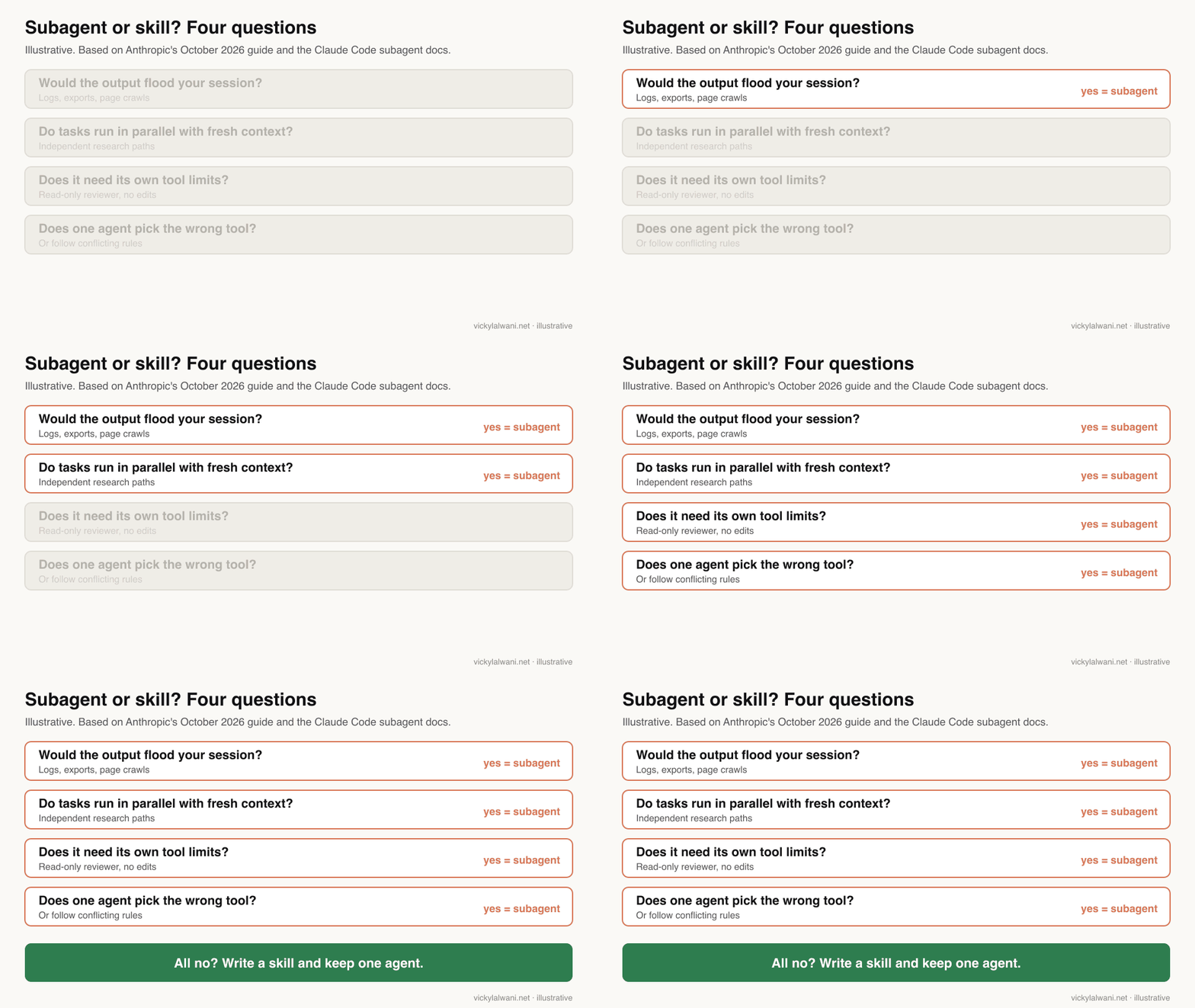
- Keep a subagent when output would flood your session, when tasks run in parallel with fresh context, or when a worker needs its own tool limits, such as a read-only reviewer.
- Build one by asking Claude to write a Markdown file in
.claude/agents/with a name, a description, a tool list and a model. - Every subagent spends its own tokens. Anthropic measured multi-agent systems at about 15 times the tokens of a chat.
What is a subagent in Claude Code?
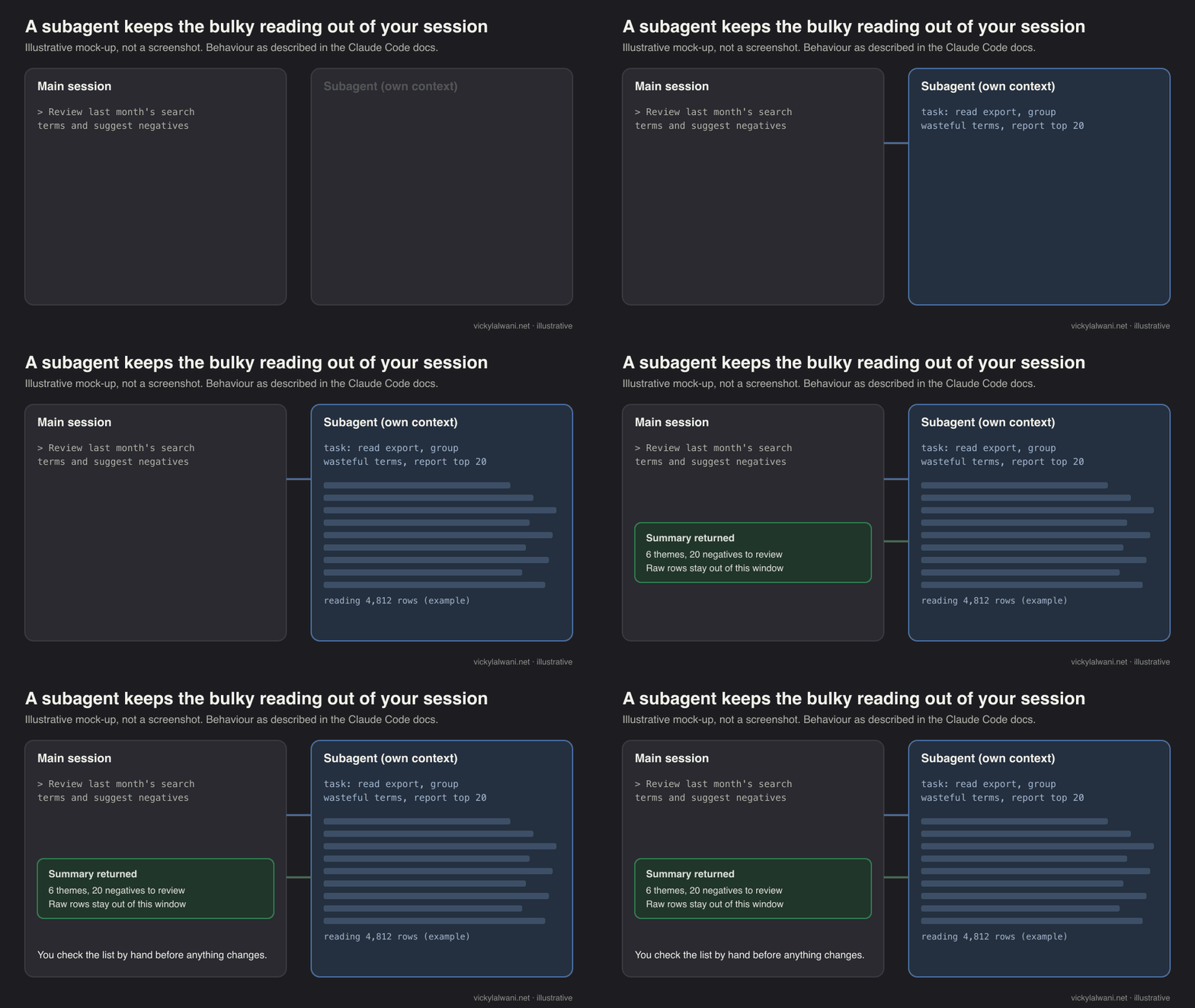
Short answer: A subagent is a specialised Claude worker that runs inside your Claude Code session with its own context window, its own system prompt and its own tool permissions. Claude hands it a task, it works independently, and only its summary comes back to your main conversation, according to the official subagents documentation.
A context window is the working memory of a conversation: everything Claude has read and said so far. When it fills with logs, exports or crawl data you will never look at again, quality drops. A subagent does that reading somewhere else and returns the short version.
Claude Code ships with three main built-in subagents, and it uses them on its own when a task fits. You do not need to create anything to benefit from them.
| Built-in | Tools | What Claude uses it for |
|---|---|---|
| Explore | Read-only | Searching files without changing them |
| Plan | Read-only | Research while you are in plan mode |
| General-purpose | All subagent tools | Multi-step work that also edits |
Two details from the docs matter for marketers. Explore and Plan start without your CLAUDE.md file, the project rules file Claude reads at the start of a session, to stay fast and cheap. And every subagent's requests count toward the same usage limits as your main conversation, so a subagent is never free.
Do you actually need subagents?
Short answer: Often not. Anthropic's Applied AI team wrote in October 2026 that a single agent with skills frequently outperformed subagent designs on quality, often at lower cost and latency. Use a subagent only when one of a few clear conditions applies.
The guide, "Building agents: When to fold subagents into your main agent loop" (22 October 2026), is written for teams building agents on the Claude Platform, but its reasoning carries straight over to Claude Code. A skill is a saved set of instructions that loads only when needed, so one agent can carry many methods without a bloated prompt. Splitting work across agents adds hand-offs where detail gets lost, and the guide warns against agent designs that copy a company's org chart.
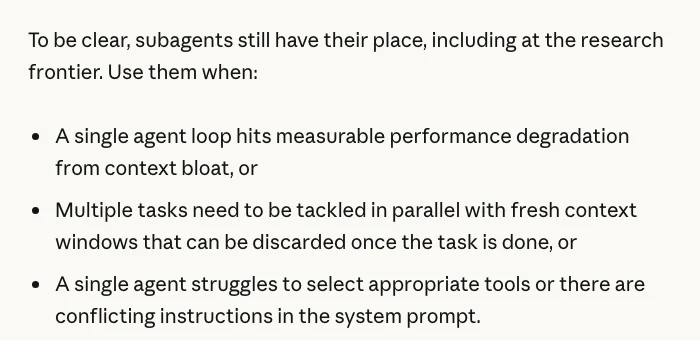
Claude Code's own best practices page adds a fourth point worth knowing: a fresh subagent has to gather context your conversation already had, so it can end up slower than doing the task where you are. It also lists tool restrictions as a reason to use one, for example a reviewer that may read but never edit.
| Situation | Better choice | Why |
|---|---|---|
| Same weekly method, every time | Skill | Loads only when used |
| Big export to digest | Subagent | Raw rows stay out of your session |
| Three independent research angles | Subagents | Parallel, fresh context each |
| A check by someone who did not write it | Subagent | Independent, read-only |
| Quick change on one page | Main session | No hand-off cost |
| Back-and-forth on a draft | Main session | Shared context matters |
One r/ClaudeCode member tested the guide's claim on two real builds in November: a team of subagents against one agent with the same instructions turned into skills. They reported identical quality on hidden tests, with the team costing more and taking about twice as long. It is one person's test on coding tasks, not a study, but it points the same way as Anthropic's guide.
Subagents, skills, agent teams and workflows: what is the difference?
Short answer: Subagents are workers inside one session that report back. Skills are instructions the main agent follows. Agent teams are separate sessions that message each other, and they are experimental and off by default. Dynamic workflows are scripts that run many subagents and cross-check the results.
Anthropic's parallel agents overview now lists five ways to run several tasks at once. Most marketing work needs only the first, plus skills.
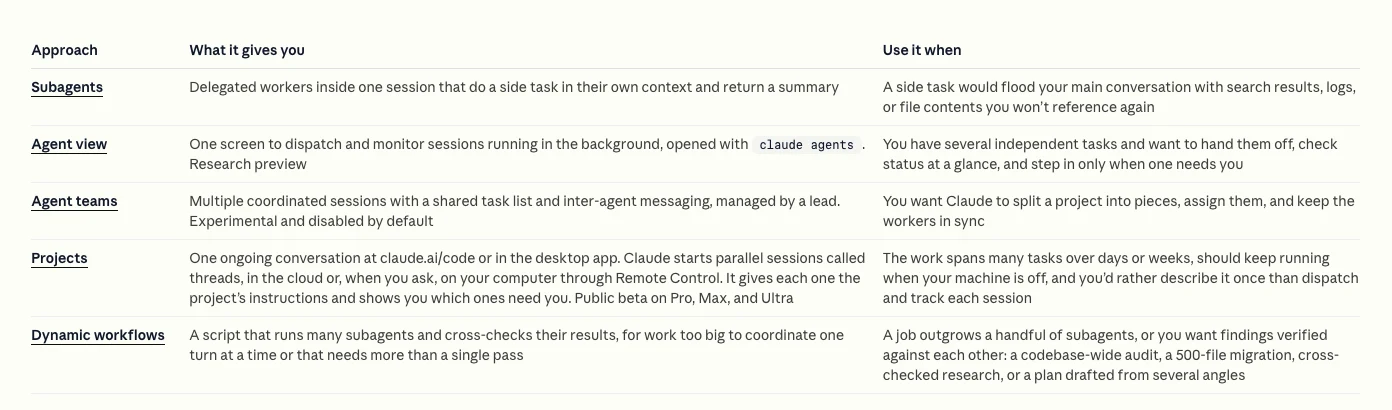
| Feature | Who runs it | Status | Use it for |
|---|---|---|---|
| Skill | The main agent | Generally available | A repeatable method |
| Subagent | Claude, inside one session | Generally available | Side tasks, checks |
| Agent team | A lead session | Experimental, off by default | Peers that must talk |
| Dynamic workflow | A script | Paid plans; on Pro via /config | Large audits, cross-checks |
/loop | Your open session | Session-scoped | Repeat a prompt on a timer |
The agent teams page says to enable them with CLAUDE_CODE_EXPERIMENTAL_AGENT_TEAMS=1 and warns they use significantly more tokens than a single session. The dynamic workflows page describes scripts Claude writes for jobs such as a codebase-wide audit, with the bundled /deep-research workflow as the easiest way to see one. For a marketer, both are later steps, not starting points.
How do you create your first subagent?
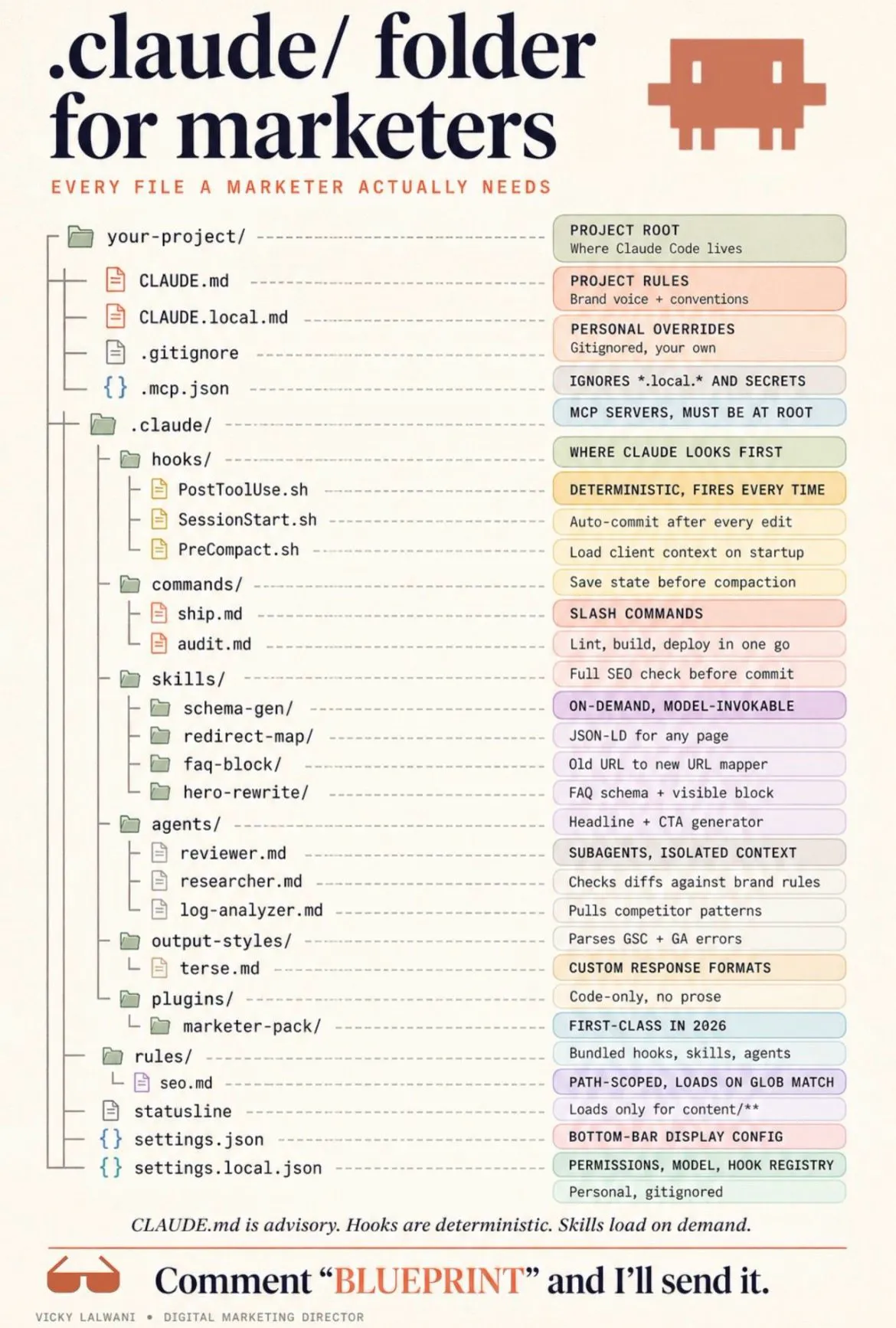
Short answer: Ask Claude Code to write it for you. A subagent is a Markdown file with a short settings block at the top, saved in .claude/agents/ for one project or ~/.claude/agents/ for all of them. Only a name and a description are required.
The quickest route, and the one the docs show first, is to describe the subagent in plain English and let Claude write the file. Older tutorials show a menu under /agents; since Claude Code 2.1.198 that command only reminds you where the files live.
- Open Claude Code in your project folder and describe the subagent: its job, what it may touch and which model to use.
- Open the file Claude wrote and check the settings block matches what you asked for.
- Test it on a real task by naming it: "Use the search-term-reviewer agent on this export".
- Fix the description if Claude does not pick it up on its own, because the description is how Claude decides when to delegate.
Create a project subagent in .claude/agents/ called search-term-reviewer.
Job: read a Google Ads search terms CSV and group wasteful terms by theme.
It is read-only: tools Read, Grep and Glob only. No edits, no web access.
Use the sonnet model.
Output: a table of suggested negative keywords with match type, the reason,
and the cost from the export. Never claim a term is wasteful without a cost row.
The file Claude writes will look roughly like this. The part between the dashed lines is the settings block, called frontmatter; everything below it becomes the subagent's instructions.
---
name: search-term-reviewer
description: Reviews Google Ads search term exports and suggests negative keywords. Use when a search terms CSV is provided.
tools: Read, Grep, Glob
model: sonnet
---

You review search term exports for paid search accounts.
Group terms by theme. Flag terms with spend and no conversions.
Suggest a negative keyword and match type for each, with the reason.
Report a table only. Do not recommend pausing anything.
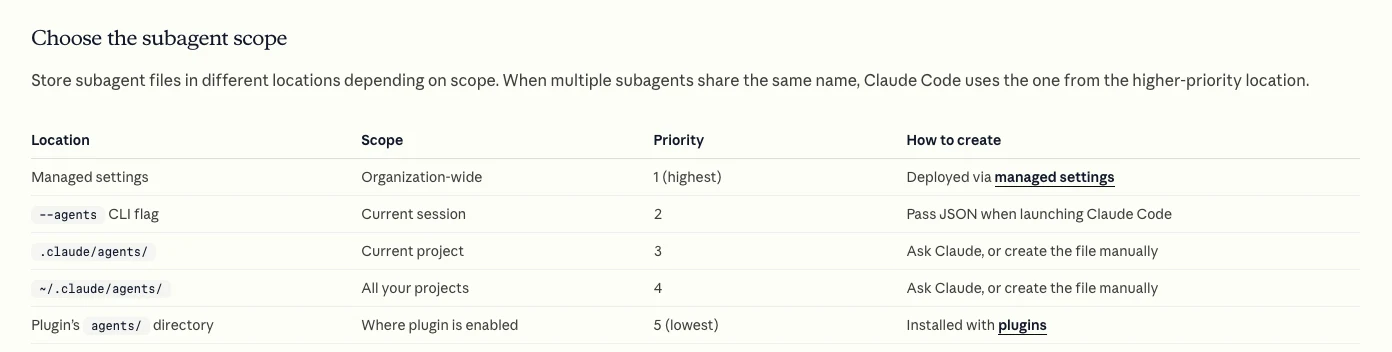
| Setting | What it does | Marketing use |
|---|---|---|
description | Tells Claude when to delegate | Name the input it expects |
tools | Allowed tools; all if omitted | Read-only reviewers |
model | haiku, sonnet, opus or inherit | Cheap model for bulk reading |
permissionMode | Its own permission mode | plan for advice only |
skills | Skills loaded at start | Your brand or audit method |
memory | Notes kept across sessions | A reviewer that learns |
maxTurns | Stops after N turns | Cap a runaway job |
isolation | worktree gives it a copy of the repo | Parallel site edits |
How do you call a subagent once it exists?
Short answer: Three ways: name it in plain language and Claude usually delegates, type @ and pick it so it runs for that task, or start a whole session as that agent with claude --agent name. Claude also delegates on its own when a task matches the description.
Subagents that Claude starts from your main conversation run in the background by default, so you can keep working. When one needs a permission, the prompt appears in your main session with the subagent's name. /tasks lists what is running and lets you open or stop each one.
| Method | Example | When to use it |
|---|---|---|
| Plain language | "Use the search-term-reviewer agent" | Everyday use |
| @-mention | @"search-term-reviewer (agent)" | Make sure it runs |
| Whole session | claude --agent search-term-reviewer | A dedicated review session |
| Skill in a subagent | context: fork in a skill | A skill that should run apart |
The last row is a useful middle path. The skills docs explain that adding context: fork to a skill runs it in a subagent, which keeps the method as a skill but isolates the bulky work.
Which subagents are worth building for SEO and Google Ads?
Short answer: Three cover most of it: a read-only reviewer for search term exports, a summariser for large crawl or Search Console exports, and an independent checker that reviews work it did not write. Each one fits a condition from Anthropic's guide.
| Subagent | Condition it meets | Tools | Model |
|---|---|---|---|
| Search term reviewer | Bulky output | Read, Grep, Glob | sonnet |
| Crawl summariser | Bulky output | Read, Grep, Glob | haiku |
| Independent checker | Tool limits, fresh eyes | Read, Grep | sonnet or opus |
Search term reviewer. Shown above. It never edits anything and never recommends pausing, because on a live ad account the safe order is audit first, findings in a sheet, a manual check, and changes only after the account owner approves. Pair it with my guide to reducing wasted Google Ads spend.
Crawl summariser. A site crawl export or a Search Console performance export can run to thousands of rows. A subagent on a cheaper model reads it and returns the pages that matter: missing titles, duplicate descriptions, pages losing clicks.
Use a subagent on the haiku model to read exports/crawl.csv.
Return only: pages with missing or duplicate title tags, pages with no meta description,
and pages returning 4xx or 5xx. Max 30 rows, as a table with URL and issue.
Do not read any other file.
Independent checker. The best practices page recommends having work reviewed by something that did not write it. For a landing page brief or an ads plan, a read-only checker compares the draft against your brief and your data and lists gaps, nothing else.
Use a subagent to check drafts/ads-plan.md against brief.md and exports/keywords.csv.
List every claim in the plan that the keyword export does not support,
every requirement in the brief the plan misses, and any search volume that looks
out of line with the export. Report gaps only. Do not rewrite the plan.
For SEO-specific methods that work better as skills, see Claude skills for SEO and Claude skills for Google Ads.
What do subagents cost, and how do you keep it down?
Short answer: Every subagent sends its own requests, which count against your plan. Anthropic measured multi-agent systems at about 15 times the tokens of a chat. Keep costs down with smaller models, short descriptions, tight tasks and a check of /usage.
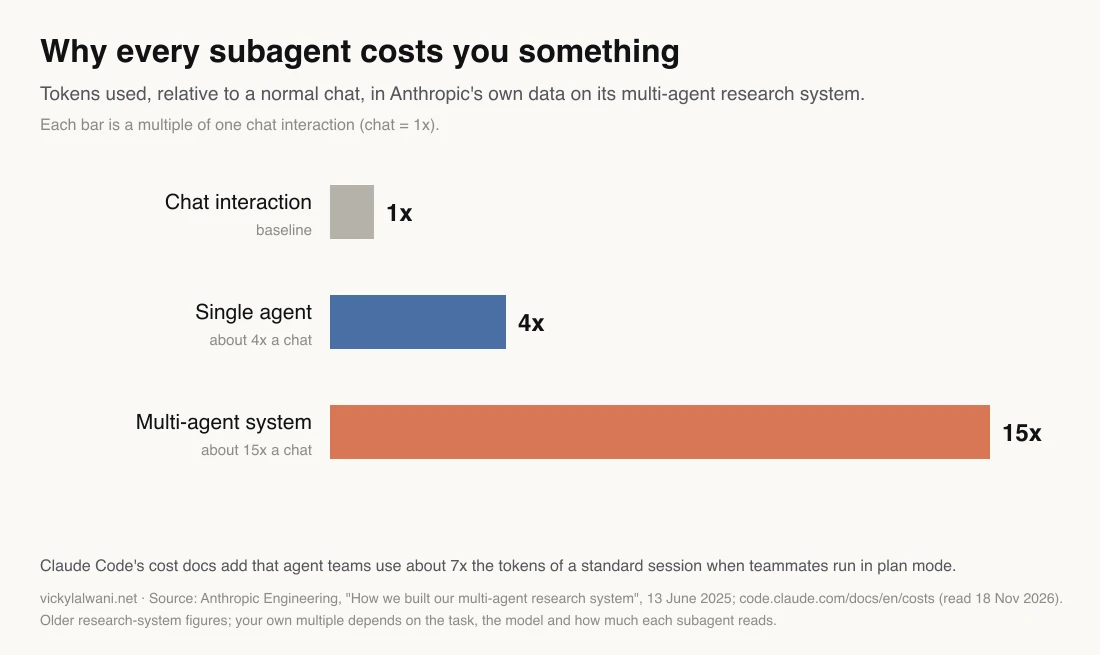
The figures come from Anthropic's write-up of its own research system, which also found the multi-agent version beat a single agent on its internal research evaluation. More tokens bought better answers on broad research questions. They will not buy better answers on a task one agent can finish.
| Lever | Default | What to do |
|---|---|---|
| Subagent model | Same as your session | model: haiku for simple reading |
| Descriptions | Warning above 15,000 tokens | One or two lines each |
| Running at once | 20 per session | Rarely need more than 3 |
| Nesting depth | 3 layers below main | Set 1 to turn off |
| Cost check | /usage | See each subagent's share |
The limits in that table come from the subagents page and the costs page. The single biggest saving is usually the model: a subagent that only reads and lists does not need the model you plan with.
What I learned running parallel Claude sessions on my own site
Short answer: Parallel agents help most with research and least with anything that touches the same files. Give each worker a brief that ends in a file, give one session ownership of anything that ships, and never leave a job that needs approvals running with nobody there.
These are lessons from building and running this site with Claude, not client work.
- Research splits well. For one long article I ran nine separate research sessions: official facts, keywords, YouTube, ranking gaps, Reddit, X, sources to cite, an AI citation check and a video breakdown. Each brief ended with the file it had to write, which made the results easy to combine.
- Shipping does not. I once typed the same deploy request into two sessions a minute apart, and both nearly shipped the same change. The fix was a rule in every brief: check what changed, commit only your own files, and let one session own deploys.
- Unattended jobs stall on approvals. A daily scheduled task kept stopping at permission prompts with nobody there to answer. Running each day's work as its own session with a self-contained brief worked around it.
- Drafts before results. The refresh you are reading was written by a delegated worker that drafts first and only hands over a final file once it passes checks, so nothing half-finished gets published.
On client ad accounts I keep a stricter rule than on my own site: agents audit and report, a person checks the evidence, and nothing changes in the account until it is approved. That is why every subagent in this guide is read-only.
What are the most common subagent mistakes?
Short answer: Building several subagents before one agent works, writing vague descriptions, giving reviewers edit rights, and expecting subagents to remember your conversation. Each has a simple fix.
| Mistake | What happens | Fix |
|---|---|---|
| A team before one agent works | Errors multiply at hand-offs | Prove one agent, then split |
| Vague description | Claude never delegates | Name the input and trigger |
| Reviewer can edit | It "fixes" instead of reporting | Read-only tools |
| Assuming it saw the chat | It misses your rules | Restate key rules in the task |
| Big model for bulk reading | Usage burns fast | model: haiku |
| Parallel edits to one folder | Changes collide | isolation: worktree or one owner |
The fourth row catches people out. A subagent starts with a fresh context: it gets its own instructions, your CLAUDE.md (except Explore and Plan), and the task message Claude writes. It does not see your earlier conversation, so the docs advise restating any rule that must reach it.
Hooks help here too. A hook is a small script Claude Code runs at a set moment; the hooks reference includes SubagentStart and SubagentStop events, so you can, for example, check a subagent's report contains every required section before Claude uses it. For a CLAUDE.md that stays short, see my CLAUDE.md template for marketing; Anthropic's memory docs suggest keeping each file under 200 lines.
What should you do in your first week?
Short answer: Start with one agent and one skill, add a single read-only subagent only when output starts flooding your session, and measure it against doing the task without it.
| Day | Do this | Done when |
|---|---|---|
| 1 | Write a short CLAUDE.md, try plan mode | Claude follows your rules |
| 2 | Turn one weekly task into a skill | Same output twice |
| 3 | Run it on a real export | You note every correction |
| 4 | Add one read-only subagent | It returns a clean summary |
| 5 | Run with and without it | You know which is better |
Plan mode is where Claude reads and proposes without editing; press Shift+Tab to reach it, as the permission modes page explains. If you want something to repeat while your session is open, /loop re-runs a prompt on an interval, per the scheduling docs. For more on running several agents, see how to manage multiple AI agents and the Claude Code commands cheat sheet.
What people say on X and Reddit
Short answer: Anthropic's own accounts push subagents for keeping context clean and for cheaper models on simple work. Users are split: some report real savings from a cheap-worker setup, others found one agent with skills just as good and cheaper.
| Source | Date | Type | What it says |
|---|---|---|---|
| ClaudeDevs on X | 14 Oct 2026 | Vendor | Parallel tasks report back to main |
| ClaudeDevs on X | 9 Nov 2026 | Vendor | Subagents on smaller models |
| A Claude Code team member | 29 Jun 2026 | Vendor staff | Background by default |
| A Claude Code team member | 31 Jan 2026 | Vendor staff | Offload to keep context clean |
| A business school professor | 2 Mar 2026 | Opinion | Subagents vs skills confusing |
| An AI startup founder | 18 Dec 2025 | Opinion | Load tools only when needed |
| r/ClaudeCode | 12 Nov 2026 | First-hand | One agent plus skills matched a team |
| r/ClaudeAI | 9 Nov 2026 | First-hand | Cheap workers, main session decides |
| r/ClaudeCode | 6 Nov 2026 | Opinion | When are subagents worth it? |
| r/ClaudeAI | 26 Oct 2026 | Opinion | Kept only a separate checker |
| r/ClaudeCode | 10 Oct 2026 | First-hand | One request, 17 subagents |
| r/ClaudeCode | 9 Sep 2026 | First-hand | Planner model, cheaper builders |
On X, the ClaudeDevs account explained that parallel tasks start nested sessions that report back, which keeps the main thread readable, and its model guide post recommends putting subagents on smaller models to save cost. A member of the Claude Code team announced that subagents now run in the background by default. A well-known business school professor asked publicly how subagents, skills and plugins differ, which is a fair sign the naming confuses experienced users too.
On Reddit, the most useful thread is the r/ClaudeCode test mentioned earlier. In r/ClaudeAI, one user described a setup where the main session plans and decides while cheaper subagents only execute fully specified steps, and stop at any open choice. Replies in a November r/ClaudeCode thread split along the same line: savings come from keeping bulky reading out of the main session, and costs climb with parallel edits to shared files. In an r/ClaudeAI discussion of Anthropic's guide, one user kept a single separate agent whose only job was to check work before it ships, which is exactly the kind the guide says to keep.
Videos worth watching
Short answer: Start with the official Claude channel: one talk on choosing between a tool, a skill and a subagent, and one on context management. Independent tutorials are useful for walkthroughs, but check them against the current docs, because the /agents menu many of them show has changed.
"Tool, skill, or subagent?" from the official Claude channel, May 2026. Anthropic's own talk, so it promotes Claude, but it is a design talk rather than a sales pitch.
"Context Management in Claude Code" from the official Claude channel, May 2026. Explains why keeping the main context clean matters, which is the main reason subagents exist.
| Video | Channel | Date | Covers |
|---|---|---|---|
| Tool, skill, or subagent? | Claude (official) | May 2026 | Choosing the right piece |
| Context Management in Claude Code | Claude (official) | May 2026 | Why context matters |
| How the Claude Code team uses Claude Code | Claude (official) | Sep 2026 | Real team habits |
| Claude SubAgents: context and token cost | CampusX | Apr 2026 | Cost trade-offs |
| How Claude Code actually works | LearnThatStack | Nov 2026 | The agent loop |
| Claude Code Tutorial #8: Subagents | Net Ninja | Sep 2025 | Setup (older menu) |
Where this advice is weak
Short answer: Anthropic's guide is about agents built on its platform, the Reddit test covers coding not marketing, and the token multiples are from 2025. Treat the direction as solid and the numbers as indicative.
- The October 2026 guide draws on enterprise agent deployments on the Claude Platform. Claude Code is the same family of agent, but the guide does not test Claude Code sessions directly.
- The 4x and 15x token figures come from Anthropic's 2025 research system on older models. Your multiple will differ.
- The Reddit comparison is one user's seven paired runs on web builds. It is a useful signal, not proof for SEO or ads work.
- Subagent behaviour changes often: background running, fork mode and the
/agentscommand all changed in 2026. Check the docs before you build on a detail. - The three marketing subagents are my recommendations from my own setup, not a benchmark.
Want subagents set up around your SEO and Google Ads work?
The file format is the easy part. Deciding what should be a skill, what deserves its own read-only worker, and where a person signs off is where the time goes. I set that up as a Claude consultant, and run the work itself through SEO consulting and Google Ads management, with published prices. For a broader view of agent design, read AI workflows versus agents for SEO and PPC.
Sources
| Source | What it supports | Date | Link |
|---|---|---|---|
| Claude Code: Create custom subagents | Definition, built-ins, frontmatter, limits | Read 18 Nov 2026 | code.claude.com |
| Claude Code: Run agents in parallel | Five approaches compared | Read 18 Nov 2026 | code.claude.com |
| Claude Code: Agent teams | Experimental, off by default, token cost | Read 18 Nov 2026 | code.claude.com |
| Claude Code: Dynamic workflows | Scripts that run many subagents | Read 18 Nov 2026 | code.claude.com |
| Claude Code: Skills | context: fork | Read 18 Nov 2026 | code.claude.com |
| Claude Code: Hooks | SubagentStart and SubagentStop | Read 18 Nov 2026 | code.claude.com |
| Claude Code: Costs | Agent teams about 7x, cheaper models | Read 18 Nov 2026 | code.claude.com |
| Claude Code: Best practices | Subagents can be slower, review | Read 18 Nov 2026 | code.claude.com |
| Claude Code: Memory | CLAUDE.md under 200 lines | Read 18 Nov 2026 | code.claude.com |
| Claude Code: Permission modes | Plan mode | Read 18 Nov 2026 | code.claude.com |
| Claude Code: Scheduled tasks | /loop | Read 18 Nov 2026 | code.claude.com |
| Claude blog: fold subagents | Single agent with skills, keep cases | 22 Oct 2026 | claude.com |
| Single agent loop kit | Anthropic migration kit | Read 18 Nov 2026 | GitHub |
| Anthropic Engineering | 4x and 15x token use | 13 Jun 2025 | anthropic.com |
| X, Reddit, YouTube | User and vendor views | Dec 2025 to Nov 2026 | Linked above |
This article expands on my post on LinkedIn ↗.
FAQ
What is a subagent in Claude Code?
A subagent is a separate Claude worker with its own context window, instructions and tool permissions. Claude hands it one task, it works independently, and only its summary returns to your main conversation. Claude Code includes built-in subagents such as Explore and Plan, and you can define your own.
How do I create a subagent in Claude Code?
Ask Claude Code to write one, describing its job, its tools and its model. It saves a Markdown file in .claude/agents/ for one project or ~/.claude/agents/ for all projects. Only a name and a description are required in the settings block at the top.
Are subagents better than skills?
Usually not. Anthropic's October 2026 guide found that a single agent with skills often beat subagent designs on quality, cost and speed. Use a subagent when output would flood your session, when tasks run in parallel with fresh context, or when a worker needs its own tool limits.
Do Claude subagents cost extra?
They do not have a separate price, but every subagent sends its own requests, which count toward the same usage limits as your main session. Anthropic measured multi-agent systems at about 15 times the tokens of a chat. Choosing the haiku model for simple reading jobs keeps the cost down.
Can a Claude subagent see my conversation?
No. A normal subagent starts with a fresh context: its own instructions, your CLAUDE.md files (except the built-in Explore and Plan agents) and the task Claude writes for it. Restate any rule it must follow in your request, or use a forked subagent when it needs the full history.
What is the difference between subagents and agent teams?
Subagents work inside one session and report back to it. Agent teams are separate Claude Code sessions led by one session, sharing a task list and messaging each other. Agent teams are experimental, off by default and use significantly more tokens.
How many subagents can Claude Code run at once?
By default Claude Code allows 20 running subagents per session and nesting up to three layers below the main conversation, according to the November 2026 docs. Both limits can be changed with settings. Most marketing tasks need one to three.
Do I need to code to use Claude subagents?
No. A subagent is a plain Markdown file, and Claude Code can write it from a description in plain English. You need Claude Code itself, which runs on paid Claude plans, and a little comfort with files and folders.