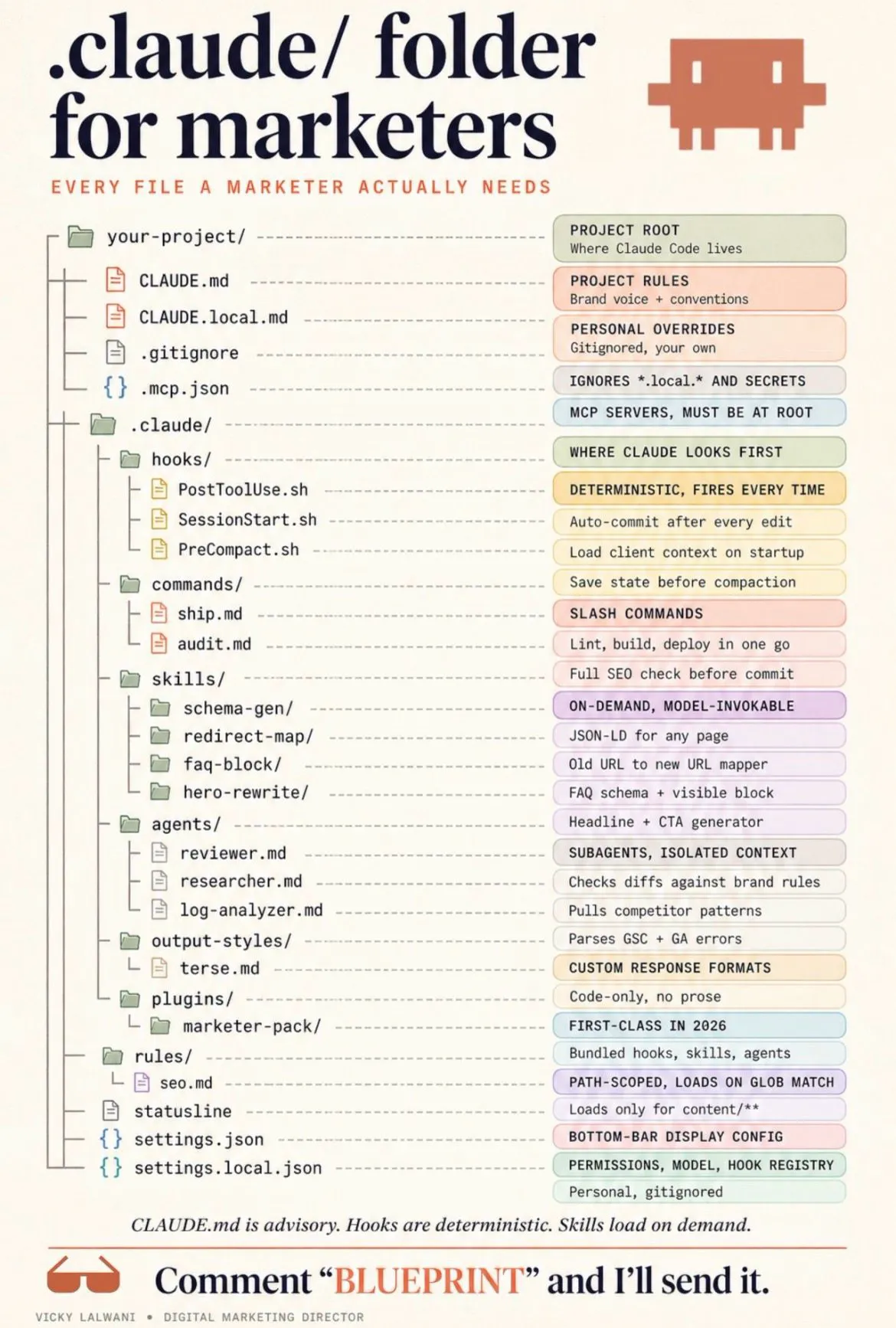
Claude folder setup for marketers puts six layers in fixed places: CLAUDE.md at the root, deny rules and hooks in .claude/settings.json, skills in .claude/skills/, subagents in .claude/agents/, data servers in .mcp.json and plugins for sharing. Keep CLAUDE.md under 200 lines, commit the project files, and keep settings.local.json, CLAUDE.local.md and every secret out of git.
TL;DR
A Claude folder setup for marketers is six layers in fixed places: CLAUDE.md at the project root, settings and hooks in .claude/settings.json, skills in .claude/skills/, subagents in .claude/agents/, MCP servers in .mcp.json, and plugins installed under ~/.claude/plugins/. Commit the project files so your team shares them; keep settings.local.json, CLAUDE.local.md and every secret out of git.
Anthropic now says to keep each CLAUDE.md under 200 lines and each SKILL.md under 500. Only settings, permissions and hooks are enforced; everything you write in Markdown is guidance. A security study in November 2026 found 1,122 public copies of the "local" settings file holding real secrets, so the gitignore step is not optional.
Short answer: put standing rules in CLAUDE.md, enforced rules in .claude/settings.json, repeatable workflows in .claude/skills/<name>/SKILL.md, isolated checks in .claude/agents/, data connections in .mcp.json, and package the lot as a plugin when a second person needs it. Personal overrides go in .claude/settings.local.json and CLAUDE.local.md, which never get committed.
You open a client repo on Monday and Claude has forgotten the brand voice, asks to run the same export command for the fifth time, and your colleague's version of the search terms skill gives different answers from yours. None of that is the model. It is files in the wrong place, loading at the wrong time, or only existing on one laptop.
This guide is the file map: the exact path for each piece, when Claude Code reads it, who else gets it through git, and which file wins when two disagree. It uses one SEO and Google Ads client folder as the worked example. Every path and limit was checked against Anthropic's Claude Code docs on 18 November 2026. If you would rather have the folder built and handed over, that is what I do as a Claude consultant.
Three related pages cover what this one does not. The concept of layers across Claude, Codex and Gemini is in AI agent operating system. The Claude app's own instructions, memory and projects are in how to use Claude for marketing. What to write inside the file is in the CLAUDE.md file for marketing.
What are the six layers of a Claude folder setup?
Short answer: CLAUDE.md for standing instructions, settings and hooks for rules that must always hold, skills for repeatable workflows, subagents for isolated work, MCP for live data and plugins for sharing. Settings and hooks are enforced by Claude Code; instructions and skills only shape what Claude tries to do.
The test for where something belongs is two questions: when should it run, and does it have to hold even if Claude ignores it? A brand voice rule is advice, so it goes in CLAUDE.md. "Never edit the client's budget file" must hold, so it goes in a deny rule. Anthropic's permissions page says it plainly: rules in your prompt or CLAUDE.md "shape what Claude tries to do, but they don't change what Claude Code allows."
| Layer | Where it lives | When it runs | Enforced? |
|---|---|---|---|
| Instructions | CLAUDE.md, .claude/rules/ | Session start | No, guidance |
| Settings and hooks | .claude/settings.json | Every matching action | Yes |
| Skills | .claude/skills/<name>/ | When the task matches | No |
| Subagents | .claude/agents/*.md | When delegated | Tools list, yes |
| MCP servers | .mcp.json | Start, once approved | Server's own limits |
| Plugins | ~/.claude/plugins/ | Start, if enabled | Depends on contents |
Two folders in the docs are newer and optional: .claude/workflows/ for scripts that coordinate many subagents, and .claude/output-styles/ for a shared response style. Most marketing folders never need them. Anthropic's own advice on the .claude directory page is that most users only edit CLAUDE.md and settings.json.
One correction to older advice, including the first version of this article: none of this runs on the free Claude plan. Claude Code needs a Pro, Max, Ultra, Team, Enterprise or Console account, and Anthropic's setup page says the free plan "does not include Claude Code access." A Claude.ai project is a different product and does not read this folder.
Where does each file live, and which ones go in git?
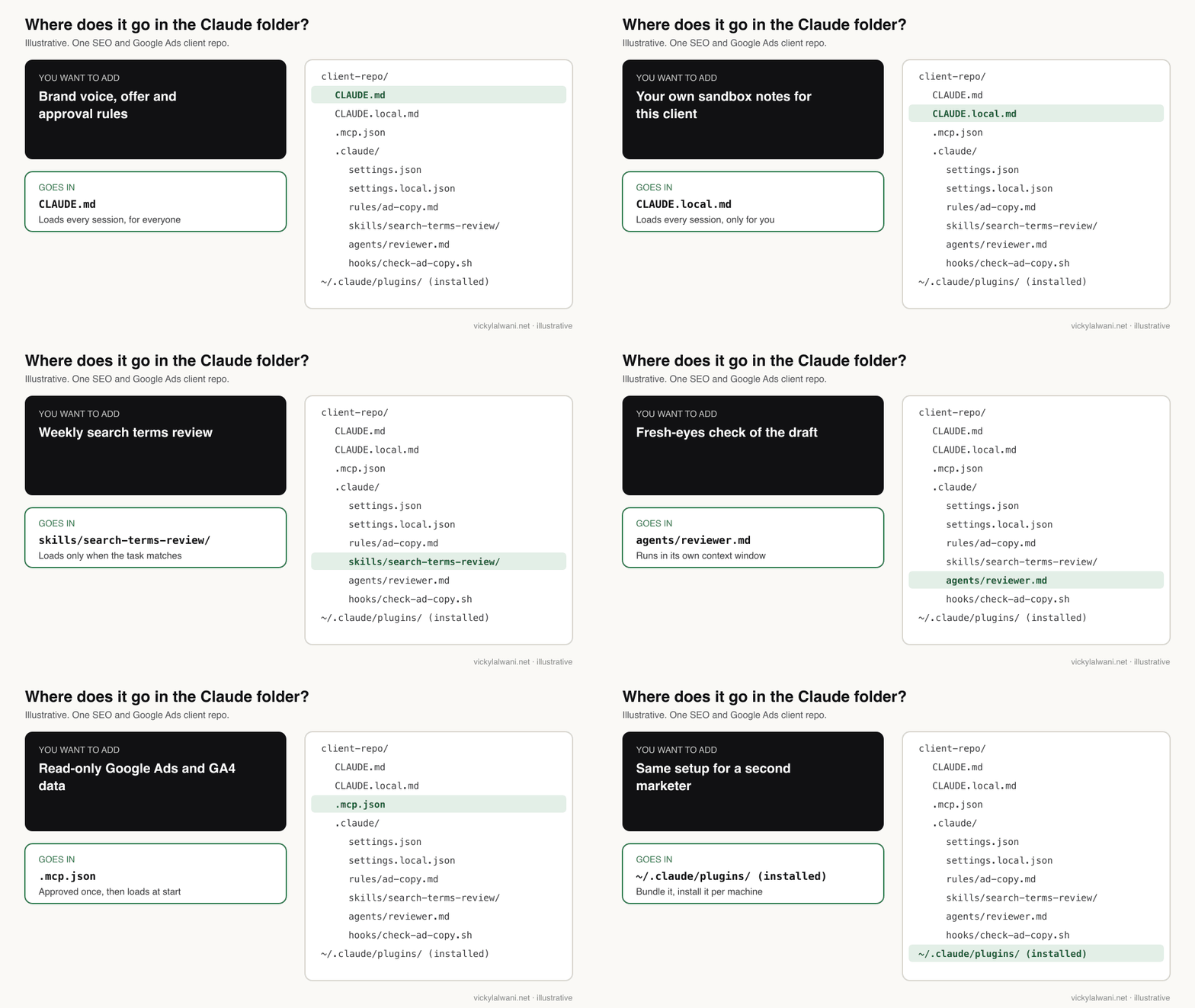
Short answer: project files live in the repo and are committed: CLAUDE.md, .mcp.json, .worktreeinclude and everything in .claude/ except settings.local.json. Personal files live in ~/.claude/ or stay gitignored: CLAUDE.local.md, .claude/settings.local.json and ~/.claude.json.
Every layer has the same three scopes. Project files are for everyone who opens the repo. Files in ~/.claude/ are yours, in every project on your machine. Local files are yours, in this one project. Organisations can add a fourth, managed scope that your own files cannot override.
| File | Scope | Commit? | Use it for |
|---|---|---|---|
CLAUDE.md | Project | Yes | Offer, voice, approval rules |
CLAUDE.local.md | You, this project | No | Your sandbox notes |
~/.claude/CLAUDE.md | You, all projects | No | Personal style |
.claude/settings.json | Project | Yes | Deny rules, hooks |
.claude/settings.local.json | You, this project | No | Your approvals |
.mcp.json | Project | Yes | Shared data servers |
~/.claude.json | You | No | Personal MCP servers |
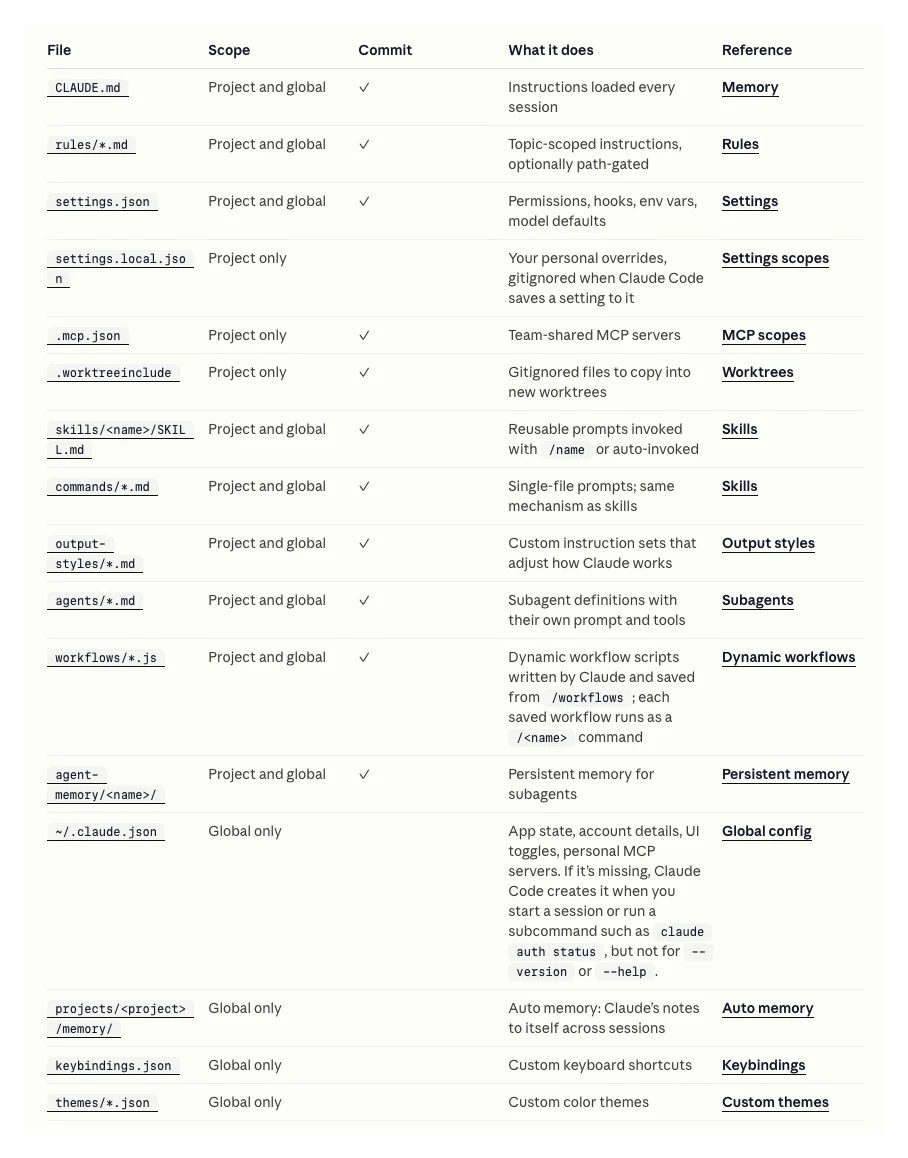
Two details catch people out. CLAUDE.local.md is not ignored for you: the memory docs say to create it by hand and add it to .gitignore yourself. And CLAUDE.md can sit at the root or at .claude/CLAUDE.md, which keeps the root tidy. If the repo already has an AGENTS.md for other coding tools, Claude Code reads that instead when no CLAUDE.md exists, from version 2.1.277.
The rule I hold to on my own work came from several sessions editing one site folder at once: check what git is tracking and commit only your own files. A Claude folder makes that matter more, because a personal file committed by accident becomes everyone's configuration.
What loads at session start, and what waits for the task?
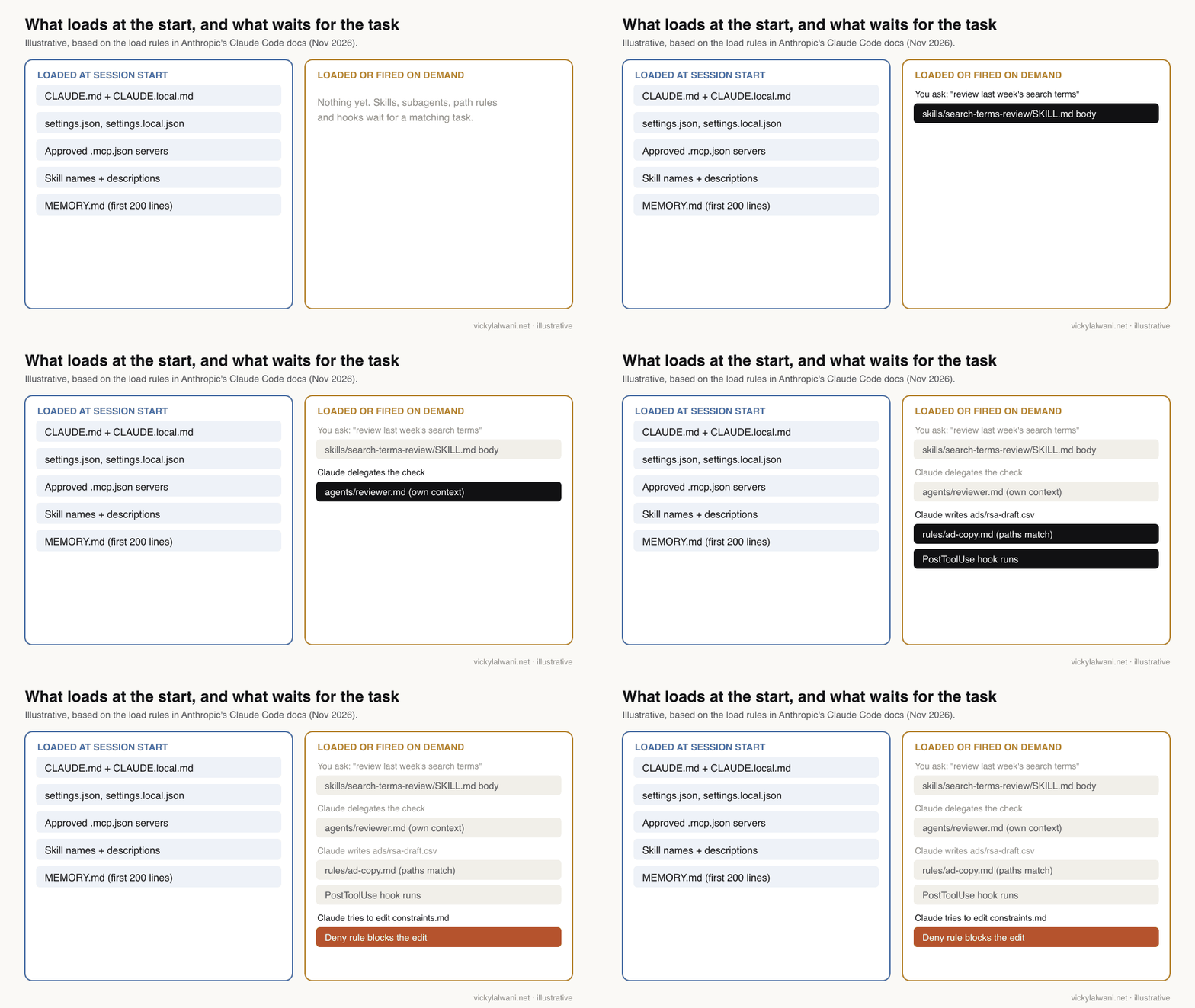
Short answer: at start Claude Code reads every CLAUDE.md from the folder upwards, the settings files, approved MCP servers, the list of skill names and descriptions, and the first 200 lines of auto memory. Skill bodies, subagents, path-scoped rules and hooks load or fire only when a task needs them.
This is the part that decides your context bill. Anything that loads at start costs tokens in every session, whether you use it or not. Anything that waits costs almost nothing until it runs.
| Piece | Loads | Documented limit |
|---|---|---|
CLAUDE.md | Session start | Target under 200 lines |
Rule without paths | Session start | Same cost as CLAUDE.md |
Rule with paths | When a matching file is touched | None stated |
| Skill listing | Every turn | About 1% of context; 1,536 characters each |
| Skill body | When used | SKILL.md under 500 lines |
| Auto memory | Session start | First 200 lines or 25KB |
| MCP tools | Schemas on demand | Via tool search |
The first version of this article said to keep CLAUDE.md under 500 lines. Anthropic's guidance is now stricter: "target under 200 lines per CLAUDE.md file. Longer files consume more context and reduce adherence." Imports with @path tidy a long file but do not reduce its cost, because imported files load with it. What does reduce it is moving rules that only matter for some files into .claude/rules/ with a paths line, so an ad copy rule loads only when Claude touches ad copy.
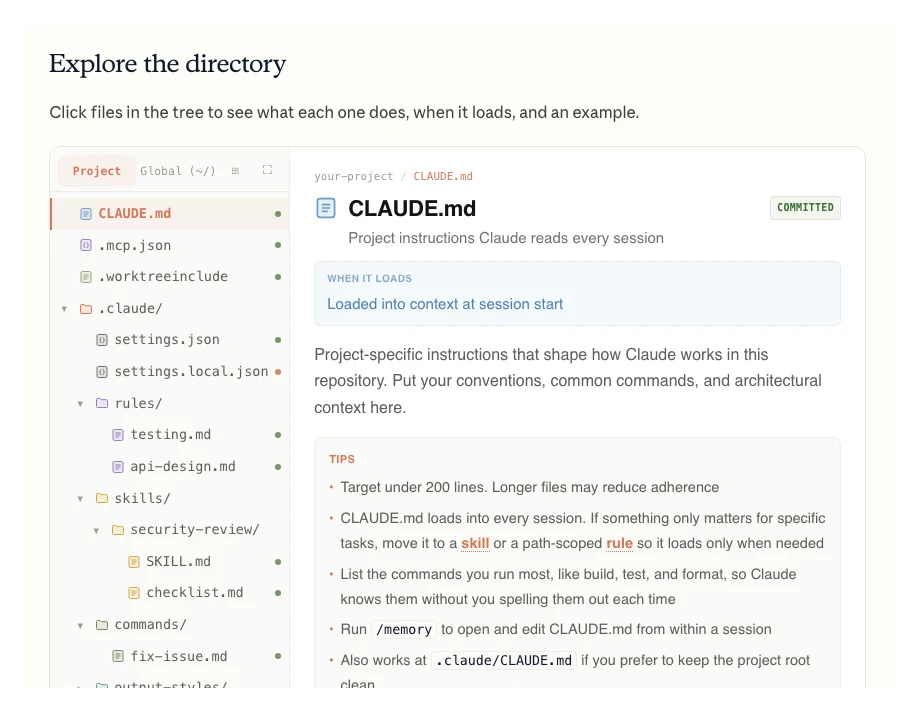
Skills have a quieter cost. Every skill's name and description sits in context on every turn, and when the list outgrows its budget Claude Code drops descriptions, starting with the skills you use least. A marketer who installs twenty skills "just in case" can end up with the one they need listed without the words Claude uses to find it. Put the main use case first in each description, and run /skill-doctor to see which skills never get used.
When two files disagree, which one wins?
Short answer: it depends on the layer. For settings, local beats project and project beats user. For skills with the same name, your personal skill beats the project's. For subagents, the project beats the user. CLAUDE.md files never override each other; they are all read, and Claude may follow either side of a conflict.
| Layer | Order, highest first | Note |
|---|---|---|
| Settings keys | Managed, command line, local, project, user | Most lists merge |
| CLAUDE.md | All loaded; closest to the folder read last | No override |
| Skills | Enterprise, personal, project | Personal beats project |
| Subagents | Managed, CLI flag, project, user, plugin | Project beats personal |
| MCP servers | Local, project, user | No field merging |
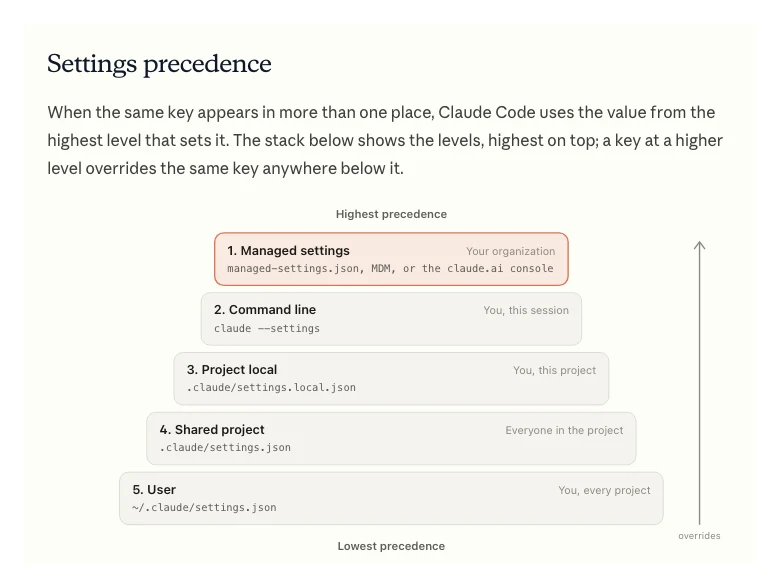
The skills row is the one that surprises teams. If you keep a personal search-terms-review skill in ~/.claude/skills/ and the client repo has one with the same name, /search-terms-review runs yours, per the skills docs. Your colleague runs the project's. Same command, two different procedures, and nobody notices until the outputs disagree. Give personal skills a prefix, or delete them once the project version exists.
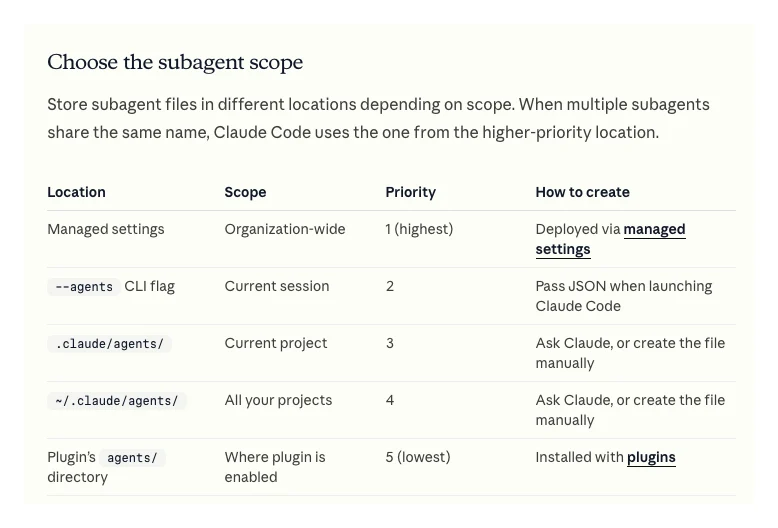
What does the folder look like for one SEO and Google Ads client?
Short answer: a short CLAUDE.md, a deny list and one hook in settings.json, two skills (search terms and content decay), a read-only reviewer subagent, a path rule for ad copy and a .mcp.json with read-only Google Ads and GA4 servers. Secrets stay in environment variables, never in the repo.
This is a reference layout, not a copy of any client's folder. It reflects how I run client ad accounts: the agent audits first, findings go into a sheet I check by hand, and nothing changes in the account before approval. So the folder gives Claude read access and no write tools on the ad platform.
client-repo/
├── CLAUDE.md                    # offer, audience, voice, approval rules (under 200 lines)
├── CLAUDE.local.md              # your notes, gitignored
├── .mcp.json                    # read-only Google Ads + GA4 servers, no secrets
├── .worktreeinclude             # copies .env into new worktrees
├── .gitignore                   # .env, CLAUDE.local.md, .claude/settings.local.json
├── config/google-ads-tools.yaml # turns off the server's write tools
├── clients/constraints.md       # targets, budget caps, banned claims (deny-listed)
├── exports/                     # Search Console and search terms CSVs
└── .claude/
    ├── settings.json            # deny rules + one PostToolUse hook
    ├── settings.local.json      # your approvals, gitignored
    ├── hooks/check-ad-copy.sh   # fails RSA lines over 30 or 90 characters
    ├── rules/ad-copy.md         # loads only when ads/** is touched
    ├── skills/
    │   ├── search-terms-review/SKILL.md
    │   └── content-decay-check/SKILL.md
    └── agents/reviewer.md       # read-only, fresh context
The shared settings file holds the rules that must hold. Deny rules use paths relative to the project, and the hook script path uses ${CLAUDE_PROJECT_DIR} as the hooks reference does:
{
  "permissions": {
    "deny": [
      "Read(./.env)",
      "Read(./secrets/**)",
      "Edit(/clients/constraints.md)"
    ]
  },
  "hooks": {
    "PostToolUse": [
      {
        "matcher": "Write|Edit",
        "hooks": [
          {
            "type": "command",
            "if": "Edit(ads/**)",
            "command": "${CLAUDE_PROJECT_DIR}/.claude/hooks/check-ad-copy.sh"
          }
        ]
      }
    ]
  }
}
The hook is short on purpose. It counts characters against Google's limits for responsive search ads (30 for headlines, 90 for descriptions) and exits with code 2 when a line is over, which makes Claude see the error and fix it. Judgement, such as whether a headline is on brand, belongs in the reviewer subagent, not in a hook that fires on every write.
The skill keeps its procedure out of CLAUDE.md until it is needed. disable-model-invocation: true stops Claude starting it by itself, which suits anything that produces client-facing output:
---
name: search-terms-review
description: Weekly Google Ads search terms review. Proposes negatives with the rows behind each one. Use when asked to review search terms or wasted spend.
disable-model-invocation: true
allowed-tools: Read, Grep, Glob, Bash
---
Use only exports/search_terms_last_30d.csv and clients/constraints.md.
Run code for every total. Never estimate a number.
Write findings to findings/search-terms-YYYY-MM-DD.md:
proposed negatives, match type, level, spend affected, supporting rows,
and a "protect" list of every term that converted.
If a file is missing or totals do not match the summary row, stop and say so.
Then ask the reviewer subagent to check the findings file.
The reviewer gets its own context and only reading tools. A subagent's tools line is an allowlist, so leaving out Write and Edit stops it editing files directly. It keeps Bash to recompute numbers, so the deny rules above still matter:
---
name: reviewer
description: Fresh-eyes check of findings files and ad copy before anything goes to a client.
tools: Read, Grep, Glob, Bash
model: sonnet
---
You are the reviewer, not the author. Recompute the five most important numbers
from the source files with code. Check every claim about the client against
CLAUDE.md and clients/constraints.md. Return PASS or FAIL with the exact line.
The data servers go in .mcp.json with environment variables instead of keys. Google's Google Ads MCP server can create assets and labels unless you switch those tools off in its tools_config.yaml; it cannot change campaigns, budgets or bids either way. The GA4 server is read-only unless you add --allow-write:
{
  "mcpServers": {
    "google-ads-mcp": {
      "command": "pipx",
      "args": ["run", "--spec", "google-ads-mcp==0.0.6", "google-ads-mcp"],
      "env": {
        "GOOGLE_CLOUD_PROJECT": "${GOOGLE_CLOUD_PROJECT}",
        "GOOGLE_APPLICATION_CREDENTIALS": "${GOOGLE_APPLICATION_CREDENTIALS}",
        "GOOGLE_ADS_MCP_TOOLS_CONFIG": "${CLAUDE_PROJECT_DIR:-.}/config/google-ads-tools.yaml"
      }
    },
    "analytics-mcp": {
      "command": "pipx",
      "args": ["run", "analytics-mcp"],
      "env": {
        "GOOGLE_CLOUD_PROJECT": "${GOOGLE_CLOUD_PROJECT}",
        "GOOGLE_APPLICATION_CREDENTIALS": "${GOOGLE_APPLICATION_CREDENTIALS}"
      }
    }
  }
}

# config/google-ads-tools.yaml (Google's read-only example)
namespaces:
  customers: true
  search: true
  metadata: true
  labels: false
  assets: false
Google's page suggests adding the server to a settings file. In Claude Code, servers meant for the whole team belong in .mcp.json, which every colleague approves once when they first open the repo; a cloned repo cannot approve its own servers. Google's list of its MCP servers has no Search Console server, so this folder uses Search Console exports; the community options are compared in MCP servers for SEO. The SEO side of the same folder, with the content decay check, is in Claude Code SEO workflow.
Where do secrets go, and why did settings.local.json leak?
Short answer: secrets go in environment variables or a gitignored .env that Claude is denied from reading, never in CLAUDE.md, settings or .mcp.json. The local settings file leaked because "Yes, and don't ask again" saves the exact approved command, secret included, and the file got committed.
In November 2026 the security firm Apiiro searched public GitHub for .claude/settings.local.json. Its study found 104,185 public copies, and 1,122 of them held a real secret: database passwords, cloud keys and API tokens. Two widely used free scanners each missed a large share.
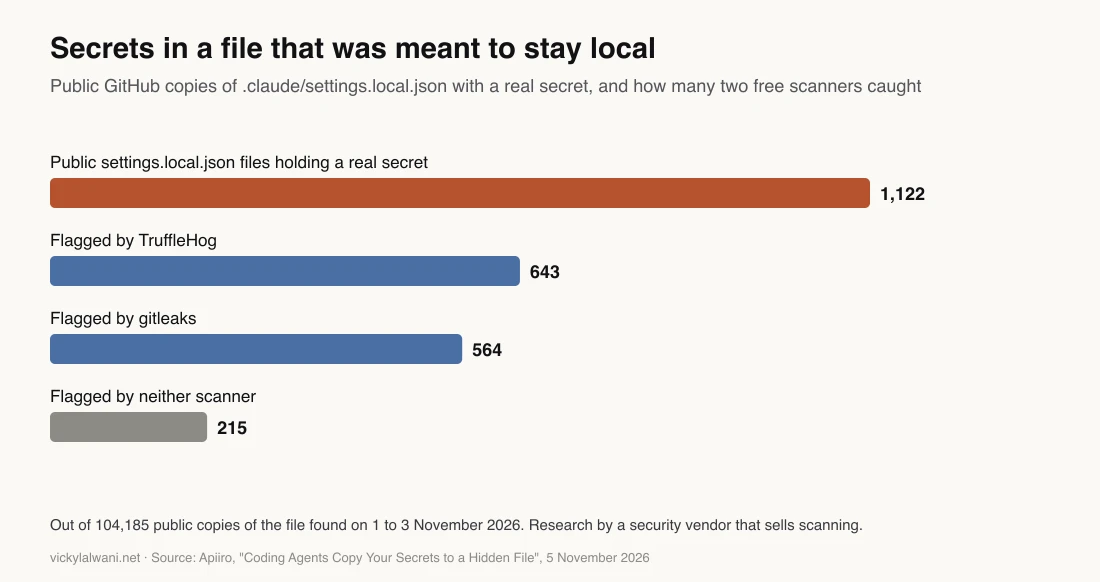
The mechanism is documented. Anthropic's permissions page says that when you choose "Yes, and don't ask again", Claude Code saves the rule to .claude/settings.local.json. The settings page says Claude Code adds that file to your global git excludes the first time it writes it, but if you create the file by hand you must ignore it yourself. Apiiro's point is that the global exclude lives on one machine, not in the repo, so a fresh clone or a new laptop has no protection. Anthropic's head of Claude Code replied that the team is looking at secret scanning.
The checklist for a marketing repo:
- Add
.claude/settings.local.json,CLAUDE.local.mdand.envto the repo's own.gitignore, not just your machine's. - Run
git ls-files .claude. Ifsettings.local.jsonappears, it is committed: rotate any secret in it first, then untrack it. - Never type a key into a command you approve. Read it from an environment variable so the saved rule holds the variable name, not the value.
- Deny
Read(./.env)so Claude cannot pull the file into a transcript. Transcripts in~/.claude/projects/are plain text. - List
.envin.worktreeincludeif you use worktrees, so a new worktree gets it without anyone copying it around.
Unattended runs need one more setting. My scheduled article runs kept stalling on permission prompts with nobody there to answer. Claude Code now has permissions.denyInsteadOfPrompting for user or managed settings, which denies a call that would wait on a prompt so the run carries on. Pair it with tight allow rules, never with a blanket approval.
How do you write skills, hooks and subagents that last?
Short answer: one job per file. A skill under 500 lines with its main use case first in the description; a hook that runs a quick, deterministic check and exits 2 to block; a subagent with an explicit tools list. Split anything that grows past that, and move reference material into supporting files.
The earlier version of this article said skills over about 200 lines should be split. That came from my guide, not from Anthropic, whose limit is 500 lines for SKILL.md with detail moved into supporting files in the skill's folder. Both point the same way: a long skill usually holds two procedures, and when it fails you cannot tell which half caused it.
The skills in my guide all share one nine-part body: name, purpose, when to use it, inputs, steps, prompt template, output format, quality checklist and optimisation notes. The format matters less than the consistency. When every skill has the same shape, a colleague can read one, fix it or write the next without guessing, and the notes section records what real runs taught you. The frontmatter on top is Anthropic's; the body structure is yours to choose. A library of marketing skills built this way is in Claude marketing skills.
| Mistake | What happens | Fix |
|---|---|---|
| Review routine in a hook | Runs on every write | Move it to a subagent |
| Hard rule in CLAUDE.md | Followed most of the time | Deny rule or hook |
| Skill with side effects | Claude starts it unasked | disable-model-invocation |
Subagent without tools | Inherits every tool | List only what it needs |
| Same skill name twice | Personal copy wins | Prefix or delete one |
| Hand-made local settings | Not gitignored | Add to repo .gitignore |
I install skills from GitHub links often, and not every one arrives finished. A skill folder is code that Claude reads with your permissions, so read the SKILL.md and any scripts before you trust it on a client repo. For subagents in more depth, including when one is overkill, see the Claude subagents tutorial.
When should a Claude folder become a plugin?
Short answer: when a second person needs the same skills, subagents, hooks or servers across several repos. A plugin is a folder with a .claude-plugin/plugin.json manifest that installs as one unit, at user, project or local scope. For one repo, committing the .claude/ folder is simpler.
Anthropic's plugins overview is direct about the cost: an enabled plugin is part of every session, and each skill and agent description it adds sits in context on every turn, even when nothing from it runs. A plugin with fifteen skills you use twice a month is a tax on every other task.
Two limits matter for marketers. Plugin subagents ignore the hooks, mcpServers and permissionMode fields for security, so a read-only reviewer that depends on them must live in .claude/agents/ instead. And project-scope install only marks the plugin as enabled in the committed settings; each colleague still installs it on their own machine. The PPC version of this, with seven skills and safe connections, is in Claude plugins for marketing.
What order should you build the folder in?
Short answer: CLAUDE.md first, then the deny list and .gitignore, then your most repeated task as a skill, then one read-only data connection, then a reviewer subagent, and a plugin only when someone else needs the same setup. Test each layer before adding the next.
| Step | File | Test before moving on |
|---|---|---|
| 1 | CLAUDE.md | Ask Claude to restate the offer |
| 2 | settings.json, .gitignore | Try to edit a denied file |
| 3 | First skill | Run it twice, compare outputs |
| 4 | .mcp.json | Totals match the platform |
| 5 | Reviewer subagent | Feed it a known error |
| 6 | Plugin | A colleague installs it cleanly |
Plan for a focused weekend for the first five steps on one client, and longer before a team relies on it. Run /doctor prompt-audit once a month: it checks your CLAUDE.md files, rules, skills and subagents for outdated or conflicting instructions.
Once the basics hold, decide what the folder should do that your team does not do today. In my guide's design that is a forecast agent: most marketing teams report backwards, while a forecast projects rankings, traffic and revenue forwards with the assumptions written next to every number. Treat it as a planning aid with stated assumptions, not a promise. I run this kind of setup myself, with 19 AI agents alongside three people, and the limits are the same at any size: it will not replace strategy, fix a vague brief or ship work nobody has checked.
What people say on X and Reddit
Short answer: practitioners agree on keeping CLAUDE.md short and pushing procedures into skills and checks. The loudest thread of November 2026 was the settings.local.json leak, and PPC users stress that output is only trustworthy when scripts write it to files.
| Source | Date | What it says | Type |
|---|---|---|---|
| A Claude tips account on X | 8 Nov 2026 | Sorts the project folder by when each part loads, to keep context clean | Opinion |
| A Claude Code team member on X | 18 Sep 2026 | From v2.1.277, Claude Code reads AGENTS.md when a folder has no CLAUDE.md | Vendor |
| Claude on X | 30 Jan 2026 | Plugins bundle skills, connectors, commands and subagents for a role or team | Official |
| A growth marketer on X | 24 Mar 2026 | A search terms skill pulls data over MCP, then a second skill scores each term | First-hand |
| A product newsletter writer on X | 11 Apr 2026 | CLAUDE.md is in context on every message, so generic lines waste tokens | Opinion |
| A marketing skills author on X | 31 Mar 2026 | A paid ads skill that drafts campaign structure from product, budget and goals | Creator |
| r/ClaudeCode | 8 Nov 2026 | PSA on secrets saved into settings.local.json; replies say ignore it globally and check history | First-hand |
| r/ClaudeCode | 14 Nov 2026 | What belongs in CLAUDE.md, a skill or a check; replies favour a short CLAUDE.md that points elsewhere | Question |
| r/PPC | 28 Apr 2026 | Using Claude Code and Codex on ad accounts; trusts output only when scripts save the data first | First-hand |
| r/ClaudeAI | 20 Oct 2026 | Half a marketing team gave up adding connectors because of keys and config | First-hand |
Reddit threads are credited by community and were read through the Arctic Shift archive. X posts were checked through X's own embed service on 18 November 2026.
Videos worth watching
Short answer: start with Anthropic's three-minute explainers on CLAUDE.md and skills, then its longer session on choosing between a tool, a skill and a subagent.
Made by Claude (Anthropic's channel), 10 May 2026, about three minutes. What the file is for and when it loads. It promotes Claude Code but sells nothing directly.
Made by Claude (Anthropic's channel), 26 February 2026, about three minutes. How a skill folder works and why its body loads only when used.
Made by Claude (Anthropic's channel), 22 May 2026, about 45 minutes. A longer session on deciding which layer a job belongs in. Developer-focused, no product pitch beyond Claude itself.
| Video | Channel | Date | What it covers |
|---|---|---|---|
| The CLAUDE.md file | Claude | 10 May 2026 | Project instructions |
| What are skills? | Claude | 26 Feb 2026 | Skill folders |
| Tool, skill, or subagent? | Claude | 22 May 2026 | Choosing the layer |
| Context Management in Claude Code | Claude | 18 May 2026 | What fills context |
| Rethinking Claude Code Best Practices | AI Engineer | 11 Nov 2026 | Talk by an Anthropic engineer |
| Claude Skills: Build Your First AI Marketing Team | A marketing educator's channel | 21 Feb 2026 | Marketing skills walkthrough |
Where this advice is weak
Short answer: Claude Code changes almost weekly, the folder suits people comfortable with git, and the security numbers come from a vendor that sells scanning. Check the live docs before you build.
- It moves fast. Several details here arrived in recent versions, such as AGENTS.md support from 2.1.277. Recheck paths and limits on the .claude directory page before a team rollout.
- It assumes git. Scopes, worktrees and the leak all turn on what git tracks. A marketer who has never committed a file will need help with that part first.
- The leak data is vendor research. Apiiro sells security scanning. Its method is published and Anthropic engaged with it, but the figures are not independently audited.
- The layout is a reference. It reflects how I keep agents read-only on client ad accounts. Teams that let agents write to accounts need stricter controls than a folder can give.
- Marketing evidence is thin. Most published experience with Claude Code folders comes from software teams, not marketing teams.
Want help setting up your Claude folder?
If you want this built around your brand, your accounts and your team, with the deny rules, skills and read-only connections tested before anyone relies on them, that is my Claude consultant work. If the folder is for SEO or paid search, I can also run the work it supports: see SEO consulting and Google Ads management. Rates are on the pricing page.
Free guide: The Marketer's Claude Folder has the full six-layer breakdown, the anti-patterns, every agent profile and the setup steps. Where its line limits differ from this page, follow the current Anthropic figures above.
For the bigger picture, the free Growth Systems Stack lays out eleven Claude folders across a marketing function, and the CMO Operating System covers the loops and runbooks that sit on top. To decide what to hand to agents in the first place, read tasks to delegate to AI agents.
Sources
All checked on 18 November 2026.
| Source | What it supports | Date |
|---|---|---|
| Claude Code: Explore the .claude directory | Paths, load timing, commit column | Read 18 Nov 2026 |
| Claude Code: memory | Under 200 lines, CLAUDE.local.md, imports, rules, AGENTS.md | Read 18 Nov 2026 |
| Claude Code: settings | Precedence, local file and git excludes | Read 18 Nov 2026 |
| Claude Code: permissions | Don't ask again, deny syntax, denyInsteadOfPrompting | Read 18 Nov 2026 |
| Claude Code: skills | 500 lines, 1,536 characters, listing budget, precedence | Read 18 Nov 2026 |
| Claude Code: subagents | Scope priority, tools allowlist, plugin limits | Read 18 Nov 2026 |
| Claude Code: hooks reference | Events, if field, exit code 2 | Read 18 Nov 2026 |
| Claude Code: MCP | Scopes, precedence, approvals, variables | Read 18 Nov 2026 |
| Claude Code: plugins | Manifest, install scopes, context cost | Read 18 Nov 2026 |
| Claude Code: setup | Plans; no access on the free plan | Read 18 Nov 2026 |
| Google Ads MCP server | Read and partial mutate, read-only config | Read 18 Nov 2026 |
| Google Analytics MCP server | Read-only unless --allow-write | Read 18 Nov 2026 |
| Google Ads Help: responsive search ads | 30 and 90 character limits | Read 18 Nov 2026 |
| Apiiro: secrets in settings.local.json | 104,185 copies, 1,122 with secrets, scanner gaps | 5 Nov 2026 |
| Google: MCP servers list | No Search Console server listed | Read 18 Nov 2026 |
| A Claude tips account on X | Folder sorted by load time | 8 Nov 2026 |
| A Claude Code team member on X | AGENTS.md support | 18 Sep 2026 |
| Claude on X | Plugins as bundles | 30 Jan 2026 |
| A growth marketer on X | Search terms skill over MCP | 24 Mar 2026 |
| A product newsletter writer on X | CLAUDE.md token cost | 11 Apr 2026 |
| A marketing skills author on X | Paid ads skill | 31 Mar 2026 |
| r/ClaudeCode | settings.local.json leak | 8 Nov 2026 |
| r/ClaudeCode | CLAUDE.md vs skills | 14 Nov 2026 |
| r/PPC | Scripts before analysis | 28 Apr 2026 |
| r/ClaudeAI | Connector setup friction | 20 Oct 2026 |
This article expands on my post on LinkedIn ↗.
FAQ
What files go in a Claude folder setup for marketers?
A Claude folder setup uses CLAUDE.md at the project root for standing instructions, .claude/settings.json for deny rules and hooks, .claude/skills/ for repeatable workflows, .claude/agents/ for subagents and .mcp.json for data connections. Plugins bundle these for a team and install under ~/.claude/plugins/.
How long should a CLAUDE.md file be?
Anthropic's Claude Code docs say to target under 200 lines per CLAUDE.md file, because longer files use more context and reduce adherence. Move rules that only matter for some files into .claude/rules/ with a paths line, so they load only when Claude touches those files.
Which Claude Code files should I commit to git?
Commit CLAUDE.md, .mcp.json, .worktreeinclude and the .claude/ folder, apart from .claude/settings.local.json. Keep CLAUDE.local.md, settings.local.json, .env and anything holding a secret out of git, and list them in the repo's own .gitignore.
What is the difference between settings.json and settings.local.json?
.claude/settings.json holds the project's shared permissions, hooks and environment settings and is committed for the team. .claude/settings.local.json holds your personal overrides for one project, ranks above the shared file and should never be committed.
Why did Claude Code's settings.local.json leak secrets?
Choosing "Yes, and don't ask again" saves the exact approved command to .claude/settings.local.json, including any key typed into it. Apiiro found 1,122 public GitHub copies of the file holding real secrets in November 2026, mostly because the file was created by hand or committed with everything else.
What is the difference between a hook and a skill in Claude Code?
A hook is a script or check that Claude Code runs every time its event fires, such as after each file write, and it can block an action. A skill is a set of instructions that loads only when a task matches it or you call it by name, so it suits workflows rather than rules.
How long should a Claude skill be?
Anthropic's skills docs say to keep SKILL.md under 500 lines and move detailed reference material into separate files in the skill's folder. Put the main use case first in the description, because the description and when_to_use text are cut at 1,536 characters in the skill listing.
Does a Claude folder setup work on the free Claude plan?
No. Claude Code needs a Pro, Max, Ultra, Team, Enterprise or Console account, and Anthropic's setup page says the free plan does not include Claude Code access. Claude.ai projects are a separate feature and do not read this folder.
When should I turn my Claude folder into a plugin?
Turn it into a plugin when a second person needs the same skills, subagents, hooks or servers across several repositories. For a single repository, committing the .claude/ folder is simpler, and every enabled plugin adds its skill descriptions to context on every turn.