A Claude MD file for marketing is a CLAUDE.md that Claude Code loads every session, holding your offer, markets, claim rules, banned wording and approval steps. Since v2.1.277 (September 2026) Claude Code also reads AGENTS.md, but only when no CLAUDE.md exists. Keep each file under 200 lines and write rules you can check.
TL;DR
A CLAUDE.md file for marketing is a plain text file that Claude Code loads at the start of every session, so your offer, audiences, spelling, claim rules and approval steps are in the room before the first prompt. Anthropic's docs say to keep each file under 200 lines and to write rules concrete enough to check.
Since Claude Code v2.1.277 (18 September 2026), Claude also reads AGENTS.md, the open format used by Codex, Gemini CLI, Copilot and others, but only when there is no CLAUDE.md in the folder or above it. If your team uses several AI tools, keep shared rules in AGENTS.md and import it from CLAUDE.md with one line: @AGENTS.md.
Put agency-wide rules in one file, client rules in each client folder, long procedures in skills, and nothing secret anywhere. The file is context, not enforcement: Claude follows it most of the time, not every time.
Short answer: a CLAUDE.md file for marketing tells Claude who you are, who you sell to, which words and claims are off limits and what needs approval, every session, without retyping. In November 2026 Claude Code reads CLAUDE.md first and AGENTS.md as a fallback, Cowork has its own global and folder instructions, and Claude chat uses project instructions. Keep it short, testable and split by client.
You open Claude Code in your marketing folder and ask for three Google Ads headlines for a client. It writes "best", uses American spelling for a UK client and forgets the offer ends on Friday. You correct it. Tomorrow, in a new session, it does the same again, because every session starts with an empty context. The fix is a file Claude reads before you type anything.
This page covers that file for marketing teams as of November 2026: where it goes, how it differs from AGENTS.md, what to put in it, and a template you can copy. It does not repeat two related guides: the design side lives in the AI brand guidelines file, and voice training with samples lives in how to train Claude on your writing style. If you want the folder, files and skills set up for your team, that is part of my Claude consultant work.
Every product fact below was checked against Anthropic's Claude Code documentation and changelog on 18 November 2026. Claude Code ships updates most weeks, so check the version notes before you rely on a detail.
What is a CLAUDE.md file, and where does Claude read it?
Short answer: it is a Markdown file of standing instructions that Claude Code loads at the start of each session. It can sit in your home folder (rules for every project), in a project folder (shared with the team), in a gitignored CLAUDE.local.md (just you), or in a managed location your IT team controls.
Anthropic's memory documentation lists four places, loaded from broadest to most specific. All the files found are joined together rather than one replacing another, so the project file appears after your personal file and is read last.
| Where | File | Marketing use |
|---|---|---|
| Your home folder | ~/.claude/CLAUDE.md | Your own habits, every project |
| Project folder | ./CLAUDE.md or ./.claude/CLAUDE.md | Team rules, shared |
| Project, private | ./CLAUDE.local.md | Your test accounts, drafts |
| Managed by IT | A system folder | Company compliance rules |
Two details matter for marketers. First, a CLAUDE.md in a subfolder, such as one client's folder, loads when Claude reads or edits a file in that folder, not at launch. Second, the docs are clear that Claude treats these files as context, not enforced configuration: if something must never happen, such as publishing without approval, use a hook (a script that runs at a fixed moment) or a permission rule, not a sentence.
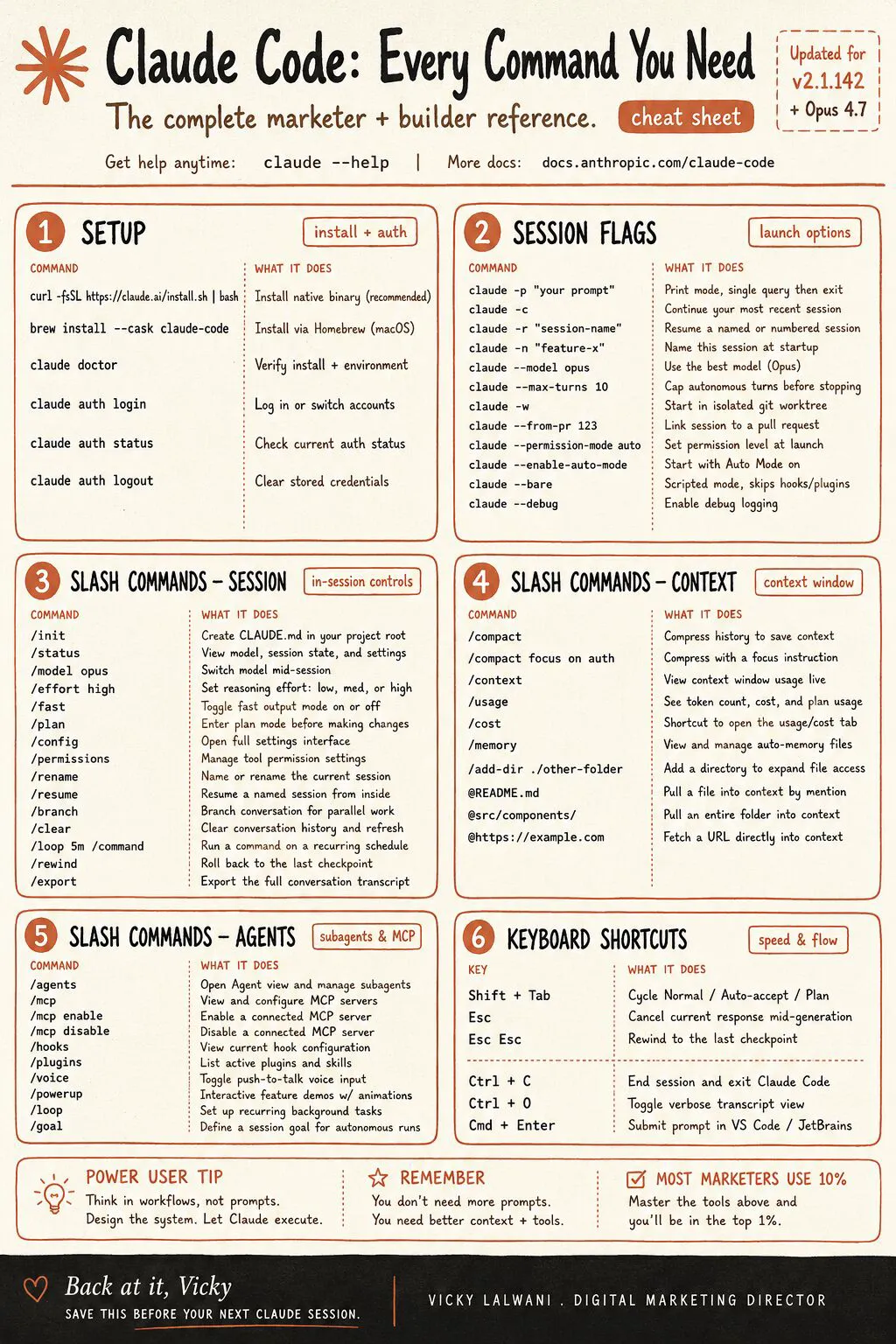
Run /init to have Claude draft a starter file from the folder, then /context all to confirm which memory files actually loaded.
Does Claude read AGENTS.md in November 2026?
Short answer: yes, since Claude Code v2.1.277 on 18 September 2026, but only as a fallback. If a CLAUDE.md or CLAUDE.local.md sits in your working folder or any folder above it, Claude reads that and skips AGENTS.md unless you change the Project instructions setting in /config.
The Claude Code changelog for 2.1.277 says: in a project with no CLAUDE.md, Claude Code reads AGENTS.md instead. A member of the Claude Code team announced it on X the same day.
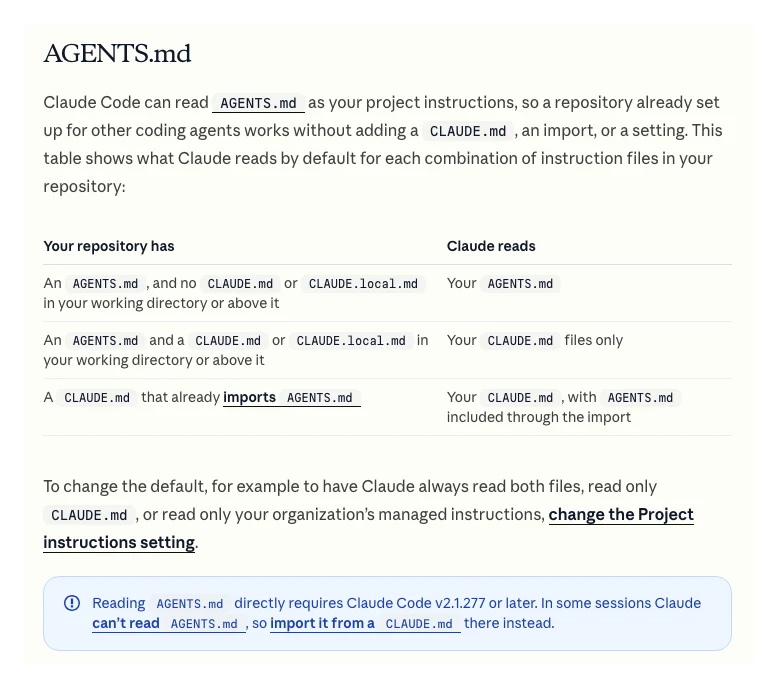
AGENTS.md is an open format that started with OpenAI's Codex and others; its site says it is used by over 60,000 open-source projects and is now stewarded by the Agentic AI Foundation, which Anthropic helped found under the Linux Foundation alongside its donation of MCP.
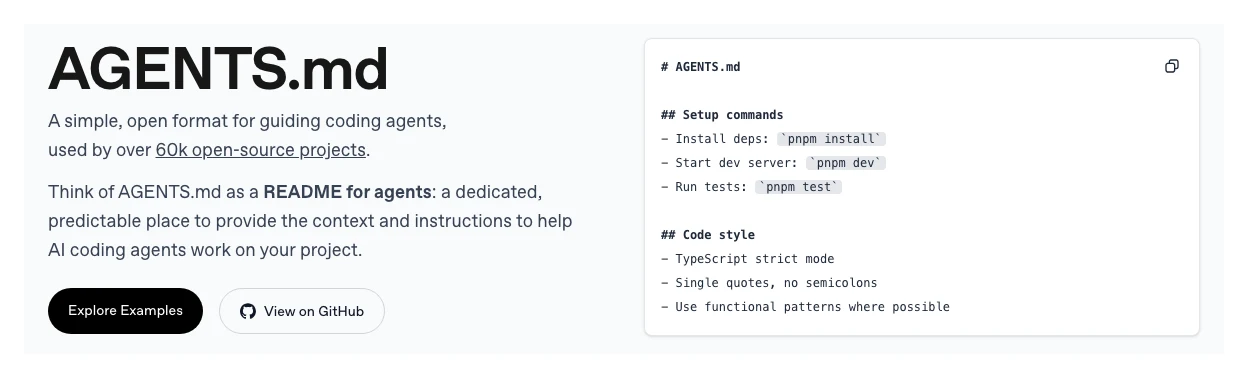
| Your folder has | Claude Code reads |
|---|---|
| AGENTS.md only | AGENTS.md |
| AGENTS.md and CLAUDE.md | CLAUDE.md only |
| AGENTS.md and CLAUDE.local.md | CLAUDE.local.md only |
| CLAUDE.md with @AGENTS.md inside | Both, AGENTS.md first |
The third row catches people out: adding a private CLAUDE.local.md stops Claude reading the team's AGENTS.md. An r/ClaudeCode post called it a "TIL" in October 2026, and Anthropic's docs confirm it.
Which should a marketing team use? If everyone uses Claude, a CLAUDE.md is enough. If some people use Codex, Gemini or Copilot, keep the shared rules in AGENTS.md and create a CLAUDE.md that starts with @AGENTS.md and adds anything Claude-specific underneath. Anthropic recommends that import over a symbolic link if anyone on the team uses Windows.
What about Claude chat and Cowork?
Short answer: they use the same idea with different controls. Claude chat has project instructions inside each Project. Cowork has global instructions for every session and folder instructions for a local folder, and Anthropic's admin docs say the global instructions are stored as a CLAUDE.md included in every session.
In Claude chat, project instructions tailor every chat in a Project, alongside uploaded knowledge files. In Cowork, the help centre explains global instructions and folder instructions, and notes that Claude can update folder instructions on its own during a session. Anthropic's Claude Desktop admin docs describe editing global instructions as changing the CLAUDE.md file that is included in every session.
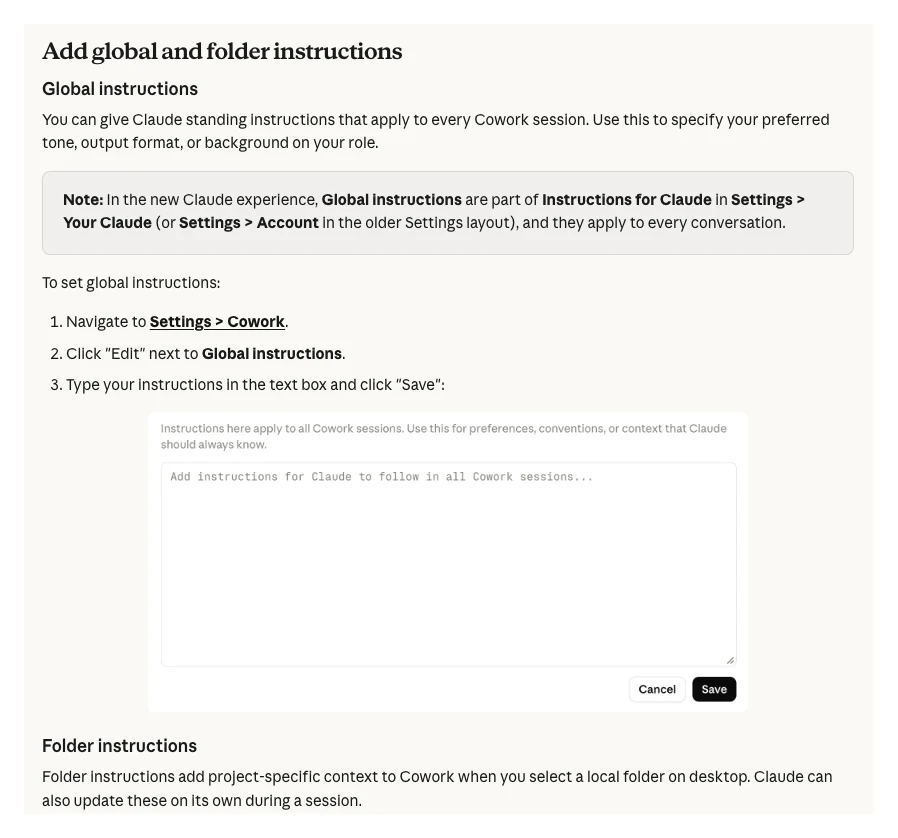
| Surface | Where the rules live | Best for |
|---|---|---|
| Claude Code | CLAUDE.md, AGENTS.md, rules | Folders of client work |
| Cowork | Global and folder instructions | Delegated tasks |
| Claude chat | Project instructions | Writing and research chats |
The same content works in all three. Write it once as a file, then paste or point each surface at it, so the rules do not drift apart. For how the surfaces differ in general, see the Claude folder setup for marketers.
What should a marketing CLAUDE.md contain?
Short answer: the facts Claude cannot guess and you keep repeating: the business and offer, audiences and markets, spelling and format rules, claims that need proof, locked and banned phrases, the approval rule, where files live, and which accounts are read-only. Leave out long brand guides, voice samples, procedures and anything secret.
Anthropic's rule of thumb is to treat the file as the place you write down what you would otherwise re-explain, and to add a line when Claude makes the same mistake a second time. Developer-focused files are full of build commands; a marketing file needs different blocks.
| Block | What goes in | Example line |
|---|---|---|
| Business | Offer, price basis, proof | We sell X to Y; proof is in proof.md |
| Audience and market | Who, where, spelling | UK clients: British spelling, GBP |
| Voice summary | Three or four rules | Short sentences, second person |
| Claims | What needs proof | No "best" without a linked source |
| Locked phrases | Exact wording | Tagline appears exactly as written |
| Banned words | Never use | No competitor names in ads |
| Approvals | What needs sign-off | Nothing is sent or published unapproved |
| File map | Where things live | Client rules in clients/name/ |
| Accounts | Access level | Google Ads connection is read-only |
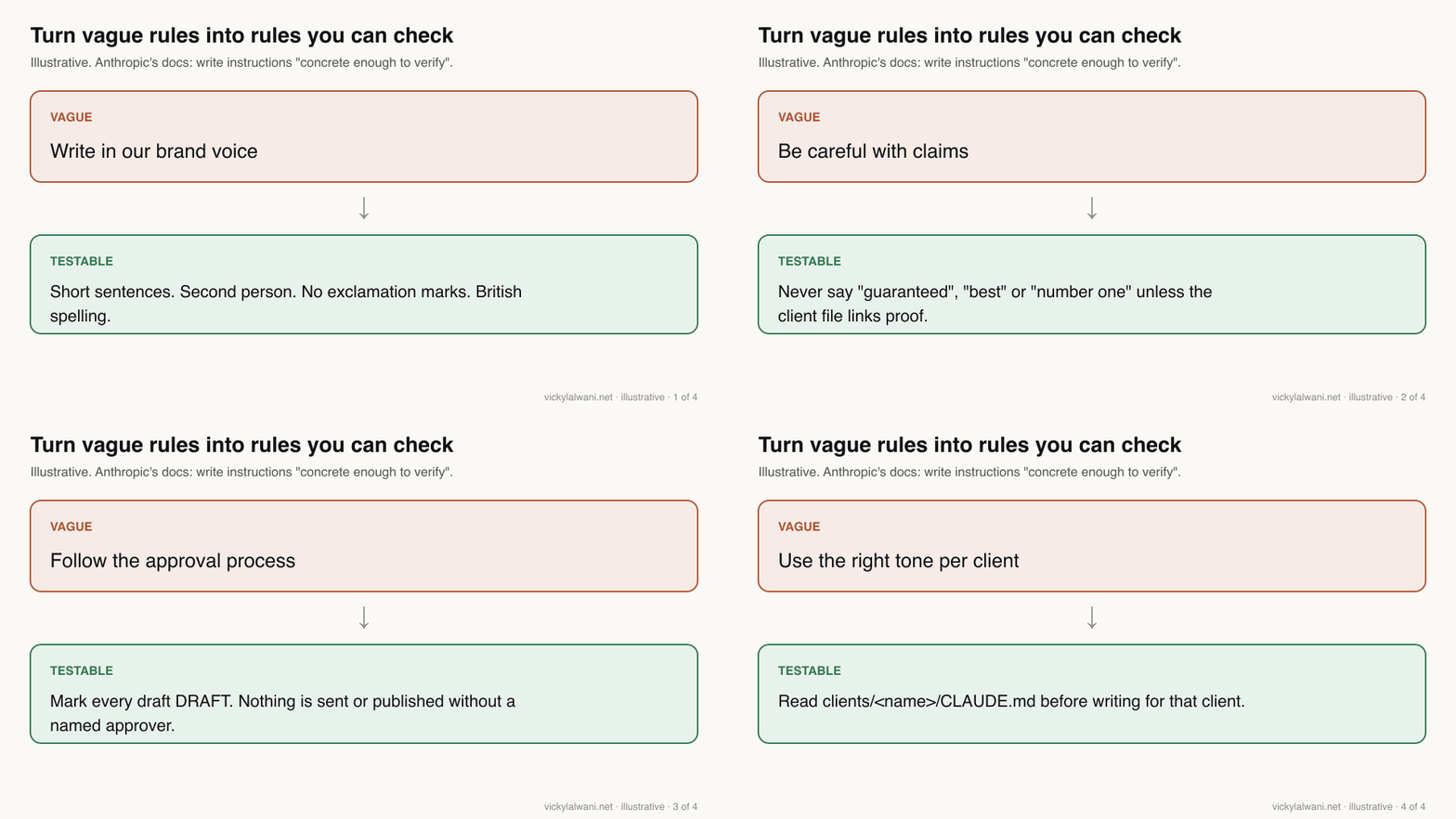
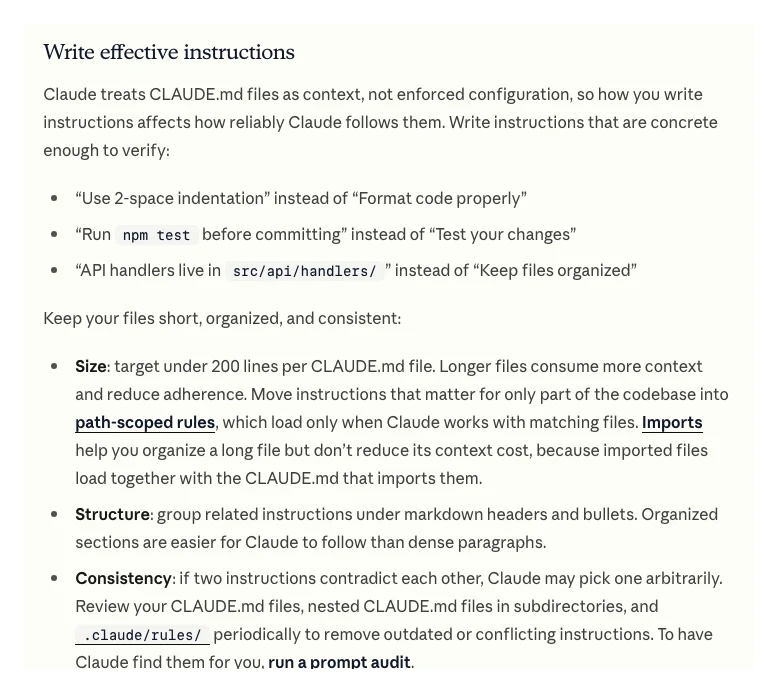
Anthropic's guidance is to write instructions "concrete enough to verify": "Use 2-space indentation" rather than "format code properly". For marketing, "British spelling, no exclamation marks, sentences under 20 words" works; "sound on-brand" does not.
What to leave out. Full brand guidelines with colours, type and layouts belong in a separate file, covered in the AI brand guidelines file. Writing samples and tone documents belong in the setup described in train Claude on your voice. Step-by-step jobs such as a monthly report belong in a skill, which loads only when the task needs it; see Claude marketing skills.
Is there a CLAUDE.md template for a marketing team?
Short answer: yes. Copy the template below into CLAUDE.md (or AGENTS.md if your team uses several AI tools), replace every bracket, delete what does not apply, and keep it under 200 lines.
# [Business name]: marketing rules for Claude

## Who we are
- We sell [offer] to [audience] in [markets].
- Proof we can cite is in proof.md. Do not invent results, figures or client names.

## Markets and format
- UK work: British spelling, GBP, DD Month YYYY dates.
- US work: American spelling, USD.
- One market per piece. Never mix spellings in one document.

## Voice (summary only; full guide in brand/voice.md)
- Short sentences, mostly under 20 words. Second person.
- No exclamation marks. No hype words: revolutionary, game-changing, unlock.

## Claims and compliance
- Never write "guaranteed", "best", "number one" or "cheapest" unless proof.md links a source.
- Prices only as published on [pricing page URL].
- Regulated clients (health, finance, legal): read clients/[name]/compliance.md first.

## Locked and banned wording
- Tagline, exactly: "[tagline]".
- Never name competitors in ad copy.

## Approvals
- Label every draft DRAFT at the top.
- Nothing is sent, scheduled, published or changed in an ad account without a named approver in chat.

## Accounts and tools
- Google Ads, GA4 and Search Console connections are read-only. Propose changes in a table; a person applies them.
- Never paste passwords, API keys or client personal data into files or chat.

## Where things live
- Client rules: clients/[name]/CLAUDE.md (read before writing for that client).
- Templates: templates/. Finished work: outputs/[client]/[YYYY-MM]/.

## When you are corrected
- If I correct the same thing twice, suggest a one-line rule for this file.
That template is about 40 lines, which leaves room for client files. If your team works in a folder with a space in its name, note that Claude Code imports need a backslash before each space, for example @Brand\ Guides/voice.md; a path in quotes is not imported at all.
How do you organise CLAUDE.md files for several clients or brands?
Short answer: one shared file at the top for rules that apply everywhere, one CLAUDE.md in each client folder, path-scoped rules in .claude/rules for work types such as ads or SEO, and skills for procedures. Start Claude Code in the client folder you are working on so the right files load.
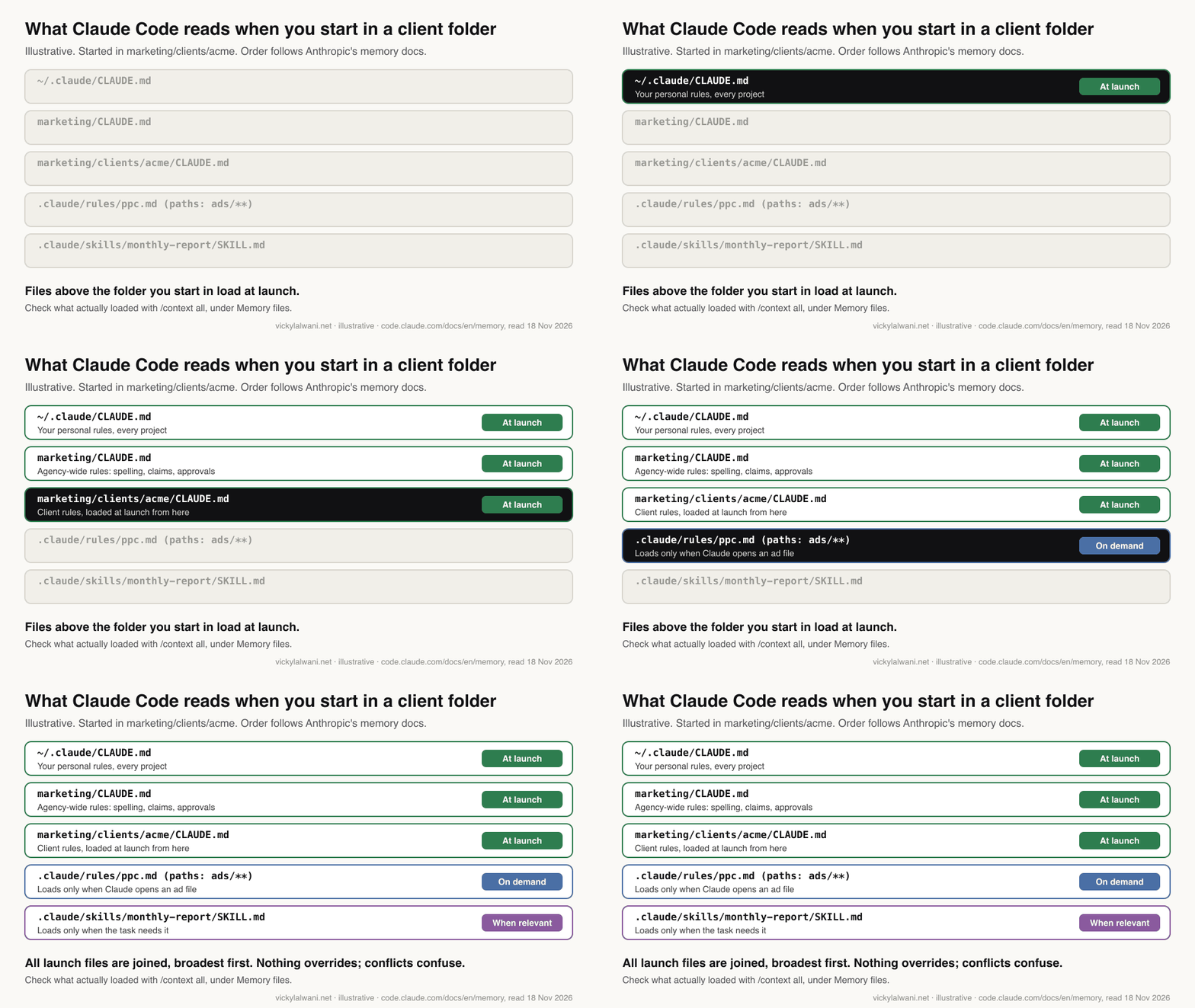
Path-scoped rules are Markdown files in .claude/rules/ with a paths line at the top, such as ads/**. Anthropic's docs say they load only when Claude reads or edits a matching file, which keeps PPC rules out of an SEO task and saves context.
| Put it in | When it loads | Use for |
|---|---|---|
| Top-level CLAUDE.md | Every session | Agency-wide rules |
| Client CLAUDE.md | When working there | Offer, voice, claims |
| .claude/rules with paths | When a matching file opens | Ads, SEO, email rules |
| Skills | When the task needs it | Reports, audits, briefs |
| CLAUDE.local.md | Every session, you only | Personal shortcuts |
This mirrors how I organise my own work: one Claude project per client, threads named by service, and skills kept in one known place, so one client's rules never leak into another's copy. One failure I have seen is a rule file or skill written for one job being used for another: instructions built for ad offers ended up writing website pages, and the pages read like adverts. Separate files by job, not just by client.
How long should a CLAUDE.md file be?
Short answer: under 200 lines per file, Anthropic says, because longer files use more context and reduce how well Claude follows them. Imports help you organise but do not save context, since imported files load with the file that imports them.
The docs add a few limits worth knowing. Block-level HTML comments are stripped before the file reaches Claude, so you can leave notes for colleagues at no cost. Imports can nest four levels deep. A CLAUDE.md in a subfolder that is over a size limit (40,000 characters on a 200,000-token context window) is only partly loaded. And Claude Code's own auto memory file, MEMORY.md, loads only its first 200 lines or 25KB.
| Limit | Value | Source |
|---|---|---|
| Target per CLAUDE.md | Under 200 lines | Anthropic docs |
| Import depth | Four hops | Anthropic docs |
| On-demand file, 200K context | 40,000 characters | Anthropic docs |
| Auto memory index loaded | 200 lines or 25KB | Anthropic docs |
| File skipped entirely | Over 4 MiB | Anthropic docs |
Shorter is also what the research suggests. A February 2026 study, "Evaluating AGENTS.md", found that context files did not generally raise coding agents' success rates and raised cost by over 20% on average; instructions in them were followed, but project overviews did not help. That was tested on code, not copy, but the lesson carries: write rules that differ from Claude's defaults, not a description of your company.
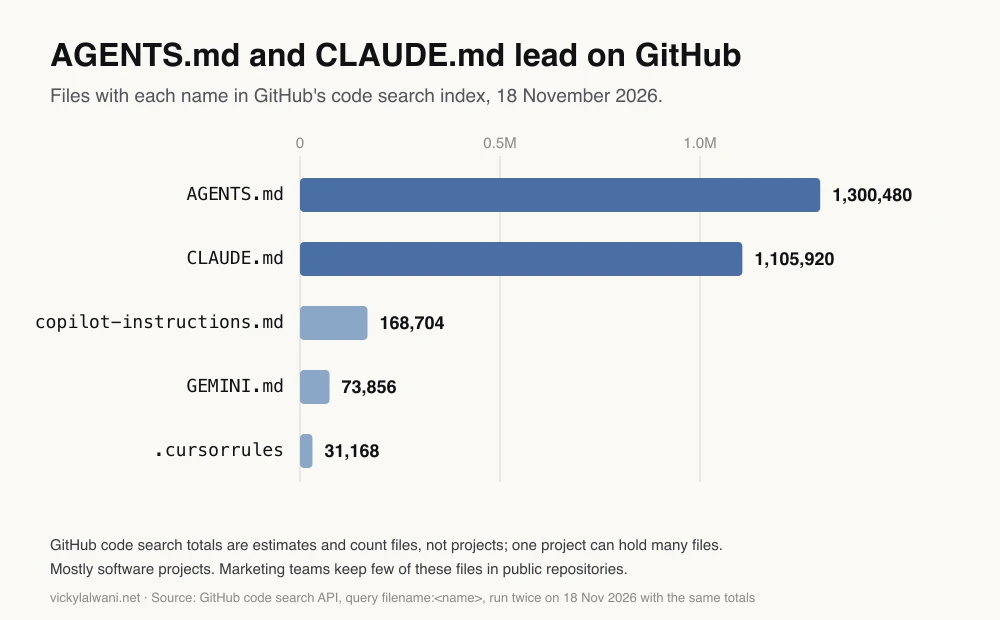
The chart shows why the AGENTS.md question matters even for marketers: the two formats are now similar in number on public GitHub, so tools and freelancers you work with may arrive with either.
How do you test and maintain a CLAUDE.md file?
Short answer: check it loaded with /context all, give Claude a task you know the right answer to, fix the rule that failed, and run /doctor prompt-audit (Claude Code v2.1.283 or later) to find stale or conflicting lines. Review it monthly and delete rules that no longer apply.
- Start small: ten to fifteen lines for offer, market, voice summary, claims and approvals.
- Run
/context alland confirm the file is listed under Memory files. - Test with a known task, such as three headlines for a live offer, and check every rule.
- When Claude repeats a mistake, add one testable line. Delete a line when it stops mattering.
- Run
/doctor prompt-audit; the changelog says it was added in v2.1.283 to find instructions written for older models and conflicting files. - Check what Claude saved in auto memory with
/memory. Move anything the whole team needs into CLAUDE.md, because auto memory stays on one machine.
The colleague test from the original version of this article still works: hand the file to a new team member and ask whether they could write an on-brand paragraph from it alone. If they cannot, Claude cannot either.
My own website project runs this way. Its standing rules live in Claude Code's memory files, one line each in an index: no client names, no long dashes, one market per article, prices only as published, and which email address commits must use. Each line was added when I set or corrected a rule in a session, so the next session starts with it.
What should never go in a CLAUDE.md file?
Short answer: passwords, API keys, tokens, customer personal data, unpublished financials and anything you would not email to every person who can open the folder. Project files are often shared through version control, so treat them as visible to the whole team.
- Keep secrets in your password manager or environment settings, never in a Markdown file.
- Keep client personal data out of instruction files; point to where it lives and who may see it.
- Watch imports from outside the project. Claude Code asks before loading them the first time, because a shared file could pull in something you did not write.
- Remember that instructions are not locks. Use read-only connections and approval steps for anything that spends money or publishes.
Where this advice is weak
Short answer: Anthropic's docs are written for software projects, the research on context files is about code, and Claude Code changes most weeks.
- The marketing blocks and template are my judgement, not an Anthropic recommendation. Test them on your own work.
- The study on context files measured coding tasks. No comparable study for marketing copy was found.
- GitHub's code search totals are estimates and count files, not teams; marketing teams rarely publish these files.
- Cowork and chat menu names change between app versions, and Cowork's handling of folder instructions is described only briefly in Anthropic's help centre.
- Version numbers (2.1.277 for AGENTS.md, 2.1.283 for prompt-audit) are from the changelog; behaviour may change in later versions.
What people say on X and Reddit
Short answer: people agree on keeping the file short and testable, argue about CLAUDE.md versus AGENTS.md, and keep finding that two files with different rules make two agents behave differently.
| Who | What they said | Take it as | Link |
|---|---|---|---|
| Claude Code team member | AGENTS.md support from v2.1.277; toggle in /config (18 Sep 2026) | Official | X post |
| Claude (official) | Projects in Cowork; files and instructions stay on your computer (20 Mar 2026) | Official | X post |
| A product newsletter writer | Generic CLAUDE.md files waste tokens; iterated theirs many times (11 Apr 2026) | First-hand | X post |
| A Claude tips account | Each part of a project folder loads at a different time (8 Nov 2026) | Explainer | X post |
| A content writer | Use Projects with instructions, one per job, not fresh chats (15 Nov 2026) | Opinion | X post |
| A marketing account | Feed brand voice, then turn the method into a Claude skill (25 Nov 2025) | Opinion | X post |
| r/ClaudeCode | Adding a private CLAUDE.local.md stopped Claude reading the team's AGENTS.md; fix: @AGENTS.md as its first line (5 Oct 2026) | First-hand | Thread |
| r/ClaudeCode | A team diffed its CLAUDE.md and AGENTS.md and found the two agents followed different rules; replies: keep one source (5 Nov 2026) | First-hand | Thread |
| r/ClaudeCode | Keep the file lean, move hard rules into hooks, test with probe tasks built from real mistakes (25 Oct 2026) | First-hand | Thread |
| r/ClaudeCode | What belongs in a global file for many kinds of work; one reply keeps a folder and Claude files per client (8 Oct 2026) | Question | Thread |
| r/ClaudeAI | Automating marketing with Claude: research and drafts yes, fully automated posting no; keep a person in the loop (29 Oct 2026) | Opinion | Thread |
Videos worth watching
Short answer: Anthropic's three-minute CLAUDE.md video covers the basics, its marketing case study shows a non-developer using Claude Code, and a developer educator explains why auto-generated files often hurt.
Made by Anthropic's Claude channel, 10 May 2026. It sells nothing beyond Claude and its free course. Covers what to put in the file and how the file hierarchy works.
Made by Anthropic's Claude channel, 27 January 2026. A growth marketer at Anthropic explains moving from never using a terminal to automated ad workflows. It promotes Claude Code.
Made by a developer educator, 24 February 2026, citing the "Evaluating AGENTS.md" paper. It links the creator's newsletter. A useful counterpoint to long auto-generated files.
| Video | Channel | Date | What it covers |
|---|---|---|---|
| The CLAUDE.md file | Claude (Anthropic) | 10 May 2026 | Basics and hierarchy |
| How Anthropic uses Claude in Marketing | Claude (Anthropic) | 27 Jan 2026 | Marketing case study |
| Claude Code best practices | Anthropic | 31 Jul 2025 | Conference talk, CLAUDE.md habits |
| Never Run claude /init | A developer educator | 24 Feb 2026 | Why short files win |
| CLAUDE.md and Agents.md Explained | An AI tutorials channel | 18 Dec 2025 | Both formats side by side |
| Cowork Part 6: Global and Folder Instructions | A developer and author | 3 Jun 2026 | Cowork instructions |
Want your team's Claude files set up properly?
The file is quick to write and easy to get wrong: rules that cannot be checked, client details in the shared file, secrets in plain text, or an AGENTS.md that silently stops loading. I can build the folder structure, the shared and client files, the skills and the read-only connections, then test them on your real work. See Claude consultant, or AI automation if you want scheduled jobs on top. Rates are on the pricing page.
Keep reading: the AI brand guidelines file, train Claude on your writing style, Claude folder setup for marketers and Claude marketing skills.
Sources
| Source | What it supports | Date |
|---|---|---|
| Claude Code docs: memory | Locations, load order, 200 lines, imports, rules, AGENTS.md, limits | Read 18 Nov 2026 |
| Claude Code changelog | AGENTS.md in 2.1.277; prompt-audit in 2.1.283 | 18 and 25 Sep 2026 |
| agents.md | Open format; 60,000+ projects; Agentic AI Foundation | Read 18 Nov 2026 |
| Anthropic: Agentic AI Foundation | AGENTS.md a founding project | 9 Dec 2025 |
| Get started with Cowork | Global and folder instructions | Read 18 Nov 2026 |
| Claude Desktop data storage | Global instructions stored as a CLAUDE.md | Read 18 Nov 2026 |
| What are projects | Project instructions in Claude chat | Read 18 Nov 2026 |
| Evaluating AGENTS.md (arXiv) | Context files and agent success, cost | 12 Feb 2026 |
| GitHub code search API | File counts in the chart | Run 18 Nov 2026 |
| X, Reddit and YouTube | Practitioner and official views, linked above | Jul 2025 to Nov 2026 |
This article expands on my post on LinkedIn ↗.
FAQ
What is a CLAUDE.md file?
A CLAUDE.md file is a Markdown file of standing instructions that Claude Code loads at the start of every session. It can live in your home folder, a project folder, a private CLAUDE.local.md or a managed location, and all the files found are joined together.
What should a CLAUDE.md file for marketing include?
Include the offer, audiences and markets, spelling and format rules, claims that need proof, locked and banned wording, the approval rule, where files live and which accounts are read-only. Leave long brand guides, voice samples and procedures in separate files or skills.
Does Claude Code read AGENTS.md?
Yes, since Claude Code v2.1.277 on 18 September 2026, but only when there is no CLAUDE.md or CLAUDE.local.md in the working folder or above it. You can change this with the Project instructions setting in /config, or import AGENTS.md from a CLAUDE.md with @AGENTS.md.
Should a marketing team use CLAUDE.md or AGENTS.md?
If everyone uses Claude, a CLAUDE.md is enough. If the team also uses Codex, Gemini CLI or Copilot, keep shared rules in AGENTS.md and add a CLAUDE.md that imports it with @AGENTS.md, with any Claude-only rules below.
How long should a CLAUDE.md file be?
Anthropic recommends keeping each CLAUDE.md under 200 lines, because longer files use more context and reduce how well Claude follows them. Imported files still count, so move rarely needed rules into path-scoped rules or skills.
Does Claude always follow CLAUDE.md?
No. Anthropic says Claude treats CLAUDE.md as context, not enforced configuration, so vague or conflicting rules are followed less reliably. Anything that must never happen, such as publishing without approval, needs a hook, a permission rule or a read-only connection.
Can one CLAUDE.md file serve several clients?
Use one shared file for agency-wide rules and a separate CLAUDE.md in each client folder. A client folder's file loads when Claude works with files there, or at launch if you start Claude Code in that folder.
Does Claude Cowork use CLAUDE.md?
Cowork has global instructions for every session and folder instructions for a local folder. Anthropic's Claude Desktop admin docs say global instructions are stored as a CLAUDE.md file included in every session.
What should never go in a CLAUDE.md file?
Never put passwords, API keys, tokens, customer personal data or confidential figures in it. Project files are often shared with the whole team through version control, so treat them as visible to everyone with access to the folder.