ChatGPT apps connect ChatGPT to services such as Semrush, Canva and Google Drive so marketers can pull data, draft creative and summarise reports inside a chat. Since 2026 they are installed through plugins that can also hold skills. For SEO and PPC they speed up research and drafts, but they are not an ad channel: OpenAI bans apps that exist to advertise, and availability depends on plan, region and workspace.
TL;DR
ChatGPT apps connect ChatGPT to services you already use, such as Semrush, Canva, Google Drive or Slack, so you can pull data, make a design or take an action inside the chat. Since 2026, OpenAI packages apps inside plugins, which can also carry skills (reusable instructions), and the app directory now sits in a plugin directory shared by ChatGPT and Codex.
For SEO and paid search the useful apps are the data ones: Semrush has an official ChatGPT app, and other tools can be added as custom MCP connections on Business and Enterprise plans. Treat everything an app produces as a draft that you check against the source tool before it goes near a live campaign or page.
Most businesses do not need to build an app. OpenAI's rules forbid apps that exist to advertise, so being found in ChatGPT still comes down to good pages, crawl access for OpenAI's search bot, a claimed business profile, and, if you pay, ChatGPT ads.
Short answer: ChatGPT apps are integrations that bring another service's data, interface or actions into a ChatGPT conversation. Marketers use them to pull keyword and traffic data, draft creative in a design tool and summarise files without switching tabs. As of November 2026 they are installed through plugins, they depend on your plan, region and workspace settings, and they help you work faster rather than rank or sell for you.
Most people still think ChatGPT is only for writing. That view has been out of date since October 2025, when OpenAI put apps inside the chat. The useful question for a marketer is narrower: which apps save real time on SEO and paid search work, which ones you can trust with client data, and whether your own business should build one.
I first wrote this guide after 8+ years in search and paid media, when apps were a launch-week novelty. This update checks every claim against OpenAI's help pages and developer docs as of 18 November 2026. If what you actually need is more enquiries from search, that is the work I do as an SEO consultant and in Google Ads management; this article explains where ChatGPT apps fit around that work.
What are ChatGPT apps in November 2026?
Short answer: an app connects ChatGPT to an external service so it can read information, show an interactive view or take supported actions there. A plugin is the package you install: it can hold one or more apps, skills, or both. Older guides call apps "connectors"; OpenAI's help pages now call them connected apps.
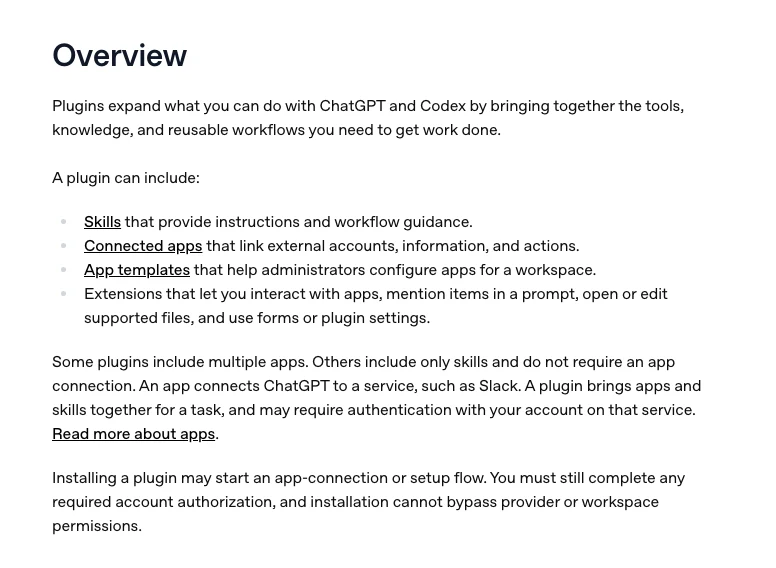
OpenAI's help page on plugins spells out the layers. A plugin can include skills that give instructions, connected apps that link accounts and actions, app templates for administrators, and extensions that add panels or file viewers.
| Term | What it is | Marketing example |
|---|---|---|
| App | Link to one service | Semrush data in chat |
| Skill | Saved instructions | Your ad copy checklist |
| Plugin | Package of apps and skills | "Weekly SEO report" |
| Apps SDK | OpenAI's toolkit to build apps | Your own tool in ChatGPT |
| MCP | Open standard apps run on | Same server works in Claude |
MCP (Model Context Protocol) matters more than the naming. OpenAI built the Apps SDK on it, so a tool that already has an MCP server for Claude can often be added to ChatGPT too. That is why so many SEO tools appeared in both within a few months.
How did ChatGPT apps get here?
Short answer: apps launched on 6 October 2025 with a small set of partners, opened to developer submissions with an app directory on 17 December 2025, and were folded into plugins during 2026. At DevDay on 29 September 2026 OpenAI added plugin extensions and said it had improved how plugins are ranked and recommended.
| Date | What changed |
|---|---|
| 6 Oct 2025 | Apps and the Apps SDK preview launch |
| 13 Nov 2025 | Apps in preview for Business, Enterprise, Edu |
| 17 Dec 2025 | Submissions open; app directory; SDK in beta |
| 22 Feb 2026 | ChatGPT fully supports the MCP Apps spec |
| 25 Mar 2026 | Approved apps can ship as Codex plugins |
| 12 Jun 2026 | Users choose when apps ask permission |
| 29 Sep 2026 | Plugin extensions; better ranking |
The launch had a catch for some readers. On day one, apps were available to logged-in users on Free, Go, Plus and Pro plans outside the European Economic Area, Switzerland and the United Kingdom, with OpenAI saying it expected to bring them to the EU soon.
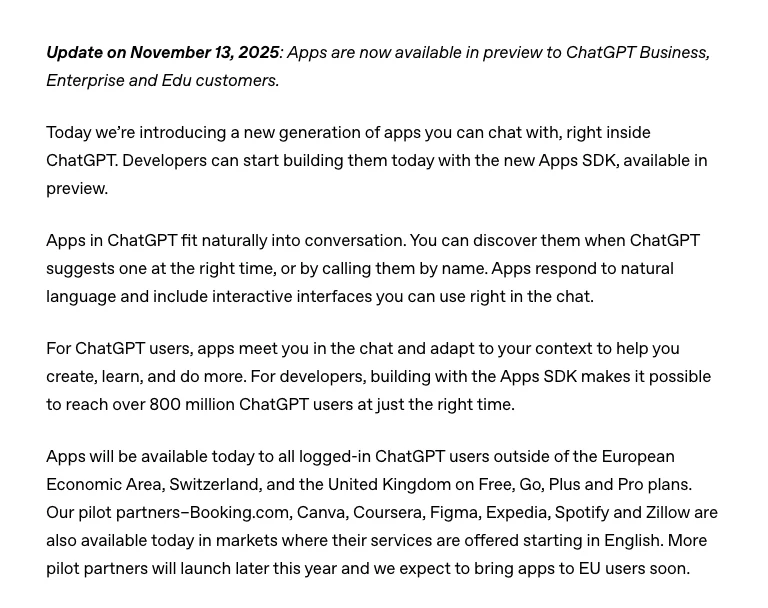
Today OpenAI says app availability depends on the app, your plan, region, workspace, role, model and the ChatGPT interface you use. In practice: check the plugin directory in your own account rather than trusting any list, including this one.
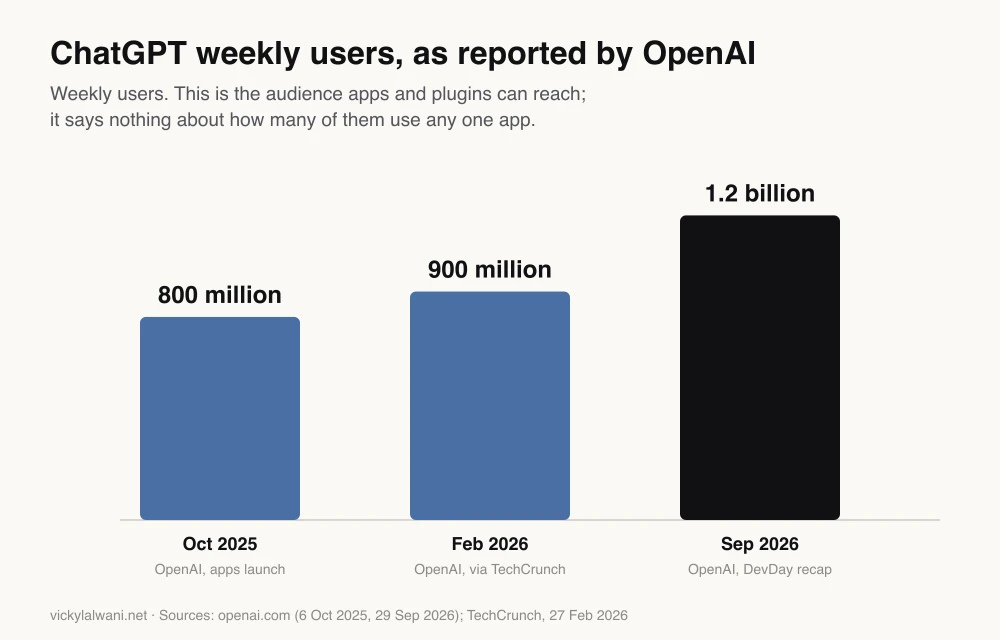
Why marketers care at all is reach. OpenAI reported more than 800 million weekly users when apps launched, and 1.2 billion at DevDay 2026.
Which ChatGPT apps are useful for SEO and PPC work?
Short answer: data apps first. Semrush has an official ChatGPT app for keyword, traffic and competitor data; file apps such as Google Drive and SharePoint let ChatGPT read your exports and reports; design apps such as Canva help with creative drafts. Tools without an official app can be added as custom MCP connections on Business and Enterprise plans.
| Job | App route | Watch for |
|---|---|---|
| Keyword and competitor data | Semrush app | Uses Semrush API units |
| Ahrefs data | Custom MCP connection | Plan and workspace rules |
| Reports and exports | Google Drive, SharePoint, Box | Read access to files |
| Ad and social creative | Canva, Figma | Brand and policy checks |
| Team updates | Slack, Notion | What gets shared |
Semrush's MCP documentation says its official ChatGPT app is enabled from ChatGPT's settings, is called with @Semrush, and draws on your Semrush API units with no extra ChatGPT fee. Semrush announced the app on 17 December 2025, the day submissions opened.
Ahrefs documents a different route: a remote MCP server for paid plans from Lite up, which its MCP overview lists for ChatGPT web among other tools. OpenAI's help page on custom MCP servers says custom connections and full MCP support are for Business and Enterprise/Edu customers on the web, added by admins or authorised members.
A Google Ads app from Google itself is absent from my list: I could not find a first-party one on 18 November 2026. Third-party vendors list Google Ads plugins, but that means giving another company access to your ad account, so read its permissions and data terms first. Otherwise you are back to exports, reports in Drive or Sheets, or a custom connection your team controls. For live ad accounts, I prefer a setup where nothing can change a campaign without a person, which is covered in Claude Code PPC workflows.
What can marketers do with ChatGPT apps day to day?
Short answer: research, draft and summarise in one place: pull keyword ideas with real volumes, turn them into ad copy within Google's character limits, mock up a visual, and summarise last month's report from a file. The final asset still moves into your normal tools after a person checks it.
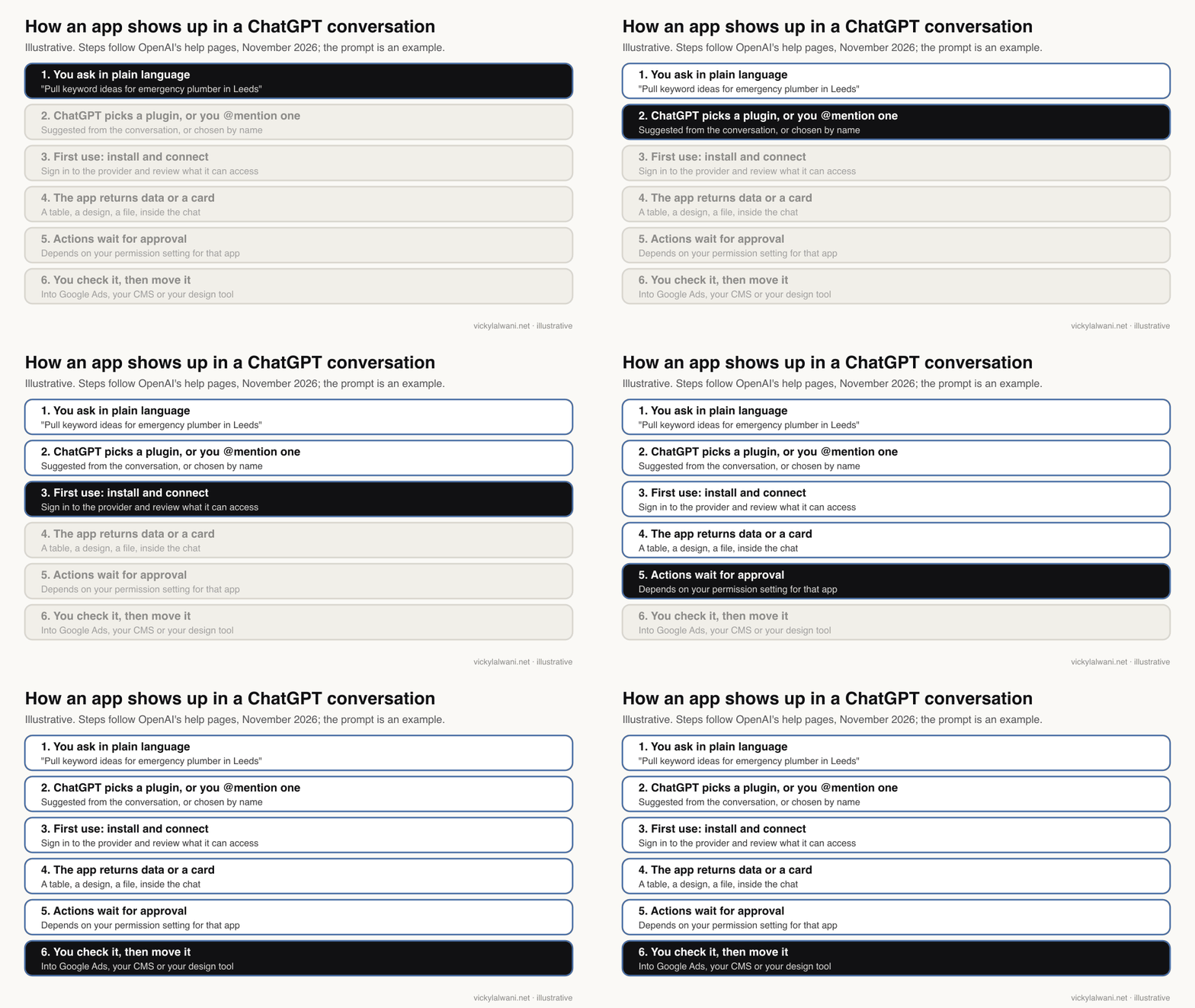
The old routine was prompt, copy, paste into another tool, tweak, export, repeat. The workflow from the first version of this guide still holds, with the data step added at the front:
- Brief. Give ChatGPT the audience, offer, tone and the channel the asset is for.
- Data. Pull search terms and volumes from a connected SEO app, not from memory.
- Draft copy. Ask for options that fit the channel's limits.
- Visual. Use a connected design app for a first version that matches the copy.
- Review and export. Check claims, brand rules and ad policy, then move the asset into Google Ads, Meta or your CMS.
A prompt for the PPC version, assuming the Semrush app is connected:
@Semrush Find 30 keywords for [service] in [country], with search
volume, CPC and keyword difficulty. Group them by intent:
ready to buy, comparing, researching.

Then, for the "ready to buy" group only, draft a responsive search ad:
- 15 headlines, each 30 characters or fewer
- 4 descriptions, each 90 characters or fewer
- No prices, guarantees or claims I have not given you
Show the character count next to each line.
Google's responsive search ads help page confirms the limits: up to 15 headlines of 30 characters and 4 descriptions of 90. Ask for counts anyway, because models still miscount.
And one for SEO, using a file app:
Open "[Search Console export, month]" from my Google Drive.
List queries with more than [N] impressions where the average
position is between 8 and 20. For each, say which page on
[domain] should answer it, or "no page yet".
Quote the impressions and position from the file. Do not
estimate any number that is not in the file.
That sequence suits social posts, simple ad concepts, email headers and first-pass SEO checks. It suits complex brand work, regulated claims and live bid changes much less.
Do ChatGPT apps matter for SEO?
Short answer: indirectly. Apps change how people get things done inside ChatGPT, and OpenAI now ranks and recommends plugins in its directory and in conversations, which is a discovery channel of its own. But for most businesses, being found in ChatGPT still depends on crawlable, useful pages and a claimed business profile, not on owning an app.
Two signals from OpenAI are worth knowing. Its DevDay 2026 recap says "improved ranking and recommendations help people find relevant plugins in the directory and in conversations". And its developer guide on metadata reads like an SEO brief.

The Optimize Metadata guide tells developers to build a "golden prompt set" of direct, indirect and negative prompts and to measure whether the right tool is picked. Anyone who has mapped keywords to pages will recognise the method. The plugin guidelines also ban the obvious shortcuts: no metadata that tells the model to prefer your plugin, no "best" or "official" style wording, no pricing or promotions in descriptions.
For most businesses, the SEO jobs are the familiar ones. OpenAI's crawler documentation says sites that block OAI-SearchBot will not be shown in ChatGPT search answers, apart from navigational links. And ChatGPT can use information from connected apps to shape its own web searches, so clear, specific pages still feed the answer. The business profile side is covered in how to get your business on ChatGPT, and what makes ChatGPT name one provider over another in how ChatGPT recommends businesses.
| Goal | What to do | App needed? |
|---|---|---|
| Appear in ChatGPT answers | Allow OAI-SearchBot, clear pages | No |
| Show correct business details | Claim your business profile | No |
| Be named as a provider | Specialism, location, reviews | No |
| Let users do a task in chat | Build a narrow plugin | Yes |
| Pay for visibility | ChatGPT ads | No |
Do ChatGPT apps matter for paid search?
Short answer: not as an ad channel. OpenAI's plugin guidelines say plugins must not serve advertisements or exist mainly as an advertising vehicle. Paid visibility in ChatGPT runs through ChatGPT ads, a separate product, while apps help with the research, copy and reporting around your Google Ads work.

If you want to pay for placement in ChatGPT, that is OpenAI's ads platform, with its own campaigns, targeting and conversion tracking. Set-up and costs are in ChatGPT Ads Manager.
One app-like feature is worth watching for lead generation. OpenAI's developer docs describe a local services "Get Quote" flow, in beta with approved partners, where a business card in ChatGPT can show a Get Quote button that opens the provider's form. It is partner-only for now, so most local businesses cannot use it yet.
The PPC risk is measurement, not media. Whenever a new source of enquiries appears, check how your analytics and CRM label it before you trust any channel report. On tracking work, enquiries that began in an AI assistant turning up under another channel is a recurring question, and it changes what your Google Ads numbers seem to say.
Should your business build a ChatGPT app?
Short answer: only if people already ask ChatGPT to do a job your product does, and you can deliver that job inside the chat with no ads or upsell. Building one needs an MCP server, a verified developer identity, domain verification and OpenAI's review, and published plugins are scanned daily for changes.
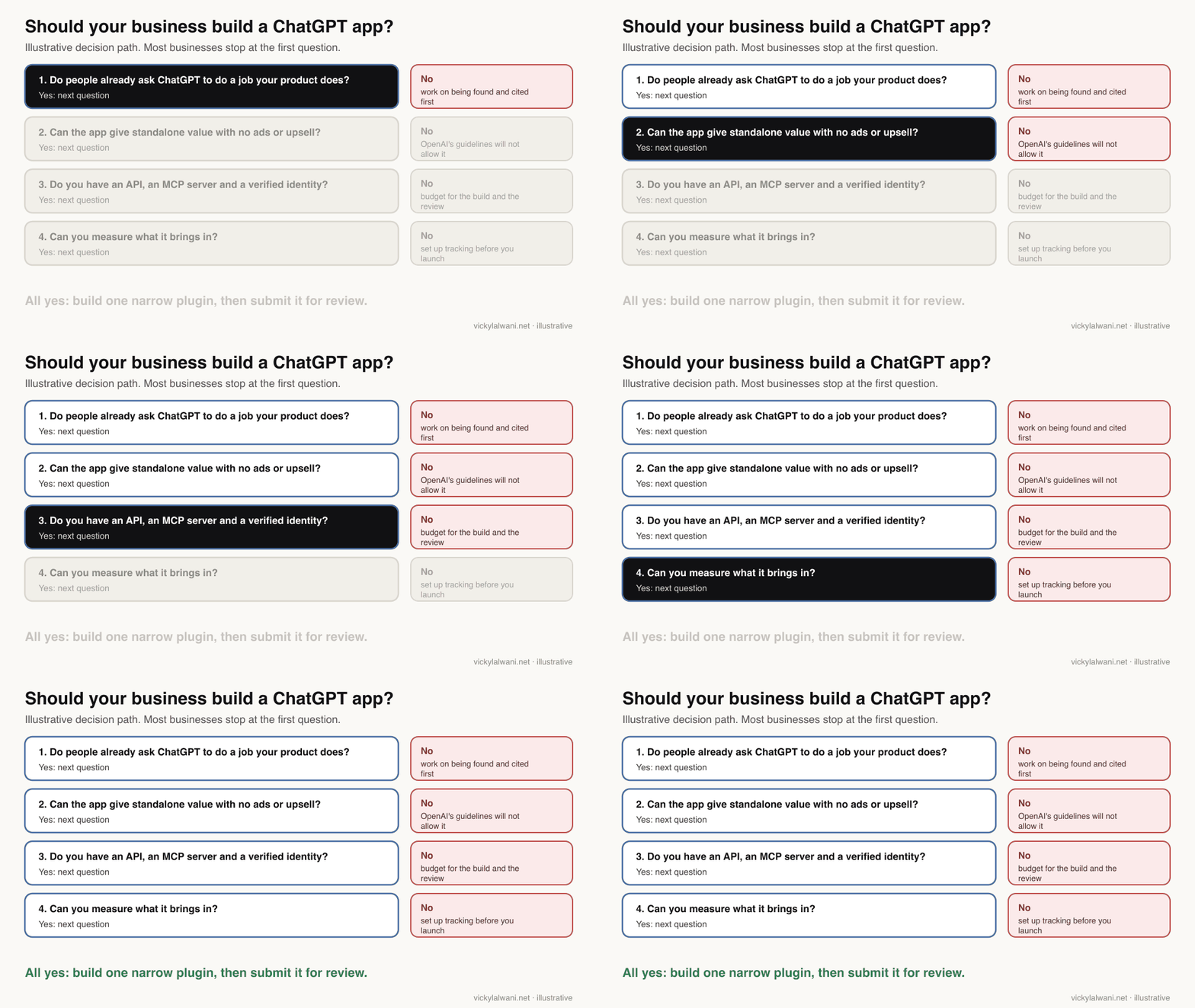
OpenAI's submission guide sets out the path: complete individual or business verification, connect and verify your MCP server's domain, add test cases and reviewer details, submit, then publish once approved. You can limit the countries where it appears. The guidelines also say plugins may not show subscription plans or promote upgrades, and may not charge ChatGPT users more than elsewhere.
| Requirement | Why it matters |
|---|---|
| Verified developer identity | Name shown in the directory |
| Remote MCP server | Your tools and data |
| Domain verification | Proves you own the server |
| Test cases, reviewer login | OpenAI tests before approval |
| No ads or upsell | Rejected otherwise |
| Daily scans after launch | Changes can be held |
Demand for review is real: one person working on OpenAI's plugin reviews wrote in October 2026 that the backlog was still growing after DevDay. Plan for a wait.
Are ChatGPT apps safe for client work?
Short answer: they can be, with settings checked first. Once enabled, an app may see relevant context from your conversation and, if Memory is on, from your memories; data shared with it follows the app's own terms. On Free, Go, Plus and Pro plans OpenAI may train on information accessed from apps if "Improve the model for everyone" is on; on Business, Enterprise and Edu it does not by default.
Those points come from OpenAI's connected apps help page, which also lists the permission choices: always ask, allow read actions, allow low-risk actions, and, for eligible apps, allow all actions. Changing a permission does not give an app new access; it only changes when ChatGPT asks.
| Check | Where | Safer choice |
|---|---|---|
| Which account you connect | App sign-in | Least access needed |
| Permission level | Settings, Plugins | Always ask |
| Model training | Data controls | Off for client work |
| Memory | Personalisation | Off or reviewed |
| Workspace controls | Admin console | Approved apps only |
My rule for client accounts is the same as for any AI tool: read access first, findings in a sheet, a person checks them, and nothing changes in a live account before the owner approves. Check your client's confidentiality terms before connecting anything that holds their data.
Where is this advice weak?
Short answer: app lists, plan rules and regional availability change month to month, and OpenAI has renamed the whole system once already. Treat the tables here as a snapshot from 18 November 2026 and check your own plugin directory before you plan around a specific app.
- Availability varies. OpenAI ties apps to plan, region, workspace, role, model and interface. What I can see may not be what you can see.
- Discovery is a black box. OpenAI says ranking and recommendations improved; it does not publish how they work.
- Third-party data. Keyword volumes in any app are estimates. Check them against the source tool before you build a campaign on them.
- No first-party Google Ads app. For live campaign data you need exports, a third-party plugin you have vetted, or a connection you control.
- Reach is not usage. The user numbers in the chart are ChatGPT's audience, not how many people use any app.
Videos worth watching
Short answer: start with OpenAI's own DevDay 2026 session on plugins for the current model, then the original apps launch video for the basics.
Made by OpenAI, published 10 November 2026. It does not sell anything beyond OpenAI's platform. Live demos of plugin extensions and how to reach users in ChatGPT and Codex.
Made by OpenAI, 6 October 2025. The launch video for apps in ChatGPT; some names have since changed.
| Video | Channel | Date | What it covers |
|---|---|---|---|
| Build What's Next on the ChatGPT Platform with Plugins | OpenAI | 10 Nov 2026 | Plugin extensions, demos |
| Apps in ChatGPT | OpenAI | 6 Oct 2025 | The original launch |
| Build Hour: Apps in ChatGPT | OpenAI | 23 Jan 2026 | Apps SDK and submission |
| ChatGPT Plugin Discovery Explained | A discoverability vendor | 30 Sep 2026 | How plugins get suggested |
| How to Use ChatGPT Plugins for Marketing in 2026 | Visla (vendor) | 22 Oct 2026 | Drive, Semrush, Notion |
| How to Run ChatGPT Ads: The Complete Tutorial | HubSpot Marketing | 22 Jun 2026 | The paid side, separate from apps |
What people say on X and Reddit
Short answer: the official posts are about access and review; vendors frame their apps as a way to keep SEO data in the chat; commentators after DevDay 2026 focus on plugin extensions and discovery. On Reddit the questions are practical: which connector brings Search Console or ad account data into ChatGPT, and whether paying for ChatGPT ads gets a brand into the answer itself.
| Who | What they said | Take it as | Link |
|---|---|---|---|
| OpenAI Developers | App submissions open; approved apps listed in the new app directory (17 Dec 2025) | Official | X post |
| Semrush | Official Semrush app in ChatGPT for SEO, traffic and competitor data (17 Dec 2025) | Vendor | X post |
| A media company founder on X | Picked the five DevDay 2026 launches that matter most after testing them (29 Sep 2026) | Opinion | X post |
| An analytics consultant on X | Plugin extensions give apps a home in the ChatGPT sidebar, unlike earlier plugins (30 Sep 2026) | Opinion | X post |
| A summary account on X | Listed the DevDay 2026 launches, big and small (30 Sep 2026) | Opinion | X post |
| Someone on OpenAI's plugin reviews | Reviews nearly doubled in a week, but the backlog is still growing (16 Oct 2026) | First-hand | X post |
| r/SEO | Which connector do people use to bring Search Console data into ChatGPT or Claude? (30 Sep 2026) | Question | Thread |
| r/PPC | A small agency wants Google Ads and Meta connected to one shared ChatGPT or Claude project for the whole team (1 May 2026) | Question | Thread |
| r/PPC | A first-hand walkthrough of setting up a first campaign in the ChatGPT Ads Manager beta (21 May 2026) | First-hand | Thread |
| r/PPC | ChatGPT ads now connect to HubSpot and Shopify; would you move Google or Meta budget? (17 Sep 2026) | Opinion | Thread |
| r/PPC | A vendor's analysis of public ChatGPT ad placements: paying put brands next to the answer, not in it (19 Aug 2026) | Vendor, disclosed | Thread |
Want help turning this into leads?
Short answer: apps make the research and drafting faster, but enquiries still come from search visibility and well-run paid campaigns. If you want either done properly, see my SEO consultant and Google Ads services.
If your team wants to use ChatGPT itself better, with apps, prompts and training, that sits under ChatGPT marketing consulting. Rates are on the pricing page, and starter prompts are in the free guides.
Sources
| Source | What it supports | Date | Link |
|---|---|---|---|
| OpenAI: Introducing apps in ChatGPT | Launch, partners, regions, 800M users | 6 Oct 2025 | Link |
| OpenAI: Developers can now submit apps | Submissions, app directory, SDK beta | 17 Dec 2025 | Link |
| OpenAI: DevDay 2026 recap | Plugin extensions, ranking, 1.2B users | 29 Sep 2026 | Link |
| OpenAI Help: Plugins in ChatGPT | What a plugin includes, directory | Read 18 Nov 2026 | Link |
| OpenAI Help: Connected apps | Availability, permissions, data, training | Read 18 Nov 2026 | Link |
| OpenAI Help: Custom MCP servers | Business and Enterprise/Edu only | Read 18 Nov 2026 | Link |
| OpenAI: Plugin UI changelog | Timeline dates in 2026 | Read 18 Nov 2026 | Link |
| OpenAI: Optimize Metadata | Metadata as product copy, prompt sets | Read 18 Nov 2026 | Link |
| OpenAI: Plugin guidelines | No ads, no upsell, fair discovery | Read 18 Nov 2026 | Link |
| OpenAI: Submission guide | Verification, review, countries, scans | Read 18 Nov 2026 | Link |
| OpenAI: Get Quote spec | Local services beta, partners only | Read 18 Nov 2026 | Link |
| OpenAI: Crawlers | OAI-SearchBot and ChatGPT search | Read 18 Nov 2026 | Link |
| OpenAI: Ads docs | Ads platform is separate | Read 18 Nov 2026 | Link |
| TechCrunch | 900M weekly users, Feb 2026 | 27 Feb 2026 | Link |
| Semrush MCP docs | Official ChatGPT app, API units | Read 18 Nov 2026 | Link |
| Ahrefs MCP overview | Remote MCP, Lite plan and up | Read 18 Nov 2026 | Link |
| Google Ads Help | RSA limits: 15 x 30, 4 x 90 | Read 18 Nov 2026 | Link |
| X, Reddit and YouTube | Practitioner views and videos | Oct 2025 to Nov 2026 | Linked in the tables above |
This article expands on my post on LinkedIn ↗.
FAQ
What are ChatGPT apps?
ChatGPT apps connect ChatGPT to another service, such as Semrush, Canva or Google Drive, so you can use its data, interface or actions inside a conversation. Since 2026 they are installed through plugins, which can also include skills with reusable instructions.
What is the difference between a ChatGPT app and a plugin?
An app connects ChatGPT to one external service. A plugin is the package you install, and it can contain one or more apps, skills, or both, according to OpenAI's help pages in November 2026.
Are ChatGPT connectors the same as apps?
Yes, in practice. Older guides call them connectors; OpenAI's help pages now call them connected apps, and they are managed under Settings, then Plugins.
Which ChatGPT apps are useful for SEO?
Data apps are the most useful: Semrush has an official ChatGPT app for keyword, traffic and competitor data, and file apps such as Google Drive let ChatGPT read your Search Console exports. Check every number against the source tool before acting on it.
Can I use ChatGPT apps for Google Ads?
Yes, for research and drafts: keyword lists, ad copy within the 30-character headline and 90-character description limits, and report summaries. I could not find a first-party Google Ads app from Google in November 2026, so live campaign changes still belong in Google Ads with a person approving them.
Can a ChatGPT app be used to advertise my business?
No. OpenAI's plugin guidelines say plugins must not serve advertisements or exist mainly as an advertising vehicle. Paid visibility in ChatGPT runs through ChatGPT ads, which is a separate product.
Should my business build a ChatGPT app?
Only if people already ask ChatGPT to do a job your product does and you can deliver it in the chat without ads or upsell. You need an MCP server, a verified developer identity, domain verification and OpenAI's review before it is published.
Are ChatGPT apps safe for client data?
They can be if you check settings first. An enabled app may see relevant conversation context and memories, and on Free, Go, Plus and Pro plans OpenAI may train on app data if "Improve the model for everyone" is on; Business, Enterprise and Edu data is not used for training by default.