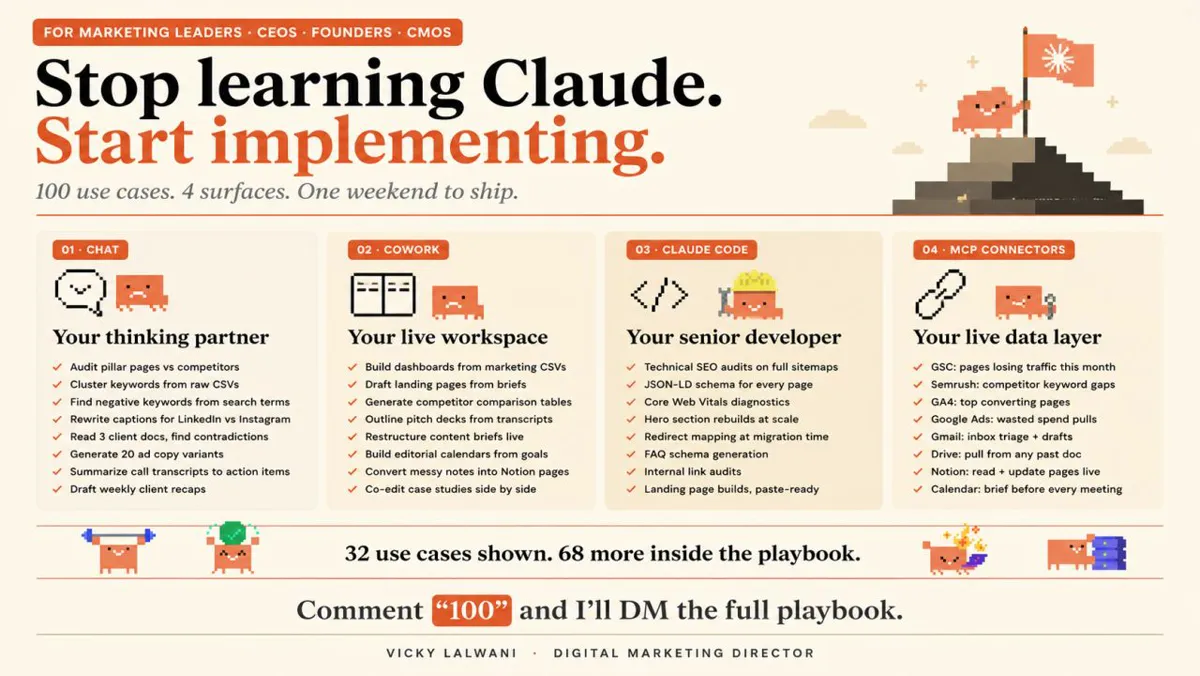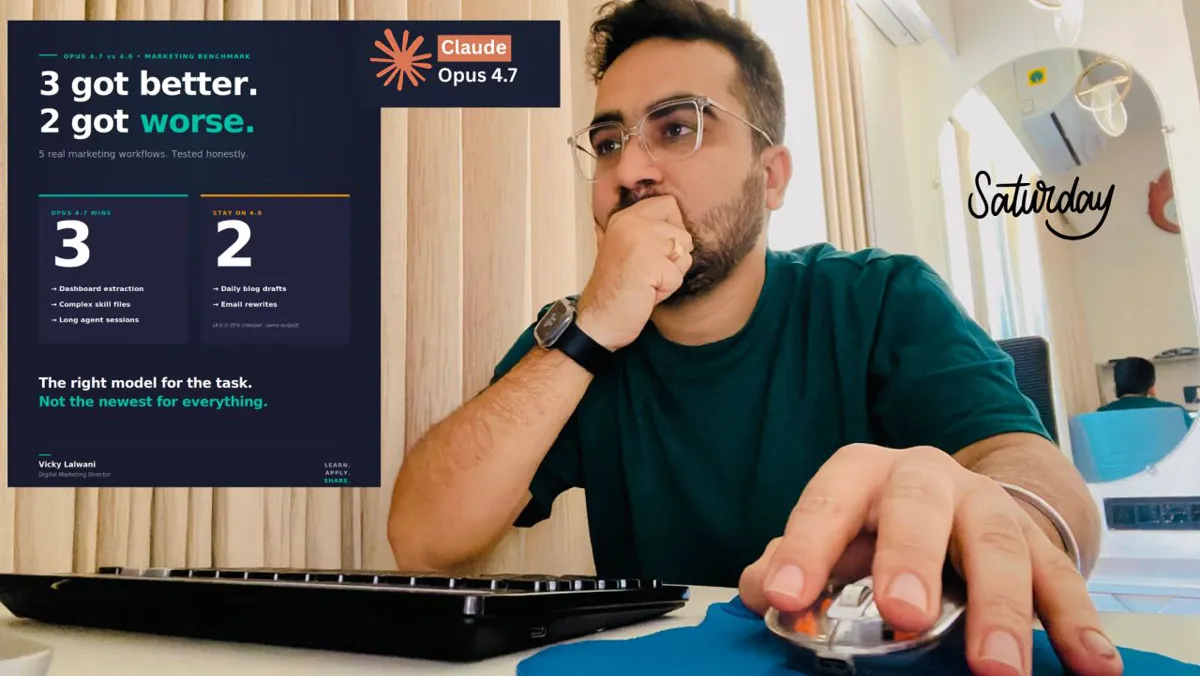
Claude training for marketing teams works best as a four-week curriculum rather than a one-off demo. Assign two free Claude Academy courses as pre-work (Claude 101 and AI Fluency), then run four weekly sessions on real work: foundations in a shared Project, judgement drills with planted errors, role tracks for SEO, PPC, content and reporting, and a shared skill plus a short skills check. One named person owns the curriculum.
TL;DR
Claude training for marketing teams works best as a short curriculum, not a one-off demo: four weekly sessions of 60 to 90 minutes, each with homework on real work, and a skills check at the end.
Anthropic's free courses do the foundations for you. Its course site, now called Claude Academy (it was Anthropic Academy), lists Claude 101 at 2.5 hours and AI Fluency: Framework and foundations at 4 hours, both with a completion badge.
Your sessions then cover what no course can: judging Claude's output on your own accounts, role tracks for SEO, PPC, content and reporting, and turning the best workflow into a shared skill.
Short answer: to train a marketing team on Claude, assign two free Claude Academy courses as pre-work, then run four weekly sessions: foundations in a shared Project, judgement (checking every number against its source), role tracks on each person's real weekly job, and finally a shared skill plus a short skills check. One person owns the curriculum and the skill library.
Most teams learn Claude the slow way. Everyone experiments alone, shares screenshots in chat and reinvents the same prompts, and three months later the best user knows ten times more than everyone else. Training fixes that, but only if it is planned like a curriculum with exercises and a pass mark, rather than a lunchtime demo. If you want the curriculum built and delivered for your team, that is part of my Claude consulting.
This page is the training plan. Two companion guides cover the rest: Claude for marketing teams is the rollout (plans, organisation instructions, shared Projects and connectors), and the Claude adoption framework describes eight levels of use, which is a handy way to place each person before training starts.
What should Claude training for a marketing team cover?
Short answer: four things, in this order: shared vocabulary (what Claude is, Projects, skills, connectors), judgement (when to use it and how to check it), role practice on each person's real work, and team habits (where work lives, who reviews what). Courses cover the first well; the other three need your accounts and your people.
A generic prompt workshop teaches people to get a nicer paragraph. What a marketing team actually needs is different: a PPC manager who can hand Claude a search terms report and catch the wrong total, an SEO lead who can brief a content draft without it inventing statistics, and a team lead who knows which work is allowed to leave the building without a human check.
| Module | Who teaches it | Outcome |
|---|---|---|
| Vocabulary | Claude Academy | Knows Projects, skills, connectors |
| Judgement | Your trainer | Checks every number |
| Role practice | Your trainer, live | One weekly job done with Claude |
| Team habits | The owner | Work in shared Projects, reviewed |
The order matters. People who skip the vocabulary waste session time asking where files go. People who skip judgement are the dangerous ones: they ship confident output nobody checked.
Is Anthropic Academy worth it for marketers?
Short answer: yes, as pre-work. Anthropic's course site was relaunched as Claude Academy on 20 August 2026; it is free, needs only a sign-in to save progress, and lists 29 courses. For marketers, Claude 101 (2.5 hours) and AI Fluency: Framework and foundations (4 hours) are the two to assign first.
The Claude account announced Claude Academy on 20 August 2026 as free and open to anyone. The old anthropic.com/learn address now redirects there, and the earlier Anthropic Academy catalogue still loads. When I read the course list on 18 November 2026 it had 29 courses, from Claude 101 to API and MCP courses for developers.
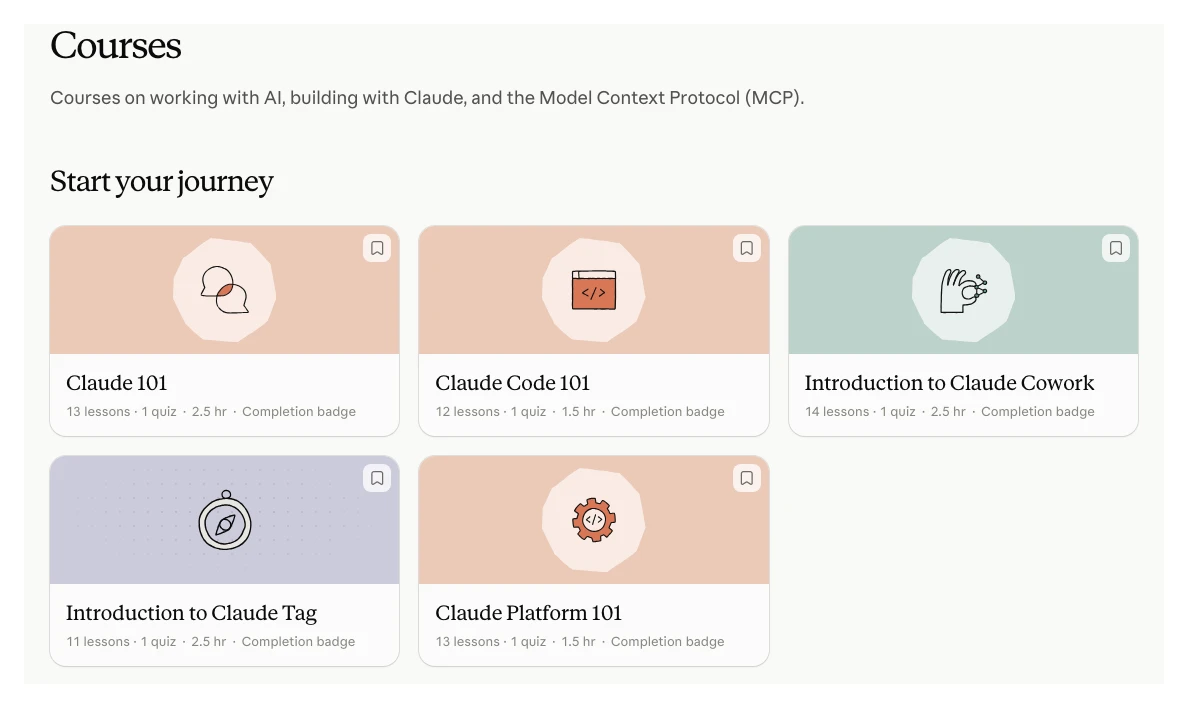
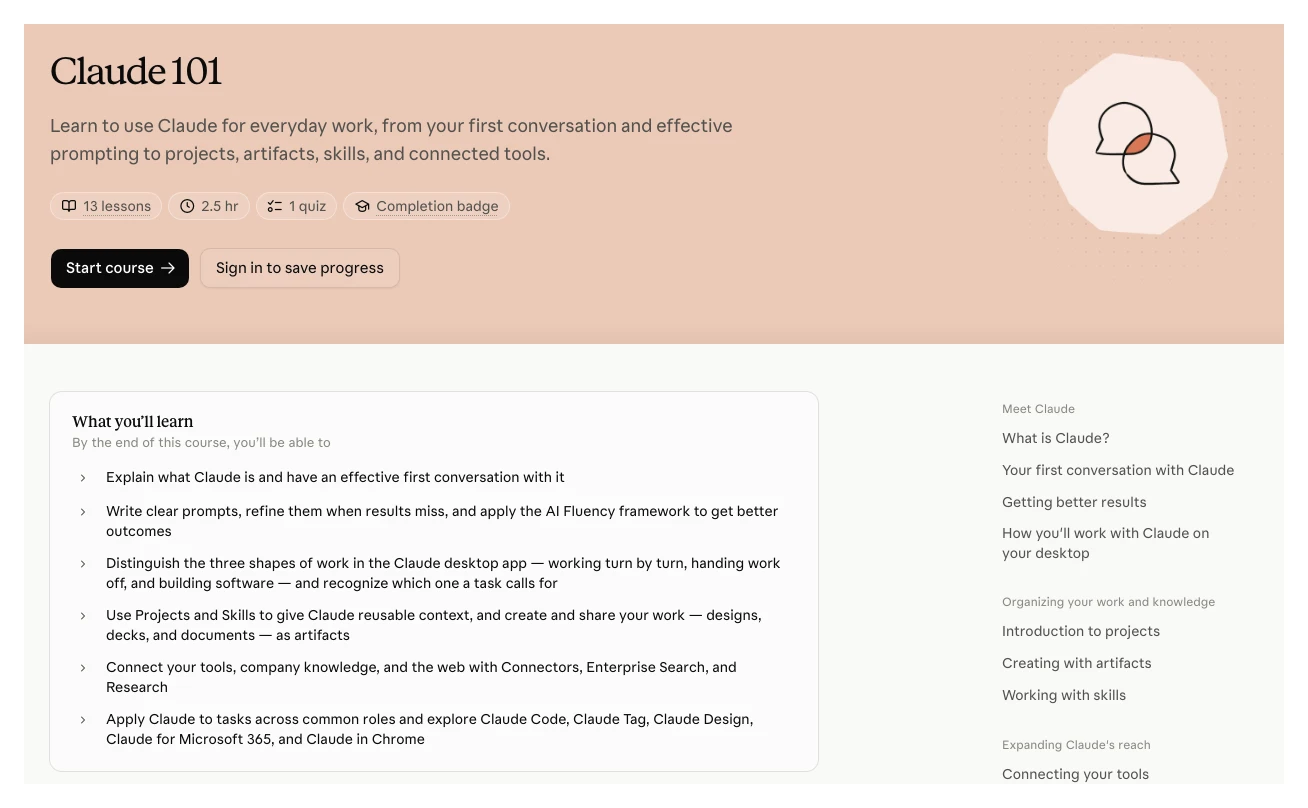
Claude 101 is the starting point. It has 13 lessons and a quiz, covers prompting, Projects, artifacts, skills and connectors, and ends with role-based use cases. Its page notes that it works on any plan, though a few lessons (Cowork, Research, Enterprise Search) need a paid or Team plan to try hands-on.
| Course | Hours | Assign to |
|---|---|---|
| Claude 101 | 2.5 | Everyone |
| AI Fluency: Framework and foundations | 4 | Everyone |
| AI capabilities and limitations | 3.5 | Heavy users |
| Introduction to Claude Cowork | 2.5 | Heavy users |
| Introduction to agent skills | 1 | The builder |
| Building effective human-agent teams | 0.75 | Team lead |
| Introduction to Claude Tag | 2.5 | Slack teams only |
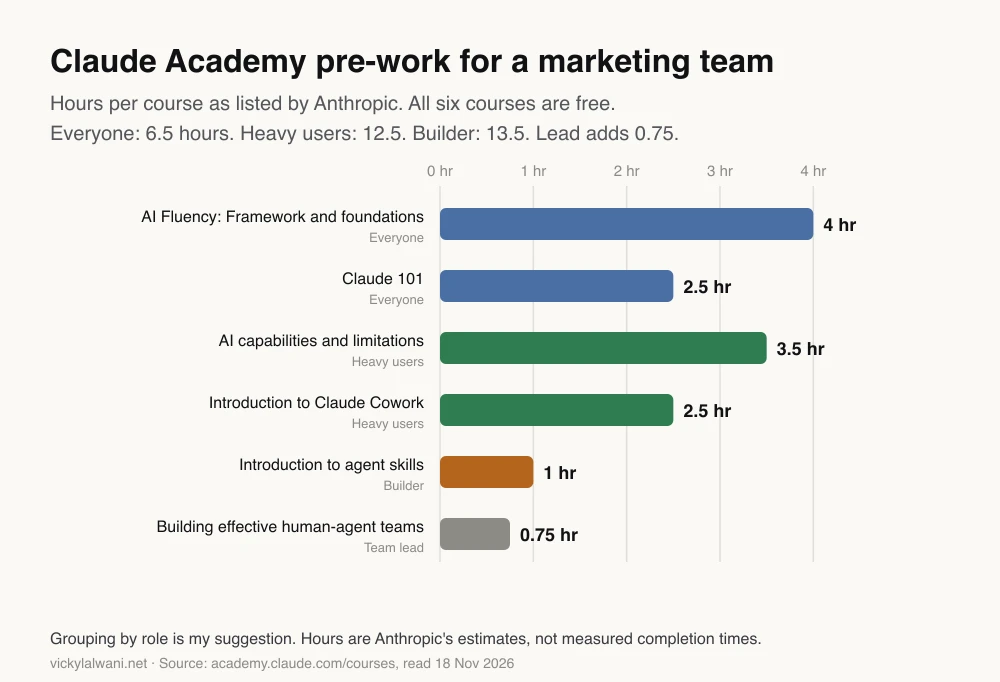
The sums: everyone does 2.5 plus 4, or 6.5 hours. Heavy users add 3.5 plus 2.5, for 12.5 hours. The person who builds skills adds the 1-hour skills course, for 13.5. The hours are Anthropic's estimates, so expect slower readers to take longer.
Two cautions. The Introduction to agent skills course teaches skills inside Claude Code and has no completion badge, so it suits your builder, not the whole team. And a completion badge proves someone finished the lessons, not that they can do the job. That is what the rest of the curriculum is for.
What does a four-week Claude training plan look like?
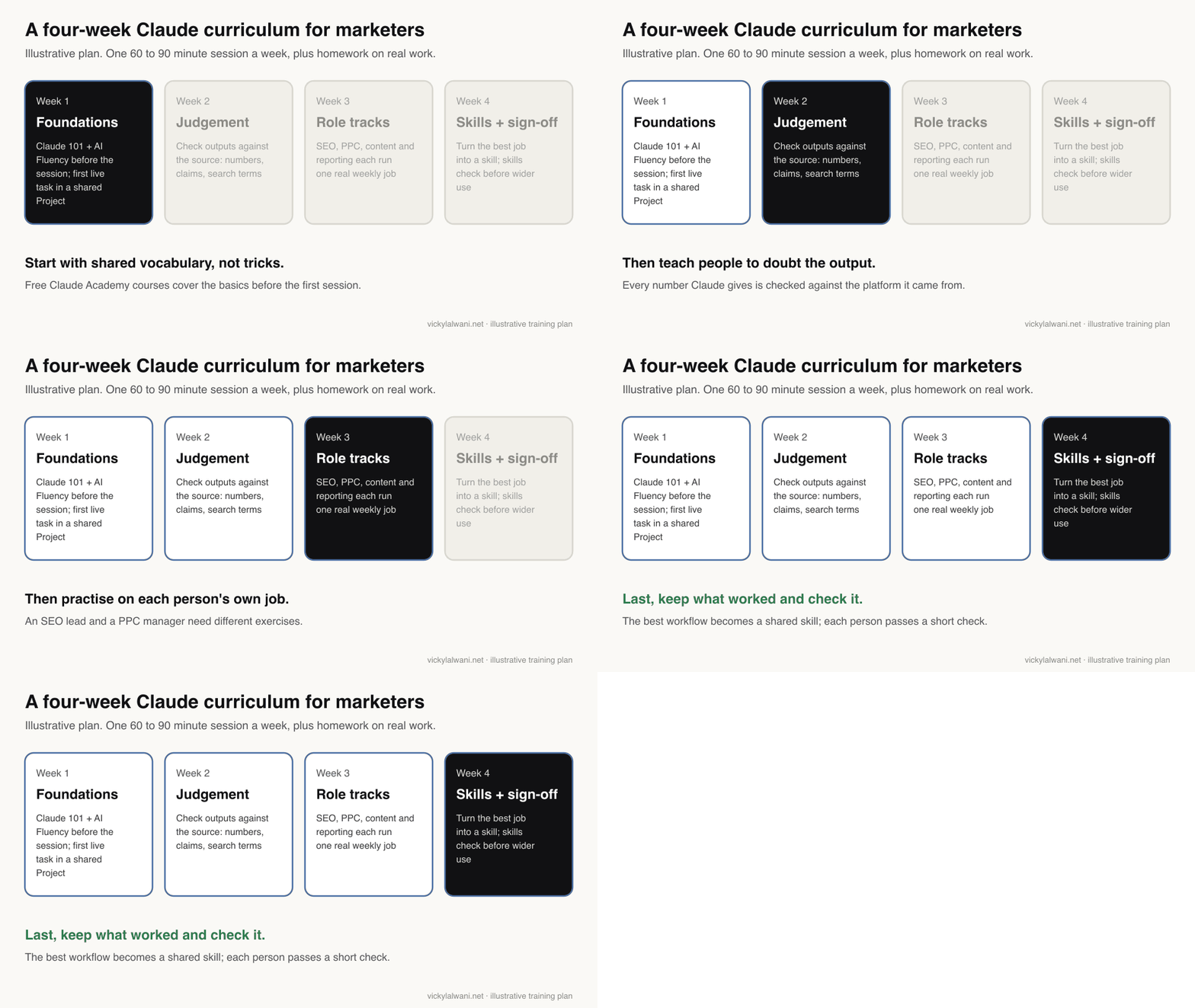
Short answer: week one is foundations in a shared Project, week two is judgement, week three is role tracks on real weekly jobs, and week four turns the best workflow into a shared skill and ends with a skills check. Each week is one 60 to 90 minute session plus homework done on live work, not toy examples.
| Week | Session | Homework |
|---|---|---|
| Before | None | Claude 101, AI Fluency |
| 1. Foundations | One task in a shared Project | Move one weekly task into it |
| 2. Judgement | Find the errors in an output | Check three outputs against source |
| 3. Role tracks | Split by role, live work | Run your job with Claude twice |
| 4. Skills | Turn the best job into a skill | Pass the skills check |
The format I use when I teach someone one to one carries over to a group. I show my own working session, messy prompts and all, rather than a tidy tutorial, so people see that loose, plain-language requests are fine. New tools are tried on a throwaway test site or a copy of a report first, never on a live client account. And people keep going in the same thread so Claude keeps the context, instead of starting a fresh chat every time something goes wrong.
Week 1: foundations
Before the session, everyone finishes Claude 101 and the AI Fluency course. In the session, the trainer opens a shared Project for one real client or brand, with the brief, brand guide and last month's report loaded, and the group does one task together. Shared Projects are available on Team and Enterprise plans, and members get Can view or Can edit access. If the rollout is not done yet, do that first; the order is in Claude for marketing teams.
You are working inside the [client] Project. Read the brief and last month's report in the Project files.
Then list the five numbers that matter most for this client, where each one comes from, and one question you would ask the client about each. Do not invent any number that is not in the files.
Week 2: judgement
This is the week most training skips, and the one that prevents the expensive mistakes. The trainer hands out an output with planted errors, a wrong total, a made-up statistic, a keyword that does not exist in the report, and people find them. The habit to build: every number Claude gives is checked against the platform or file it came from.
I teach this one from experience. An agent-built Google Ads plan once went to a reviewer without a human check, and its search volumes were far too low. The first question back was what had been added by a person. Since then, every plan gets a person's check and a short human note before it goes anywhere.
Week 3: role tracks
Split the group by job. Each person brings one task they do every week and runs it with Claude twice, comparing the result with their usual version. The tracks are in the next section.
Week 4: skills and sign-off
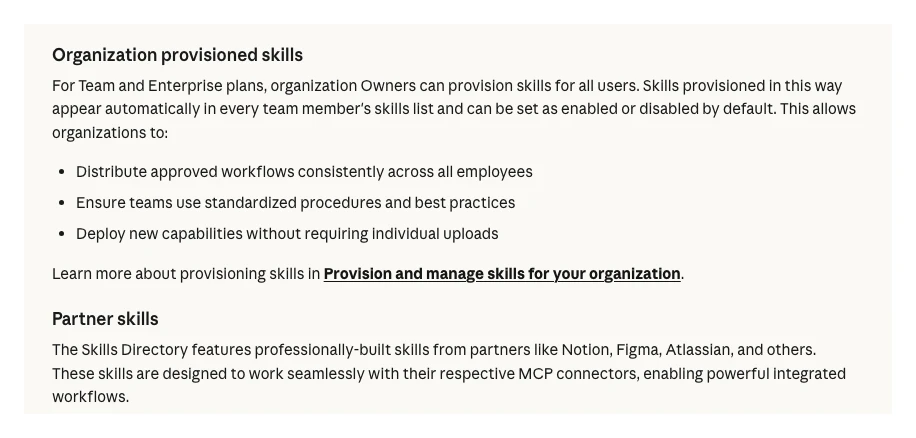
The best workflow from week three becomes a skill: a saved set of instructions Claude loads when a request matches. On Team and Enterprise plans, organisation Owners can provision skills so they appear in every member's skills list. Then everyone sits the skills check described further down.
What should SEO, PPC and content people practise?
Short answer: each role practises the job it already does every week. SEO people brief and check content against Search Console data, PPC people group and review search terms without letting Claude decide exclusions, content people draft from evidence in the brand voice, and whoever reports turns raw exports into a summary a client can act on.
| Role | Exercise | The check |
|---|---|---|
| SEO | Quick-win pages from a Search Console export | Positions match the export |
| PPC | Group search terms by theme | A person picks negatives |
| Content | Draft from a brief and real sources | Every claim has a source |
| Reporting | Monthly summary from exports | Totals match the platform |
| Team lead | Review three outputs from the team | Catches the planted error |
For the SEO track, Claude skills for SEO has a weekly routine worth copying. For PPC, Claude skills for Google Ads covers the same for paid search. A starter prompt for the PPC exercise:
Here is last week's search terms report as a CSV.
1. Group the terms into themes and show clicks, cost and conversions per theme.
2. Flag terms that look irrelevant to [service], with your reason.
3. Do not recommend exclusions. I decide those.
4. At the end, give the total cost of all rows so I can check it against the platform.
The last line is deliberate. A practitioner on r/PPC who has run Claude against ad accounts for about a year put the warning bluntly: do not let it do maths, because it will state a wrong ROAS with confidence. Asking for a total you can check is the cheapest guard.
For content, the common failure is tone. I once saw a skill built for writing offers end up writing website pages, and the pages read like adverts. The fix was a separate skill for pages, which is why training should show people which skill a job should use. Training Claude on your writing style covers the voice side, and the Claude prompting framework gives the team one shared way to write briefs.
How do you teach judgement, not just prompts?
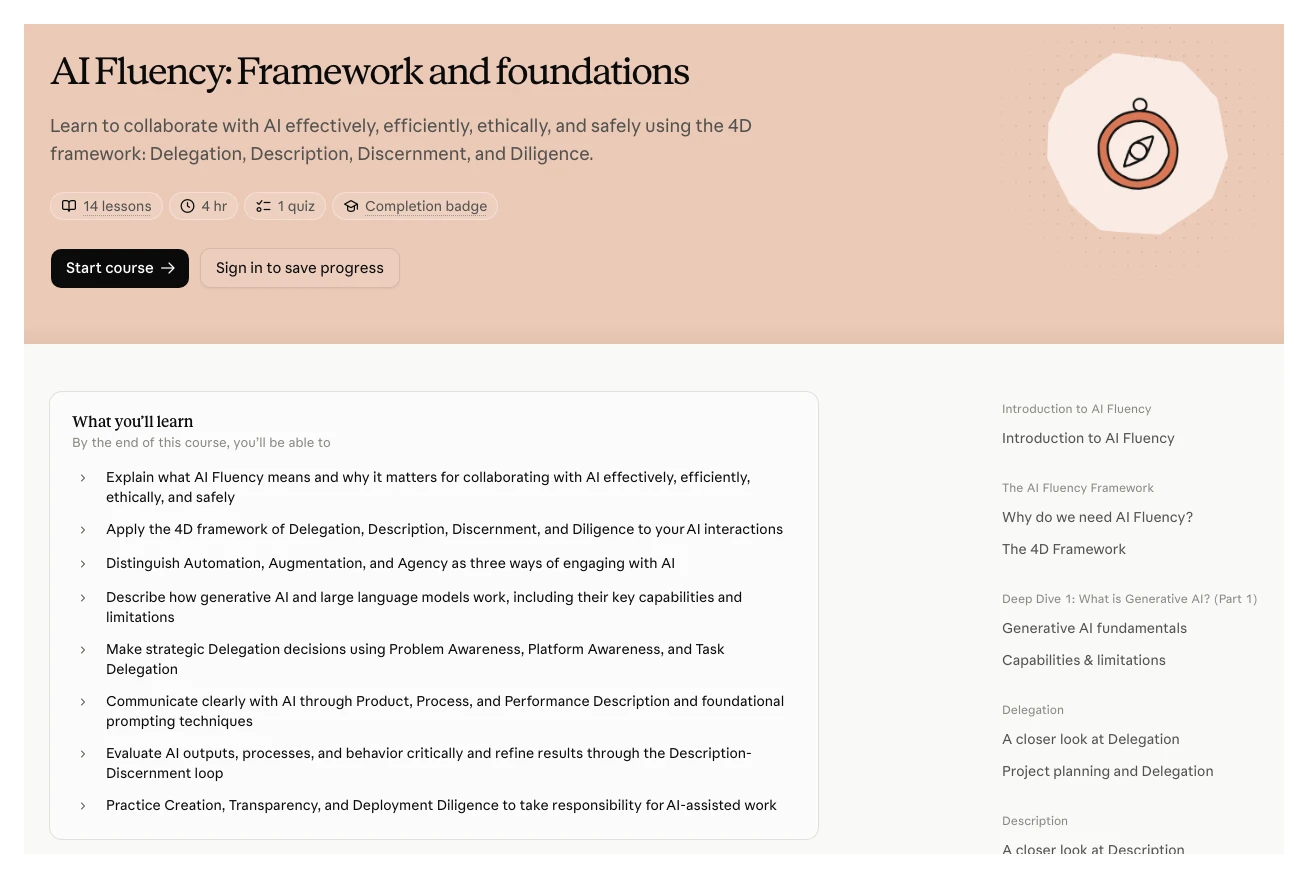
Short answer: use the four habits from Anthropic's AI Fluency course, Delegation, Description, Discernment and Diligence, on your own tasks. Decide what Claude should do, describe what good looks like, check the output against the source, and take responsibility for what ships.
The AI Fluency course was built with two university professors who developed the framework, and it is 14 lessons and about 4 hours. It also names three ways of working with AI: automation, augmentation and agency. That gives a team a common language for a question that otherwise turns into an argument: should Claude do this, help with this, or not touch it?
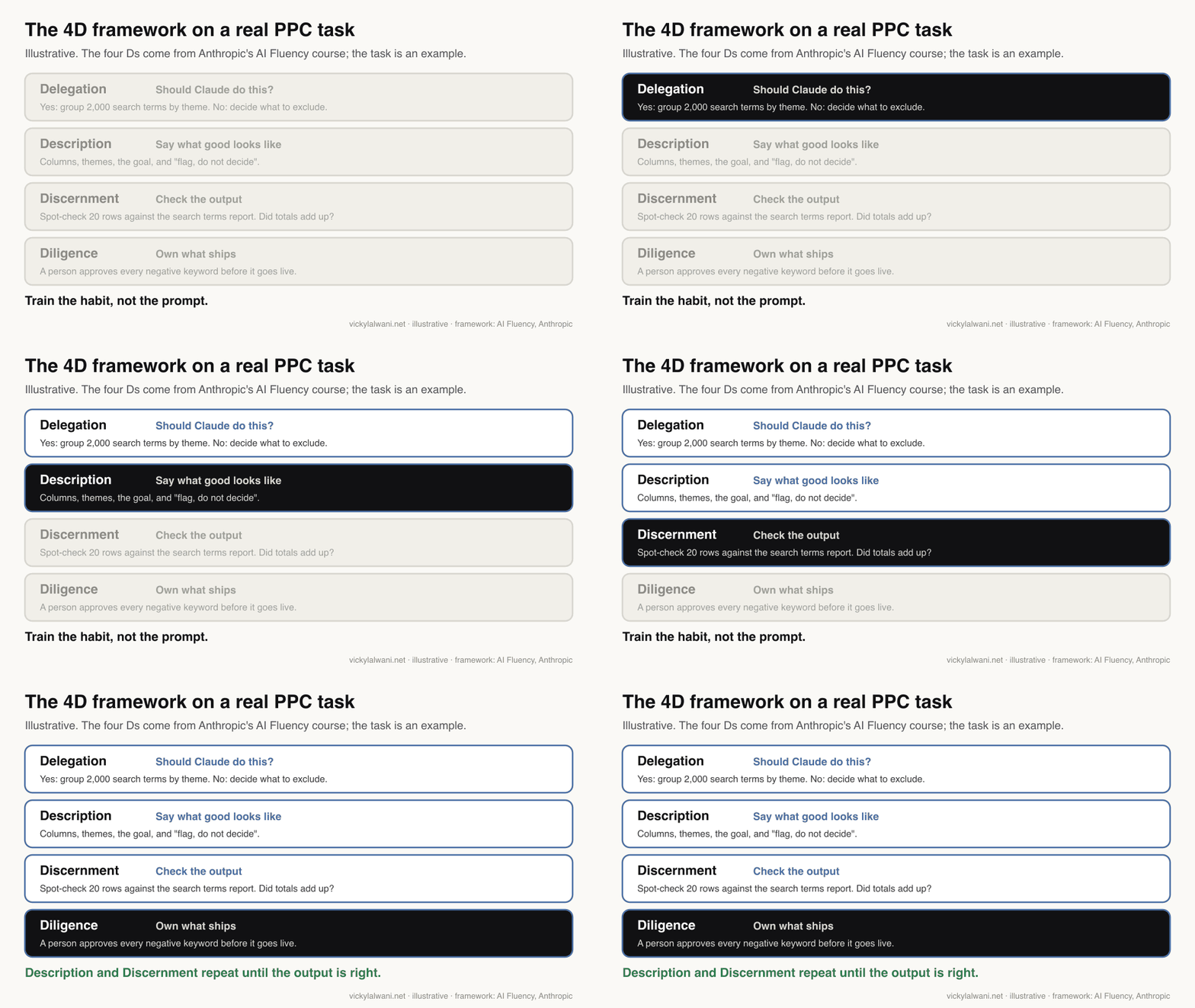
| Habit | Question | Marketing example |
|---|---|---|
| Delegation | Should Claude do this? | Grouping terms, yes; budgets, no |
| Description | What does good look like? | Columns, goal, what not to decide |
| Discernment | Is the output right? | Totals match the platform |
| Diligence | Who owns what ships? | A person approves changes |
In practice I teach Discernment with planted errors, Description by having two people brief the same task and comparing results, and Diligence by agreeing who approves what before anyone needs to. Nothing goes live, to a client or into an ad account, without that approval.
Who should run Claude training in a marketing team?
Short answer: one named person, the builder, who owns the curriculum, the shared Projects and the skill library. They need marketing judgement more than technical skill. On Team plans, the Owner role controls skills, connectors and usage analytics, so the builder is usually an Owner or works closely with one.
Training without an owner decays within a month. The builder keeps the exercises current, retires skills that stopped working, and is the person others ask before they reach for a new tool. Anthropic's course list has an admin course for larger rollouts, Deploying Claude Enterprise with confidence (2.5 hours), and a 45-minute course for leads on building effective human-agent teams.
- Builder: owns skills and Projects, writes the exercises, runs week four.
- Team lead: sets the review rules and joins week two.
- Everyone else: does the pre-work, brings real tasks, passes the check.
When someone says Claude "will not connect" to a tool, check access and permissions before rewriting the prompt. When I coached a colleague through exactly this, the cause was a browser permission, not the wording. Connectors are enabled by an Owner, each person still signs in individually, and every tool can be set to Always allow, Needs approval or Blocked.
How do you know the training worked?
Short answer: two ways. A skills check per person (can they do their weekly job with Claude and catch a planted error?) and the usage analytics on Team and Enterprise plans, which show adoption level, skill use and estimated time saved. Badges and attendance alone tell you little.
| Check | Pass looks like |
|---|---|
| Weekly job with Claude | Done, reviewed, used |
| Planted error | Found without a hint |
| Brief from scratch | Output usable first or second try |
| Uses the shared skill | Same format as the team |
| Knows what not to delegate | Names two examples |
For the team view, usage analytics are available to Team plan Owners and Primary Owners. They include weekly active members, adoption level, skills with number of uses, connectors with read and write actions, and estimated time saved. Look again a month after training ends: if skill use has dropped back to one or two people, the habit did not stick and week three needs repeating. To place people on a longer ladder, use the eight levels in the Claude adoption framework.
What mistakes do teams make with Claude training?
Short answer: teaching tricks instead of judgement, training on toy examples instead of real work, skipping the review rules, letting everyone build private prompts instead of shared skills, and treating a course badge as proof of skill.
- One big demo. Enthusiasm lasts a week. Four short sessions with homework last longer.
- Toy tasks. People practise on a made-up brand, then freeze on a real account. Use live, low-risk work.
- No planted errors. If nobody ever catches a mistake in training, they will not catch one in production.
- Private prompts. The best prompt stays in one person's chat history. Turn it into a provisioned skill.
- Outdated material. Claude changes monthly. Chat and Cowork merged into one Claude, reaching Team plans on 12 November 2026 per Anthropic's announcement, so older tutorials show tabs that no longer exist.
What people say on X and Reddit
Short answer: people who took Anthropic's courses call them a good, free starting point that only sticks once you apply them to a real task. Teams that made Claude work describe onboarding it like a colleague, with rules, access and written playbooks.
| Who | What they said | Take it as | Link |
|---|---|---|---|
| Claude on X, 20 Aug 2026 | Claude Academy is live, free and open to anyone | Vendor | Post |
| Claude on X, 30 Jan 2026 | Plugins bundle skills and connectors for a role or team | Vendor | Post |
| A performance marketer at Anthropic, 24 Mar 2026 | Paid search workflows encoded as skills in a plugin | First-hand | Post |
| A marketing educator on X, 9 Feb 2026 | Confusion between chat, Cowork and Code | Opinion | Post |
| A writer and creator on X, 15 Nov 2026 | Treat each Project like a dedicated employee | Opinion | Post |
| r/ClaudeAI, 22 Oct 2026 | Beginner asks for a course; replies say build one small project per topic | Opinion | Thread |
| r/marketing, 5 Aug 2026 | A brand manager just got Claude at work and asks how marketers use it | Question | Thread |
| r/AI_Agents, 13 Nov 2026 | Team onboarded Claude in three layers: rules, access, playbooks | First-hand, vendor | Thread |
| r/PPC, 14 Apr 2026 | Compliance built an ad copy review skill; reply warns not to trust its maths | First-hand | Thread |
The r/AI_Agents post is the closest to this page. Its author, from an AI services firm, describes a marketing team where everyone used AI alone until the company onboarded Claude "like a new teammate": rules such as "take numbers only from named sources", connector access, and written playbooks. It is one firm's account and the firm sells AI work, but it matches the order of this curriculum. The r/ClaudeAI thread makes the training point well: a reply suggests skipping the hunt for one perfect course and building one small project per topic, because Claude's tools change faster than most paid courses.
Videos worth watching
Short answer: Anthropic's own videos are the best free training material, because they show the current product and sell nothing else. Use them as pre-work or to open a session.
Made by Anthropic on 12 June 2025 for the first version of the AI Fluency course. It sells only the free course and is a good two-minute opener for week two.
Made by Anthropic on 2 December 2025. A short walk through the basics for anyone who has not opened Claude before week one.
| Video | Channel | Date | What it covers |
|---|---|---|---|
| A closer look at Discernment | Anthropic | 12 Jun 2025 | Checking AI output |
| Getting started with projects | Anthropic | 2 Dec 2025 | Projects basics |
| What are skills? | Claude (Anthropic) | 26 Feb 2026 | Skills explained |
| Cowork and chat are now one Claude | Claude (Anthropic) | 16 Sep 2026 | The merge |
| How to share Claude skills across your team | An independent creator | 22 Jun 2026 | Sharing skills |
Where this advice is weak
Short answer: the four-week plan is a template, not a measured result; course hours are Anthropic's estimates; and Claude's features change often enough that any curriculum needs a monthly review.
- The curriculum is how I would sequence it. A team that already uses shared Projects can compress weeks one and two.
- Course lists and hours are from academy.claude.com on 18 November 2026 and will change.
- Usage analytics show activity, not quality. A busy dashboard can hide outputs nobody checks.
- Some lessons need a paid or Team plan to try hands-on, so a team on free accounts will hit gaps.
- The social evidence is a handful of self-selected posts, one from a vendor.
Want your team trained on Claude?
Short answer: I build and run this curriculum for marketing teams: the shared Projects, the role exercises from your own accounts, the first skills and the skills check. That is part of my Claude consulting service.
My rates are on the pricing page. If your team has not rolled Claude out yet, start with Claude for marketing teams; if it has, use the adoption framework to see where each person sits before week one.
Sources
| Source | What it supports | Date | Link |
|---|---|---|---|
| Claude Academy courses | 29 courses, hours, badges | Read 18 Nov 2026 | Open |
| Claude 101 course page | Lessons, plan requirements | Read 18 Nov 2026 | Open |
| AI Fluency course page | 4D framework, 14 lessons | Read 18 Nov 2026 | Open |
| Introduction to agent skills | Claude Code focus, no badge | Read 18 Nov 2026 | Open |
| Anthropic Academy on Skilljar | Earlier course catalogue | Read 18 Nov 2026 | Open |
| Claude on X | Claude Academy launch | 20 Aug 2026 | Open |
| Claude Help: skills | Owners provision skills | Read 18 Nov 2026 | Open |
| Claude Help: project sharing | Can view, Can edit | Read 18 Nov 2026 | Open |
| Claude Help: connectors | Owner enables, user signs in, permissions | Read 18 Nov 2026 | Open |
| Claude Help: usage analytics | Metrics for Owners | Read 18 Nov 2026 | Open |
| Anthropic: Cowork is now Claude | Merge reached Team 12 Nov | Read 18 Nov 2026 | Open |
| Reddit and X posts | What people report | See table above | Linked above |
This article expands on my post on LinkedIn ↗.
FAQ
What should Claude training for a marketing team include?
Claude training for a marketing team should cover four things: shared vocabulary (Projects, skills, connectors), judgement about what to delegate and how to check it, practice on each person's real weekly work, and team habits such as review rules. Free courses handle the vocabulary; the rest needs your own accounts.
Is Anthropic Academy free?
Yes. Anthropic's course site, relaunched as Claude Academy at academy.claude.com on 20 August 2026, offers its courses and tutorials free. You sign in only to save progress, and most courses end with a quiz and a completion badge.
Which Claude Academy course should marketers take first?
Start with Claude 101 (13 lessons, about 2.5 hours), then AI Fluency: Framework and foundations (14 lessons, about 4 hours). Heavy users can add Introduction to Claude Cowork and AI capabilities and limitations.
How long does Claude training take for a marketing team?
A practical plan is about four weeks: 6.5 hours of free course pre-work per person, then one 60 to 90 minute session a week with homework on real tasks. Heavy users and the person who builds skills need a few more hours of courses.
Do marketers need technical skills to learn Claude?
No. Claude 101 and the AI Fluency course need no coding, and Introduction to Claude Cowork says no command-line experience is needed. Only the person who builds skills in Claude Code benefits from a more technical course.
Should SEO and PPC people get different Claude training?
Yes, after the shared foundations. SEO people should practise briefing and checking content against Search Console data, and PPC people should practise grouping search terms while keeping exclusion decisions and budget changes with a person.
How do you know if Claude training worked?
Give each person a skills check: do their weekly job with Claude, find a planted error and brief a task from scratch. On Team and Enterprise plans, Owners can also see adoption level, skill use and estimated time saved in usage analytics.
Do Claude Academy courses give a certificate?
Most Claude Academy courses end with a quiz and a completion badge, but not all; Introduction to agent skills has none. A badge shows someone finished the lessons, not that they can do the job, so pair it with your own skills check.
Who should run Claude training in a marketing team?
One named person who owns the curriculum, the shared Projects and the skill library. They need marketing judgement more than technical skill, and on a Team plan they are usually an Owner or work closely with one.