Claude marketing skills work best as a small library organised by job: one SKILL.md per repeat task, with a specific description, fixed inputs and output, three to five test requests, an owner and a version. Load skills in role bundles, keep anything that touches an account as a draft for approval, and read every public skill before installing it.
TL;DR
Claude marketing skills work best as a small library organised by job, not a folder of clever prompts. Below are 19 skill files across six jobs (SEO, Google Ads, paid social, content, conversion and reporting), each with its trigger, input and output, plus a copy-paste SKILL.md template.
The parts most libraries skip are the ones Anthropic's own guidance stresses: specific descriptions so the right skill fires, three to five test requests per skill, an owner and version for each file, and role bundles so nobody loads every skill at once.
This page does not repeat installation. For setup, see the guides to Claude skills for SEO and for Google Ads linked below.
Short answer: a marketing skill library is a set of SKILL.md files, one per repeat job, that Claude loads when a request matches. Name each skill for one job, say in its description when to use it and when not to, give it the inputs it needs and a fixed output, test it with real requests, and keep anything that changes an account as a draft for approval.
Most teams reach the same point. Someone writes a good prompt for the weekly search terms review, someone else writes a better one for monthly reports, and six months later there are forty prompts in a shared document, half of them out of date, and nobody knows which one produced last month's numbers. Skills fix the storage problem. They do not fix the library problem on their own.
This guide is about the library: what to put in it, how to write each file and how to keep it trustworthy. Installation is covered elsewhere: Claude skills for SEO walks through setup and a weekly SEO routine, and Claude skills for Google Ads does the same for paid search. If you want a library like this built and tested for your team, that is what my Claude consultant work covers.
Every product fact below was checked against Anthropic's Agent Skills documentation and the Claude Help Center on 18 November 2026.
What is a Claude marketing skill library?
Short answer: it is a set of skill folders, each holding a SKILL.md file with a name, a description and instructions for one marketing job. Claude keeps only the names and descriptions in view, about 100 tokens per skill, and reads the full file when a request matches.
Anthropic's Agent Skills overview describes three levels: the name and description load at startup, the SKILL.md body (under 5,000 tokens) loads when the skill is triggered, and extra reference files load only when Claude needs them. That is why a library can hold many skills without crowding every chat.
Skills are one of four places marketing knowledge can live, and mixing them up is the most common reason a library feels messy.
| Where | Holds | Loads | Example |
|---|---|---|---|
| Prompt | One task, once | When you send it | "Summarise this call" |
| Project or CLAUDE.md | Standing facts | Every chat or session | Offer, audience, banned claims |
| Skill | A repeatable method | When a request matches | Weekly search terms review |
| Connector | Access to data | When a tool is called | Read-only ad account data |
Standing facts belong in a project or CLAUDE.md file, covered in the CLAUDE.md guide for marketing teams. How to write the prompt that becomes a skill is covered in the Claude prompting framework.
Which skills belong in a marketing library?
Short answer: one skill per job you repeat weekly or monthly, grouped by function. Start with the jobs where a mistake is cheap to catch and the format never changes, such as search term reviews and monthly reports, and keep every skill that touches money in draft mode.
The overview below shows the six jobs and what each group is allowed to do. "Reads" means it only analyses; "Drafts" means it produces something a person approves before it goes anywhere. None of these skills changes an account on its own.
| Job | Skills | Mode |
|---|---|---|
| SEO | 5 | Reads, drafts |
| Google Ads | 4 | Reads, drafts |
| Paid social | 2 | Reads, drafts |
| Content | 3 | Drafts |
| Conversion | 2 | Reads |
| Analytics and reporting | 3 | Reads, drafts |
Public skill authors lean heavily towards some of these jobs. A GitHub code search on 18 November 2026 found about 7.8 million files named SKILL.md, and the terms below show which marketing jobs they mention most. The counts are rough: a file that mentions "seo" once is counted, and web developers write about SEO and landing pages too.
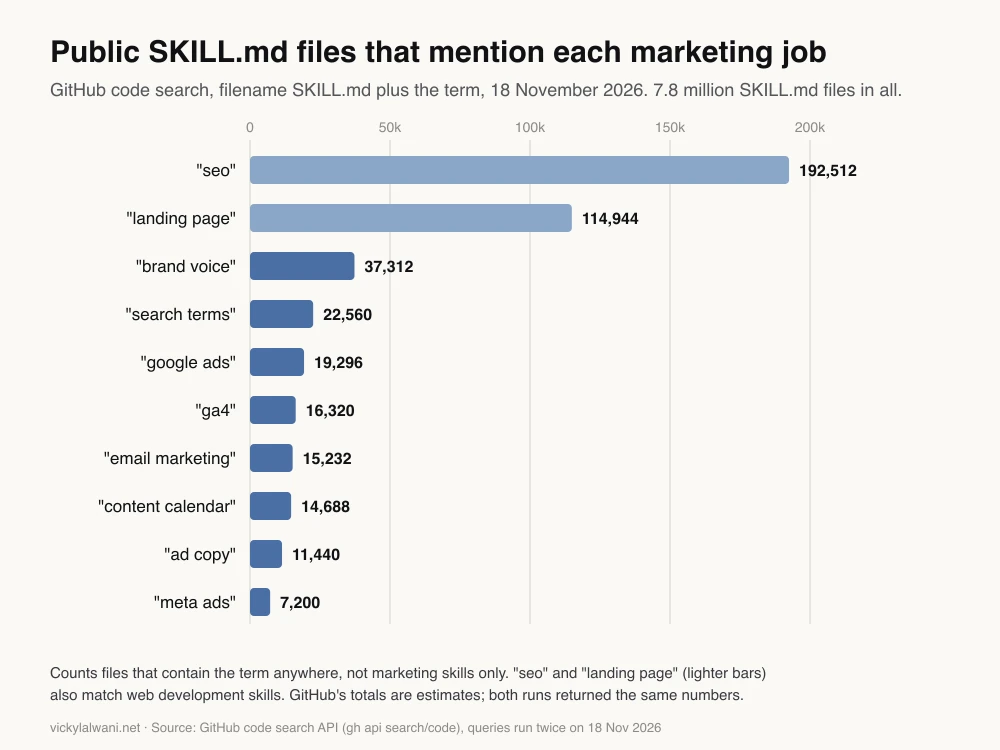
Brand voice outnumbers every paid media term in that search, which matches what you see in public collections: plenty of writing skills, far fewer for the dull, high-value jobs like search term reviews and tracking checks. Those dull jobs are where a library earns its keep.
SEO skills
| Skill | Use when | Needs | Gives |
|---|---|---|---|
| auditing-technical-seo | Monthly or after a release | Crawler export | Ranked fix list |
| clustering-keywords | Planning pages | Keyword export with volumes | Clusters mapped to pages |
| writing-content-briefs | New page or refresh | Query, top results notes | Outline, FAQs, links |
| rewriting-title-tags | Pages rank, few clicks | Search Console export | Title table for approval |
| checking-schema | Before publishing | Page HTML | Issues, draft markup |
Google Ads skills
| Skill | Use when | Needs | Gives |
|---|---|---|---|
| reviewing-search-terms | Weekly | Search terms export | Draft negatives table |
| writing-rsa-copy | New ad or refresh | Offer, proof, keywords | 15 headlines, 4 descriptions |
| pacing-budgets | Mid-month | Spend and plan | Over and under flags |
| checking-conversion-tracking | Before scaling | Conversion actions list | Broken or duplicate actions |
Paid social skills
| Skill | Use when | Needs | Gives |
|---|---|---|---|
| briefing-ad-creative | New creative round | Offer, audience, past winners | Concept briefs |
| reading-ad-breakdowns | Weekly | Breakdown export | Fatigue and placement notes |
Content skills
| Skill | Use when | Needs | Gives |
|---|---|---|---|
| drafting-in-brand-voice | Any long draft | Voice samples, banned words | Draft plus self-check |
| repurposing-content | After publishing | Finished article | Posts, email, snippets |
| building-case-studies | After a project | Notes, approved figures | Draft with claims flagged |
Conversion skills
| Skill | Use when | Needs | Gives |
|---|---|---|---|
| auditing-landing-pages | Page gets paid traffic | URL or screenshot | Message match, friction list |
| reading-ab-tests | A test ends | Results per variant | Decision note, maths by script |
Analytics and reporting skills
| Skill | Use when | Needs | Gives |
|---|---|---|---|
| naming-utms | New campaign | Campaign plan | UTM table to your rules |
| checking-ga4-events | After a site change | Event list, test notes | Missing or duplicate events |
| writing-monthly-reports | Month end | Platform exports | One-page summary, next steps |
Two notes on the list. The A/B test skill should run its statistics in code rather than in prose, because Anthropic's best practices recommend scripts where a task needs exact, repeatable steps. And the brand voice skill depends on good samples, which is a guide of its own: how to train Claude on your writing style.
Is there a SKILL.md template for marketing skills?
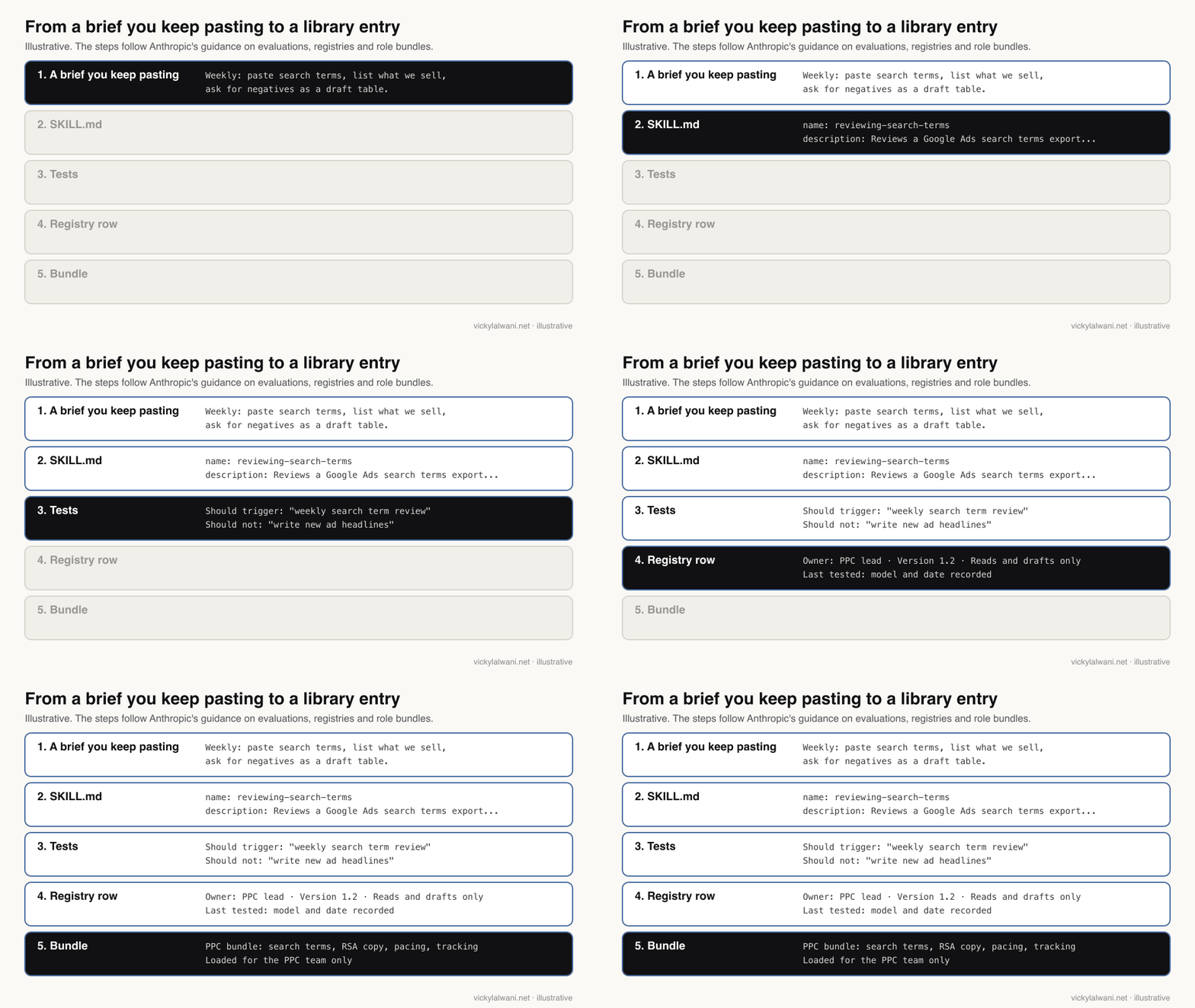
Short answer: yes. Every skill needs YAML front matter with a name and a description, then plain sections for when to use it, inputs, steps, output, checks and limits. Keep the body under 500 lines and move long reference material into separate files in the same folder.
The template below is the search terms skill from the library, written out in full. Copy it, then change the name, the description and the sections for your own job.
---
name: reviewing-search-terms
description: Reviews a Google Ads search terms export and drafts negative keywords for approval. Use for weekly search term reviews or when wasted spend on irrelevant searches comes up.
---

# Reviewing search terms

## When to use
- Weekly review, or after a new campaign has run for a week.
- Not for writing ads or choosing new keywords.

## Inputs
- Search terms export: term, match type, campaign, cost, clicks, conversions.
- offer.md in this folder: what we sell and do not sell.
If either is missing, ask for it. Do not guess.

## Steps
1. Group the terms by theme.
2. Mark themes we cannot serve, using offer.md.
3. Leave any term that converted alone.
4. Draft negatives with match type and level (campaign or account).
5. List plural and synonym forms separately: Google negatives
   do not match close variants.

## Output
Table: negative keyword | match type | level | terms it blocks | reason.
Then a short list of terms you are unsure about.

## Checks before you finish
- Every negative maps to at least one term in the export.
- No negative blocks a term with a conversion.

## Limits
- Output is a draft for approval. Ask before changing anything in the account.
- See examples/good-output.md for a reviewed example.
The folder that holds it stays small:
reviewing-search-terms/
  SKILL.md                 the method above
  offer.md                 what we sell and do not sell
  examples/good-output.md  one reviewed output
  tests.md                 the test requests (see below)
The field rules come from Anthropic's docs and the Help Center. They differ slightly between surfaces, so write to the stricter one.
| Field | Rule | Source |
|---|---|---|
| name | 64 characters, lowercase, numbers, hyphens | Developer docs |
| name | No "anthropic" or "claude" | Developer docs |
| description | 200 characters in the Claude apps | Help Center |
| description | 1,024 characters in the API | Developer docs |
| Body | Under 500 lines | Best practices |
Anthropic's skill authoring best practices also suggest gerund names (reviewing-search-terms rather than search-terms-helper), one default method instead of a menu of options, and no dates in the instructions that will go stale: keep old methods in a separate "old patterns" note.
How do you write descriptions so the right skill fires?
Short answer: write each description in the third person, say what the skill does and when to use it, and use the words your team actually types. The description is the only part Claude sees before choosing a skill, so a vague one either fires on the wrong requests or never fires.
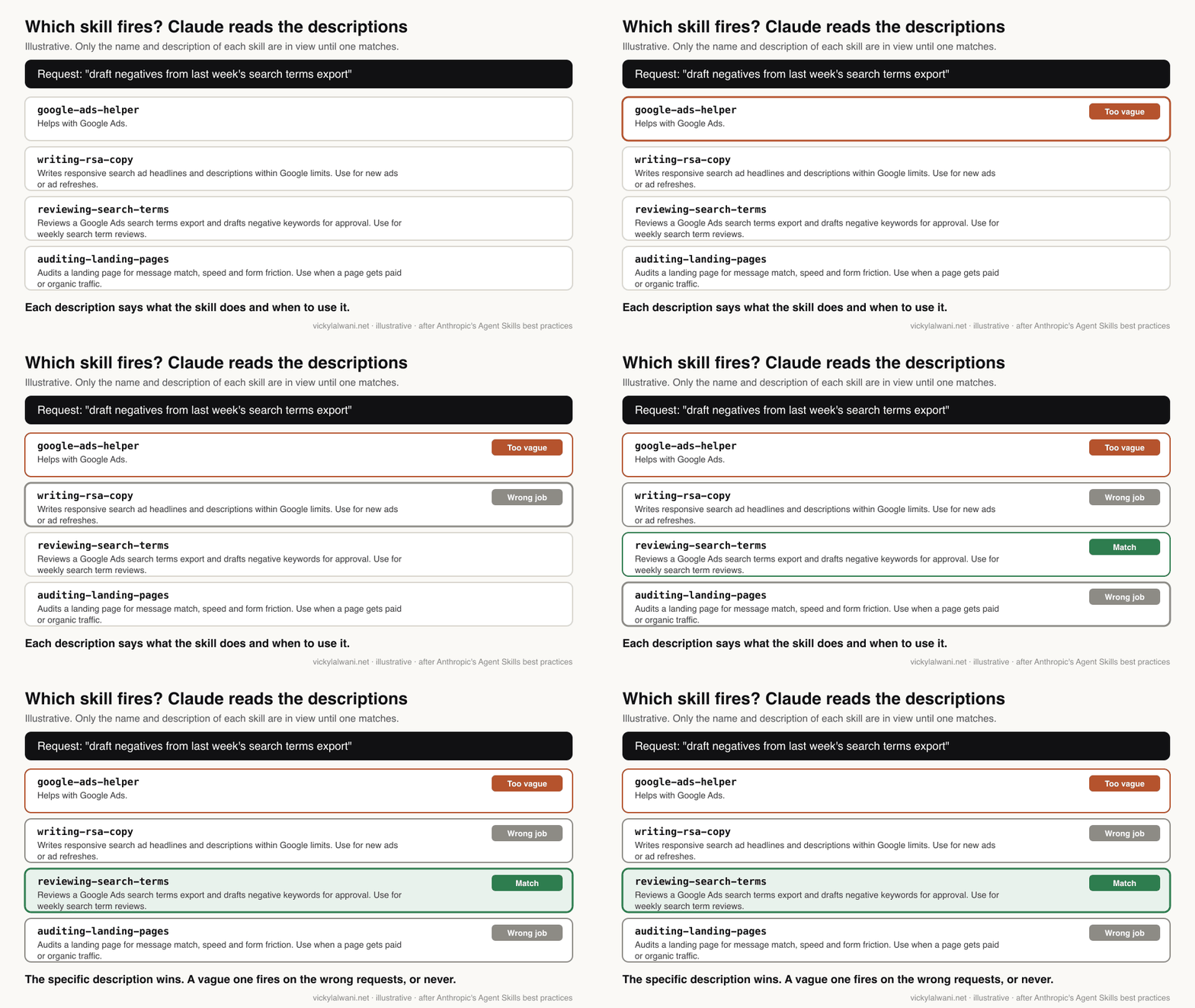
Anthropic says Claude uses the description to choose "from potentially 100+ available Skills", and warns that first or second person ("I can help you...") can cause discovery problems because the description is injected into the system prompt.
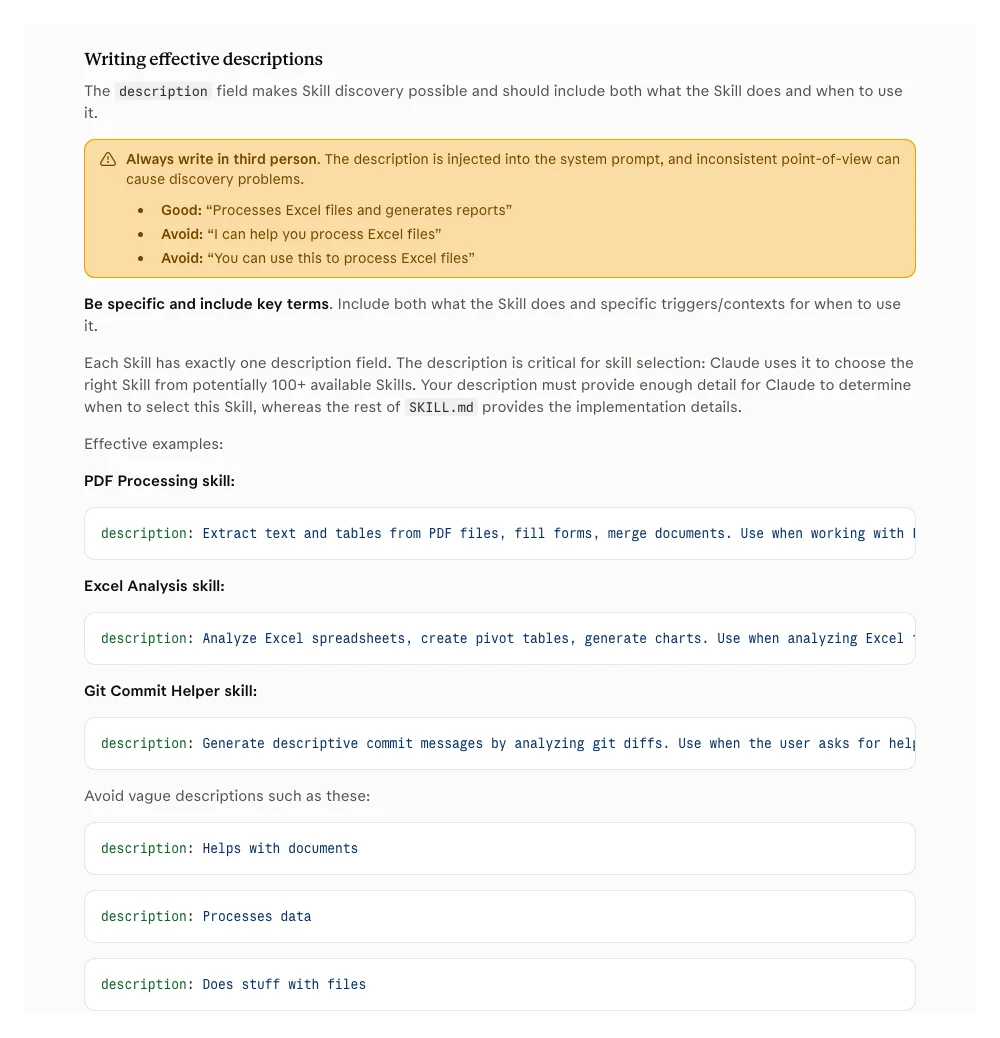
| Weak description | Why it fails | Better |
|---|---|---|
| Helps with SEO. | Matches everything | Rewrites title tags from a Search Console export. Use when pages rank but get few clicks. |
| I write ads for you. | First person, no trigger | Writes responsive search ad copy within Google limits. Use for new ads or refreshes. |
| Monthly report. | No inputs, no scope | Turns monthly platform exports into a one-page client summary. Use at month end. |
Scope is the other half. A lesson from my own work: a skill written for offer copy was later used to write website pages, and the pages read like adverts. The fix was one line in the description and the "When to use" section saying what the skill is not for.
How many skills should one team load at once?
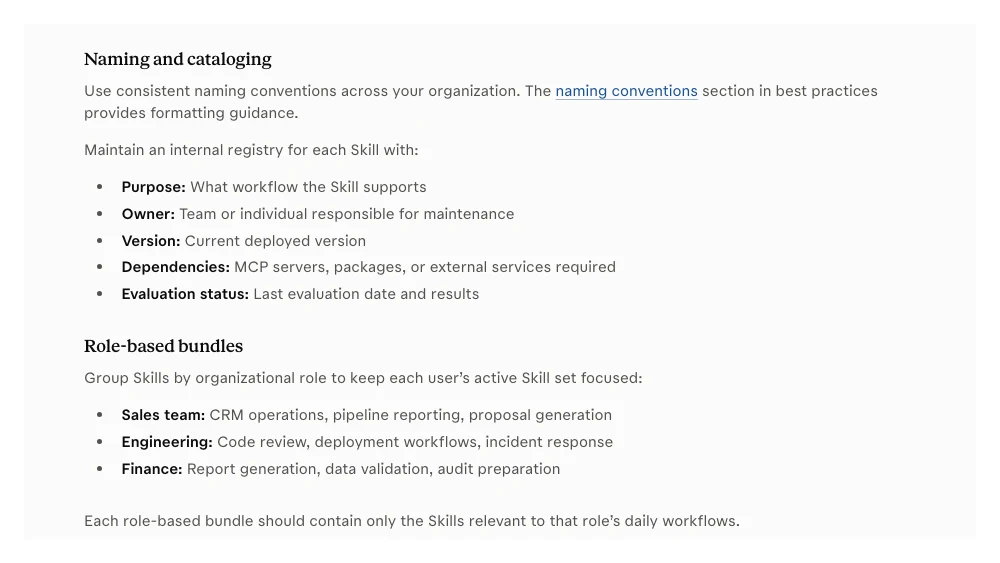
Short answer: only the skills a role uses every week. Anthropic's enterprise guide warns that with too many skills active, Claude can pick the wrong one or miss the right one, and API requests accept at most 20 skills each. Group skills into role bundles instead.
Anthropic's guide to skills for enterprise recommends starting with narrow, workflow-specific skills, merging them only when tests show the merged skill performs as well, and grouping skills by role. Its examples are sales, engineering and finance; for marketing the same idea looks like this.
| Bundle | Skills | Who loads it |
|---|---|---|
| SEO | The five SEO skills plus monthly reports | SEO lead, content editor |
| Paid search | The four Google Ads skills, UTMs, landing pages | PPC manager |
| Paid social | Creative briefs, breakdowns, A/B tests | Social ads manager |
| Content | Brand voice, repurposing, case studies | Writers, editors |
How do you test a marketing skill before the team relies on it?
Short answer: write three to five test requests per skill before you polish it: requests that should trigger it, requests that should not, and one awkward edge case. Run them on a fresh chat with the skill loaded, on every model your team uses, and record the date and result.
Anthropic's best practices put evaluations first: run the task without a skill, note where Claude fails, write three test scenarios for those gaps, then write only enough instructions to pass them. The enterprise guide adds the "should not trigger" cases, because a broad new skill can steal requests from existing ones.
| Test request | Should fire? | Pass if |
|---|---|---|
| "Weekly search term review, export attached" | Yes | Draft table, nothing changed |
| "Which of these searches are wasting money?" | Yes | Same skill, same format |
| "Write new headlines for this ad group" | No | Copy skill fires instead |
| Export with no conversions column | Yes | Asks for the missing column |
Anthropic also describes a two-instance method that suits marketers well: work through the task with one Claude chat, ask it to turn what you explained into a skill, then test the skill in a fresh chat and bring what went wrong back to the first. Because skills add to a model rather than replace it, the docs say to test with every model you plan to use; what works on Opus may need more detail on Haiku.
When installing a skill from GitHub, my own practice has been to ask Claude for a dry run first. On client ad accounts, nothing a skill produces goes live before approval.
How do you share and maintain the library?
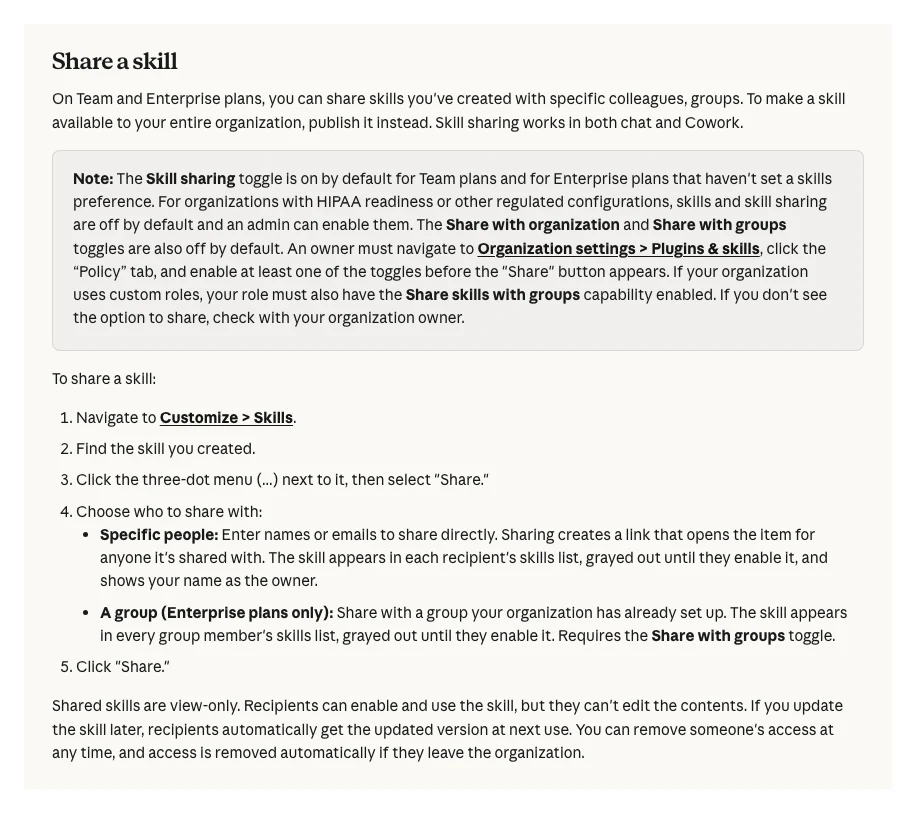
Short answer: keep the source files in one place under version control, record an owner, version and last test date for each skill, and share through your Claude plan. On Team and Enterprise plans, shared skills are view-only for recipients and update for them automatically.
The Claude Help Center's Use skills in Claude page says skills are available on Free, Pro, Max, Ultra, Team and Enterprise plans with code execution switched on. On Team and Enterprise plans you can share a skill with colleagues or groups, or publish it to your organisation's library.
Two maintenance facts matter more than they look. Anthropic's docs say custom skills do not sync across surfaces: a skill uploaded in the Claude app is a separate copy from the one in Claude Code or the API, so keep one source folder and copy out from it. And the enterprise guide suggests a registry entry for every skill.
| Registry field | Example |
|---|---|
| Purpose | Weekly negative keyword drafts |
| Owner | PPC lead |
| Version | 1.2, changed the B2B rule |
| Depends on | Search terms export, offer.md |
| Last tested | Date, models, pass or fail |
Retire skills nobody runs, and re-run the tests when a model changes or Google changes a limit the skill relies on. One habit that keeps this manageable in my own work is one Claude project per client, with skills kept in one known place rather than copied into every project.
Are public marketing skills safe to borrow?
Short answer: read every file before you install one. Anthropic says to use skills only from trusted sources, because a skill can tell Claude to run code, call tools or send data elsewhere. Scripts, network calls, connector references and hard-coded keys are the high-risk signs.
Skills are now an open standard: Anthropic donated Agent Skills to the Agentic AI Foundation on 22 October 2026 and says more than 70 agent platforms have adopted the format since December 2025. That makes public skills easy to find and easy to copy, which is exactly why the review step matters.
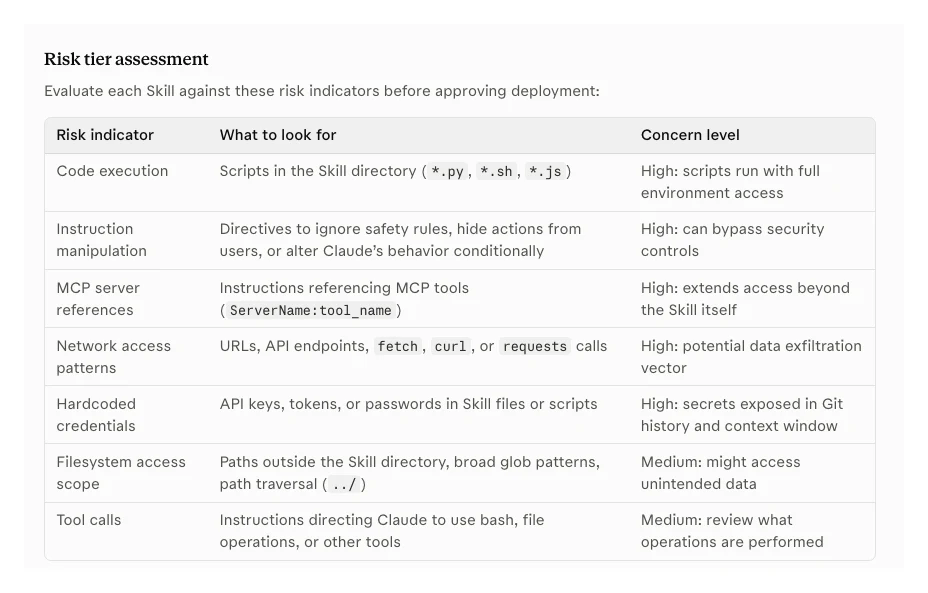
Good starting points are Anthropic's example skills repository and Google's skills repository, which includes Google Ads API skills. For a wider list of repositories, with notes on each, see the best GitHub repos for running a business with AI. Claude Enterprise organisations can also turn on automatic security scanning for uploaded skills; the review checklist still applies.
Which skills should run first on a new account?
Short answer: tracking first, because every later finding depends on trustworthy conversions; then the money leaks in paid search; then SEO; then landing pages; then reporting and content once the priorities are clear.
| Order | Skill | Why now |
|---|---|---|
| 1 | checking-conversion-tracking | Bad data spoils every other skill |
| 2 | reviewing-search-terms, pacing-budgets | Fastest money leaks |
| 3 | auditing-technical-seo, clustering-keywords | Slow wins start early |
| 4 | auditing-landing-pages | Traffic needs somewhere to convert |
| 5 | writing-monthly-reports, content skills | Once priorities are agreed |
This order mirrors how I work on accounts: tracking before spend, and an audit in a sheet that a person checks before anything changes. If tracking is the weak point, my analytics and tracking service starts there; for the paid search side, see Google Ads management, and for search, SEO consulting.
Where this advice is weak
Short answer: the library is a starting design, not a tested benchmark, Anthropic's governance guide is written for large companies, and the skill format and limits are still changing.
- The 19 skills are a suggested set built from common marketing jobs, not a measured ranking of which skills save the most time.
- The GitHub chart counts files that mention a term, not marketing skills, and GitHub's totals are estimates.
- The Help Center gives a 200-character description limit and the developer docs give 1,024. Writing to 200 is the safe choice until the two agree.
- Anthropic's registry, version pinning and scanning advice targets enterprise admins. A three-person team can keep the same fields in a spreadsheet.
- Recording a skill in Cowork on Mac is another way to create one; it is covered in record a skill in Claude rather than here.
What people say on X and Reddit
Short answer: practitioners share paid media skills openly and split method from data, while Reddit threads keep returning to two warnings: skills without your own strategy context produce generic output, and anything that touches an account needs a person in the loop.
| Who | What they said | Take it as | Link |
|---|---|---|---|
| Claude (official) | A media company's team shares skills through one company agent in Slack (6 Oct 2026) | Vendor case study | X post |
| A growth marketer | One skill mines search terms, a second holds the review method; the first calls the second (24 Mar 2026) | First-hand | X post |
| A paid media practitioner | Gives away 12 Claude Code skills for ad accounts; spend claims not verified (15 Aug 2026) | Vendor, first-hand | X post |
| A marketing skills author | A skill that structures paid campaigns by intent level (31 Mar 2026) | Vendor | X post |
| A founder who runs several sites | Open-sourced 12 SKILL.md SEO workflows (11 Nov 2026) | Vendor, first-hand | X post |
| r/SEO | Public writing skills from GitHub disappointed; one reply rewrote over 60% of the tone, another split the work into writer, auditor and image skills (26 Aug 2026) | First-hand | Thread |
| r/SEO | Biggest problems with SEO skills and agents: generic suggestions that miss the company's real context (28 Oct 2026) | Question | Thread |
| r/ClaudeAI | A daily user asks if skipping skills is a mistake; replies say a skill loads itself when a request matches and is easier to share than a saved prompt (27 Oct 2026) | Question, first-hand replies | Thread |
| r/PPC | Building routines and skills in Claude Code for accounts; replies: without your strategy context it is garbage in, garbage out, and keep execution behind approval (19 Sep 2026) | First-hand | Thread |
| r/PPC | After many LinkedIn tools, what stuck was one skill that drafts comments in the poster's own voice plus one connector (26 Jun 2026) | First-hand | Thread |
Videos worth watching
Short answer: Anthropic's short "What are skills?" video covers the basics, a conference talk by two Anthropic engineers explains why skills rather than more agents, and a marketing educator builds a small set of marketing skills on screen.
Made by Anthropic's Claude channel, 27 February 2026. Under three minutes; sells nothing beyond Claude.
Published by the AI Engineer conference channel, 8 December 2025. Two Anthropic engineers on why packaged skills scale better than new agents. Developer-focused but clear.
Made by a marketing educator's channel, 21 February 2026. Builds several marketing skills in Claude Code; the channel promotes its own courses.
| Video | Channel | Date | What it covers |
|---|---|---|---|
| What are skills? | Claude (Anthropic) | 27 Feb 2026 | The basics |
| Don't Build Agents, Build Skills Instead | AI Engineer | 8 Dec 2025 | Why skills scale |
| Creating custom Skills with Claude | Anthropic | 16 Oct 2025 | Making a skill, under a minute |
| Build Your First AI Marketing Team | A marketing educator | 21 Feb 2026 | Marketing skills on screen |
| 5 Claude Marketing Skills I Can't Live Without | A marketing creator | 24 Aug 2026 | Five working skills |
Want a skill library built for your team?
Short answer: I build and test marketing skill libraries: the skills, the descriptions, the test requests and the registry, starting with the jobs your team repeats every week.
See my Claude consultant service for how that works, and the pricing page for rates. If you want the setup steps first, start with Claude skills for SEO or Claude skills for Google Ads; for the prompts that become skills, read the Claude prompting framework.
Sources
| Source | What it supports | Date |
|---|---|---|
| Anthropic: Agent Skills overview | Three levels, 100 tokens, 5,000 tokens, no sync, security | Read 18 Nov 2026 |
| Anthropic: Skill authoring best practices | Descriptions, names, 500 lines, evaluations, models | Read 18 Nov 2026 |
| Anthropic: Skills for enterprise | Risk tiers, tests, registry, bundles, 20 per request | Read 18 Nov 2026 |
| Claude Help Center: Use skills | Plans, sharing, publishing | Read 18 Nov 2026 |
| Claude Help Center: Create custom skills | 200-character description | Read 18 Nov 2026 |
| Anthropic: Agent Skills to the AAIF | Open standard, 70+ platforms | 22 Oct 2026 |
| GitHub: anthropics/skills | Example skills | Read 18 Nov 2026 |
| GitHub: google/skills | Google Ads API skills | Read 18 Nov 2026 |
| GitHub code search API | Counts in the chart | Run twice 18 Nov 2026 |
| X, Reddit and YouTube | Practitioner and official views, linked above | Oct 2025 to Nov 2026 |
This article expands on my post on LinkedIn ↗.
FAQ
What are Claude marketing skills?
Claude marketing skills are SKILL.md files that hold the method, inputs, output format and checks for one repeat marketing job, such as a weekly search terms review or a monthly report. Claude keeps only each skill's name and description in view and loads the full file when a request matches.
Which marketing skills should I build first?
Start with jobs you repeat weekly where mistakes are cheap to catch: a conversion tracking check, a search terms review and a monthly report. Tracking comes first because every later finding depends on trustworthy conversion data.
What goes in a SKILL.md file for marketing?
YAML front matter with a name and a description, then sections for when to use the skill, the inputs it needs, the steps, the output format, checks before finishing and limits. Anthropic recommends keeping the body under 500 lines and moving long reference material into separate files.
How long can a Claude skill description be?
The Claude Help Center gives a 200-character maximum in the Claude apps, while Anthropic's developer docs allow 1,024 characters in the API. Writing to 200 characters, in the third person, with what the skill does and when to use it, works on both.
How many skills can Claude use at once?
Anthropic's enterprise guide says too many active skills can make Claude pick the wrong one or miss the right one, and API requests accept at most 20 skills each. Group skills into role bundles, such as SEO or paid search, so each person loads only what they use.
How do I test a Claude skill?
Write three to five test requests: ones that should trigger the skill, ones that should not, and one awkward edge case such as a missing column. Run them in a fresh chat on every model your team uses and record the date and result, as Anthropic's skill guidance recommends.
Can I share Claude skills with my marketing team?
Yes, on Claude Team and Enterprise plans you can share a skill with colleagues or groups, or publish it to your organisation's library. Shared skills are view-only for recipients and update automatically when the owner changes them.
Are skills from GitHub safe to use?
Only after you read every file. Anthropic says to use skills from trusted sources, because a skill can tell Claude to run code, call tools or send data elsewhere; scripts, network calls and hard-coded keys are the main warning signs.
Do Claude skills sync between the app and Claude Code?
Anthropic's developer docs say custom skills do not sync across surfaces, so a skill uploaded in the Claude app is separate from one in Claude Code or the API. Keep one source folder under version control and copy from it to each place you use.