Claude skills for consultants are SKILL.md files that hold one repeat part of your method, such as discovery prep, an audit or a client report. Claude loads the full method only when a request matches. Build skills for the jobs you repeat most, keep client data in separate projects, test each skill on past work, and write the judgment calls in as questions you answer first.
TL;DR
Claude skills for consultants are SKILL.md files that hold one repeat part of your method: discovery call prep, a proposal outline, a Google Ads or SEO audit, a monthly client report. Claude keeps only each skill's name and short description in view and loads the full method when a request matches, so the same steps, inputs, format and checks run on every client.
Build skills around the jobs you repeat with the least variation, keep client data out of the skill, test each one on a past case where you know the answer, and write the judgment calls into the skill as questions you answer first. Anthropic's own study found experts went with an agent's coin-flip lean 86% of the time, so the skill has to protect your judgment, not just save time.
Short answer: a Claude skill turns one repeat consulting job into a written method Claude follows the same way every time. Start with two or three jobs you do for every client, such as audit triage and the monthly report, give each skill a precise description, test it on old work, and keep every recommendation behind your own review.
You have run the same Google Ads audit for the fifth client this quarter. Each time you paste the same instructions, remind Claude which columns you want, and catch the same weak recommendation at the end. The method lives in your head and in old chats, so every new client starts from a blank page.
That is the gap a skill closes. This page shows how to map an SEO or paid search engagement into skills, what goes inside each one, how to test them, where client data should live, and the one risk most guides skip: an agent that quietly makes your judgment calls for you. If you want this built and tested for your practice, my Claude consultant service covers skill design, testing and rollout. Product facts were checked against Anthropic's documentation on 18 November 2026.
What is a Claude skill, and how is it different from a prompt?
Short answer: a prompt is a one-off request. A skill is a folder with a SKILL.md file that says what the job is, when to use it, the steps, the output and the checks. Claude reads only the name and description until a request matches, then loads the instructions, so you can keep many skills installed without cluttering every chat.
Anthropic's Agent Skills overview describes three loading levels. The name and description cost about 100 tokens per skill and are always loaded. The SKILL.md body, under 5,000 tokens, loads when the skill is triggered. Extra files and scripts load only when the instructions point to them, and a script's code never enters the context; only its output does.
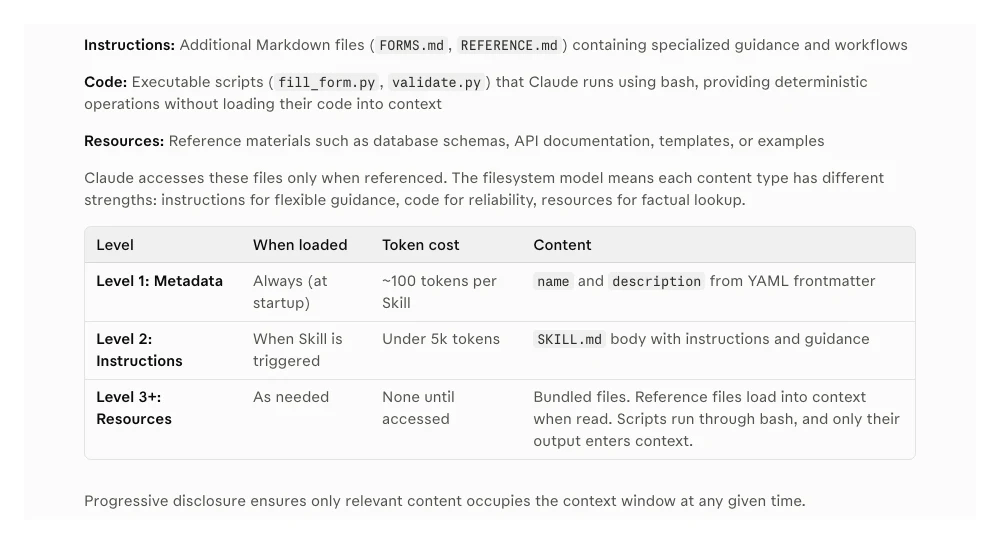
For a consultant, that structure matters because a full method is long. Your audit checklist, scoring rules and report template can sit in reference files that cost nothing until the audit runs.
| Tool | Holds | Loads | Use it for |
|---|---|---|---|
| Prompt | One request | When you paste it | One-off questions |
| Project | Client files, chats | Inside that project | One client's context |
| Skill | A method | When a request matches | Repeat jobs, any client |
| CLAUDE.md | Standing rules | Every session in a folder | House rules in Claude Code |
The split that works: the method goes in a skill, the client goes in a project or folder. My habit on client ad accounts is one separate chat per account, so findings never mix between clients. For the folder version of the same idea in Claude Code, see the CLAUDE.md file for marketing guide.
Which consulting jobs should become skills first?
Short answer: the jobs you repeat for every client, that follow the same shape each time, and where a mistake is cheap to catch before the client sees it. For SEO and Google Ads consultants that usually means discovery prep, a tracking check, audit triage, the findings summary and the monthly report.
Walk through one engagement from first call to monthly reporting and list every stage you repeat. Then rank them by how often they recur and how similar each run is. Do not build them all at once; start where you lose the most time.
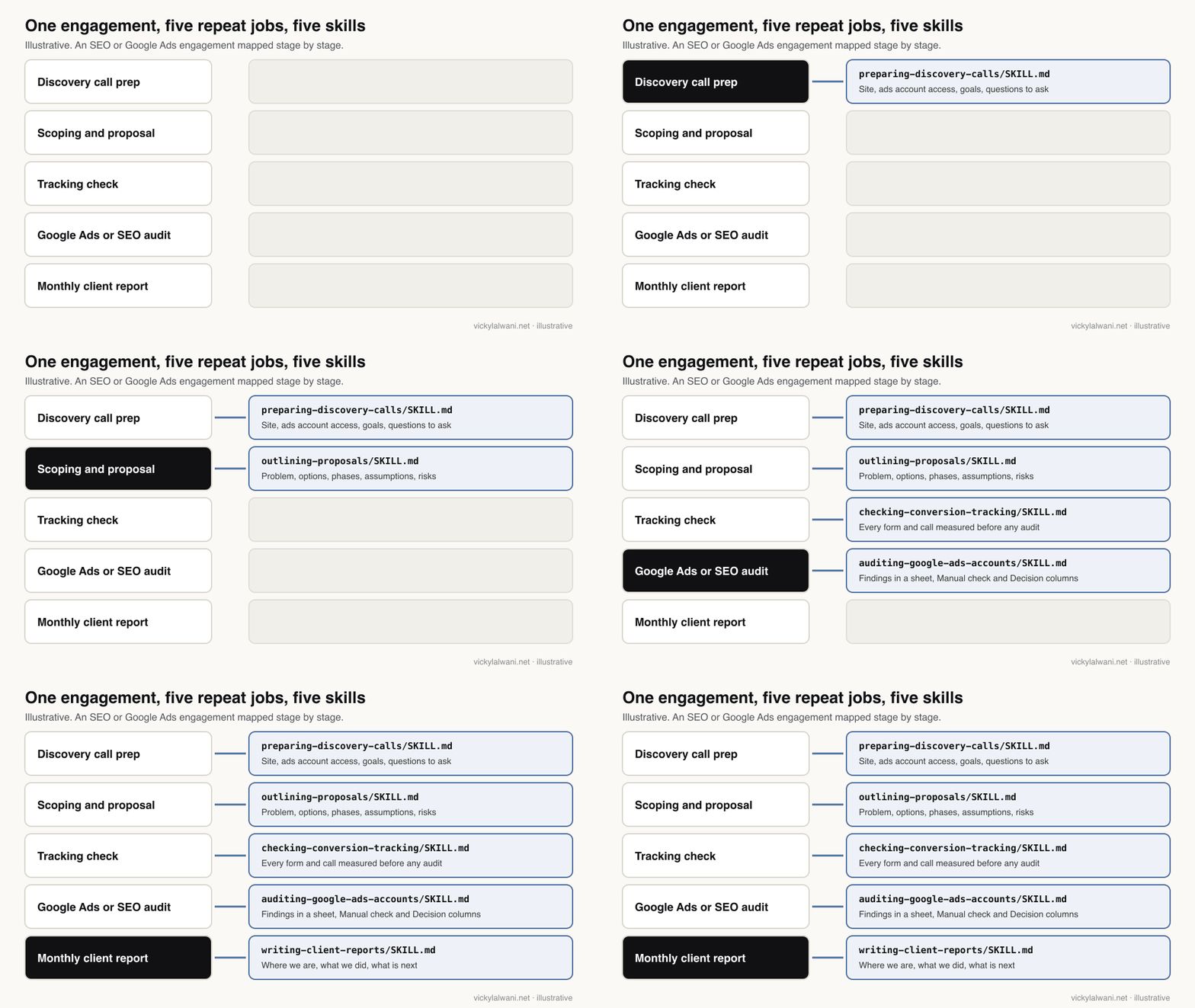
| Stage | Skill name | Main input | Output |
|---|---|---|---|
| Discovery prep | preparing-discovery-calls | Site, goals, access list | Question list, red flags |
| Scoping | outlining-proposals | Call notes | Options, phases, risks |
| Tracking check | checking-conversion-tracking | Tag and goal list | What is measured, gaps |
| Google Ads audit | auditing-google-ads-accounts | Exports, search terms | Findings sheet |
| SEO audit | triaging-seo-crawls | Crawl, Search Console | Issues by impact |
| Monthly report | writing-client-reports | Period data, notes | Summary and next steps |
Put the tracking check before any audit skill. If conversions are not measured properly, every later finding rests on bad data, so the audit skill should refuse to score performance until the tracking skill has passed. The conversion tracking audit checklist is a good source for that skill's steps.
Leave the judgment-heavy stages for later: pricing, deciding which client to take, and the strategy recommendation itself. A skill can prepare the evidence for those, but the call stays with you.
What goes inside a consulting skill?
Short answer: YAML front matter with a name and a description, then sections for when to use it, the inputs, the steps, the output format, the checks, the judgment calls you keep and the limits. Keep the body under 500 lines and move long checklists into separate reference files.
A consulting skill needs seven parts. The first five come from the original version of this article; the last two answer the problems that show up when an AI-assisted audit is checked against the live account.
| Part | What it says | Why it matters |
|---|---|---|
| When to use | The trigger, in the description | Claude matches on it |
| Inputs | Data needed before starting | No guessing |
| Steps | The method, in order | Same method every client |
| Output | Columns, headings, length | Consistent deliverables |
| Checks | Questions before finishing | Catches weak claims |
| Judgment calls | Decisions you make first | Keeps the advice yours |
| Limits | What it must not do | No account changes |
The field rules are strict. In Anthropic's overview, the name allows 64 characters, lowercase letters, numbers and hyphens only, and cannot contain "anthropic" or "claude". The description must say what the skill does and when to use it. The best practices page adds: write the description in the third person, keep the body under 500 lines, and prefer gerund names such as "auditing-google-ads-accounts".
| Field | Limit | Source |
|---|---|---|
| name | 64 characters, lowercase, hyphens | Developer docs |
| description | 1,024 characters | Developer docs |
| description | 200 characters | Help Center upload |
| Body | Under 500 lines | Best practices |
| Front matter in app uploads | 6 fields only | Claude Code docs |
Two details catch people out. The Claude Help Center's custom skills guide gives a 200-character description limit, while the developer docs allow 1,024; writing to 200 works everywhere. And the Claude Code skills docs warn that uploads to claude.ai accept only name, description, license, compatibility, metadata and allowed-tools. A Claude Code field such as argument-hint makes the upload fail with an error.
Here is a complete audit skill you can adapt. It reads and drafts only, and it ends with the Manual check and Decision columns I use when I review an AI-assisted audit by hand.
---
name: auditing-google-ads-accounts
description: Audits a Google Ads account from exported reports and drafts findings in a review sheet. Use when a client account needs a first audit or a quarterly review.
---

# Google Ads account audit

## When to use
New client, or quarterly review of an existing one. Not for live changes.

## Inputs (stop and ask if any are missing)
- Campaign, ad group, keyword and search terms exports, last 90 days
- Conversion actions list with which ones count as primary
- The client's goal in one line, and what a qualified lead or sale is worth to them

## Steps
1. Confirm tracking first. If primary conversions look wrong, report that and stop.
2. List spend with no conversions by campaign, keyword and search term.
3. Check match types, negatives, ad strength, assets and landing page URLs.
4. Group findings by likely impact, highest first.

## Judgment calls (ask me before recommending)
- Pausing anything that has converted in the period
- Changing broad match, bidding strategy or budget split
For each one: ask which way I lean, then give the case for both options.

## Output
A table with columns: Finding, Evidence, Impact, Suggested action, Manual check, Decision.
Then three lines: what is wrong, the order to fix it, what happens next week.

## Checks before finishing
- Is every finding tied to a number in the exports?
- Has anything with conversions been marked for pausing? Flag it.
- Which figure is least reliable, and why?

## Limits
Never change the account. Never estimate search volumes; mark them "to verify".
The output section carries two habits from my own audit work. When I asked Claude to audit a client's Google Ads account, I asked for the findings in a sheet I could check by hand, with nothing changed in the account before approval. And for anything going to a decision maker, I ask for three things: what is wrong, the order to fix it in, and the action plan from tomorrow.
How do you keep the judgment calls yours?
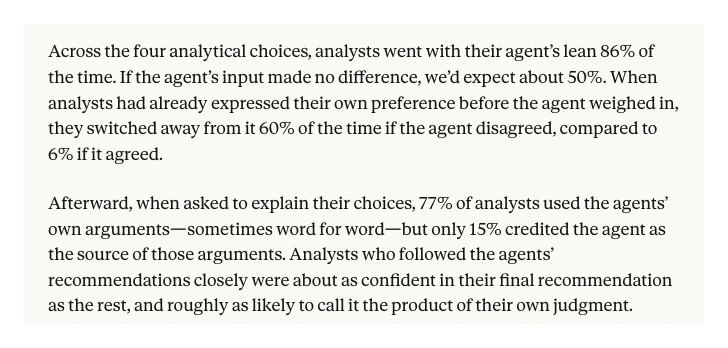
Short answer: write the judgment calls into the skill as explicit questions, make Claude ask for your view before it gives its own, and make it argue both options. In Anthropic's study, experts went with an agent's randomly assigned lean 86% of the time, against 50% if it made no difference.
This is the part most skill guides skip, and it matters more for consultants than anyone. In October 2026 Anthropic published How AI agents shape experts' judgment calls. Fifty professional analysts did an hour-long statistical analysis with Claude Code to advise a farming cooperative's board, which is a consulting task in all but name. On each of four open decisions, a coin flip set which option the agent would argue for.
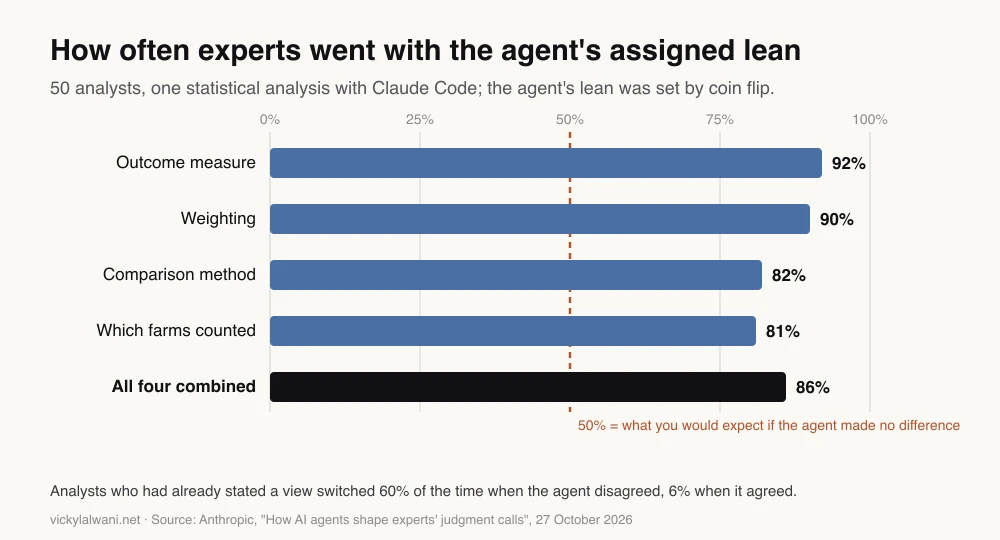
Analysts matched the agent's lean 86% of the time. Those who had already stated a preference switched 60% of the time when the agent disagreed, and 6% when it agreed. Afterwards, 77% explained their choices with the agent's arguments, but only 15% credited the agent. Analysts who used the agent also made far fewer serious errors, so the lesson is not to avoid AI. It is that a sign-off is not proof of independent judgment.
Anthropic's own suggestions point at the fix: agents that make the best case for each option, or ask the expert's view before offering one. A skill can do both today. The checkpoint below is the pattern built into the audit skill above.
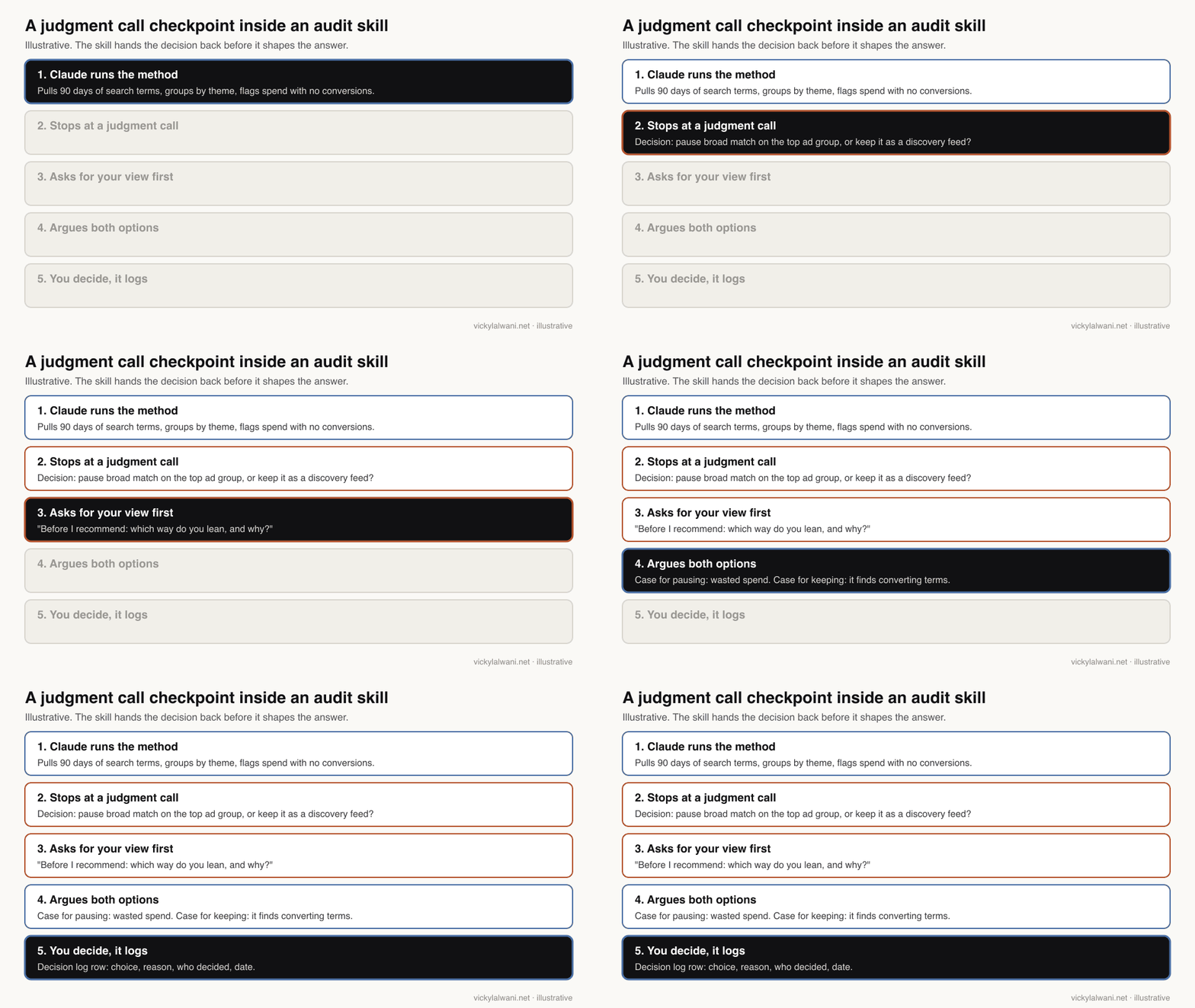
It earns its place. When I reviewed an AI-assisted audit of a client's Google Ads account against the live data, several recommendations did not survive: a keyword marked for pausing was bringing conversions, broad match terms flagged as waste were bringing business, and one ad group flagged for action was already switched off. Each was a judgment call presented as a finding, which is why the skill above raises anything that has converted as a question for you before it suggests pausing it.
How should a consultant test a skill before using it on a client?
Short answer: run it on a past engagement where you already know the right answer, plus three to five test requests that should and should not trigger it. Fix the skill whenever it misses something you would have caught, and record the model and date of each test.
Anthropic's best practices say to build evaluations before writing long instructions: find where Claude fails without the skill, write three scenarios that test those gaps, then write just enough to pass them. Its enterprise guide asks for three to five test queries per skill, covering cases that should trigger it, cases that should not, and awkward edge cases, run on every model your team uses.
| Test request | Should trigger? | Pass if |
|---|---|---|
| "Audit this account from these exports" | Yes | Tracking checked first |
| "Quarterly review for this client" | Yes | Same table, same columns |
| "Write three new headlines" | No | Audit skill stays quiet |
| Exports missing conversions | Yes | Stops and asks |
| Converting keyword with high cost | Yes | Raised as a judgment call |
The past-case test is the one that teaches you most. Take an audit you delivered last quarter, strip the client's name, and run the skill on the same exports. Every gap between its findings and yours is a line to add to the steps or the checks. Facts deserve the same treatment: before a client meeting I check search volumes for the client's own city myself rather than trusting a generated figure, and the skill above marks volumes "to verify" for that reason.
Where should skills and client data live?
Short answer: keep the method in the skill and the client's data in that client's project or folder. In the Claude apps, skills are added under Customize, Skills; in Claude Code they are folders; on the API they are uploaded per workspace. Shared skills on Team and Enterprise plans are view-only for recipients.
| Surface | Where skills live | Sharing |
|---|---|---|
| Claude apps | Customize, Skills (ZIP upload) | Team, Enterprise: share or publish |
| Claude Code | ~/.claude/skills or .claude/skills | Repo or plugin |
| Claude API | Skills API upload | Whole workspace |
The Help Center's Use skills in Claude lists skills on every plan from Free to Enterprise with code execution turned on; the developer overview lists custom uploads from Pro upwards, so check your own Customize page. Skills you enable in the apps also load in Claude Code, version 2.1.273 or later, when you sign in with the same account. That sync is one way, and skills uploaded through the API stay separate.
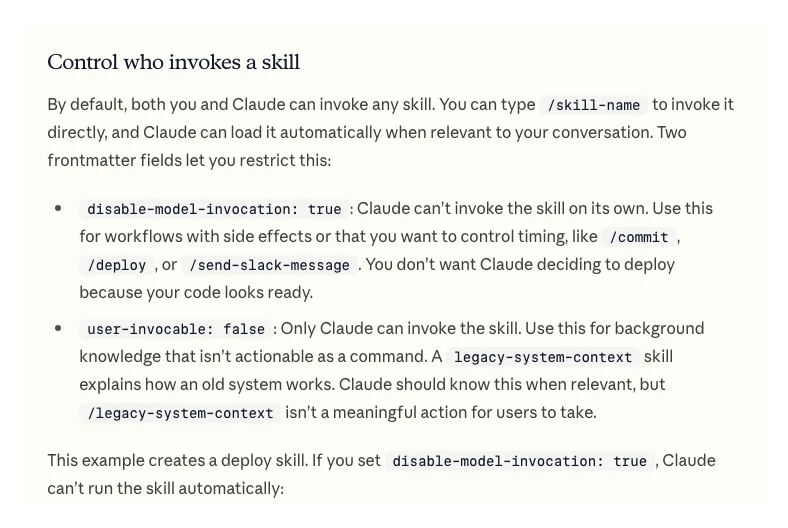
For client-facing outputs, decide who may start the skill. Claude Code lets you set disable-model-invocation: true so a skill runs only when you type its name, which suits anything that sends a report or touches an account.
Two confidentiality points belong in any client conversation. Anthropic's overview says Agent Skills are not covered by zero data retention arrangements, so skill definitions and execution data follow standard retention. And a skill from a stranger can tell Claude to run code or send data elsewhere, so Anthropic says to treat installing one like installing software. When I install a skill from GitHub, I ask for a dry run first and read what it will do before it goes in.
What will skills not do for a consultant?
Short answer: they will not replace judgment, relationships or accountability. A skill removes the blank page and the repeated setup; it cannot tell you which recommendation a nervous client will accept, and it can state industry facts confidently and wrongly.
A solo B2B consultant on r/ClaudeAI listed the limits after nine months of daily use: a positivity bias that will not say "drop this client", confident but wrong answers on industry rules, and briefings that miss how a client feels about last week. One reply made the useful point: if you want Claude to spot bad clients, write the rubric for what a bad client looks like. That is a skill, but the rubric is yours.
Skills also do not fix a broken process. If your proposals vary because your scope varies, the proposal skill will faithfully reproduce the inconsistency. Fix the method first, then write it down.
How do you roll this out in a month?
Short answer: one skill a week, starting with the tracking check, then the audit, then the report, with a test pass on old work before any client sees the output. By week four you have three tested skills and a log of what each one gets wrong.
| Week | Build | Test on |
|---|---|---|
| 1 | Tracking check skill | Two past accounts |
| 2 | Audit skill with judgment calls | Last quarter's audit |
| 3 | Monthly report skill | Last month's report |
| 4 | Fix descriptions, share | Should-not-trigger cases |
For the setup steps by discipline, see Claude skills for Google Ads and Claude skills for SEO. For a wider library of marketing skill files, see Claude marketing skills. If you would rather show Claude the job than write it, recording a skill in Cowork is an option on Mac.
What do people say on X and Reddit?
Short answer: practitioners like skills for repeat work and for sharing a method across a team, and they are blunt about the limits: confident errors on platform specifics, and output that is only as good as the context and rubric behind it.
| Source | Date | Point | Type |
|---|---|---|---|
| Claude on X | 16 Oct 2025 | Launch: skills are packaged instructions that teach Claude your way of working | Official |
| Claude on X | 6 Oct 2026 | A media company's team shares skills through one company agent in Slack | Vendor case study |
| A growth marketer on X | 24 Mar 2026 | One skill pulls search terms through MCP, a second skill holds the review method | First-hand |
| A marketing skills author on X | 10 Apr 2026 | A Claude Code skill that runs a full SEO audit and lists fixes | Vendor |
| A founder who runs several sites, on X | 11 Nov 2026 | Open-sourced 12 SKILL.md SEO workflows used across their own sites | Vendor, first-hand |
| r/ClaudeAI | 25 May 2026 | Solo consultant's critique: positivity bias, confident wrong industry facts; reply: write the rubric yourself | First-hand |
| r/ClaudeAI | 6 Nov 2026 | Consulting practice run from one workspace with skills and a README per client; thread sprawl is the pain | First-hand |
| r/ClaudeAI | 9 Jul 2026 | One project per client; Claude blends two clients if asked a vague question in the wrong project | First-hand |
| r/PPC | 15 Jun 2026 | AI for audits, proposals and grunt work; replies keep it away from direct account changes | Opinion |
| r/SEO | 26 Aug 2026 | Public writing skills needed most of the tone replaced; build your own, split into separate skills | First-hand |
Videos worth watching
Short answer: start with Anthropic's own short explainers on skills, then a practitioner's view of Claude in Google Ads work.
Made by Claude (Anthropic), 26 February 2026, about two minutes. The official explainer of what a skill is and when Claude loads one. It promotes Claude itself.
Made by Anthropic, 16 October 2025, under a minute. Shows a custom skill being built with Claude at launch; product demo.
Made by a PPC practitioner's channel, 18 August 2026, about 15 minutes. A specialist's own Google Ads workflow with Claude; practitioner content rather than an Anthropic demo.
| Video | Channel | Date | What it covers |
|---|---|---|---|
| What are skills? | Claude | 26 Feb 2026 | What a skill is |
| Claude Agent Skills Explained | Anthropic | 26 Nov 2025 | How loading works |
| Creating custom Skills with Claude | Anthropic | 16 Oct 2025 | Building a skill |
| Getting started with projects in Claude.ai | Anthropic | 2 Dec 2025 | One project per client |
| How I use Claude as a Google Ads specialist | PPC practitioner | 18 Aug 2026 | Claude in account work |
| Claude Skills for Google Ads | PPC practitioner | 9 Jan 2026 | Skills for Google Ads |
Where this advice is weak
Short answer: the judgment study used one task, one model and an agent told to push its lean; skills limits differ between the Help Center and the docs; and none of this measures client outcomes.
- Anthropic's study deliberately strengthened the agent's preferences. Its authors say the effect may be smaller when an agent has no assigned lean.
- The Help Center and developer docs disagree on the description limit and on which plans allow custom uploads. I follow the stricter figure.
- The skill set and SKILL.md above are a design built from common SEO and paid search jobs, not a measured ranking.
- Skill features change often. Recheck the linked pages before you rely on a limit.
Want help turning your method into skills?
If you run SEO or paid search for clients and want your audit, reporting and proposal methods written as tested skills, my Claude consultant service does the design, testing and rollout. If you would rather hand the account work over, see Google Ads management or SEO consulting. Rates are on the pricing page.
Keep reading: PPC audit with Claude, Claude skills for Google Ads and tasks to delegate to AI agents.
Sources
| Source | What it supports | Date |
|---|---|---|
| Anthropic: Agent Skills overview | Loading levels, field rules, retention, security | Read 18 Nov 2026 |
| Anthropic: Skill best practices | Third person, 500 lines, evaluations | Read 18 Nov 2026 |
| Anthropic: Skills for enterprise | 3 to 5 test queries, review | Read 18 Nov 2026 |
| Claude Code: Skills | Invocation control, upload fields, sync | Read 18 Nov 2026 |
| Help Center: Use skills | Plans, sharing, Claude Code sync | Read 18 Nov 2026 |
| Help Center: Custom skills | 200-character description | Read 18 Nov 2026 |
| Anthropic: Judgment calls study | 86%, 60% vs 6%, 77% vs 15% | 27 Oct 2026 |
| X, Reddit and YouTube | Practitioner views, linked above | Oct 2025 to Nov 2026 |
This article expands on my post on LinkedIn ↗.
FAQ
What are Claude skills for consultants?
Claude skills for consultants are SKILL.md files that hold one repeat part of a consulting method, such as discovery call prep, an audit or a monthly client report. Claude keeps each skill's name and description in view and loads the full method only when a request matches.
What is the difference between a Claude skill and a prompt?
A prompt is a single request you paste each time. A skill is a saved method with a trigger, inputs, steps, output format and checks, which Claude loads on its own when a request matches, so results stay consistent across clients.
Which consulting task should I turn into a skill first?
Pick the job you repeat for every client with the least variation, such as a conversion tracking check, audit triage or the monthly report. Repeat work with a fixed shape is where a skill pays back fastest and where mistakes are easiest to catch.
Can Claude skills replace a consultant?
No. Skills replace the blank page and the repeated setup, not judgment, relationships or accountability. Anthropic's own research found experts often adopt an agent's view without noticing, so the decisions need to stay deliberately with the consultant.
How long can a Claude skill description be?
Anthropic's developer docs allow 1,024 characters, but the Claude Help Center gives a 200-character limit for skills uploaded in the Claude apps. Writing to 200 characters, in the third person, with what the skill does and when to use it, works everywhere.
Should client data go inside a Claude skill?
No. Keep the method in the skill and each client's data in that client's own project or folder. Anthropic says Agent Skills are not covered by zero data retention arrangements, so skill files should not hold confidential client details.
How do I test a Claude skill before using it with clients?
Run it on a past engagement where you know the right answer, then try three to five requests that should and should not trigger it, as Anthropic's enterprise guide recommends. Add every miss to the skill's steps or checks and record the model and date.
Can I share Claude skills with my consulting team?
Yes, on Claude Team and Enterprise plans you can share a skill with colleagues or publish it to your organisation's library. Recipients get a view-only copy that updates automatically when the owner changes it.