The tasks to delegate to AI agents first repeat, follow rules you could write down, are quick to check and are cheap if they go wrong: reports, monitoring, data pulls and first drafts. Brief the agent like a new hire, split actions into do alone, prepare for approval and never, review the costly step, and keep money, customer contact and strategy with a person.
TL;DR
The tasks to delegate to AI agents first are the ones that repeat, follow rules you could write down, are quick to check and are cheap if they go wrong: research, monitoring, data pulls, first drafts and routine reports. Spending money, contacting customers and strategy stay with a person, or sit behind an approval step.
Brief the agent like a new hire, split actions into "do alone", "prepare for approval" and "never", and review the one step where a mistake is expensive. Anthropic's data shows Claude Code most often stops to offer a choice or ask for missing information, so a good brief answers those questions before the agent has to ask.
Short answer: delegate work an agent can do and you can check quickly: weekly SEO and Google Ads reports, search term reviews drafted for approval, competitor and rank monitoring, data clean-up and first drafts. Keep budget moves, customer messages, positioning and final sign-off with a person until the agent has a track record on that exact job.
For about three years the whole game with AI was prompting: how clearly you could ask, and how good the answer was. Agents change the question. Claude can now run scheduled tasks while your computer is asleep, work through a project with tools and files, and come back only when it needs a decision. The skill that matters is deciding what work you can hand off, and trust.
Delegation is a management skill, not a technical one. If you can brief a new hire well, you can delegate to an agent well; if you cannot, the agent will magnify the problem. My own split shows the range: on my own website I hand over deploys, research and daily publishing almost completely, while on client ad accounts I want an audit first, findings in a sheet I check by hand, and nothing changed before approval. If you want help drawing that line for your team, my AI marketing agents service starts there. Product facts were checked on 18 November 2026.
For running several agents at once, see how to manage multiple AI agents; this page is about choosing the work in the first place.
Which tasks should you delegate to AI agents first?
Short answer: tasks that pass five questions: does it repeat, could you write the rules down, can you check the output quickly, is a mistake cheap, and is there no judgment call or customer contact in it. Five yeses means delegate and spot-check; a no on cost or judgment means the agent prepares and you approve.
Anthropic studied its own staff in How AI is transforming work at Anthropic (December 2025). Engineers delegated work that was easy to verify, low-stakes or boring, and kept high-level thinking and design decisions that need "taste". Most said they could fully delegate only 0 to 20% of their work, because the rest still needed supervision. That survey predates this year's agent features, but the selection rules still hold.
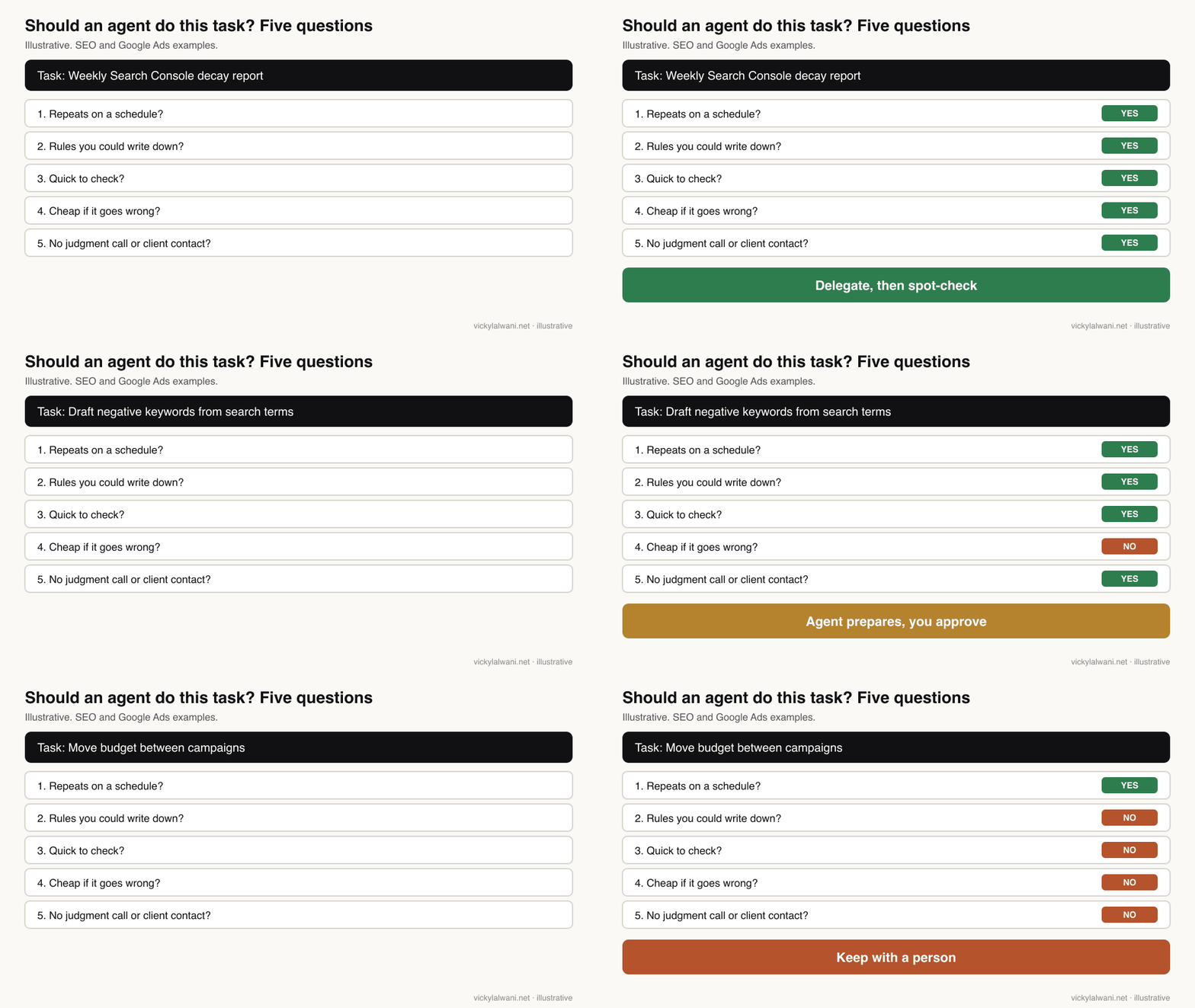
| Task | Verdict | Why |
|---|---|---|
| Weekly Search Console report | Delegate | Read-only, easy to check |
| Rank and competitor watch | Delegate | Monitoring, no changes |
| Crawl triage after a release | Delegate | Findings list only |
| Monthly report first draft | Delegate | You edit before sending |
| Negative keyword list | Prepare | A wrong negative hides leads |
| New ad headlines | Prepare | Brand and policy check |
| Title and meta rewrites | Prepare | Live pages |
| Budget or bid changes | Keep | Money, hard to judge |
| Client or customer emails | Keep | Relationship, consent rules |
| Strategy and positioning | Keep | Judgment is the product |
Platform limits often make the call for you. Google's Google Ads MCP server, the official way to connect an AI client to an ad account, reads reporting data and can create assets and labels, but it "cannot create, modify, pause, or enable campaigns, ad groups, ads, budgets, or bids". For more PPC-specific calls, see what to automate in PPC and what not to.
What can AI agents actually do on their own in 2027?
Short answer: more than most teams use. Claude Code can work through long tasks with the permission level you choose, Cowork can run scheduled tasks remotely on paid plans, and Claude Managed Agents run hosted agents with per-tool approval rules. All of them still stop for approvals you set, and none removes the need for review.
| Product | Runs | Control you set |
|---|---|---|
| Claude Code | On your machine or cloud | Permission mode, allow and deny rules |
| Cowork scheduled tasks | Remotely, on a cadence | Connector "Always ask" |
| Managed Agents (beta) | Hosted sandbox | always_allow or always_ask per tool |
| Google Ads MCP | Your AI client | Propose, then confirm |
Claude Code's permission modes are the clearest picture of delegation levels. Manual mode lets Claude read without asking and asks before most edits or commands; auto mode lets a second model review actions instead of you; bypassPermissions skips checks and is meant only for isolated containers.
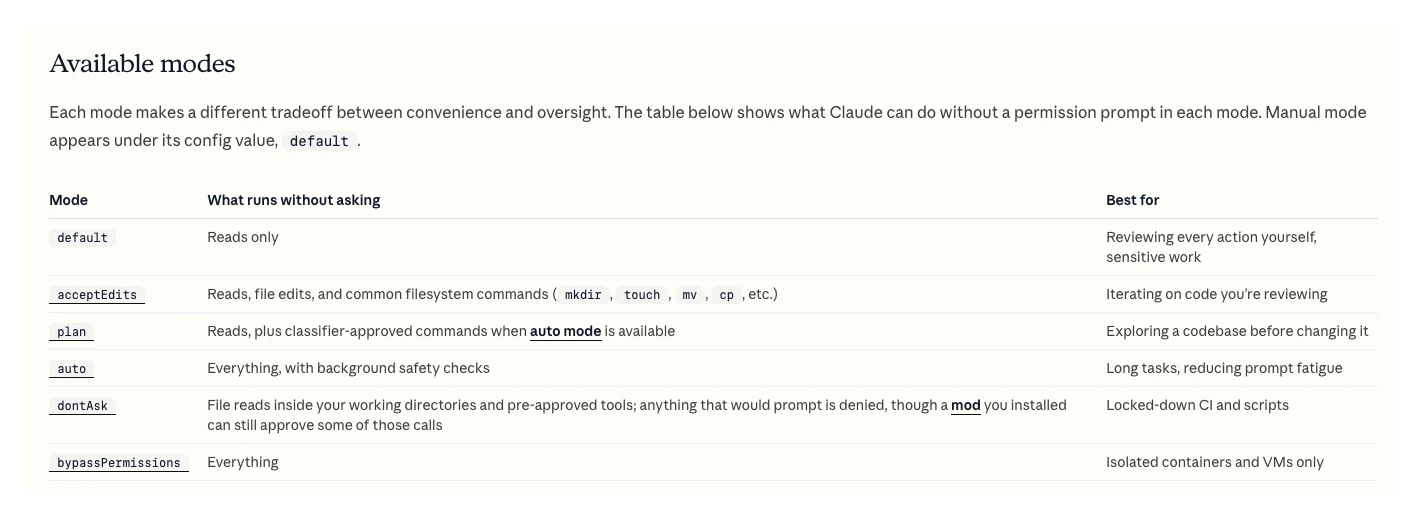
The Help Center's scheduled tasks guide says scheduled tasks are on all paid plans, run even when your computer is asleep, and that a task using a connector set to "Always ask" may wait for your answer or finish without that tool. In Managed Agents, the built-in agent tools default to running without confirmation, while connected MCP tools default to asking first. Check those defaults before an agent touches anything a client can see.
How do you brief an AI agent like a new hire?
Short answer: give it the goal and why it matters, the data and access it needs, what it may and may not touch, examples of good output, the output format, what done looks like, and when to stop and ask. Most agent stops are requests for a choice or missing information, so answer those in the brief.
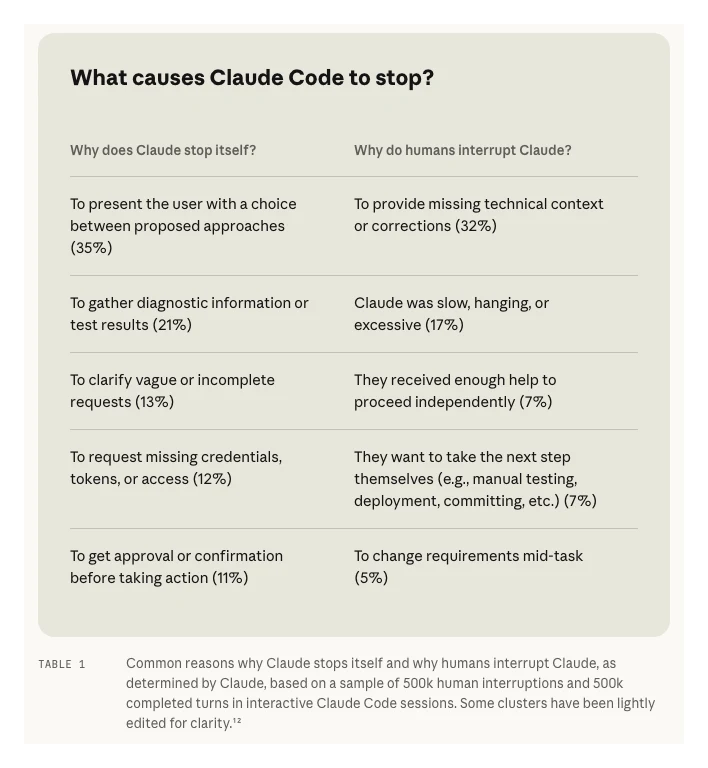
Anthropic's Measuring AI agent autonomy in practice (February 2026) classified why Claude Code sessions stop. When Claude stopped itself, the commonest reasons were to offer a choice between approaches, gather test results, clarify a vague request, ask for credentials or access, and get approval before acting. When people interrupted, the top reason was to give missing context or corrections.
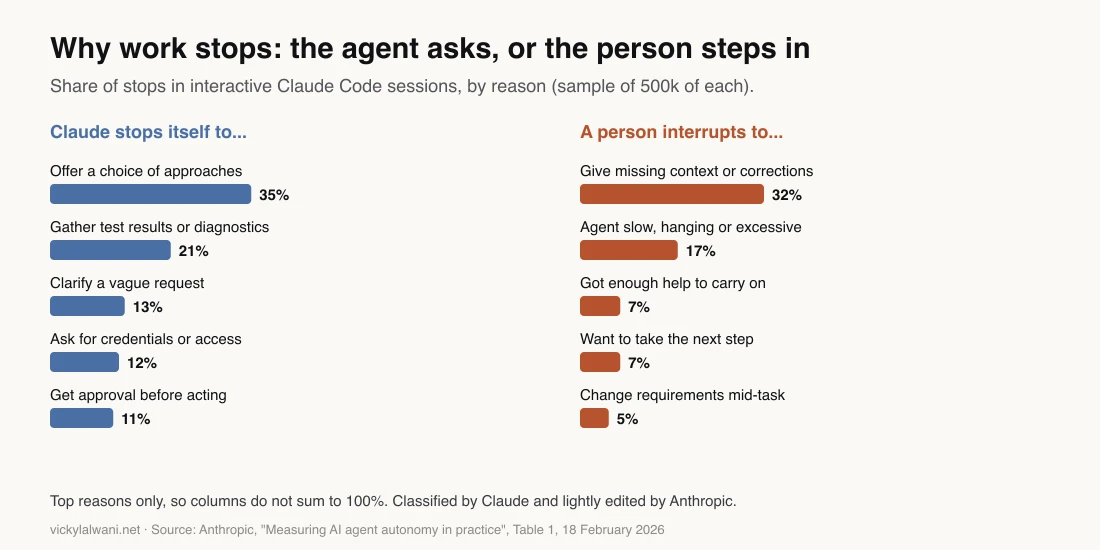
Read that as a checklist. Missing context, vague goals and missing access cause a large share of stops on both sides, and all three can be fixed in the brief. When I handed an approved Google Ads plan from Claude to a second agent to carry out, my question was how that agent would understand the situation. The answer was a hand-off pack: context files, a task list and the expected outcome of each task.
Here is a brief for one common SEO job. Swap the task, data and limits for your own.
Goal: every Monday, find pages losing organic clicks so I can decide what to refresh.
Why: content decay is our biggest quiet traffic loss.

Data: Search Console performance export, last 28 days vs previous 28 days, page level.
Access: read-only. You may not edit the site, the CMS or Search Console settings.

Steps:
1. List pages whose clicks fell by more than a third, with at least 100 clicks before.
2. For each, note the queries that lost the most clicks and the current average position.
3. Mark likely causes only where the data shows them (lost position, lower CTR, seasonality).

Output: a table with Page, Clicks before, Clicks now, Main lost query, Likely cause, Confidence.
Then three lines: what changed, what to look at first, what you could not tell from the data.

Done when: the table covers every page that meets the rule, sorted by clicks lost.
Stop and ask if: the export is missing, dates do not match, or more than 30 pages qualify.
Set permissions before the first unattended run. Scheduled runs I set up for this site kept stalling on permission prompts with nobody there to answer them. The workaround was to run each day's job as its own session with a self-contained brief, and the lesson is to settle what an unattended run may do before it starts. For more on writing briefs, see how to brief AI.
Where should approval points sit?
Short answer: split actions into three groups: what the agent may do alone, what it may prepare for your approval, and what it must never do. Put approvals only where a mistake is costly, because people approve almost everything they are asked to: Anthropic found Claude Code users accept 93% of permission prompts.
| Group | SEO examples | Google Ads examples |
|---|---|---|
| Do alone | Pull reports, crawl, draft briefs | Pull reports, flag anomalies |
| Prepare for approval | Title rewrites, redirects | Negatives, new ads, assets |
| Never | Delete pages, change robots rules | Budgets, bids, billing |
Most teams make the middle group too small and the first group too big. The middle group is where agents save the most time without the most risk: the agent does all the analysis, writes the change list with evidence, and you approve or reject each line.
Anthropic's auto mode write-up (March 2026) explains why too many approvals backfire. Users accepted 93% of prompts, which is approval fatigue, and even the classifier built to replace those prompts let through 17% of overeager actions in Anthropic's test. Fewer, more meaningful approvals beat many reflexive ones.
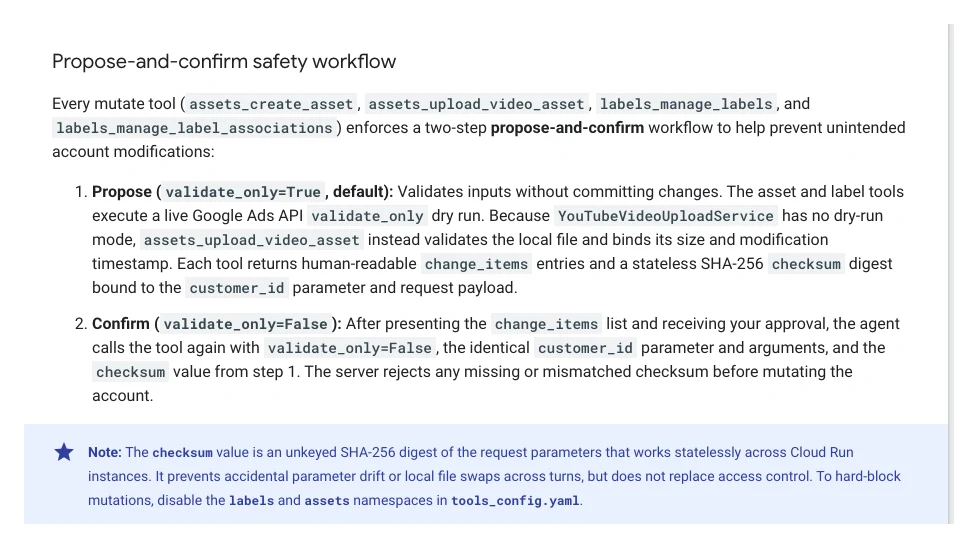
Google's MCP server shows what a good approval step looks like. Every change it supports first runs as a dry run that lists the exact changes; only after you approve does the agent repeat the call, and the server rejects it if anything differs from what you saw.
Client work adds a layer. On one retail client's account, the owner approved every ad before it ran at the start. For the same business, I handed a prioritised buyer list built with an AI model to the owner to approve, because they know their local market better than any model. And the client corrected me on their country's rules for emailing private individuals: an agent will happily build a list that is illegal to use. So I test agents in my own workspace first and apply only what has worked to a client's.
How should you review what an agent hands back?
Short answer: check the one step where being wrong is expensive, not every step, and keep a log you can read. Effective oversight means being able to step in when it matters, which is how experienced Claude Code users work: they auto-approve more and interrupt more.
Anthropic's autonomy study found that newer Claude Code users ran full auto-approve in about 20% of sessions, rising to over 40% by around 750 sessions. The same experienced users interrupted more, in about 9% of turns against 5% for new users. Across the public API, 80% of tool calls came from agents with at least one safeguard, 73% had a person in the loop somehow, and only 0.8% of actions looked irreversible.
| Measure | New users | Experienced |
|---|---|---|
| Sessions on full auto-approve | About 20% | Over 40% |
| Turns interrupted | About 5% | About 9% |
A manager who reads everything becomes the bottleneck. Spot checks plus a readable log usually give enough confidence, as long as you know which errors matter. When I checked an AI-assisted audit of a client's Google Ads account against the live data, several recommendations did not survive, including a keyword marked for pausing that was bringing conversions. On another account, ad images generated with AI promised a deal without its key condition, and the client caught it in review. Review the claim that would embarrass you, not the formatting.
Watch for silent failure. A reply on r/AI_Agents made the point well: a task can fail and still produce a convincing "done" report, so build a check into each task when you write it, not after.
When is a task ready for more freedom?
Short answer: after several runs in a row where you changed nothing, mistakes caught by the agent's own checks, and a log you can read without confusion. Move up one rung at a time, and drop back a rung the moment approvals start being skimmed or outputs cannot be traced to a source.
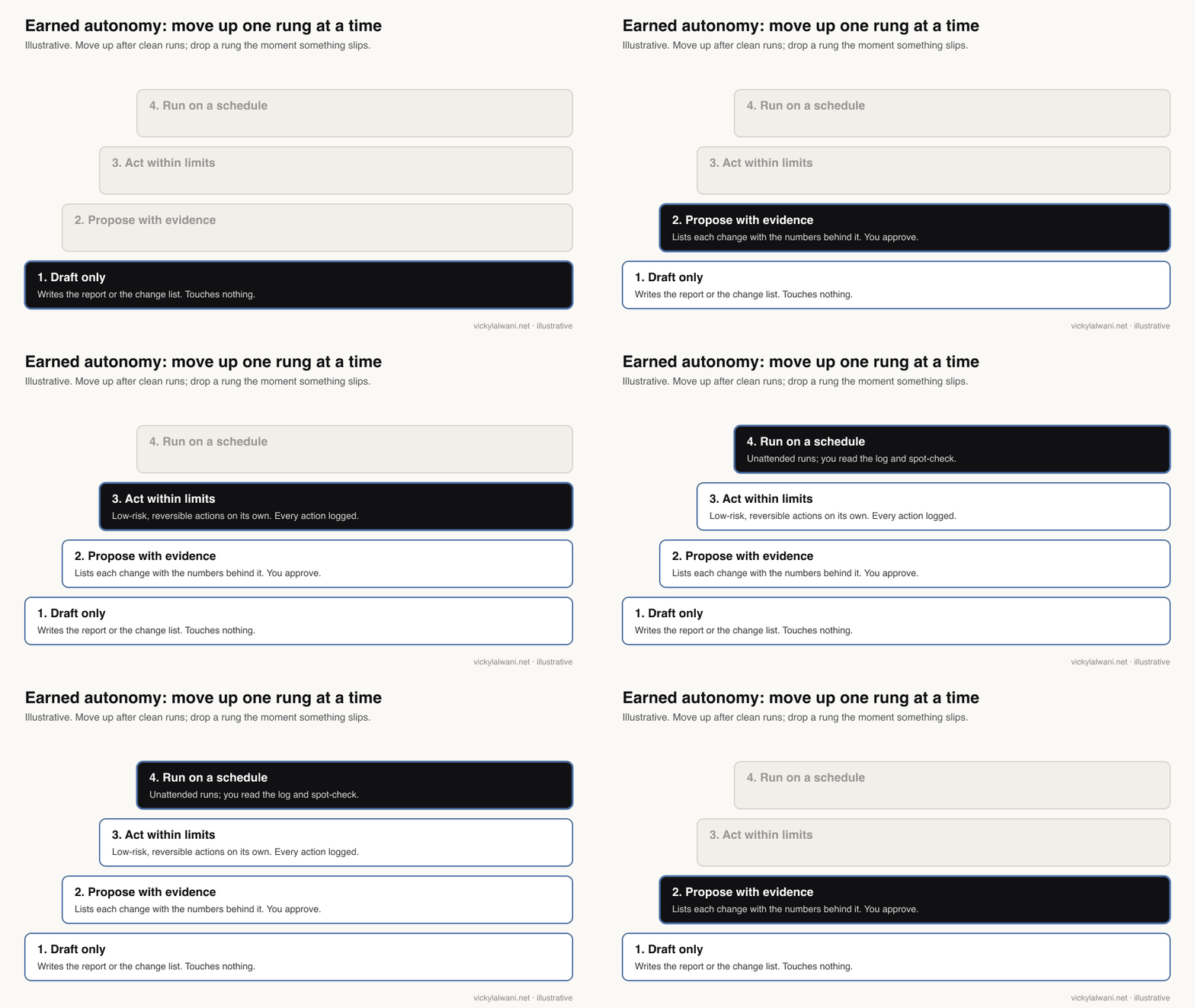
| Rung | Agent may | Move up when |
|---|---|---|
| 1. Draft only | Write, touch nothing | Several runs need no edits |
| 2. Propose | List changes with evidence | You approve without changes |
| 3. Act within limits | Reversible actions, logged | Log is clean for weeks |
| 4. Scheduled | Run unattended | Spot checks stay clean |
Warning signs: polished outputs that cannot be traced to a source, a growing list of exceptions in the brief, approvals you have started to skim, and two agents working on the same thing. That last one happened to me when two sessions nearly deployed the same site change; the rule since is that each session checks what else is changing and commits only its own files. When you see a warning sign, tighten the rules rather than adding capability.
What should stay with you?
Short answer: your offer, positioning, strategy, pricing, budget decisions, customer relationships and the final call on what ships. These are the parts where your judgment is the product, and research shows people adopt an agent's view on judgment calls without noticing.
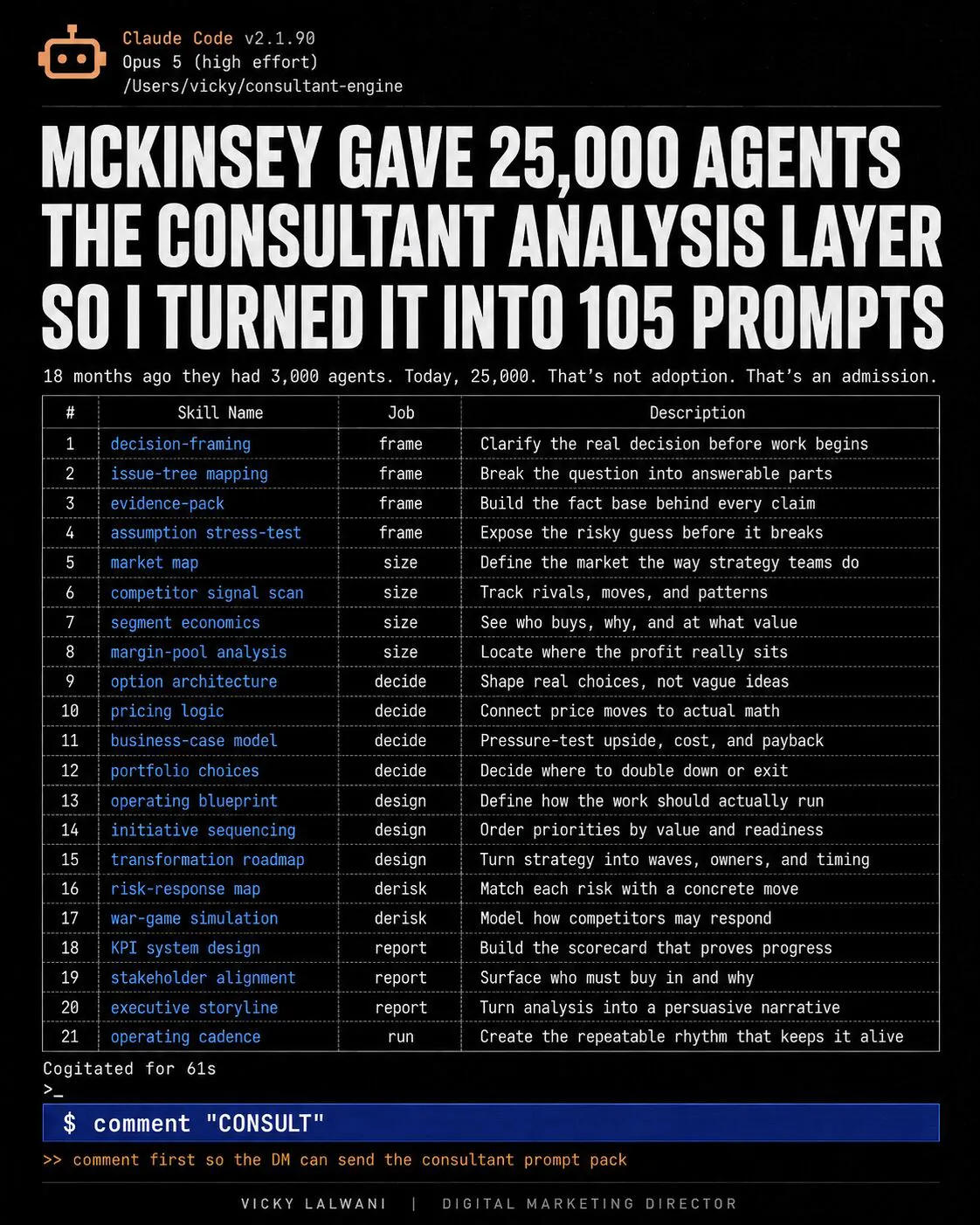
Anthropic's October 2026 study of 50 professional analysts found they went with their agent's randomly assigned lean 86% of the time on open decisions, and few credited the agent afterwards. I cover what that means for client advice in Claude skills for consultants. For delegation, the lesson is simple: decide the judgment calls yourself before the agent argues for one.
The goal is not to remove yourself from the business. It is to stop spending your best hours on busywork.
What is a good first experiment?
Short answer: pick one weekly task you dislike and could describe in ten steps, write the brief, run it for two weeks with approvals on, and log every correction. The corrections tell you what to add to the brief and whether the task is ready for the next rung.
| Day | What you do |
|---|---|
| 1 | Write the brief and limits |
| 2 to 7 | Run, approve, log corrections |
| 8 | Add corrections to the brief |
| 9 to 14 | Run again, count edits |
| 15 | Decide: same rung or next |
Good candidates are the Monday content decay report above, or a weekly Google Ads search terms review where the agent drafts negatives and you approve each one. Both are read-only until you say yes.
What do people say on X and Reddit?
Short answer: official accounts show agents running on schedules and in teams; practitioners mostly keep agents on monitoring and analysis, with a person approving changes, and warn about silent failures and missing context.
| Source | Date | Point | Type |
|---|---|---|---|
| Claude on X | 10 Jun 2026 | Scheduled deployments run an agent on a set schedule, such as a daily digest | Official |
| Claude developers on X | 9 Oct 2026 | Dynamic workflows in beta: a lead agent plans work across many agents | Official |
| Google Ads liaison on X | 12 Nov 2025 | Ads Advisor and Analytics Advisor, conversational agents inside Google's tools | Official |
| A startup operator on X | 19 Jul 2026 | Gave each business agent its own inbox and a scoped API key | First-hand |
| An AI tools account on X | 18 Oct 2026 | Claims Google and Meta agent access puts paid media teams "in trouble" | Opinion |
| r/AI_Agents | 8 Sep 2026 | The hard part is deciding what to delegate; replies warn a failed task can still report "done" | Opinion, first-hand replies |
| r/PPC | 19 Sep 2026 | Claude Code on ad accounts: garbage in, garbage out without strategy context; some monitor only | First-hand |
| r/ClaudeAI | 31 Oct 2026 | Agents that hand work to each other and ask a person only when stuck; replies cite latency and review cost | First-hand, own open-source app |
| r/ClaudeAI | 30 Sep 2026 | Debate on Anthropic's 0 to 20% figure; replies say they still review all output | Opinion |
Videos worth watching
Short answer: Anthropic's talk on effective agents for the design principles, then short official demos of scheduled tasks and Google's Ads MCP server.
Made by Anthropic, 17 October 2025, about 18 minutes. A conversation on what changed since the original agents guide and when simple designs still win. It sells nothing directly.
Made by Claude (Anthropic), 18 March 2026, under a minute. Official demo of a recurring Cowork task; promotes Cowork.
Made by Google's advertising developer channel, 29 October 2025, about four minutes. Introduces the official server for connecting AI clients to Google Ads.
| Video | Channel | Date | What it covers |
|---|---|---|---|
| Building more effective AI agents | Anthropic | 17 Oct 2025 | Agent design principles |
| Scheduled Tasks in Cowork | Claude | 18 Mar 2026 | Recurring tasks |
| Build a proactive agent workflow with Claude Code | Claude | 20 May 2026 | Agents that act on events |
| How Anthropic uses Claude in Marketing | Claude | 26 Jan 2026 | Anthropic's own marketing use |
| Introducing the Google Ads MCP Server | Google Ads developers | 29 Oct 2025 | AI access to Google Ads |
| Introducing Ask Advisor | Google Ads | 21 May 2026 | Google's own agent |
Where this advice is weak
Short answer: most of the published data on delegation comes from coding agents, the task sorting is a design rather than a measurement, and product limits change month to month.
- Anthropic's autonomy and staff studies are mostly about software work; marketing tasks may behave differently.
- The staff survey dates from December 2025, before this year's agent features.
- The task table and trust ladder are a framework built from common SEO and paid search jobs, not a ranking measured across accounts.
- Defaults such as permission modes and connector settings change; recheck the linked pages.
Want help choosing what to hand off?
If you want the right jobs chosen, the briefs written and the approval rules built around your accounts, my AI marketing agents service does that, read-only first. If you would rather hand over the account work itself, see Google Ads management or SEO consulting. Rates are on the pricing page.
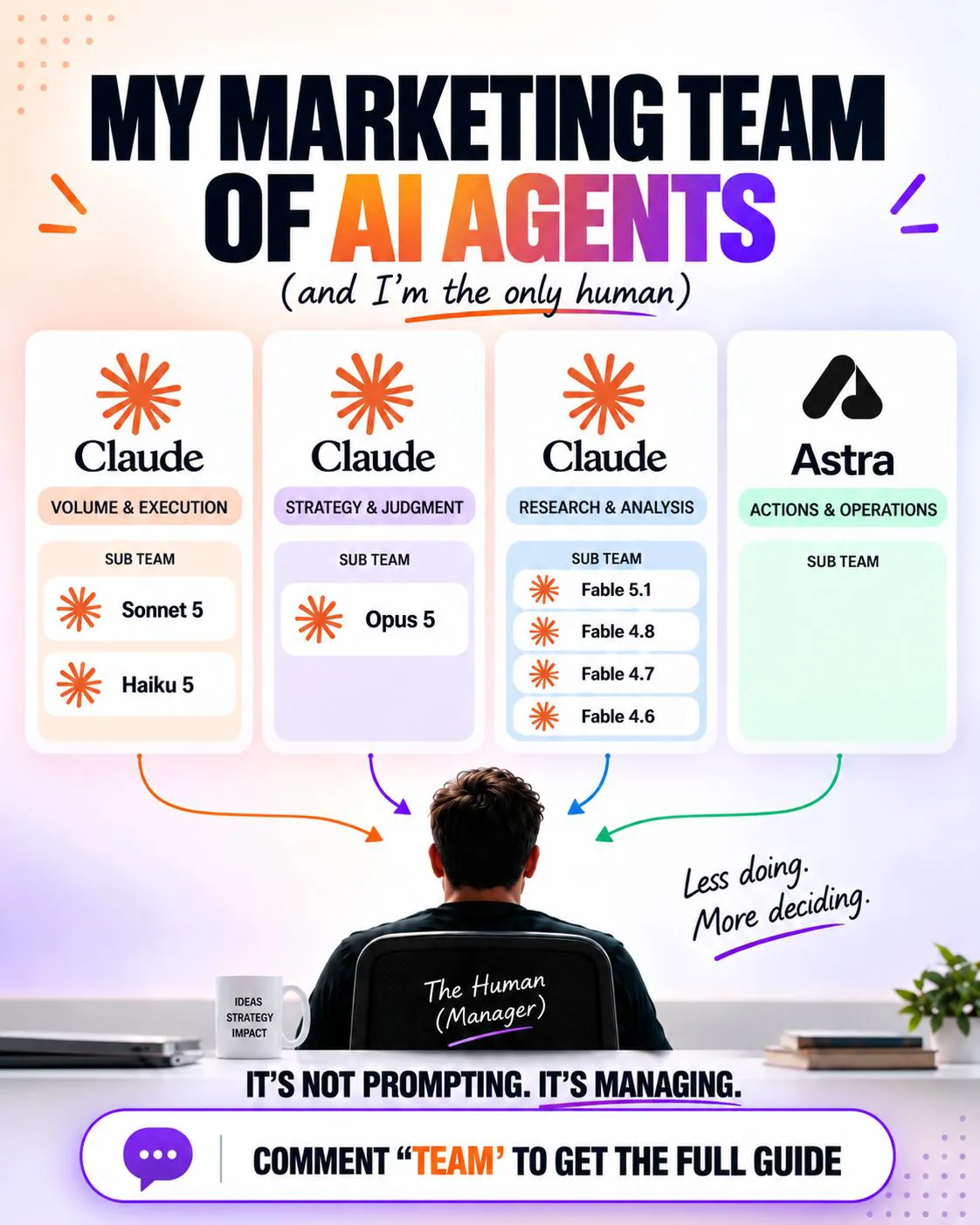
Free guide: The AI Team Playbook covers the roles, model routing, briefs and checks for running AI agents as a team, plus a five-step daily loop.
Keep reading: human in the loop for Google Ads, what to automate in PPC and how to manage multiple AI agents.
Sources
| Source | What it supports | Date |
|---|---|---|
| Anthropic: AI at work at Anthropic | 0 to 20% fully delegated; selection rules | 2 Dec 2025 |
| Anthropic: Measuring agent autonomy | Stop reasons, auto-approve, safeguards | 18 Feb 2026 |
| Anthropic: Claude Code auto mode | 93% approvals, 17% missed | 25 Mar 2026 |
| Anthropic: Judgment calls study | 86% followed agent's lean | 27 Oct 2026 |
| Anthropic: Building effective agents | Checkpoints, sandbox testing | 19 Dec 2024 |
| Claude Code: Permission modes | Modes and what runs unasked | Read 18 Nov 2026 |
| Help Center: Scheduled tasks | Paid plans, remote runs, Always ask | Read 18 Nov 2026 |
| Managed Agents: Permission policies | Default approval settings | Read 18 Nov 2026 |
| Google Ads MCP server | Limits, propose and confirm | Read 18 Nov 2026 |
| X, Reddit and YouTube | Practitioner views, linked above | Oct 2025 to Nov 2026 |
This article expands on my post on LinkedIn ↗.
FAQ
What tasks should I delegate to AI agents first?
Start with repeatable, rule-based work that is quick to check and cheap if it goes wrong, such as weekly SEO and Google Ads reports, monitoring, data clean-up and first drafts. Keep budget moves, customer contact and strategy with a person or behind an approval step.
What tasks should you not delegate to AI agents?
Do not hand an agent unsupervised control of money, customer or client messages, legal or consent decisions, positioning or strategy. These carry high costs when wrong, and Anthropic's research shows people tend to adopt an agent's view on judgment calls without noticing.
How do I brief an AI agent?
Brief it like a new hire: the goal and why it matters, the data and access it needs, what it may not touch, an example of good output, the output format, what done looks like and when to stop and ask. Missing context and vague requests are among the commonest reasons agents stop or need correcting.
How much work can you fully delegate to AI?
Less than most demos suggest. In Anthropic's December 2025 survey of its own staff, most said they could fully delegate only 0 to 20% of their work to Claude, because the rest still needed supervision and checking.
Should AI agents need approval for every action?
No. Approve only where a mistake is costly, because approval fatigue sets in fast: Anthropic found Claude Code users accepted 93% of permission prompts. Split actions into do alone, prepare for approval and never, and keep the middle group generous.
Can an AI agent change my Google Ads campaigns?
Not through Google's official Google Ads MCP server, which reads reporting data and can create assets and labels but cannot create, modify, pause or enable campaigns, ads, budgets or bids. Other tools can, which is why budget and bid changes belong behind your own approval.
When can an AI agent work without supervision?
When it has run the same task several times with no edits from you, its own checks catch its mistakes, and its log is easy to read. Move it up one level of autonomy at a time and step back down as soon as outputs cannot be traced to a source.
Will delegating to AI agents replace my team?
It changes the work more than the headcount. People spend less time on reports and data pulls and more on direction, review and the decisions a machine should not make.