AI automation for business works best in revenue order. Founders should first automate the path a lead takes after a search or Google Ads click: one CRM record with the source, an instant reply, a lead brief for whoever calls back, and the outcome sent back to Google Ads through enhanced conversions for leads. SEO and paid search routines come next, and support, finance and hiring last, with approval on anything that sends, posts or pays.
TL;DR
- Start where the money comes in. For most founders that is leads from Google search: organic results and Google Ads. Automate the path from click to reply to CRM before you touch finance or hiring.
- Close the loop. Send the outcome of each lead back to Google Ads, so bidding learns which clicks became customers. Google's route for this is enhanced conversions for leads.
- Most businesses are not connected yet. In a 2026 survey of 500 marketers, 41% said their CRM data was not connected to their ad platforms and only 19% had fully integrated tools.
- Keep approval on anything that sends, posts or pays. Even Anthropic's own small business package asks you to approve before anything sends, posts, or pays.
Here is the trap every founder knows. The business runs on a dozen disconnected tools: a CRM here, email there, project boards, invoices, hiring pipelines, support tickets and analytics dashboards. None of them talk to each other, so you become the integration. Your day is the glue.
AI automation for business is about removing that glue work. But the usual advice, "connect every department", skips the question that matters most to a founder: which connection makes money first? For most service businesses, the answer is the path a lead takes after someone finds you on Google, through search results or a Google Ads click.
This plan puts that path first, then SEO and paid search operations, then the back office. If you want it scoped and built for your company, my AI automation service covers the mapping, the build and the approval rules. If the search side is the bigger gap, my Google Ads and SEO services handle the traffic the system will process.
A note on evidence. Product facts come from Anthropic's and Google's own pages, read on 18 November 2026 and linked where used. Survey figures are labelled with who ran them. Anything written as "I" is a working habit from my own client work; I do not share client names or client numbers, so the examples are illustrative.
Jump to: Meaning · Why leads first · Order · Lead generation · Google Ads loop · SEO · FAQs
What does AI automation for business mean for a founder?
Short answer: It means connecting the tools you already pay for, such as your CRM, email, calendar, analytics, Google Ads and Search Console, so AI agents and simple rules move information between them and draft the routine work. You stop being the person who copies data from tab to tab, and you approve what goes out.
An AI agent here is an assistant such as Claude or ChatGPT with access to your tools, able to work through a task in several steps. A rule is simpler: "when a form arrives, create a CRM record and send this reply". Most founders need both, and more rules than they expect.
| Layer | Example | Best for |
|---|---|---|
| Rules | Form to CRM, instant reply | Same action every time |
| AI drafts | Follow-up email, weekly summary | Words that vary by case |
| AI agents | Research a lead, prepare a brief | Multi-step reading |
| You | Price, promise, hire, refund | Judgement and trust |
The tools have caught up with this idea during 2026. Anthropic launched Claude for Small Business on 13 May 2026: 15 ready-made workflows and 15 skills inside Claude Cowork, with connectors for HubSpot, QuickBooks, PayPal, Canva, Docusign, Google Workspace and Microsoft 365. Its marketing workflows include lead triage and campaign attribution in HubSpot. In July, Claude's scheduled tasks began running with the computer off, leaving follow-ups drafted but unsent.
The tools are no longer the hard part. The order is.
Why start with leads from search, not the back office?
Short answer: Because that is where speed changes revenue and where the data already exists. Someone who searched for your service and filled in a form is ready now; a slow reply sends them to the next result. Errors are also cheap here: a reply template is easy to check, while an automated invoice or hiring email is not.
Think about what happens after a search click today. A form lands in an inbox. A call goes to voicemail after six. A chat message sits until Monday. None of that is a marketing problem, but it decides whether your SEO and Google Ads spend turns into customers.
The numbers on response speed are mostly vendor studies, so read them as direction, not fact. One example: a lead response study by a franchise marketing vendor, fielded in March and April 2025 across 530 franchise brands, found that only 25% sent a personal reply within five minutes, and 44% sent only an automated acknowledgement or nothing at all.
Practitioners describe the same leak. A small service business owner on r/smallbusiness said after-hours calls were their biggest leak, because most callers do not leave a voicemail; they ring the next company. A PPC manager on r/PPC described a healthcare account where the ads looked fine but missed calls and slow callbacks made the leads look bad.
The questions I hear most from business owners are not about AI at all. They are "why does analytics show no leads when the CRM shows dozens?" and "who calls a lead back, and how fast?" Both are automation problems in disguise, and both sit on the lead path.
What order should a founder connect things in?
Short answer: Connect in revenue order: reporting first (read-only), then lead capture and reply, CRM follow-up, lead quality back to Google Ads, SEO content operations, paid search checks and email nurture. Customer support, finance and hiring come last, with the strictest approval rules, because mistakes there touch customers, money and people.
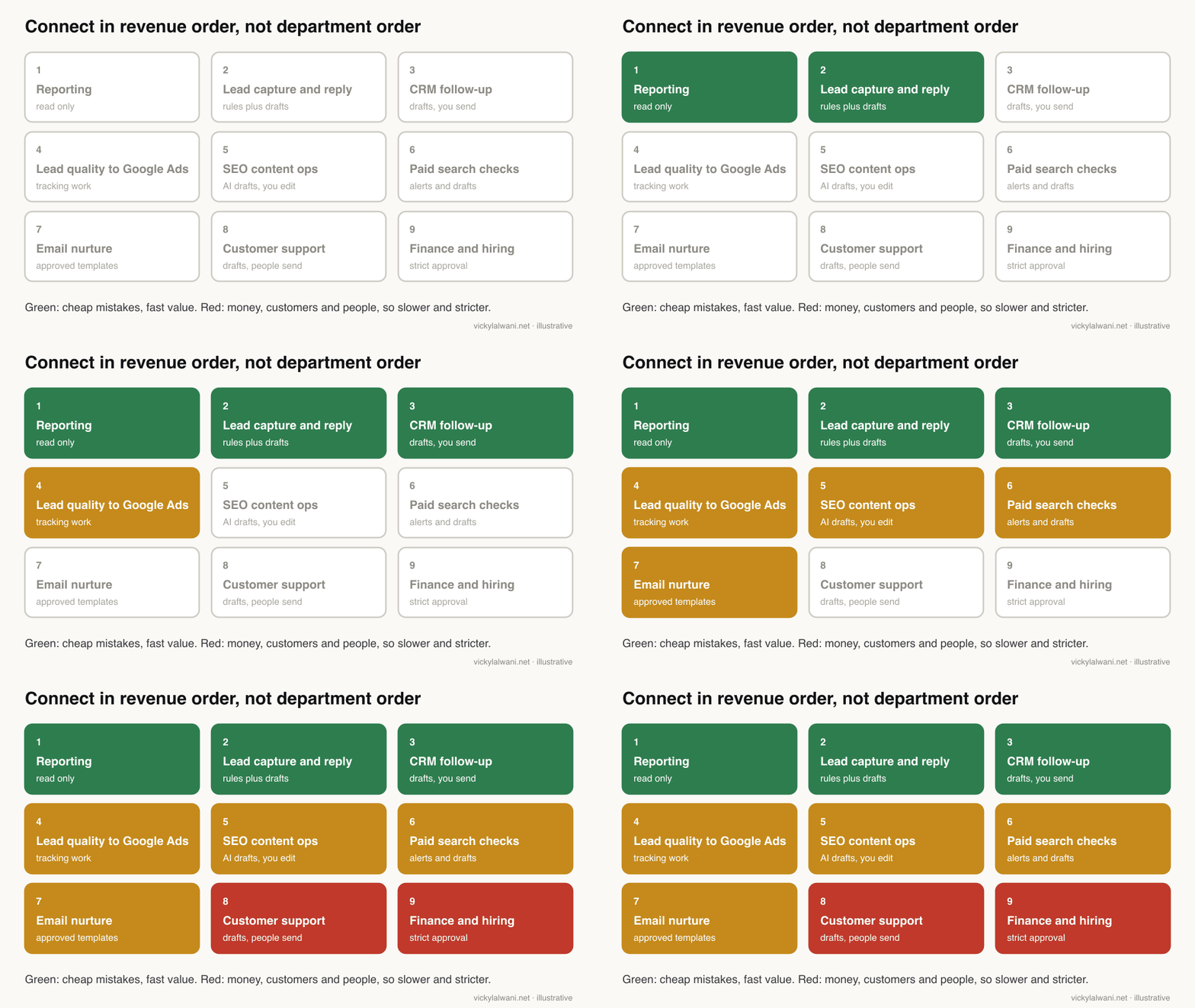
| Order | Area | AI does | You approve |
|---|---|---|---|
| 1 | Reporting | Pulls and summarises | Nothing; read-only |
| 2 | Lead capture and reply | Routes, replies from templates | The templates |
| 3 | CRM follow-up | Drafts the next email | Each send at first |
| 4 | Lead quality to Google Ads | Prepares the upload | What counts as qualified |
| 5 | SEO content | Finds gaps, drafts briefs | Every published word |
| 6 | Paid search checks | Alerts and draft changes | Bids, budgets, offers |
| 7 | Email nurture | Drafts sequences | The sequence |
| 8 | Customer support | Triages, drafts replies | Anything with risk |
| 9 | Finance and hiring | Prepares, reminds | Every payment and decision |
Reporting comes first because it is read-only and makes everything else visible. It is also the cheapest place to learn how your AI tool handles your data. A Claude Dashboards beta launched in October 2026 can connect to a CRM and build a live dashboard from a plain-language question, and every chart shows the query behind it, so you can check the maths.
For each area, write one paragraph describing what good looks like: how quickly a lead is answered, how a follow-up reads, how an applicant is acknowledged. Those paragraphs become the instructions your agents follow. If you cannot describe good in a paragraph, the process needs fixing before it gets automated. Automation magnifies whatever process it is given, including a poor one.
How does AI automation help lead generation?
Short answer: It makes sure every enquiry from search, ads or referrals lands in one CRM record with its source, gets an immediate reply, and reaches a person quickly. AI drafts the replies and summarises each lead; rules do the routing; a person makes the call and the promise. Generating more traffic is a separate job.
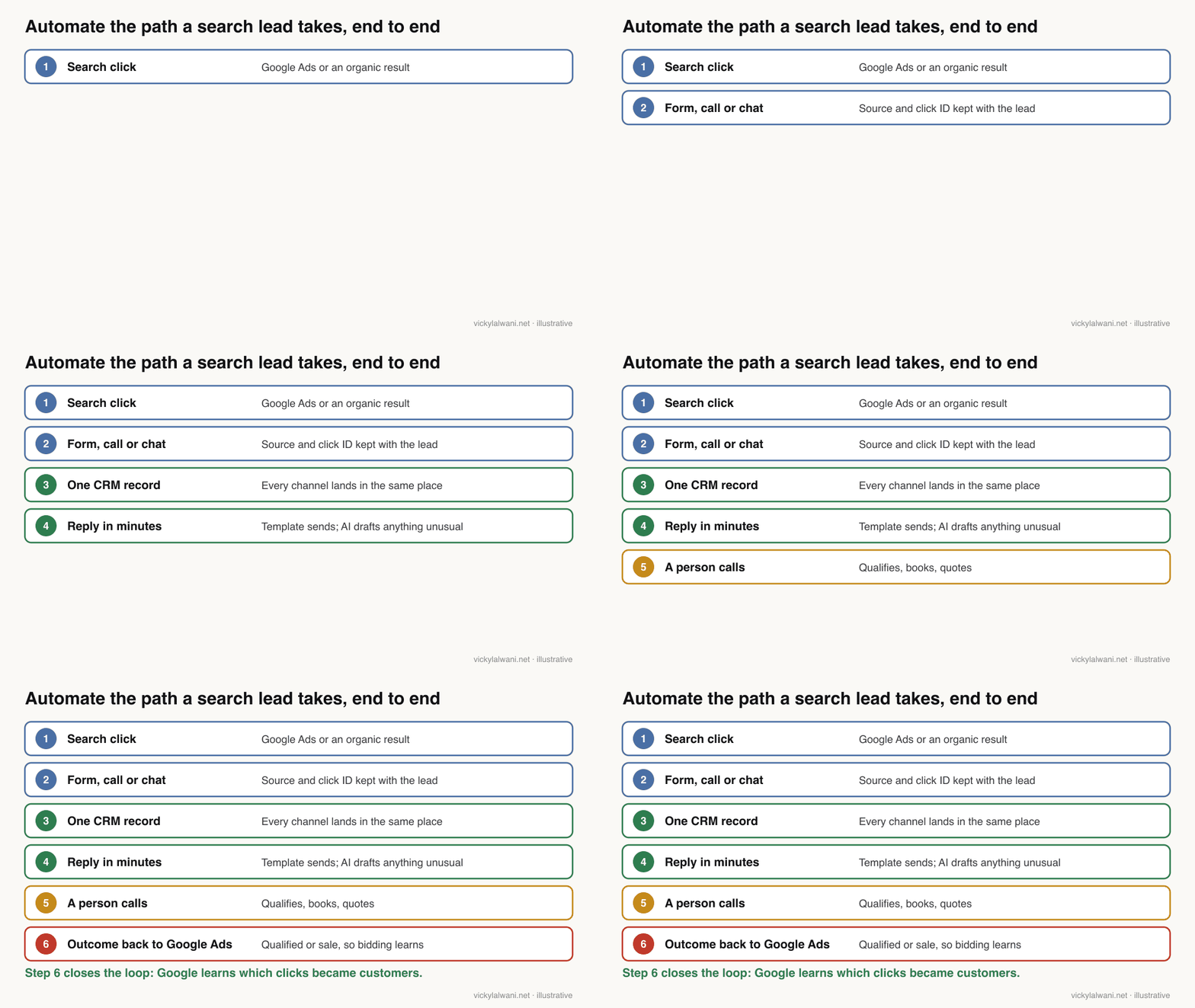
My habit on lead systems is "one system for leads": forms, chat, calendars and calculators all write to one CRM, and then I reconcile the conversions tracked in analytics against the leads in the CRM. When the two disagree, the gap is usually a form that is not tracked, a duplicate, or a source label that got lost.
| Step | Automate with | Watch for |
|---|---|---|
| Capture | Form and call tracking into the CRM | Lost source or click ID |
| Acknowledge | Rule: instant reply template | Sounding like a robot |
| Summarise | AI: one-line lead brief | Invented details |
| Route | Rule: owner by service or area | Nobody owns the gap |
| Book | Calendar link in the reply | Double bookings |
| Chase | AI drafts day 2 and day 5 follow-ups | Sending without review |
Do not overbuild this. A small business owner on r/smallbusiness described moving every phone, email and form lead into one shared sheet with a status column and one person owning follow-up within a day, and summed it up as "the habit beat the tool". Automation should make that habit impossible to skip, not replace it with something clever.
A copy-paste prompt for the "summarise" step, which keeps the AI from filling gaps with guesses:
You are preparing a lead brief for the person who will call this lead.
Use only the information below. If something is missing, write "not given". Do not guess.
Return:
1. Name and preferred contact method
2. What they asked for, in their own words (quote it)
3. Source: the channel and campaign or page, exactly as recorded
4. Urgency signals they stated (dates, deadlines)
5. Two questions the caller should ask first
Do not draft a reply, offer a price or make any promise.

Lead record:
[paste the CRM record or form submission]
The after-hours lead response guide goes deeper on calls that arrive when nobody is in, and the small business website guide covers the forms and pages that feed this path.
How do you feed lead quality back to Google Ads?
Short answer: Use enhanced conversions for leads: your website sends Google hashed details from the form, you keep the lead in your CRM, and when the lead becomes qualified or a sale you upload the same hashed data back. Google matches it to the ad click, so Smart Bidding can aim for customers instead of form fills.
Google's own account put it bluntly in March 2026: a form fill is just a signal; a closed sale is the goal. If your Google Ads account only knows about form fills, its automated bidding will find you more form fills, including the junk. A small business marketer on X described about 200 Meta form fills in a month, none of them genuine, which is the same problem on another platform.
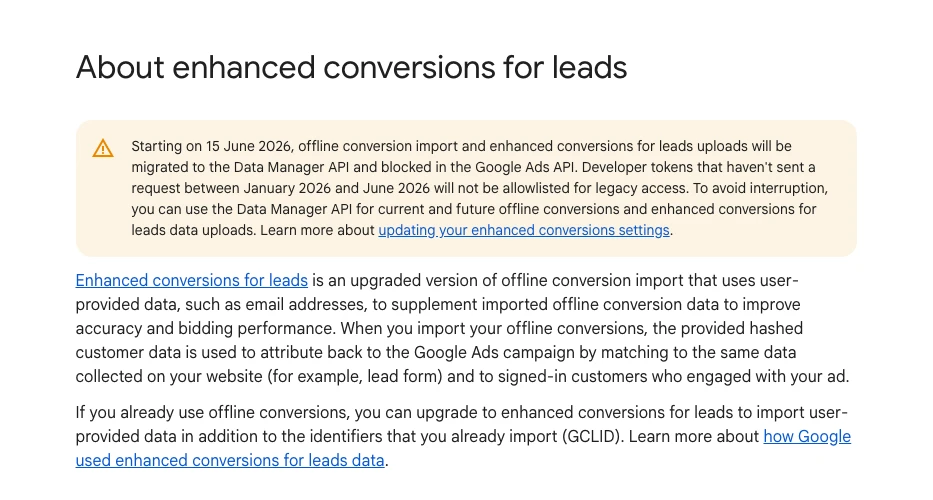
According to Google's help page, enhanced conversions for leads is an upgraded version of offline conversion import that uses data people give you, such as email addresses. Two practical points for 2026:
- The upload route changed. From 15 June 2026, offline conversion import and enhanced conversions for leads uploads moved to Google's Data Manager API and are blocked in the Google Ads API. Google's Ads Liaison account announced the Data Manager API in December 2025.
- Keep the click ID. Google asks you to include the GCLID (the Google click identifier in the landing page URL) with uploads where possible, and requires it if you do not collect user-provided data with a tag.
| Piece | Who sets it up | AI's role |
|---|---|---|
| Hashed form data via the Google tag | Tracking specialist | None |
| Lead stages in the CRM | You and sales | Suggests definitions |
| Upload of qualified leads and sales | Connector or scheduled job | Checks the file, flags gaps |
| Conversion goals in Google Ads | You or your PPC manager | None |
This is the step founders skip most often, and the one that links AI automation to paid search results. A practitioner on r/PPC who runs Claude Code and Codex on Google Ads, GA4, Search Console and the CRM wrote that Google Ads alone is not enough context: the ad platform can say a keyword converted, but only the CRM knows whether it became revenue. The conversion tracking event map guide shows how to plan the events, and my analytics and tracking service sets them up.
I always put tracking before spend: campaigns stay in draft until every form and call button is measured. The same rule applies here. Do not automate lead uploads until the stages in your CRM mean the same thing every time.
Where does AI fit in SEO for a founder?
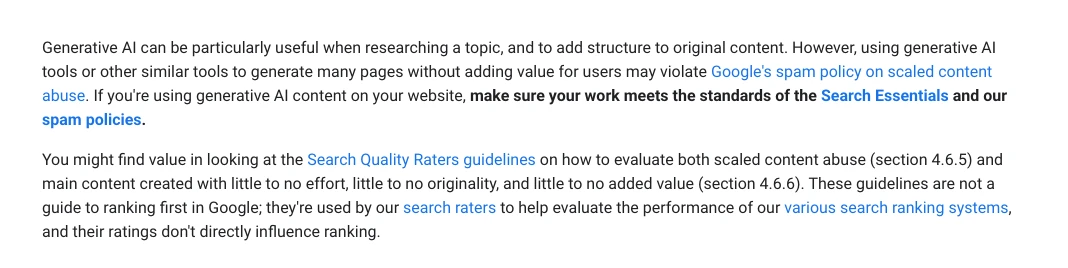
Short answer: AI is useful for the research and the first draft: reading Search Console data, finding pages that are slipping, grouping queries and drafting briefs. Google says AI content is fine if it is accurate and useful, but generating many pages without adding value may break its spam policy on scaled content abuse. A person edits and fact-checks everything that goes live.
Google's guidance on generative AI content is clear on both sides. It says generative AI "can be particularly useful when researching a topic, and to add structure to original content", and also that "it is critical to manually factcheck and review all AI-generated content". The same review applies to titles, meta descriptions, structured data and image alt text.
| SEO task | Verdict | Why |
|---|---|---|
| Weekly Search Console summary | Automate | Read-only, repeatable |
| Find pages losing clicks | Automate | Clear rule, easy to check |
| Keyword and query grouping | AI assists | Needs your service knowledge |
| Content briefs | AI assists | You add experience and proof |
| Publishing pages | Keep human | Accuracy and brand risk |
| Google Business Profile replies | AI drafts | Public and permanent |
Set expectations honestly. I tell business owners SEO takes six to nine months at minimum before it brings steady leads, so the quick wins come first: tracking, the lead path above and paid search. The AI SEO system guide shows the weekly routine in detail.
Paid search follows the same logic. Pacing alerts and tracking checks can run alone; search term reviews and ad drafts need your approval; bids, budgets and offers stay with you. The PPC automation guide scores each Google Ads task one by one.
How connected is the average marketing setup?
Short answer: Not very. In a 2026 survey of 500 marketers, 56% named data quality and 49% fragmented data pipelines as reasons not to hand more work to AI, 41% said their CRM or first-party data was not connected to their ad platforms, and only 19% had fully integrated tools.
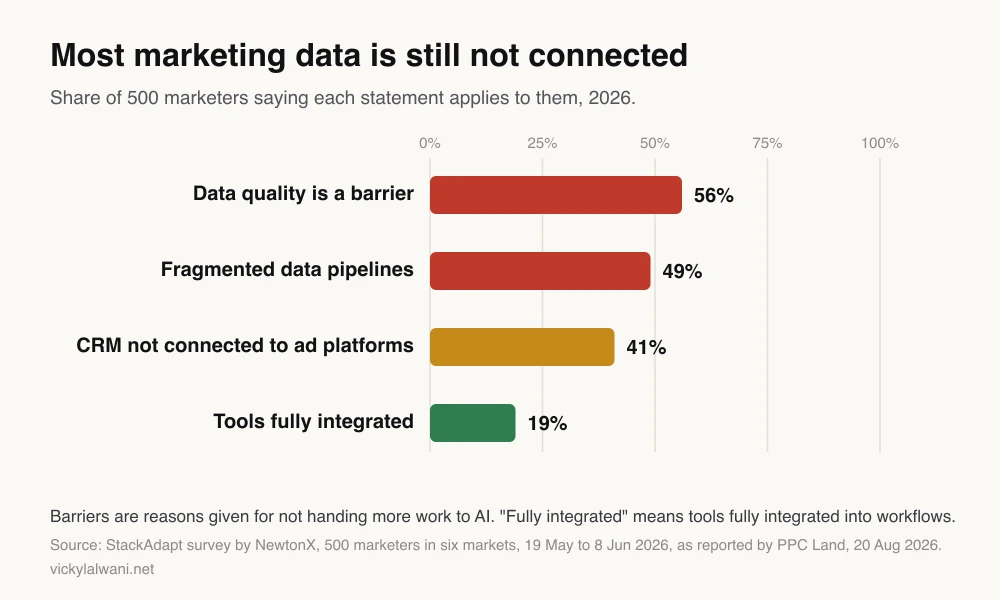
This is good news for a founder with a small team. The gap is not access to AI; almost everyone has that. The gap is plumbing: one CRM, consistent lead stages, a source on every record and a feed back to the ad platforms. A business that fixes the plumbing gets more from the same AI tools than one that buys more of them.
Treat the survey with care. StackAdapt sells advertising technology, the full report sits behind a form, and respondents are marketers, not founders.
What does a 90-day plan look like?
Short answer: Weeks 1 to 2: list your tools and fix tracking. Weeks 3 to 6: one CRM, instant replies and a weekly report. Weeks 7 to 10: lead stages and uploads to Google Ads. Weeks 11 to 13: SEO and paid search routines. Leave finance, hiring and support for the next quarter.
| Weeks | Focus | Done when |
|---|---|---|
| 1 to 2 | Tool list, owners, tracking | Every form and call is measured |
| 3 to 4 | One CRM, source on every lead | Analytics and CRM roughly agree |
| 5 to 6 | Instant reply, lead brief, weekly report | No lead waits overnight unanswered |
| 7 to 8 | Lead stages agreed with sales | Qualified means one thing |
| 9 to 10 | Qualified leads back to Google Ads | Uploads run on a schedule |
| 11 to 13 | SEO and PPC weekly routines | Each has an owner and a log |
Two rules keep this safe. Start with read access before write access, and check access live rather than trusting it: a surprising number of "I gave you access" moments turn out to be view-only logins or invitations that never arrived. And put approval before anything goes live, with a short human note on every report: where we are, what we are doing, what is next.
What should stay human?
Short answer: Prices, promises, refunds, hiring decisions, anything legal or medical, and any message that could embarrass you if it went out wrong. AI can prepare all of these; a person decides. Limit permissions so the tool can only see and do what the job needs.
| Keep human | AI can still |
|---|---|
| Quoting prices and terms | Pull past quotes and costs |
| Refunds and payments | Prepare the list for approval |
| Hiring and firing | Acknowledge applicants, schedule |
| Public replies with risk | Draft for review |
| Strategy and offer | Summarise the data behind it |
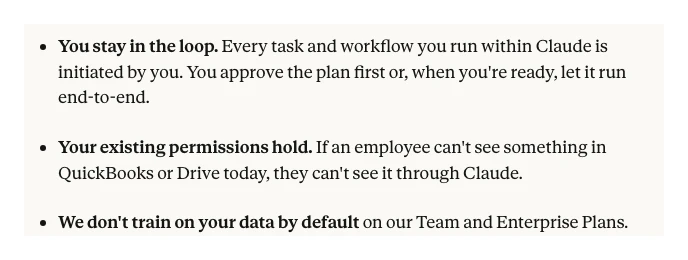
Anthropic builds the same rule into its small business package. Its launch post says workflows do not send, post or pay until you approve, and that "your existing permissions hold": if an employee cannot see something in QuickBooks or Drive, they cannot see it through Claude. It also reports that half of the small business owners it surveyed named data security as their biggest hesitation about AI.
What people say on X and Reddit
Short answer: Owners say the leak is after the lead arrives: missed calls, slow callbacks and enquiries spread across inboxes. Practitioners say ad data alone optimises the wrong thing without CRM outcomes. Google and Anthropic both push the same two ideas: send sale data back, and keep a person approving.
| Post | Where | Date | Type |
|---|---|---|---|
| One shared sheet beat new software | r/smallbusiness | 6 Nov 2026 | First-hand |
| After-hours calls are the biggest leak | r/smallbusiness | 20 Oct 2026 | First-hand |
| Is the hard part getting leads or answering them? | r/smallbusiness | 2 Nov 2026 | Opinion, vendor |
| Ads data alone is not enough context | r/PPC | 28 Apr 2026 | First-hand |
| Clean tracking, bad front desk | r/PPC | 30 Aug 2026 | First-hand |
| A form fill is just a signal | X, Google Ads | 25 Mar 2026 | Official |
| Data Manager API launch | X, Google Ads Liaison | 9 Dec 2025 | Official |
| Scheduled tasks, follow-ups left unsent | X, Claude | 7 Jul 2026 | Vendor |
| Dashboards from a CRM | X, Claude | 8 Oct 2026 | Vendor |
| 200 form fills, none genuine | X, a small business marketer | 28 Jun 2026 | First-hand |
- Process before tools. The r/smallbusiness intake thread is the plainest version of this article: one place for leads, one owner, a one-day rule.
- The leak is after the click. In the "getting leads or answering them" thread, the poster (who says they sell lead follow-up services) asks whether answering is now harder than getting leads.
- Ad data is not business data. The r/PPC practitioner using Claude Code on the Google Ads API found the main lesson was context: CRM outcomes, offline conversions and notes on strategy.
- Vendors agree on approval. Claude's own scheduled tasks post describes follow-ups "drafted but unsent", with decisions sent to your phone.
These are individual reports, not studies. I use them as a checklist of what to test, not as proof of how common each problem is.
Videos worth watching
Short answer: Start with Google's implementation guide for enhanced conversions for leads, the step that links your CRM to Google Ads bidding, then Google Search Central's mid-2026 news update for what changed in Search reporting.
From the official Google Ads channel, July 2025. It shows how to measure sales that happen offline with enhanced conversions for leads. Google's own product guidance; note that uploads now go through the Data Manager API.
From Google Search Central, June 2026: the quarterly Google Search News episode, including generative AI performance reporting in Search Console. Official, not selling anything.
| Video | Channel | Date | What it covers |
|---|---|---|---|
| Enhanced conversions for leads guide | Google Ads | Jul 2025 | Sending lead outcomes back |
| Search news, Q2 2026 | Google Search Central | Jun 2026 | Gen AI reports in Search Console |
| Search news, Q1 2026 | Google Search Central | Apr 2026 | AI websites, crawling, Search Console |
| Set up Claude for Small Business | An AI tutorials channel | Oct 2026 | Setup walkthrough (sponsored) |
| How speed to lead works | Kixie (vendor) | Jan 2026 | Response speed; sells calling software |
Where this advice is weak
Short answer: The revenue-first order suits service businesses that sell through enquiries. Ecommerce, subscription and B2B companies with long sales cycles may need a different first step, and the survey and response-time figures come from vendors.
- Not every business sells through leads. An online shop may get more from automating stock, feeds and customer service first.
- Response-time data is weak. The best-known studies are old or vendor-run. The direction is consistent; the exact numbers are not.
- Enhanced conversions for leads needs volume and consistency. If you close a handful of deals a month, the signal to Google is thin, and clean lead stages matter more than the upload.
- Tools change fast. Claude for Small Business, Claude Dashboards and the Data Manager API all launched or changed within the past year. Re-check the linked pages before you build.
- Privacy and consent rules vary by country. Sending customer data to ad platforms needs consent and a lawful basis; check with a professional for your market.
Want help connecting leads, search and your CRM?
Short answer: I map the path from search click to sale, fix the tracking, connect the CRM, set up replies and lead briefs, and send lead quality back to Google Ads, with approval rules you control. You keep every decision on prices, budgets and people.
My AI automation service covers the mapping, build and support, and the pricing page shows how projects are quoted. If you would rather start with the traffic, see Google Ads management or SEO consulting.
The founders who do well over the next couple of years will not be the ones working the most hours. They will be the ones who turned the company into a system, starting where the money comes in.
Sources
| Source | What it supports | Date | Link |
|---|---|---|---|
| Anthropic | Claude for Small Business: workflows, connectors, approval, permissions, survey | 13 May 2026 | Launch post |
| Google Ads Help | Enhanced conversions for leads; Data Manager API from 15 Jun 2026; GCLID | Read 18 Nov 2026 | Help page |
| Google Search Central | AI content guidance, scaled content abuse, fact-checking | Read 18 Nov 2026 | Guidance |
| StackAdapt via PPC Land | Chart: data quality, pipelines, CRM, integration | 20 Aug 2026 | Article |
| FranFunnel (vendor) | Franchise lead response study, 530 brands | Fielded Mar to Apr 2025 | Study page |
| X | Google Ads, Ads Liaison, Claude, a marketer | Dec 2025 to Oct 2026 | Linked above |
| r/smallbusiness and r/PPC threads | Apr to Nov 2026 | Linked above | |
| YouTube | Five videos, titles checked by oEmbed | Jul 2025 to Oct 2026 | Linked in the videos table |
This article expands on my post on LinkedIn ↗.
FAQ
What should a founder automate first with AI?
Start with read-only reporting, then the path a lead takes after a search click: capture into one CRM, an instant reply and a lead brief for whoever calls back. Those steps are cheap to get wrong and quick to pay back, unlike finance or hiring.
How does AI automation help lead generation?
It makes sure every enquiry lands in one place with its source, gets an immediate reply and reaches a person fast. AI drafts replies and summaries, rules route the lead, and a person makes the call. It improves conversion of existing traffic rather than creating new traffic.
How do I send lead quality back to Google Ads?
Use Google Ads enhanced conversions for leads. Your site sends hashed form data through the Google tag, and when a lead qualifies or buys you upload the same hashed data, ideally with the GCLID. Since 15 June 2026 these uploads go through Google's Data Manager API.
Can AI write my SEO content?
AI can research, structure and draft, but Google's guidance says to fact-check and review all AI-generated content, including titles and meta descriptions. Generating many pages without adding value may break Google's spam policy on scaled content abuse, so a person should edit everything that goes live.
What is Claude for Small Business?
It is a package Anthropic launched on 13 May 2026 inside Claude Cowork, with 15 workflows, 15 skills and connectors for tools such as HubSpot, QuickBooks, PayPal and Google Workspace. Anthropic says nothing sends, posts or pays until you approve it.
Do I need a custom AI system or can I use existing tools?
Usually existing tools. Your CRM, calendar, analytics and ad accounts stay the source of truth, and an AI layer plus simple rules connects them. Custom builds make sense only when a step is unusual for your business and repeats often.
What should never be automated in a small business?
Prices, promises, refunds, payments, hiring decisions and anything legal or medical. AI can prepare these for you, but a person should decide and send. Limit tool permissions so the AI can only see what each job needs.
How long does it take to set up AI automation for a business?
In the 90-day plan in this guide, tracking, one CRM, instant replies and a weekly report are planned for weeks 1 to 6. Feeding lead quality back to Google Ads and adding SEO and PPC routines fill the rest of the quarter; the real pace depends on your tools and how clean your data is.