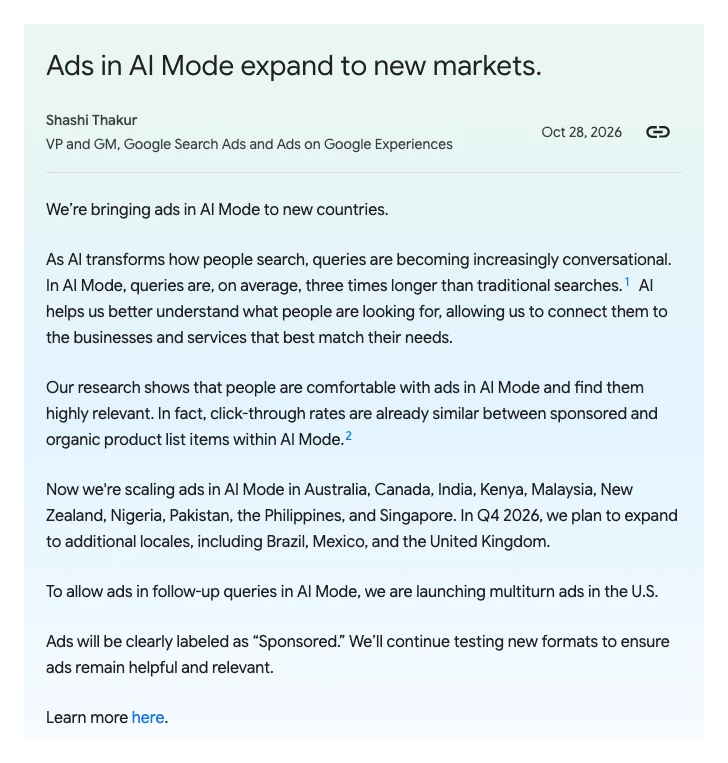
Since 28 October 2026, Google has been scaling ads inside AI Mode in Australia. Existing Search, Shopping and Performance Max campaigns are eligible automatically, in English, through the same auction and bidding as normal Search, with no surcharge. Broad match, AI Max for Search, Shopping and Performance Max can match ads to both the question and Google's AI answer; exact and phrase match only reach plainly commercial searches. There is no separate opt out and no AI Mode report: results are mixed into normal campaign and search terms reports. Ads in follow-up questions are US only for now.
Running Google Ads in Australia? Do three things this week:
1. Find out which campaigns reach AI Mode's long questions. Broad match, AI Max, Shopping and Performance Max can; exact and phrase can't. Some campaigns were moved to AI Max automatically in September 2026.
2. Read the last two weeks of search terms, longest first. Add negatives for questions you can't serve, and check the landing pages Google picked.
3. Mark 29 October 2026 in your reports. From then on, AI Mode clicks sit inside your normal numbers, right as Black Friday and Christmas traffic arrives.
TL;DR
- What happened: on 28 October 2026 Google started scaling ads inside AI Mode in Australia (Google).
- Who's in: existing Search, Shopping and Performance Max campaigns, automatically. Text and Shopping ads, English only (Google Ads Help).
- Opt out: there isn't one. Negative keywords and brand exclusions still apply.
- Cost: same auction and bidding as normal Search, no surcharge.
- Reporting: AI Mode results are mixed into your normal reports. There's no AI Mode segment.
- Google's own caveat: it told investors it was seeing "lower monetization" in AI Mode (Alphabet transcript).
Jump to: What changed · AI Mode vs AI Overviews · Eligible campaigns · Matching · Match types · Opt out? · AI explainers · Reporting · What to change · Practitioners · Evidence · Not confirmed yet · Open questions
Picture a Monday in November. You look after Google Ads for a Sydney plumbing business.
The search terms report has new rows that read like someone talking: "is it safe to use my shower if the hot water is leaking". Spend is up a little. Calls aren't.
Nobody changed the account. So is this AI Mode? Should you block it or lean in?
Google answers part of that in its help pages. The rest it hasn't answered yet, and this guide shows you which is which.
How this was checked. Facts and screenshots come from Google's public blog and Google Ads Help pages, read on 10 November 2026 without logging in to any account. Australian dates come from Google's Australia blog and archived copies of Google's help page.
The plumbing business and the search terms in the GIFs are illustrative. Practitioner reports are credited to whoever made them.
What changed in Australia in October 2026
On 28 October 2026, Google said it is "scaling ads in AI Mode in Australia", along with nine other markets (Google Ads blog). In Sydney that was the morning of 29 October.
"Scaling" matters. It reads as a rollout, not a switch flipped in every account on one day. Google gave no other Australian date.
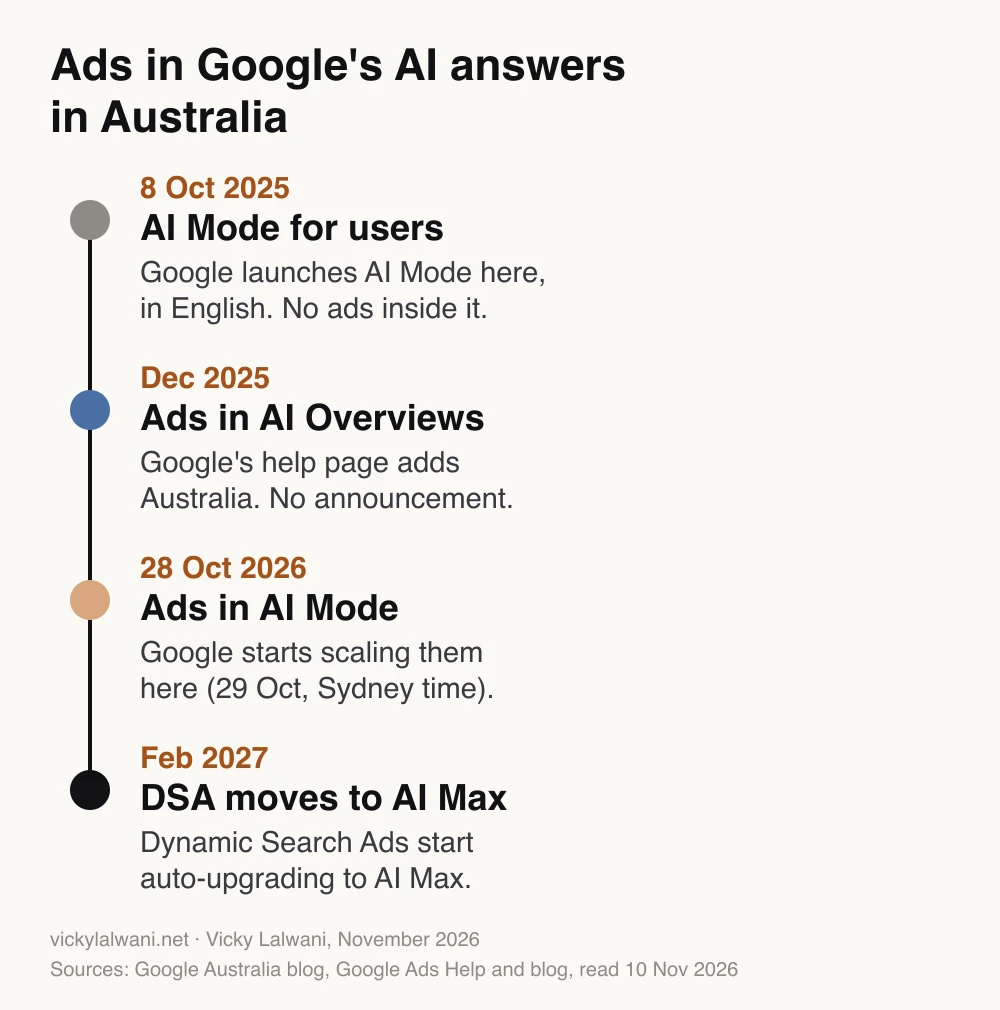
It's the third step here, not the first:
- 8 October 2025: AI Mode itself opened to Australian users, in English (Google Australia).
- December 2025: ads inside AI Overviews reached Australia. There was no announcement; Google's help page simply added Australia to its list (archived help page).
- 28 October 2026: ads inside AI Mode.
One thing didn't come with it: ads in follow-up questions, which Google calls multiturn ads, launched in the US only. Still, Australia is in the first group of markets after the US, so Australian accounts are among the first to deal with this.
AI Mode vs AI Overviews: where your ads can show
People mix these up, and so do some agency reports. AI Max is a third thing again: a campaign setting, not a place on the page. Define all three in client reports.
| AI Overviews | AI Mode | |
|---|---|---|
| Where | Top of normal results | Its own tab, a chat |
| Ads | Above, below or inside | Inside or alongside |
| Ads inside (AU) | Since Dec 2025 | Since Oct 2026 |
| Follow-up ads | Not applicable | US only |
| Language (AU) | English | English |
Normal search ads still show above or below an AI Overview, too.
Getting cited in these answers is a different job. See Google AI Mode SEO and how to appear in Google AI Overviews. Google says buying ads doesn't change what its AI says or which sites it cites (Google Ads Help).
Which campaigns can show ads in AI Mode
You don't build anything. Google says existing Search, Shopping and Performance Max campaigns are "automatically eligible", with no new campaign and no separate budget (Google Ads Help).
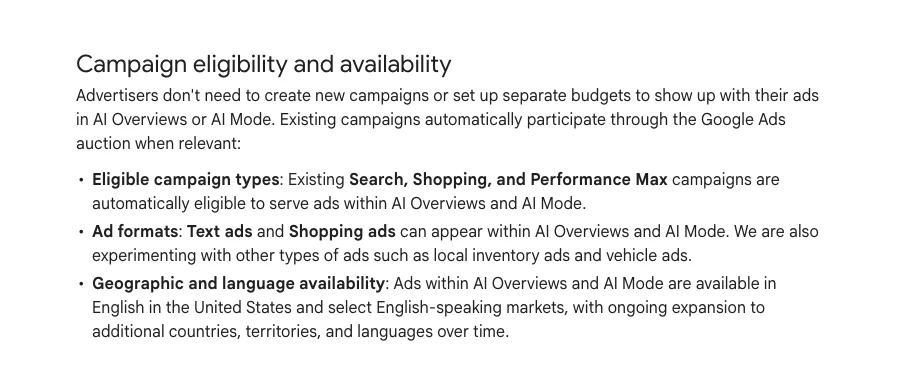
- Ad types: text ads and Shopping ads. Google is "experimenting" with local inventory ads and vehicle ads, with no country named.
- Not listed: Demand Gen, Display, Video and App campaigns.
- Language: English only in Australia.
- Cost: the same auction, and the same CPC or conversion-based bidding, as normal Search. No extra charge, though what you pay per click still depends on the auction.
So the question isn't "should we join". You're in. It's which of your settings decide how far in.
How Google matches ads to AI Mode answers
This is the part most guides skip, and it decides almost everything else. Google matches ads in AI Mode and AI Overviews in two ways (Google Ads Help):
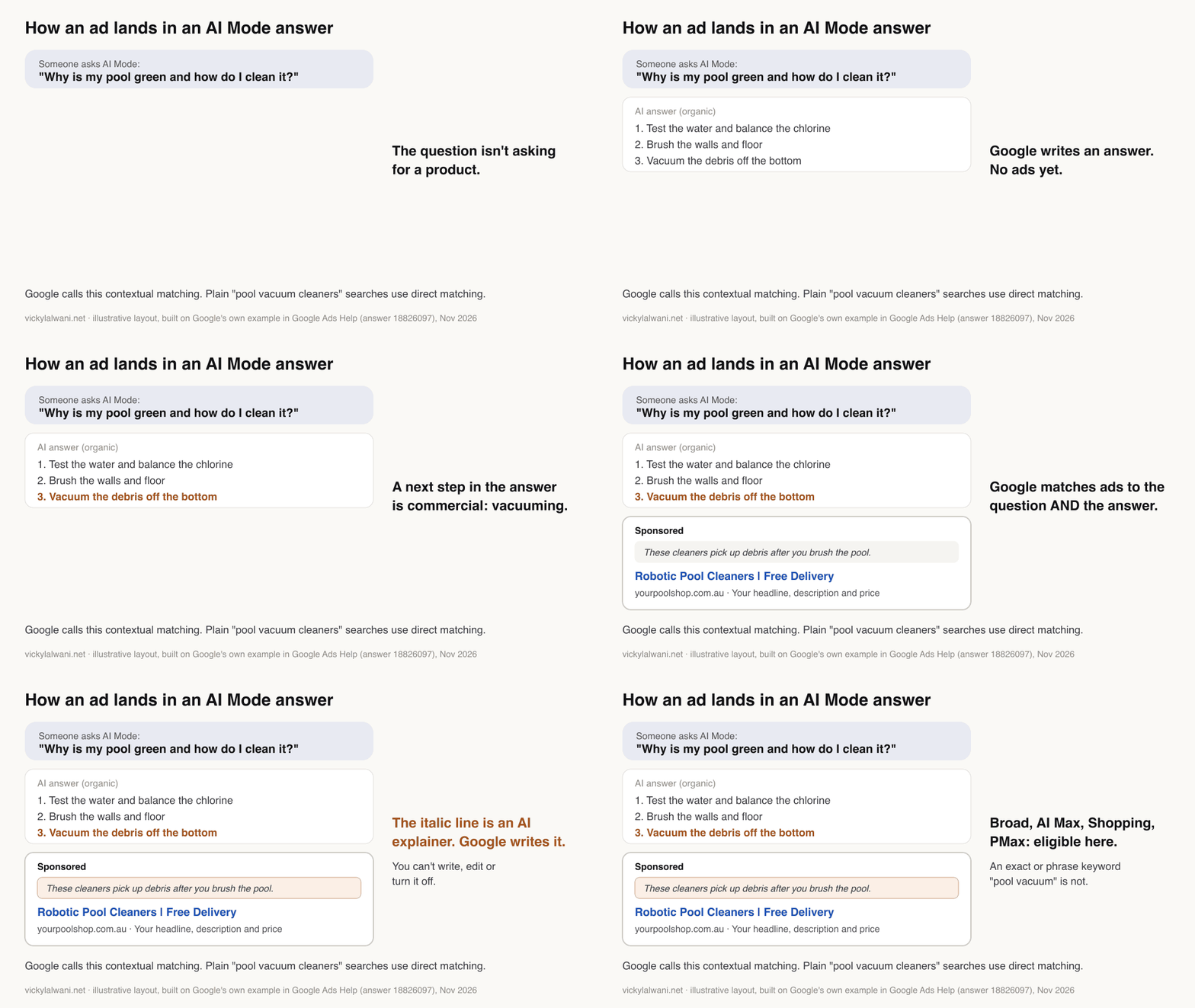
- Direct matching. The search is already commercial, like "pool vacuum cleaners". Google matches ads to the query, the same as on the normal results page.
- Contextual matching. The question isn't commercial, like "why is my pool green and how do I clean it?". But Google's answer says to vacuum the pool, so Google matches ads to the question and its own answer.
Contextual matching is the new part. The searcher never typed anything you'd bid on. Your ad only had to fit what the answer suggested next.
Which of your settings get which kind of matching (Google Ads Help):
| Setting | Direct | Contextual |
|---|---|---|
| Exact match | Yes | No |
| Phrase match | Yes | No |
| Broad match | Yes | Yes |
| AI Max for Search | Yes | Yes |
| Shopping | Yes | Yes |
| Performance Max | Yes | Yes |
Exact, phrase, broad and AI Max: what each one reaches
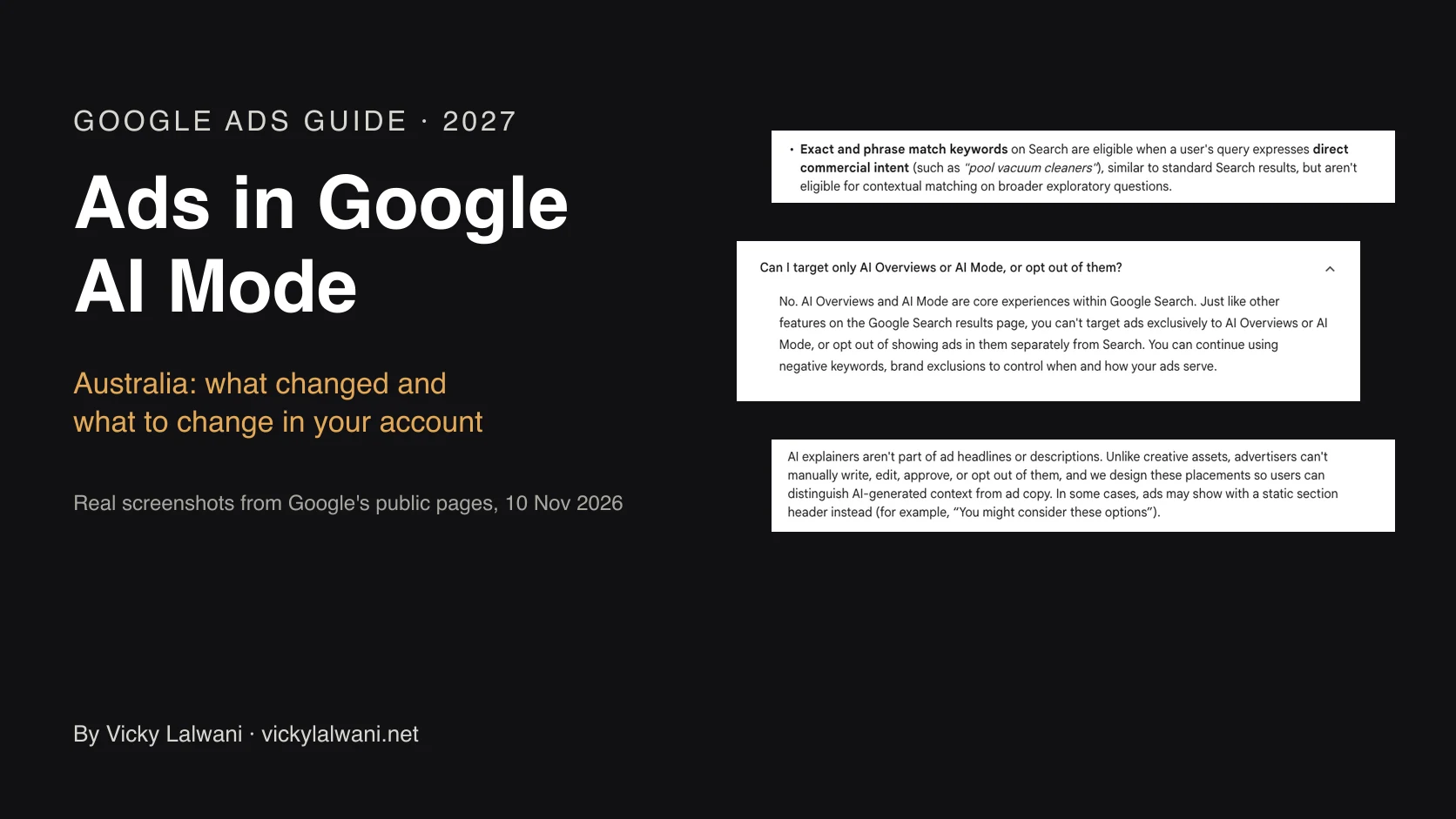
Here's the rule in Google's words:
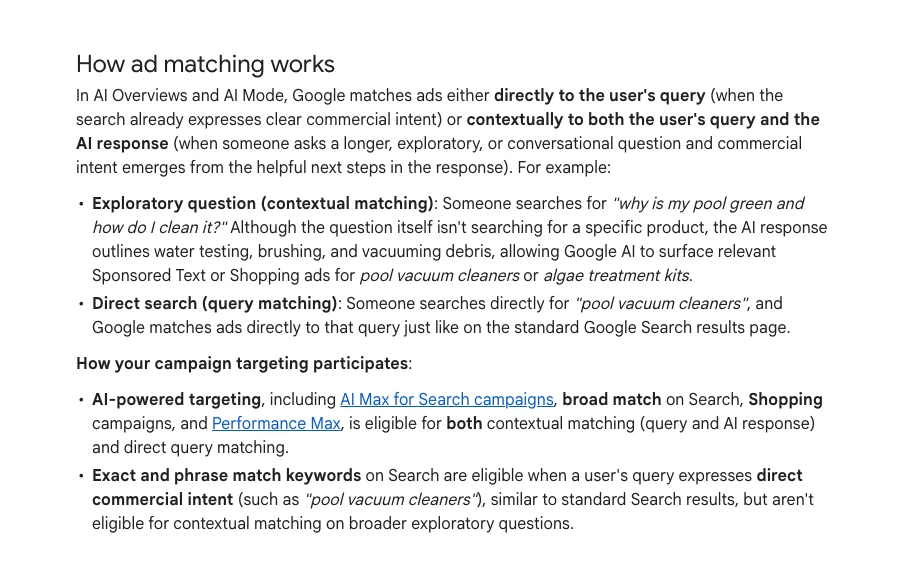
That corrects older advice, including Google's own. Exact match isn't shut out of AI Mode; it just can't follow the conversation.
Google's Ads Liaison, Ginny Marvin, described exact and phrase eligibility in AI Mode as a small experiment in September 2026 (Relevant Audience). It's now on the help page.
Three details change how you read your own account:
- AI Max widens exact and phrase. With search term matching on, AI Max goes beyond your keywords. Mike Ryan of Smarter Ecommerce looked at about a million AI Max impressions. On average about 80% came from widening exact match keywords, and Ryan suspects competitor brand names are a big part of that (Search Engine Roundtable).
- Some campaigns got AI Max without anyone choosing it. Google began upgrading campaigns that used automatically created assets or the campaign-level broad match setting in September 2026. Dynamic Search Ads follow from February 2027 (Google Ads blog).
- Keyword priority may not hold. Normally your exact match keyword wins over Performance Max for the same search (Google Ads Help). For AI Mode searches, Google says the search term is "the best approximation of the user's intent", so keywords may not get priority automatically (Google Ads Help).
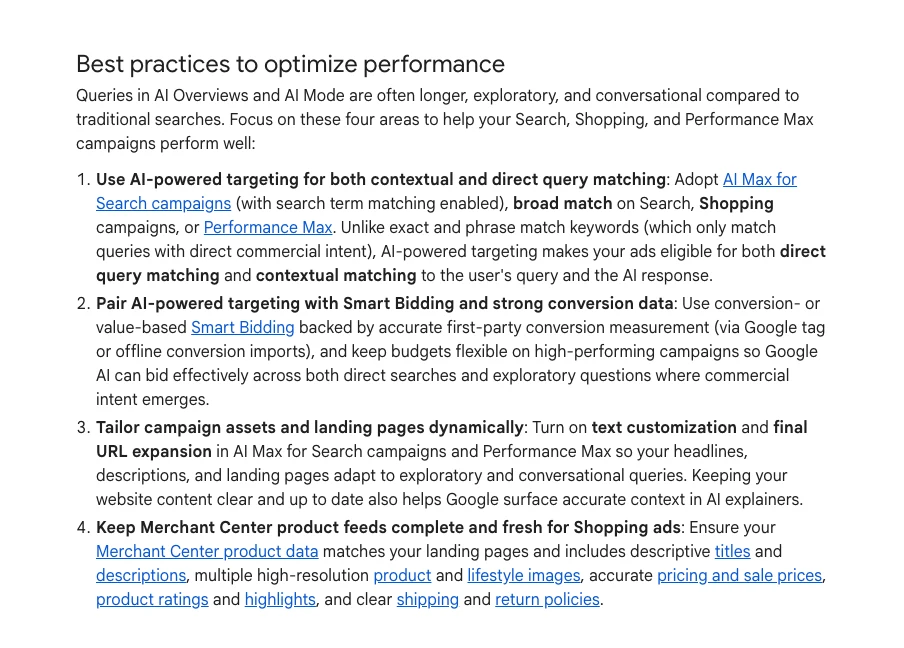
Google's advice is to move to AI-powered targeting with Smart Bidding, and to turn on text customisation and final URL expansion (Google Ads Help). That advice also sells more of Google's new inventory, so test it rather than take it on trust. Broad match is eligible without AI Max, a smaller first step (TechWyse).
Test broad match or AI Max if
- Your tracking counts real leads or sales, ideally with offline conversions.
- Customers ask questions before they buy: pool care, solar, renovations, courses.
- Someone reads search terms every week.
- Budgets aren't capped every day.
Stay on exact and phrase for now if
- Lead quality swings and you can't measure it.
- The budget is small and already runs out daily.
- You're in finance, health or gambling, where Google hasn't said what applies.
- Nobody has time to check search terms.
A cautious middle path: keep exact and phrase campaigns as they are, and test broad match or AI Max on one campaign as a Google Ads experiment. More on targets in Target CPA vs Maximize Conversions.
Can you opt out of ads in AI Mode?
No. Google says you can't target AI Mode or AI Overviews on their own, "or opt out of showing ads in them separately from Search" (Google Ads Help).
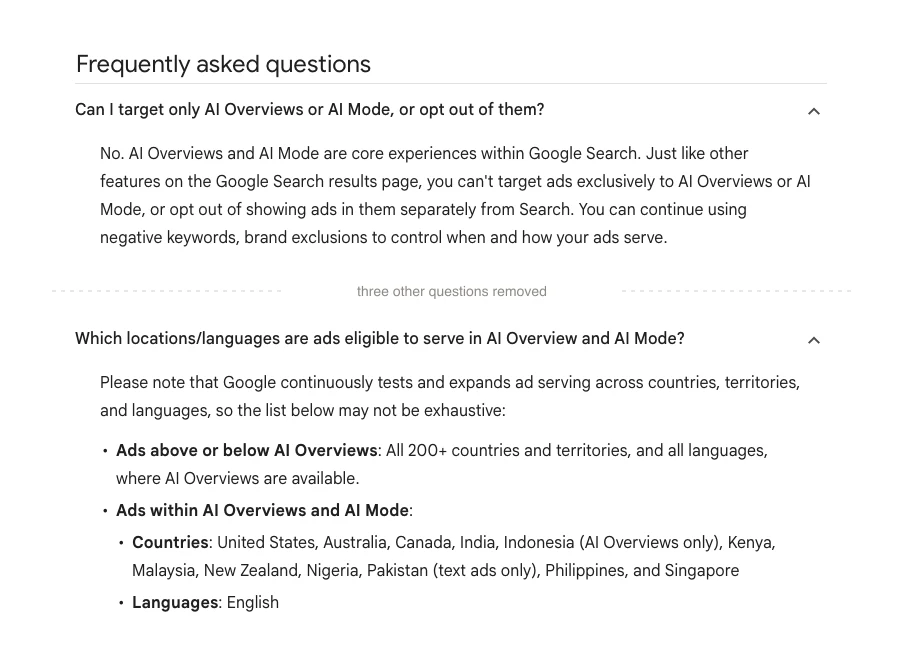
What you can still control:
- Negative keywords. Campaign, shared and account-level lists all still apply.
- Brand exclusions. Keep ads off brands you don't want, and your own brand out of non-brand campaigns. In Search campaigns these now sit in the AI Max settings, so exact and phrase campaigns use brand negative keywords instead (Google Ads Help).
- AI Max switches. Search term matching can be turned off per ad group. Text customisation and final URL expansion are campaign settings (Google Ads Help).
- URL exclusions. Stop Google picking careers pages, blog posts or old promos as landing pages (Google Ads Help).
- Asset pinning. Pins still apply, but Google says they may not be used once final URL expansion is on.
What you can't control: whether an ad that's eligible on normal Search also shows in AI Mode, and the AI explainer Google adds next to it.
AI explainers: the text Google adds to your ad
Every ad in AI Mode carries a "Sponsored" label. Google builds it from your existing headlines, descriptions, images, prices and landing pages.
The surprise is what can sit next to it. In some AI Mode and AI Overviews layouts, Google adds a short line written by its Gemini model that introduces a group of ads or adds context next to yours (Google Ads Help).
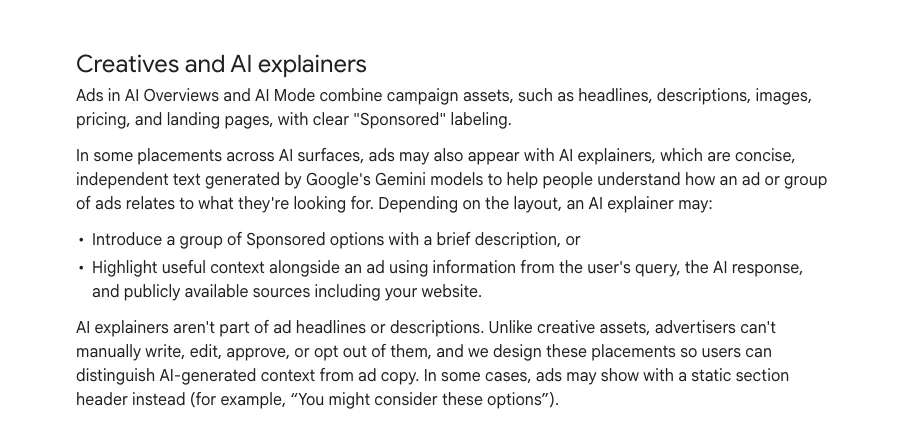
It can draw on the question, the AI answer and your website. It isn't part of your ad, and you can't write, edit, approve or opt out of it.
Google is testing more of it: on 9 November 2026, Search Engine Roundtable reported AI summaries above and under ads on mobile, market unnamed (Search Engine Roundtable).
Your only lever is your website, and Google's own best practices say clear, current site content helps it write accurate explainers. If a summary paraphrases your site, make sure the site is right:
- Prices and "from" prices are current.
- Service areas list the suburbs and cities you actually cover.
- Terms, guarantees and licences are in plain text.
- Old promos are gone or clearly dated.
If you need set wording in every ad, Google's text disclaimers for AI Max keep it in the ad even with final URL expansion on (Google Ads blog). They don't change the AI explainer.
How to see AI Mode performance in your reports
Say a client asks how AI Mode is doing for them. You open Google Ads to look for a segment.
There isn't one. Google says AI Mode and AI Overviews results are "included in aggregate" in your campaign reports and the search terms report (Google Ads Help).
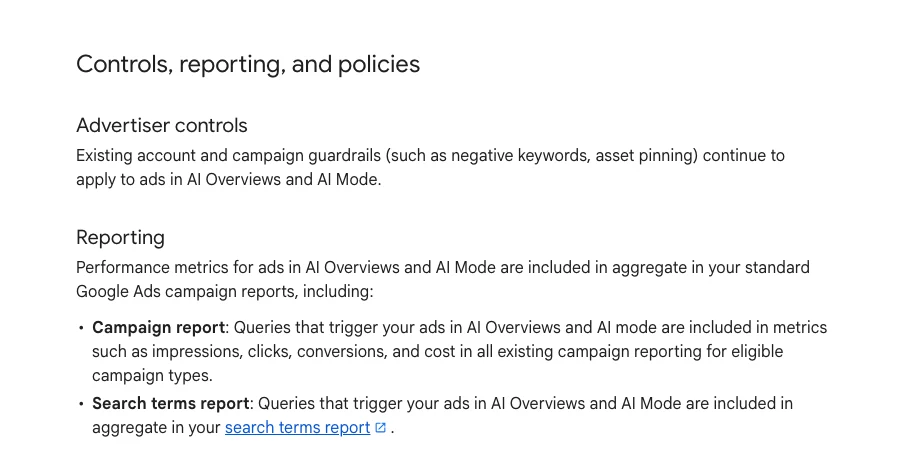
There's no AI Mode segment, column or channel. The Performance Max channel report lists Google Search, not AI Mode (Google Ads Help).
In GA4, with auto-tagging on, a click on an ad in AI Mode looks like any other Google Ads click. Search Console covers only the organic side; see the Search Console generative AI report.
Retailers get one partial view: Merchant Center's AI performance insights, live in Australia since September 2026, show your share of voice on AI Mode and AI Overviews (Google). That's visibility, not ad results.
Two more catches make the search terms report harder to read:
- For AI Mode searches, the term shown is Google's "best approximation" of what the person meant, not always their words (Google Ads Help).
- Low-volume searches are left out of the list and only counted in the "Other search terms" total (Google Ads Help, Google Ads Help). Long, one-off questions are likely to end up there.
What you can see is how a search matched. AI Max adds an "AI Max" match type and a source column for broad match expansion or keywordless matching. The landing pages report shows pages AI Max picked in a "Selected by" column (Google Ads Help).
A rough proxy. Google says AI Mode queries in the US are on average three times longer than traditional searches (Google). There's no Australian figure, but it's a fair starting point: sort your search terms by length and look hard at the long, question-style ones.
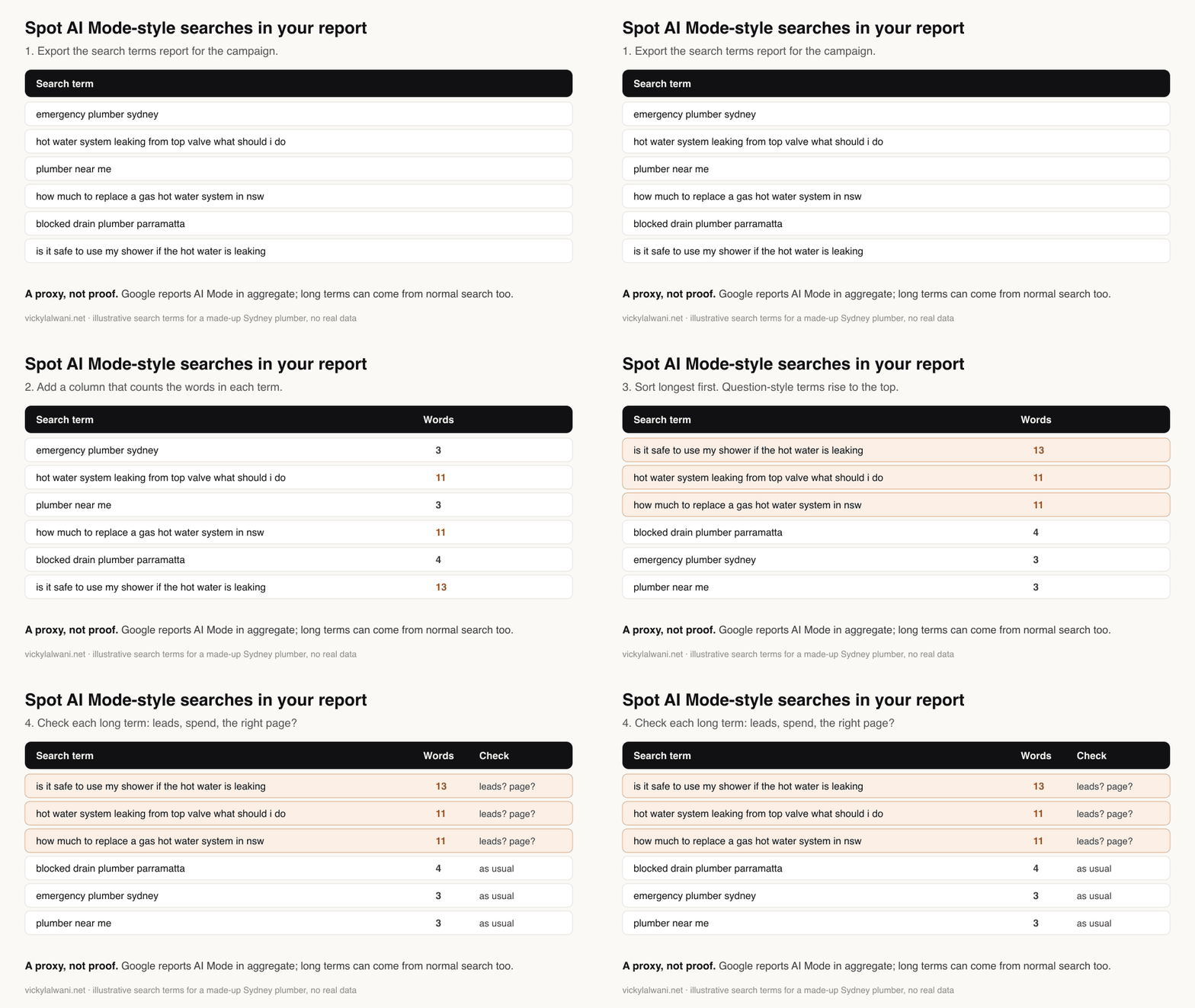
Treat it as a flag, not proof. Voice searches and ordinary long-tail searches are long too.
Watch the calendar. Google started scaling ads in AI Mode here on 29 October, Sydney time. Black Friday is 27 November, then Christmas and Boxing Day.
Any before-and-after comparison over the next eight weeks mixes AI Mode with the busiest retail season of the year. Compare year on year, test any setting change as a Google Ads experiment, or wait for January.
This prompt does the sorting. Paste it into Claude or ChatGPT with a search terms export, after removing any personal details:
You are analysing a Google Ads search terms export for an Australian account. Currency is AUD.
Columns may include: Search term, Match type, Source, Campaign, Ad group, Keyword, Impressions, Clicks, Cost, Conversions, Conv. value.

Ignore total rows and the "Other search terms" row.

1. Add to every row:
   - word_count, and a length bucket: 1-3, 4-6, 7-10, 11+
   - is_question: starts with how, what, which, why, when, can, should, is, does or do, or ends with "?"
   - has_comparison: contains the whole word vs, versus, best, compare, cheapest or alternative
   - has_constraint: a price, a place or "near me", a time, or "for [someone]"
   - score: one point each for 7+ words, question, comparison, constraint
2. Call score 2 or more "AI Mode-style". Say clearly this is a proxy: Google doesn't report where a search served.
3. Summarise by length bucket and by AI Mode-style yes/no: share of cost, clicks, conversions, conversion rate, CPA, and ROAS if value exists.
4. If Match type or Source exist, repeat the summary split by them.
5. List the 20 most expensive AI Mode-style terms with a one-line intent note: researching, comparing, ready to buy, or off-topic.
6. Compare only with this account's own averages. Don't invent benchmarks. Say where volumes are too small to conclude anything.
What to change in your Google Ads account
Say you have one hour this week and your Black Friday plan is already locked. Spend the hour in this order. None of it needs a new campaign, and don't rebuild a working account for a placement you can't measure yet.
This week
- Map your matching. Add the AI Max columns to your campaign list (Google Ads Help). Note which campaigns are exact and phrase only, broad, AI Max, Shopping or Performance Max. Check change history and notifications for September 2026 upgrades.
- Check budgets. Google says AI Max won't be effective on campaigns "Limited by budget" (Google Ads Help). Lift the cap or keep those on exact and phrase.
- Refresh negatives. Build an account-level list from the search terms since 29 October. Check it doesn't block anything that converted.
- Set brand exclusions in Performance Max and AI Max campaigns for competitors you don't want, and for your own brand in non-brand campaigns. In exact and phrase campaigns, add brand names as negative keywords.
- Check the pages Google chose. In the landing pages report, filter "Selected by" for AI Max and exclude pages with no next step. URL rules match whole words: "faq" won't block "/faqs" (Google Ads Help).
- Mark 29 October 2026 in your reports and dashboards.
This month
- Fix tracking before you test. Count real leads or sales. For lead gen, import offline conversions or lead quality. Google ties AI Mode performance to accurate first-party conversion data (Google Ads Help). Start with the conversion tracking audit.
- Tidy Shopping and Performance Max feeds. Google's list: descriptive titles and descriptions, several high-resolution product and lifestyle images, accurate prices and sale prices, ratings and product highlights, and clear shipping and returns policies (Google Ads Help). Optional conversational attributes, such as questions and answers, can go in a supplemental feed (Merchant Center Help).
- Run one test. Try broad match or AI Max on one campaign as an experiment. Google asks for two weeks before changes like new negatives (Google Ads Help), but check for obvious waste sooner.
- Fix thin landing pages that long questions land on: answer the question, then give the next step.
- Make every headline stand alone. Google reassembles ads, so cut headlines that only work in a set order.
Before February 2027
- Upgrade Dynamic Search Ads yourself before the automatic upgrade starts in February 2027, so you choose the settings (Google Ads blog).
- Check Search campaigns with the Display Network on. From February 2027 their current spend split goes away. Google says to set the Display Network to Low priority with a 50% budget allocation to keep today's setup (Google Ads blog).
- Set a review for when ads in follow-up questions reach Australia. Google hasn't given a date.
Common problems and fixes:
- Long questions, spend, no leads. Add negatives for the theme, or turn off search term matching in that ad group.
- Clicks land on the wrong page. Final URL expansion picked it. Add a URL exclusion, or turn final URL expansion off for that campaign.
- Headlines you didn't write. That's text customisation: turn it off per campaign, or add text guidelines (still in beta).
- Performance Max takes searches meant for Search. Keyword priority isn't guaranteed in AI Mode. Add Performance Max negatives.
For a weekly routine, see the PPC audit checklist and how to reduce wasted ad spend in Google Ads. This prompt drafts negatives without cutting what converts:
Using the attached Google Ads search terms export (AUD), find wasted spend without cutting converting traffic.

My target is CPA $[___]. We sell [products or services] in [service area]. We don't do [what you don't sell].

- Mark a term as a waste candidate if it cost more than [2] x my target CPA with zero conversions, or it's clearly off-topic for us.
- Group candidates into themes: jobs, DIY only, free, wrong product, outside our area, competitor, informational.
- For each theme, suggest negative keywords with a match type (exact, phrase or broad) and a level (account list, campaign or ad group).
- Check every suggested negative against the terms that DID convert. If it would block one, flag it and suggest a narrower version.
- List long, question-style terms separately, and say whether the better fix is a negative, a URL exclusion, a brand exclusion, or more data.
- Output a theme table with cost and clicks, then a CSV: Negative keyword, Match type, Level, Campaign, Reason, Blocks a converter (Y/N).
- Use only the data in the file. Don't invent volumes or benchmarks.
Want a second pair of eyes on your account? See Google Ads management in Australia or, for local businesses, Google Ads in Sydney.
What practitioners are seeing so far
Not much from Australia yet: in the first 13 days, this research found no Australian advertiser posting AI Mode results. Most of what follows comes from the US, where these ads have run longer.
- More ads per answer. One or two is usual. Search Engine Roundtable reported up to four under one answer on 4 November 2026, from a single screenshot (Search Engine Roundtable).
- Your ad gets reassembled. In 35,892 US AI Mode ad items, Adthena never saw the same assembled headline on two different prompts (Adthena).
- Feeds: fill attributes, don't chase "AI titles". In a 6 November 2026 r/PPC thread, practitioners said they're filling colour, size and material, which show on product cards, rather than rewriting titles for AI (r/PPC).
- Judge it on its own target. Brooke Osmundson suggests not benchmarking AI-driven traffic against your most mature campaigns, and deciding up front what marginal CPA you'll accept (Search Engine Journal).
What the evidence says, and what Google won't say
Google's pitch: click-through rates are "already similar" between sponsored and organic product listings in AI Mode (Google).
Read the footnote. It's US data, product listings only, from 20 August to 3 September 2026. Nothing on text ads, nothing on Australia.
The same day, Google's chief business officer, Philipp Schindler, told investors that strong growth in AI Mode queries "had an impact because of the lower monetization we were seeing in AI Mode" (Alphabet transcript, via Search Engine Roundtable). Schindler gave no number, and named currency swings as the bigger factor in slower search revenue growth.
An inference, not Google's words: more ads per answer and ads in follow-ups are how that gap closes, so plan for more ad space here, not less.
The independent numbers:
- Ads on AI Overview searches get fewer clicks, but the gap is closing. Seer Interactive (53 brands, 296.9 million paid impressions, market not stated) found a paid click-through rate of 16.21% on searches with an AI Overview against 21.85% without in February 2026, up from 14.64% against 25.98% in January 2025 (Seer Interactive). That's AI Overviews, not AI Mode.
- Ads usually sit under answers that cite someone else. SE Ranking checked 50,032 US commercial keywords on 30 June 2026. Text ads showed on 29.45% of them, and only 11.53% of the advertisers' own sites were cited in the answer (SE Ranking). It's a vendor study: SE Ranking sells an AI Mode ad tracker.
- Australians are wary. Telsyte's 2026 study, reported by B&T, found 27% of Australians comfortable seeing ads in AI answers, and 52% saying sponsored AI answers are less trustworthy than organic ones (B&T). The sample size wasn't published.
- Google's Australian example is about AI Max, not AI Mode. On the earnings call, Google said Telstra used AI Max for long and multilingual searches and saw 52% more conversions and a 36% lower cost per order (Alphabet transcript). No period or method was given.
This research found no published click-through rate, conversion rate or cost per click for text ads inside AI Mode, in any market. Treat any figure you see with care. For Australia there isn't even a usage figure for AI Mode.
What isn't confirmed for Australia yet
Not in Australia yet:
- Ads in follow-up questions (multiturn ads): US only (Google). Search Engine Roundtable saw them on later follow-ups there (Search Engine Roundtable).
- Universal Cart: launched in the US only (Google).
- New checkout tools in Google's UCP hub: rolling out in the US, with Australia "early next year" (Google).
No country named, so check your own account:
- Direct Offers, where AI Mode shows a deal you set: a pilot, launched with US brands (Google).
- New AI Mode ad formats from Google Marketing Live 2026, such as Conversational Discovery ads and Highlighted Answers: in testing (Google). Background in Google Marketing Live 2026 PPC changes.
- AI Max for Shopping: in beta (Google Ads Help).
Also buying ads in another AI answer engine? See ChatGPT Ads Manager in Australia.
Limits and open questions
- Sensitive industries. The version of Google's help page archived on 22 October 2026 said Google didn't show ads in AI Overviews for sensitive verticals such as alcohol, gambling, finance, healthcare and politics (archived help page). The current page drops that line and says nothing either way. If you're in one of those, don't assume you're in or out.
- Reporting. In September 2026 Google announced one AI Max view of search term, ad and landing page, and said it would share "additional details and availability later this year" (Google Ads blog). Even that isn't an AI Mode report.
This page will be updated when Google adds AI Mode reporting, gives a date for follow-up ads in Australia, or Australian results are published.
Sources
Every source used, with the date read or published. Google pages were read on 10 November 2026 without logging in.
| Source | What it supports | Date | Link |
|---|---|---|---|
| Google Ads blog | Australia among 10 new markets; multiturn US only | 28 Oct 2026 | blog.google |
| Google Ads Help | Eligibility, matching, explainers, reporting, opt out, countries | Read 10 Nov 2026 | support.google.com |
| Google Australia blog | AI Mode launches in Australia | 8 Oct 2025 | blog.google |
| Wayback Machine | Ads in AI Overviews list Australia | 25 Dec 2025 capture | web.archive.org |
| Wayback Machine | Old sensitive-verticals line | 22 Oct 2026 capture | web.archive.org |
| Alphabet | Q3 2026 call: lower AI Mode monetization; Telstra | 28 Oct 2026 | q4cdn.com (PDF) |
| Google Ads Help | Search term is a best approximation for AI Mode | Read 10 Nov 2026 | support.google.com |
| Google Ads Help | AI Max for Search features and reporting | Read 10 Nov 2026 | support.google.com |
| Google Ads Help | AI Max reporting; wait two weeks | Read 10 Nov 2026 | support.google.com |
| Google Ads Help | URL exclusions match whole words | Read 10 Nov 2026 | support.google.com |
| Google Ads Help | Brand exclusions moved into AI Max | Read 10 Nov 2026 | support.google.com |
| Google Ads Help | AI Max columns in the campaign list | Read 10 Nov 2026 | support.google.com |
| Google Ads Help | Search terms report, hidden low-volume terms | Read 10 Nov 2026 | support.google.com |
| Google Ads Help | Performance Max channel report | Read 10 Nov 2026 | support.google.com |
| Google Ads Help | Performance Max and keyword priority | Read 10 Nov 2026 | support.google.com |
| Google Ads Help | AI Max for Shopping (beta) | Read 10 Nov 2026 | support.google.com |
| Merchant Center Help | Conversational attributes | Read 10 Nov 2026 | support.google.com |
| Google Ads blog | DSA and settings upgrade to AI Max | 15 Apr 2026, updated 11 Jun | blog.google |
| Google Ads blog | AI Max new features, text disclaimers | 30 Apr 2026 | blog.google |
| Google Ads blog | AI Max journey report announced | 23 Sep 2026 | blog.google |
| Google Ads blog | Display Network change, Feb 2027 | 14 Oct 2026 | blog.google |
| Google Shopping blog | AI performance insights; UCP checkout | 16 Sep 2026 | blog.google |
| Google Ads blog | Direct Offers pilot | 11 Jan 2026 | blog.google |
| Google Shopping blog | Universal Cart, US | 15 Oct 2026 | blog.google |
| Google Ads blog | GML 2026 AI Mode formats | 20 May 2026 | blog.google |
| Search Engine Roundtable | Earnings call quotes | 29 Oct 2026 | seroundtable.com |
| Search Engine Roundtable | Up to four ads per answer | 4 Nov 2026 | seroundtable.com |
| Search Engine Roundtable | Multiturn ads in the US | 9 Nov 2026 | seroundtable.com |
| Search Engine Roundtable | AI summaries around ads (test) | 9 Nov 2026 | seroundtable.com |
| Search Engine Roundtable | Mike Ryan on AI Max widening | Dec 2025 | seroundtable.com |
| Relevant Audience | Exact and phrase in AI Mode | 7 Sep 2026 | relevantaudience.com |
| TechWyse | Ginny Marvin Q&A on eligibility | 11 Jun 2026 | techwyse.com |
| Adthena | US AI Mode ad items study | 26 Aug 2026 | adthena.com |
| Reddit r/PPC | Shopping feed titles thread | 6 Nov 2026 | reddit.com |
| Search Engine Journal | Judging AI Mode traffic | 30 Apr 2026 | searchenginejournal.com |
| Seer Interactive | Paid CTR with AI Overviews | 24 Apr 2026 | seerinteractive.com |
| SE Ranking | US AI Mode ads study | 14 Jul 2026 | seranking.com |
| B&T | Telsyte Australian AI study | 3 Jun 2026 | bandt.com.au |
FAQ
Do Google ads show in AI Mode in Australia?
Yes. On 28 October 2026 Google said it is scaling ads in AI Mode in Australia. Existing Google Ads Search, Shopping and Performance Max campaigns are automatically eligible to show text and Shopping ads inside AI Mode answers, in English, through the same auction and bidding as normal Search, with no extra charge. There is no AI Mode campaign type and no separate budget.
When did ads in Google AI Mode start in Australia?
Google announced on 28 October 2026, which was 29 October in Australian eastern time, that it is scaling ads in AI Mode in Australia. It is a rollout, so not every account saw AI Mode traffic on the same day. Ads inside Google AI Overviews reached Australia earlier, in December 2025.
What do ads in Google AI Mode look like?
Ads in Google AI Mode are labelled "Sponsored" and show within or alongside the AI answer. Google builds them from your existing headlines, descriptions, images, prices and landing pages, and may add a short AI explainer written by Gemini. Search Engine Roundtable reported up to four ads under one AI Mode answer in November 2026.
Can exact match keywords show ads in Google AI Mode?
Yes, but only on searches with direct commercial intent, such as "pool vacuum cleaners". Google says exact and phrase match keywords are not eligible for contextual matching, where ads are matched to a longer question plus Google's AI answer. Broad match, AI Max for Search, Shopping and Performance Max are eligible for both kinds of matching.
Do I need AI Max to get my ads into Google AI Mode?
No. Google lists broad match on Search, Shopping and Performance Max alongside AI Max for Search as eligible for contextual matching in AI Mode, and exact and phrase match can still serve on plainly commercial searches. AI Max widens reach further, but it is not required.
Can I opt out of ads in Google AI Mode?
No. Google says advertisers can't target AI Mode or AI Overviews on their own, or opt out of them separately from Search. Negative keywords still apply, and AI Max for Search adds brand exclusions, URL exclusions and per ad group search term matching to control when and where your ads serve.
How do I see AI Mode performance in Google Ads?
You can't see it separately. Google includes AI Mode and AI Overviews results in aggregate in campaign reports and the search terms report, with no AI Mode segment, column or channel. Long, question-style search terms are a rough proxy, but long terms also come from voice and ordinary searches.
Do ads in Google AI Mode cost more?
There is no surcharge. Google says ads in AI Overviews and AI Mode use the same auction and the same cost-per-click or conversion-based bidding as standard Search ads, there is no extra charge to take part, and you pay only for valid clicks. What you pay per click still depends on the auction.
What are AI explainers in Google Ads?
AI explainers are short lines written by Google's Gemini model that can introduce a group of sponsored results or add context next to an ad in AI Mode and AI Overviews. They can draw on the question, the AI answer and your website. Advertisers can't write, edit, approve or opt out of them.
Are ads in AI Overviews the same as ads in AI Mode?
They use the same Google Ads campaigns, matching rules and reporting, but they are different places. AI Overviews are summaries at the top of normal Google results; AI Mode is a separate conversational tab. In Australia, ads inside AI Overviews arrived in December 2025 and ads inside AI Mode in October 2026.
Can Shopping ads show in Google AI Mode in Australia?
Yes. Google lists Shopping ads alongside text ads for AI Mode in Australia, served from Shopping and Performance Max campaigns. Google recommends complete Merchant Center data: descriptive titles and descriptions, several images, accurate prices and sale prices, ratings, product highlights, and clear shipping and returns policies.
Are ads in Google AI Mode follow-up questions available in Australia?
Not yet. Google launched multiturn ads, which show on follow-up questions in an AI Mode conversation, in the US only on 28 October 2026, and as of 10 November 2026 had not given a date for Australia.
Can finance or health businesses show ads in AI Mode in Australia?
Google hasn't said. An older version of Google's help page, archived on 22 October 2026, said ads didn't show in AI Overviews for sensitive verticals such as finance, healthcare, gambling and alcohol. The current page, read on 10 November 2026, doesn't mention sensitive verticals either way.
Does advertising in AI Mode help my site get cited in Google's AI answers?
No. Google says paid ads don't influence organic AI Overviews or AI Mode answers, and organic citations don't affect ad eligibility. An SE Ranking study of 50,032 US commercial keywords found the advertiser's own site cited in only 11.53% of the answers it advertised under.
What should I change in Google Ads now that AI Mode shows ads in Australia?
Check which campaigns use broad match, AI Max, Shopping or Performance Max, because those reach AI Mode's longer questions. Then refresh negative keywords and brand exclusions, check which campaigns are limited by budget, review the landing pages Google chose, fix conversion tracking, and mark 29 October 2026 in your reports before comparing results.