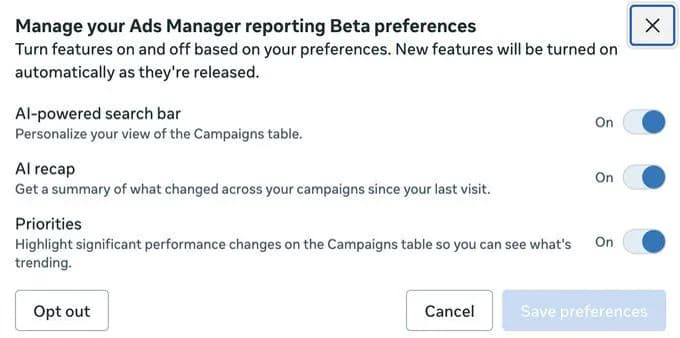
Meta Ads Manager AI reporting, through the Meta AI business assistant, opportunity score and the ads MCP server, can summarise what changed and recommend fixes. It is built by the company that sells the ads and is measured on conversions, not your margin. Keep it as the first read, and add your own analysis layer with thresholds that can fail, your own attribution check and human sign-off on every budget change.
TL;DR
Meta's reporting AI in November 2026 is mainly the Meta AI business assistant inside Ads Manager, opportunity score and, for outside tools, the ads MCP server. They are good at "what changed" and "which ad is weak".
They are built by the company that sells the ads. Meta measures its own assistant by conversions at the same cost per conversion, and opportunity score does not reflect your actual or future performance. Neither is judged on your margin.
Use the platform AI as the first read, not the verdict. Add your own layer: an export or read-only connection, rules written before you look, a marginal cost check, a CRM or shop reconciliation, and a person who signs off every budget change.
If you let any agent act, Meta now offers ads MCP server rules that can deny budget increases above a percentage. Use them.
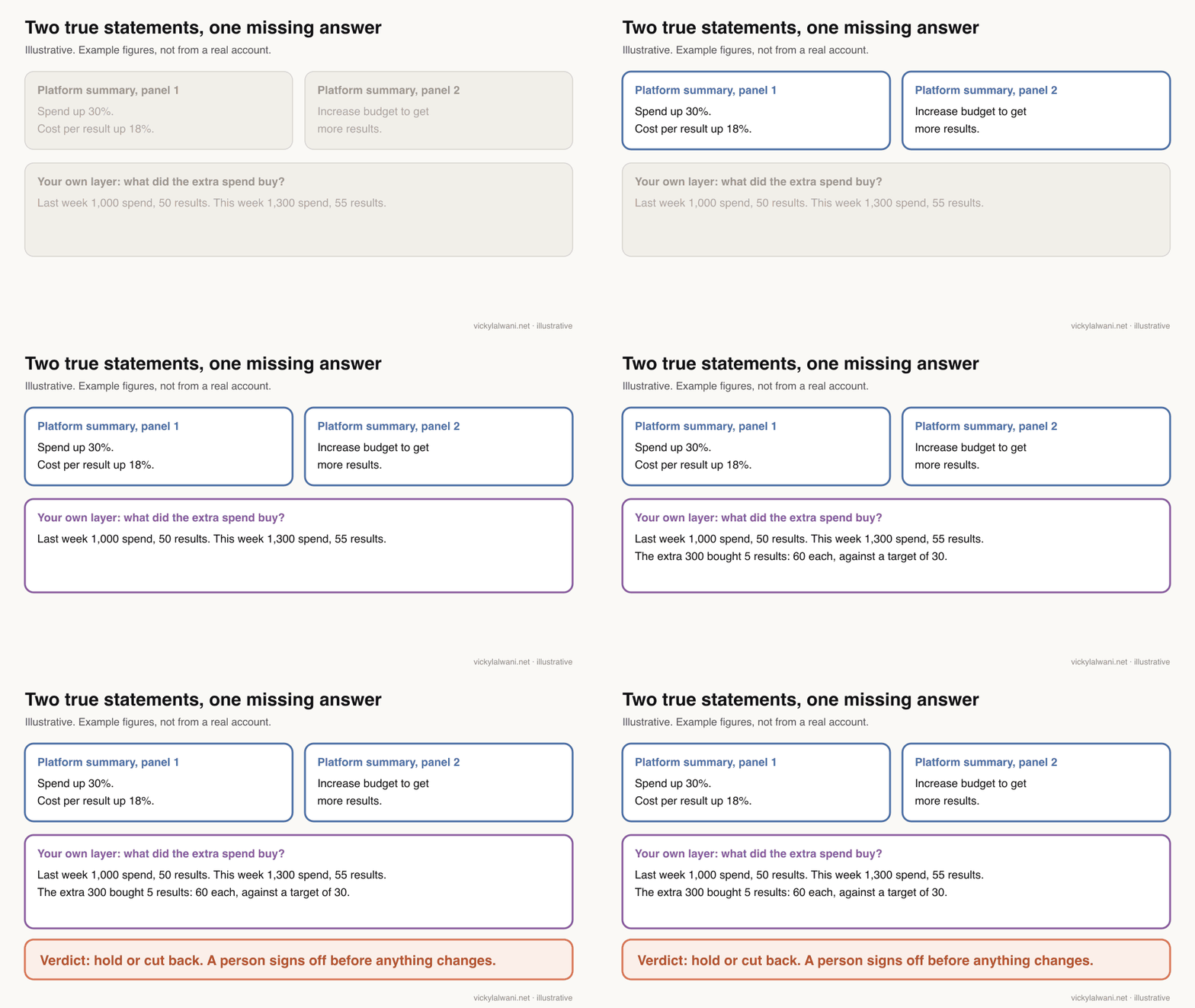
You open Ads Manager and the assistant has a tidy summary. Spend went up and cost per result went up. A card further down suggests increasing budget to get more results. Both statements are true. Neither answers the only question that matters: is the extra volume still profitable for you?
That gap is the subject of this guide. If you would rather have someone independent review your account, my Meta ads management service starts with exactly this kind of check.
What does Meta Ads Manager AI reporting include in November 2026?
Short answer: Three things: the Meta AI business assistant inside Ads Manager, which answers questions and recommends changes; opportunity score with its recommendations; and the ads MCP server, which lets outside AI tools such as Claude read reports and, with permission, edit campaigns. Several newer abilities are still in testing.
| Feature | What it does | Status (Nov 2026) |
|---|---|---|
| Meta AI business assistant | Answers questions, recommends fixes | In Ads Manager; agentic actions in testing |
| Assistant scheduled tasks | Weekly summaries, alerts | Testing (announced 6 Oct 2026) |
| Opportunity score | 0 to 100, based on recommendations applied | "In development and may evolve" |
| Ads MCP server | Reports and edits from outside AI tools | Open beta since 29 Apr 2026 |
| Ads MCP server rules | Deny agent actions, such as big budget rises | Limited availability |
| Automated rules | Your own if-then checks | Long-standing, up to 250 per account |
Meta began testing the assistant with advertisers in Q4 2025, according to its January 2026 update. At Advertising Week New York on 6 October 2026, Meta said it had given the assistant "a deeper memory of your business", and that it is "beginning to test" campaign creation, targeting and budget changes by conversation, plus scheduled tasks and alerts for "weekly summaries".
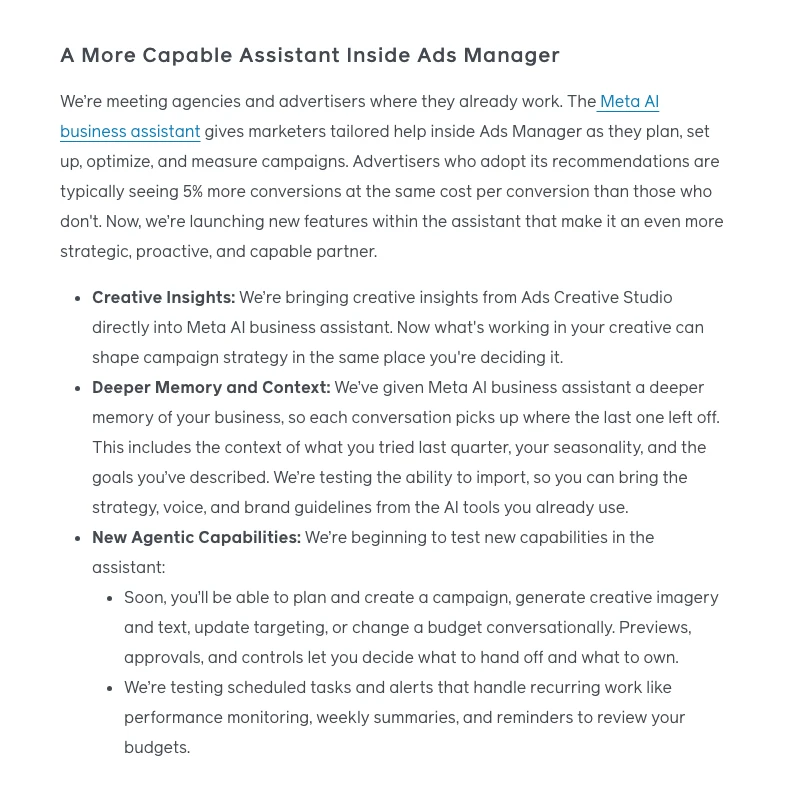
The same announcement gives Meta's own measure of success: "Advertisers who adopt its recommendations are typically seeing 5% more conversions at the same cost per conversion than those who don't." Note what that measures. It is volume at a steady average cost. It says nothing about profit, about advertisers who chose not to follow the advice, or about what the extra conversions were worth.
Where does Meta's AI reporting get soft?
Short answer: On the trade-off between more volume and a higher cost per result. The assistant will flag a weak ad or a poor quality ranking, and that is useful. What it is not set up to answer is whether the next slice of budget is worth it for your margins, because that needs your margin, your other channels and your real sales.
Be fair to the tool first. In a hands-on review by a UK Meta ads agency channel (linked below), the assistant compared ads with a benchmark, flagged ones well above it, and suggested refreshing or switching off weak creative. It does tell you to cut individual ads.
The soft spot is total spend. Look at the pattern of two panels that are each true: spend up, cost per result up; then "increase budget for more results". The missing number is the cost of the extra results, not the average.
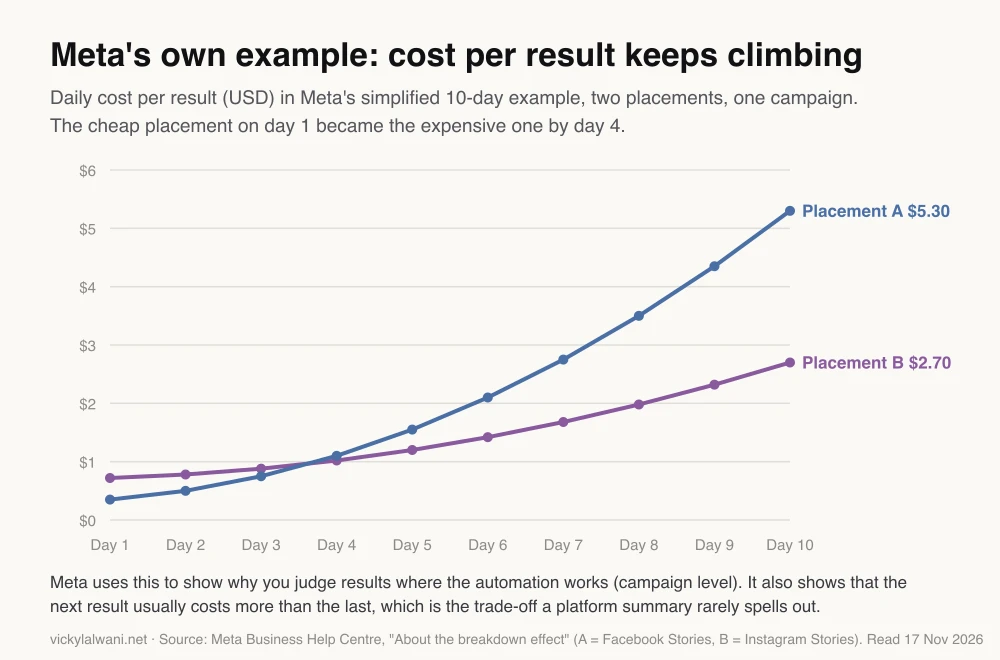
Meta's own help pages show why averages mislead. In its breakdown effect example, the cheaper placement on day 1 becomes the more expensive one by day 4, and both keep climbing. Meta uses this to tell you to judge results at the level the automation works, which is right. It also shows that the next result usually costs more than the last.
Is the platform AI biased towards more spend?
Short answer: Not by a hidden switch, as far as anyone can show. The incentive is structural: the platform earns when you spend, measures its assistant on conversions, and scores you on how many of its recommendations you apply. A tool built that way will be quicker to suggest growth than to question it.
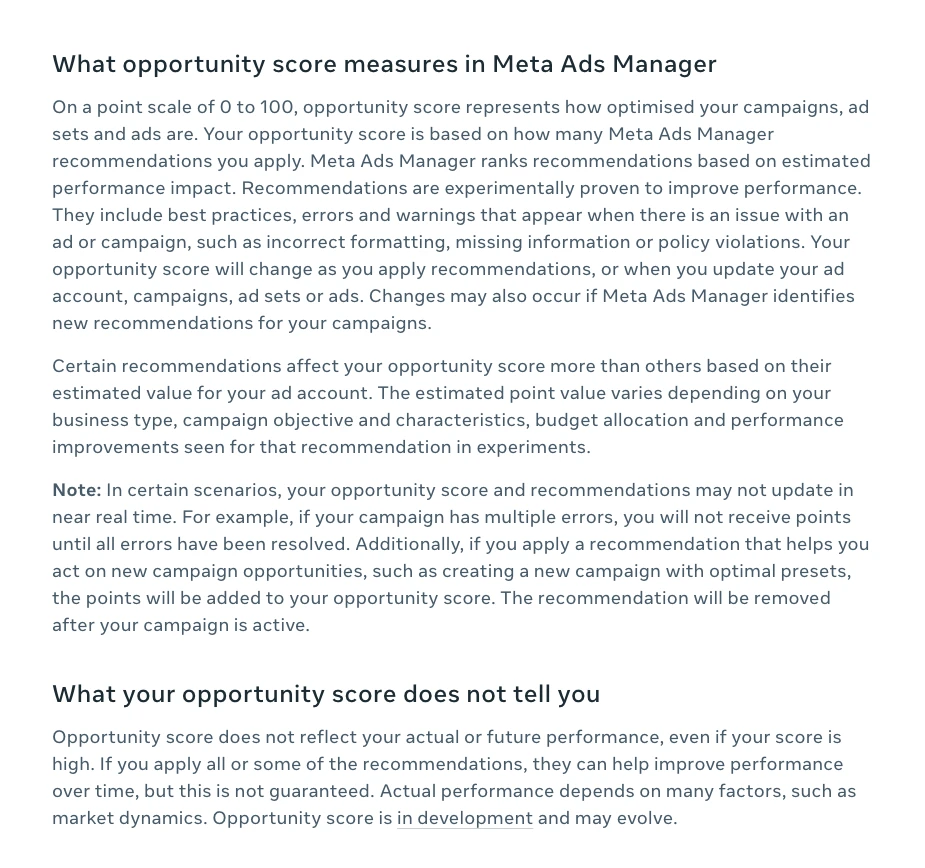
Opportunity score is the clearest example. Meta's page says the score "is based on how many Meta Ads Manager recommendations you apply", and that creating a new campaign with recommended presets adds points. It also says plainly that the score does not reflect your actual or future performance.
An e-commerce agency channel that compared five accounts found no clear link between a higher score and better return, and says that declining to raise budget on an ad set Meta flags as a top performer can lower the score. Treat that as one agency's review, not a study. On X, a PPC practitioner said in August 2026 that it was the first time they had ever seen Google Ads suggest reducing budget. The pattern is not unique to Meta.
| Signal | What it rewards | What it ignores |
|---|---|---|
| Assistant success measure | More conversions, same average cost | Profit and margin |
| Opportunity score | Recommendations applied | Your actual results |
| Default attribution | Conversions Meta can credit | Sales that would have happened anyway |
| Your own layer | Your margin and real sales | Nothing, if you write the rules |
How do you build an analysis layer that works for you?
Short answer: Pull the same data the platform uses, write rules before you look at it, check what extra spend bought rather than the average, reconcile with your CRM or shop, and have an AI or a script propose verdicts that a person approves. The key is thresholds that can fail.
- Export the data. Ads Reporting can email a recurring report for a single ad account, or an AI tool can read it through the ads MCP server reporting tools. Keep that access read-only.
- Write the rules first. Highest cost per result your margin can carry, smallest sample you will trust, and the most you will pay for an extra result when spend rises.
- Check the margin, not the average. When spend goes up, divide the extra spend by the extra results.
- Reconcile. Compare Meta's results with CRM leads or shop orders every week.
- Propose, then approve. The layer names ad sets to keep, cut, pause or hold, with the number that decided it. A person signs off.
- Log it. Keep proposals and outcomes, so you can see which advice held up, including Meta's.
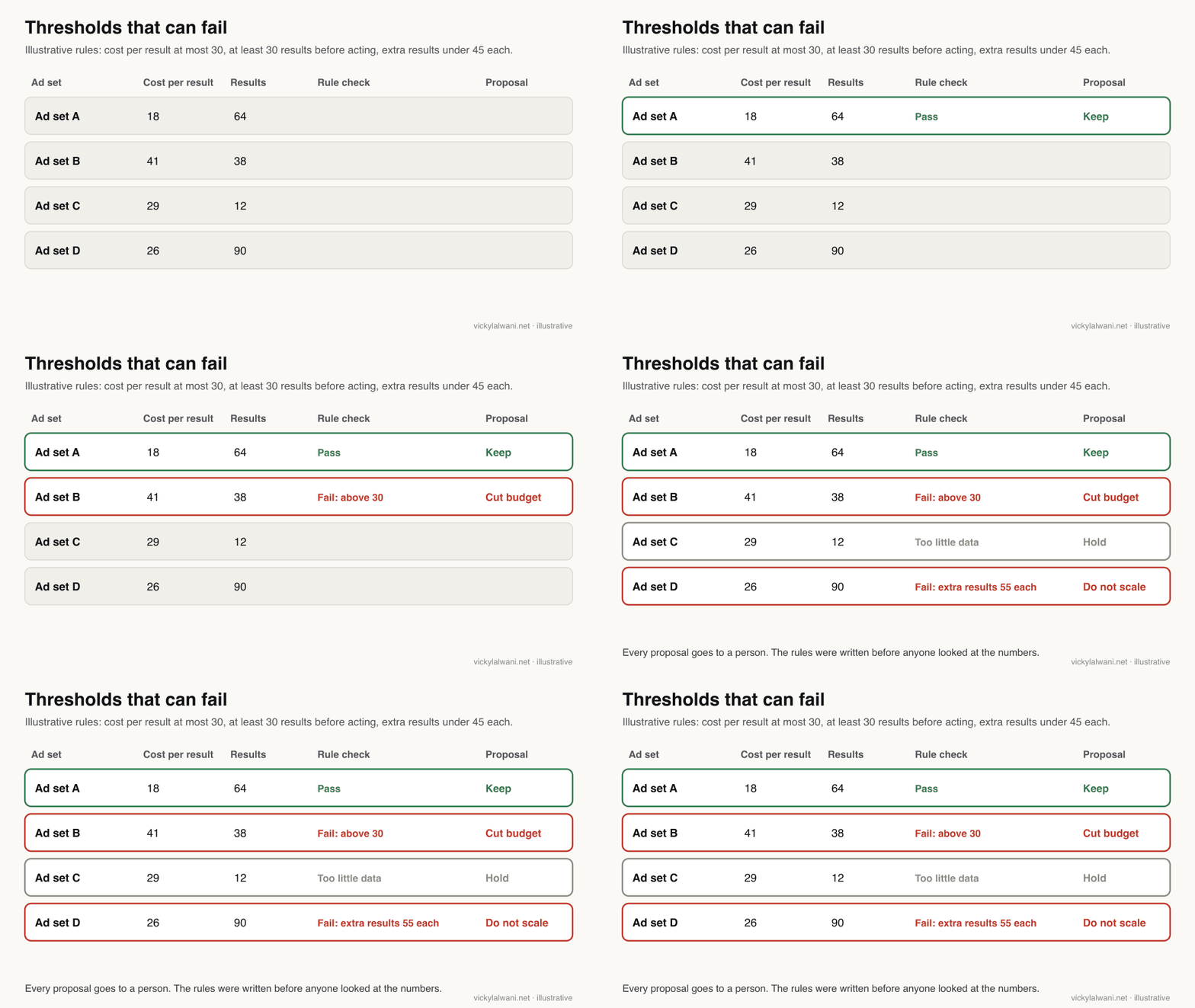
This prompt works with Claude or another assistant pointed at an export. Fill in the brackets with your own numbers before the first run.
You are an independent reviewer of a Meta ads account. You have no target for how much we spend.
Data: last 14 days by ad set, from the Ads Reporting export in data/meta/ (or read-only access to the ads MCP server).
Business rules (written before looking at the data):
- Maximum cost per result we can afford: [amount]
- Minimum results in the period before any verdict: [number]
- Maximum cost of an extra result when spend went up: [amount]
- Attribution setting used in the export: [for example 7-day click, 1-day view]. Do not mix ad sets with different attribution models.

For each ad set:
1. Compare this week with last week: spend, results, cost per result.
2. If spend rose, work out what the extra spend bought: (extra spend) / (extra results).
3. Apply the rules. Verdict: keep, cut, pause, hold (too little data) or test more spend.
4. Give the number that decided the verdict.

Then:
- List what would need to be true for a budget increase to make sense.
- Check results against CRM leads or shop orders in data/crm/ and flag any gap above [x]%.
- Note which of Meta's own recommendations you agree or disagree with, and why.
Write proposals only. Do not change budgets, bids, status or targeting. Save to reports/meta/[date].md for review.
When I run platforms side by side, I set the date to cut the weaker one before launch, not after the numbers come in. Writing the rule down first protects you from talking yourself into more spend. The same idea sits behind my paid media wasted spend audit.
From a UK Meta ads agency founder's channel, June 2026. A hands-on test of the assistant on live accounts, broadly positive about its benchmarks and creative advice; the channel sells agency services and training.
Which numbers should your own layer trust?
Short answer: Your own sales or CRM numbers first, then Meta's results with the attribution setting written next to them, and a lift test when a big budget decision rides on the answer. Never compare ad sets that use different attribution models, and never add Meta and Google conversions together.
Meta now offers standard, incremental and custom attribution. Its help page warns that results "cannot be compared" across ad sets with different models. Standard settings count link clicks within 1 or 7 days, views within 1 day, and other engagement within 1 day.
| Change | Date | Effect on reports |
|---|---|---|
| 7-day and 28-day view windows dropped from the API | 12 Jan 2026 | Old exports used to compare differently |
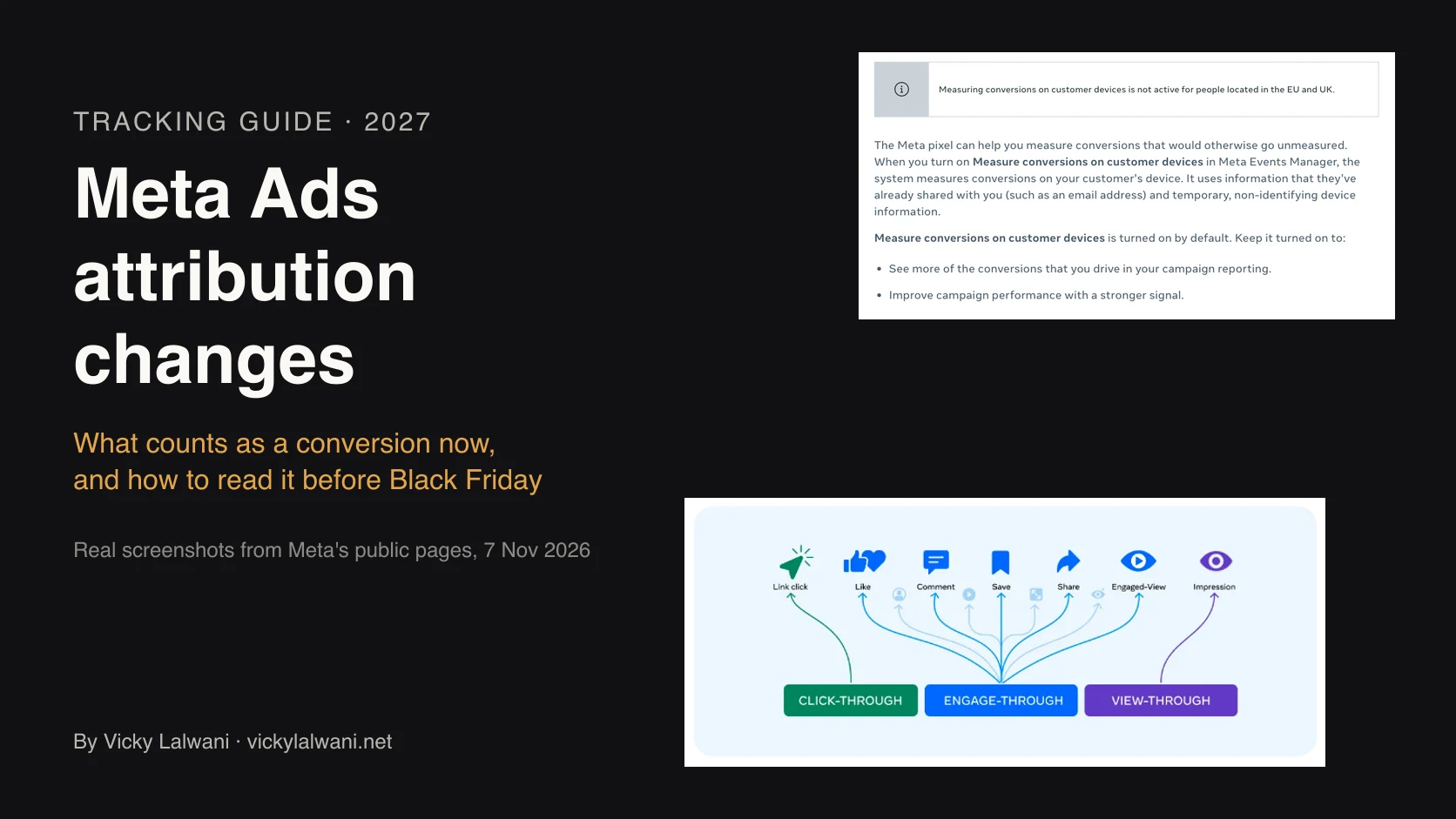
| Click-through counts link clicks only; "engage-through" added | From Mar 2026 | Fewer click-credited conversions |
| Incremental attribution model | Available now | Credits conversions predicted to be caused by ads |
Sources: Meta for Developers, 16 October 2025 and Meta for Business, 3 March 2026. In that March post Meta itself calls incrementality experiments such as Conversion Lift "the gold standard in measurement". My guide to Meta attribution changes covers the detail.
From the official Meta for Business channel, February 2026. A 90 second explainer: Conversion Lift splits people into a group that sees ads and a control group that does not.
If the numbers disagree by a lot, fix tracking before you trust any layer, platform or yours. That is the first step of my analytics and tracking work.
Should you let an AI agent change your Meta budgets?
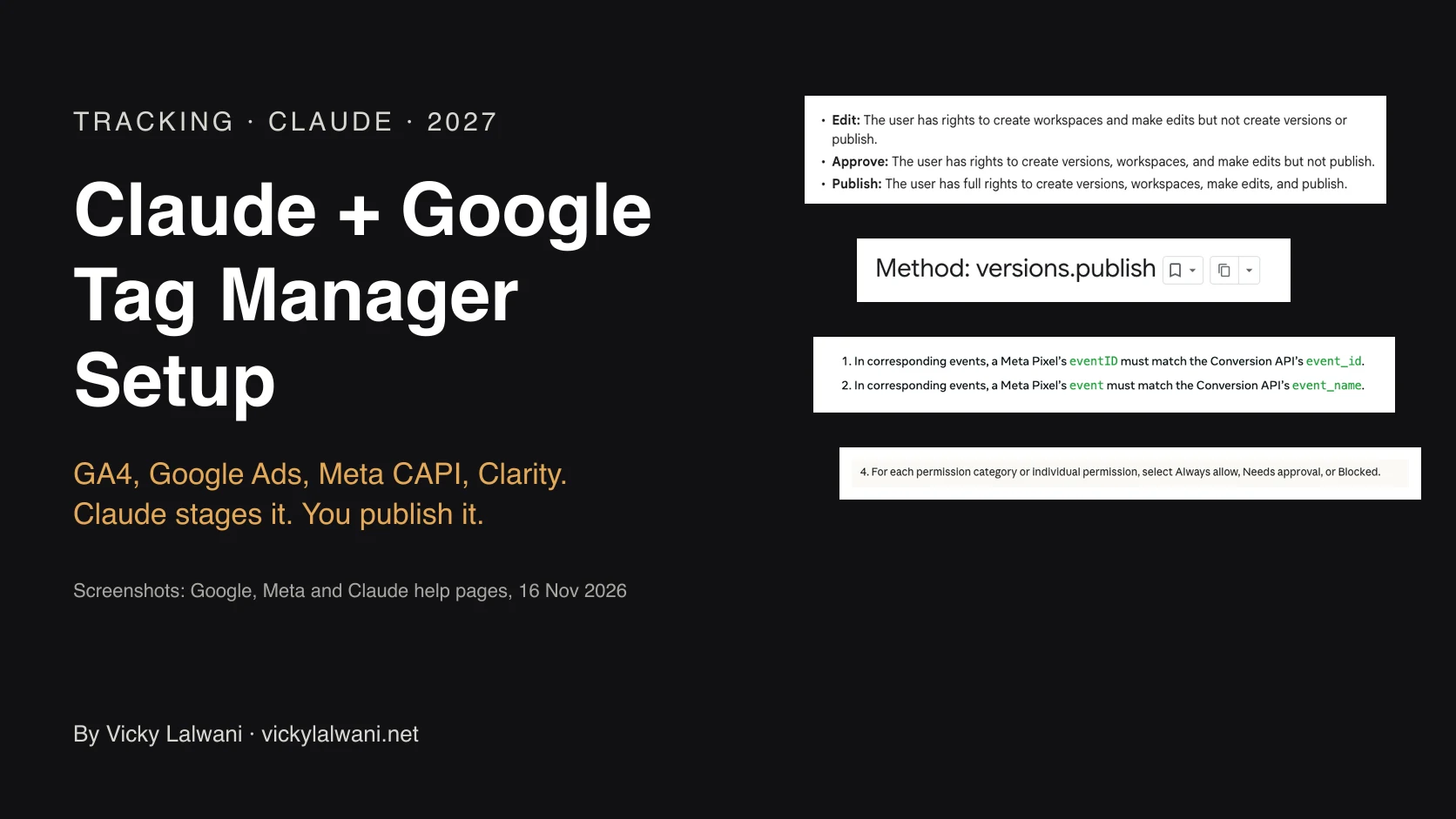
Short answer: Not without limits. Meta's ads MCP server can create and edit campaigns from tools such as Claude, and Meta says agent work lands as a draft and needs explicit approval. Add ads MCP server rules that deny large budget rises, keep automated rules for simple safety nets, and keep a person on every budget change.
Meta launched its ads AI connectors in open beta on 29 April 2026. The server covers reporting, ad creation and management, catalogues, signals, A/B tests and lift studies, and activity logs. On 16 July 2026 Meta added rules that let anyone with full control of a business portfolio govern what agents can do.
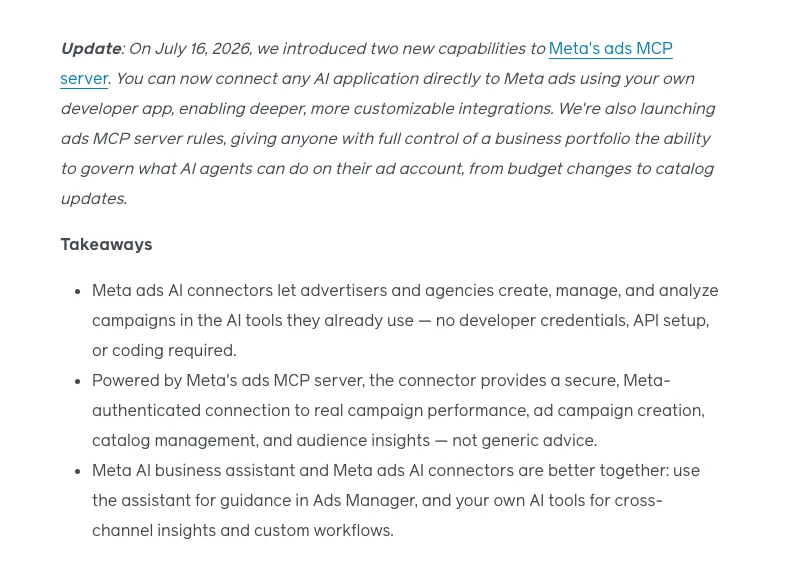
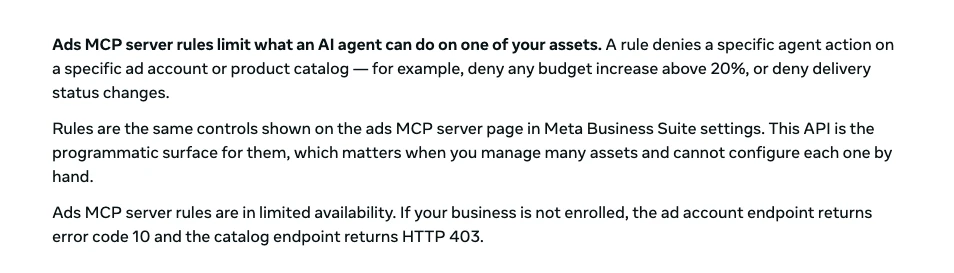
| Rule type | What it blocks | Use it for |
|---|---|---|
| edit_budget, percentage | Budget rises above a percentage | Stop runaway scaling |
| edit_budget, absolute max | Budgets above a ceiling | Hard monthly limits |
| edit_status | Pausing or activating | Agents that only report |
| all | Every agent action | Read-only accounts |
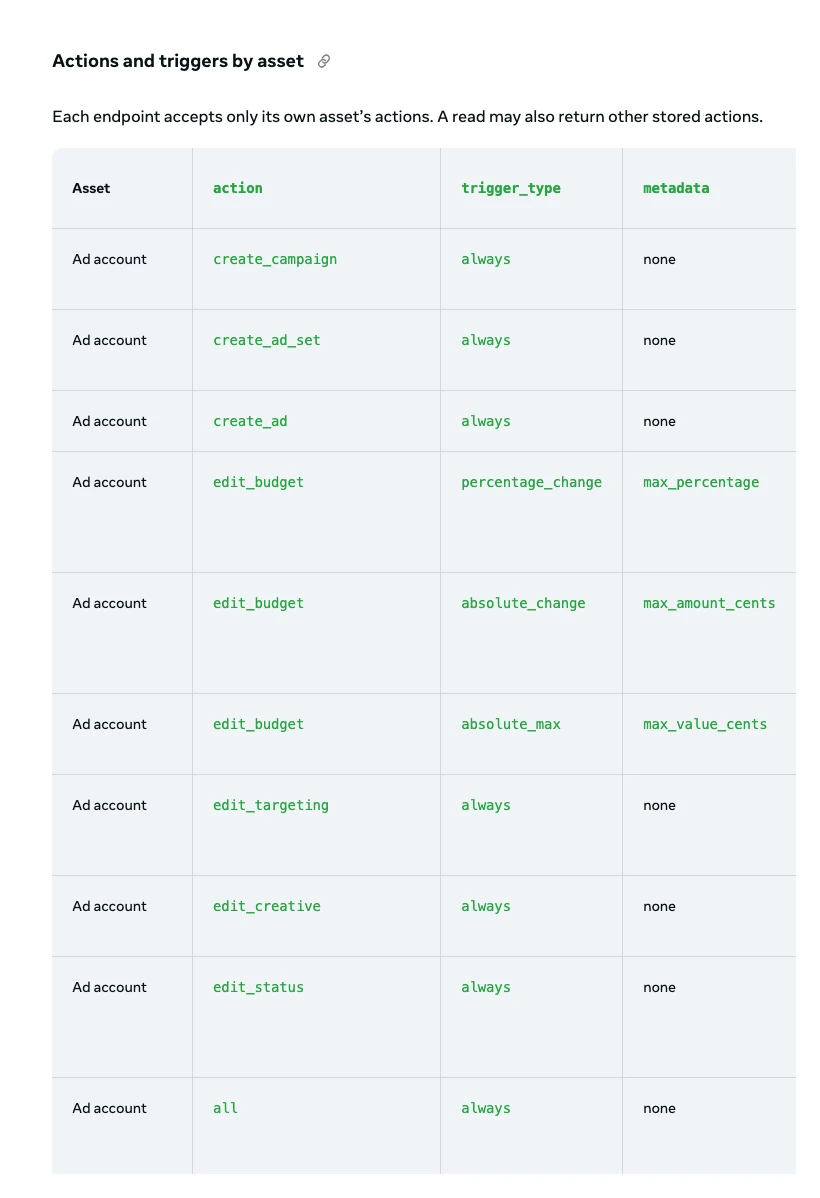
For simple checks you do not need an agent at all. Ads Manager automated rules can watch campaigns and notify you or act, up to 250 rules per ad account. A notify-only rule on cost per result is a cheap first version of your own layer. The Meta and Google audit shows how I run it as one weekly job.
How should you use Meta's AI and your own layer together?
Short answer: Let Meta's AI find what moved and explain it; let your layer judge whether it matters for your business. Keep human sign-off on budget changes and log every decision so you can see whose advice held up.
| Job | Meta's AI | Your layer |
|---|---|---|
| What changed this week | Yes, fast | Confirms with your data |
| Which ad is weak | Yes, with benchmarks | Checks against your target |
| Is more budget worth it | Soft | Marginal cost and margin |
| Did ads cause the sales | Attribution model | CRM, shop, lift test |
| Make the change | Agentic, in testing | A person approves |
- Use the assistant to find what moved, and to compare dates with Ads Manager's compare toggle.
- Use your own layer to judge whether it matters.
- Keep a person on every budget change, even if an agent drafts it.
- Log decisions, including the recommendations you rejected.
In my calls with business owners, the Meta questions I hear most are about boosted posts that spent without leads, creative fatigue, and how to feed lead quality back to Meta. All three need your own data, which the platform cannot see unless you send it.
What people say on X and Reddit
Short answer: Practitioners use the platform AI as a starting point and distrust platform numbers as a verdict. Common advice: anchor on backend sales, never add platforms together, and give AI tools narrow, pre-filtered data rather than a whole account.
| Post or thread | Where, when | Type | Point |
|---|---|---|---|
| Google Ads suggested reducing budget | A PPC practitioner on X, 7 Aug 2026 | First-hand | Rare enough to remark on |
| Incremental attribution avoids bad calls | A DTC growth practitioner on X, 31 Jan 2026 | Opinion | Standard windows over-credit email days |
| Claude Code audits a Meta account | An AI-for-ads course creator on X, 19 Aug 2026 | Vendor | Week on week, score, three fixes |
| Official Meta ads MCP for Claude | An AI tips account on X, 11 May 2026 | Reporting | Launched 29 Apr 2026, free in beta |
| Meta says 9x ROAS, GA4 says almost nothing | r/PPC, Apr 2026 | First-hand | Anchor on shop revenue |
| Meta 22 purchases, Google 45, GA4 different | r/PPC, Sep 2026 | First-hand | Never add platforms together |
| Losing trust in attribution | r/PPC, May 2026 | Opinion | Judge on blended numbers |
| AI is not good at auditing accounts | r/PPC, Oct 2026 | Mixed | Feed AI pre-filtered reports |
The r/PPC thread on AI audits is worth reading in full. Several replies say results improve when a script first pulls a weekly anomaly report or a week-on-week diff, and the model only sees those rows. That is the same design as the layer above.
One reply in the attribution thread claims platforms double-count 30% to 60% of revenue. No source is given, so treat it as one person's experience.
Videos worth watching
Short answer: Start with Meta's own Conversion Lift explainer, then two independent tests of the business assistant that reach different conclusions. The opportunity score and MCP videos help if you are deciding how far to trust automation.
| Video | Channel | Date | What it covers |
|---|---|---|---|
| How Conversion Lift from Meta proves your ads drive real results | Meta for Business (official) | Feb 2026 | Lift tests |
| How Good Is Meta's New AI Business Assistant? | A UK Meta ads agency founder | Jun 2026 | Hands-on, positive |
| Does Meta AI Business Assistant Give Good Advice? | A Meta ads freelancer | Jun 2026 | Hands-on, sceptical |
| Meta's Opportunity Score: Does It Actually Increase ROAS? | An e-commerce ads agency | Feb 2026 | Score vs return, 5 accounts |
| How to Install the Official Meta Ads MCP in Claude | A Meta ads tool vendor | Apr 2026 | Setup walkthrough |
From an e-commerce ads agency channel, February 2026. Compares opportunity score with return on ad spend across five accounts and explains which recommendations the agency ignores; the channel sells agency services.
Where this advice is weak
Short answer: Meta's agentic features are in testing and will change; the bias argument is structural, not proven by a study; and your own layer is only as good as the rules and data you give it. A badly set threshold can cut a campaign that was working.
- The assistant's agentic actions, scheduled tasks and alerts were "in testing" on 6 October 2026. What reaches your account, and when, may differ.
- No independent study shows Meta's assistant recommending more spend than is optimal. The argument rests on how the tools are measured and scored.
- Meta's 5% figure compares advertisers who adopted recommendations with those who did not; they may differ in other ways.
- Marginal cost from one week to the next is noisy on small budgets. Use a minimum sample before acting.
- Ads MCP server rules are in limited availability, so you may not be able to switch them on yet.
Want an independent view of your Meta account?
Short answer: If Meta's summaries keep pointing to more budget and you are not sure the extra spend pays, an independent review starts from your margin and your real sales. I review the account, the tracking and the rules, and propose changes you approve.
My Meta ads management service includes this kind of review, and my analytics and tracking service fixes the data underneath it. Rates are on the pricing page. For frameworks you can use yourself, browse the free guides.
The platform's AI works for the platform. In 2027, make sure one part of your reporting works only for you.
Sources
| Source | What it supports | Date |
|---|---|---|
| Meta for Business: Advertising Week 2026 | Assistant memory, agentic tests, 5% claim, MCP drafts and approval | 6 Oct 2026 |
| Meta newsroom | Assistant testing began Q4 2025 | Jan 2026 |
| Meta for Business: ads AI connectors | Open beta, MCP rules update | 29 Apr, 16 Jul 2026 |
| Meta for Developers: ads MCP server | Tool categories, endpoint | Updated 14 Jul 2026 |
| Meta for Developers: reporting tools | Opportunity score, anomaly, benchmark tools | Updated 14 Jul 2026 |
| Meta for Developers: MCP rules | Deny budget rises, limited availability | Updated 12 Aug 2026 |
| Meta Help: opportunity score | Based on recommendations applied; not performance | Read 17 Nov 2026 |
| Meta Help: breakdown effect | Example data for the chart | Read 17 Nov 2026 |
| Meta Help: attribution | Standard, incremental, custom; no comparing | Read 17 Nov 2026 |
| Meta for Developers blog | 7-day and 28-day view windows dropped | 16 Oct 2025 |
| Meta for Business: click attribution | Link clicks only; lift as gold standard | 3 Mar 2026 |
| Meta Help: automated rules | What rules do | Read 17 Nov 2026 |
| Meta Help: rule limits | 250 rules per ad account | Read 17 Nov 2026 |
| Meta Help: recurring reports | Scheduled email, single account | Read 17 Nov 2026 |
| Meta Help: compare date ranges | Compare toggle | Read 17 Nov 2026 |
| X and Reddit | Practitioner and vendor views | Jan to Oct 2026, see table above |
This article expands on my post on LinkedIn ↗.
FAQ
What is Meta Ads Manager AI reporting?
It is the set of AI features Meta puts around Ads Manager data: the Meta AI business assistant that answers questions and recommends changes, opportunity score and its recommendations, and the ads MCP server that lets outside AI tools read reports. In November 2026 several assistant abilities, such as scheduled summaries and budget changes by conversation, were still in testing.
Is the Meta AI business assistant useful?
Yes, as a first read. It can summarise what changed, compare ads with benchmarks and flag weak creative. Treat it as a navigation aid rather than a verdict, and check its advice against your own targets and sales data.
Does Meta's AI tell you to spend more?
There is no proof of a hidden bias, but the incentives point that way. Meta measures its assistant by conversions at the same cost per conversion and scores you on recommendations applied, and neither looks at your margin. Check what extra spend actually bought before following any budget advice.
Does a high opportunity score mean better results?
No. Meta's own help page says opportunity score does not reflect your actual or future performance, even if the score is high. It runs from 0 to 100 and is based on how many Ads Manager recommendations you apply.
What is an independent analysis layer for Meta ads?
It is your own workflow, a script or an AI assistant, pointed at the same data with rules you set before looking, such as a maximum cost per result. It checks what extra spend bought, reconciles results with your CRM or shop, and proposes keep, cut or hold verdicts for a person to approve.
Can Claude connect to Meta Ads Manager?
Yes. Meta's ads MCP server, in open beta since 29 April 2026, lets MCP-compatible tools such as Claude pull reports and, with permission, create and edit campaigns. Keep the connection read-only for analysis, and use ads MCP server rules to block large budget changes if you allow any edits.
What are ads MCP server rules?
They are Meta controls that deny specific AI agent actions on an ad account or catalogue, for example budget increases above a set percentage, budgets above a ceiling, or any status change. Meta added them on 16 July 2026, and they were in limited availability in November 2026.
Which attribution setting should my own Meta analysis use?
Use the same setting for every ad set you compare and write it next to the numbers. Meta says results cannot be compared across ad sets with different attribution models. For big budget decisions, check against backend sales or run a Conversion Lift test, which Meta calls the gold standard.