Ad copywriting frameworks such as PAS, AIDA, FAB and BAB give an ad a persuasive order. In 2027 that order has to survive Google responsive search ads, which mix up to 15 headlines in any order, and Meta feed ads, where the first line carries most of the weight. Use frameworks to plan asset sets, not scripts.
TL;DR
Ad copywriting frameworks give an ad a persuasive order: PAS (problem, agitate, solution), AIDA (attention, interest, desire, action), FAB (features, advantages, benefits) and BAB (before, after, bridge). The 4Cs (clear, concise, compelling, credible) is an editing check, not a structure.
Google responsive search ads take up to 15 headlines of 30 characters and 4 descriptions of 90, and show them in any order. So write each framework step as a separate asset that stands alone, and pin only what must always show.
On Meta, the feed ad guide recommends 50 to 150 characters of primary text and a 27-character headline. PAS works well there, but its agitate step must not imply personal attributes, which Meta's ad standards forbid.
Frameworks decide the order. Your customers' words decide the content: see how to write ad copy from customer words and before and after ad copy examples. For help inside a live account, see Google Ads consulting or Meta Ads consulting.
You have an offer, an ad group and a blank headline field. Writing from inspiration gives you fifteen versions of the same line. A framework gives you a plan: which line names the problem, which proves the claim and which asks for the click.
This guide shows how the classic ad copywriting frameworks fit the formats you actually buy in 2027: Google responsive search ads and Meta feed ads. It is part of a three-article set. This one covers structure; customer-focused ad copy covers where the words come from; ad copy framing examples shows before and after rewrites.
What are ad copywriting frameworks?
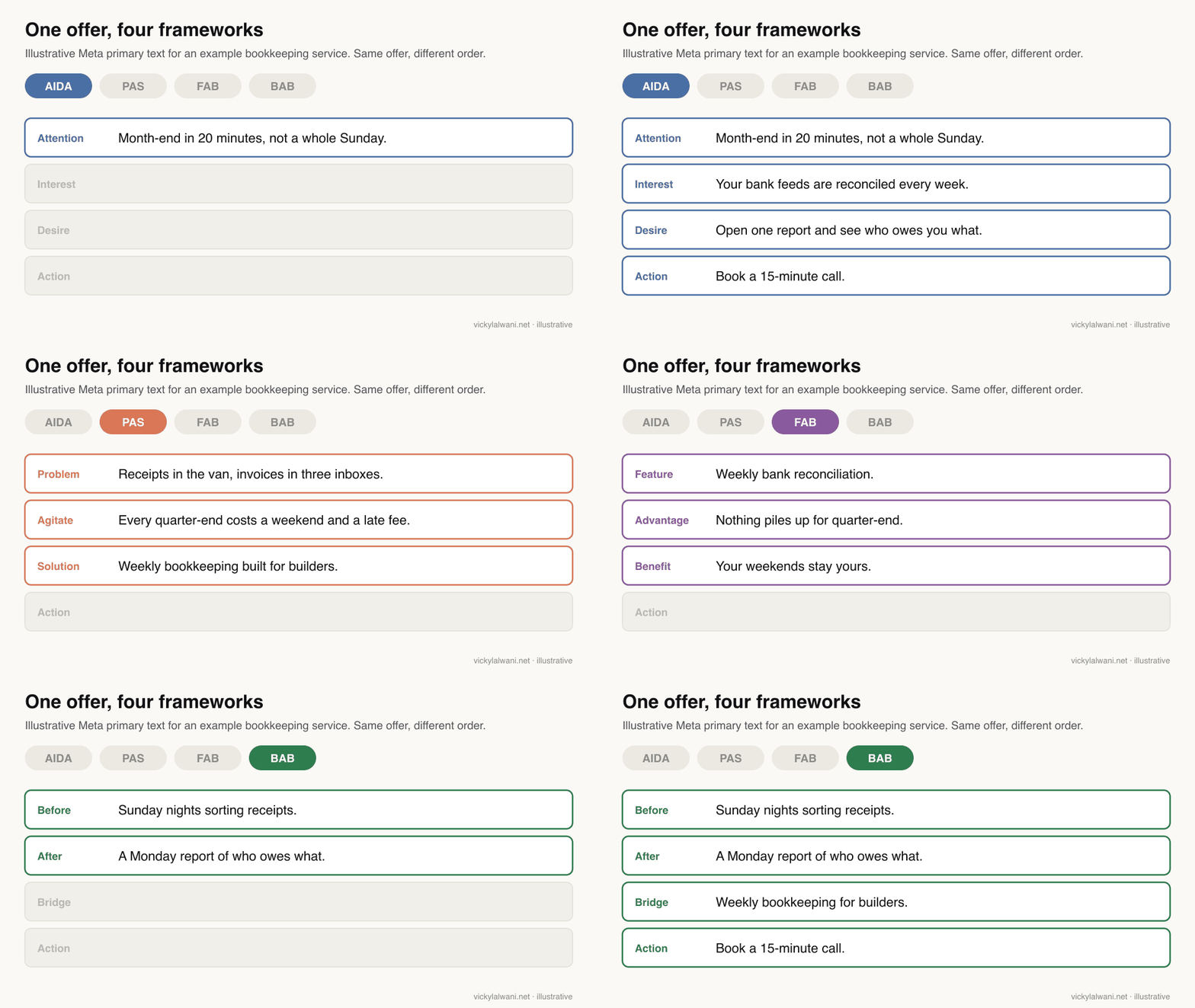
Short answer: They are fixed sequences for persuasive writing. Each one orders the same ingredients (the reader's problem, your offer, proof and a call to action) in a different way, so you can draft fast and test angles on purpose instead of rewriting at random.
A framework is not a template you fill in word for word. It is a checklist of jobs the copy must do. The words still have to come from your customers, your search terms and what you can prove.
| Framework | Order | Best for | Watch out for |
|---|---|---|---|
| PAS | Problem, agitate, solution | Short ads, known pain | Fear tactics, policy |
| AIDA | Attention, interest, desire, action | Longer copy, pages | Weak first line |
| FAB | Feature, advantage, benefit | Products, comparisons | Leading with features |
| BAB | Before, after, bridge | Clear transformation | Overpromising the after |
| 4Cs | Clear, concise, compelling, credible | Editing any draft | Not a structure |
Which ad copywriting framework should you use?
Short answer: Pick by what the reader already knows. If they feel the problem, use PAS. If they need to notice you first, use AIDA. If they are comparing options, use FAB. If the change is easy to picture, use BAB. Then run every draft through the 4Cs.
| Reader situation | Framework | Example placement |
|---|---|---|
| Feels the pain now | PAS | Search ads, Meta text |
| Not looking yet | AIDA | Meta video, landing page |
| Comparing options | FAB | Search ads, product page |
| Wants a result | BAB | Meta image ads, email |
| Any draft | 4Cs edit | Everything |
A practitioner on X put it neatly: all the frameworks aim at the same action, and the real difference is where they put the pressure. PAS presses on the pain, AIDA on the opening, BAB on the picture of the result.
Search ads lean to PAS and FAB because the searcher has already named a need. Paid social leans to AIDA and BAB because you are interrupting someone who was not looking. Those are starting points, not rules; test against your own results.
How do frameworks fit Google responsive search ads?
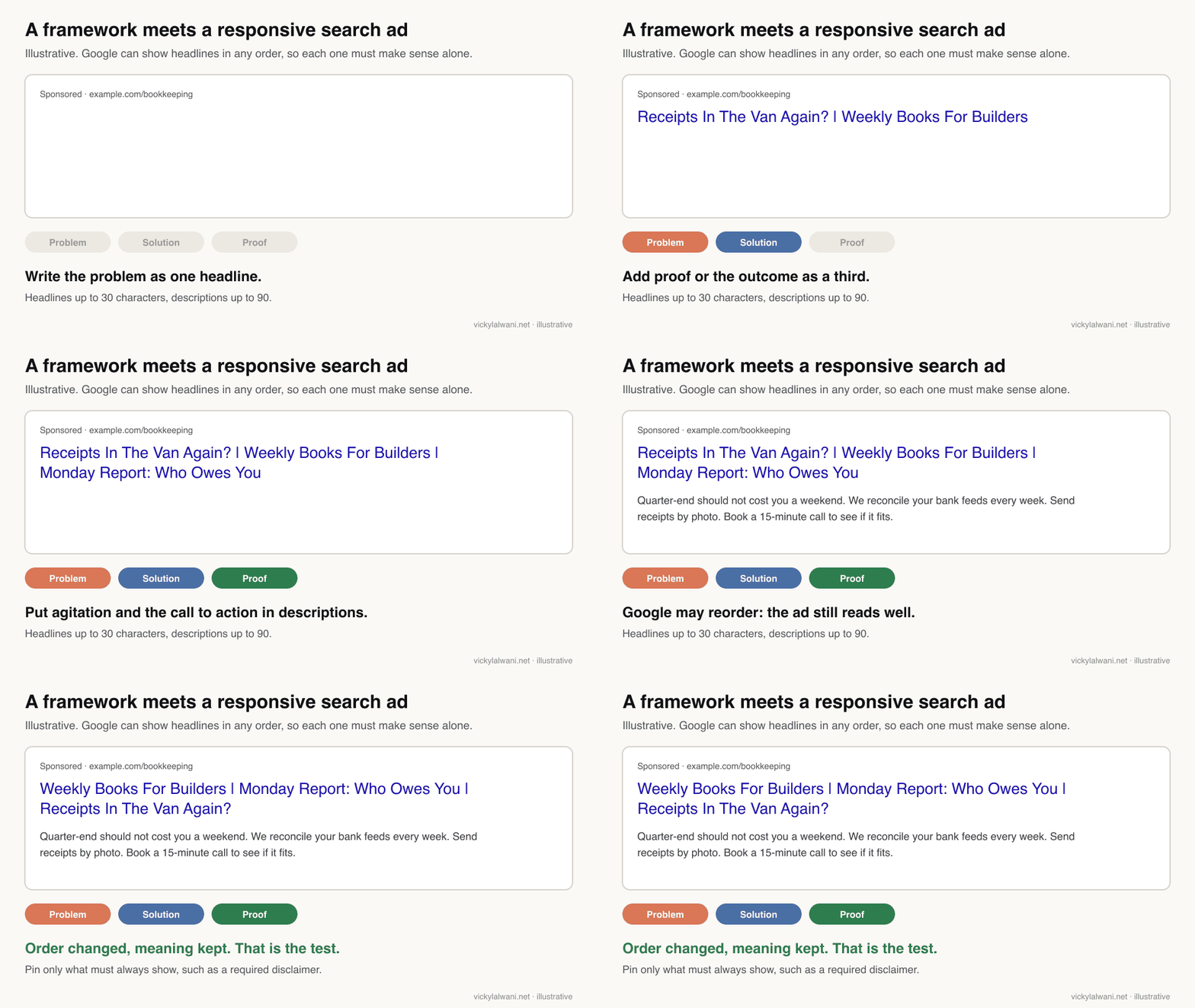
Short answer: As asset sets, not sequences. A responsive search ad takes 3 to 15 headlines of up to 30 characters and 2 to 4 descriptions of up to 90, and Google Ads assembles them in different combinations and orders. Write each framework step as several standalone headlines.
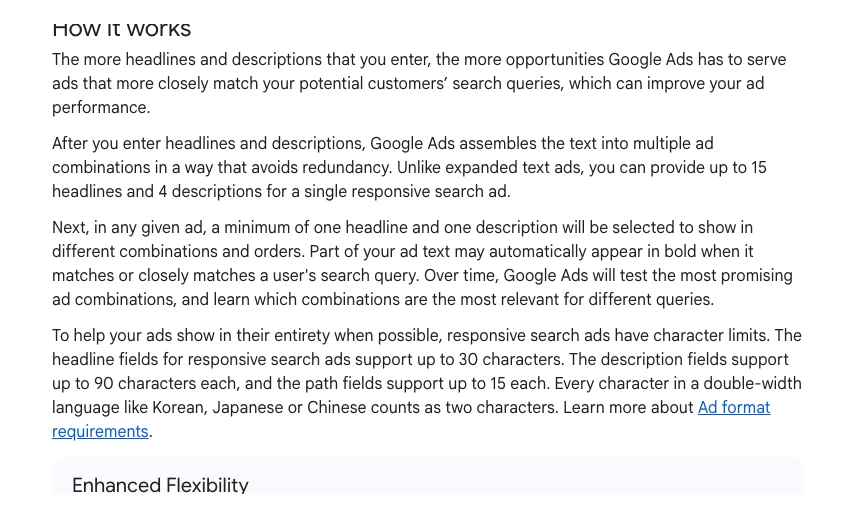
That breaks the classic sequence. Your problem headline might show second, or not at all. So the test for every headline is simple: does it make sense on its own, next to any other headline you wrote?
Google's page also says headline text can appear at the start of the description, and up to two unused headlines can serve as link-style assets under the ad. That is more reason to write every line as a complete thought.
| Framework step | RSA asset | How many |
|---|---|---|
| Problem (PAS) | Headline in searcher words | 3 to 4 |
| Solution | Headline with the keyword | 3 to 4 |
| Proof or benefit | Headline with a specific | 3 to 4 |
| Agitate | Description | 1 to 2 |
| Action | Description ending | 1 to 2 |
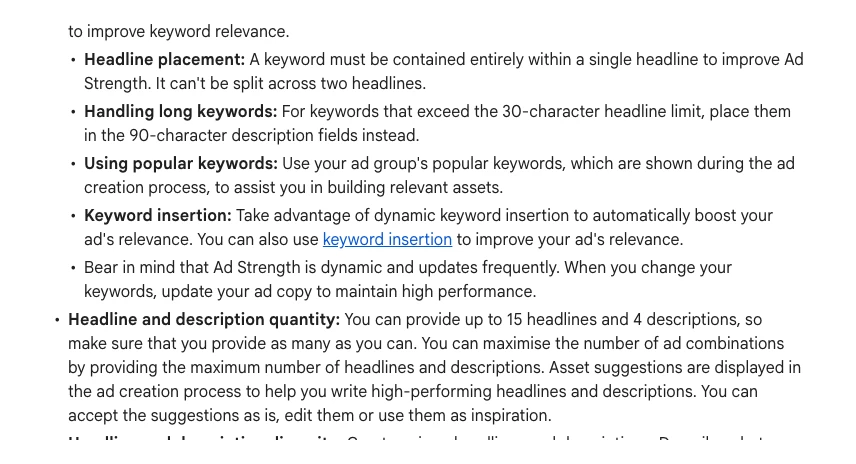
Keep keywords whole. Google's Ad Strength page says a keyword must be contained entirely within a single headline to improve Ad Strength, and keywords longer than 30 characters belong in a description.
Here is a prompt that turns PAS into a full asset set. Paste your own offer and proof; the model does not know what is true about your business.
Write responsive search ad assets for one ad group using the PAS framework.

Offer: [what you sell, price or starting point if public]
Keyword theme of this ad group: [main keyword and 2 close variants]
Who searches it: [the buyer and their situation]
Proof we can stand behind: [reviews count, years, guarantee, accreditation]
Never say: [claims we cannot prove, banned words, competitor names]

Rules:
- 12 headlines, each 30 characters or fewer, each one able to stand alone in any order.
  4 name the problem in the searcher's words, 4 state the solution with the keyword inside one headline, 4 give proof or a specific next step.
- 4 descriptions, each 90 characters or fewer: 2 agitate the cost of waiting (no fear tactics, no personal attributes), 2 end with a specific call to action.
- Label each line P, A or S and show its character count.
- Flag any line that makes a claim I have not given you proof for.
Should you pin headlines to keep the framework order?
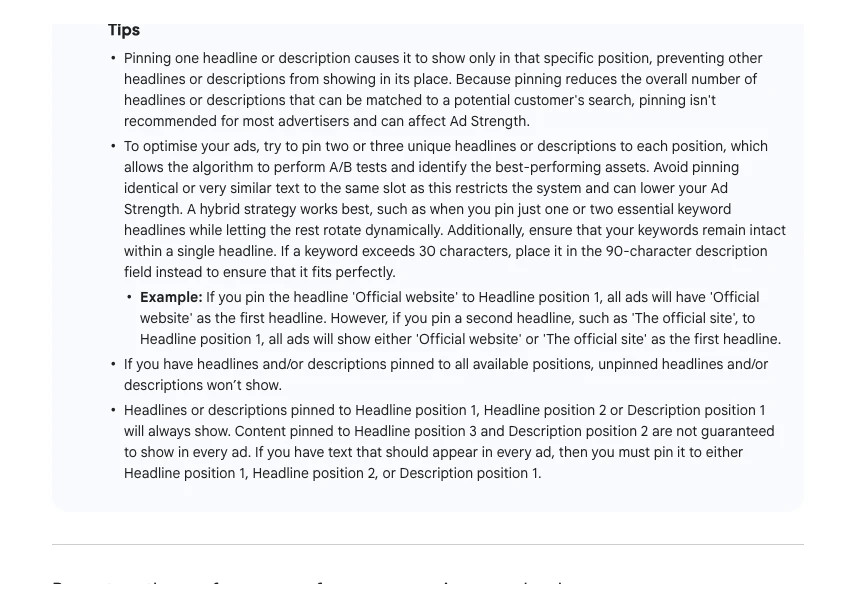
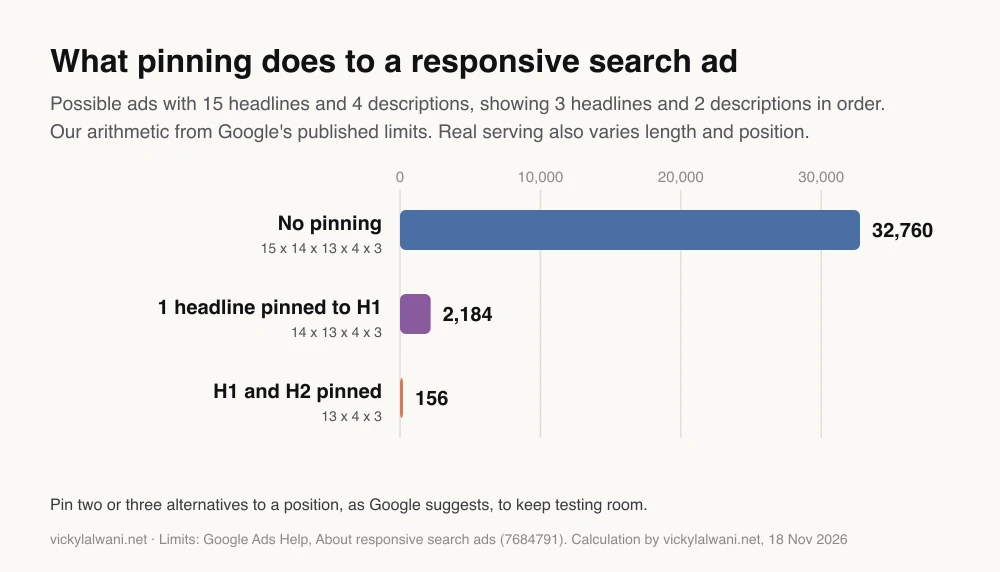
Short answer: Only for lines that must always show, such as a required disclaimer or your brand. Google says pinning "isn't recommended for most advertisers" because it cuts the combinations it can test, and suggests pinning two or three alternatives to each position if you must pin.
The arithmetic shows why. With 15 headlines and 4 descriptions, there are 32,760 ordered ways to show three headlines and two descriptions. Pin one headline to position 1 and that drops to 2,184. Pin positions 1 and 2 and it is 156.
Practitioners disagree. In an r/googleads thread on pinning, some pin only brand names, one local services advertiser pins everything to run cleaner tests, and another reply says the pinned version usually wins despite a lower Ad Strength rating. Pinning is not a guarantee either: an agency owner on X reported Google showing a different headline from the one pinned in a branded ad.
A middle path works for frameworks: pin two or three problem headlines to position 1, leave solution and proof headlines free. You keep the PAS opening and still let Google test the rest.
How do frameworks fit Meta primary text and headlines?
Short answer: Meta's feed guide recommends primary text of 50 to 150 characters and a 27-character headline. Put the framework's opening step in the first line, because the rest may be cut off, and keep each step to one short sentence.
| Meta field | Recommended | Framework job |
|---|---|---|
| Primary text, first line | Short, stands alone | Problem or attention |
| Primary text, rest | 50 to 150 characters | Agitate, desire, proof |
| Headline | 27 characters | Benefit or offer |
| Call to action button | Preset options | Action |
PAS needs care on Meta. Its ad standards on personal attributes ban ads that assert or imply things like health, financial status, age or religion about the reader. Meta's own examples of disallowed text include "Do you have diabetes?" and "Are you bankrupt?".
So agitate the situation, not the person. "Quarter-end eats a weekend" is fine. "Drowning in debt?" implies a financial attribute and invites a rejection. The same rule makes AIDA and BAB safer when they describe the product's result, not the reader's flaws.
Write 3 versions of Meta primary text for the same offer, one each in AIDA, PAS and BAB.

Offer: [offer]
Audience: [who, and what they already know about the problem]
Customer phrases to reuse: [paste 5 to 10 phrases from reviews or calls]

Rules:
- First line under 125 characters and able to stand alone, because people may only see that much.
- Total 50 to 150 characters for the short version, then a longer version under 400 characters.
- A 27-character headline for each.
- Do not assert or imply personal attributes (health, finances, age, religion and similar). Say what the product does, not what the reader "is".
- Name which framework each version uses.
For the research step before any of this, my guide to a Meta ad creative brief shows how to turn customer research into creative directions.
How do you use frameworks with AI without generic copy?
Short answer: Give the model the framework, the offer, real customer phrases, proof and a list of claims it must not make. Ask for labelled options with character counts, then edit by hand. Without your inputs, AI fills a framework with generic phrases that sound like every competitor.
On the accounts and sites I work on, ad and page copy is written and approved in a document before anything goes live, and a person checks every AI draft. I have seen a direct-response skill write website pages that read like adverts. Website copy and ad copy are different jobs, and they need different instructions.
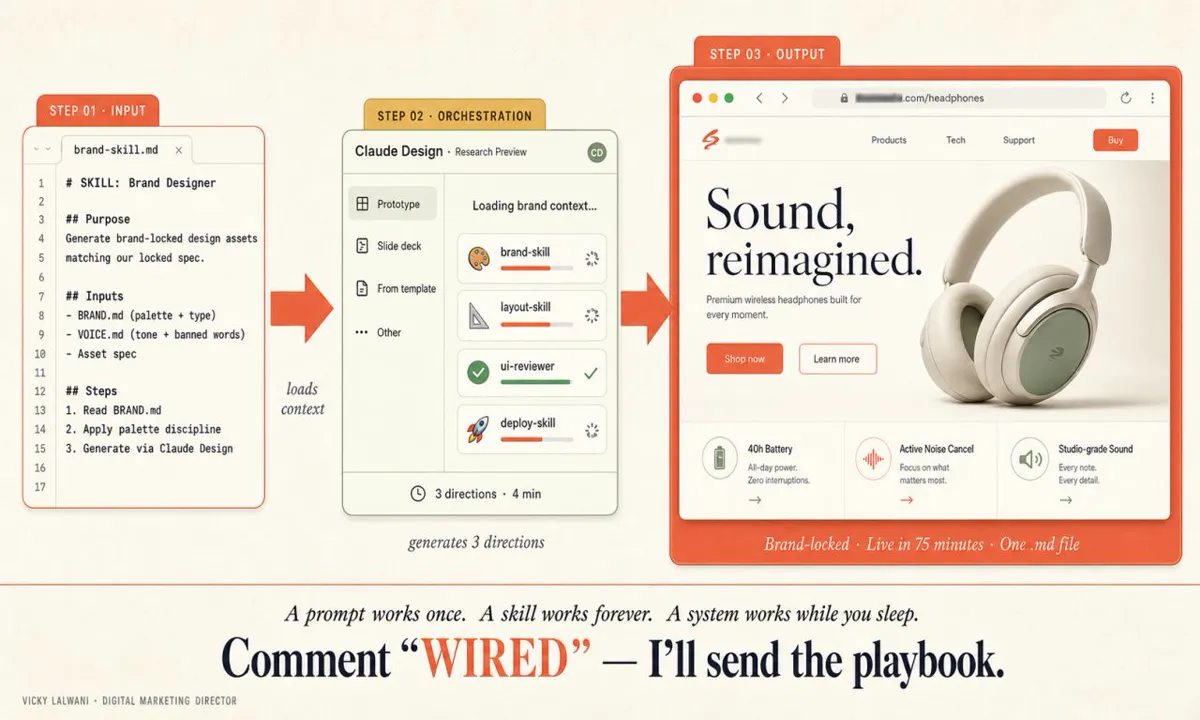
A marketing account on X suggests a similar setup: feed the model your brand voice, aim for a style between brand speak and hard selling, and turn it into a reusable Claude skill. That is a sound way to keep drafts consistent, as long as a person still reviews them.
Google now writes copy too. Text customisation in AI Max for Search generates extra headlines and descriptions from your landing page, ads and keywords. Google says campaigns using it are upgraded to AI Max automatically from September 2026, and a text guidelines pilot lets you exclude terms and set a tone. Check the asset report for lines you would not have written.
| Task | Who does it | Why |
|---|---|---|
| Choose the framework | You | Depends on the buyer |
| Collect phrases and proof | You | AI cannot invent proof |
| Draft 10 to 15 options | AI | Fast variety |
| Cut, check claims, policy | You | You are accountable |
| Pick what to test | You | One change at a time |
How do you test which framework works?
Short answer: Change one thing at a time. Run a framework-led ad against your current best ad with the same audience, budget and landing page, and judge on conversions, not click-through rate. In Google Ads, use ad variations or a second responsive search ad, and read the asset report.
- Pick one offer and one audience.
- Write one ad in each of two frameworks, labelled in the ad name.
- Run them against your current best ad with the same budget and targeting.
- Judge on conversions or qualified leads, not clicks.
- Record which framework and angle won, and your guess at why.
Google's best practices page supports running more than one responsive search ad per ad group: it reports an average 6.6% increase in conversions when advertisers go from one to two, and 3.7% from two to three, at a similar cost per conversion. Those are Google's averages, not a promise for your account.
Volume matters. In an r/googleads thread about small budgets, the question was whether 15 headlines spread a budget under 100 dollars a day too thin. Replies split between filling all 15 and using 5 to 8 sharp headlines so the system can pick a winner with little traffic. Another thread warns that with a couple of dozen conversions, asset data is too thin to judge single headlines; look at search terms and lead quality instead.
What do people say about frameworks and RSAs on X and Reddit?
Short answer: Copywriters still lean on the classic frameworks, PPC managers argue about pinning, and many treat Ad Strength as a hint rather than a goal. The common thread: frameworks help, but the words and the testing decide the result.
| Source | What they say | Date | Type |
|---|---|---|---|
| An email marketer on X | Frameworks differ in where the pressure goes | 12 Apr 2026 | Opinion |
| A marketing account on X | Brand voice plus a Claude skill | 25 Nov 2025 | Opinion |
| An agency owner on X | Pinned headline not shown | 9 Feb 2025 | First-hand |
| Search Engine Land | Headline performance data added | 28 Jul 2025 | Publication |
| Google Ads on X | Changes to headlines and sitelinks | 1 Feb 2024 | Official |
| r/googleads | Pin for brand only, or pin all | 28 Mar 2026 | Opinion |
| r/googleads | Do 15 headlines thin a small budget? | 25 Mar 2026 | Opinion |
| r/googleads | 4 relevant headlines versus 15 | 8 Jul 2026 | Opinion |
| r/googleads | Asset data too thin to judge headlines | 9 Mar 2026 | Opinion |
Read these as single voices. They are useful for the arguments, not as benchmarks.
Videos worth watching
Short answer: Start with Google's own two-minute video on responsive search ads, then a copywriting school's take on PAS and on choosing a framework. The table adds paid social walkthroughs and Google's AI Max explainer.
Google Ads' official channel, 3 August 2026. The same video sits on Google's best practices page. It sells nothing beyond Google Ads itself.
A conversion copywriting school's channel on writing the agitate step without overdoing it, 1 September 2022. The description promotes its courses.
The same school on picking a framework for a blank page, 15 November 2022.
| Video | Channel | Date | What it covers |
|---|---|---|---|
| Responsive search ads for success | Google Ads | 3 Aug 2026 | RSA best practice |
| How to use the PAS formula | Copywriting school | 1 Sep 2022 | Agitation done well |
| How to choose a framework | Copywriting school | 15 Nov 2022 | Picking a structure |
| PAS and AIDA for Meta ads | Paid social course channel | 4 Oct 2026 | Primary text, hooks |
| PAS, AIDA and BAB explained | Digital marketing channel | 16 May 2026 | Three formulas |
| How to use AI Max for Search | Google Ads | 21 Apr 2026 | Google-written assets |
Where this advice is weak
Short answer: No public study shows one copywriting framework beating another across accounts. The framework-to-format matches here are reasoned from how the formats work, not measured. Your test results beat any rule in this article.
- Google's uplift figures are averages Google publishes about its own products, without a full method.
- The 32,760 figure is arithmetic on the published limits. Google also varies how many headlines and descriptions show, so real counts differ.
- Meta's 50 to 150 and 27 character figures are recommendations for one placement, not hard limits.
- Policies change. Check Google's and Meta's current pages before launching anything in health, finance or other sensitive categories, and get professional advice where the law applies.
Want help turning frameworks into ads that convert?
Short answer: I can review your responsive search ads and Meta ads, rebuild the asset sets around a clear framework and your customers' words, and set up tests that give you an answer. See Google Ads consulting, Meta Ads consulting or pricing.
Next in this set: how to write ad copy from your customers’ own words and ad copy examples: before and after rewrites.
Sources
| Source | What it supports | Date | Link |
|---|---|---|---|
| Google Ads Help | RSA limits, order, pinning | Read 18 Nov 2026 | About responsive search ads |
| Google Ads Help | Keyword in one headline | Read 18 Nov 2026 | About Ad Strength |
| Google Ads Help | More RSAs, 6.6% and 3.7% | Read 18 Nov 2026 | Create effective Search ads |
| Google Ads Help | Text customisation, AI Max | Read 18 Nov 2026 | Text customisation |
| Google Ads Help | Ad variations | Read 18 Nov 2026 | About ad variations |
| Meta ads guide | Feed text recommendations | Read 18 Nov 2026 | Facebook Feed image specs |
| Meta Transparency Centre | Personal attributes rule | Read 18 Nov 2026 | Personal attributes |
| X and Reddit | Practitioner views | 2024 to 2026 | Linked in the table above |
This article expands on my post on LinkedIn ↗.
FAQ
What are the main ad copywriting frameworks?
The most used are PAS (problem, agitate, solution), AIDA (attention, interest, desire, action), FAB (features, advantages, benefits) and BAB (before, after, bridge). The 4Cs (clear, concise, compelling, credible) is an editing checklist you apply to any of them.
Which copywriting framework is best for Google Ads?
PAS and FAB suit search ads, because the searcher has already named a need. In a responsive search ad, write each step as separate headlines that stand alone, since Google can show them in any order.
Which copywriting framework works for Meta ads?
PAS suits short primary text when the reader already feels the problem, while AIDA and BAB suit people who were not looking. Keep the agitate step about the situation, because Meta bans ads that imply personal attributes such as health or finances.
How many headlines can a responsive search ad have?
A responsive search ad takes at least 3 and up to 15 headlines of up to 30 characters each, plus 2 to 4 descriptions of up to 90 characters. Path fields take up to 15 characters each.
Should I pin headlines in responsive search ads?
Only when a line must always show, such as a disclaimer or brand name. Google says pinning is not recommended for most advertisers; if you pin, pin two or three alternatives to the same position so testing can continue.
Can AI write ads using copywriting frameworks?
Yes, AI can draft framework-based ads quickly if you give it the offer, real customer phrases, proof and claims to avoid. A person should still check every line for accuracy, tone and platform policy before it runs.
Do copywriting frameworks make ads sound generic?
They can if you use them as scripts. Use the framework for the order of ideas and fill it with your customers' own words and specific proof, which is what makes the copy sound like your business.
How do I test which ad copywriting framework works best?
Run one framework-led ad against your current best ad with the same audience, budget and landing page, and judge on conversions rather than clicks. Change one thing per test and record what won and why.