These ad copy examples keep the offer the same and change only the framing: reader first instead of company first, a specific detail instead of an adjective, and a first step the buyer can feel instead of a distant result. Eight Google headlines and six Meta lines, each within current character limits.
TL;DR
The ad copy examples below keep each offer the same and change only the framing. Most weak lines fail for one of six reasons: they start with the company, sell a feature, promise a distant result, use adjectives instead of specifics, end with a generic call to action, or say something about the reader that a platform will reject.
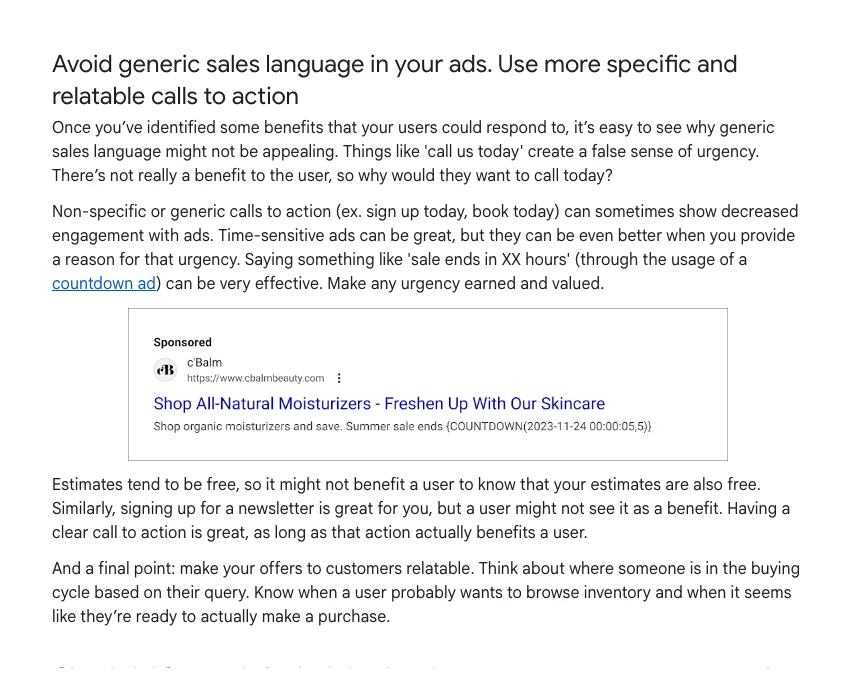
Google's own copy guidance says generic calls to action like "call us today" create a false sense of urgency, and recommends specific, relatable ones. Every Google headline below fits the 30-character limit.
The strongest single move is usually the first step: promise the first thing the buyer will notice, which you can deliver and they can check, and leave the long-term result to the proof.
This is the examples article in a set of three. For structure see ad copywriting frameworks; for where the words come from see how to write ad copy in your customers’ words. For help with your own account, see Google Ads consulting or Meta Ads consulting.
Two ads, same product, same price, same landing page. One says "Professional plumbing services". The other says "Leak fixed today, fixed price". Nothing about the offer changed, yet the second answers the questions in the searcher's head: how soon, and how much.
That is framing: how you present an offer that stays the same. This article collects fourteen before and after ad copy examples, explains the moves behind them, and shows how to test a rewrite so you learn something either way.
What makes one ad copy example better than another?
Short answer: The better line answers the reader's real question faster: what do I get, how soon, how sure can I be, and what do I do next. Framing changes how quickly those answers arrive. The offer, the price and the proof behind it stay the same.
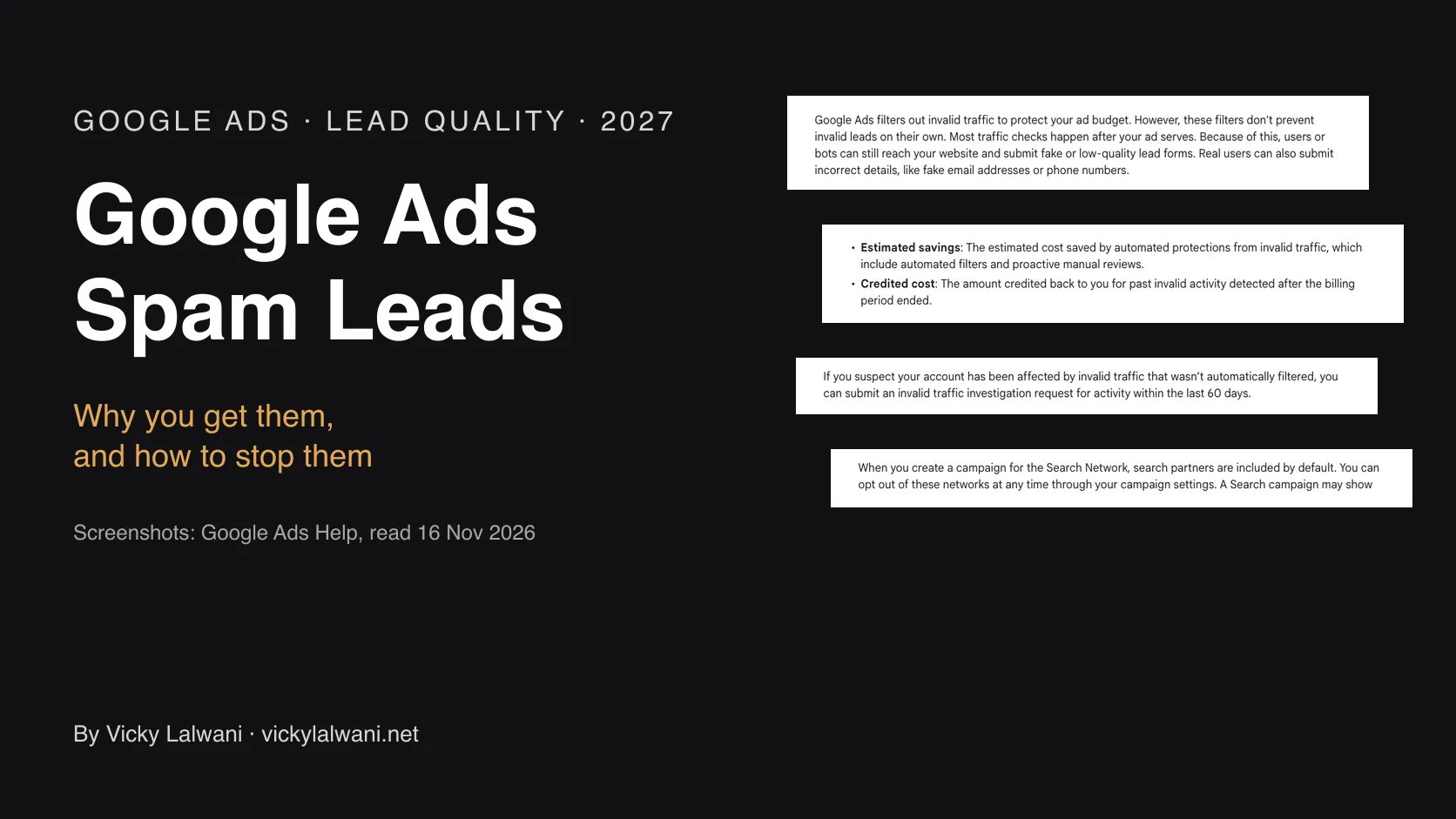
Most weak ad lines fail in one of six predictable ways. Each has a matching rewrite move.
| Move | Before (weak) | After (stronger) |
|---|---|---|
| We-first to reader-first | We offer... | You get... / the result |
| Feature to outcome | Smart reminders | Fewer empty slots |
| Distant to first step | Transform your results | Three fixes on the first call |
| Adjective to specific | Fast, premium service | Quote within 24 hours |
| Generic to specific CTA | Call us today | Get a fixed quote today |
| Attribute to product | Struggling with debt? | How repayment plans work |
Ad copy examples for Google search ads
Short answer: Each after line below fits Google's 30-character headline limit. The pattern: replace the category description with the answer to the searcher's next question, such as speed, price certainty, proof or the next step. All examples are illustrative; only use details your business can deliver.
| Business | Before | After | Move |
|---|---|---|---|
| Plumber | Professional Plumbing Services | Leak Fixed Today, Fixed Price | Vague to specific |
| Accountant | Award-Winning Accountancy Firm | Tax Return Filed This Week | We-first to result |
| Dentist | State-Of-The-Art Dental Care | Emergency Appointments Today | Feature to need |
| Invoicing software | All-In-One Business Platform | Invoices Sent In Two Clicks | Distant to first step |
| Removals | Quality Removal Services | Fixed Quote Within 24 Hours | Vague to specific |
| Driving school | Expert Driving Instructors | Book Your First Lesson Online | Generic to next step |
| Running shoes | Premium Running Shoes Sale | Free Returns Within 60 Days | Adjective to proof |
| IT support | End-To-End IT Solutions | IT Fixed Same Day, On Site | Jargon to outcome |
Notice that most of the before lines describe the category: plumbing services, accountancy firm, dental care. The searcher already knows the category; they typed it. The after lines tell them why to pick this result over the nine others on the page.
Keep your keyword whole in at least some headlines. Google's Ad Strength guidance says a keyword must sit inside a single headline to count, so a rewrite that drops every keyword can lower relevance even if it reads better.
Ad copy examples for Meta ads
Short answer: On Meta, the first line of primary text does most of the work, and Meta recommends 50 to 150 characters for feed image ads. The after lines below describe a moment or a first step the reader can picture, and none implies a personal attribute about the reader.
| Business | Before | After | Move |
|---|---|---|---|
| Fitness studio | Transform your body with our proven programme. | Start with a 30-minute class built for beginners. | Distant to first step |
| Home cleaning | We are a trusted, professional cleaning company. | Come home on Friday to a clean kitchen. | We-first to moment |
| Business coaching | Helping founders scale with clarity. | Leave the first call knowing your next three fixes. | Distant to first step |
| Skincare | Premium skincare for better results. | A three-step routine that takes four minutes. | Adjective to specific |
| Debt advice | Struggling with debt? We can help. | Free guide: how debt repayment plans work. | Attribute to product |
| Restaurant | The best food in town. | Table for two, booked in 20 seconds. | Claim to action |
The debt advice example is a policy rewrite as well as a framing one. Meta's ad standards list "Are you bankrupt?" as disallowed because it implies the reader's financial status. The after line describes the product instead of the person, which is both safer and clearer.
A practitioner on X makes the same point about feeling, with two headlines: a goal-based line versus a first-person moment. The moment usually wins attention; your test decides whether it wins sales.
Why do distant promises weaken ad copy?
Short answer: Because they ask the buyer to trust a result that is weeks or months away, for someone like them, after effort they cannot see. A first-step promise asks for much less belief: they will know quickly if it is right. That lowers the risk of saying yes.
"Helping founders scale with clarity" makes the buyer wonder whether it will work someday. "Leave the first call knowing your next three fixes" changes the question to "will I get three fixes?", which is easy to judge and easy to deliver.
The rule only works if the first step is real. Pick the first thing that genuinely changes after someone buys: a task removed, a decision made, a number they can see. Check your delivery team can produce it in the first session or week. If not, choose a smaller moment.
Some products genuinely take months, such as an SEO build or a complex implementation. Promising instant movement there creates refunds and complaints. Frame the first step as clarity instead: a ranked fix list, a clear audit, a confirmed plan.
How do you rewrite a generic call to action?
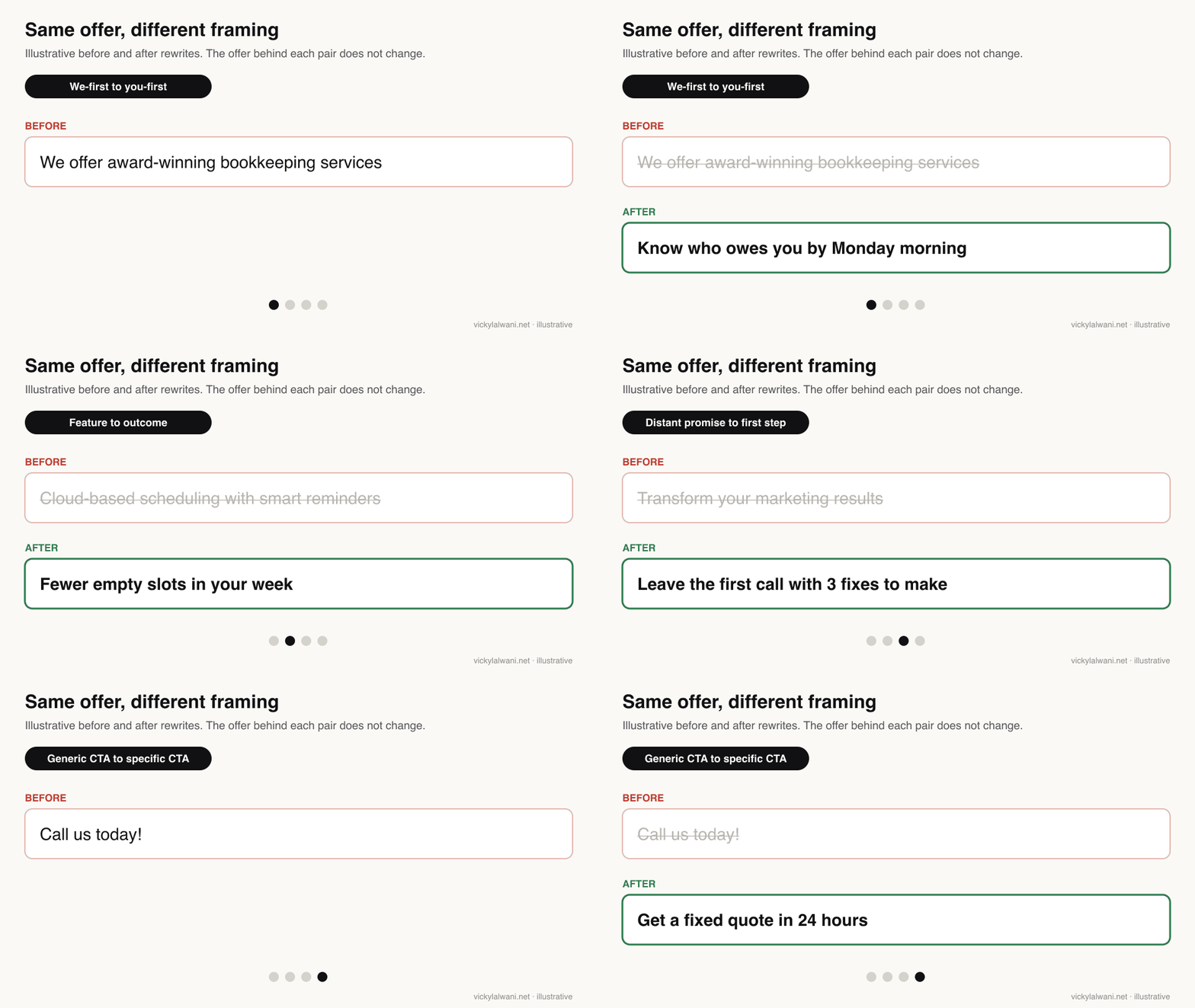
Short answer: Name the action and what the reader gets from it. Google says non-specific calls to action such as "sign up today" or "book today" can show decreased engagement, and that urgency should be earned, for example with a real deadline shown by a countdown.
| Generic | Specific |
|---|---|
| Call us today | Get a fixed quote today |
| Learn more | See prices and sizes |
| Sign up now | Start a 14-day trial |
| Contact us | Book a 15-minute call |
| Free estimate | Price in 24 hours, in writing |
Google makes one more useful point: free estimates are often standard in a category, so "free estimate" may not be a benefit at all. Offer something the competing ads do not.
What does one rewrite look like, step by step?
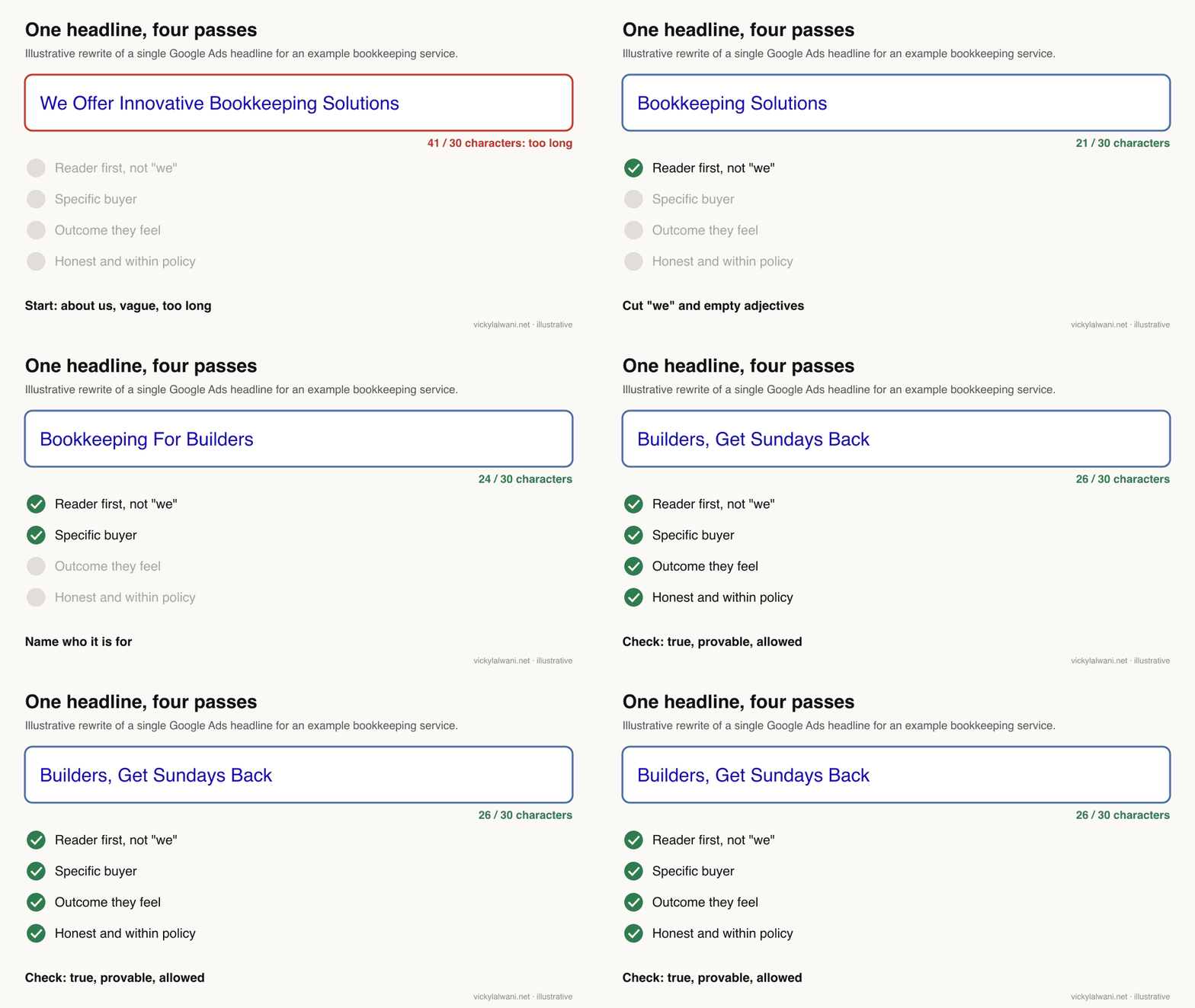
Short answer: Start with the weakest line, then make four passes: cut the company talk and empty adjectives, name who it is for, say what changes for them, and check it is true, provable and allowed. Count characters at every pass.
Here is a prompt for doing this at scale with an AI assistant. It keeps the offer fixed, asks for three framings per line and forces character counts. Check every output yourself; on my own work, AI drafts are reviewed by a person and approved in a document before they go live.
Rewrite each ad line below. Keep the offer exactly the same; change only the framing.

For each line give three versions:
1. Reader first: start from what the reader gets, not from us.
2. Specific: add a number, time or concrete detail I have given you (do not invent one).
3. First step: promise the first thing the buyer will notice, not the final result.

Rules: Google headlines 30 characters or fewer, descriptions 90 or fewer, Meta headlines 27 or fewer. Show character counts.
No claim beyond this proof list: [paste]. No personal attributes (health, finances, age and similar) in Meta copy.
Then tell me which version you would test first against the original, and why, in one line.

Lines: [paste your current headlines and primary text]
Does Google reward better ad copy?
Short answer: Indirectly. Google reports that advertisers who improve responsive search ad Ad Strength from Poor to Excellent see 15% more conversions on average, and Ad Strength rewards unique headlines that include your keywords. It does not judge your offer or your landing page.
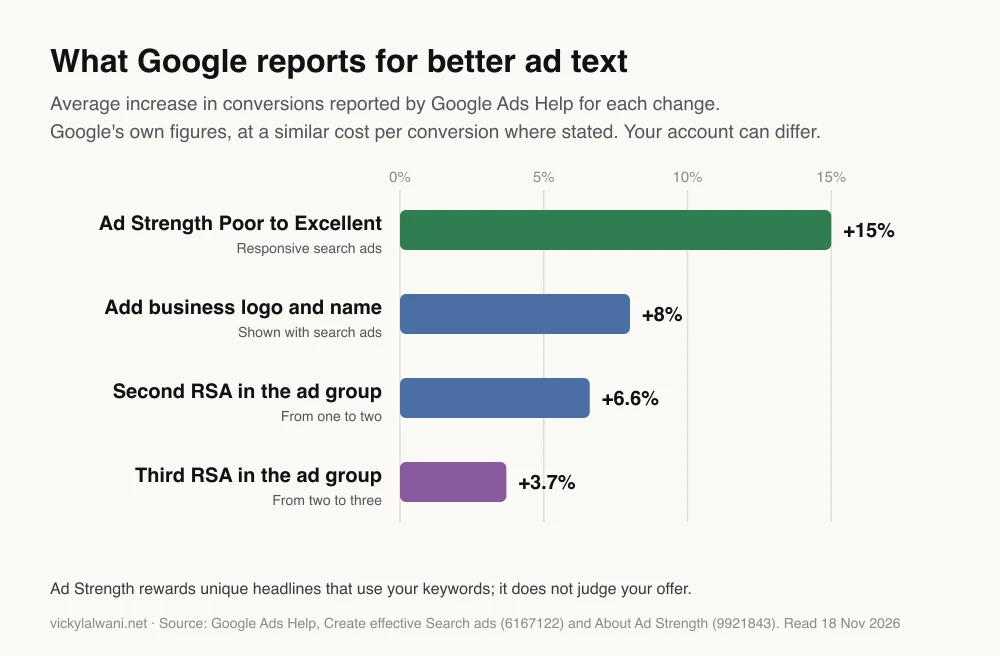
Rewrites help Ad Strength when they add genuinely different angles. Fifteen versions of "Professional plumbing" add nothing; speed, price, proof, area and guarantee are five different headlines.
Will Google rewrite your ad copy anyway?
Short answer: It can. Text customisation, now part of AI Max for Search, generates extra headlines and descriptions from your landing page, ads and keywords. Google says campaigns using it are upgraded to AI Max from September 2026, and its assets serve only when predicted to beat yours.
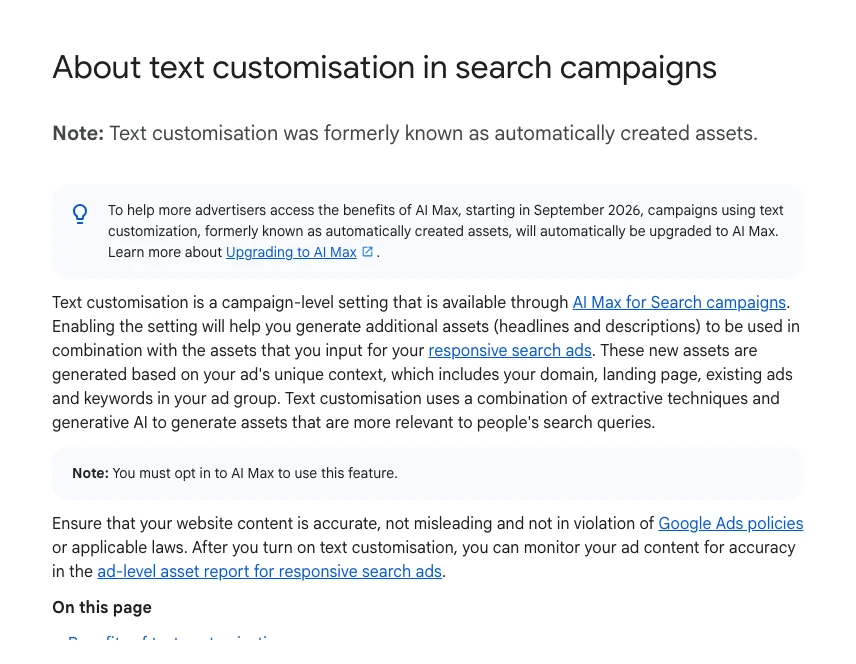
So the landing page is part of your ad copy now. If the page says "comprehensive solutions", generated headlines may too. Rewrite the page in the same reader-first way, check the asset report for lines you would not approve, and look at Google's text guidelines pilot for excluding terms and setting tone.
Match the page to the ad either way. A practitioner on X describes three ad angles all landing on one generic headline, and rewriting the landing page headline to match each ad.
How do you test an ad copy rewrite fairly?
Short answer: Run the rewrite against the original with the same audience, budget and landing page, change one thing, and judge on conversions or qualified leads. In Google Ads use a second responsive search ad or ad variations; on Meta, a separate ad in the same ad set.
- Pick the ad with the most spend, not the one you like least.
- Choose one move from the table above and rewrite only that.
- Run both versions side by side with the same targeting and budget.
- Wait for enough conversions to judge, then keep the winner.
- Log the move, the line and the result, and try the next move.
Do not pause a proven winner just because a prettier version exists. In an r/FacebookAds thread, an "ugly" original kept beating redesigned versions, and replies advised testing the new ads in a separate campaign instead of switching off what works.
What do people say about rewriting ad copy on X and Reddit?
Short answer: The rewrite threads agree on clarity: say what the product does, for whom, in plain words, and match the landing page. They disagree on tone, from very plain copy to personality-led lines.
| Source | What they say | Date | Type |
|---|---|---|---|
| A copywriter on X | Match page headline to ad angle | 13 Feb 2026 | Opinion |
| A native ads marketer on X | Show a real change, not a product | 18 Jul 2026 | Opinion |
| A marketer on X | Prompt AI to edit as a sceptic | 5 Nov 2026 | Opinion |
| A creative strategist on X | Two headlines: goal versus feeling | 29 Dec 2024 | Opinion |
| A marketer on X | 22 angles from vintage ads | 27 Jan 2026 | Opinion |
| r/FacebookAds | Vague positioning, clearer rewrites | 23 Jul 2026 | First-hand |
| r/FacebookAds | Long copy reads as AI-written | 29 May 2026 | Opinion |
| r/FacebookAds | Simple copy wins on clarity | 21 Sep 2026 | Opinion |
| r/FacebookAds | Ugly original beats redesigns | 12 May 2026 | First-hand |
The roast thread is a good live example: a founder's headline was clever, but readers could not tell what the product did. Suggested rewrites named the pain and the job it does, much like the moves above.
Videos worth watching
Short answer: Three practitioners critiquing and rewriting real ads, plus Google's own videos on responsive search ads and AI Max in the table. Watch the critiques for the habit of asking what the reader understands in five seconds.
A paid social practitioner's channel, 10 November 2026, comparing weak and strong lines for Meta and TikTok.
A copywriting coach's channel critiquing six ads, 7 September 2022. The description promotes a paid guide and courses.
A self storage marketing channel on adding offer language to Google Ads headlines, 8 September 2026. It sells marketing services to that industry.
| Video | Channel | Date | What it covers |
|---|---|---|---|
| Good vs bad ad copy | Paid social practitioner | 10 Nov 2026 | Meta, TikTok lines |
| Ad writing critique | Copywriting coach | 7 Sep 2022 | Six ads rewritten |
| One ad copy change | Industry marketing channel | 8 Sep 2026 | Offer in headlines |
| Facebook ad copy with examples | Copywriting coach | 2 Jun 2021 | Annotated examples |
| Responsive search ads for success | Google Ads | 3 Aug 2026 | RSA best practice |
| AI Max for Search campaigns | Google Ads | 12 Jun 2025 | Google-written assets |
Where this advice is weak
Short answer: The fourteen examples are illustrative rewrites, not tested results. Framing advice is widely shared, but there is no public data showing how much any single move lifts conversions across accounts. Your own tests are the only evidence that counts for your market.
- Google's uplift figures are its own averages about ad formats and Ad Strength, not about wording choices.
- A specific detail is only better if it is true. "Fixed today" is a promise you must keep every day the ad runs.
- Health, finance and other sensitive categories have extra rules on both Google and Meta. Check current policies and get professional advice where the law applies.
- Clear beats clever on average, but brand-led advertisers may rightly choose a different balance.
Want your ad copy rewritten and tested?
Short answer: I can review your highest-spend Google and Meta ads, rewrite them using the moves above and your customers' words, and set up tests that give you a clear answer. See Google Ads consulting, Meta Ads consulting or pricing.
Also in this set: ad copywriting frameworks (PAS, AIDA and responsive search ads) and how to write ad copy in your customers’ own words. To see how competitors frame the same offer, read how to analyse a competitor landing page.
Sources
| Source | What it supports | Date | Link |
|---|---|---|---|
| Google Ads Help | Generic CTAs, false urgency | Read 18 Nov 2026 | Write genuine ad copy |
| Google Ads Help | 30-character headlines | Read 18 Nov 2026 | About responsive search ads |
| Google Ads Help | 15%, 8%, 6.6%, 3.7% | Read 18 Nov 2026 | Create effective Search ads |
| Google Ads Help | Ad Strength, keyword in one headline | Read 18 Nov 2026 | About Ad Strength |
| Google Ads Help | Text customisation, AI Max | Read 18 Nov 2026 | Text customisation |
| Meta ads guide | Feed text recommendations | Read 18 Nov 2026 | Facebook Feed image specs |
| Meta Transparency Centre | Personal attributes examples | Read 18 Nov 2026 | Personal attributes |
| X and Reddit | Practitioner views | 2024 to 2026 | Linked in the table above |
This article expands on my post on LinkedIn ↗.
FAQ
What is a good example of ad copy?
A good ad line answers the reader's next question fast, for example "Leak Fixed Today, Fixed Price" instead of "Professional Plumbing Services". It names a result, a specific detail or the next step, and only promises what the business can deliver.
What does framing mean in ad copy?
Framing is how you present an offer that does not change. The product, price and proof stay the same, but the line leads with what the reader gets, a specific detail or the first step, instead of a company description or a distant result.
How do I rewrite ad copy to improve it?
Change one thing at a time: start from the reader instead of the company, swap a feature for an outcome, replace adjectives with specifics, promise a first step, or make the call to action specific. Then test the rewrite against the original.
What are examples of Google Ads headlines under 30 characters?
Examples include "Leak Fixed Today, Fixed Price", "Tax Return Filed This Week", "Fixed Quote Within 24 Hours" and "Emergency Appointments Today". Each answers a searcher's question about speed, certainty or the next step within Google's 30-character limit.
Why is "call us today" a weak call to action?
Google's own guidance says generic calls to action such as "call us today" create a false sense of urgency with no benefit to the reader. A specific action with a benefit, such as "Get a fixed quote today", gives a reason to act.
Can I ask questions like "Struggling with debt?" in Meta ads?
No. Meta's ad standards ban ads that assert or imply personal attributes such as financial status or health, and list "Are you bankrupt?" as a disallowed example. Describe the product instead, for example a guide to how repayment plans work.
Does Google write ad copy for me?
It can. Text customisation in AI Max for Search generates headlines and descriptions from your landing page, ads and keywords, and Google says campaigns using it were upgraded to AI Max from September 2026. Review its assets in the asset report.
How do I test a new ad headline?
Run it against your current ad with the same audience, budget and landing page, change only the headline, and judge on conversions or qualified leads rather than clicks. Keep the winner and log what changed.