The fastest way to write ad copy that converts is to stop inventing it. Collect the words buyers already use in search terms, reviews and sales calls, turn them into you-first headlines that fit Google's 30-character limit and Meta's short feed text, and test them against your current ads.
TL;DR
To write ad copy that converts, collect the words your buyers already use before you write a line: search terms, reviews, sales calls and the objections you hear. Then write from the reader's result (you) instead of your company (we).
Google's own guidance says to focus on user needs and benefits and to mine the search terms report and your best pages for language. That is the method in one sentence.
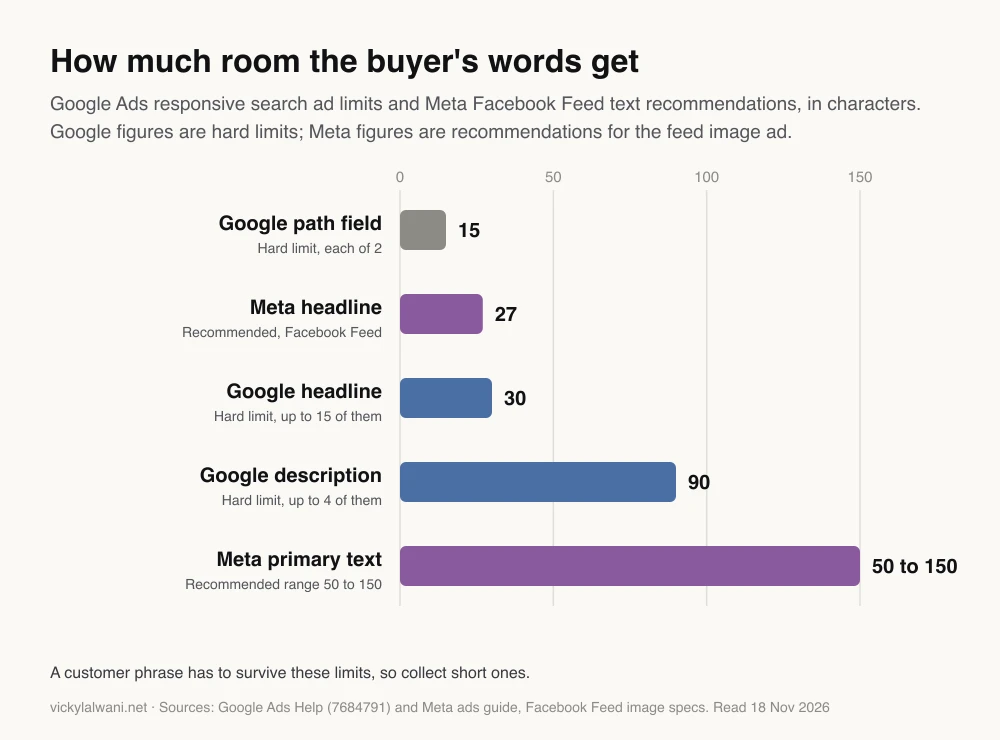
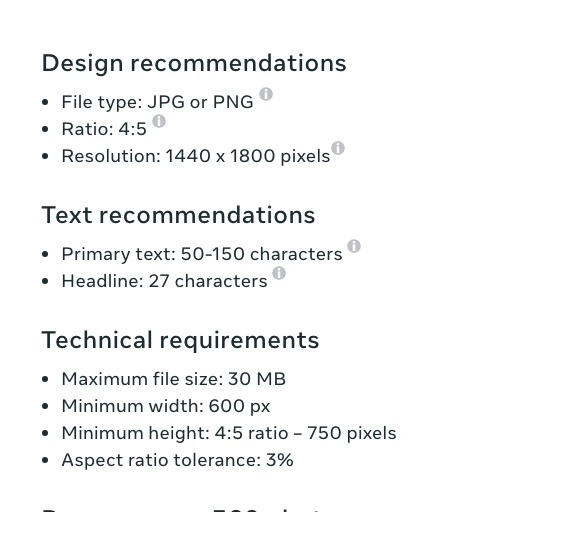
The words must fit: Google headlines take 30 characters, descriptions 90; Meta recommends a 27-character headline and 50 to 150 characters of primary text. And on Meta, "you" copy must not imply a personal attribute such as health or money trouble.
This article is about where the words come from. For structure see ad copywriting frameworks; for rewrites see ad copy examples, before and after. For help inside your account, see Google Ads consulting or Meta Ads consulting.
Most weak ads are written from the inside out. The team describes the service the way they talk about it in meetings: "comprehensive solutions", "premium packages", "award-winning service". The buyer, meanwhile, typed "accountant who does builders" into Google and wrote "they had everything ready before I asked" in a review.
Customer-focused ad copy closes that gap. You stop inventing language and start reusing the buyer's. This guide shows where to find those words, how to turn them into headlines that fit, and what the platforms will not let you say. If you want someone to do this with you on a live account, my Google Ads consulting includes an ad copy review.
How do you write ad copy in your customers’ words?
Short answer: Collect before you write. Pull exact phrases from four places (search terms, reviews, sales calls or emails, and objections), sort them into problem, result and worry, then write headlines and primary text that reuse those phrases from the reader's side. Test them against your current ads.
- Export the last 90 days of search terms and your most recent reviews.
- Add notes from sales calls, enquiry emails and the questions people ask before buying.
- Copy exact phrases into a phrase bank, tagged by source and by type: problem, result, worry.
- Write headlines and descriptions from the bank, starting with what the reader gets.
- Check each line fits the limit, is true and is allowed, then test it.
Why does 'you' copy beat 'we' copy?
Short answer: Because the reader is asking what is in it for them. A line that starts with we asks them to care about your company first; a line that starts with you, or with their result, answers their question straight away. Google's ad copy guidance makes the same point: focus on what a user gets.
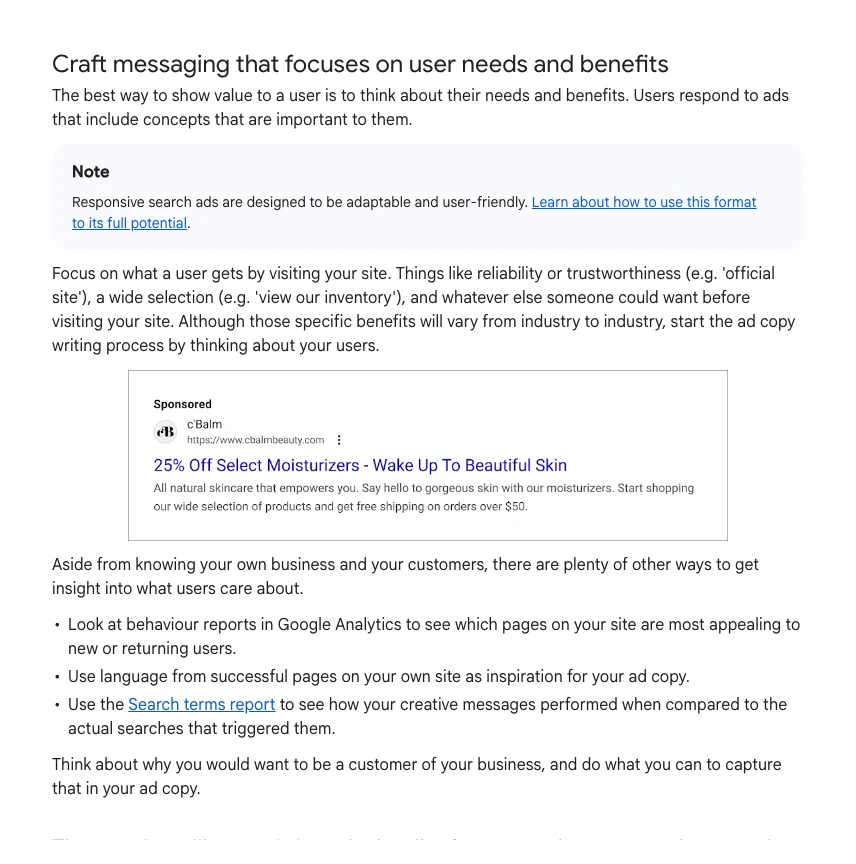
Google's page on writing compelling, genuine ad copy says "users respond to ads that include concepts that are important to them" and suggests starting "by thinking about your users". It also warns that generic lines like "call us today" create false urgency with no benefit to the reader.
Starting with the word you is a useful habit, not a rule. "Know who owes you by Monday" is reader-first. So is "Same-day boiler repair", which has no you in it at all. The test is whose point of view the line takes.
| We-first | Reader-first |
|---|---|
| We offer premium mattresses | Wake up without back ache |
| We manage Google and Meta ads | See which ads waste money |
| Our clinic has advanced options | Sorted in one visit, not three |
| Powerful all-in-one platform | Decide without switching tools |
Each rewrite names a result and drops an adjective. None needs a bolder claim, only a clearer one, and every result still has to be true for your product.
Where do you find your customers’ words?
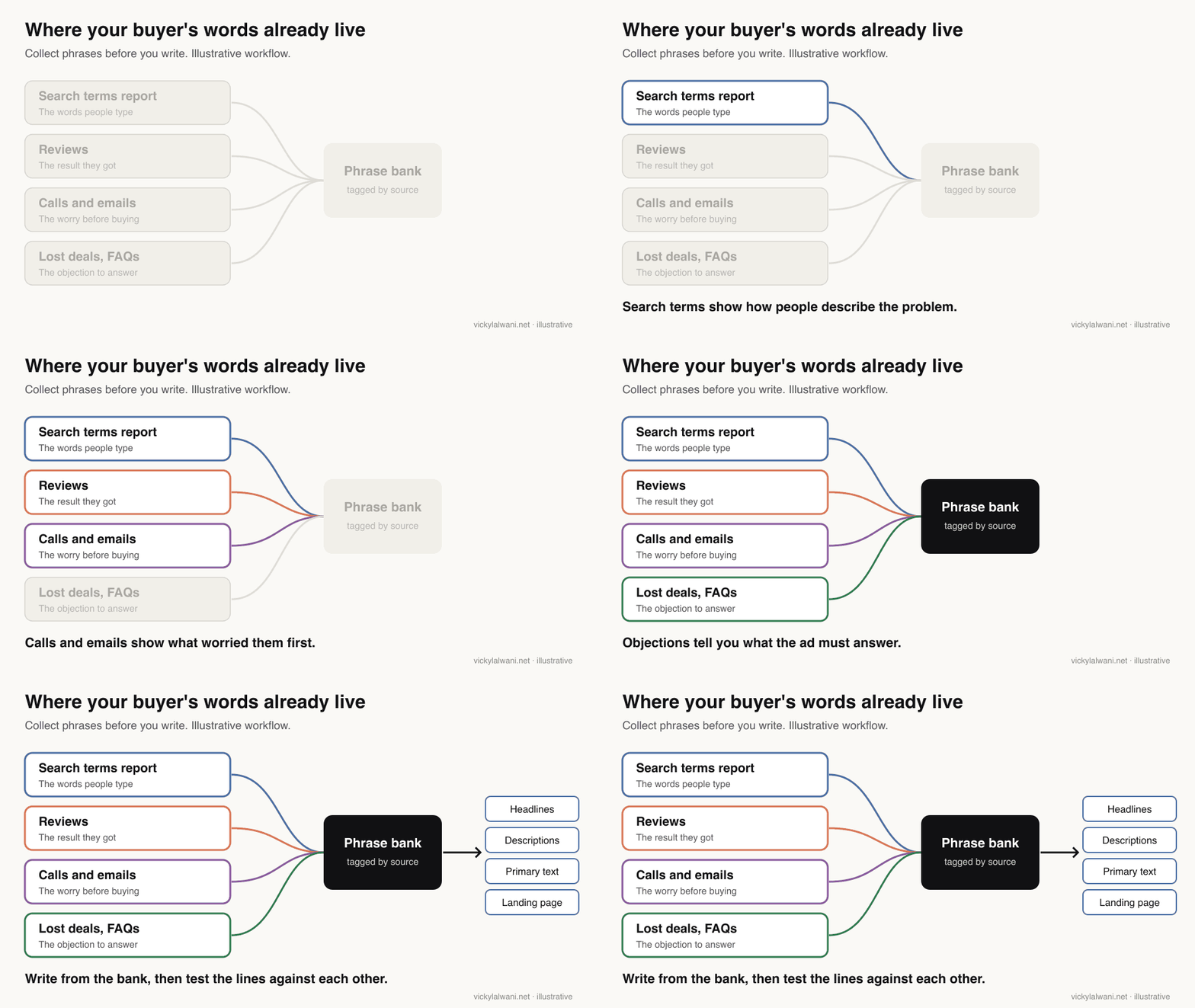
Short answer: In four places you already have: the search terms report (how they describe the need), reviews (the result in their words), sales calls and enquiry emails (the worry before buying), and lost deals or FAQs (the objection to answer). Competitor reviews and forums add more.
| Source | What it gives you | Where to find it |
|---|---|---|
| Search terms report | The need, as typed | Google Ads, Insights |
| Your reviews | The result, as felt | Google, Trustpilot, site |
| Calls and emails | Worries before buying | CRM, inbox, call notes |
| Lost deals, FAQs | Objections | Sales team, chat logs |
| Competitor reviews | Gaps and complaints | Public review sites |
| Forums, Reddit | Unfiltered language | Niche communities |
The search terms report is the most underused. It shows the actual searches that triggered your ads, which are the words people choose before they know your brand. Google's page suggests using it to compare your messages with those searches.
Searcher words beat internal words. On one Google Ads build I worked on, a review caught that the location keywords used local council names that residents never type; people search by suburb. The fix was to rebuild the keywords and ad copy around suburb names. Branded package names have the same problem: nobody searches for what you call your service internally.
Practitioners describe the collection step as the slow part. In an r/copywriting thread on mining reviews and Reddit for customer language, replies suggested pulling whole threads as text and tagging phrases with an AI model, while others said they still read every review by hand because they trust it more.
How do you turn a review into a headline?
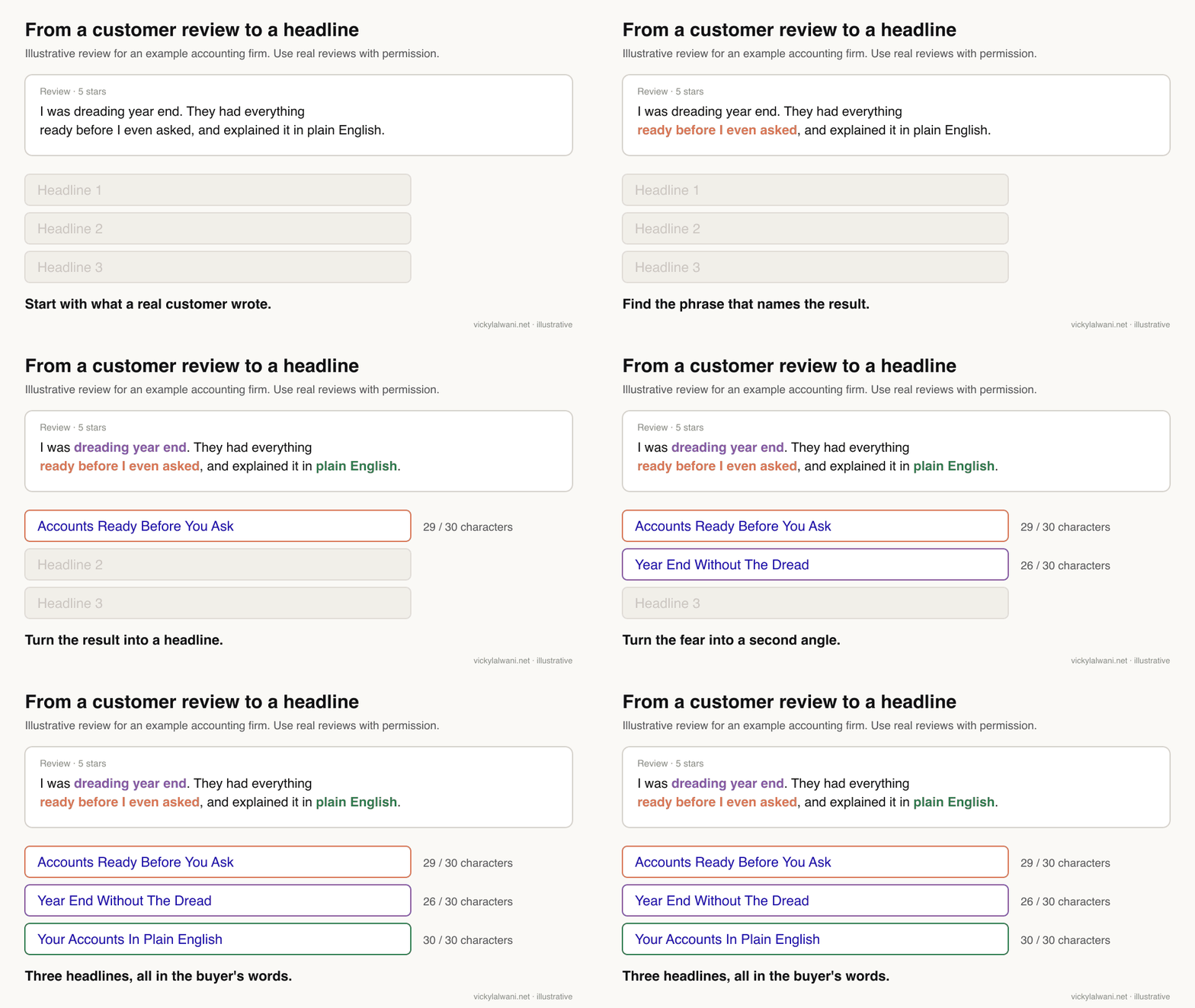
Short answer: Find the phrase that names the result, keep the customer's wording, and cut it to fit. A Google headline takes 30 characters, so look for short phrases. Then turn the fear before buying into a second angle and the relief after into a third.
Space is the constraint. Google's responsive search ad limits are hard limits; Meta's feed text figures are recommendations for the image ad in Facebook Feed. A customer phrase has to survive these.
| Phrase type | Best slot | Example (illustrative) |
|---|---|---|
| Result | Headline | Accounts ready before you ask |
| Fear before | Second headline | Year end without the dread |
| How it felt | Description | Explained in plain English |
| Objection | Description or FAQ | Fixed fee, no surprises |
What can't you say in 'you' copy?
Short answer: On Meta, you cannot assert or imply a personal attribute about the reader: health, financial status, age, religion, sexual orientation, criminal record and similar. Meta's ad standards explicitly allow "you/your" language without a personal attribute, so "you" is fine; "your diabetes" is not.
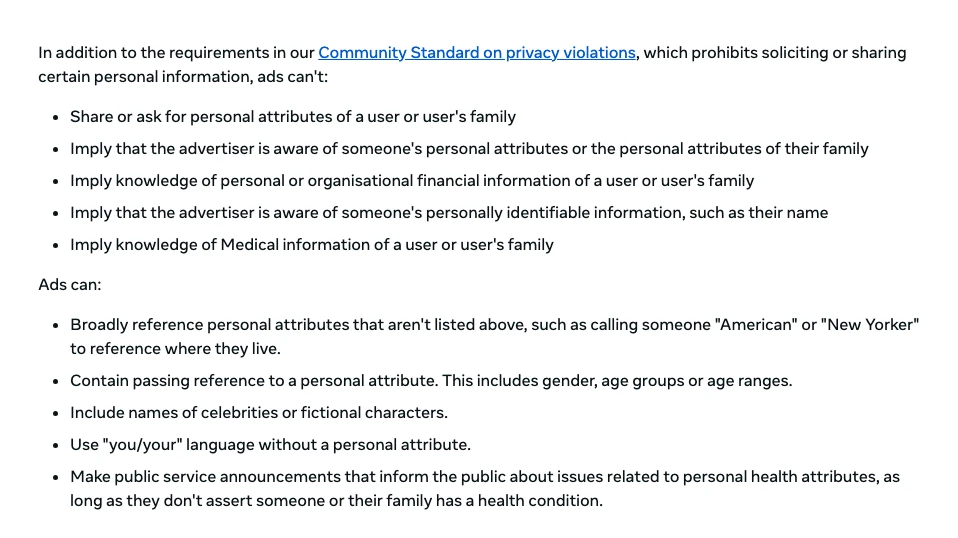
This is where customer language can get you into trouble. A review might say "my anxiety about money is gone". As a quote on your site it may be fine; as an ad line that says "Your money anxiety, gone" it implies a financial and mental health attribute about the reader. Describe the product's result instead: "Clear monthly figures, no surprises".
Reviews also belong to the people who wrote them. Use them as a source of phrases and themes, quote named reviews only with permission, and never write a review-style line that a customer did not say.
How do you use AI to mine customer language?
Short answer: Give the model anonymised reviews, call notes and search terms, and ask it to extract exact phrases under problem, result and worry, with counts and sources. Ask it not to paraphrase. Write from the extracted bank in a second step, and check every line yourself.
Below are customer reviews, call notes and search terms for [business]. Do not write ads yet.

1. Pull out exact phrases (do not paraphrase) under four headings:
   - The problem in their words
   - What they tried before and why it failed
   - The result they describe after buying
   - Worries or objections before buying
2. For each phrase, note the source (review, call, search term) and how many times a similar phrase appears.
3. Flag any phrase that names a health condition, money trouble, age or another personal attribute. Those cannot be used as "you" statements in Meta ads.
4. List the 10 phrases that appear most often and are short enough for a 30-character headline.

[paste anonymised reviews, notes and search terms]
Using only the phrase bank below, write:
- 8 Google Ads headlines (30 characters or fewer), each starting from the reader's result, not from us
- 3 descriptions (90 characters or fewer)
- 2 Meta primary texts (under 150 characters) and 2 headlines (27 characters or fewer)
Rules: keep the customer's wording where it fits; no "we" in the first three words; no claim that is not in the phrase bank or the proof list; show character counts.

Phrase bank: [paste]
Proof we can stand behind: [paste]
Practitioners on X describe the same pattern. One Google Ads account suggests building a project brain with product pages, reviews, objection docs and search terms reports before asking for any copy. Another shares a research prompt that starts with the website, reviews and competitor ads.
On my own work, AI drafts are checked by a person before anything goes live, and copy is approved in a document first. Google will also write copy for you: text customisation in AI Max builds headlines from your landing page. If your page uses internal language, so will those headlines, which is one more reason to fix the page first.
How do you test customer-focused copy?
Short answer: Rewrite your highest-spend ads with the phrase bank, run them against the current versions with the same targeting and budget, and judge on conversions or qualified leads, not click-through rate. Change one thing at a time and keep a log of which phrase won.
- Pick the five ads or ad groups that spend the most.
- Write one reader-first version of each from the phrase bank.
- In Google Ads, add it as a second responsive search ad; Google reports 6.6% more conversions on average going from one to two RSAs per ad group.
- In Meta, run the new primary text as a separate ad in the same ad set.
- After enough conversions to judge, keep the winner and log the phrase and its source.
Over a few months the log becomes your playbook: which customer phrases sell, from which source. That is worth more than any list of templates. For the structure to put those phrases in, see ad copywriting frameworks.
What do people say about customer language on X and Reddit?
Short answer: The agreement is strong: real customer words beat invented ones, and frameworks are only scaffolding for them. The disagreement is about method, from reading every review by hand to feeding thousands into an AI model.
| Source | What they say | Date | Type |
|---|---|---|---|
| A creative strategist on X | Use real, unpolished testimonials | 6 Jan 2026 | Opinion |
| A Google Ads account on X | Feed reviews and search terms first | 23 Sep 2026 | Opinion |
| A creative strategist on X | Research prompt before writing | 20 Jan 2026 | Opinion |
| An ad creative agency on X | AI needs real customer language | 4 Aug 2025 | Vendor |
| A Google Ads account on X | Problem searches reveal new angles | 23 Apr 2026 | Opinion |
| r/copywriting | How to pull phrases from reviews | 7 Aug 2026 | Opinion |
| r/copywriting | Frameworks need real insights | 19 Feb 2026 | Opinion |
| r/FacebookAds | Write the annoying moment, not specs | 20 May 2026 | Opinion |
| r/copywriting | B2B buyers need proof first | 30 Apr 2026 | Opinion |
The r/FacebookAds thread has the clearest example: "keeps drinks hot" is a feature, while "my coffee is already cold before I get to work" is the moment that makes someone care. In another, a copywriter sums up the relationship: you will not pick the right problem to agitate if you do not understand your audience.
Videos worth watching
Short answer: A conversion copywriting school's short method for finding customer language fast, a talk on mining third-party reviews, and a vendor's take on doing it with AI. The table adds two more on voice of customer and Google's AI Max explainer.
A conversion copywriting school's channel, 2 May 2020. Older, but the method has not changed. The description promotes its courses.
A recorded talk from a message-testing company's event, 23 November 2020, on using reviews when you cannot run interviews.
An ad tool vendor's short video, 15 July 2025. It demonstrates the idea and promotes the vendor's product.
| Video | Channel | Date | What it covers |
|---|---|---|---|
| Super speedy VOC formula | Copywriting school | 2 May 2020 | Fast phrase finding |
| Review mining talk | Message testing company | 23 Nov 2020 | Third-party reviews |
| Ad copy hiding in reviews | Ad tool vendor | 15 Jul 2025 | Reviews with AI |
| Voice of customer in your brand | Copywriting school | 12 Mar 2021 | Taglines from VOC |
| Find your copy in customer reviews | Copywriter channel | 29 Jun 2021 | Review mining steps |
| How to use AI Max for Search | Google Ads | 21 Apr 2026 | Google-written assets |
Where this advice is weak
Short answer: There is no published study showing how much customer language lifts ad results across accounts, and Google's uplift figures are about ad formats, not wording. Treat this as a method to test, not a guaranteed gain.
- Small businesses may have few reviews or search terms. Sales calls and competitor reviews fill the gap, but the sample is thin.
- Customer words can be vague, emotional or off-brand. Edit them; do not paste them blindly.
- Meta's personal attributes rule and Google's policies change, and sensitive categories have extra rules. Check the current pages and get professional advice where the law applies.
- The "you beats we" principle is widely taught but I have no controlled figures to prove it for your market. Your test is the evidence.
Want a second pair of eyes on your ad copy?
Short answer: I can mine your search terms and reviews, rebuild your highest-spend ads in your customers' words and set up a fair test. See Google Ads consulting, Meta Ads consulting or pricing.
Also in this set: ad copywriting frameworks for responsive search ads and Meta and ad copy examples: same offer, better framing. For competitor research, see how to analyse a competitor landing page.
Sources
| Source | What it supports | Date | Link |
|---|---|---|---|
| Google Ads Help | Benefits, search terms, pages | Read 18 Nov 2026 | Write genuine ad copy |
| Google Ads Help | RSA character limits | Read 18 Nov 2026 | About responsive search ads |
| Google Ads Help | Search terms report | Read 18 Nov 2026 | Search terms report |
| Google Ads Help | Second RSA, 6.6% | Read 18 Nov 2026 | Create effective Search ads |
| Google Ads Help | Text customisation, AI Max | Read 18 Nov 2026 | Text customisation |
| Meta ads guide | Feed text recommendations | Read 18 Nov 2026 | Facebook Feed image specs |
| Meta Transparency Centre | You/your and personal attributes | Read 18 Nov 2026 | Personal attributes |
| X and Reddit | Practitioner views | 2025 to 2026 | Linked in the table above |
This article expands on my post on LinkedIn ↗.
FAQ
How do I write ad copy that converts?
Start from your buyers' own words: search terms, reviews, sales calls and objections. Write from the reader's result rather than your company, keep it within the platform's character limits, and test it against your current ads on conversions.
What is customer-focused ad copy?
It is ad copy written from the buyer's point of view, naming the result they get or the problem they want gone, often in the words they use themselves. It contrasts with company-first copy that lists features or awards.
Should every headline start with the word you?
No. Starting with you is a useful habit, but the real test is whether the line takes the reader's point of view. A clear result such as "Same-day boiler repair" works without the word you.
Where can I find my customers’ language for ads?
Use the Google Ads search terms report, your reviews, notes from sales calls and enquiry emails, lost-deal reasons and FAQs. Competitor reviews and niche forums add more unfiltered language.
Can I use customer reviews in my ads?
You can use reviews as a source of phrases and themes. Quote or show a named review only with the customer's permission, never invent or alter a review, and check each platform's rules on testimonials.
Is 'you' language allowed in Meta ads?
Yes. Meta allows you and your language as long as the ad does not assert or imply a personal attribute such as health, financial status, age or religion. Describe the product's result rather than the reader's condition.
How long can a Google Ads headline be?
A Google responsive search ad headline can be up to 30 characters, a description up to 90, and each path field up to 15. Each ad takes up to 15 headlines and 4 descriptions.
How do I test customer-focused ad copy?
Add the rewritten version as a second ad alongside your current one with the same targeting and budget, and judge on conversions or qualified leads, not clicks. Change one thing at a time and log which phrase won.