A strong Meta ad creative process starts with research, not visuals: find the angle competitors miss, write one specific brief, then build four genuinely different directions mapped to the funnel before copy and design. Meta's rebuilt delivery system (Andromeda, GEM and GenRecs, October 2026) asks for more creative variety, and Advantage+ creative lists 30 enhancements, 16 using generative AI, so review them before launch.
TL;DR
Good Meta ad creative starts with research, not visuals: find the angle your competitors are missing, write one specific brief, then build four genuinely different directions, one for each funnel stage, before you write copy or brief a designer.
That matters more now. Meta's delivery system (Andromeda shortlists candidate ads; GEM and GenRecs help rank and recommend them) was rebuilt again in October 2026, and Meta's own advice is to "supply more creative variety so the system has more to test and learn from". Four versions of one idea do not give it variety.
Before launch, open Advantage+ creative and check every enhancement. Meta lists 30 of them, 16 use generative AI, and some are on by default.
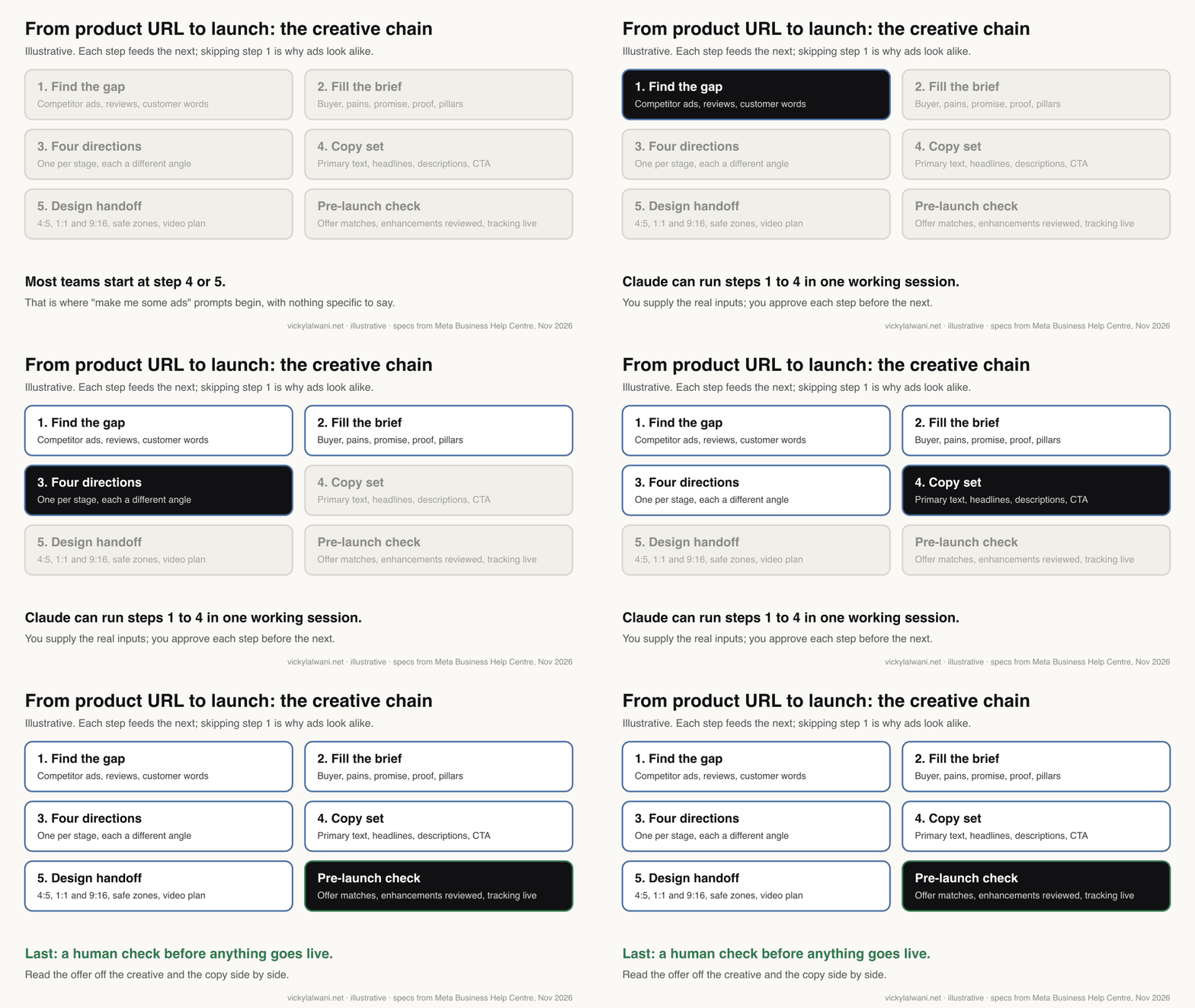
Short answer: a strong Meta ad creative process runs in five steps: research the category gap, fill a brief with real customer language, write four directions mapped to the funnel, produce a copy set for each, and hand the designer a brief that needs no follow-up questions. Then check what Advantage+ creative will change before anything goes live.
This page is the November 2026 version of that process, with what Meta has actually published about Andromeda and creative variety, the current text and aspect ratio guidance, and the prompts I use with Claude for each step. If you would rather have someone run it on your account, that is part of my Meta ads management.
If you want the copywriting side in more depth, read ad copywriting frameworks that still work. If your problem is account settings rather than creative, start with the Meta ads settings checklist.
What changed for Meta ad creative in 2026?
Short answer: three things. Meta rebuilt the ad delivery system again (announced 28 October 2026) and repeated its advice to supply more creative variety. Advantage+ creative now lists 30 automatic enhancements, 16 of them generative AI. And Meta's own AI tools can now make video from your still images and new variations in Ads Creative Studio.
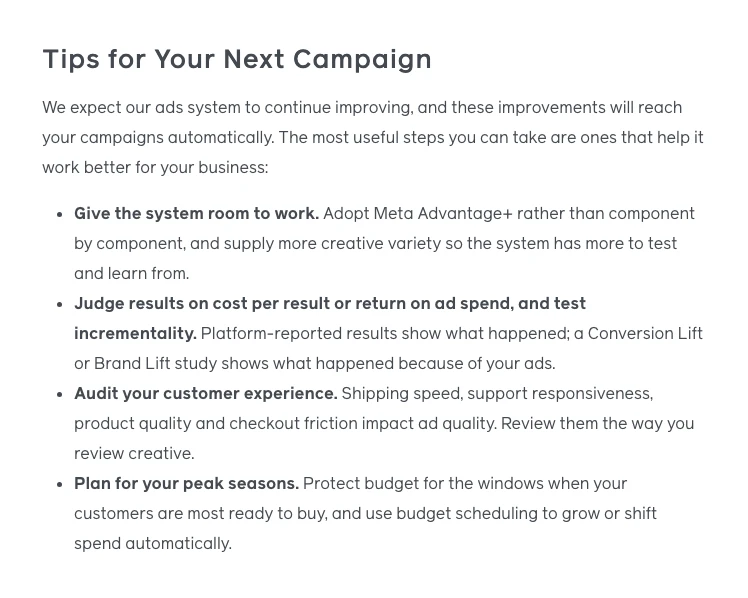
On 28 October 2026 Meta published two explainers for advertisers. The first, Inside the three new AI innovations in ads ranking, covers Andromeda (which picks candidate ads), GEM (the model that ranks them) and GenRecs (an LLM-based recommender that helps brand new ads with little history). The second, how Meta's ads system matches your ad to the right person, ends with four tips. The first tip is the one that matters for creative.
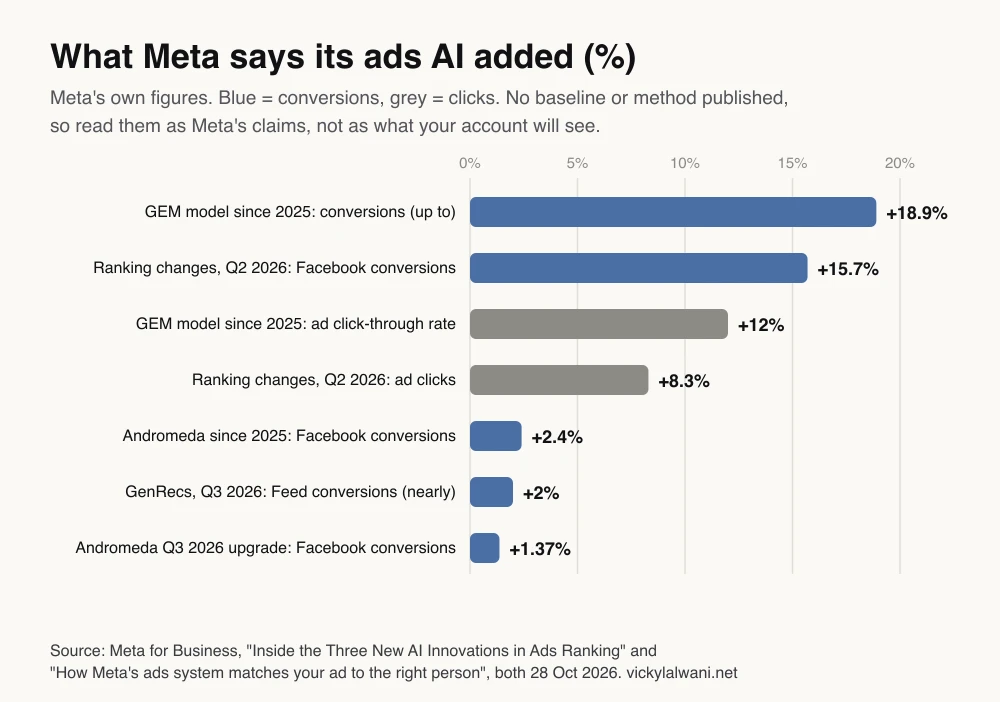
Meta also put numbers on what the system added. These are Meta's figures, with no baseline or method published, so read them as claims about Meta's whole ad system, not as a forecast for your account.
The October announcements built on Meta's Advertising Week New York update of 6 October 2026: video generation from static images in Advantage+ creative is now generally available, Ads Creative Studio is rolling out more widely with tools to change hooks, clip length, captions and end scenes, and the Meta AI business assistant is testing the import of "strategy, voice, and brand guidelines" from other AI tools.
| Change | Date | What it means for creative |
|---|---|---|
| Andromeda next generation | 28 Oct 2026 | More of your ads are considered for each person |
| GenRecs on Feed | Q3 2026 | New ads can find their audience with less history |
| Advantage+ video generation | GA, 6 Oct 2026 | Stills can become video inside Ads Manager |
| Ads Creative Studio | Wider rollout, Oct 2026 | Edit hooks, captions, length and end scenes |
| Updated Commercial Terms | On hold | Existing terms of 6 March 2024 still apply |
What is Andromeda, and what does it mean for your creative?
Short answer: Andromeda is the first stage of Meta ad delivery. It narrows tens of millions of eligible ads to a few thousand worth ranking for each person. It does not judge your ad on its own; it decides whether your ad is even in the shortlist. Meta's practical advice is to give it more varied creative, and Meta has not published a required number of ads.
Meta's engineers first described Andromeda in December 2024, and said plainly why they built it: generative AI tools were multiplying the number of ads the system had to choose from. The October 2026 follow-up says the new version surfaces candidates at over one billion ads per second, about 100 times the 2024 system, and has added 2.4% to conversions on Facebook since 2025.
A lot of what you read about Andromeda online goes further than Meta does. The table below separates what Meta has published from what practitioners report.
| Claim | Who says it | Status |
|---|---|---|
| Supply more creative variety | Meta, 28 Oct 2026 | Official advice |
| Andromeda shortlists, ranking models decide | Meta engineering | Official |
| Similar ads are grouped as one | Agencies, Reddit | Not published by Meta |
| Same first 3 seconds counts as identical | An agency, after a Meta workshop | Second-hand |
| You need a set number of ads | Course sellers | No Meta number exists |
| "Andromeda 2.0" | Creators | Not Meta's name |
When Marketing Brew asked Meta in September 2026 how its models treat similar creative, a spokesperson declined to explain and called the advice deliberately outcome-based: diversify, test and let the system optimise. So the honest reading is simple. Meta wants different ideas, not more copies of one idea, and nobody outside Meta knows the exact similarity rule.
That fits what I tell anyone making creative for me. Ten images that differ only in the text hook are not ten ideas. The images need genuinely different angles: a comparison, a different offer, a lighter moment, a different person or setting.
Why does AI ad creative look generic?
Short answer: because it starts with no research. A prompt such as "make ads for a coffee brand" can only return the category average. Give the model real competitor ads, real reviews and the customer's own words, and it has something specific to work with.
When a campaign takes weeks, the time rarely goes on the idea. It goes on research, briefing, formatting, handoffs and revision cycles. None of that is the spark, but it decides how good the spark can be. An idea built on a rushed brief looks like everything else in the feed.
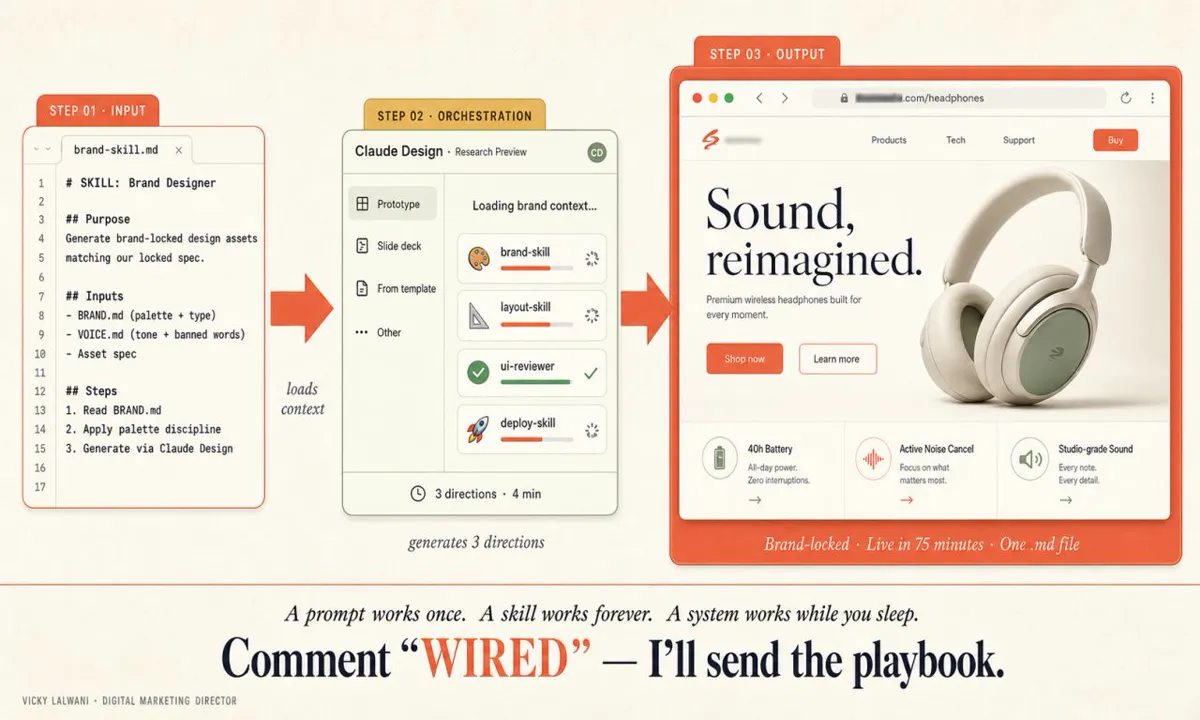
That is why I treat creative as a chain, not as one clever prompt. Each step feeds the next, and all of it hangs off one campaign brief. To be clear about the split: Claude does the research, strategy, briefs and copy. Finished visuals are made in the design step, by a designer or an image tool, from a tight design brief. If you use Claude Design for that step, see what to ship and skip in Claude Design.
Step 1: how do you find the gap in your category?
Short answer: look at what competitors already run in the public Meta Ad Library, read your reviews and theirs, and answer four questions: which angles everyone uses, which have become wallpaper, which emotional angles nobody uses, and where the biggest positioning gap is.
This is the step rushed media buyers skip. Before any creative, collect four kinds of input:
| Input | Where to get it | Why it matters |
|---|---|---|
| Competitor ads | Meta Ad Library (public) | Shows the angles already taken |
| Your reviews | Google, Trustpilot, your site | The words buyers use unprompted |
| Competitor reviews | Their listings | Complaints you can answer |
| Sales or support notes | Your team | Real objections and doubts |
Reviews are the most valuable input, because they contain the words buyers use when no marketer is in the room. If you also want to study competitor video ads frame by frame, the method is in how to analyse competitors' videos with AI.
You are a paid social strategist. I sell [product or service] to [buyer] in [market].
Here are 15 competitor ads (text and a description of each visual), 40 customer reviews of ours and 20 reviews of competitors.

1. List the angles competitors lean on most, with how many ads use each.
2. Mark which of those angles have become so common people no longer notice them.
3. List emotional angles nobody in this set uses.
4. Name the single biggest positioning gap, in one sentence.
5. Quote the 10 most useful customer phrases word for word, with the review they came from.
Do not invent quotes. If the inputs do not support an answer, say so.
Step 2: what goes in a Meta ad creative brief?
Short answer: the real buyer, their top pains and desires in their own words, a one-line promise, the proof you can show, the offer and its conditions, and the psychological pillars to hit, such as status, fear, belonging, proof or convenience. Every line should be specific enough that it could not describe a different company.
| Brief field | Weak | Strong |
|---|---|---|
| Buyer | Coffee lovers | Home workers who hate pod coffee |
| Pain | Wants better coffee | "Tastes like the jar has been open a month" |
| Promise | Premium quality | Roasted this week, at your door Friday |
| Proof | Customers love us | Roast date printed on every bag |
| Offer | Great deal | First bag half price, new customers only |
The example rows are invented for illustration. The point is the gap between the two columns. A vague brief makes vague ads, and the model will fill every gap with the category average.
Put the offer's conditions in the brief from the start. Before any sale campaign goes live, I read the offer off the creative and the ad text side by side, because an AI-assisted plan will happily carry an old discount forward from earlier context. If an offer has a condition, such as new customers only, I want it in the image itself, not just the small print on the landing page.
Step 3: why four directions and not four versions?
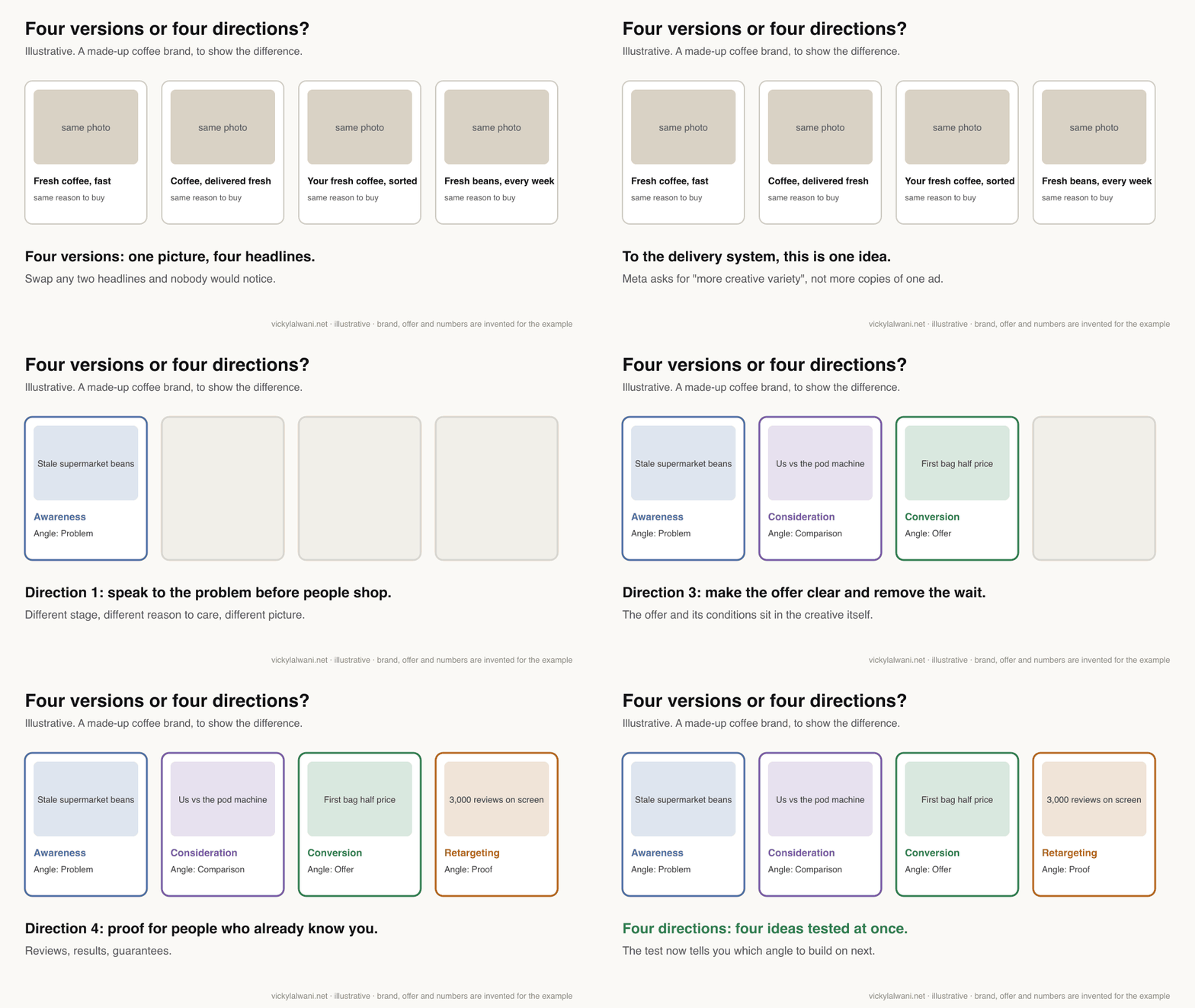
Short answer: four versions of one ad only tell you which headline won inside one idea. Four directions tell you which idea the market responds to, and they give Meta's delivery system the variety it asks for. Map one direction to each funnel stage so the set covers the whole journey.
| Stage | Job of the ad | Typical angle |
|---|---|---|
| Awareness | Name the problem before they shop | Problem, desire, identity |
| Consideration | Show why your way wins | Comparison, demo, myth |
| Conversion | Make the offer clear now | Offer, risk reversal, urgency |
| Retargeting | Prove it to people who know you | Reviews, results, guarantees |
For each direction, define the stage, the pillar, what is in frame, the headline, the primary text and the call to action. My test is that the four should feel as if four different teams made them. If you could swap two headlines without anyone noticing, the directions are not different enough, so push back and ask again.
Matching the stage matters for lead quality too. A lead campaign can fill with people who are nowhere near ready when the ad speaks to an unaware audience with a conversion-stage promise. The usual fix is new creative aimed at people already in the market, not a new audience setting.
Using the brief above, write four creative directions, one per stage: awareness, consideration, conversion, retargeting.
For each give: the stage, the psychological pillar, the core angle in one line, what is in frame (describe the image or the first 3 seconds of video), the headline, the primary text and the call to action.
Rules: each direction must use a different angle and a different visual idea. No two may share an opening image or first line. Use the customer's own phrases where they fit. Then tell me which two directions are most similar and rewrite the weaker one.
Step 4: how much copy does each direction need?
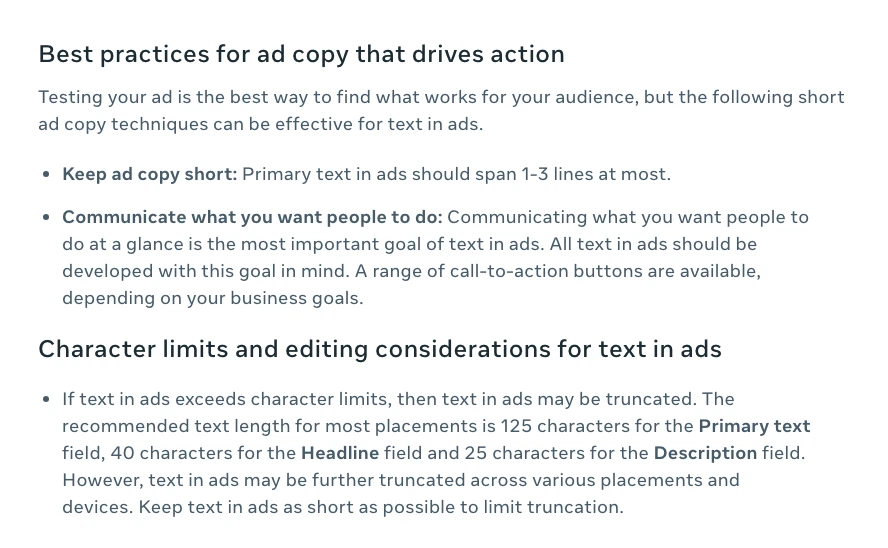
Short answer: for each direction, write primary text in a short and a longer version, three to five headlines, a description and the call to action. Meta recommends about 125 characters for primary text, 40 for headlines and 25 for descriptions, and says primary text should span one to three lines.
| Field | Meta's guide | What to write |
|---|---|---|
| Primary text | About 125 characters | Short and longer version |
| Headline | About 40 characters | 3 to 5 options |
| Description | About 25 characters | 1 to 2 options |
| Call to action | Button from a set list | Match the stage |
Meta lets you add several text options for primary text, headline and description in one ad, and its system picks combinations per person. That is useful inside one direction. It is not a substitute for different directions, because every option still sells the same idea.
Hold the copy to the customer voice in the brief. Ban hype words, then read it aloud. If it sounds like an advert talking to nobody, send it back. For more on why "you" copy beats "we" copy, see how to write ad copy that talks to the buyer.
For each of the four directions, write:
- primary text: one version under 125 characters, one story version of 3 to 5 short lines
- 5 headlines under 40 characters
- 2 descriptions under 25 characters
- the call to action button
Use only claims the brief supports. Mark any claim that needs proof before launch with [CHECK]. Banned words: revolutionary, game-changing, unlock, elevate, seamless.
Step 5: what should the design handoff include?
Short answer: for each direction, the formats and aspect ratios (4:5 for Facebook Feed, 1:1 for Instagram Feed, 9:16 for Stories and Reels), what is in frame, the text hierarchy, brand elements, one reference style and, for video, what happens in the first three seconds. My test: the designer should need no follow-up questions.
| Placement | Meta recommends | Note |
|---|---|---|
| Facebook Feed | 4:5 | Images and video |
| Instagram Feed | 1:1 single image | 4:5 also supported |
| Stories and Reels | 9:16 | Keep text in the safe zone |
| Carousel | 1:1 or 4:5 | Keep ratios consistent |
The ratios come from Meta's best practices for aspect ratios. The same page says you can upload up to ten images or videos for a single ad, and that if you do not supply every ratio, Meta fills the gaps with padding, cropping and AI expansion. Review those automatic crops before you publish.
Plan for video even if the brief is mostly static. Meta's creative best practices for conversion testing report that campaigns with both static images and video achieved conversion lift at a 17% higher rate than campaigns with static images alone. The same page suggests 5 to 10 second videos, movement in the first three seconds and one benefit per ad.
This is why I call the brief the real product. The finished image is the last small part of the work. If the research, buyer, voice, pillar and direction are right, the visual has a clear job.
Should you leave Advantage+ creative enhancements on?
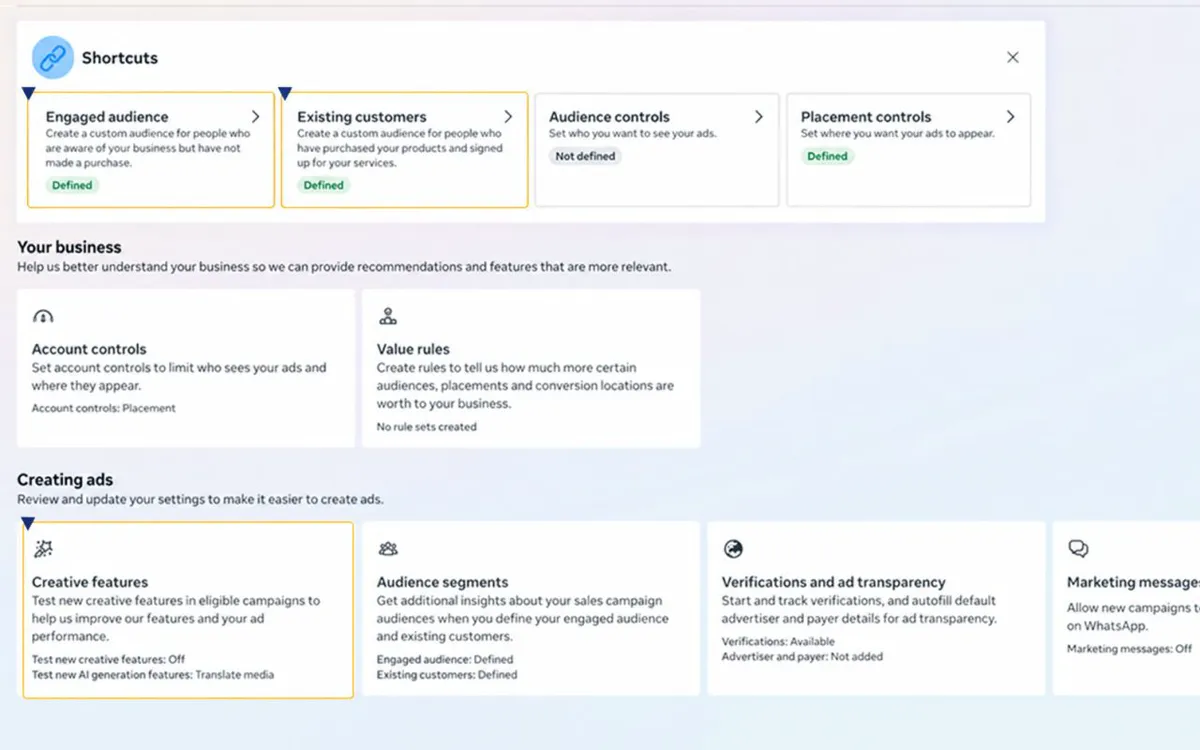
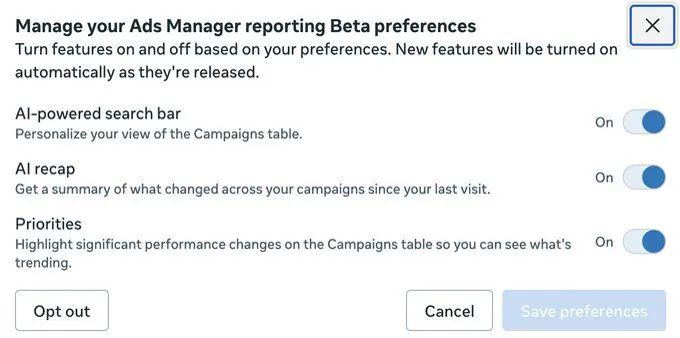
Short answer: review them ad by ad rather than accepting the defaults. Meta's help page lists 30 enhancements, 16 of which use generative AI, and says some are on by default. Some only show in Advanced preview, so check both places before you publish.
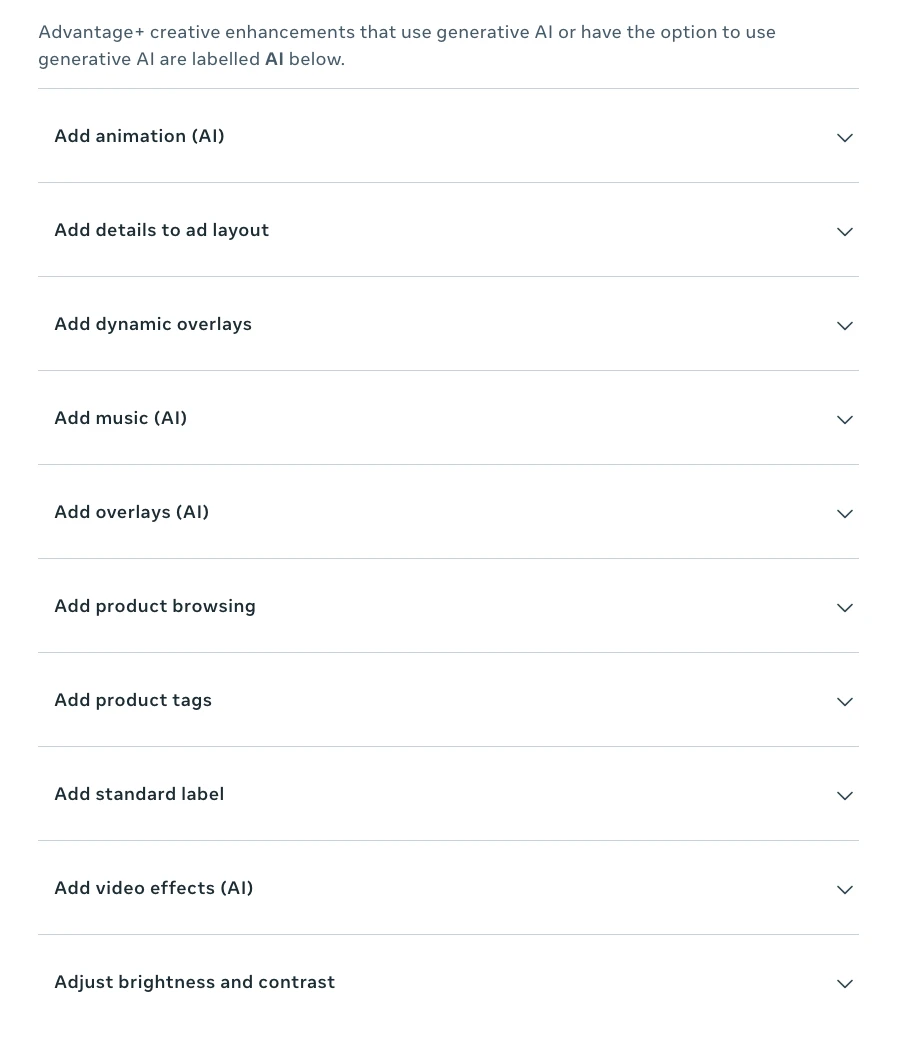
Meta's own guide to turning enhancements off says that some are on by default and that some can only be turned off in Advanced preview. It tells you to check the ad preview before publishing. That is the right habit whatever you decide.
| Type | Examples | My default |
|---|---|---|
| Around the creative | Relevant comments, CTA, store locations | Usually fine, check preview |
| Small touch-ups | Brightness and contrast | Usually fine |
| Changes your words | Text improvements, translations | Review every one |
| Changes your picture | Background generation, image touch-ups | Off for brand or regulated ads |
| Changes the format | Product browsing, flex media | Test deliberately |
The "my default" column is my judgement, not Meta's. The reason for care is real, though. In October 2026 advertisers including a bookseller pulled live ads after AI changes they had not approved, as Adweek reported. Trade press also reported that updated Commercial Terms would make advertisers responsible for AI edits from 30 October. As of 18 November 2026, Meta's terms page says those updates are on hold.

This is not legal advice. If an AI edit could create a compliance problem for your industry, ask your adviser, and in the meantime switch the picture-changing enhancements off.
How do you judge which direction won?
Short answer: on cost per result or return on ad spend, measured over at least a week, with tracking you trust. Do not judge on clicks, and do not switch off weak ads by reflex. Meta's system already shifts spend away from them; your job is to add the next round of directions.
Tracking comes first. I keep a campaign in draft until every form and call button is measured, because a creative test on broken tracking only tells you which ad the pixel happened to see. If you are not sure yours is right, the conversion tracking event map is the place to start.
Then give the system room. When someone asks me what to do with ads that are not spending after two weeks, my answer is usually to leave them and keep adding new angles, offers and concepts. I also prefer fewer campaigns, with several ad sets inside one, to a separate campaign per product category, so learning is not split across many small budgets.
| Signal | Read it as | Next step |
|---|---|---|
| One direction takes most spend | The system prefers it | Check its cost per result |
| Cheap clicks, no conversions | Wrong promise or page | Match ad and page topic |
| Results fade after weeks | Creative fatigue | New direction, not a new crop |
| Leads arrive, few buy | Wrong stage or audience | Feed lead quality back to Meta |
Meta's own advice points the same way: choose the outcome you actually want, because "a lead isn't a sale", and use a Conversion Lift study when you need to know what happened because of your ads rather than alongside them.
Product or service: how does the brief change?
Short answer: the five steps stay the same. Product research leans on visual conventions and desirability; service research leans on trust and the risk the customer wants to remove.
| Element | Product | Service |
|---|---|---|
| Research focus | Category visuals, desirability | Trust signals, perceived risk |
| Hero creative | The product in use | The outcome, the people |
| Proof | Reviews, ratings, certifications | Testimonials, credentials, results |
| Offer condition | Price, stock, delivery | Eligibility, area, availability |
A dental clinic and a pet food brand run the same chain. Only the inputs shift.
Where this advice is weak
Short answer: it gets you to tested ideas faster, but it cannot tell you which one will work, and nobody outside Meta knows exactly how Andromeda treats similar ads.
- Small budgets. Four directions split a small budget four ways. If an account only gets a handful of results a week, consider running two directions at a time and rotating them in.
- Meta's numbers are Meta's. The conversion gains in the chart have no published method. At least two r/FacebookAds threads from late October 2026 report worse results on their own accounts.
- Similarity rules are guesswork. Claims about first-three-second rules or similarity scores come from agencies and vendors, not from Meta documentation.
- AI research can invent. Claude can misquote a review or overstate a competitor's angle. Check every quote against the source before it goes in a brief.
- Regulated categories. Some generative AI features are limited for special ad categories and regulated industries, per Meta's help page.
What people say on X and Reddit
Short answer: practitioners agree that different ideas beat many versions, distrust Meta's headline numbers, and spend real time switching AI enhancements off.
| Who | What they said | Take it as | Link |
|---|---|---|---|
| A paid social commentator | A new ad may no longer need weeks of history before the system knows where it belongs (28 Oct 2026) | Opinion | X post |
| A Meta ads agency | After a workshop with Meta: ads with a similar first 3 seconds are treated as identical (6 Oct 2025) | Second-hand | X post |
| A Meta ads educator | Build diversity through formats, angles, personas and settings (8 Feb 2026) | Opinion | X post |
| A DTC agency head | The team checks two to three mornings a week that AI enhancements are still off (29 Oct 2025) | First-hand | X post |
| A media buyer | The product browsing toggle on existing ads swapped creative for catalogue formats (14 Oct 2026) | First-hand | X post |
| A paid social consultant | November Ads Manager updates: some switched on without asking (10 Nov 2026) | Opinion | X post |
| r/FacebookAds | A store owner with 20 UGC videos still cannot scale; replies say that is three or four ideas (23 Oct 2026) | First-hand | Thread |
| r/FacebookAds | Has anyone seen the conversion gains Meta claims for Andromeda? (29 Oct 2026) | Sceptical | Thread |
| r/FacebookAds | A practitioner reads Meta's engineering post after a fresh campaign failed (30 Oct 2026) | First-hand | Thread |
| r/FacebookAds | One ad set or many after the update? No consensus from big spenders (10 Nov 2026) | Mixed | Thread |
| r/FacebookAds | Removing enhancements now takes as long as building the ad (7 May 2026) | First-hand | Thread |
Most Andromeda threads also attract replies selling courses or creative tools, so weigh confident advice in the comments with that in mind.
Videos worth watching
Short answer: Meta's own short Blueprint videos are the best starting point. They are under two minutes each and explain creative variety, fatigue and the generative tools in Meta's words.
Made by Meta for Business, 3 July 2026. It does not sell anything beyond Meta's own tools. It defines creative diversification and covers formatting for mixed placements.
Made by Meta for Business, 3 February 2026. It does not sell anything. A short explanation of how varied creative prevents fatigue with new and existing customers.
Made by Meta for Business, 10 February 2026. It promotes Meta's own image generation, text generation and video touch-ups. Watch it alongside the enhancements section above.
| Video | Channel | Date | What it covers |
|---|---|---|---|
| Unlock better performance by diversifying your ad creative | Meta for Business | 3 Jul 2026 | What creative variety means |
| Solving creative fatigue with strategies to refresh your ads | Meta for Business | 3 Feb 2026 | Fatigue and refresh |
| Three generative AI tools to create better ads faster | Meta for Business | 10 Feb 2026 | Meta's AI creative tools |
| Expand your creative variety with format display options | Meta for Business | 3 Nov 2026 | One ad shown as carousel, collage or video |
| Repurpose your winning creative with related media | Meta for Business | 3 Nov 2026 | Reusing creative you own |
| The 5 Levels of Creative Diversity | A creative strategist's channel (sponsored) | 18 Dec 2025 | Visual, journey, desire and audience levels |
Sources
| Source | What it supports | Date |
|---|---|---|
| Meta for Business: how ads are matched | "Supply more creative variety", tips, Q2 figures | 28 Oct 2026 |
| Meta for Business: three AI innovations | Andromeda, GEM, GenRecs figures | 28 Oct 2026 |
| Meta Engineering: next-gen Andromeda | One billion ads a second, 2.4% lift | 28 Oct 2026 |
| Meta Engineering: Andromeda | What Andromeda is, why it was built | 2 Dec 2024 |
| Meta for Business: AWNY 2026 | Video generation GA, Ads Creative Studio | 6 Oct 2026 |
| About Advantage+ creative | 30 enhancements, 16 AI, defaults | Read 18 Nov 2026 |
| Turn off Advantage+ creative enhancements | Advanced preview, defaults | Read 18 Nov 2026 |
| Creative best practices for text in ads | 125, 40 and 25 characters | Read 18 Nov 2026 |
| Best practices for aspect ratios | 4:5, 1:1, 9:16, up to ten media | Read 18 Nov 2026 |
| Creative best practices for conversion testing | 17% higher lift rate with video | Read 18 Nov 2026 |
| Meta Commercial Terms | Updated terms on hold | Read 18 Nov 2026 |
| Marketing Brew | Meta declined to explain similarity | Sep 2026 |
| Adweek | Advertisers pulled AI-edited ads | Oct 2026 |
| PPC Land | Reported AI Features terms | 22 Oct 2026 |
| X posts and r/FacebookAds threads | Practitioner views (table above) | Oct 2025 to Nov 2026 |
Want a second pair of eyes on your Meta creative?
If your concepts feel flat, the fault is usually upstream, in the research or the brief, not in the design. That is what I look at first in my Meta ads work: the brief, the four directions, the enhancements left on and the tracking behind the results. Rates are on the pricing page.
To try the process yourself, take one real offer and run only Step 1 today. Seeing the gaps your category has left open is the quickest way to judge whether the chain suits you. The ad creative system guide has the full prompt chain and the brief template when you want to run all five steps, and the cross-platform ad audit covers the account around the creative.
FAQ
What is the best Meta ad creative process in 2026?
Research the category gap first, then write one specific brief, four directions mapped to the funnel, a copy set for each and a design handoff. Finish with a pre-launch check of the offer, the Advantage+ creative enhancements and the tracking.
What is Meta Andromeda?
Andromeda is the first stage of Meta ad delivery. It narrows tens of millions of eligible ads to the few thousand worth ranking for each person, and Meta announced a rebuilt version on 28 October 2026. Ranking models such as GEM then decide which ad is shown.
How many ads does Meta Andromeda need?
Meta has not published a number. Its advice, repeated on 28 October 2026, is to supply more creative variety so the system has more to test and learn from. Different ideas count for more than many versions of one idea.
What is the difference between creative directions and ad versions?
Versions change the wording or crop of one idea, so a test only tells you which headline won. Directions change the angle, the stage and the visual, so a test tells you which idea the market responds to.
What should a Meta ad creative brief include?
The real buyer, their pains and desires in their own words, a one-line promise, the proof you can show, the offer with its conditions and the psychological pillars to hit. Every line should be specific enough that it could not describe another company.
How long should Meta ad text be?
Meta recommends about 125 characters for primary text, 40 for headlines and 25 for descriptions, and says primary text should span one to three lines. Longer text may be cut off on some placements and devices.
Which aspect ratios should Meta ad creative use?
Meta recommends 4:5 for Facebook Feed, 1:1 for single images on Instagram Feed and 9:16 for Stories and Reels. Carousels work best at 1:1 or 4:5 with the same ratio on every card.
Should I turn off Advantage+ creative enhancements?
Review them ad by ad instead of accepting the defaults. Meta lists 30 enhancements, 16 use generative AI and some are on by default, so check both the creative setup and Advanced preview before publishing.
Can Claude make Meta ad creative?
Claude can run the research, brief, four directions and copy in one session if you give it real competitor ads, reviews and customer language. Finished visuals come from a designer or an image tool working from the design brief.