Claude Managed Agents is Anthropic's hosted agent service on the Claude API, in beta since 8 April 2026. You define an agent once and Anthropic runs it in a cloud sandbox, on a schedule if you want, for normal token prices plus $0.08 per running hour. For marketing it suits recurring SEO and paid search jobs, such as a weekly search terms review, with a grader checking the draft and a person approving any change.
TL;DR
Claude Managed Agents is Anthropic's hosted agent service on the Claude API. You define an agent once (model, instructions, tools, MCP servers, skills), and Anthropic runs the agent loop and a cloud sandbox for every session. It launched in public beta on 8 April 2026 and is still in beta in November 2026.
For marketing, the useful parts are scheduled deployments (an agent that runs every Monday), outcomes (a separate grader checks the work against your rubric), memory stores, and permission policies that make the agent ask before it uses a tool. You pay normal token prices plus $0.08 for each hour a session is actually running.
It is a developer product, not a button in the Claude app. If you only need a weekly report for yourself, a scheduled task in the Claude app or in Claude Code is simpler. Managed Agents makes sense when an SEO or PPC agent has to run on its own, for a team or for clients, with logs, budgets and approvals.
Short answer: Claude Managed Agents are hosted Claude agents that Anthropic runs for you. You describe the agent and its tools, and each run happens in a managed cloud sandbox with no servers to build. For SEO and paid search, that means a search terms review, a content decay check or a weekly report can run on a schedule and wait for a person to approve anything it proposes.
Most marketers still use Claude one chat at a time. The jump from "a good chat" to "an agent that runs every Monday at 7am and hands me a checked draft" used to need a developer, a server, a scheduler and somewhere to keep logins. Managed Agents takes most of that away. It does not take away the need to decide what the agent may touch, and that is where most of this article goes.
If you want an agent like this designed around your own accounts, that is what my AI marketing agents service does. Product facts below were checked against Anthropic's documentation on 18 November 2026. Managed Agents is in beta, so check the linked pages before you build on any detail.
What are Claude Managed Agents, as of November 2026?
Short answer: a set of Claude API endpoints that give you a ready-made agent harness plus the infrastructure to run it. Anthropic's docs describe it as a "pre-built, configurable agent harness that runs in managed infrastructure", aimed at long-running and asynchronous work.
Anthropic announced Managed Agents on 8 April 2026 as a public beta on the Claude Platform. The overview page says access is enabled by default for all API accounts, and every request carries the managed-agents-2026-04-01 beta header (the SDKs add it for you).
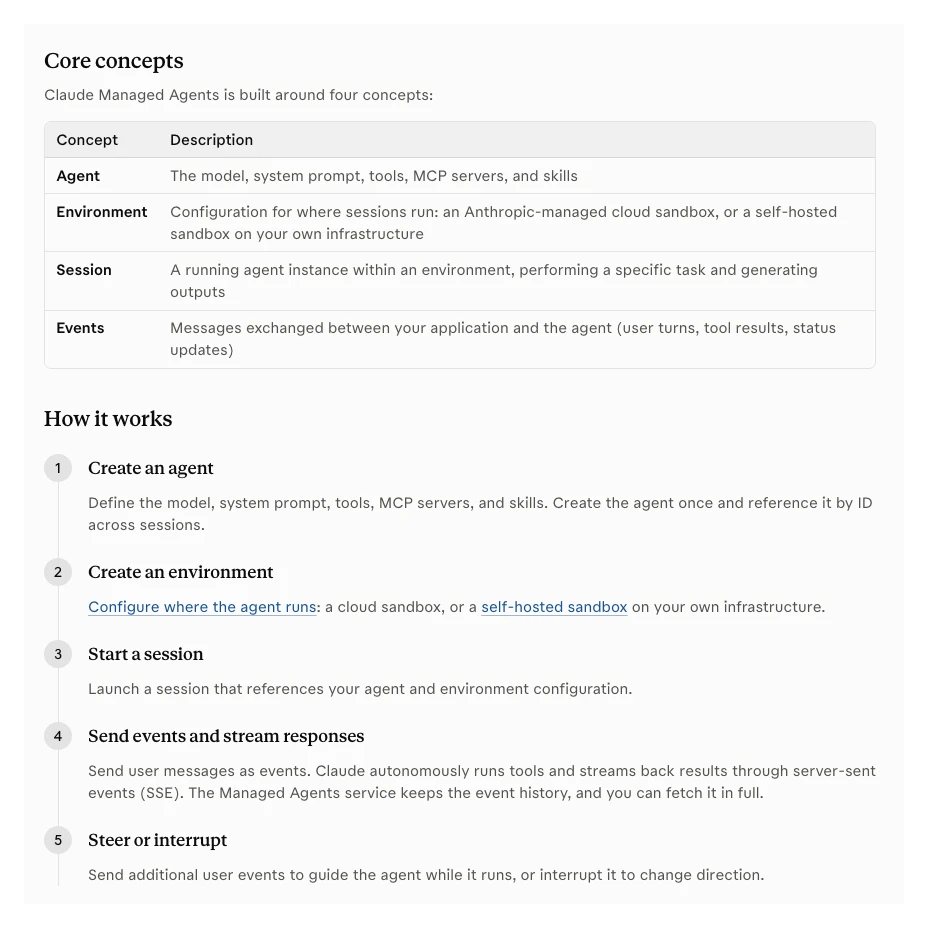
It is built from four pieces. Learn these and the rest of the docs make sense.
| Piece | What it is | Marketing example |
|---|---|---|
| Agent | Model, instructions, tools, MCP servers and skills, saved once | "Search terms reviewer" with your negative keyword rules |
| Environment | Where sessions run: Anthropic's cloud sandbox or your own | A cloud sandbox with web access limited to a few sites |
| Session | One run of the agent on one task | This week's review for one account |
| Events | Messages between your app and the agent | The draft, a tool approval request, your "yes" |
Agents are versioned. When you change the instructions, a new version is created and sessions already running keep the old one. That matters for marketing teams: you can tighten a rule in your PPC agent without breaking this week's run, and roll back if the new rule makes things worse.
What changed since launch?
Short answer: almost everything a marketing team needs arrived after launch. Memory, outcomes, multiagent orchestration, webhooks, scheduled deployments, vaults and dynamic workflows were all added between April and October 2026.
| Date (2026) | What arrived | Why a marketer cares |
|---|---|---|
| 8 April | Public beta launch | Hosted agents with tools and MCP |
| 23 April | Memory in public beta | The agent keeps your rules and past decisions |
| 6 May | Outcomes, multiagent and webhooks to public beta; dreaming in research preview | A grader checks work; your systems hear when a run ends |
| 9 June | Scheduled deployments and vaults | Weekly runs; logins kept out of the agent |
| 9 October | Dynamic workflows in public beta | One agent can fan work out to many |
| 12 November | Self-hosted Managed Agents in private beta | For firms that must keep data in their own cloud |
Dates come from Anthropic's June product post and the official posts listed in the X table further down. At launch, multiagent coordination and outcomes needed a separate access request. In the current overview, only dreaming and MCP tunnels still sit in a research preview that you apply for.
How is it different from Claude Code, Cowork and the Claude app?
Short answer: the Claude app and Claude Code run on your plan and are built for you as the user. Managed Agents runs on the API, is billed per use, and is built for agents that run without anyone sitting in a chat, often for other people.
This is the first decision, and many teams get it wrong in the expensive direction. Both the Claude app and Claude Code can now run work on a schedule in the cloud. Anthropic's help page says scheduled tasks run hourly, daily, weekly or on weekdays on paid plans, and keep running when your computer is asleep. Claude Code has cloud scheduled tasks, formerly routines, triggered by a schedule, an API call or a GitHub event, in research preview.
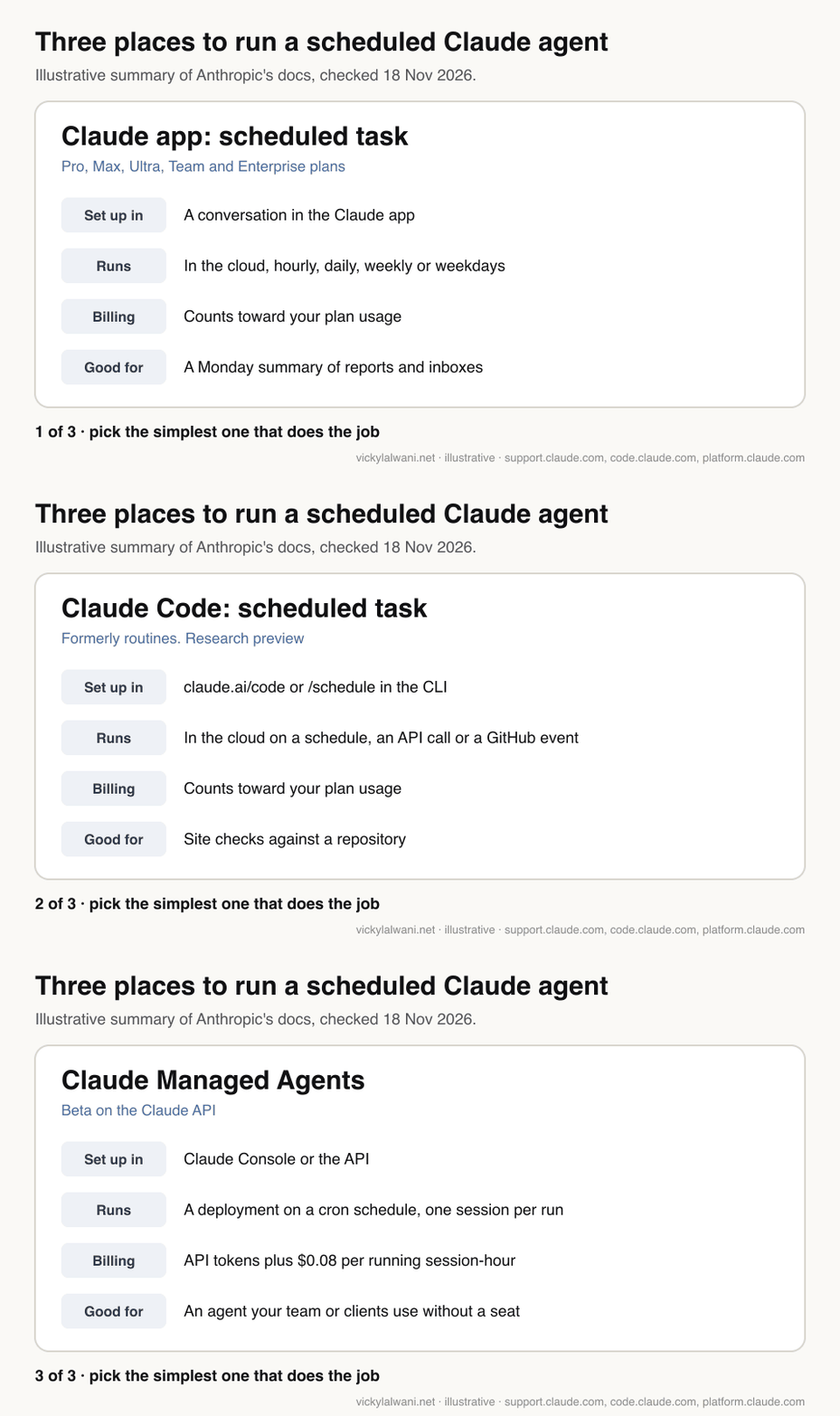
| Question | Claude app or Claude Code | Managed Agents |
|---|---|---|
| Who uses it? | You, signed in | Your app, team or clients |
| How is it paid? | Your plan's usage | API tokens plus runtime |
| Set up with | A chat or a prompt | Console or code |
| Hard spend cap? | Plan limits | Session and deployment budgets |
| Best for | Your own weekly checks | Agents that must run unattended |
A plain rule: if the only person who reads the output is you, start in the Claude app. Move to Managed Agents when the agent has to serve several accounts, run inside your own tools, or keep an audit trail someone else will check. For a fuller view of the app side, see my guide to Claude Chat vs Code vs Cowork.
Which SEO and paid search jobs suit a managed agent?
Short answer: recurring jobs with clear inputs, clear rules and an output a person can check in minutes. Search terms reviews, content decay checks, competitor ad and landing page watches, and weekly reports fit. Bidding, budgets and anything that publishes do not, unless a person approves each change.
The PPC practitioners on r/digital_marketing describe the same split: AI for the grunt work, people for platform decisions, partly because models still misstate Google Ads features. That matches how I work on client accounts: audit first, put findings in a sheet, check them by hand, and change nothing before approval.
| Job | Input | Output to approve | Fit |
|---|---|---|---|
| Search terms review | Weekly search terms export | Negative keyword list with reasons | Strong |
| Content decay check | Search Console page export | Pages losing clicks, with a brief each | Strong |
| Competitor watch | A list of rival pages | What changed in offers and copy | Strong |
| Weekly PPC report | Platform and CRM exports | Draft report with sources | Strong |
| Ad copy variants | Landing page and brand rules | Drafts for review | Good |
| Bids and budgets | Live account access | Changes to spend | Avoid |
For more agent ideas on the paid side, see AI agents for PPC. For an approval model built around overnight work, see human in the loop AI for Google Ads.
How would a weekly Google Ads search terms agent work?
Short answer: a scheduled deployment starts a session each Monday, the agent reads last week's search terms, drafts negatives with a reason for each, a grader checks the draft against your rubric, and the result waits for a person. Nothing reaches the account without a yes.
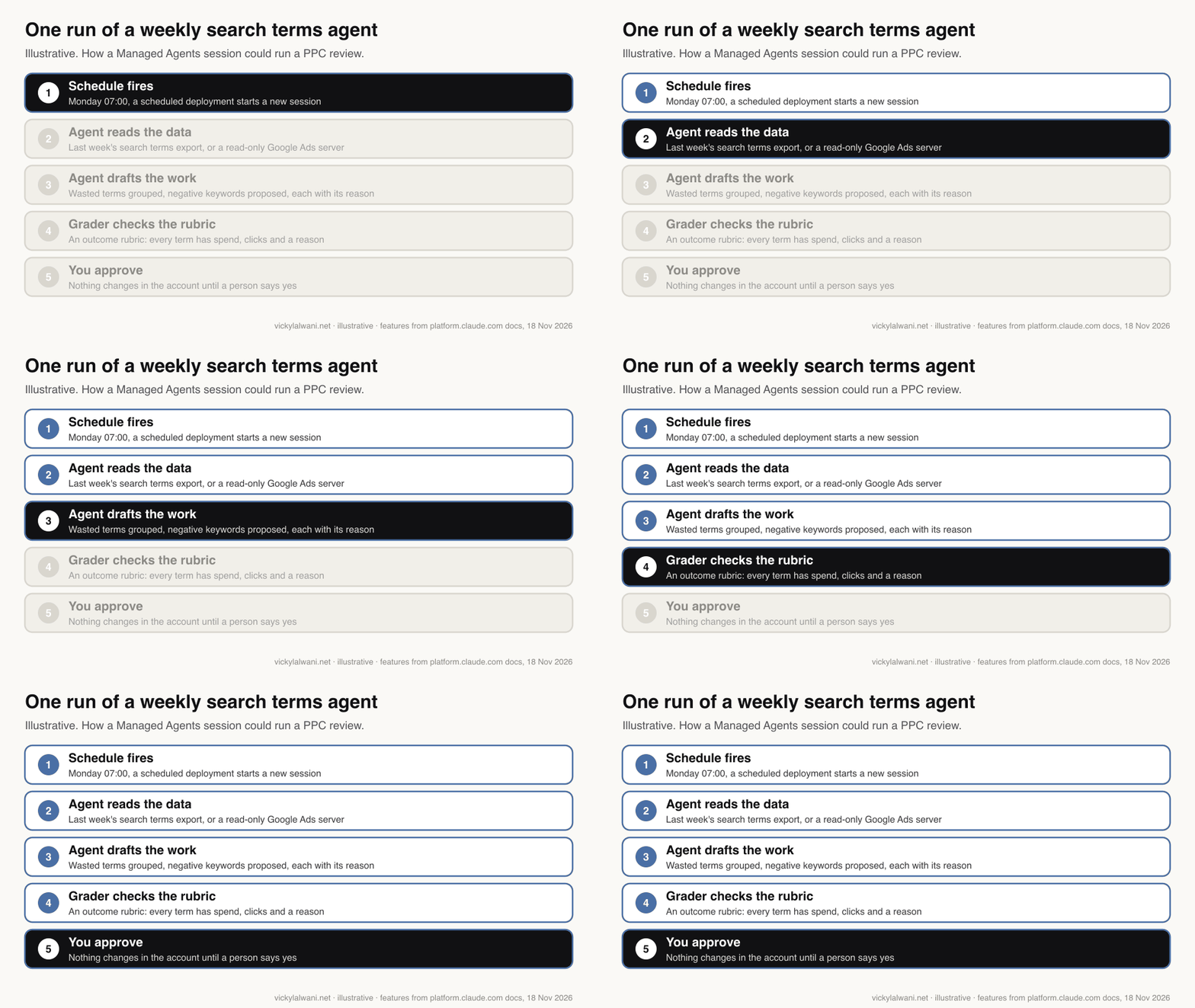
Here is how the documented features map to that job.
| Step | Feature | Setting to choose |
|---|---|---|
| Run every Monday | Scheduled deployment | Cron time and your timezone |
| Give it the data | File attached to the session | An export, not live access, at first |
| Keep your rules | Memory store | Brand terms and past decisions |
| Check the draft | Outcome with a rubric | 5 to 10 checkable criteria |
| Ask before tools | Permission policy | always_ask on anything that writes |
| Cap the spend | Session or deployment budget | A dollar limit per run |
The outcome step is the one most people skip. Anthropic's docs say the harness provisions a grader that "uses a separate context window" to judge the work against your rubric, then hands the feedback back for another pass. A rubric for negatives might read like this:
# Search terms review rubric
- Every proposed negative shows the search term, cost, clicks and conversions from the export.
- Every proposed negative has a one-line reason a person can check.
- No term that converted in the period is proposed as a negative.
- No brand term from the memory store's brand list is proposed as a negative.
- Each negative states its match type and whether it applies to a campaign or the account.
- Terms that look relevant but have not converted are listed separately as "watch", not "exclude".
- The output ends with the three largest wasted spend terms, in order.
The memory store holds the things you would otherwise repeat every week: brand terms, competitors you do bid on, terms the client has asked you to keep. Every change to a memory creates a new version, so you can see what the agent wrote and when. Memory stores use their own beta header, agent-memory-2026-07-22.
Can a managed agent connect to Google Ads and Search Console?
Short answer: yes, through MCP servers you declare by URL and authenticate through a vault, but start with exports. Google's own Google Ads MCP server is mostly read-only and has to be hosted by you to be reachable as a URL.
In Managed Agents, MCP servers are declared on the agent by name and URL, and the login is supplied per session from a vault. That split is useful for an agency or a consultant: one agent definition, one vault per client. The docs warn that vaults are workspace-scoped, so any API key with access to the workspace can use them.
Google's Google Ads MCP server is described as read and partial mutate. It can search account data, create assets and manage labels, but it cannot change campaigns, ad groups, ads, budgets or bids, and its write tools ask for confirmation. It runs locally, or as a remote service you deploy yourself on Google Cloud. A managed agent in Anthropic's cloud can only reach the remote kind.
For a first version I would not connect live accounts at all. A search terms export or a Search Console page export attached to the session gives the agent everything it needs for the jobs above, and it cannot change anything. For the bigger picture on Google's and Meta's servers, read what a marketing MCP server is.
What does a Claude Managed Agents run cost?
Short answer: tokens at normal model prices, plus $0.08 per session-hour while the session is running. Anthropic's own worked example, a one-hour session on Claude Opus 5.5 with 50,000 input and 15,000 output tokens, costs $0.58.
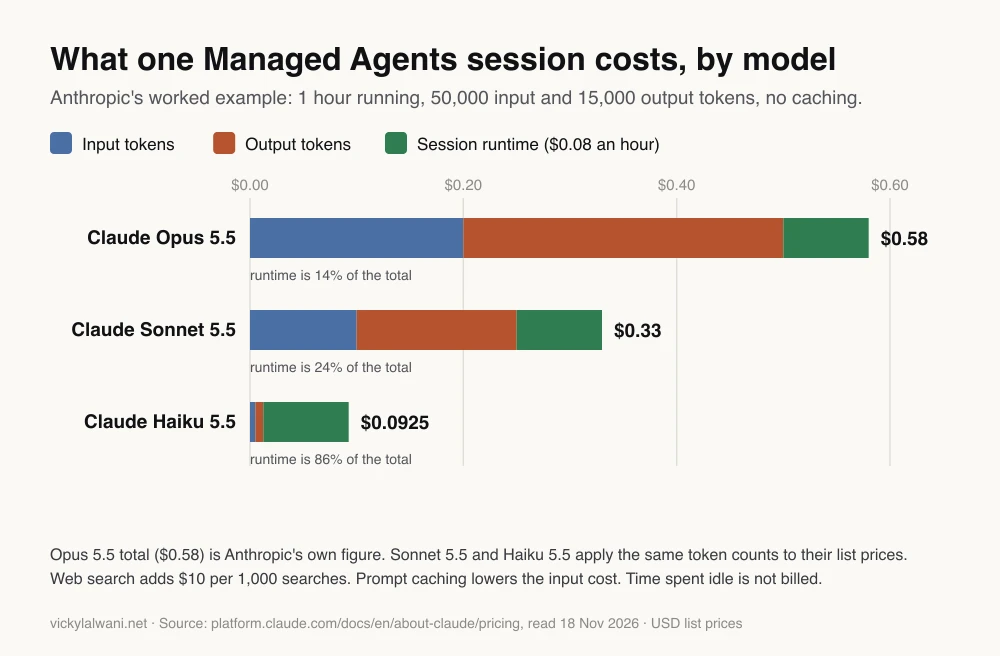
The pricing page says runtime is measured to the millisecond and only counts while a session's status is running. Time spent idle, for example waiting for your approval, is not billed. Web search inside a session costs the usual $10 per 1,000 searches, and the Batch API discount does not apply.
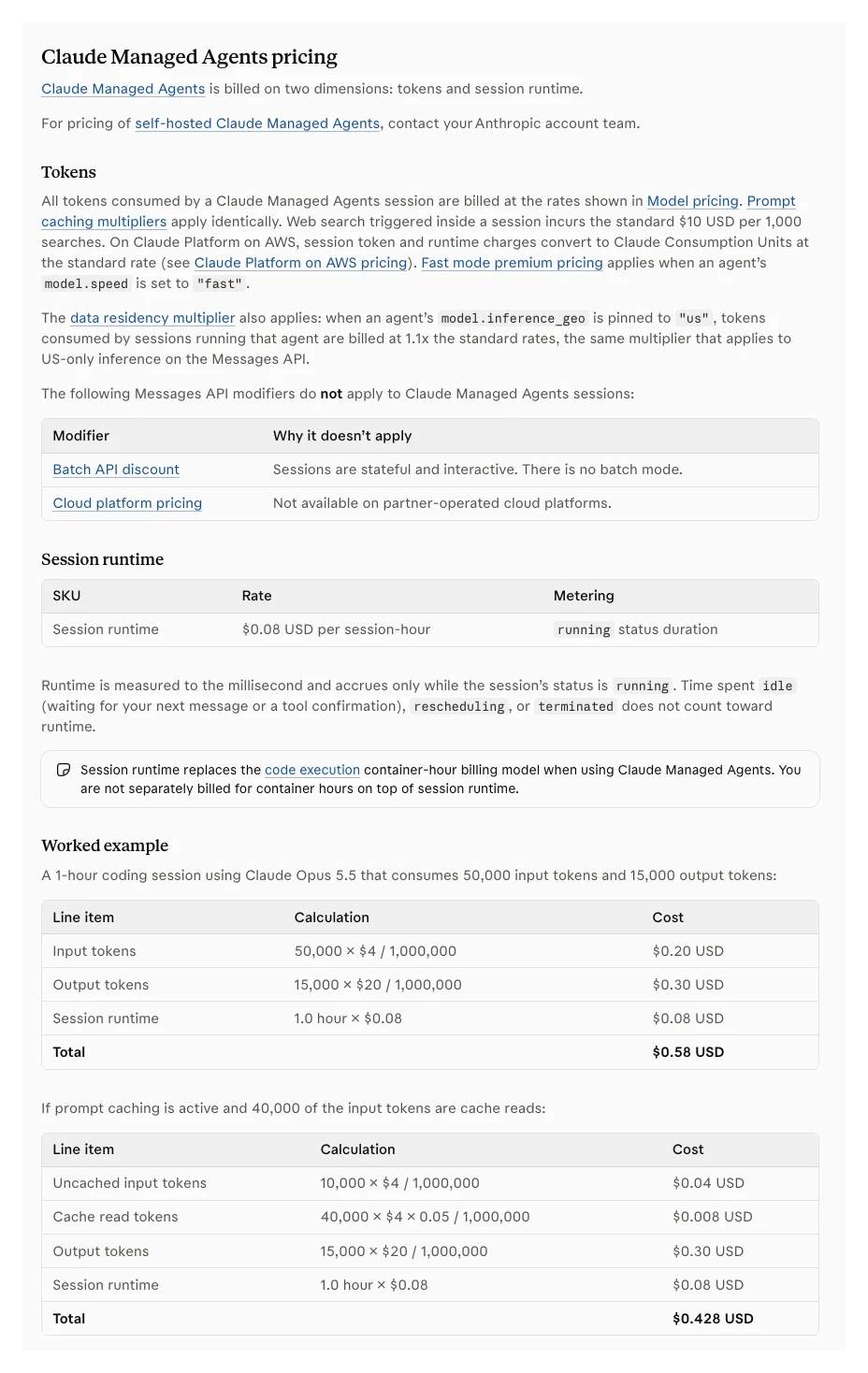
As an example only: if a weekly search terms run looked like Anthropic's worked session on Claude Sonnet 5.5 ($0.33), 52 runs would come to about $17 a year in API charges. Real runs vary with the size of the export, the number of grader passes and any web searches. Set a session budget, which is a hard dollar ceiling, before the first scheduled run.
| Cost item | Rate | Source |
|---|---|---|
| Session runtime | $0.08 per running hour | Pricing page |
| Claude Opus 5.5 tokens | $4 in, $20 out per million | Pricing page |
| Claude Sonnet 5.5 tokens | $2 in, $10 out per million | Pricing page |
| Claude Haiku 5.5 tokens | $0.10 in, $0.50 out per million | Up to 100,000-token prompts |
| Web search | $10 per 1,000 searches | Pricing page |
Do you need a team of agents, or one?
Short answer: one, at first. Managed Agents supports subagents, dynamic workflows and an advisor model, but each extra agent adds tokens and failure points. Split the work only when one agent's context fills up with reading.
The multiagent docs describe three options. With subagents, the lead agent hands tasks to other agents and reads their reports. With dynamic workflows, the agent writes a program that runs many agents in phases in the background. With an advisor, it consults a stronger model mid-task and keeps doing the work itself.
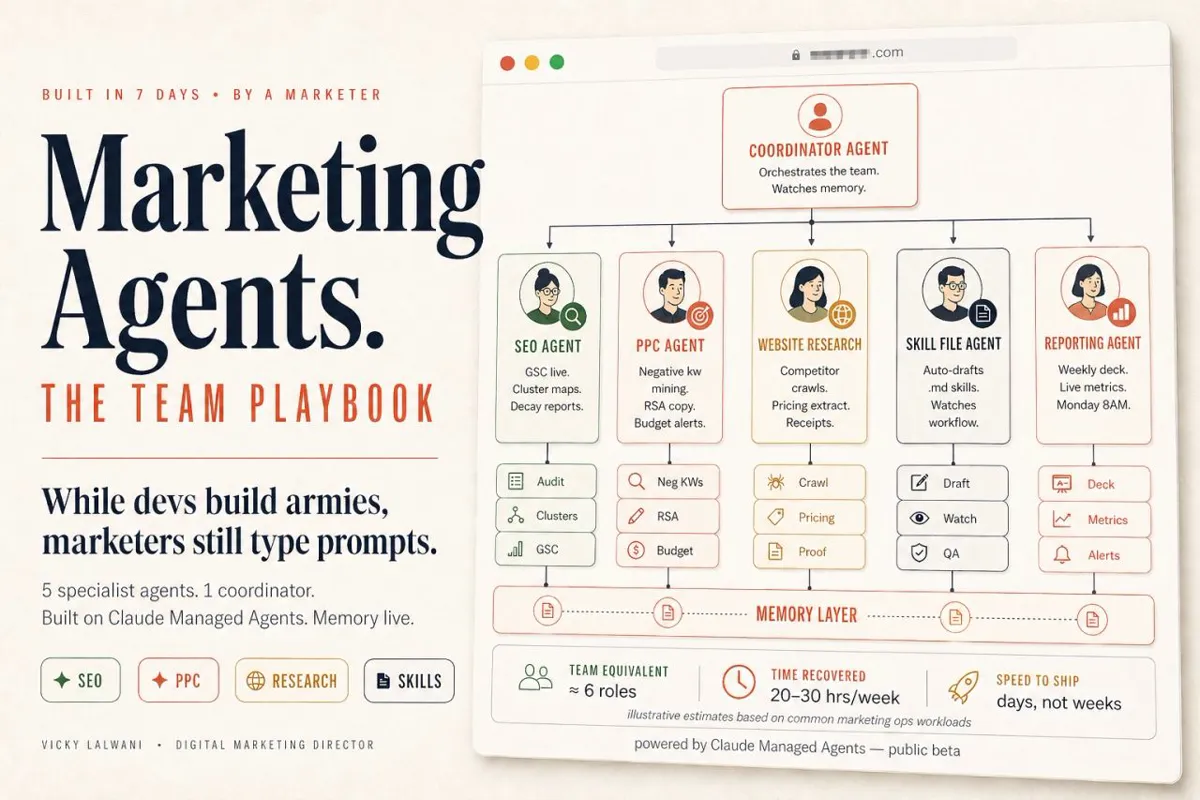
For a marketing team, the sensible pattern is one reliable agent per recurring job, then a coordinator only when you have several that each work alone. A content audit across hundreds of pages is a fair case for a workflow. A weekly report is not. One thread on r/ClaudeAI also points out that a workflow run can show as completed while some of its threads failed, so check coverage before anyone acts on the output. If you want the design side of this, read how to build a Claude subagent team.
How do you keep a managed agent safe on client accounts?
Short answer: least access, approvals on every write, a spend cap, and a person reading the output before it goes anywhere. Set these in the agent definition so they apply to every run, not in a prompt the agent might ignore.
| Risk | Control in Managed Agents | What to set |
|---|---|---|
| Agent changes an account | Permission policies | always_ask on write tools |
| Agent browses bad pages | Web tool restrictions | Allow only the sites it needs |
| Logins leak or spread | Vaults | One vault per client, read-only users |
| A run costs too much | Session budget | A dollar cap per run |
| Nobody checks the work | Outcomes plus your approval step | A rubric and a named reviewer |
| Client data rules | Data handling | Note: not eligible for ZDR or HIPAA |
Two defaults are worth knowing. The built-in toolset (bash, files, web) defaults to always_allow, while MCP toolsets default to always_ask. So connecting an ad platform through MCP asks by default, but the agent can still run code and browse freely unless you restrict it. The overview also says sessions are stateful and transcripts persist until you delete them, which is why Managed Agents is not eligible for zero data retention, except in the self-hosted version.
Access is the problem that comes up most in my client work: the access someone believes they granted and the real role often differ. Check the actual role of the login the agent uses, on screen, before the first run.
How do you start without writing code?
Short answer: use the Claude Console's visual agent builder. Anthropic's "Build in Console" page says it walks you through the model, instructions, MCP servers, tools and skills, lets you run a test session on the page, and shows the matching API request.
A sensible first month, in order:
- Pick one job. The weekly task with the clearest rules, often a search terms review or a report.
- Write the brief. Inputs, steps, output format, and what the agent must never do.
- Build it in the Console with exports only, and run test sessions on last month's data.
- Write the rubric from a version you know is good, then add it as the outcome.
- Compare for three or four weeks against what you would have produced by hand.
- Schedule it with a session budget and a named person who approves the output.
- Only then consider live connections, and keep write tools on
always_ask.
This prompt helps you write the brief before you open the Console:
I want to build a Claude Managed Agent for one recurring marketing job: [describe the job, e.g. weekly Google Ads search terms review].
Ask me questions until you can write:
1. The agent's system prompt: role, inputs, step-by-step method, output format, and a "never do" list.
2. A rubric of 5 to 10 criteria a separate grader can check one by one.
3. The minimum tools it needs, and which must ask before running.
4. What the person approving the output should check in under five minutes.
Do not suggest live account access unless I say an export is not possible.
Videos worth watching on Claude Managed Agents
Short answer: Anthropic's own channel has the clearest material: the launch video, a four-minute explainer and a session on memory. None is aimed at marketers, so watch for the mechanics and apply them to your own jobs.
Made by Anthropic's Claude channel, 9 April 2026. It sells nothing beyond Claude itself. A short explainer: you set the tools, environment and success criteria.
Made by Anthropic's Claude channel, 8 April 2026, at launch. It sells nothing beyond Claude itself. Covers the APIs, MCP, tools and memory, from single tasks to multi-agent pipelines.
| Video | Channel | Date | What it covers |
|---|---|---|---|
| Introducing Claude Managed Agents | Claude | 8 Apr 2026 | Launch video: composable APIs, native MCP, tools and memory, from single tasks to multi-agent pipelines |
| What is Claude Managed Agents? | Claude | 9 Apr 2026 | Four minute explainer: you set the tools, environment and success criteria |
| Memory and dreaming for self-learning agents | Claude | 8 May 2026 | How memory is designed and how dreaming checks and enriches it between sessions |
| Build a production-ready agent with Claude Managed Agents | Claude | 21 May 2026 | Hands-on build, then live debugging and monitoring in the developer console |
| Ship your first Managed Agent | Claude | 26 May 2026 | Agent, environment and session in a few functions, with pointers to subagents, vaults and memory |
| How founders build on Claude Managed Agents | Claude | 8 Sep 2026 | Three founders on what they learned building and scaling agents on the platform |
What people say on X and Reddit
Short answer: official posts trace the feature releases; Reddit adds the practical worries: token bills, the fact that it is API only and not part of a fixed-price plan, and checking that a "completed" run really did all the work. No public post shows an SEO or Google Ads agent running on Managed Agents yet.
Paraphrased, dated and labelled. Reddit is credited by community, not by user.
| Account | What they said | Type | Link |
|---|---|---|---|
| @claudeai (official) | Launch: a tuned agent harness plus production infrastructure, in public beta on the Claude Platform (8 Apr 2026) | Official | Post |
| @claudeai (official) | Rakuten runs specialist agents for product, sales, marketing and finance, each built in under a week (8 Apr 2026) | Official | Post |
| @claudeai (official) | Memory moves to public beta, so agents can learn from every session (23 Apr 2026) | Official | Post |
| @claudeai (official) | Dreaming arrives as a research preview; outcomes, multiagent orchestration and webhooks go to public beta (6 May 2026) | Official | Post |
| @claudeai (official) | Scheduled deployments run an agent on a timetable you set, such as a nightly sync or a daily digest (10 Jun 2026) | Official | Post |
| @ClaudeDevs (official) | Dynamic workflows in public beta: a lead agent writes a plan that runs across many agents in phases (9 Oct 2026) | Official | Post |
| @ClaudeDevs (official) | Self-hosted Managed Agents in private beta: harness, sandboxes and session history in your own cloud (12 Nov 2026) | Official | Post |
| An Anthropic staff account | Frames the platform as built to be both powerful and secure, now with a self-hosted option (12 Nov 2026) | Official | Post |
| An AI commentator account | Thread on how Anthropic's own growth team built agentic workflows for paid search, paid social and SEO with Claude Code (21 Feb 2026) | Opinion | Post |
| Community | What the thread found | Type | Link |
|---|---|---|---|
| r/ClaudeAI | Will a hosted agent harness wipe out agent wrapper start-ups? Replies say enterprises still pay for security, scale and support (10 Apr 2026) | Opinion | Thread |
| r/ClaudeAI | A Slack relay built on launch day: caching made a repeat session cost under a cent, but nothing could call the agent in at first (9 Apr 2026) | First-hand | Thread |
| r/ClaudeAI | A marketer pictures a Monday campaign summary agent and a competitor price watcher; replies note there was no scheduler at launch (11 Apr 2026) | Opinion | Thread |
| r/ClaudeAI | Months running an unattended overnight research tool: the gain is not writing your own loop, retry and state code (19 Jun 2026) | First-hand | Thread |
| r/ClaudeAI | Dreaming, outcomes and multiagent land; replies worry about token bills and that it is API only, not on fixed-price plans (6 May 2026) | Opinion | Thread |
| r/ClaudeAI | How should a business manage several agents? Small firms reply: one scoped credential per agent, a shared log and clear roles (14 Sep 2026) | Question | Thread |
| r/ClaudeAI | A workflow run can show completed while some threads failed; replies say check coverage before anyone acts on a report (13 Oct 2026) | Opinion | Thread |
| r/digital_marketing | A PPC practitioner uses AI for grunt work, not bidding decisions, because models misstate Google Ads features (16 Jun 2026) | Opinion | Thread |
The marketer's thread on r/ClaudeAI is worth reading in full. It pictures exactly the jobs in this article, a Monday cross-platform summary and a competitor price watcher. The replies note that there was no scheduler at launch. Scheduled deployments, added on 9 June, fixed that.
Where this advice is weak
- No marketing results. I have not measured a Managed Agents search terms review against a manual one, and nothing here shows a change in cost per lead, rankings or return on ad spend.
- Beta. Anthropic says it may refine behaviour between releases. Field names, defaults and prices can change.
- Cost example. The Sonnet and Haiku totals apply Anthropic's worked token counts to list prices. Your runs will differ.
- Google's server. Its capabilities are taken from Google's page on 18 November 2026; the page shows no update date.
- Self-hosted. Pricing is "contact your account team", and I have not seen it.
Want an SEO or PPC agent built for your accounts?
The platform is ready for a first, narrow agent. The work is choosing the job, writing the rubric, locking down access and deciding who approves. My AI marketing agents service designs and builds that with you, starting from exports and adding live connections only when the output is trusted. If you would rather have the account itself managed, see Google Ads management or SEO consulting, with rates on the pricing page.
Keep reading: AI agents for PPC, human in the loop AI for Google Ads, Claude subagents tutorial and what a marketing MCP server is.
Sources
| Source | What it supports | Date |
|---|---|---|
| Managed Agents overview | Definition, concepts, beta, access, research preview, ZDR | Read 18 Nov 2026 |
| Launch post | Launch date, public beta, early research preview items | 8 Apr 2026 |
| Scheduled deployments and vaults post | June features, scheduled work examples | 9 Jun 2026 |
| Pricing | Runtime rate, token prices, worked example | Read 18 Nov 2026 |
| Scheduled deployments | Cron schedules, initial event, budgets | Read 18 Nov 2026 |
| Define outcomes | Rubric and separate grader | Read 18 Nov 2026 |
| Memory stores | Mounted memory, versions, beta header | Read 18 Nov 2026 |
| Permission policies | always_allow, always_ask, auto; defaults | Read 18 Nov 2026 |
| Multiagent orchestration | Subagents, workflows, advisor | Read 18 Nov 2026 |
| Vaults and MCP connector | Credentials per session, workspace scope | Read 18 Nov 2026 |
| Session budgets | Hard spend ceiling | Read 18 Nov 2026 |
| Scheduled tasks in the Claude app | Plans, cadence, runs while asleep | Read 18 Nov 2026 |
| Claude Code scheduled tasks | Formerly routines, triggers, plans | Read 18 Nov 2026 |
| Google Ads MCP server | Read and partial mutate, local or self-hosted remote | Read 18 Nov 2026 |
| X posts and Reddit threads | Release dates, practitioner views | Listed in the tables above |
This article expands on my post on LinkedIn ↗.
FAQ
What are Claude Managed Agents?
Claude Managed Agents is Anthropic's hosted agent service on the Claude API. You define an agent once with its model, instructions, tools and MCP servers, and Anthropic runs the agent loop and a cloud sandbox for each session. It launched in public beta on 8 April 2026 and was still in beta in November 2026.
How much do Claude Managed Agents cost?
You pay normal token prices for the model plus $0.08 for every hour a session is running; idle time is not billed. Anthropic's worked example, a one-hour Claude Opus 5.5 session with 50,000 input and 15,000 output tokens, costs $0.58.
Can I use Claude Managed Agents with a Pro or Max plan?
No. Managed Agents is part of the Claude API and is billed per use through the Claude Console, not through a Pro, Max or Team plan. If you want scheduled work on a plan, use scheduled tasks in the Claude app or Claude Code instead.
Do I need to code to use Claude Managed Agents?
Not to start. The Claude Console has a visual builder for the model, instructions, tools, MCP servers and skills, with a test session on the same page. To run agents for a team or inside your own tools, someone will still need to call the API.
Can Claude Managed Agents run on a schedule?
Yes. Scheduled deployments, added on 9 June 2026, start a new session on a cron schedule in your timezone, down to the minute. Each run needs a starting message or an outcome, and you can pause, resume or cap the spend of a deployment.
Can a managed agent change my Google Ads account?
Only if you give it a tool that can. Google's own Google Ads MCP server cannot change campaigns, budgets or bids, and MCP tools in Managed Agents ask for approval by default. Start with exported reports so the agent cannot change anything.
What marketing jobs suit Claude Managed Agents?
Recurring jobs with clear rules and output a person can check quickly: Google Ads search terms reviews, content decay checks from Search Console exports, competitor page watches and weekly reports. Bids, budgets and publishing should stay with a person.
Is Claude Managed Agents safe for client data?
It has strong controls, including permission policies, vaults, web restrictions and spend budgets, but sessions keep transcripts until you delete them. Anthropic says it is not eligible for zero data retention or HIPAA cover, except the self-hosted version, so check your client contracts first.