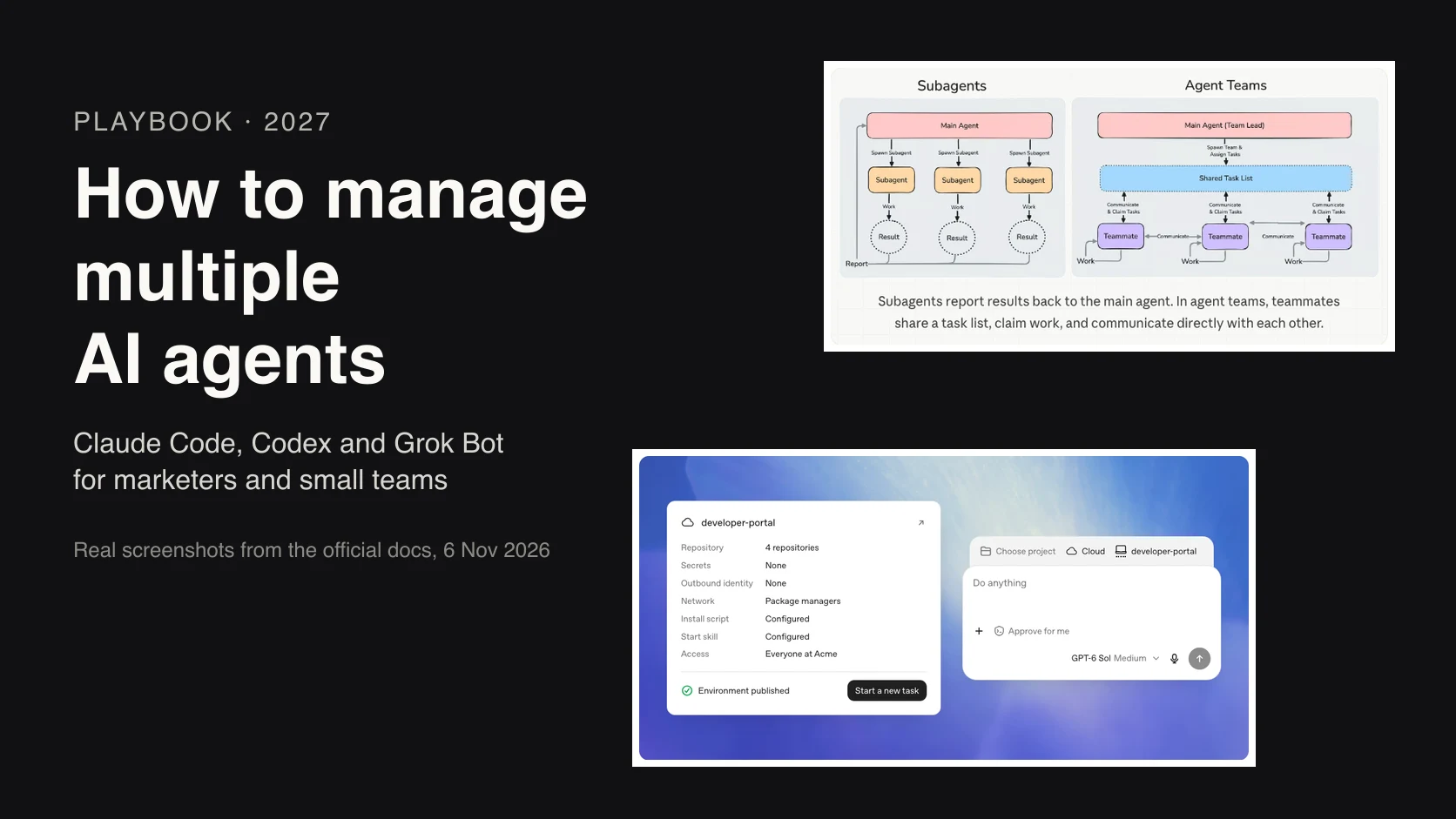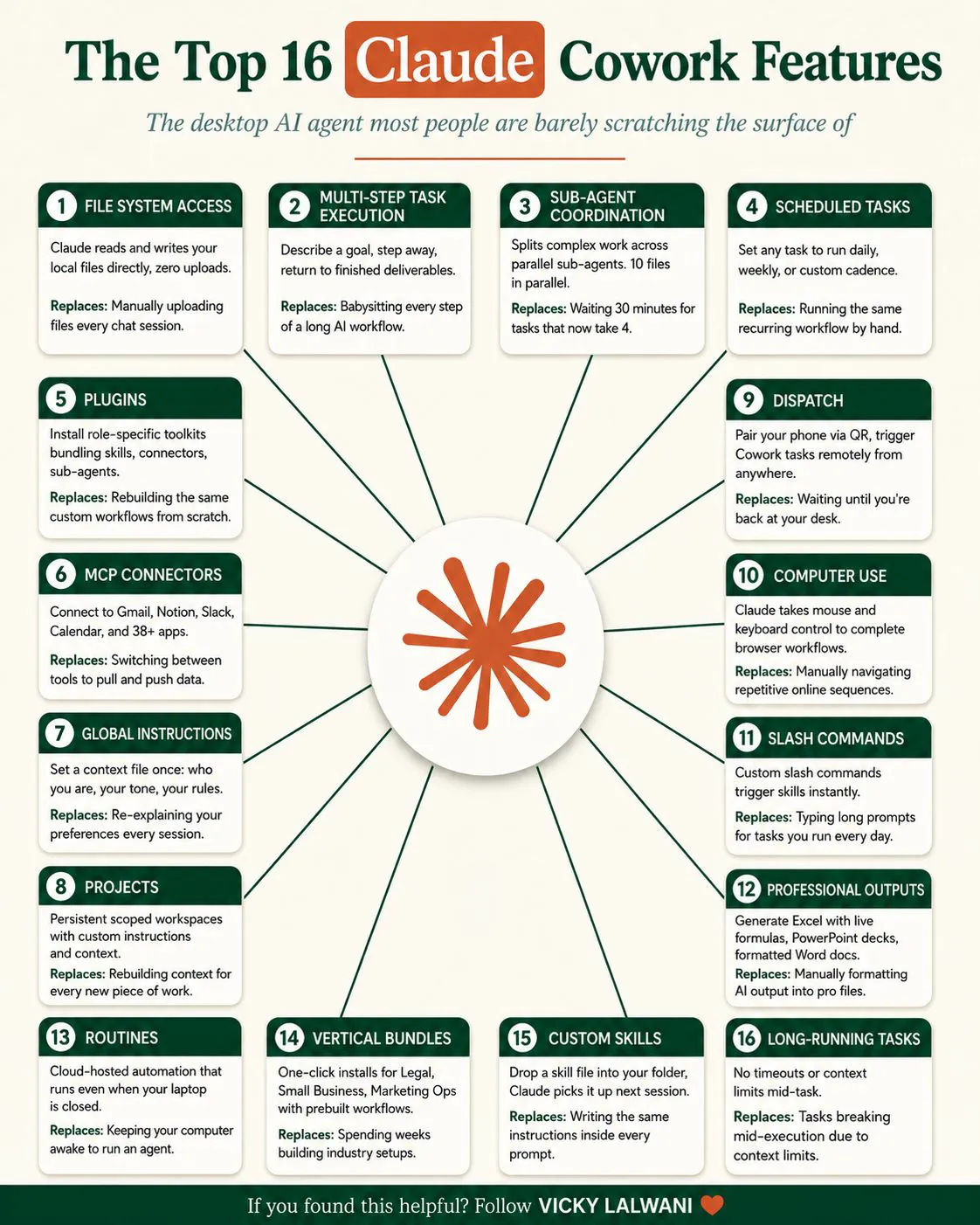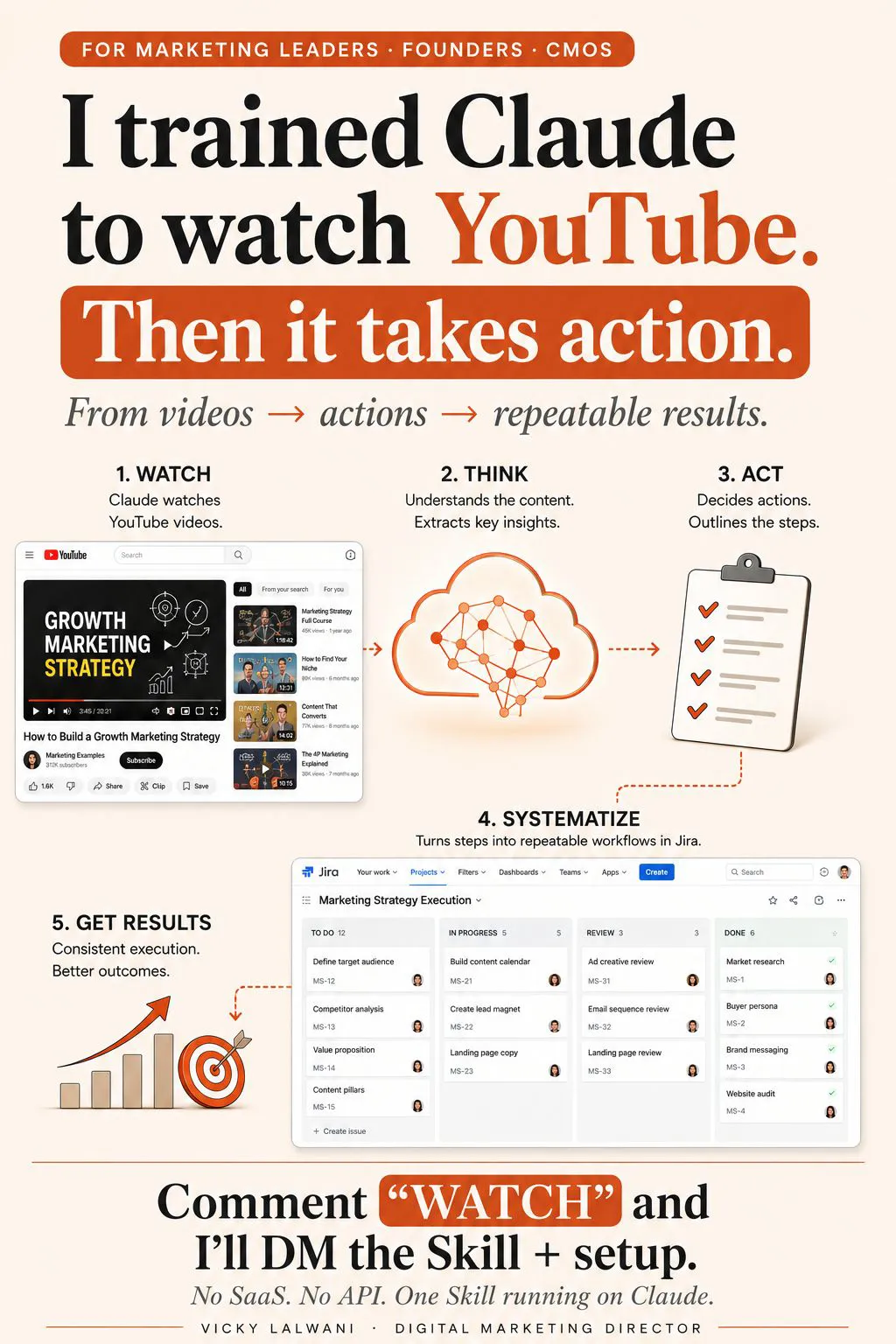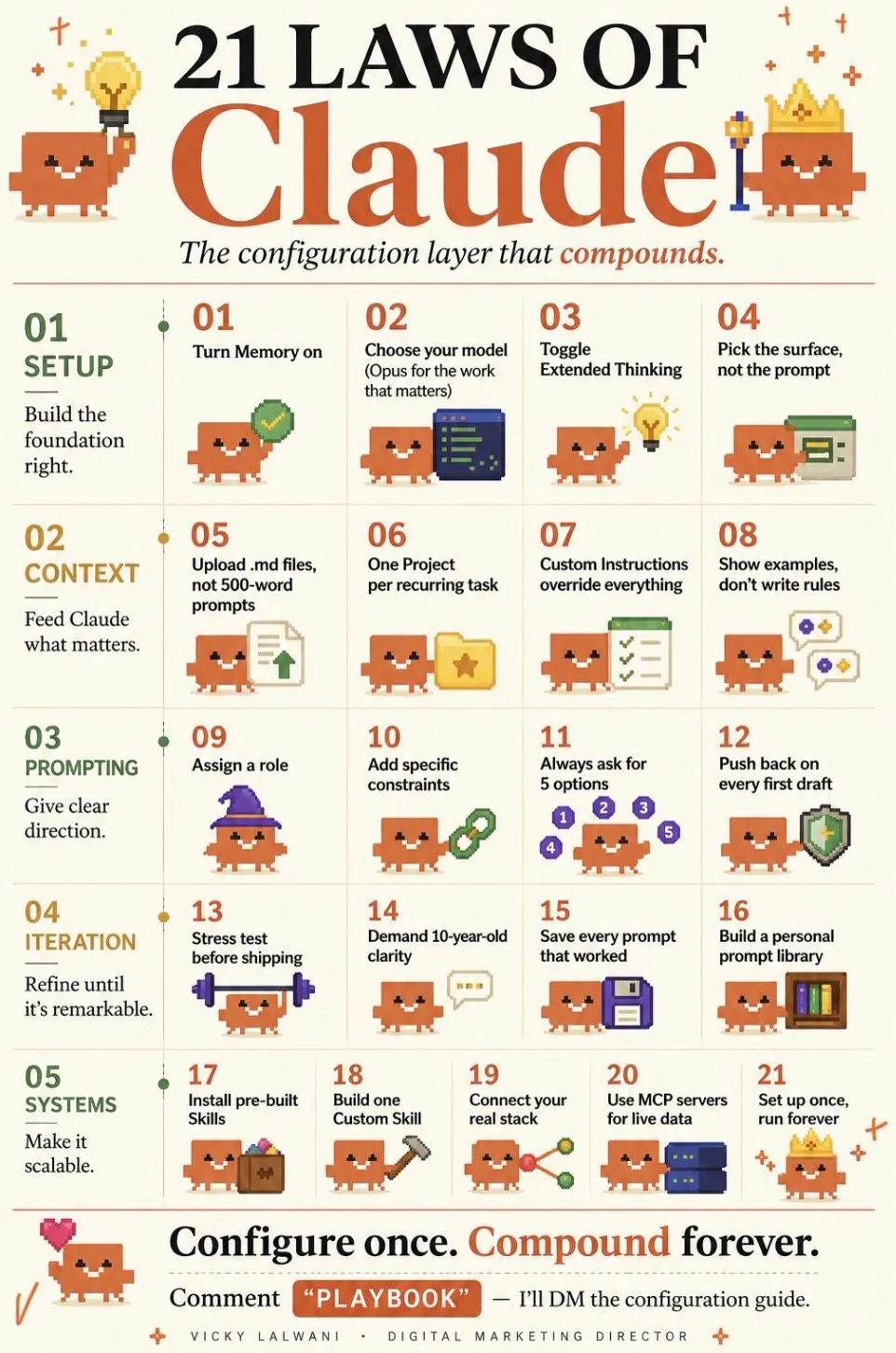
Claude chat vs code vs cowork is now a choice between two tools. Since 16 September 2026 Cowork is part of every Claude conversation, which can answer quick questions or run whole tasks in the cloud and return docs, sheets and decks. Claude Code stays separate, as the Code tab, terminal, IDE and web, for work on a folder of files with a CLAUDE.md rules file. Marketers should think and deliver in Claude and build repeatable SEO and PPC work in Claude Code.
TL;DR
Claude chat vs Code vs Cowork is now a choice between two things, not three. On 16 September 2026 Anthropic merged Cowork into the main Claude app: any conversation can now answer a quick question or take on a whole task, such as a report, spreadsheet or deck. Claude Code stayed separate, as the Code tab in the desktop app, the terminal, IDEs and the web.
Use a Claude conversation for thinking, writing and handing off tasks that live in your apps. Use Claude Code when the work lives in a folder of files you want to keep: crawl exports, ad account exports, a website, anything you will run again with the same rules.
Two old tips are out of date. You no longer pick "Cowork" before a task, and on the newest models thinking is always on, so you control depth with the effort level instead of an extended thinking switch. Facts checked against Anthropic's pages on 18 November 2026.
Jump to: What changed · Claude vs Claude Code · When to use Claude · When to use Code · Moving work · Thinking and effort · Plans · Problems
You open Claude to ask for five ad headlines and the message box no longer shows a "Chat" or "Cowork" switch. Last month you had to decide where a task belonged before you started. Now Claude decides. If you learned the three-mode way of working, a lot of what you were told, including in the first version of this article, needs updating.
This refresh explains the current shape of Claude for marketers, as of November 2026: what merged, what stayed separate, which tasks go where for SEO and paid search work, and what people are struggling with since the change. If you want it set up for your team, with skills, connectors and review rules, that is what my Claude consultant service covers.
What changed when Cowork merged into Claude?
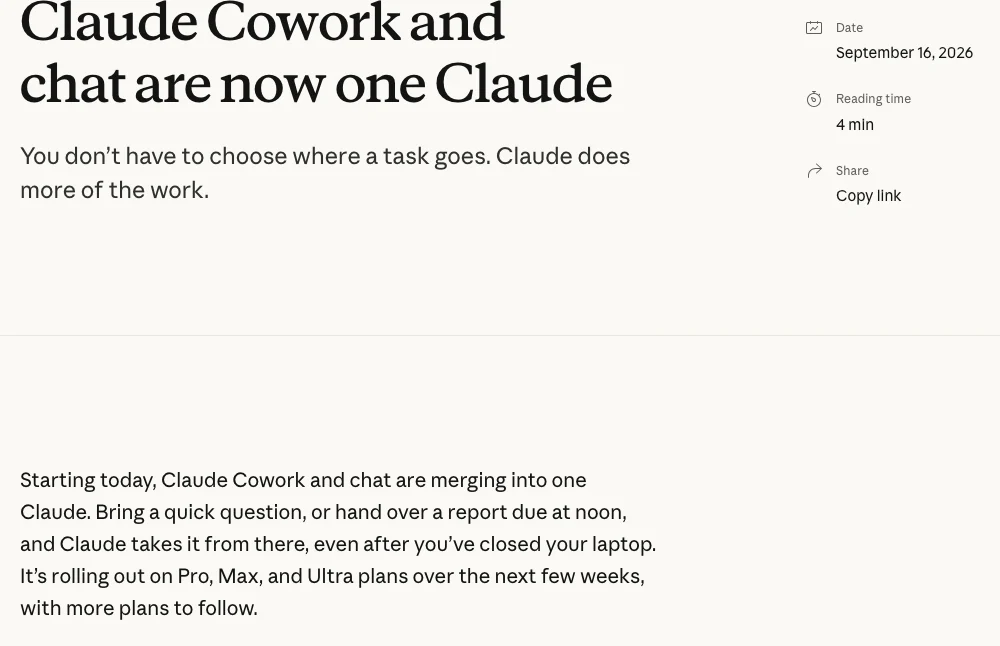
Short answer: chat and Cowork became one conversation on 16 September 2026. You no longer choose a mode; Claude answers quick questions directly and turns bigger requests into tasks that run in the cloud and hand back finished files. Claude Code, the model picker and the Code tab did not change.
Anthropic's announcement was blunt about why: people told it the frustrating part was deciding where a task belonged, and what they started in one place did not carry into the other. So everything Cowork could do is now available from any conversation, with the same projects, connectors and skills.
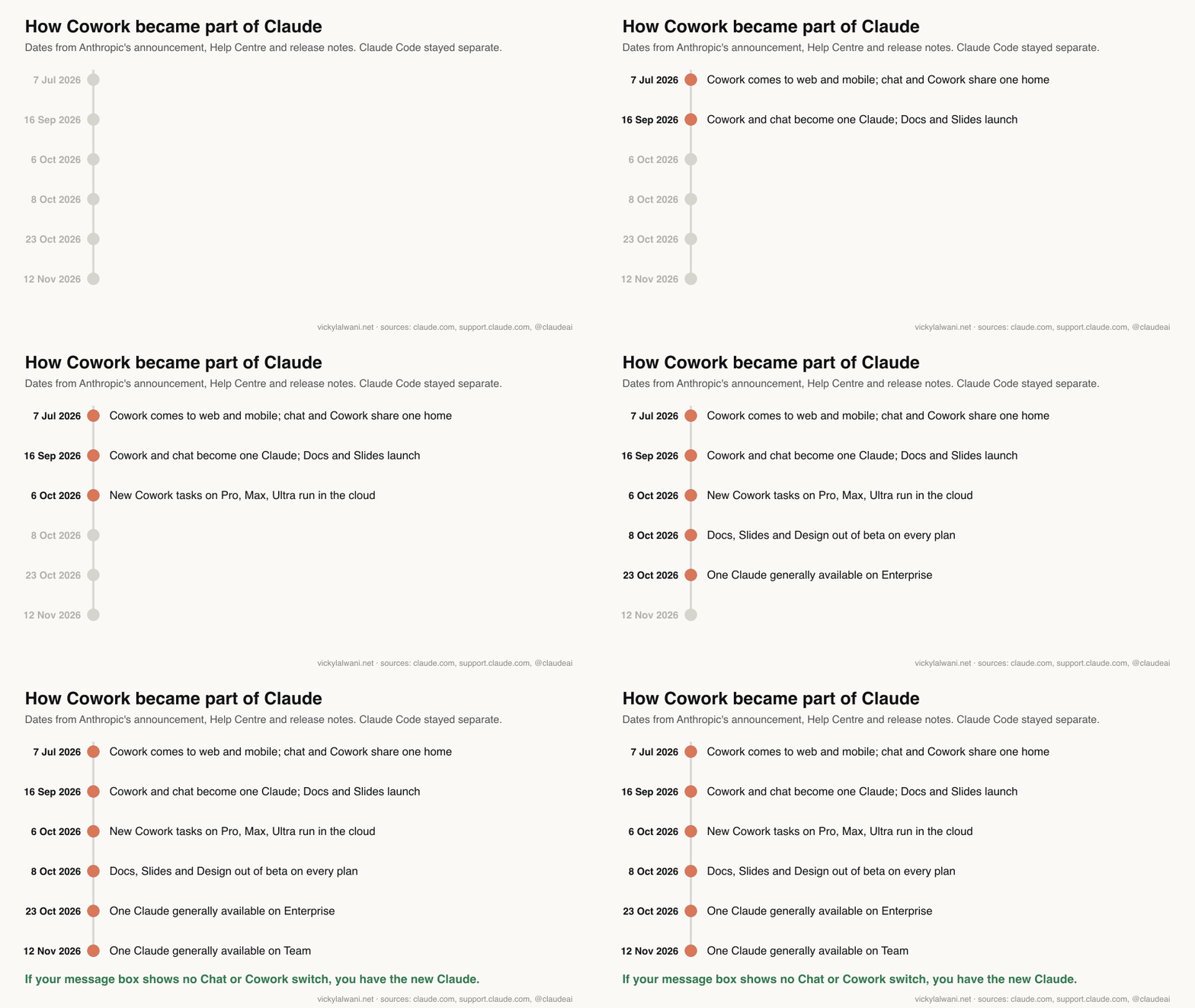
It did not happen in one day. The rollout ran in stages, and a few related changes landed around it:
| Before the merge | Now |
|---|---|
| Pick "Chat" or "Cowork" first | No mode; Claude decides |
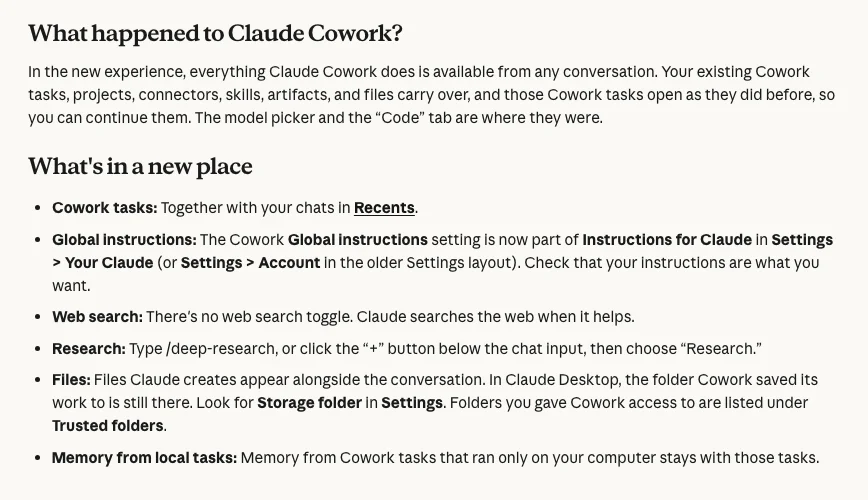
| Cowork tasks in their own list | Tasks and chats together in Recents |
| Cowork could run on your computer | New tasks run in the cloud (Pro, Max, Ultra) |
| Web search toggle | Claude searches when it helps |
| Cowork global instructions | Part of Instructions for Claude |
| Design as a separate tool | Design, Docs, Slides in any chat |
| Code tab | Unchanged |
The quick way to tell if you have it: if your message box no longer shows "Chat" and "Cowork" options, you have the new experience, and there is no switching back. Enterprise got it on 23 October and Team on 12 November; Anthropic's page said Free would follow.
What is the difference between Claude and Claude Code now?
Short answer: Claude (the app conversation) is built for knowledge work: questions, writing, research, reports and decks, using your connected apps, with long tasks running on Anthropic's servers. Claude Code is built for work on a folder or code repository: it reads and edits the files, runs commands and follows a CLAUDE.md rules file every session, on your machine or in the cloud.
Anthropic describes Cowork as using the same agentic architecture that powers Claude Code, with no terminal required. So the engines are related; the difference is where the work lives and how much control you get over it.
| Claude conversation | Claude Code | |
|---|---|---|
| Where you open it | Web, desktop, mobile | Code tab, terminal, IDE, web |
| Where it runs | Cloud; your folders via desktop | Your machine, cloud or SSH |
| Starting point | A request | A project folder or repo |
| Standing rules | Projects, Instructions for Claude | CLAUDE.md, settings, hooks |
| Output | Docs, decks, sheets, answers | Changed files, scripts, sites |
| Free plan | Yes, with limits | No, Pro and above |
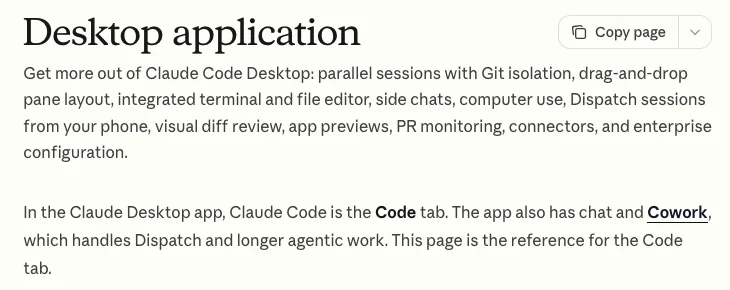
The Claude Code docs put the desktop arrangement plainly: in the Claude Desktop app, Claude Code is the Code tab, and each Code session has its own history and project folder. You can also start Claude Code sessions in the cloud from the browser, the mobile app or the terminal, and they keep running after you close the laptop.
The line blurred because the Claude conversation can now reach local folders, run code and use a browser too. That is why practitioners in an r/ClaudeAI thread in November 2026 settled on a simple split: the conversation for thinking, Claude Code for building once there is a project folder with a plan and a rules file.
When should a marketer use a Claude conversation?
Short answer: for strategy, briefs, copy, research and anything that ends as a document, sheet or deck, and for recurring tasks that pull from connected apps, such as a Monday report. If you would brief a colleague in a message rather than hand them a folder, start here.
| Marketing task | Why the conversation fits |
|---|---|
| Ad copy angles and briefs | Back-and-forth thinking |
| Competitor research write-up | Searches the web, writes a doc |
| Weekly ads summary as slides | Scheduled task, deck output |
| Inbox or Slack digest each morning | Connectors, runs in the cloud |
| Content brief from a keyword | One request, several outputs |
| Client-ready one-pager | Docs or Design, shared by link |
Scheduled work is the biggest gain from the merge for marketers. Anthropic's own example is client prep set for 6am, with the follow-up left drafted but unsent. That "drafted but unsent" part is the habit to copy: I keep approval before anything goes live, and a scheduled task should prepare, never publish or change an ad account on its own.
The new permission setting controls that. In the message box you choose Auto, where Claude keeps going and an automated check reviews actions first, or Manual, where it asks before each action. Anthropic's help page warns that the automated check can miss risky actions. For anything touching ad spend, client email or a live site, use Manual or set those connector tools to "Always ask".
Docs, Slides and Design matter here too. They launched with the merge, and on 8 October the official Claude account announced they were out of beta on every plan, including Free. A monthly report can now be a shareable deck from the same conversation that analysed the numbers.
When should you use Claude Code instead?
Short answer: when the work is a set of files you will come back to: large exports, an SEO crawl, a website, a reporting script, or a client folder with standing rules. Also when the work must stay on your own computer, because new Cowork tasks no longer can.
Three things make Claude Code the better home for repeatable SEO and paid search work:
- It works on the real files. A 40,000-row crawl export or a year of search terms sits in a folder, and Claude Code reads, filters and writes back to it rather than juggling uploads.
- Rules load every time. A CLAUDE.md file in the folder holds the client's brand rules, naming conventions and "never do" list, and Claude Code reads it at the start of each session.
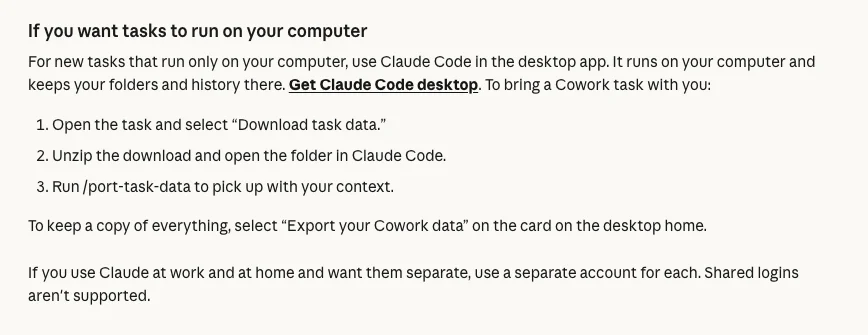
- It can stay local. Since 6 October, new Cowork tasks on Pro, Max and Ultra run in the cloud; Anthropic's own advice for tasks that run only on your computer is Claude Code in the desktop app.
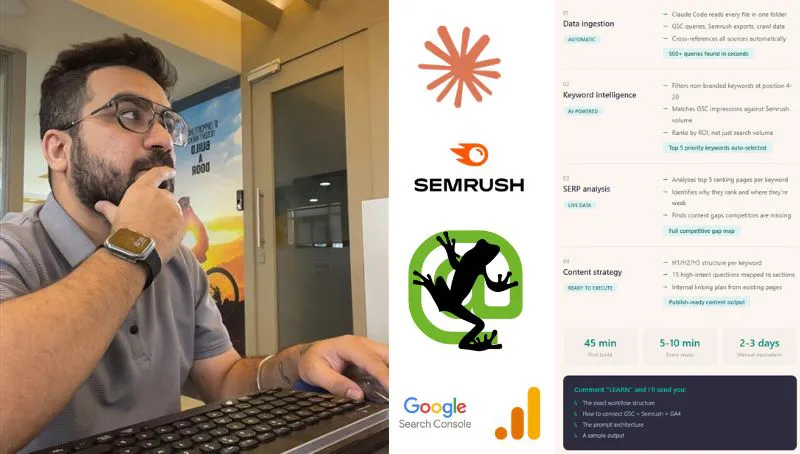
I build and edit this website with Claude Code: describe the change in plain English, add a screenshot if the design matters, preview it, then push it live. The same pattern suits routine edits on most marketing sites, while bigger structural problems still deserve a developer. The step-by-step version is in how to build a website with Claude Code, and the SEO folder set-up is in Claude Code for SEO.
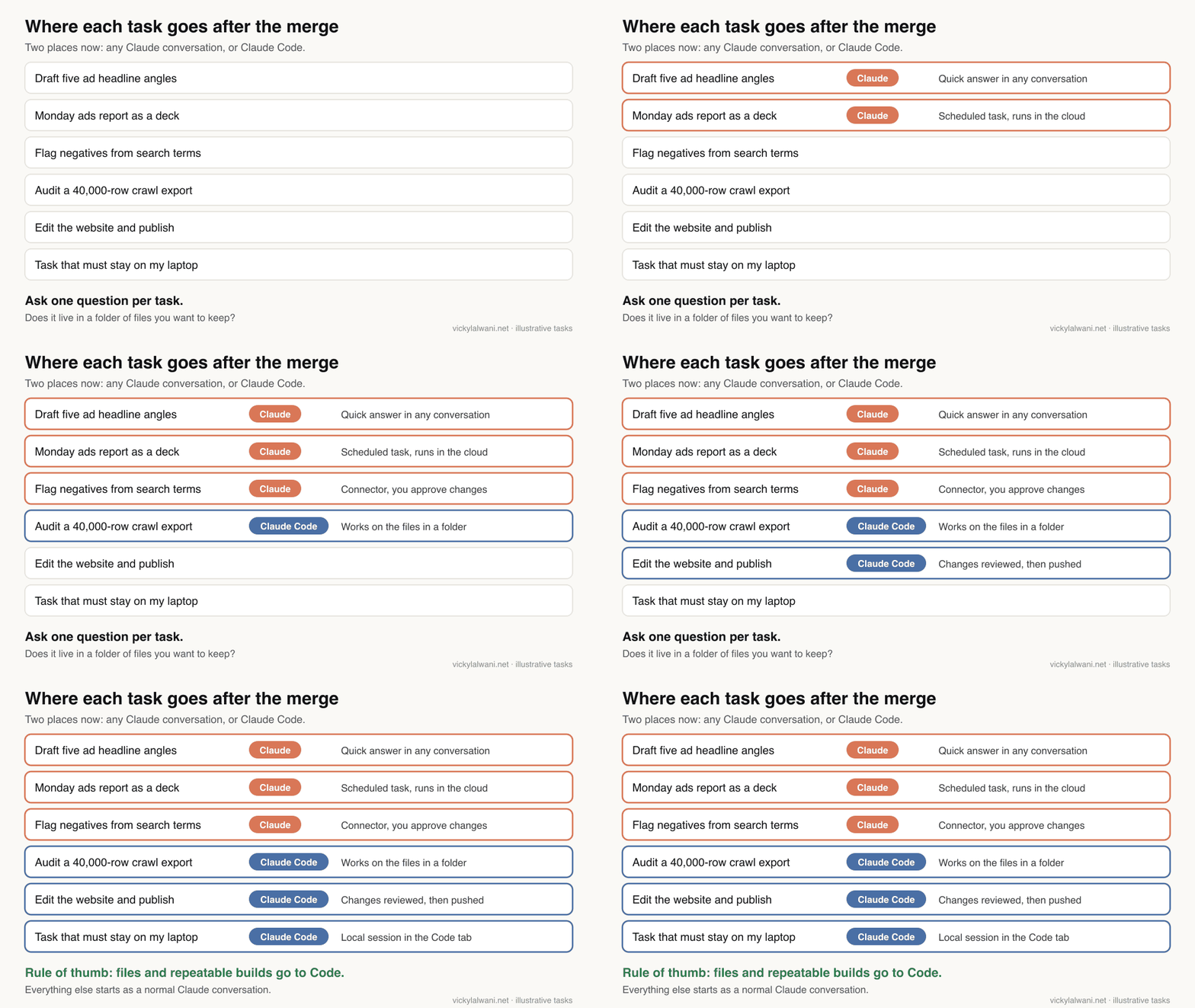
For paid search, the same split applies. A practitioner thread in r/PPC described Claude Code for automated briefs and account reports, with the sensible warning to keep any changes behind approval and to give it the strategy and context first. Search term review can start in a conversation; a weekly audit you run the same way for every account belongs in Code. My Google Ads management runs on that kind of set-up, with every change approved by a person.
How do you move work from chat or Cowork into Claude Code?
Short answer: for an old Cowork task, use Anthropic's route: download the task data, open the folder in Claude Code and run /port-task-data. For a long chat, ask it for a full handoff summary, save that as a file in your project folder and start a Claude Code session there.
A common situation after the merge: a half-finished project spread across chat and old Cowork tasks, with the context stranded there. You do not need to start again. Ask the old conversation to write everything down, then continue in Claude Code with that file attached. Using one standard prompt for this, rather than improvising each time, keeps handoffs consistent across a team.
Everything we have done here is fine. I am moving this project into Claude Code, so I need a complete handoff.
Write a handoff summary as a single Markdown file with these sections:
1. Goal: what this project is for and what "done" looks like.
2. Decisions so far, with the reason for each.
3. Files and links: every file, sheet, page or account we used, and where it is.
4. Rules: brand, tone, naming and anything I told you never to do.
5. Work finished, work in progress, and the next three steps.
6. Open questions I still need to answer.
Do not summarise away details I would need to repeat. Quote exact rules and names.
Then create a folder for the project, save the file in it as HANDOFF.md, turn the rules section into a CLAUDE.md, open the folder in the Code tab and say "Read HANDOFF.md and continue from the next steps." One more trap: a skill installed in Claude Code on one laptop lives in that folder only. To use it in the Claude app as well, upload it under Customize, then Skills. If a skill works in one place but is missing in another, check where it was installed before reinstalling it.
Do you still need to switch on extended thinking?
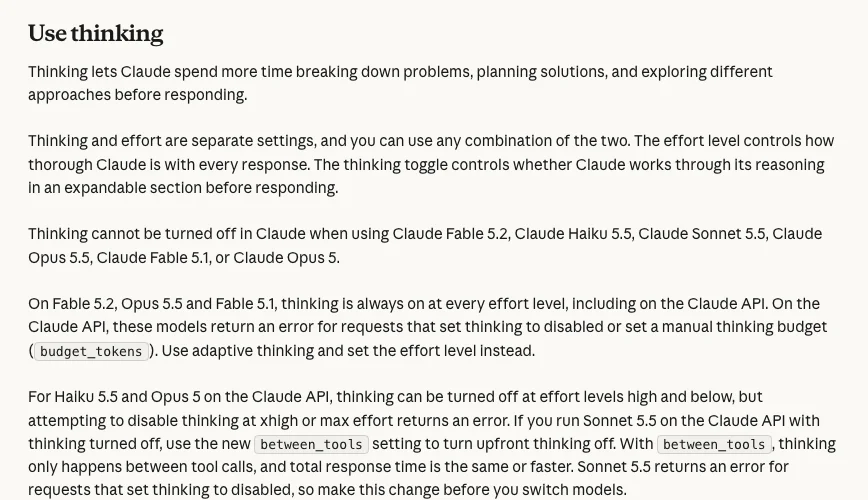
Short answer: not on the newest models. On Claude Fable 5.2, Opus 5.5, Sonnet 5.5, Haiku 5.5, Fable 5.1 and Opus 5, thinking cannot be turned off in the app. You control how hard Claude works with the effort level: low or medium for routine content, high as the balanced default, extra high or max for audits and complex analysis.
The first version of this article said to turn extended thinking on for audits and off for content. That advice is out of date. Anthropic's help page now separates thinking from effort: the effort level controls how thorough every response is, and higher effort uses more of your usage limit.
| Marketing task | Effort to try |
|---|---|
| Social posts, rewrites, headlines | Low or medium |
| Briefs, reports, research | High (usual default) |
| Account or site audit | Extra high |
| Strategy with conflicting data | Max, sparingly |
The model still matters as much as the effort. Anthropic's pricing page notes that how fast you reach a limit depends on the model you use, so save the newest, most expensive model for work that needs it rather than routine jobs. If your team pays for extra usage or API credits, set usage limits and keep automatic top-up off until you know your pattern. Which model suits which task is covered in the best Claude model for marketing.
Which Claude plan do you need?
Short answer: Free covers chat, file creation, Docs, Slides and Design. Handing off and scheduling tasks, and Claude Code, start on Pro at $20 a month ($17 billed yearly). Max at $100 gives 5 times Pro's weekly usage and Ultra at $200 gives 10 times, with no 5-hour limit for verified accounts.
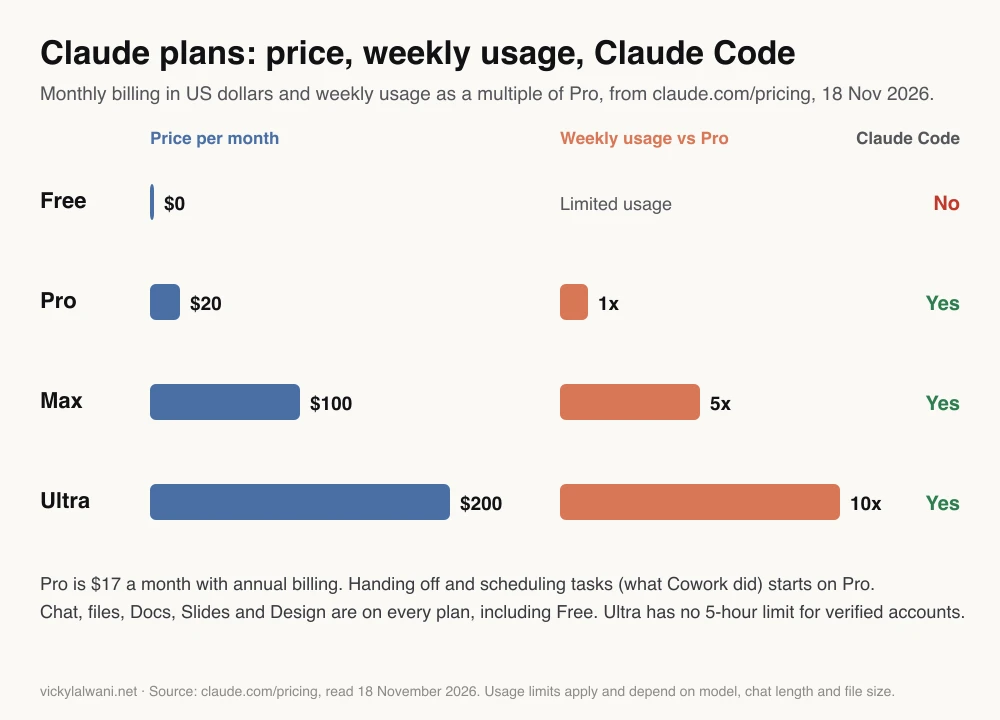
One detail worth noticing: on these published figures, a unit of Pro's weekly usage costs about the same on every paid plan ($20 for 1x, $100 for 5x, $200 for 10x on monthly billing). You pay for headroom, not a discount. Everything in the Claude app and Claude Code counts towards the same plan limits, and Anthropic says longer agentic tasks generally use more than a quick question.
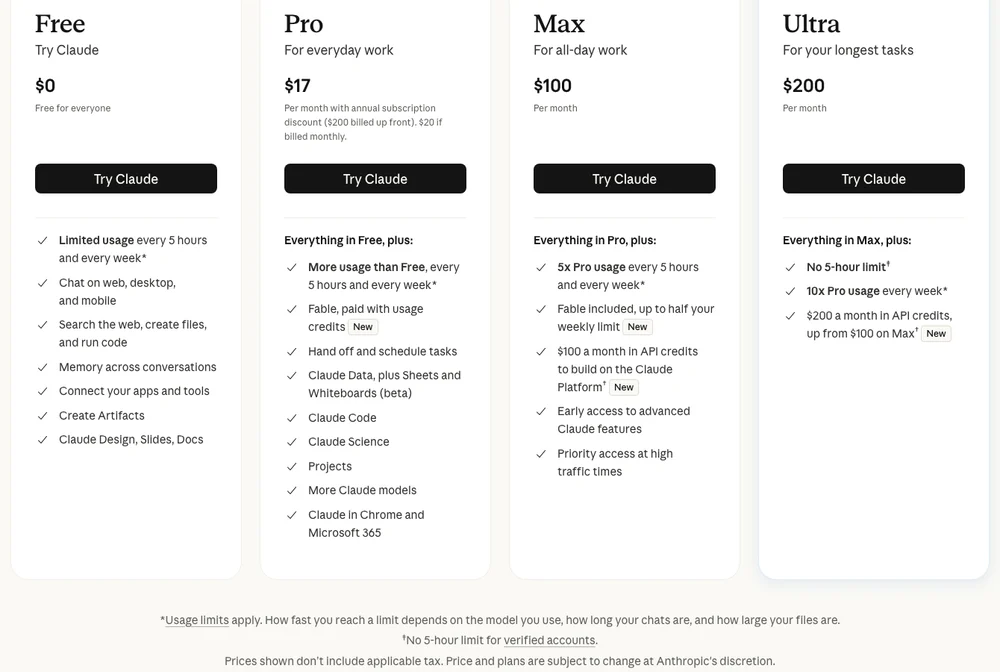
If a team member says Claude Code "needs a higher plan", check which account they are signed into before upgrading anything. Claude Code is not on the Free plan, so a person signed in with a free account instead of the paid one cannot use it.
What confuses people after the merge?
Short answer: rules files that no longer load, long chats that get summarised when a task turns agentic, usage counted as task work, and missing features such as branching and adding from GitHub. Most have a workaround, and the cleanest one for project work is Claude Code.
| Problem | What to do |
|---|---|
| CLAUDE.md not read at the start | Put rules in project instructions, or use Code |
| Long chat summarised mid-task | Start big tasks in a fresh conversation |
| Simple chats using task usage | Check Settings, then Usage; report it |
| Cannot switch back to modes | None; it is one-way |
| Old Cowork tasks not in search | Find them by name in Recents |
| No branching or GitHub import | Use Claude Code for repos |
| Incognito chats in the old style | Expected for now |
The rules-file problem hit people who had built Cowork around a CLAUDE.md. One researcher in r/ClaudeAI found the workaround: add the file to the project and tell the project instructions to read it at the start of every session. The summarising problem shows up in another thread, where a very long chat was condensed when a file task began. Anthropic's own help page lists the missing features, so these are known limits, not user error.
What review rules apply to Claude and Claude Code?
Short answer: a person reviews anything before it is published, sent or switched on. Use Manual permissions for actions with consequences, keep scheduled tasks to drafts, and widen access only after a few weeks of good behaviour on real work.
A Claude draft can sound confident and be wrong, Claude Code can change a file you did not mean to touch, and a task with browser access can misread a page. None of that changed with the merge. What changed is that more of it now happens while you are away, so the review step has to be designed in rather than done by watching.
- Scheduled tasks write drafts and reports; a person sends and changes.
- Connector tools that write (email, ads, CMS) set to "Always ask".
- Claude Code works on a copy or a branch, and you review the diff before anything is published.
- Keep a short log of what each task did, and check it weekly.
Which videos explain the change best?
Short answer: Anthropic's three short official videos show the merge, the new Docs, Slides and Design, and Claude Code cloud sessions. Independent explainers are useful for the caveats, but check their dates; anything before 16 September 2026 describes the old three-mode set-up.
Claude Cowork and chat are now one Claude, from Claude's official channel, 16 September 2026. A 71-second announcement; it promotes Anthropic's product.
Meet Claude Slides, Claude Design and Claude Docs, from Claude's official channel, 16 September 2026. A deck, social images and a one-pager from one brief, in about a minute and a half; a product video.
Coding on the go with Claude Code, from Claude's official channel, 13 October 2026. Four minutes on Claude Code cloud sessions you start and check from a phone; a product video.
| Video | Channel | Date | What it covers |
|---|---|---|---|
| The new Claude Code desktop app | Claude (official) | 14 Apr 2026 | The Code tab and parallel sessions |
| Claude just merged Chat and Cowork | An AI consultant's channel | 17 Sep 2026 | What changed, one caveat |
| Claude Cowork has a MASSIVE Change | An automation agency's channel | 5 Oct 2026 | The move to the cloud |
| Claude Chat vs Cowork vs Code (6-Min Guide) | The Tech Space | 29 Oct 2026 | Which to use, post-merge |
| Claude Chat vs Cowork vs Code | Futurepedia | 27 Jul 2026 | The old three modes (pre-merge) |
What people say on X and Reddit
Short answer: heavy users split the work the same way: the conversation for thinking and deliverables, Claude Code for anything built from files. The complaints since the merge are about lost control: rules files, summarised chats and usage, not about the idea of one Claude.
| Where | Date | What they say | Type |
|---|---|---|---|
| Claude on X | 8 Oct 2026 | Docs, Slides, Design on every plan | Vendor |
| Claude on X | 7 Jul 2026 | Scheduled tasks run with the computer off | Vendor |
| Claude on X | 14 Apr 2026 | Routines in Claude Code | Vendor |
| Screaming Frog on X | 5 Aug 2026 | Crawls started from a phone via Dispatch | Vendor |
| An SEO practitioner on X | 24 Aug 2026 | Keyword research with a connector in Claude | Opinion |
| r/ClaudeAI | 4 Nov 2026 | Chat to think, Code to build | Mixed |
| r/ClaudeAI | 8 Oct 2026 | Long chats summarised by tasks | First-hand |
| r/ClaudeAI | 4 Oct 2026 | Local work moves to Claude Code | Mixed |
| r/ClaudeAI | 25 Sep 2026 | CLAUDE.md workaround via projects | First-hand |
| r/ClaudeAI | 20 Oct 2026 | Simple chats counted as task usage | First-hand |
| r/ClaudeAI | 16 Oct 2026 | Earlier summarising since the update | First-hand |
| r/PPC | 19 Sep 2026 | Code for briefs and reports, approval first | Mixed |
| r/ClaudeAI | 15 Sep 2026 | Code users rarely needed Cowork | Mixed |
Two cautions. The Screaming Frog tip relies on Dispatch, which Anthropic says is no longer available to new users in the unified experience. And several Reddit reports, such as earlier summarising and usage being counted as task work, are user observations that Anthropic had not confirmed when I checked.
Where this advice is weak
- Anthropic is changing this monthly. Every fact here was checked on 18 November 2026; expect the details, plan names and limits to move.
- Free and some Team accounts may still see separate Chat and Cowork options while the rollout finishes.
- Plan prices are in US dollars and exclude tax; local prices differ.
- Usage limits are not published as numbers, so "5x" and "10x" are Anthropic's relative figures.
- The effort table is a starting point based on Anthropic's description of each level, not a benchmark.
- Reddit threads are self-selected and often written by heavy users or people selling tools.
Want help setting up Claude for your marketing team?
Short answer: decide which work belongs in a conversation and which in Claude Code, move project work into folders with rules files, and put approval in front of anything that publishes or spends.
I set up Claude and Claude Code for marketing teams: skills for repeat jobs, connectors to the tools you already use, project folders with rules files, scheduled reports, and the review rules that keep people in charge. That is my Claude consultant service, and rates are on the pricing page. For the bigger picture of the rebuilt app, read what the new Claude desktop app changes for marketers, and for delegated ad work, what to delegate in Google Ads.
Sources
| Source | What it supports | Date |
|---|---|---|
| Anthropic: Cowork and chat are now one Claude | Merge, Docs and Slides, rollout updates | 16 Sep 2026, updated 12 Nov |
| Help Centre: one Claude | What moved, permissions, usage, limits | Read 18 Nov 2026 |
| Help Centre: Cowork on each surface | Cloud from 6 Oct; local work in Code | Read 18 Nov 2026 |
| Help Centre: get started with Cowork | Same architecture as Code; Auto and Manual | Read 18 Nov 2026 |
| Claude release notes | Dates of Cowork, merge and model launches | Read 18 Nov 2026 |
| Help Centre: models, effort, thinking | Thinking always on; effort levels | Read 18 Nov 2026 |
| Help Centre: use skills | Upload skills in Customize | Read 18 Nov 2026 |
| Claude Code docs: overview | Surfaces: terminal, IDE, desktop, web | Read 18 Nov 2026 |
| Claude Code docs: desktop | Code tab in Claude Desktop | Read 18 Nov 2026 |
| Claude Code docs: cloud sessions | Cloud sessions and plans | Read 18 Nov 2026 |
| Claude pricing | Plan prices, usage, features | Read 18 Nov 2026 |
| X, Reddit and YouTube | Linked in the sections above | Apr to Nov 2026 |
This article expands on my post on LinkedIn ↗.
FAQ
What happened to Claude Cowork?
On 16 September 2026 Anthropic merged Cowork and chat into one Claude conversation. Everything Cowork did is now available from any conversation, your Cowork tasks, projects, connectors and skills carried over, and there is no Cowork switch to select.
What is the difference between Claude and Claude Code now?
A Claude conversation is for questions, writing, research and tasks that end as docs, sheets or decks, using connected apps. Claude Code works on a folder or code repository, reads a CLAUDE.md rules file every session and can run on your own machine, in the cloud or over SSH.
Is Claude Code still separate from the Claude app?
Yes. Claude Code was not part of the merge; in the Claude Desktop app it is the Code tab, and it also runs in the terminal, IDEs and on the web at claude.ai/code. The model picker and the Code tab stayed where they were.
Can Claude Cowork tasks still run on my own computer?
Not new ones on Pro, Max and Ultra. Since 6 October 2026 new Cowork tasks run in the cloud, and Anthropic recommends Claude Code in the desktop app for tasks that must run only on your computer.
Do I still need to turn on extended thinking in Claude?
Not on the newest models. Thinking cannot be turned off on Claude Fable 5.2, Opus 5.5, Sonnet 5.5, Haiku 5.5, Fable 5.1 or Opus 5; you control depth with the effort level, from low to max.
Which Claude plan includes Claude Code?
Claude Code starts on Pro, which costs $20 a month or $17 a month billed yearly. Max at $100 gives five times Pro usage and Ultra at $200 gives ten times; the Free plan does not include Claude Code.
Why does my CLAUDE.md file no longer work in Claude chat?
The merged Claude conversation does not read a CLAUDE.md file automatically at the start of a session. Put the rules in your project instructions or ask the project to read the file first, or use Claude Code, which loads CLAUDE.md every session.
How do I move a Cowork task into Claude Code?
Open the task, choose Download task data, unzip it, open the folder in Claude Code and run /port-task-data. For a long chat, ask it for a full handoff summary, save it in a project folder and continue in Claude Code from there.
Should marketers use Claude or Claude Code for SEO and Google Ads work?
Use a Claude conversation for briefs, copy, research and scheduled report decks. Use Claude Code for repeatable audits on exported files, crawl data and website edits, and keep every change to a live account or site behind human approval.