An AI agent marketing team is a set of specialist AI agents, each with one role such as research, keywords, ad copy or reporting, working from skill files. People set goals, review drafts and approve anything that spends money or reaches a customer. Capacity is set by review time, not by how many agents you run.
TL;DR
An AI agent marketing team is a set of specialist AI agents, each with one role (research, keywords, ad copy, reporting, QA), working from written skill files, with people who set goals, review output and own every decision that spends money or reaches a customer.
You still need humans in three roles: a lead who sets priorities and approves, an operator who maintains the skills and access, and specialists who review drafts. Capacity is set by review time, not by how many agents you run.
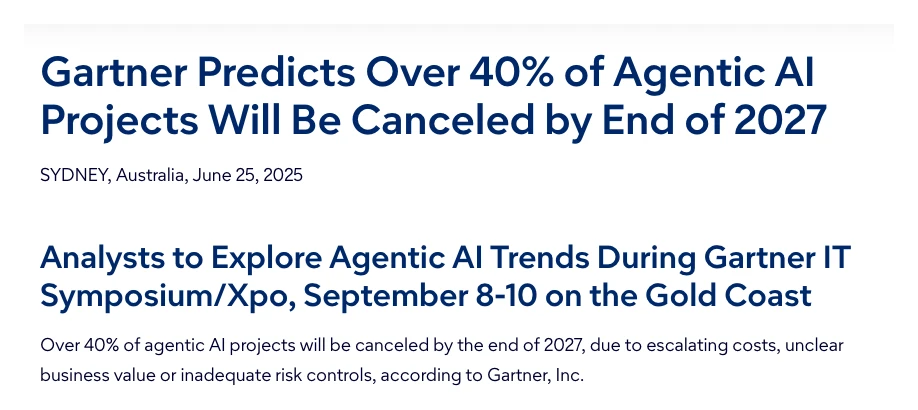
Start with one squad and read-only access. Gartner expects over 40% of agentic AI projects to be cancelled by the end of 2027, mostly for cost, unclear value and weak controls, so prove one workflow before adding more.
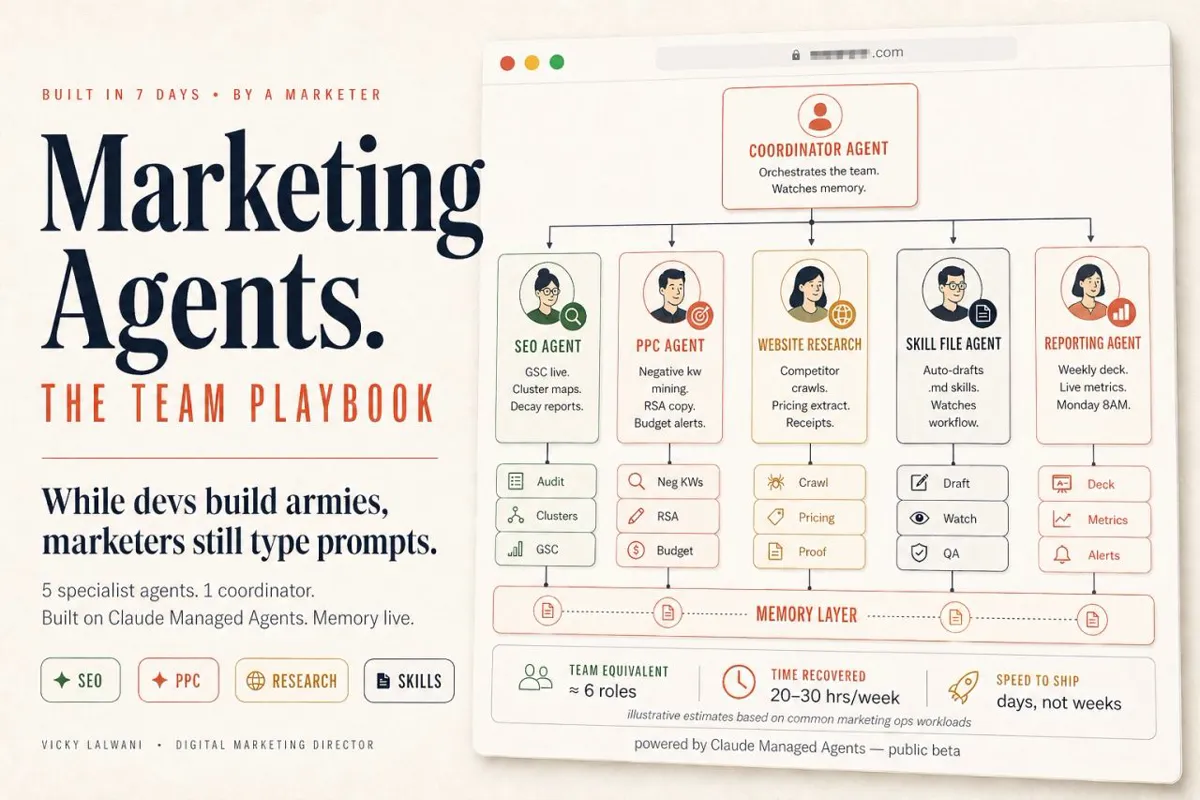
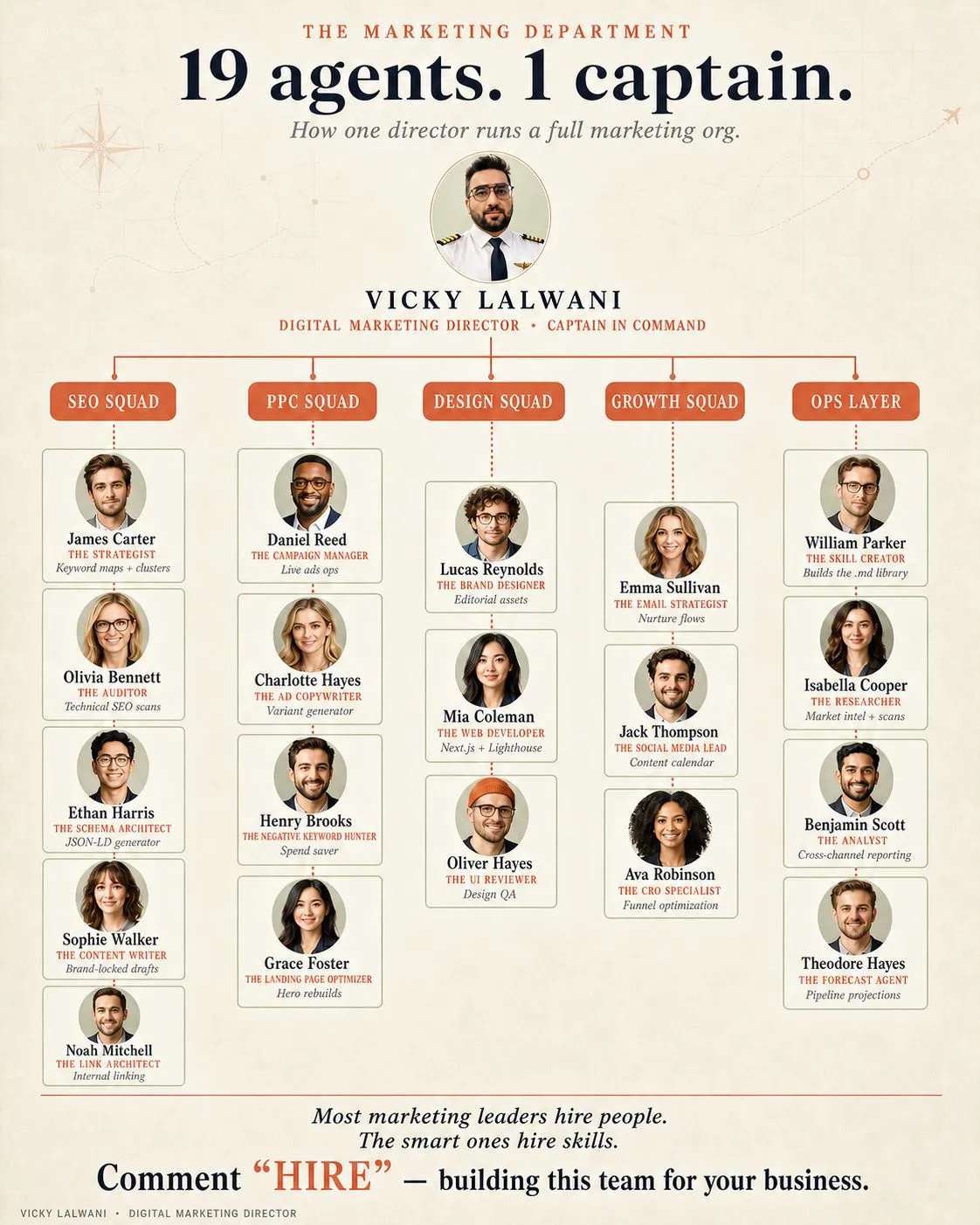
Many marketing leaders reach the same wall: more work than the team can handle, and new headcount that nobody can promise. I hit that wall too, and instead of waiting I built the team I needed from specialist AI agents. My setup runs 19 AI agents alongside 3 humans. The numbers matter less than the structure, and the structure is what this guide covers.
You will find the roles AI teammates can fill, the people and skills you still need, how work intake and capacity planning change, what access to give, and what the 2026 data says. If you want help designing it around your own stack, see my AI marketing agents service.
What is an AI agent marketing team?
Short answer: a group of AI agents with narrow marketing roles, each following a written skill file, coordinated through one task list and supervised by people. It is closer to a well-run department than to one clever chatbot.
A single general assistant tries to be good at everything and ends up average at most things. Specialist agents, each with one job, clear inputs and a defined output, are easier to check and easier to improve.
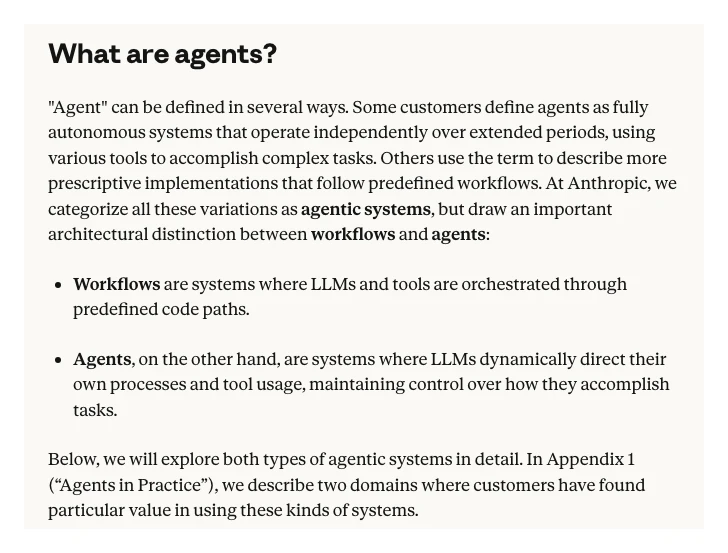
It helps to use Anthropic's distinction. In its guide to building effective agents, workflows are systems where models and tools follow predefined code paths, while agents decide their own steps and tool use. Most of a marketing team should be workflows. True agents earn their place only where the path is genuinely open-ended, such as research.
| Workflow | Agent | |
|---|---|---|
| Path | Fixed steps | Model decides |
| Best for | Reports, audits, drafts | Research, triage |
| Cost | Lower, predictable | Higher, variable |
| Checking | Easy | Harder |
| Marketing share | Most of the team | A few roles |
For more on the choice, see AI workflows vs agents.
Which marketing roles can AI teammates fill?
Short answer: roles whose output is a draft, a check or a summary: research analyst, keyword and SEO analyst, ad copywriter, reporting analyst, content drafter, QA reviewer and an intake coordinator. Roles that own budgets, brand and clients stay human.
"AI teammates" is now a product category as well as a phrase. Asana, for example, describes three marketing roles it runs with AI Teammates: a help centre writer, an SEO and schema auditor, and a sprint coordinator, with people setting the brief and signing off. The pattern is the same whatever tool you use.
| AI teammate role | What it produces | Human owner | Access |
|---|---|---|---|
| Research analyst | Competitor and SERP notes | Strategist | Web only |
| Keyword analyst | Keyword maps, negatives | SEO or PPC lead | Read only |
| Ad copywriter | Variants labelled by angle | PPC manager | Drafts only |
| Reporting analyst | Weekly one-page brief | Marketing lead | Read only |
| Content drafter | Briefs and first drafts | Editor | Drafts only |
| QA reviewer | Checks against the rules | Editor | Read only |
| Intake coordinator | Tagged, routed requests | Marketing lead | Task board |
| Skill librarian | New and updated skill files | Marketing ops | Skills folder |
The skill librarian is the force multiplier. Every time a person corrects an agent, the lesson goes into a skill file, so the next run starts better. For the delegation side, tasks to delegate to AI agents lists which jobs suit agents first.
What skills and team structure do you need to run AI agents in marketing?
Short answer: three human roles: a lead who sets goals and approves, an operator who builds and maintains skills, access and logs, and channel specialists who review drafts. The core skills are writing clear briefs, mapping processes, judging output and managing permissions.
| Human role | Owns | Key skill |
|---|---|---|
| Marketing lead | Goals, priorities, final yes | Judgement |
| Agent operator | Skills, access, logs | Process writing |
| Channel specialists | Reviewing drafts | Domain expertise |
| Data owner | Which data agents see | Privacy, permissions |
In a small business one person may hold several of these. What matters is that each is named. When nobody owns access, agents sit blocked; when nobody owns review, unchecked work goes out.
- Briefing. Writing a task so a stranger could do it: goal, inputs, output format, what not to do.
- Process mapping. Breaking a job you do by feel into steps an agent can follow.
- Evaluation. Spotting confident errors, invented figures and off-brand tone quickly.
- Permissions. Knowing the difference between view, edit and admin in each ad and analytics tool.
How should you group agents into squads?
Short answer: by marketing function, mirroring a real department: SEO, paid media, content, growth, plus an operations layer that keeps skills, intake and reporting running. Each squad has a human owner.
| Squad | Agents in it | Human owner |
|---|---|---|
| SEO | Keywords, technical audit, schema, internal links | SEO lead |
| Paid media | Search terms, ad copy, landing page checks | PPC manager |
| Content | Briefs, drafts, repurposing | Editor |
| Growth | Email flows, funnel audits | Growth lead |
| Operations | Intake, skills, weekly brief, forecasts | Marketing ops |
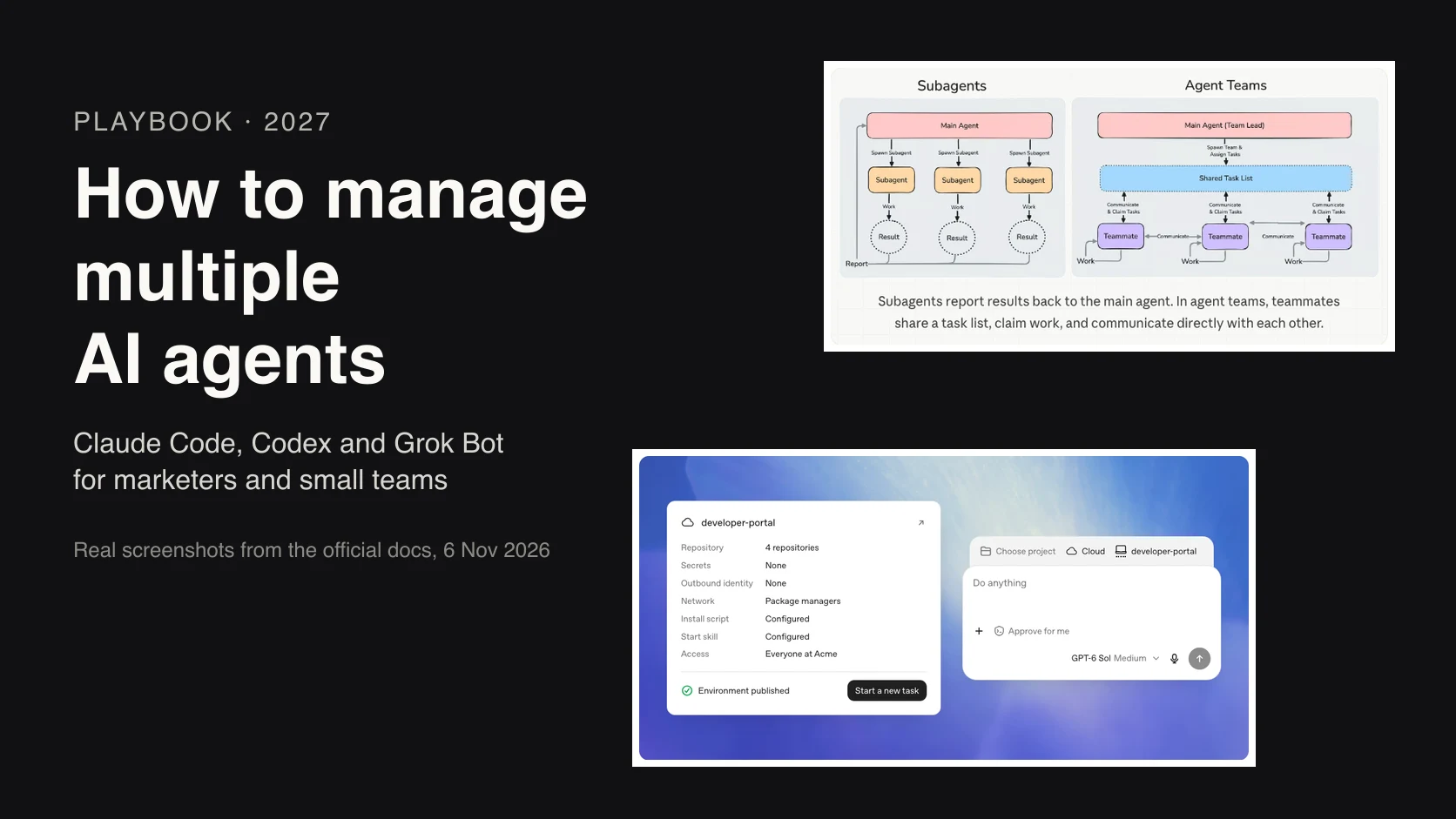
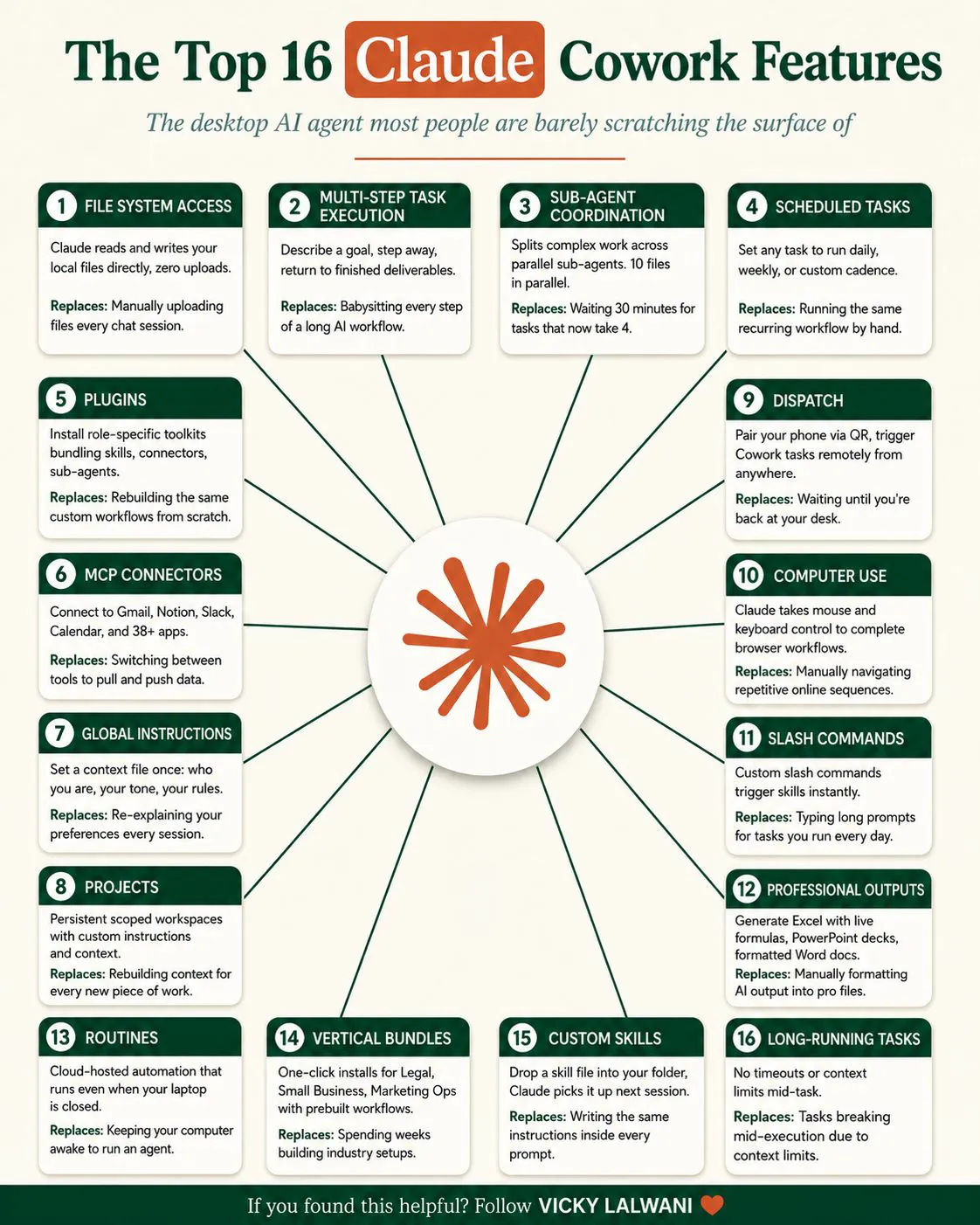
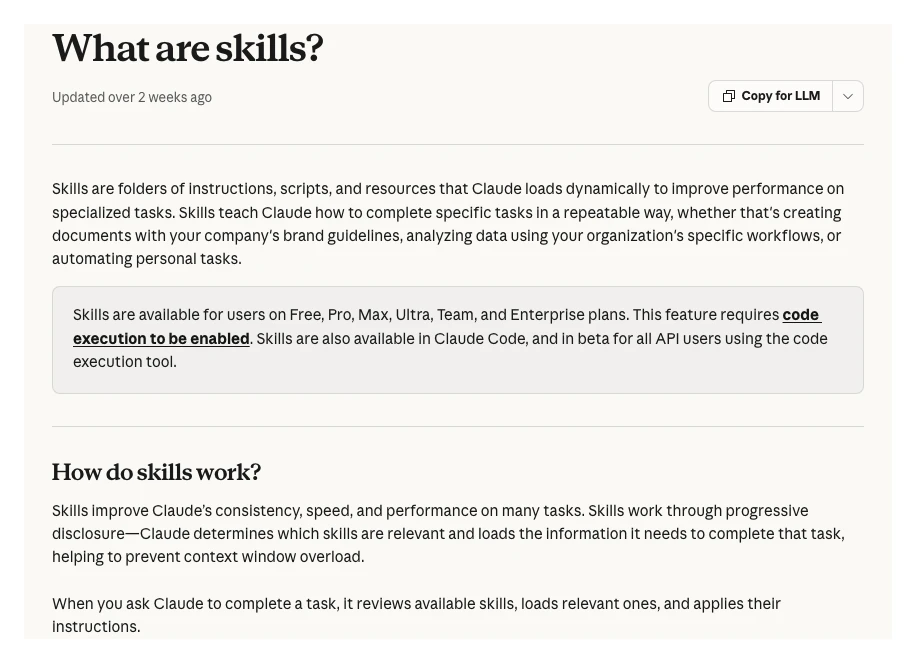
In Claude, the two building blocks are skills and subagents. Claude's help centre describes skills as folders of instructions, scripts and resources that Claude loads when a task needs them, available on every plan with code execution turned on.
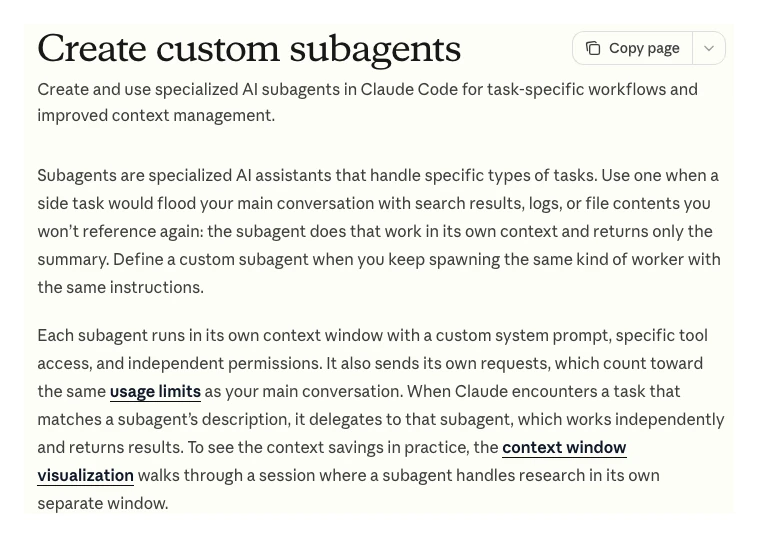
Claude Code's subagent docs say each subagent runs in its own context window with its own instructions, tool access and permissions. That maps neatly onto a role: the ad copywriter subagent never needs analytics access, so it does not get it. The Claude subagents tutorial walks through the setup.
How do work intake and capacity planning change with AI agents?
Short answer: requests go into one intake list, a person triages each one, agents draft in parallel, and specialists review. Capacity is no longer set by how fast people produce work but by how much they can review well in a day.
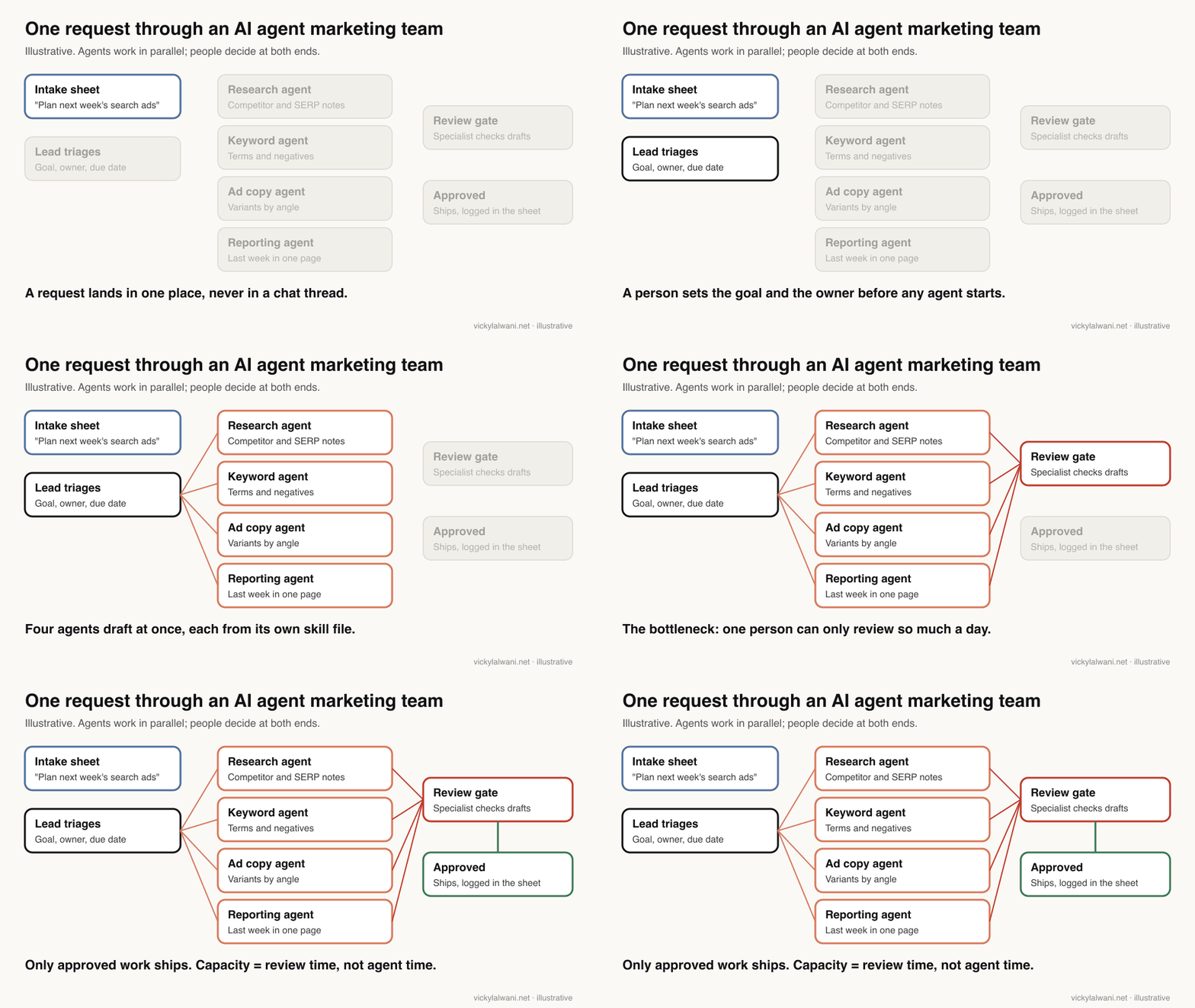
Agents can produce ten drafts in the time a person reads two. If you plan capacity by agent output, the review queue grows until people start approving without reading. Plan by review slots instead: how many drafts each specialist can check properly per day, and route only that many.
| Intake field | Why it matters |
|---|---|
| Request and goal | Stops vague asks |
| Type | Picks the skill file |
| Owner | Names the reviewer |
| Due date | Protects review slots |
| Data needed | Flags access early |
| Status | Draft, review, approved, live |
A shared sheet works as the intake list and the approval record at the same time. Fancier task tools help once the habit exists; they do not create it.
How do you write a skill file for a marketing role?
Short answer: take a task you already do well, write the steps as if training a new hire, define the exact output, list what the agent must never do, and test it on real work until the output needs only light edits.
Hiring used to mean adding a person. Now it can also mean writing a skill file. A good one captures how the task is done, what quality looks like, the output format and the failure modes. Here is a starting template for a reporting role:
---
name: weekly-ppc-brief
description: Writes the Monday paid search brief from last week's export. Use when asked for the weekly PPC summary.
---

# Weekly PPC brief

## Inputs
- Last week's campaign export (CSV) and the same week last month.
- The account notes file (goals, target cost per lead, known issues).

## Steps
1. Compare spend, clicks, conversions and cost per conversion week on week.
2. Flag any campaign whose cost per conversion moved more than the threshold in the notes file.
3. List the 5 search terms with the most spend and no conversions.

## Output
- One page: what happened, why it probably happened, three actions.
- Every number must come from the export. If a number is missing, write "not in export".

## Never
- Never change the account. Never estimate figures. Never email the client.
Test it on three real weeks before trusting it. Revise after every correction. For a library of starting points, see Claude marketing skills.
What access should each AI agent get?
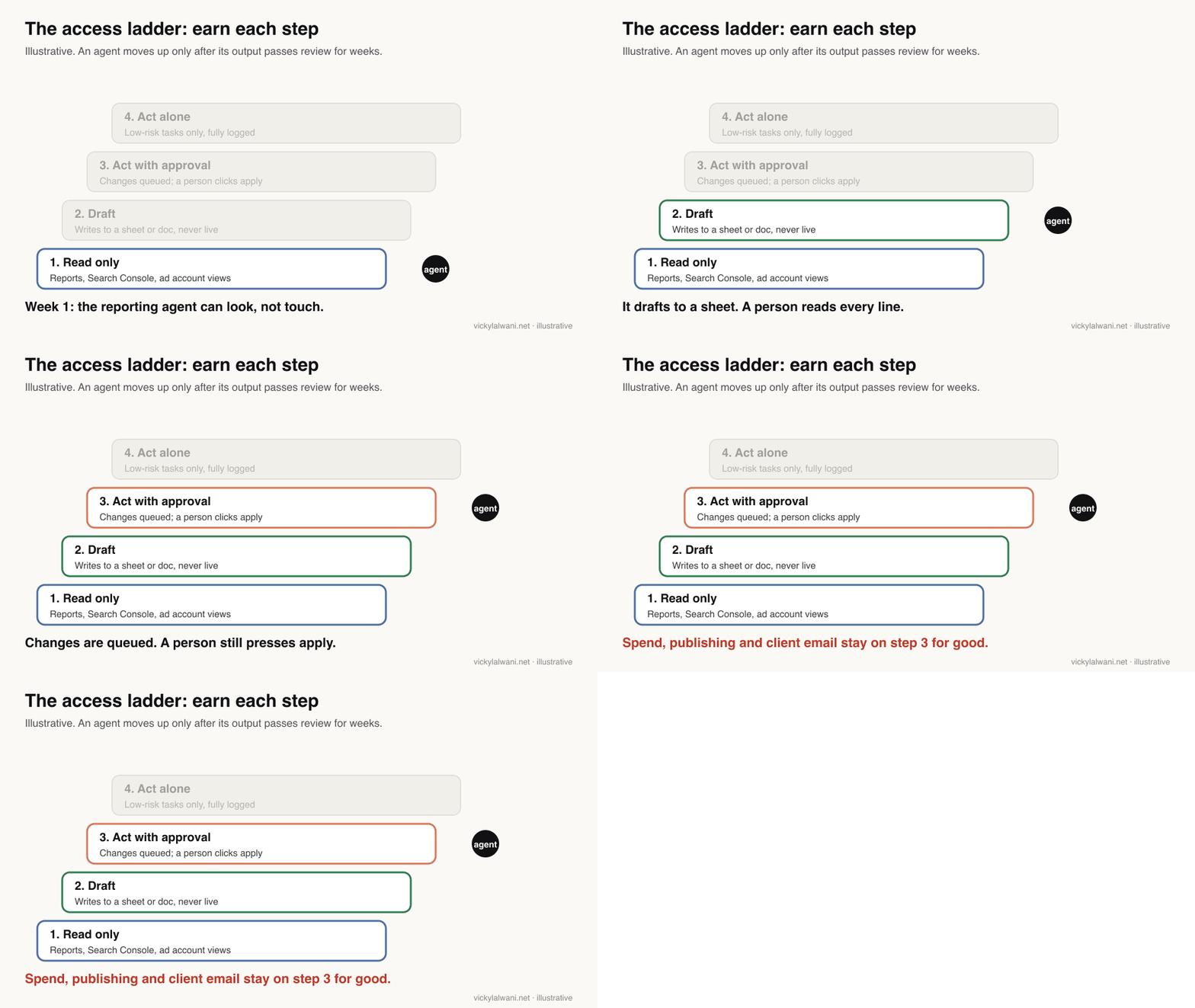
Short answer: the least it needs: read-only first, then drafts into a sheet, then changes a person applies. Anything that spends money, publishes or emails a customer should always wait for a human click.
| Action | Agent alone? | Rule |
|---|---|---|
| Read reports | Yes | Scoped login |
| Draft copy | Yes | Into a sheet |
| Change bids or budgets | No | Person applies |
| Publish content | No | Editor approves |
| Email a customer | No | Never automatic |
| Accept terms or invites | No | Account owner only |
- Logs of what each agent did, so mistakes can be traced.
- Regular evaluation against real results; weak agents get rewritten or retired.
- Privacy checks on what customer data each agent can see.
What does the data say about AI agents at work?
Short answer: adoption is real but uneven. McKinsey's 2026 survey found 40% of respondents at large organisations scaling AI agents, up from 27%, while smaller organisations stayed at 22%. Gartner expects many agent projects to be cancelled.
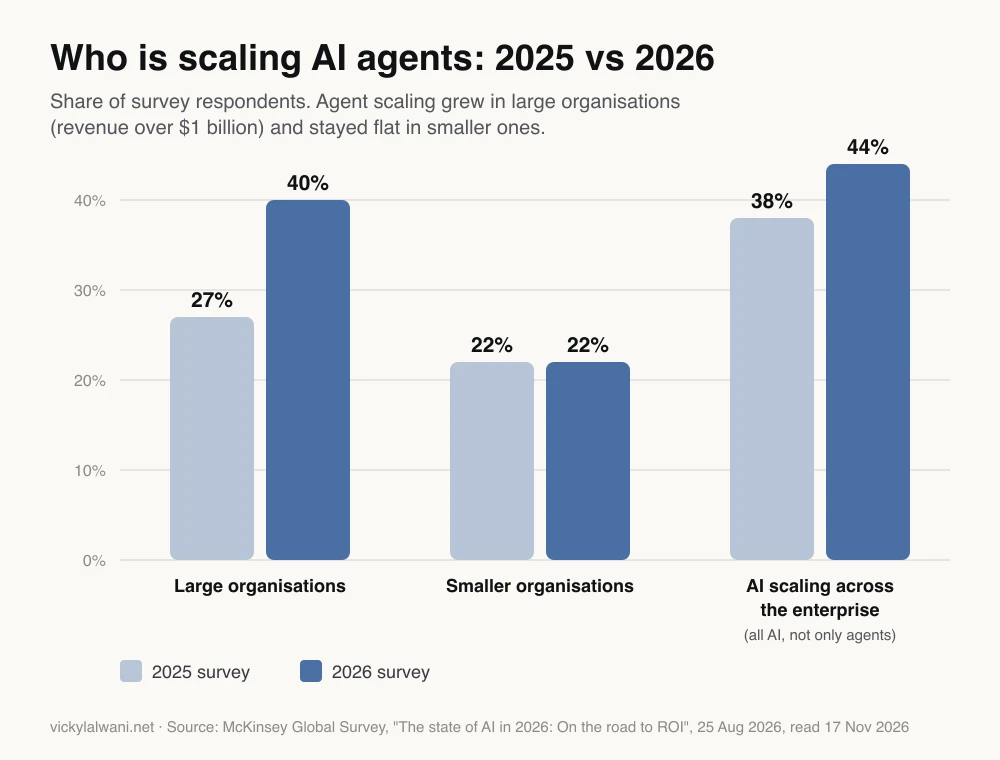
The same McKinsey report (published 25 August 2026) says 37% of respondents attribute at least some EBIT impact to AI, about the same as last year, and about 20% say operating costs, including token costs, limited their AI use. Usage is growing faster than measurable profit.
Gartner's June 2025 prediction is the counterweight: over 40% of agentic AI projects cancelled by the end of 2027, because of escalating costs, unclear business value or inadequate risk controls.
The practical reading: start with one workflow that has a clear owner and a number you already track, such as hours spent on the weekly report, and expand only when it holds.
How I run my own AI agent team
Short answer: one project per client, a planning model separate from the agent that executes, written hand-off packs, a shared sheet as the task board and approval gate, and nothing live until I have checked it.
I keep one Claude project per client, with threads named by service and skills stored in a known place. A thinking model plans; a separate agent carries out the plan. That split makes it obvious where an error came from.
Before any hand-off I ask one question: how will the agent doing the work understand the situation? An executing agent starts with none of the planning context, so every hand-off pack includes a task list with expected outcomes, the relevant documents and strategy notes, and the exact prompt.
The other is access. Agents get blocked by things only a person can do, such as accepting an updated terms screen or an account invite. Those stay with the account owner. And on client ad accounts the order never changes: audit first, findings in a sheet, I check by hand, no changes before approval.
Videos worth watching
Short answer: Anthropic's own talks on agents and skills, plus a short vendor demo of AI teammates. All three are free; the third promotes Asana's product.
What are skills?, from Claude (Anthropic), February 2026. A three-minute explainer of skill files. It promotes Claude.
Building more effective AI agents, from Anthropic, October 2025. A longer talk on when agents help and when simpler workflows win. It sells nothing beyond Anthropic's own tools.
Introducing Asana AI Teammates, from Asana, March 2026. A two-minute product introduction. It is an advert for Asana.
| Video | Channel | Date | What it covers |
|---|---|---|---|
| What are skills? | Claude | Feb 2026 | Skill files |
| Building more effective AI agents | Anthropic | Oct 2025 | Agent design |
| Building secure agents for knowledge work | Claude | Oct 2026 | Agent security |
| Introducing Asana AI Teammates | Asana | Mar 2026 | AI teammates |
| How to Build an AI Marketing Team That Runs Itself | Marketing Against the Grain (HubSpot) | Sep 2026 | Live demo |
| Claude Code: Build Your Full AI Marketing Team | A marketing AI educator | Mar 2026 | Agents and skills |
What people say on X and Reddit
Short answer: vendors talk about AI teammates handling intake and status; practitioners talk about scoped access and context; sceptics point out that review work grows with output. The useful posts are the specific ones.
Each post and thread was opened and checked on 17 November 2026. X posts were confirmed through X's own embed service; Reddit threads are credited by community only.
| Where | Date | What it says | Type |
|---|---|---|---|
| Asana, X | 12 Nov 2026 | AI Teammates "handle intake, status, and risk" | Vendor |
| Asana, X | 15 Oct 2026 | A "blueprint for human-agent teamwork" | Vendor |
| A startup operator, X | 19 Jul 2026 | Each agent gets its own inbox and scoped API key | First-hand |
| An AI tools account, X | 22 Jul 2026 | "Not to replace people", to automate repeat work | Opinion |
| An AI commentator, X | 10 Nov 2026 | Agencies may face a staffing problem | Opinion |
| A developer, X | 30 Oct 2026 | A longer instruction file will not give agents context | Opinion |
| r/AI_Agents | Nov 2026 | Onboard AI like a new teammate: rules, access, playbooks | First-hand, AI services firm |
| r/AI_Agents | Oct 2026 | Team of agents or one agent with skills? | Discussion |
| r/marketing | Aug 2026 | Marketers reduced to adding the "human touch" | First-hand |
| r/marketing | Oct 2026 | A manager leaning on AI without a plan | First-hand |
The most practical idea in that list is the operator who gave each agent its own inbox and its own scoped key. It is the same principle as the access ladder above: separate identities make it possible to see, limit and switch off what each agent does.
The two r/marketing threads are the warning. When AI replaces the process instead of supporting it, experienced strategists, writers and designers end up polishing machine output, and the planning nobody wrote down still does not happen.
Where this approach is weak
Short answer: agents make confident mistakes, review time grows with output, and a team of agents built on unclear processes simply produces unclear work faster.
- No cost savings promise. A skill file does not draw a salary, but writing, testing and maintaining one takes real thinking time. The honest benefit is capacity and consistency.
- Review fatigue. If people approve without reading, the safety net is gone. Cap the drafts per reviewer per day.
- Brand drift. Agents slide towards generic copy. Keep examples of on-brand work inside the skill files.
- Fragile access. Expired tokens, changed permissions and new terms screens stop agents without warning. Someone must own this.
- Survey data is self-reported. McKinsey's figures are what respondents said, not measured outcomes.
Want help structuring your AI agent marketing team?
Short answer: I can map your roles, write the first skill files, set up intake, access and approval, and stay on as the reviewer while it beds in.
See my AI marketing agents service for design, setup and oversight, or Claude consulting if your team already uses Claude and needs structure. Rates are on the pricing page.
Free guide: The AI Team Playbook covers the roles, model routing, briefs and checks for running AI agents as a team, plus a five-step daily loop.
Keep reading: How to manage multiple AI agents, Claude subagents tutorial and tasks to delegate to AI agents.
Sources
| Source | What it supports | Date |
|---|---|---|
| Anthropic: Building effective agents | Workflows vs agents | 19 Dec 2024 |
| Claude Help: what are skills | Skill definition, plans | Read 17 Nov 2026 |
| Claude Code docs: subagents | Own context, tools, permissions | Read 17 Nov 2026 |
| McKinsey: The state of AI in 2026 | 40%, 27%, 22%, 44%, 37%, 20% | 25 Aug 2026 |
| Gartner press release | Over 40% of agentic projects cancelled by 2027 | 25 Jun 2025 |
| Asana: AI Teammates marketing roles | Vendor example of AI teammate roles | 17 Nov 2026 |
| Asana, X | AI Teammates "handle intake, status, and risk" | 12 Nov 2026 |
| Asana, X | A "blueprint for human-agent teamwork" | 15 Oct 2026 |
| A startup operator, X | Each agent gets its own inbox and scoped API key | 19 Jul 2026 |
| An AI tools account, X | "Not to replace people", to automate repeat work | 22 Jul 2026 |
| An AI commentator, X | Agencies may face a staffing problem | 10 Nov 2026 |
| A developer, X | A longer instruction file will not give agents context | 30 Oct 2026 |
| r/AI_Agents | Onboard AI like a new teammate: rules, access, playbooks | Nov 2026 |
| r/AI_Agents | Team of agents or one agent with skills? | Oct 2026 |
| r/marketing | Marketers reduced to adding the "human touch" | Aug 2026 |
| r/marketing | A manager leaning on AI without a plan | Oct 2026 |
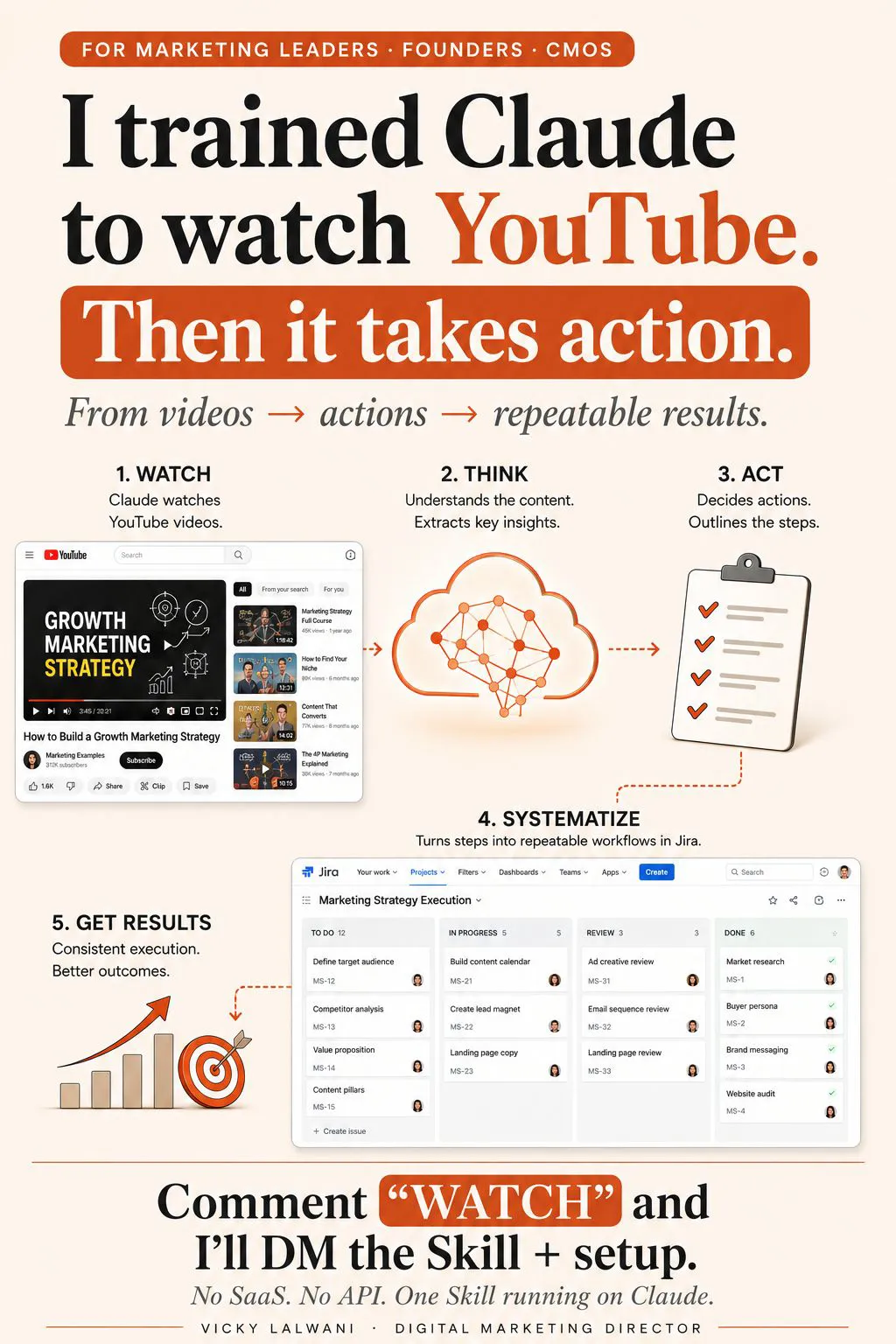
This article expands on my post on LinkedIn ↗.
FAQ
What is an AI agent marketing team?
An AI agent marketing team is a group of specialist AI agents, each with one marketing role such as research, keywords, ad copy or reporting, working from written skill files. People set goals, review the drafts and make every decision that spends money or reaches a customer.
Which marketing roles can AI teammates fill?
AI teammates suit roles whose output is a draft, a check or a summary: research analyst, keyword analyst, ad copywriter, reporting analyst, content drafter, QA reviewer and intake coordinator. Roles that own budgets, brand decisions and client relationships should stay with people.
What skills do you need to run AI agents in marketing?
The core skills are writing clear briefs, turning a job into steps an agent can follow, judging output for errors and tone, and managing permissions in ad and analytics tools. A small team needs a lead who approves, an operator who maintains skills and access, and specialists who review.
Can AI agents replace a marketing team?
They can take over repeatable tasks such as audits, drafting and reporting, but people still set strategy, approve work and carry accountability. I run a setup of 19 AI agents and 3 humans, and the humans make the decisions.
How do you plan capacity for an AI agent marketing team?
Plan by review time, not agent output. Agents can draft far faster than people can check, so count how many drafts each specialist can review properly per day and route only that many through one shared intake list.
What is a skill file?
A skill file is a reusable written instruction set, usually a markdown file, that tells an agent how to do one task, with steps, output format, rules and examples. In Claude, skills are folders of instructions, scripts and resources loaded only when a task needs them.
What access should an AI marketing agent have?
Start with read-only access, then let the agent draft into a sheet, then let it queue changes that a person applies. Spending money, publishing content, emailing customers and accepting terms or invites should always need a human click.
How many companies are scaling AI agents in 2026?
In McKinsey's 2026 State of AI survey, 40% of respondents at organisations with over $1 billion in revenue reported scaling AI agents, up from 27% a year earlier. Among smaller organisations the figure stayed at 22%.
How long does it take to set up an AI agent marketing team?
It depends on how clearly your processes are written down and how easily agents can get access to your tools. Start with one squad and one workflow, prove it over a few weeks of real work, then expand; building every role at once usually produces weak output.