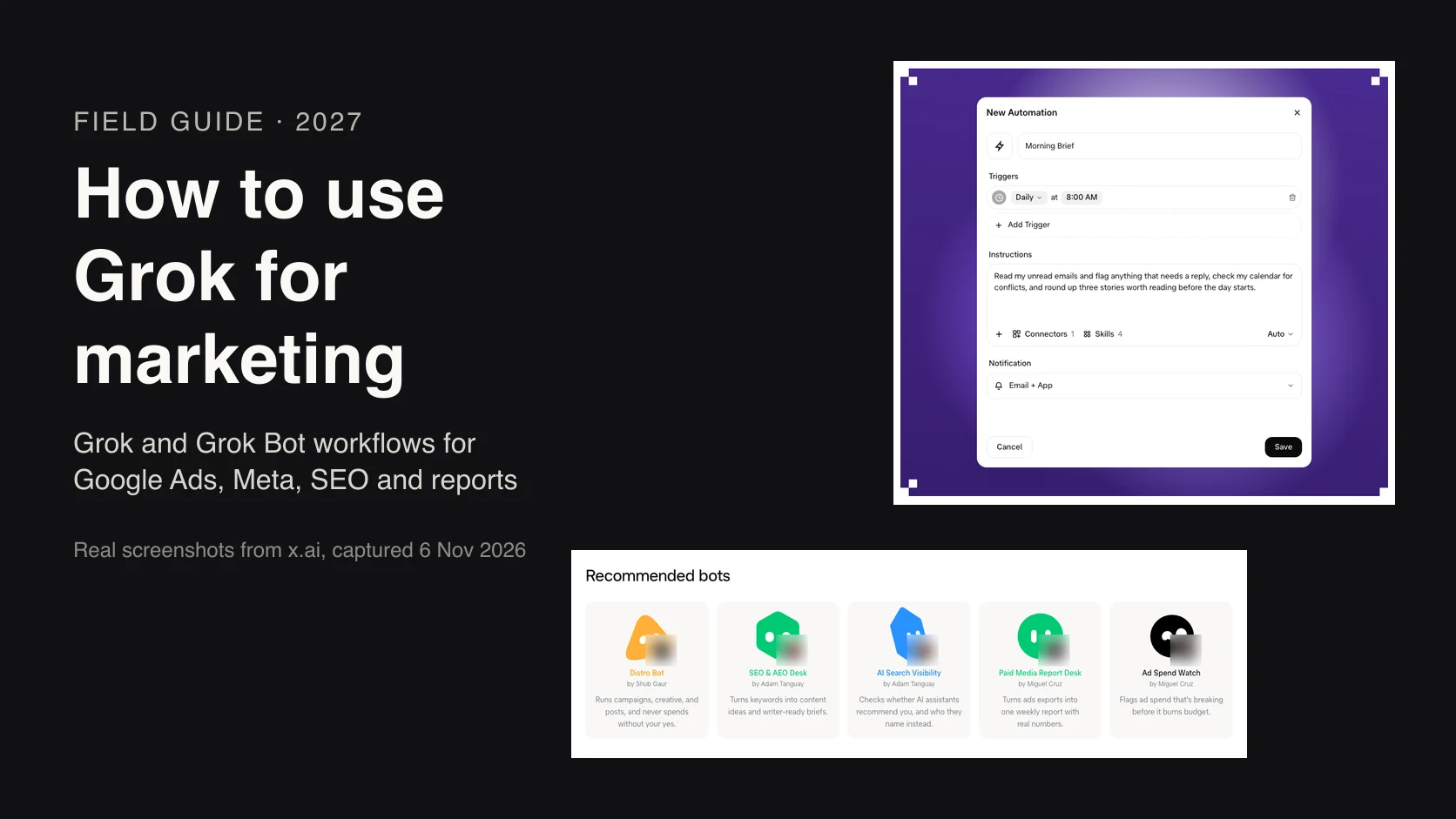
To use Grok for marketing, upload exports or screenshots with personal details removed, tell Grok to work only from those files, ask for a data check table first, and re-add the totals yourself before acting. Grok's clearest edge is live X search for social listening and research. Grok Bot, a separate agents app from $30 a month, runs repeat browser jobs and waits for your approval.
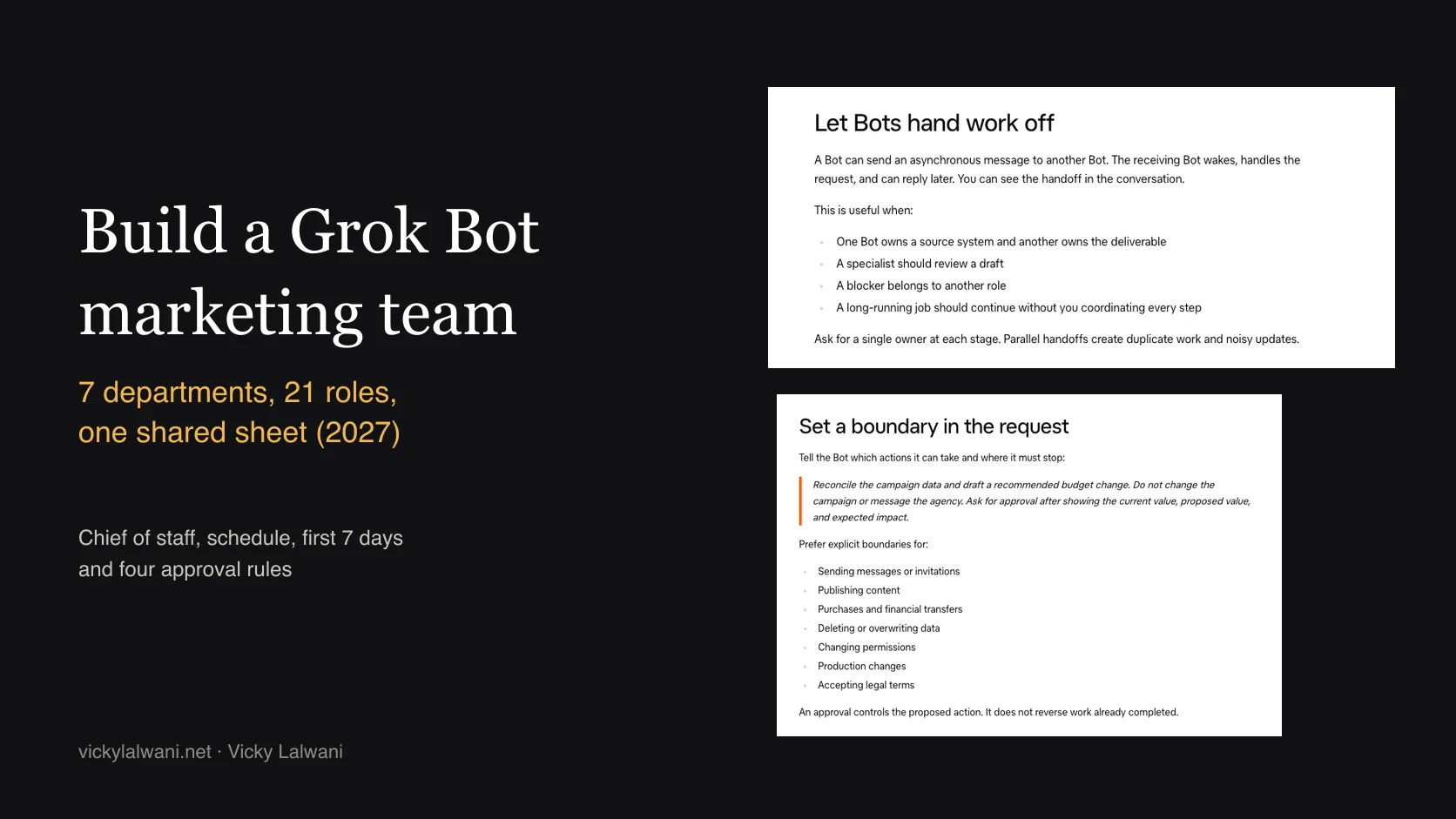
New: want the whole team, not just the tools? How to build a Grok Bot marketing team covers the shared sheet, the chief-of-staff bot, 21 roles and a 24-hour schedule.
TL;DR
| Question | Short answer | Source |
|---|---|---|
| Is Grok good for marketing? | Partly. It's good for X listening and research, and usable on exports if you re-check its maths. Ad copy needs checking: in my 3 November 2026 test it wrote two descriptions over Google's 90-character limit. | My four-tool test |
| What is Grok Bot? | A separate product from the Grok chat app: always-on agents that work on a cloud computer with a browser, files and a terminal, shared by all your Bots. Launched in beta on 11 August 2026. | Launch post |
| What does it cost? | Grok has a free tier. Grok Bot starts on the $30 a month Premium plan (USD, before tax). | Pricing docs |
| Does it connect to Google Ads, Meta or GA4? | Not natively. You bring the data in through exports, screenshots, Google Drive, a custom MCP connector, Grok Bot's browser or the API. | Connectors docs |
| Does it know keyword volumes? | No built-in keyword data is documented. Any volume without a linked source is a guess. A Grok Bot can read a keyword tool you give it access to. | Performance marketing guide |
| Can you advertise on Grok? | Not inside Grok's answers, as far as official pages show. X has Grok tools for advertisers in phased rollouts. | Details below |
| Should I put client data in it? | Only with personal details removed, and preferably through the API or a Grok Business team workspace, which have stated no-training terms. | API security FAQ |
Jump to: Grok vs Grok Bot · Prices · Getting your data in · Grok Bot setup · 8 workflows · My test · Is Grok Bot worth it
Say you manage five Google Ads accounts and a client asks on Monday why their cost per lead has risen three weeks running. You have the search terms, the keyword report and the change history, but no clear place to start. That is the kind of job this guide is about. It covers what Grok can do as of November 2026, how to get your data in, eight workflows, and the checks that stop a confident wrong answer reaching a client.
A note on evidence. Product facts come from the official pages of SpaceXSI, the company formerly called xAI, and are dated. My only documented Grok test is the 3 November 2026 four-tool test further down. Community findings are labelled as a demo, a claim or vendor material. The example outputs in the workflows are illustrative, written to show the shape of a good answer, not results from a real account.
Grok, Grok Bot, @grok and "Grokbot": which is which
Several products share the Grok name. On 6 November 2026, the official pages describe them separately:
| Name | What it is | Use it for | Source |
|---|---|---|---|
| Grok | The assistant at grok.com and in the iOS and Android apps, often called Grok AI | Chat, research, file analysis, images, scheduled Automations | Grok overview |
| Grok Bot | Always-on agents, each with a name and a job, working on one shared cloud computer with a browser, files and a terminal | Repeat jobs that need a browser or several tools, with approvals | Grok Bot docs |
| @grok on X | Grok's reply account. Tag it under a post to ask about that post | Quick context on a post | TechCrunch, March 2025 |
| @bot on X | Hands an X post to your Grok Bot as a task. Not available if your X account is registered in Australia, the UK, the EU, Iceland, Liechtenstein or Norway | Starting a Bot task from X | Tag on X docs |
| xAI API | Developer access to Grok models, billed per token | Your own scripts, n8n, Zapier, Google Sheets | API pricing |
| "GrokBot" crawler | A label used by third-party bot directories. SpaceXSI documents no crawler user agent, and its own robots.txt has no bot-specific rules | Nothing you can rely on yet | x.ai robots.txt |
When people search "grokbot", the results are mostly about Grok Bot, the agents product. In this guide, "Grok" means the chat assistant and "Grok Bot" means the agents app.
What Grok costs in November 2026
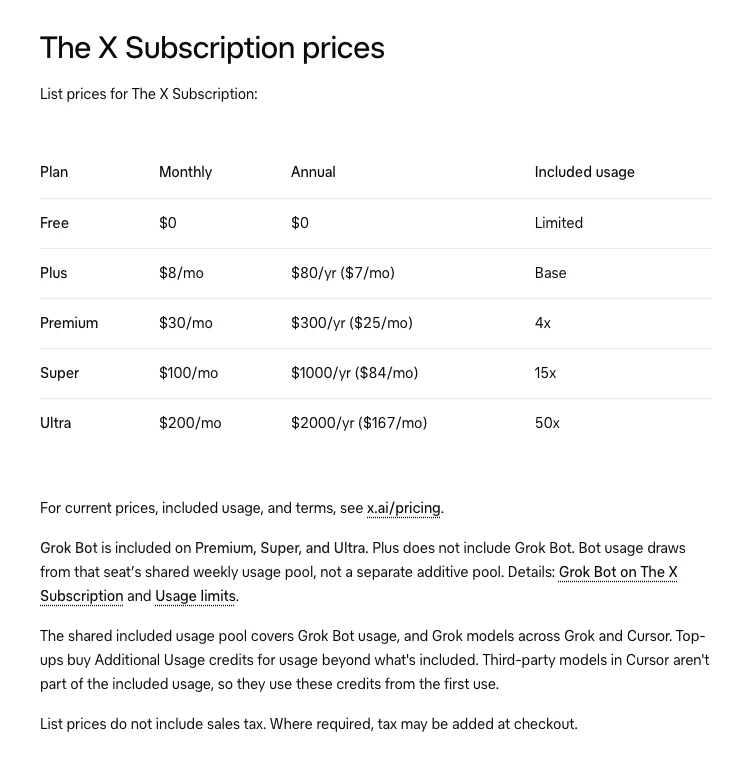
Prices changed on 12 October 2026, when SpaceXSI moved new customers onto "The X Subscription" (announcement). Existing Cursor, SuperGrok and X Premium plans continue, so older price lists online may still be right for those subscribers, just not for new ones.
| Plan | Monthly (USD) | Included usage | Grok Bot |
|---|---|---|---|
| Free | $0 | Limited | No (some accounts get a 7-day trial credit) |
| Plus | $8 | Base | No |
| Premium | $30 | 4x | Yes |
| Super | $100 | 15x | Yes |
| Ultra | $200 | 50x | Yes |
Sources: X Subscription pricing (last updated 11 October 2026) and the Grok Bot FAQ. Grok, Grok Bot and Grok models in Cursor all draw from one weekly usage pool per seat, and top-ups cost extra. Team seats exist on Premium, Super and Ultra. Grok Business launched at $30 per user per month in December 2025 with a no-training promise for its team workspace; SpaceXSI's pages don't make clear whether it's still sold to new teams, so ask before you buy. API use is billed separately: the API pricing page lists grok-4.7 at $2 per million input tokens and $6 per million output tokens for prompts under 200,000 tokens, and double above that.
In Australia or the UK? Prices are listed in US dollars and exclude sales tax, so GST or VAT may be added at checkout. Check the final figure there rather than converting it yourself. Tagging @bot on X isn't available for accounts registered in either country. If you upload client data, the Australian Privacy Act or UK GDPR still applies to any personal information in it, so strip it out first. This isn't legal advice.
Is Grok good for marketing? What it can and can't do
| Job | Verdict | What to know | Source |
|---|---|---|---|
| Read CSV or Excel exports | Yes | Up to 150 MB per file and about 100 files on the web app. Very long files "may be summarized or handled in sections". | Grok FAQ |
| Exact maths on exports | Only with code, and check it | In xAI's own API test on a 167 KB file, Grok answered a column total without running code and was "off by more than three times". The API can force code; the chat app can't, and printed code isn't proof it ran. Re-add key totals in a spreadsheet. | xAI cookbook |
| Read screenshots | Yes | Good for layout and copy. Re-check any number it reads off an image. | Grok overview |
| Search X posts | Yes | By keyword, meaning, account and date range. Useful for social listening, but X's audience skews, so treat it as language, not market share. | X Search docs |
| Search the web with citations | Yes, with care | Grok's source list includes pages it looked at and rejected, and inline citations aren't guaranteed on every answer. | Citations docs |
| Keyword volumes | No | No built-in keyword data is documented. Use Keyword Planner or an SEO tool, or give a Grok Bot access to one. | Performance guide |
| Make ad images and video | Yes, with limits | Grok Imagine output carries a Grok watermark with no setting to remove it. Check each platform's AI disclosure rules, and don't show real people without consent. | Grok FAQ |
| Run jobs on a schedule | Yes | Automations run once, daily, on weekdays, weekly, monthly or yearly. At launch, email triggers needed SuperGrok; check which current plans include them. | Automations post |
| Use a browser for you | Grok Bot only | Sites can block automation, expire sessions or ask for a human step, and the Bot hands those back to you. | Grok Bot docs |
| Post to social media | Grok chat: no. Grok Bot: only with your approval | SpaceXSI's Distro Bot drafts posts and "never changes spend, posts, or sends without your yes". How each platform posting works isn't documented. | Distro Bot |
Can you advertise on Grok?
| Option | Status on 6 November 2026 | Source |
|---|---|---|
| Paid placements inside Grok's answers | Elon Musk told advertisers in August 2025 that brands would be able to pay to appear in Grok's suggestions. I found no launch on an official page. | Search Engine Land |
| "Prefill with Grok" in X Ads | Drafts ad copy, images and a headline from your website. Reported as a phased rollout in February 2025. | Search Engine Land |
| Grok guidance inside X Ads Manager | A limited beta reported from an advertiser notice in July 2026, with no official X statement. | Social Media Today |
So you can advertise on X today, and check your own X Ads account for the Grok tools. You can't buy a place in Grok's answers, as far as I could confirm.
How your marketing data gets into Grok
No ad or analytics platform connects to Grok directly. These are the routes in, from simplest to most involved. The data terms differ by route, so read the next section before you upload anything.
| Route | Best for | Watch out for |
|---|---|---|
| Upload a CSV or XLSX export | Search terms, keyword reports, leads, Search Console and GA4 tables | Remove personal data first. Ask for a data check table before any analysis. |
| Screenshots | Ads, landing pages, Ad Library listings, a dashboard view | Numbers read from images need checking against the source. |
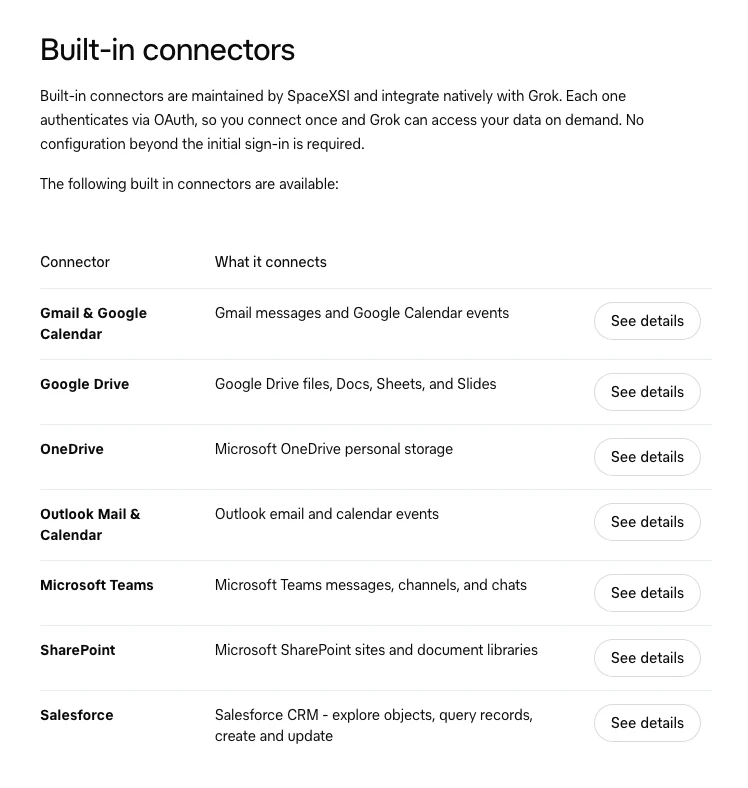
| Google Drive connector or the Workspace add-on | Reports that already live in Google Sheets | The add-on (July 2026) edits your files, and its announcement makes no privacy statement, so test it on a copy with no client data. |
| Custom MCP connector | Teams with a developer and a vetted MCP server | The server must be reachable on the public internet. Google's Google Ads MCP server is read-only and names Gemini, Claude and ChatGPT as clients, not Grok. Meta's ads MCP server can create and edit ads, and its setup guide covers Claude Code and ChatGPT. Neither confirms Grok works. |
| Grok Bot using platform logins | Jobs with no clean export or API | Give the Bot its own user with the lowest access the job needs, never your admin login. All Bots share one computer and its logins, and Bot traffic comes from shared data-centre IPs that some services flag (security FAQ). Your client agreement may not allow it. |
| The xAI API in your own script, Zapier or n8n | Recurring jobs at scale | Zapier's "Grok by xAI" app has actions but no triggers, so another app starts the run. |
Before you upload client data
- Strip personal data. Replace names, emails and phone numbers with an ID before any lead file goes in. Swap client names for a code too.
- Turn off training in the consumer app. SpaceXSI's consumer FAQ says it may use your prompts and Grok's responses to train its models, and that you control this: on grok.com go to Settings, then Data, then "Improve the Model"; in the app it's Settings, then Data Controls. Private Chat isn't used for training, and the privacy policy says Private Chat conversations are deleted within 30 days. Logged-out use can't be opted out in some regions. If you use Grok inside X, X's own settings apply.
- Know the business terms. The API doesn't train on your inputs without permission and keeps requests for 30 days. Business and enterprise content isn't used to improve the models, per the same consumer FAQ.
- Treat Grok Bot as one shared workspace on Cursor's cloud. Files, browser sessions and credentials are available across your whole Bot roster. Its training opt-out follows your Cursor privacy settings, it requires data storage, and it may send a task to third-party models (security docs).
- Don't share chats with client data. In August 2025, shared Grok chat links were found indexed by search engines (TechCrunch).
- Check your client contract. Some agreements require you to name every tool that processes their data.
How to set up Grok Bot for marketing
If you decide Grok Bot is worth trying, set it up like a new junior hire with one task and close supervision:
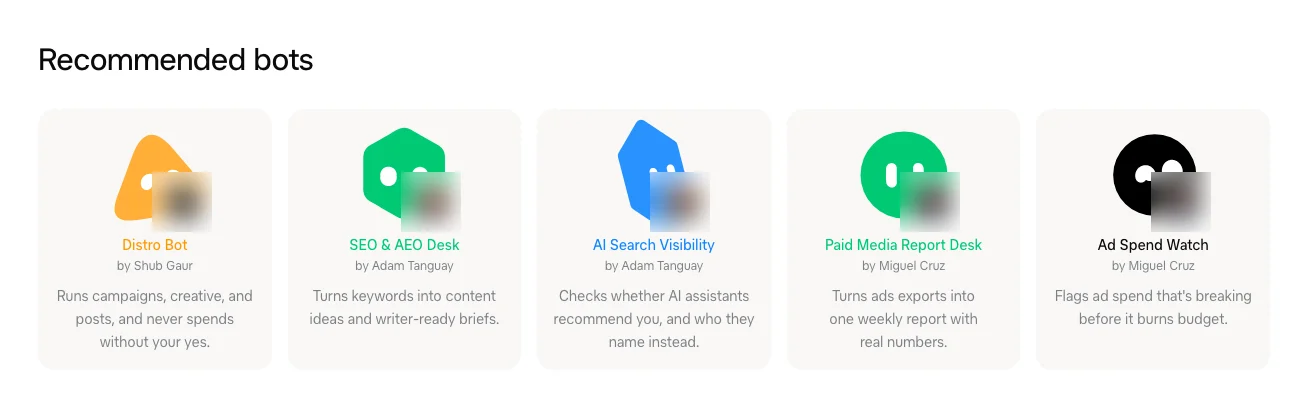
- Start with one Bot and one read-only job, such as a weekly paid media report from exports or a funnel check. SpaceXSI's marketing guide recommends marketplace Bots such as a Paid Media Report Desk and Ad Spend Watch, which work from exports you give them.
- Write the job down as a skill: which files to use, what "done" looks like, and what to do when data is missing or old, so the Bot reports a failure instead of working from stale numbers.
- Set the routine to weekly for reports. Schedules can run as often as every 5 minutes, but frequent runs drain the weekly usage pool (routine docs).
- Require approval before anything is sent, bought, deleted or published, as SpaceXSI advises. Its own performance marketing guide says to keep platform actions as drafts for the first few weeks.
- Connect only what the job needs, with the lowest access level the platform offers.
- Watch the usage meter for a week before adding a second Bot.
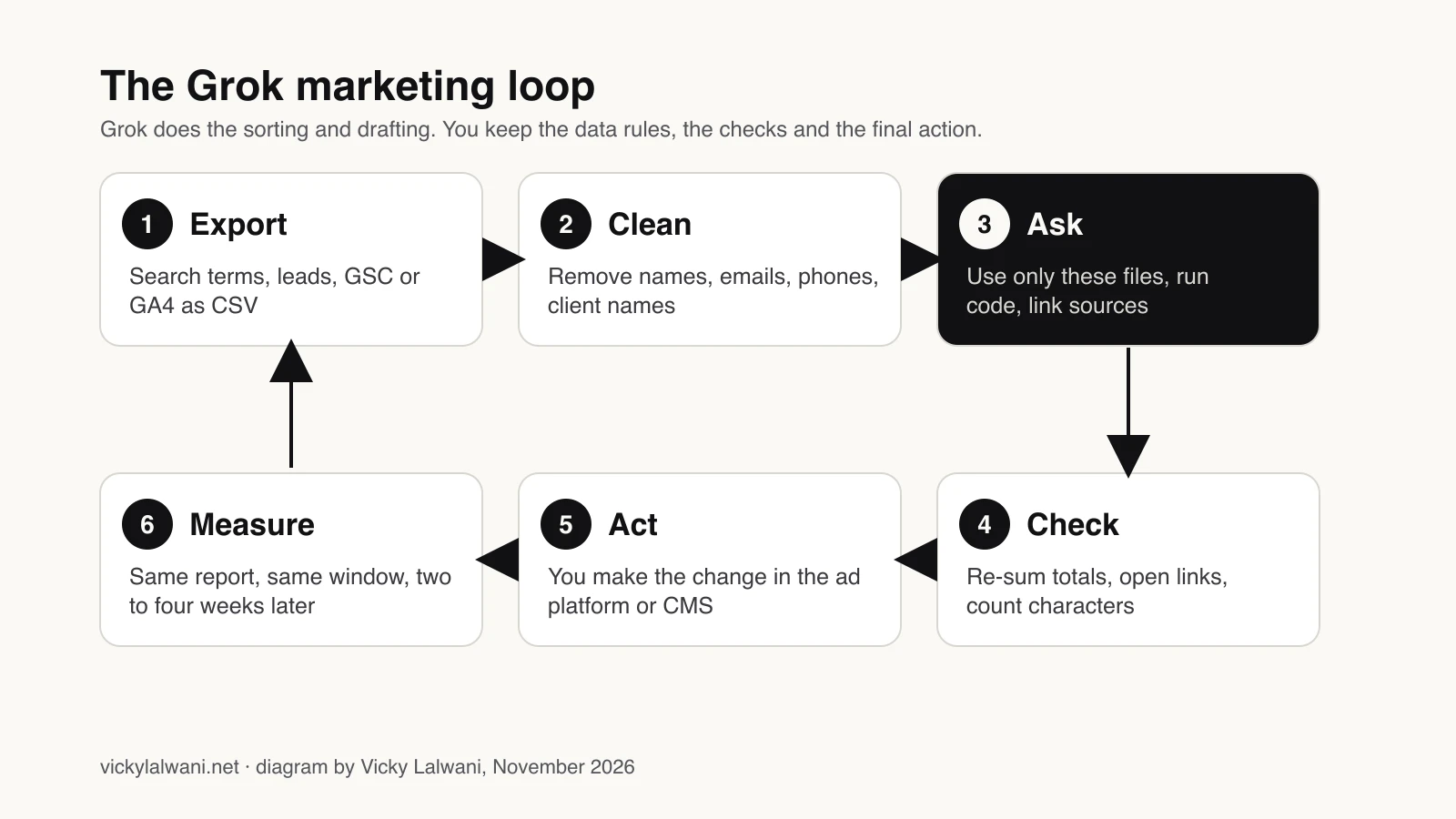
8 Grok workflows for Google Ads, Meta, SEO and reporting
Each workflow starts with a common problem in paid search, paid social or SEO accounts. The first one is written out in full: the problem, why people get stuck, the data you need, how Grok helps, a copy-paste prompt, what a good answer looks like, how to read it, what to do next, mistakes, and how to tell it worked. The rest are shorter, and each gets its own deep dive later in this series.
I haven't run these eight prompts on a live account. They're built from each platform's own report columns and SpaceXSI's guidance, and the example outputs are illustrative. Adjust the thresholds to your account.
1. Google Ads: "My cost per lead keeps rising and I don't know what to cut"
Google Ads · full workflow · Run it in: Grok chat
The problem. Cost per lead has crept up for three weeks. You don't know which keywords to pause, which search terms to exclude, or whether the problem is clicks or conversions.
Why people get stuck. They start pausing keywords before they know whether CPCs rose or the conversion rate fell. Those are different problems with different fixes.
What you need. The search keywords report and the search terms report for two equal periods, with cost, clicks, conversions, cost per conversion and search lost impression share (rank), plus the change history, your bid strategy and target per campaign, and your negative lists. Make sure the lead is the only primary conversion action, or add a custom column for it: Google Ads blanks the cost columns when you segment by conversion action (Google Ads Help). For Performance Max, use its search terms report.
How Grok helps. It splits the change into CPC versus conversion rate, ranks keywords by spend above target, sorts wasted search terms by intent and drafts negatives with a match type and level.
The prompt.
You are a senior Google Ads analyst. Use ONLY the attached files. Do not use outside data and do not estimate search volumes.

Files: (1) Search keywords report, [DATE RANGE A] vs [DATE RANGE B]. (2) Search terms report, same periods. (3) Change history for both periods.
Business: [what we sell]. The only primary conversion is [conversion action name]. Target cost per lead = [amount]. We serve [locations].
Bid strategy by campaign: [for example Target CPA 60, Maximize conversions, Manual CPC].

0. First show a data check table: rows loaded per file, date range found, and total cost, clicks and conversions per file. Stop if anything looks wrong.
1. Explain the cost per lead change using: cost per lead = average CPC / conversion rate. Show both periods, in total and by campaign, and say which driver moved more. Use code for the maths.
2. Keywords: (a) cost of at least 2x the target and 0 conversions in period B; (b) cost per conversion at least 1.5x the target with [N] or more clicks. For each: keyword, match type, cost, conversions, cost per conversion, search lost IS (rank), recommendation (pause, tighten match type, change bid or target, keep) and the reason. If a campaign uses Smart Bidding, don't suggest keyword bids; say whether its target or budget should change instead.
3. Search terms: group wasted terms into intent clusters (jobs, DIY, free, wrong location, competitor, informational). For each proposed negative: the negative, match type, level (ad group, campaign, shared list or account), example terms it blocks, and spend affected. Negatives don't cover close variants, plurals or synonyms, so list those separately.
4. Never propose a negative that would block a term with conversions in either period. List those under "Protect".
5. List 2(a) is a spend test, so apply it even with 0 conversions. For every other judgement, mark rows with fewer than 3 conversions as "Low data: monitor, don't act".
6. Check the change history and say whether any change lines up with the shift.
7. End with total spend affected, your assumptions, and what data would change your view.
Use tables. If a column is missing, say so and skip that step.
What a good answer looks like (illustrative).
| Finding | Example from a good answer |
|---|---|
| Data check | Rows, dates and cost totals that match the Google Ads interface |
| Driver | Cost per lead rose mainly because the conversion rate fell; average CPC barely moved |
| Pause or tighten | A broad match keyword spending well over target with no conversions |
| Negative cluster | "jobs", "salary" and "course" terms, as phrase match at account level |
| Protect | A long search term that looks off-topic but converted twice |
How to read it. Check the data table first; if the totals don't match Google Ads, stop. Then read the driver line. If the conversion rate fell, look at the landing page, tracking and lead quality before cutting keywords. If CPC rose, look at auction insights and the bid target.
What to do next. Add the negatives yourself in Google Ads, starting with the clearest clusters. A negative keyword doesn't block close variants, plurals or synonyms (Google Ads Help), and lists have limits (negative list limits).
Mistakes and limits. Single-word broad negatives that kill good traffic. Judging the last few days while conversions are still coming in. Pausing a keyword limited by rank when the real issue is the bid target. Grok can't see your account, so attach the change history or it won't know what changed.
How to tell it worked. Re-run the same two reports two to four weeks later, same window length. Cost per lead should fall without a matching drop in lead volume or lead quality.
For a fuller weekly routine, see my PPC audit checklist.
2. Meta Ads: "We get plenty of leads, but sales says they're junk"
Meta Ads · Run it in: Grok chat
The problem. Facebook and Instagram lead ads hit their cost per lead target, but few leads pick up the phone or qualify. Ads Manager reports leads, not sales outcomes, so every ad looks fine.
What you need. The leads download (ad, ad set, form, platform and answers), the CRM outcome for each lead, and spend and results by campaign, ad set and ad. You need a shared ID in both files: if your CRM doesn't store Meta's lead ID, join the files in a spreadsheet first, or swap each email for the same random ID in both, then remove the personal details.
How Grok helps. It joins leads to outcomes, works out cost per qualified lead by ad and platform, spots answer patterns that predict junk, and maps fixes to Meta's options: the Higher intent form type, SMS phone number verification and work email verification, which Meta limits to Instagram or its Marketing API (Meta, October 2025).
The prompt.
Goal: improve lead quality for our Meta instant form campaigns. Use only the attached files. Personal details have been removed. Both files share a lead ID.

0. First show a data check table: rows per file, date range, and how many lead IDs match between the two files. Stop if fewer than 80% match.
1. Join leads.csv to crm_outcomes.csv on the lead ID (column "id" in Meta's download; strip any text label so it matches the CRM).
2. For each campaign, ad set, ad, form and platform (Facebook or Instagram), show: leads, qualified leads, qualification rate, spend, cost per lead and cost per qualified lead. Sort by cost per qualified lead. If a column is missing, say so instead of estimating it.
3. Find answer patterns linked to unqualified leads, question by question. Show counts.
4. Recommend form changes using only these options: form type (More volume or Higher intent), SMS phone number verification, work email verification (Instagram or Marketing API only), an extra qualifying question with conditional answers, clearer intro and thank-you copy. For each, give the likely effect on volume versus quality, and how to test it.
5. Say whether we have enough CRM stage data to send back to Meta through the Conversions API, and list what is missing.
Never invent conversion rates. Mark any segment with fewer than 30 leads as "Low sample".
Read it and act. Judge everything on cost per qualified lead, not cost per lead. The cheapest leads are often the most expensive once you count only the ones that turn into appointments. Then test one form change at a time against the current form, and send CRM outcomes back to Meta if you have the stages. The lead download shows platform, not placement, so don't ask Grok for placement-level quality unless your CRM records it.
Mistakes and limits. Uploading raw lead details to a chatbot. Changing the form and the audience in the same week. Treating Meta's average uplift figures as a forecast for your account.
How to tell it worked. Cost per qualified lead falls over two to four weeks, and sales confirms it in the CRM, not just in Ads Manager.
Related: Meta Ads settings checklist and how Meta lead ads appointment booking works.
3. SEO: "Traffic dropped and I don't know if it's technical, content or competition"
SEO · Run it in: Grok chat
The problem. Organic clicks fell over a month. It could be indexing, a site change, a Google update, seasonality or a competitor. Site-wide average position hides which pages actually moved.
What you need. Search Console Performance exports comparing two equal periods (plus the same period last year), the URL list for each not-indexed reason in Page indexing (open each reason and export it; each list stops at 1,000 URLs), URL Inspection notes for your biggest losers, GA4 traffic by channel to confirm the drop is organic, and your change log.
How Grok helps. It compares the tables, sorts each losing page into a pattern, ranks possible causes with the rows that support them, and searches for update dates in your window.
The prompt.
Attached: Search Console Performance exports (Queries, Pages, Devices, Countries, Dates) comparing [period A] with [period B], the URL list for each not-indexed reason in Page indexing, URL Inspection notes for [number] URLs, and our change log.

0. First show a data check table: files loaded, date ranges found, and total clicks and impressions per period from the Dates file.
1. Using code, calculate the click and impression change by page, query, device and country. List the 20 pages that lost the most clicks.
2. Classify each losing page: (a) impressions steady, CTR down; (b) impressions and clicks both down; (c) URL appears in one of the attached not-indexed lists.
3. Rank the likely causes: technical, indexing, content or relevance, demand or seasonality, competition or a results page change. For each, cite the rows that support it and name the one check that would rule it out.
4. Search the web for confirmed Google ranking updates between [dates]. Link each one.
Don't invent numbers. If a value isn't in the files, write "not in data".
Read it and act.
| Pattern | What it usually points to |
|---|---|
| Impressions steady, CTR down | A snippet or results page change, such as a new AI Overview or a competitor's richer result |
| Impressions and clicks both down | A ranking, indexing or demand change |
| URL in a not-indexed list | A technical or indexing problem to fix first |
Keep only the causes that survive their own "this would rule it out" check. A Google update in the same week is a lead, not proof. Run live URL Inspection tests on the losing pages and confirm update dates on Google's Search Status Dashboard.
Mistakes and limits. Comparing periods of different length. Treating a 1,000-row export as complete. Uploading a huge file that Grok quietly summarises. Grok can't see the live results page from your market, and it can't confirm indexing.
How to tell it worked. Indexing counts recover in Search Console, and clicks on the affected pages recover against last year's baseline. Google says some changes show within days, while others can take several months (Google).
4. AI search: "We rank on Google, but do AI answers mention us?"
AEO and GEO · Run it in: Grok chat, one Private Chat per question
The problem. You rank well, but you don't know whether Grok names you when a buyer asks. Checking one prompt once and taking a screenshot proves very little, because answers change between runs.
What you need. 20 to 50 real buyer questions with no brand named, your brand and competitor names (for your own sheet, not the prompt), and a log by date. Use a fresh Private Chat for each question: one long chat doesn't behave like 20 separate buyers.
How Grok helps. Each answer shows the sources Grok used, which tells you where to earn mentions. Log that list rather than relying only on what Grok says afterwards.
The prompts.
I'm a buyer in [country]. [One buyer question, with no brand named.] Search the web and X, then answer as you would for me.
Then, in the same chat:
Now tell me: which businesses or brands did you name, in what order, and which pages did you open for this answer? Don't add any brand that wasn't in your answer.
Read it and act. Repeat each question three times and keep the majority result. Grok tends to lean on social and community sources: Ahrefs found Reddit, YouTube and Facebook led its citations across 1.9 million US queries (June 2026), while a vendor study of B2B software prompts found X posts were nearly half (MaxAEO, July 2026). Different samples, different counting. Measure your own category, then work on the sources Grok actually cited.
Mistakes and limits. Trusting citations blindly. In a February 2025 test of news citations, Grok 3, an older model, got 94% of queries wrong (Columbia Journalism Review). An October 2026 study planted a made-up concept on popular posting sites; within a week 8 of the 10 AI search tools tested cited it, and once Grok picked it up, it cited the planted page in 30 of 32 answers (arXiv). Grok can't tell you what ChatGPT or Google says, and Bing's AI Performance report covers Copilot, not Grok.
How to tell it worked. Your mention rate on the same question set rises over two to three months, and the sources Grok cites start to include pages that mention you.
For the wider method, see my AI citation audit and what generative engine optimization is.
5. Website and CRO: "The page looks good, but nobody fills in the form"
Website and CRO · Run it in: Grok chat, plus Grok Bot for the funnel walk
What you need. Screenshots of the page on desktop and mobile, and a GA4 exploration with sessions and event counts for form_start and form_submit by device category and session source. These come from enhanced measurement's form interactions or your own events, and often miss embedded forms, so check they fire in DebugView first (GA4 Help).
How Grok helps. It finds where people drop off in the numbers and, from the screenshots, points out what a new visitor wouldn't understand quickly.
The prompt.
Attached: three screenshots of our landing page (desktop above the fold, mobile above the fold, mobile form) and a GA4 exploration for this page: sessions, and event counts for form_start and form_submit, by device category and session source, last 28 days.
1. From the numbers only, show where people drop off, by device and source. Show the maths.
2. From the screenshots only, list what a first-time visitor from [ad or keyword] would not understand in the first 5 seconds, and anything that slows the form down. Point to the exact element.
3. Keep what the data shows separate from what you are guessing about design.
4. Suggest 3 changes, each written as a test: change, reason, the metric it should move, and how long to run it.
Don't claim to know scroll depth, heatmaps or field errors unless they are in the files.
Check before you act. Grok can't see heatmaps, scroll depth or form field errors unless you give them to it. Test every suggestion as an A/B test, and fill in the form yourself on a real phone.
The most useful public demo I found was Stew's Grok Bot "Paid Funnel Tester" (AI for PPC, 28 October 2026). Acting as a first-time buyer, the Bot walked four US advertisers' paid funnels and flagged a ClickUp "Get Started" button that sent new visitors to a "Welcome back" login screen. The creator sells PPC services and discloses no affiliation with SpaceXSI. If you try this, start the Bot from the landing page URL, not a live ad, so you don't pay for its clicks. It browses from US data-centre IPs, so geo-targeted pages and bot checks may differ from what a local buyer sees (security FAQ).
6. Content and social: "What is our audience talking about this week?"
Content and social · Run it in: Grok chat or an Automation
What you need. A category or problem, a country, and a 7-day window.
How Grok helps. Live X search is the job Grok gets the most credible praise for in public demos. It can search X posts by keyword, meaning, account and date (X Search docs) and turn the conversation into themes, real phrasing and ad or content angles.
The prompt.
Search X posts from the last 7 days about [category or problem]. Where you can tell, focus on [country].
1. Group what people say into 5 themes. For each theme, quote short phrases people actually use and link 2 posts.
2. For each theme, give 2 ad headlines and 1 content idea built from that wording.
3. Tell me which themes look like real buyer problems and which are noise or jokes.
4. Leave out any post you can't link. Don't count likes or views unless you can see them.
Check before you act. Open the linked posts. X conversation skews towards certain audiences and can be dominated by a few loud accounts, so use it for language and angles, not market share. X has no country filter in its search, so treat the country focus as best effort.
Greg Isenberg's July 2025 test of Grok 4 shows the same pattern (video). Isenberg rated market research with web and X search 9.5 out of 10, but gave the first content drafts 6 out of 10 (generic and hashtag-heavy), rising to 9 once Grok had a style example to follow. Those are Isenberg's own ratings, but other reviewers make the same complaint about generic copy.
7. Reporting: "Turn this week's exports into a client update"
Analytics and reporting · Run it in: Grok chat, or a Grok Bot routine once exports land in Drive
What you need. This week's and last week's exports from each ad platform and GA4.
How Grok helps. It does the joining and the first draft, which is the slow part of a weekly report.
The prompt.
Attached: this week's and last week's exports from Google Ads (campaign level), Meta Ads (campaign level) and GA4 (sessions and key events by default channel group).
First show a data check table: rows loaded per file, date range found, and your totals for spend, clicks and conversions per platform. Use code for every number.
Then write a client update with: what changed week over week, the two biggest reasons you can see in the data, one thing we're testing next, and one risk.
Rules: never add conversions across platforms, because each counts them differently. Report each platform separately. If GA4 and an ad platform disagree, say so plainly instead of picking one. Under 250 words, plain English.
Check before you act. Compare the data check table with the totals in each platform before reading anything else. If they don't match, stop there, for the reason in the capability table above.
Related: one cross-channel report for Google Ads and Meta.
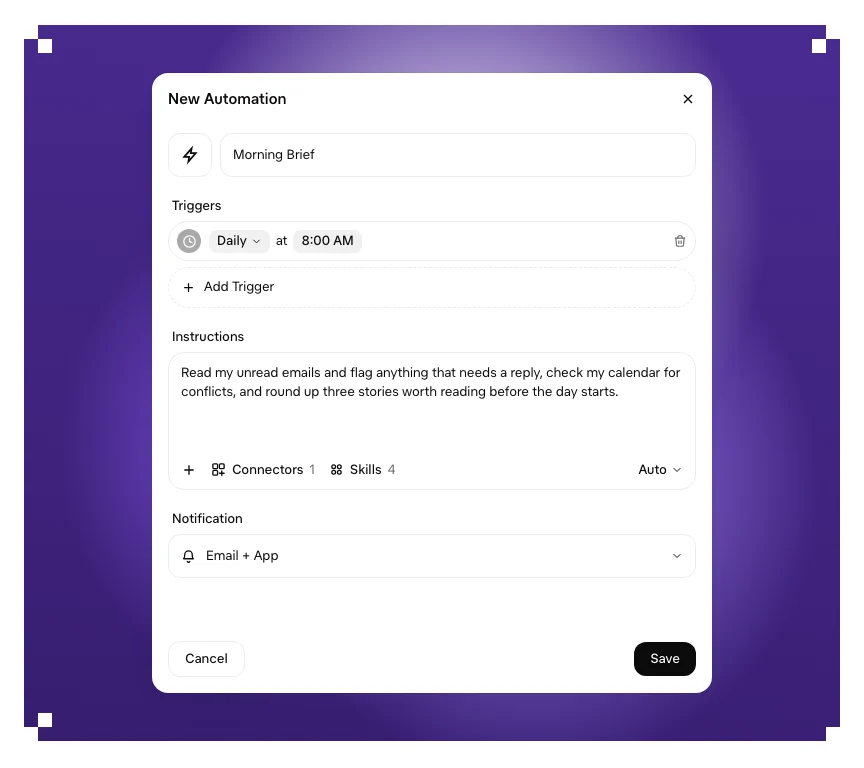
8. Automation: "Give me a research brief every Monday without me asking"
Automation · Run it in: a Grok Automation or a Grok Bot routine
What you need. A Grok account, a list of sources and competitors, and 10 minutes.
How Grok helps. Automations run a saved job on a schedule and deliver the result by email or app notification. Scheduled runs are available to everyone and "Run now" lets you test one (xAI, July 2026). Each run is a fresh request with the same instructions, which is why the prompt uses the run date instead of fixed dates.
Set it up. In grok.com/automations, add a schedule trigger: weekly, Monday, at your chosen time. Then paste the prompt.
The prompt.
Produce a research brief covering only the 7 days before today's run date, for a performance marketer working with [industries] in [countries]. State the date range you used at the top.
1. Platform changes: Google Ads, GA4, Google Search, Meta Ads, LinkedIn Ads, X. Prefer official sources. For each item: what changed, the date, the link, and who it affects.
2. What [audience] is discussing on X: 3 themes, 2 linked posts each.
3. Competitor watch: [names or handles]. Anything new, with links.
4. Three content ideas tied to the items above.
5. "Unverified or unclear": items you saw but couldn't confirm.
Every item needs a link and a date inside the window. Drop anything older. If a section has nothing notable, write "Nothing notable". No numbers without a source.
Check before you act. SpaceXSI doesn't say whether scheduled runs search the web and X live, so check that the first run's links fall inside the 7-day window. For the first four weeks, click every link and note anything stale or wrong. If you build it as a Grok Bot routine instead, keep it weekly, and don't let it post anything on its own.
What I saw when I tested Grok myself
On 3 November 2026 I gave ChatGPT, Claude, Gemini and Grok the same marketing tasks and scored the answers against things I could measure. Grok ran on the free version on X in Fast mode, while the others were paid, so this isn't a level comparison. The full write-up is in my four-tool marketing test.
| Check | What Grok did |
|---|---|
| Responsive search ad descriptions (90 character limit) | Two came to 93 and 94 characters, so Google Ads wouldn't accept them as written. The other three tools stayed inside every limit. |
| Headlines and meta tags | Inside the limits |
| Sorting 12 search terms against an answer key | 12 out of 12 (all four tools got 12 out of 12) |
| Claims it added that I never gave it | "24/7" and "free consultation" for a plumber brief that mentioned neither. Every tool added at least one claim; Gemini added seven. |
| Recent article links | All five loaded, but they leaned on small sites I'd want to verify before quoting |
Two lessons came out of it. Recount every character limit yourself; Google allows 30 characters per headline and 90 per description (Google Ads Help). And give Grok your real business facts and tell it to use nothing else, or it will fill gaps with promises you might not keep.
What other marketers report
| Source | Date | What it shows | Type |
|---|---|---|---|
| Stew, AI for PPC | 28 Oct 2026 | Grok Bot walks paid funnels as a buyer and finds a broken sign-up path | Demo |
| Greg Isenberg | 15 Jul 2025 | Research scored 9.5 out of 10; content 6 out of 10 until given a style example | Demo, subjective scores |
| Marketing Against the Grain | 15 Jul 2025 | Grok 4 against OpenAI's o3 on live marketing tasks | Demo |
| Kacper Rutkiewicz | 18 Sep 2026 | How Grok Bot routines eat the weekly usage pool, and how to cut waste | Demo |
| Cursor forum thread | 10 Sep 2026 | A user on the $200 Ultra plan hit 99% of the weekly allowance in three days | User report |
| Aaron Makelky | 21 Aug 2026 | Paid-user review: unreliable follow-through, CAPTCHAs, no model choice | Demo and opinion |
| Chris Alarcon | 10 Sep 2026 | A creator running 12 Bots reports one produced nothing and others were inconsistent | User report |
| Social Media Examiner | 3 Nov 2026 | An experienced user rates Grok Bot highly but may drop it because the team already pays for another agent | Interview |
| SpaceXSI marketing guide | Sep to Oct 2026 | Recommended marketplace Bots: Distro Bot, SEO and AEO Desk, AI Search Visibility, Paid Media Report Desk, Ad Spend Watch | Vendor |
Across these sources, X listening and competitor research get the most credible praise. Usage limits are the most repeated complaint about Grok Bot. I found no credible public test of Grok analysing real ad exports, and no ranking or cost results that came with a method, so treat any such claim with care.
Is Grok Bot worth it for marketers?
For a solo marketer or a small team, start with the Grok chat app and Automations, which cover most of the workflows above. Grok Bot is worth the $30 Premium plan when you have a repeat job that needs a browser, such as checking funnels, gathering competitor pages or moving data between tools that have no export.
Usage is the catch. To make the weekly pool last, start a fresh chat for each task, run routines weekly or daily rather than every few minutes, use an export or connector before browser work, and check the meter before big jobs. Grok Bot also picks the model for each task, and you can't choose (Grok Bot FAQ). If you're building a wider agent setup, my guides to always-on AI agents and AI agents for PPC cover approvals and roles in more depth.
What to try first: a 30-minute start
- Pick one account and one problem. Rising cost per lead is a good first test because the answer is easy to check.
- Export the reports and replace any client names and personal details.
- Turn off "Improve the Model" in Grok's settings, or use Private Chat.
- Paste the prompt, fill in the brackets, and read the data check table first.
- Re-add the totals in a spreadsheet. If they match, read the recommendations. If not, ask why before going further.
- Make one change yourself, note the date, and re-run the same reports in two to four weeks.
If it saved you time and the numbers held, set up the Monday brief next. If you'd rather have this set up and checked for your accounts, see how I build AI marketing agents and run Google Ads and GEO work.
Coming next in this series
- Grok for Google Ads: search terms, negatives, ad copy and scripts
- Grok for Meta Ads: lead quality, creative tests and the Ad Library
- Grok for SEO: traffic drops, content refreshes and internal links
- How to get your brand cited by Grok
- Grok for landing pages and CRO
- Grok Automations and Grok Bot routines for marketers
- Grok for GA4, Search Console and client reports
- Grok for social media and content research
Sources
Last checked 6 November 2026. SpaceXSI changes features, plans and names often, so go by the live pages.
FAQ
Is Grok good for marketing?
Partly. Grok, from SpaceXSI (formerly xAI), is good for live X research and social listening, useful for sorting exports if you re-check its maths, and weak where numbers, citations and ad copy limits must be exact. In my 3 November 2026 test, its free version wrote two ad descriptions over Google's 90-character limit.
How do I use Grok for marketing?
Pick one problem, export the relevant report, remove personal data, ask Grok to work only from the file and show a data check table first, then re-add the totals yourself before acting. Rising cost per lead in Google Ads is an easy first test to verify.
What is Grok Bot?
Grok Bot is the always-on agents app from SpaceXSI, the company formerly called xAI, launched in beta on 11 August 2026. Each Bot has a job and works on a cloud computer with a browser, files and a terminal shared by all your Bots, and it asks for approval before sensitive actions.
Is Grokbot the same as Grok Bot?
Usually, yes. Most people searching "grokbot" mean the Grok Bot agents app, made by SpaceXSI (SpaceX Super Intelligence LLC, formerly xAI). Some bot directories also use "GrokBot" as a label for crawler traffic, but SpaceXSI documents no crawler by that name.
How much does Grok Bot cost?
Grok Bot is included on the Premium ($30), Super ($100) and Ultra ($200) monthly plans of The X Subscription, in US dollars before tax. Usage comes from a weekly pool shared with Grok and Cursor, and top-ups cost extra.
Can I use Grok Bot for free?
Not on the Free or $8 Plus plans. SpaceXSI says some accounts are offered a trial, which is a usage credit with a 7-day window. After that, Grok Bot needs Premium or higher.
How much does Grok cost in Australia or the UK?
SpaceXSI publishes US dollar prices only. Premium, the cheapest plan with Grok Bot, is $30 a month before tax. Check the final AUD or GBP price, including any GST or VAT, at checkout.
Can you use Grok for business?
Yes. Team seats are sold on the Premium, Super and Ultra plans, and SpaceXSI says content from its business and enterprise customers isn't used to improve its models, so check which terms cover your seat. For client work, remove personal data first and keep anything that spends, sends or publishes behind a person.
Can Grok connect to Google Ads or Meta Ads?
Not natively. You can upload exports, use screenshots, connect Google Sheets through Drive, build a custom MCP connector, or let Grok Bot use the platform in a browser. Google and Meta don't name Grok as a supported client of their own connectors.
Does Grok know keyword search volumes?
No built-in keyword data is documented. Any volume Grok gives without a linked source is a guess. Use Keyword Planner or an SEO tool, or give a Grok Bot access to one.
Do Grok and Grok Bot train on my data?
It depends on the product. The consumer app may train on your chats unless you turn off "Improve the Model" in Settings or use Private Chat. The xAI API doesn't train without permission, business content isn't used, and Grok Bot follows your Cursor privacy settings.
Can you advertise on Grok?
Not inside Grok's answers, as far as official pages show on 6 November 2026. Elon Musk said in August 2025 that brands would be able to pay to appear in Grok's suggestions. On X, Grok ad tools have been reported in phased rollouts and a limited Ads Manager beta.
Can Grok make ad creatives?
Yes. Grok Imagine makes images and short videos, but every output carries a Grok watermark with no setting to remove it. Use it for concepts and tests, follow each platform's AI disclosure rules, and don't depict real people without consent.
Can Grok post on social media for me?
The chat app can't. Grok Bot can draft posts, and SpaceXSI's Distro Bot only posts with your approval for the exact text. Keep publishing as a human step and check each platform's automation rules.
Is Grok better than ChatGPT for marketing?
It depends on the job. Grok stands out for live X research. In my four-tool test on 3 November 2026, two of Grok's ad descriptions came to 93 and 94 characters, over Google's 90-character limit, while ChatGPT's stayed inside it.